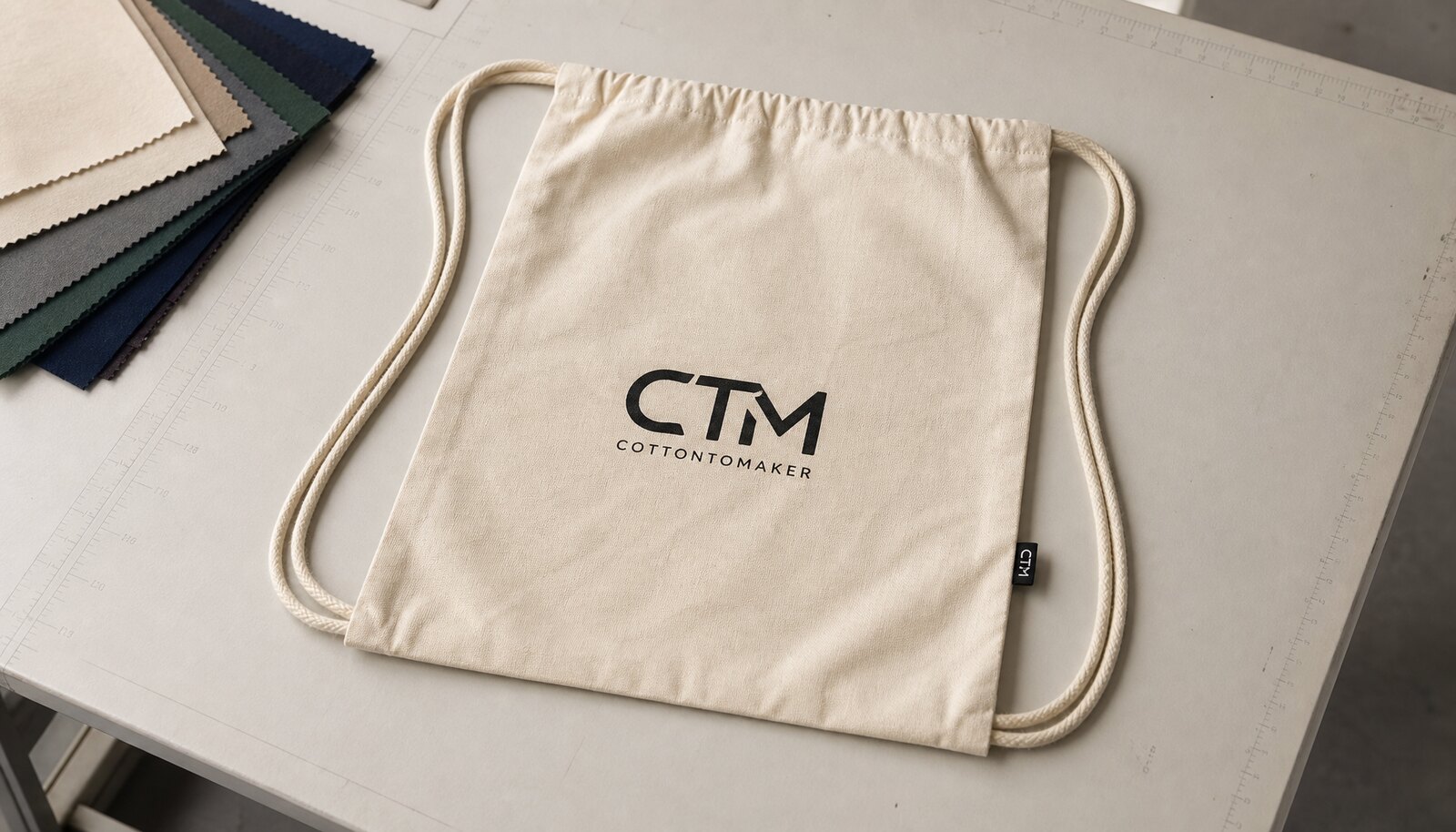
What procurement teams are really buying when they source a custom printed drawstring backpack
A custom printed drawstring backpack is often treated as a simple promotional item, but the commercial reality is closer to a small sewn product program. The quote is built from several independent decisions: fabric composition and weight, bag structure, cord quality, reinforcement, print method, packing format, and freight term. If any one of those changes, the unit price can shift enough to make two quotes look similar when they are not actually comparable.
For procurement buyers, the right starting point is not the logo, but the use case. A giveaway bag for a trade show can prioritize low cost and speed. A school bag needs stronger seams and a better cord tunnel. A retail bag must look clean on shelf and survive repeated handling. If the buying team does not define that use case first, the factory will fill in the blanks with its default construction, and the result may miss the program requirement even if the sample looks acceptable.
This is why good RFQs for a custom printed drawstring backpack should read like a mini product brief rather than a general inquiry. The buyer should spell out who will use the bag, how long it needs to last, what it will carry, whether it must be washable, and where the bag will be distributed. Those answers help the supplier choose a spec that fits the job instead of quoting the cheapest possible version of the item.
One useful internal question is whether the bag is being purchased as a primary product or as a packaging accessory. If it is a primary product, the buyer should care more about handfeel, seam finish, and print durability. If it is part of a gift set or event kit, the bag may need to look premium for a short time but not endure repeated use. That distinction changes the right fabric, print method, and packing method.
Procurement teams also benefit from separating commercial risk from design preference. A buyer may prefer a cotton handfeel, but if the event budget is tight and the bag is only intended for a one-day handout, a lighter woven construction may be a better trade-off. A buyer may want a full-color logo, but if the reorder plan depends on speed and low setup cost, a simpler one- or two-color print can reduce future friction. The right decision is not always the nicest looking one; it is the one that best fits the program economics.
- Define the use case before quoting: giveaway, retail, school, sports, event kit, or packaging insert.
- Treat the bag as a sewn product with multiple cost drivers, not as a generic promotional item.
- Align the spec to the expected handling, carry weight, and reorder pattern.
- Separate visual preference from commercial necessity so the quote reflects the real buyer requirement.
Fabric choice: how to balance handfeel, structure, print quality, and cost
Fabric is the first meaningful cost driver and also the first quality signal a buyer will feel in hand. For many promo programs, cotton between roughly 140 and 180 GSM can be acceptable when the bag is meant for light items and a low unit price matters most. However, very light fabric can look thin, collapse when packed, and show the outlines of contents. If the buyer wants a bag that feels more substantial, 200 to 260 GSM is often a more practical band because it improves structure, appearance, and perceived value.
GSM alone is not enough. The weave structure and finish affect both print results and durability. A tighter weave usually produces cleaner print edges and less visible distortion in the logo area. A looser weave may feel softer but can allow more ink bleed or uneven coverage, especially on larger solid areas. If the buyer is sourcing a canvas-style custom printed drawstring backpack, ask for weave details and a sample under the actual print method rather than relying on a material description in the quote.
Shrinkage matters more than many first-time buyers expect. If the bag will be washed or exposed to moisture, an untreated or poorly controlled fabric can move out of size tolerance. That can create problems in retail presentation, kit insertion, or warehouse automation. If the supplier cannot state shrinkage behavior clearly, the buyer should treat the spec as incomplete. For programs where consistency matters, request whether the fabric is pre-shrunk, sanforized, or otherwise stabilized, and ask for the expected shrinkage range after the relevant test method.
Color also has procurement implications. Raw cotton or natural canvas is often the easiest route for cost and lead time, but it may show flecks and fiber variation. Dyed fabric can look more premium, yet matching shade across lots may be harder and can require a minimum dye lot. If the design depends on exact brand colors, the buyer should ask for shade tolerance, reference swatches, and whether the factory can maintain consistency on repeat orders. For dark-colored bags, also ask how the supplier handles print opacity on darker backgrounds so the logo does not disappear or require multiple print passes.
The fabric decision should be tied to the product’s end use. If the bag will carry notebooks, shoes, or a water bottle, choose enough structure to avoid sagging and distortion. If the bag is mostly for event collateral, a simpler fabric may be enough. The buyer’s job is to define the acceptable trade-off between cost, appearance, and durability before the factory locks in its material buy.
- 140–180 GSM: practical for lightweight giveaways and short-use event bags.
- 200–260 GSM: better for retail, school, gift sets, and repeated use.
- Tighter weave: better print clarity and less logo distortion.
- Controlled shrinkage: essential if the bag must stay within size tolerance after washing or moisture exposure.
Print method and artwork: where appearance, setup cost, and reorder economics intersect
For a custom printed drawstring backpack, print method should follow artwork complexity and volume, not habit. Screen print is usually the strongest choice when the logo is simple, the colors are limited, and the order volume is stable. It can produce strong coverage on cotton and canvas, but fine lines, small text, and tight registration need careful control. If the buyer’s artwork is more detailed or the run is smaller, heat transfer or DTF may be more practical because they can handle full-color graphics and short runs with less setup burden.
That said, the lowest setup barrier is not always the lowest total cost. Transfer-based methods can look attractive on a small quote because they reduce screen charges, but buyers should confirm wash resistance, edge durability, and how the finish behaves when the bag is folded repeatedly. If the artwork has large solid blocks or if the bag will be handled frequently, the buyer should ask for a sample that reflects the intended wear pattern, not just a pristine photo.
Embroidery can be a good premium option for a small placement, such as a logo badge near the top panel, but it is not a universal solution. It adds thread cost and labor, and on softer fabrics it can distort the material or make the front panel puckered. For a broader front graphic, embroidery is usually less efficient than print. If a supplier proposes embroidery for a large design, ask why and request a side-by-side sample if possible.
Artwork control matters as much as method selection. Buyers should specify the exact print dimensions, placement relative to the top seam and side edge, color references, and whether the art is allowed to be scaled. If the logo must stay a certain visual size, state that clearly. Ask for a print proof on the actual bag panel or a pre-production sample, not only an artwork mockup on a digital template. A proof on paper can hide distortions that appear when the image is applied to woven fabric.
The most useful procurement mindset is to separate setup cost from recurring cost. Screen count, film prep, color matching, transfer production, and digital setup may all create one-time costs. A supplier quote should show which items are one-off and which recur on every reorder. That matters because the cheapest first order may become the most expensive long-term program if the buyer needs to reorder multiple times a year.
- Screen print: best value for simple logos and repeat orders.
- DTF or transfer: useful for short runs, variable names, or full-color art.
- Embroidery: best for small premium placements, not large graphics.
- Always specify print size, placement, color reference, and whether scaling is allowed.
How to compare supplier routes without comparing the wrong numbers
The supplier route can change both the price and the amount of control the buyer has over the product. Direct factories usually make the most sense when the artwork is stable, the forecast is repeatable, and the buyer wants to reduce unnecessary markups. This route gives procurement teams the clearest path to controlling the fabric, stitching, and print setup, especially for annual or seasonal programs where reorders are likely.
Trading companies can be useful for buyers who need smaller trial orders, quicker communication, or support sourcing related items at the same time. The trade-off is that the buyer may not see the underlying factory cost structure as clearly. Two trading quotes can look similar while using different factories, different fabrics, or different packing assumptions. That is why buyers should not accept a quote without understanding what is actually inside it.
Sourcing agents are a separate category. They can add value when the buyer needs factory vetting, audit follow-up, or QC support across several suppliers. But the buyer should still ask whether the agent is quoting a fixed service fee, an embedded markup, or a commission already included in the product price. Without that clarity, it becomes difficult to judge whether the product cost is truly competitive.
Domestic suppliers can be attractive for urgent programs or for buyers who need a very short communication loop. They may also be easier to visit for sign-off or inspection. However, the unit price may be higher, and material options may be narrower than at larger export-oriented factories. This does not make domestic sourcing better or worse; it only means the buyer should compare it on a landed-cost and service basis rather than on unit price alone.
A robust comparison starts with one question: if the same bag is made at two different suppliers, are the specs identical enough to compare fairly? If the answer is no, the buyer should not compare the price yet. First align the spec. Then ask each supplier to show the exact material, construction details, sample history, packing format, and shipping term. Only then does route comparison become meaningful.
Procurement teams often overlook the management cost of the route itself. A lower quoted price from a less transparent route can consume time in sample correction, approval delays, and correction freight. A slightly higher direct-factory quote may be the cheaper option if it reduces rework and gives the buyer better reorder continuity. The real question is not which route is cheapest on paper; it is which route delivers the lowest total cost with acceptable control.
- Direct factory: best for repeat programs and spec control.
- Trading company: useful for trial orders and coordination support.
- Sourcing agent: helpful when audit, inspection, or multi-supplier management is needed.
- Compare route choices by total landed cost and control, not just by unit price.
A practical procurement table for route, cost drivers, and buyer scenario
The table below is more useful than a basic spec chart because it helps procurement teams identify where price differences come from. It also shows where hidden cost often sits: setup charges, packaging, and freight term differences. Use it to normalize quotes before the final supplier decision.
If the buyer is sourcing a custom printed drawstring backpack for a campaign, the cheapest route is not always the best route. Some programs need speed and low complexity; others need print consistency and repeatability. This is where route selection and commercial structure need to be discussed together.
- Write decisions in measurable language, not only descriptive wording.
- Ask for sample photos plus one physical approval sample for important orders.
- Keep quotation, sample approval, and inspection notes tied to the same spec version.
What a useful sample should prove before mass production starts
A pre-production sample is only valuable if it proves the elements most likely to fail in bulk. For a custom printed drawstring backpack, that means more than checking whether the logo looks good. The sample should show the actual fabric handfeel, seam quality, cord movement, print placement, top opening behavior, and reinforcement in the stress areas. If the supplier only sends a digital artwork proof, the buyer has not actually validated the product.
Good sample approval is based on measurable checkpoints. The front logo should be centered according to a signed spec sheet. The bag should open and close without cord snagging. The print should not bleed into the weave or appear washed out under normal light. The seams should be neat at the top opening and bottom corners, and the cord tunnel should not show distortion when pulled by hand. If any of those items are ambiguous, the sample is not ready for sign-off.
For branded programs, the buyer should also approve the sample in the same packing format intended for shipment if possible. A bag that looks fine in a loose sample may scuff or crease once packed in cartons or polybags. If the order will go into retail or kit assembly, check whether the sample accommodates the barcode label, insert card, or any hang tag without covering the logo or causing damage to the print surface.
A useful discipline is to write acceptance comments on the sample itself or on a signed reference sheet. That way the factory can’t later claim that a defect was acceptable. If the buyer approves a sample with a certain shade, print position, or seam finish, that becomes the standard for production. Without that written reference, bulk disputes tend to become subjective and expensive.
When the order is important, ask for both a physical sample and clear photos from the factory: front, back, inside seam, cord tunnel, and close-up of the print texture. Those images are not a substitute for the sample, but they help during inspection and reorders. Over time, the approved sample package becomes the most useful control document in the program.
- Approve against a signed sample reference, not a vague verbal approval.
- Check the exact print position, seam finish, cord movement, and packing format.
- Use the sample to validate stress areas, not just the front graphic.
- Keep the approved sample record with the PO and QC checklist for the full order lifecycle.
How to read a quote for hidden charges, setup fees, and freight terms
Many quote problems happen because the buyer sees a low unit price but not the full commercial structure. A quote for a custom printed drawstring backpack should show whether the unit price includes one or more screens, whether a transfer setup fee applies, whether color matching is extra, and whether sample cost is refundable. If those items are hidden, the buyer cannot compare suppliers fairly.
Setup charges are a major issue for buyers who want low MOQ. A supplier may offer a good-looking unit price but add separate costs for screen preparation, film output, color matching, or label application. That can make the real cost much higher than the headline quote, especially on small orders. When the buyer asks for a quote, it is worth requesting the same bag at two volume levels so the setup burden becomes visible.
Freight terms matter just as much. Comparing an EXW quote to a FOB or DDP quote without adjustment can produce a false conclusion. Under EXW, the buyer may pay local pickup, export handling, inland trucking, and export documentation separately. Under FOB, those costs are partly included. Under DDP, the supplier may include freight and duty assumptions that are not easy to verify. For procurement teams, the cleanest approach is to compare all suppliers on the same Incoterm and then add freight and duty in the same way.
Packing is another hidden cost driver. Individual polybagging, barcode stickers, insert cards, master carton marks, and retail-ready bundling each require labor. If the program is a giveaway, simpler packing may be enough. If the product goes to shelf or a fulfillment center, those extras are necessary and should be priced in from the start. A quote that excludes them is not necessarily cheaper; it may simply be incomplete.
The buyer should ask one simple question before choosing: what happens to the unit cost after sample approval, after setup is paid, and after freight is added? If the supplier cannot answer that clearly, the quote is not procurement-ready.
- Ask for setup charges separately from recurring unit cost.
- Make suppliers quote the same Incoterm so landed cost is comparable.
- Clarify whether sample fees, screen prep, and color matching are one-time or recurring.
- Include packing, labeling, and carton specs in the quote from the start.
QC acceptance criteria that are specific enough to prevent the common failures
Quality control for a custom printed drawstring backpack should focus on the ways this product actually fails in the field. The most common issues are not catastrophic; they are visible and annoying. Loose threads, weak bartacks, uneven drawstrings, miscentered prints, weak top seams, and scuffed packing can make a batch look careless even if the bag is technically functional.
To keep QC actionable, define measurable acceptance criteria before production starts. Size tolerance should be written against the finished sewn bag, not the cut panel. Print placement should be checked against centerline and top-edge references. Cord symmetry should be measured by draw length on both sides. If the bag is designed to carry weight, the pull points should be tested on random samples from each lot or carton group.
The failure modes are fairly specific. If the cord tunnel is under-stitched, the opening may tear during repeated pulls. If the print method is too light, the logo may fade into the weave or show uneven opacity. If the fabric is too soft or too thin, the bag can look wrinkled and out of shape once packed. If the packing crew over-compresses the carton, the print may crease before the product even reaches the buyer’s warehouse.
A stronger QC plan also includes in-process checks, not only final inspection. Ask for photo evidence of the first production pieces, the print alignment, and the cord insertion stage. For larger orders, inspect by carton lot so a good early batch does not hide a later deviation. If the buyer is serious about brand consistency, a written defect threshold should be approved in advance. For example, a visible front-print defect may be a reject even if overall AQL would otherwise allow a few defects in the lot.
The goal is to catch the problems that matter for this specific product, not to use a generic checklist copied from a different item. A drawstring backpack is judged heavily on front appearance, seam integrity, and closing function. QC should reflect that reality.
- Measure finished size after full assembly.
- Check print registration, opacity, and edge sharpness under normal light.
- Run pull checks on cord tunnels and bartacks from multiple cartons.
- Set defect thresholds for the front print area before production starts.
Packing, labeling, and carton planning that protect margin after the factory gate
Packing affects landed cost more than many buyers expect. A flat bulk pack is typically the most economical choice because it minimizes labor, carton cube, and handling. This is usually suitable for giveaways, distribution through a warehouse, or use inside a second-stage kit. But if the bag must go directly to retail shelves or an e-commerce fulfillment center, the buyer may need an individual polybag, barcode label, insert card, or other retail-ready treatment.
Those requirements change both the unit cost and the freight cost. Every extra layer of packing takes labor and usually adds cube. A small increase in carton dimensions can matter when the shipment is going by air or courier, where dimensional weight is critical. For that reason, procurement teams should ask for units per carton, outer carton size, gross weight, and whether carton marks align with the buyer’s warehouse requirements.
Label placement also matters. A barcode sticker should not cover the logo or sit where the adhesive might leave residue on print. If the bag is going into a retail assortment, the supplier should confirm whether the label is removable or permanent and whether it affects consumer presentation. For kit assembly, ask whether the factory can pack to a defined sequence without abrasion to the printed surface.
Packaging questions should be part of the commercial conversation, not a late-stage logistics issue. If the buyer only discusses packing after the sample is approved, the supplier may need to rework the process, and that can affect both lead time and cost. The best practice is to set the packing standard in the RFQ and make the factory quote it directly.
When buyers compare quotes, packing is often where the cheapest-looking offer becomes more expensive in practice. A slightly higher quote that includes the right retail packing may avoid relabeling, repacking, or warehousing work later. That is often the better procurement outcome.
- Flat bulk packing: best for low-cost distribution.
- Individual polybag: needed for shelf or retail presentation.
- Ask for carton dimensions, unit count, and gross weight before comparing freight.
- Confirm barcode and label placement so branding is not damaged or hidden.
Lead time planning and reorder logic for a bag that will likely be repeated
A realistic lead time for a custom printed drawstring backpack usually has four parts: sampling, sample correction or approval, mass production, and shipping buffer. A practical planning range is often 7 to 10 days for sample development and 20 to 35 days for production after approval, but that window can widen if the artwork changes, the fabric must be matched carefully, or the factory is waiting on final sign-off. Buyers should treat the lead time as a project schedule, not a single number.
The biggest delays are often administrative rather than sewing-related. Artwork revisions, print approval, missing color references, and back-and-forth on packing are all common causes of schedule slip. If the bag is tied to an event date, a retail launch, or a seasonal promotion, the buyer should build in a buffer for one revision cycle and for shipping disruptions. Rushing the freight because approval was late usually costs more than planning the order properly in the first place.
Reorders deserve a different conversation from first orders. Once the supplier has the approved spec, print setup, and packing method, the buyer should ask which costs disappear on reorder. Some one-time setup charges should drop away. If they do not, the buyer should ask why. For recurring programs, that distinction becomes critical because the first order may not represent the real unit cost of the ongoing program.
If the product will be bought every season or used across multiple departments, the buyer should archive the approved artwork, the sample photos, the final spec sheet, and the carton standard in a single file. That record reduces the chance of drift when the order is repeated months later by a different buyer or coordinator. For procurement teams, this is one of the simplest ways to protect consistency and margin over time.
- Plan for sample development, approval, mass production, and freight buffer.
- Assume artwork and packing decisions can add more delay than sewing.
- Ask what costs disappear on reorder and what costs recur every time.
- Archive approved specs and samples so the next PO matches the first one.
Specification comparison for buyers
| Supplier route | Best-fit buyer scenario | Typical cost drivers | Procurement watchouts |
|---|---|---|---|
| Direct factory | Repeat programs, stable artwork, forecasted annual volume, and buyers who need control over construction details | Fabric GSM, print setup, cord type, reinforcement labor, packing method, and shipping term | Ask whether the quoted bag matches the sample exactly; confirm whether setup charges are one-time or repeated on reorders |
| Trading company | Small trial orders, mixed-category sourcing, faster coordination, or buyers without local QC coverage | Agent margin, factory selection, order consolidation, and more variable packaging or artwork handling | Compare the underlying factory spec, not just the trading company quote; verify who owns the pre-production approval and after-sales responsibility |
| Sourcing agent | Multi-supplier programs, complicated compliance requirements, or buyers needing audit support and production follow-up | Service fee or commission, factory vetting, inspection visits, and coordination time | Clarify whether the agent is quoting a fixed service fee or embedded markup; require factory identity and sample traceability |
| Domestic supplier | Urgent replenishment, low logistics complexity, or highly responsive design changes | Higher labor cost, shorter freight lanes, lower communication friction, and often smaller MOQ | Check whether local convenience is offset by a materially higher unit price or reduced fabric/print options |
| Integrated packaging vendor | Orders that must ship as kits, retail-ready items, or subscription inserts | Bag production plus insert cards, barcode labeling, polybagging, and carton assembly | Confirm whether the vendor can hold the same print quality and QC standard across both bag making and final packing |
| Material | 6-10 oz cotton canvas, 210D polyester, rPET, or blended cotton with shrinkage and colorfastness expectations set before sampling | Before price comparison | Different cloth weights, backing, or certification claims make quotes hard to compare |
| Construction | cord diameter, eyelet or reinforced channel, bottom corner reinforcement, seam allowance, bar-tack position, and load target | Before sampling | Weak stress points create returns and failed inspections |
| Decoration | screen print, transfer, embroidery, woven label, or drawstring tag tested against folding and abrasion | Before artwork approval | The wrong method can crack, bleed, pucker, or fail on the chosen fabric |
Buyer checklist before sampling
- Define the use case first: giveaway, retail, school, sports, event kit, or gift packaging. That decision affects fabric weight, reinforcement, print method, and packing.
- Lock the artwork before quoting: vector file, Pantone references, print size, print location, and acceptable color tolerance. Do not ask suppliers to quote from a low-resolution image.
- Ask every supplier to quote the same baseline spec: exact bag size, fabric GSM, weave or canvas type, cord material, print method, reinforcement, packing format, and Incoterm.
- Request a second price tier for the same spec at a higher volume. This shows whether the quote is built on real scale economics or padded at the low end.
- Separate one-time charges from recurring charges: screen setup, film, transfer prep, mold or label fees, carton design, and sample fees.
- Confirm whether sample fees are refundable, credited against the order, or charged every time a sample is revised.
- Ask for actual fabric composition, GSM tolerance, shrinkage allowance, and colorfastness expectations rather than a generic material description.
- State whether the bag must be washable, colorfast, or suitable for repeated hand washing. If yes, request the wash test method used by the factory.
- Specify reinforcement points: cord tunnel, top edge, base corners, stress bartacks, and any eyelet or rivet locations.
- Request a pre-production sample made from production materials, not only a printed artwork proof.
Factory quote questions to send
- What exact fabric are you quoting, including composition, GSM, weave, and shrinkage allowance?
- Is the quoted unit price based on the pre-production sample specification, or on a simplified quote version?
- Which print method is included, how many colors are covered, and what happens if the artwork needs an additional screen or transfer setup?
- What is the MOQ for this exact spec, and which elements change the MOQ: fabric color, print size, cord type, or packing?
- Can you share a sample photo or a physical sample of the same or very similar construction, including inside seams and cord tunnel?
- Where are the stress points reinforced, and what stitch density or bartack standard do you use?
- What is included in the packing quote: individual polybag, insert card, barcode sticker, inner label, or master carton mark?
- Are sample fees, screen/setup fees, label fees, or color-matching fees refundable or reusable on reorder?
- What is the production lead time after sample approval, and what are the most common reasons for delay on your side?
- Which inspection standard do you follow before shipping, and can you accept a buyer-written QC checklist?
Quality-control points to confirm
- Measure finished bag size after full sewing, trimming, and pressing if applicable. Do not inspect cut panels only; they do not reflect the final assembly size.
- Check the front-panel print position against a measured centerline and top-edge reference. For branding programs, set an allowable offset range before production starts.
- Inspect print under two light conditions: normal indoor white light and daylight-equivalent light. This helps catch color shift, edge fuzziness, and poor opacity.
- Run a manual cord pull test on a statistically meaningful sample from each carton lot. Check for cord slippage, tunnel tearing, and uneven draw length.
- Check the cord tunnel stitching and bartacks for skipped stitches, loose ends, or open needle holes. Fail any bag with visible opening at a stress point.
- Inspect seam density and seam cleanliness at the top opening, bottom corners, and side gussets if present. Loose thread trimming should be consistent and not left hanging.
- Test logo rub resistance with a dry white cloth or equivalent buyer-approved method on the approved sample standard. Any visible smearing or transfer should trigger review.
- Check for print defects specific to fabric bags: ink pooling in weave valleys, cracking on folded areas, ghosting, misregistration on multi-color art, and uneven coverage on textured canvas.
- Verify cord length and left-right symmetry. Drawstrings should cinch evenly, and knots should be secure enough that the cord does not pull back through under normal handling.
- If the design includes eyelets, toggles, or metal trims, inspect for plating flaws, rust risk, sharp edges, and inconsistent hole reinforcement.