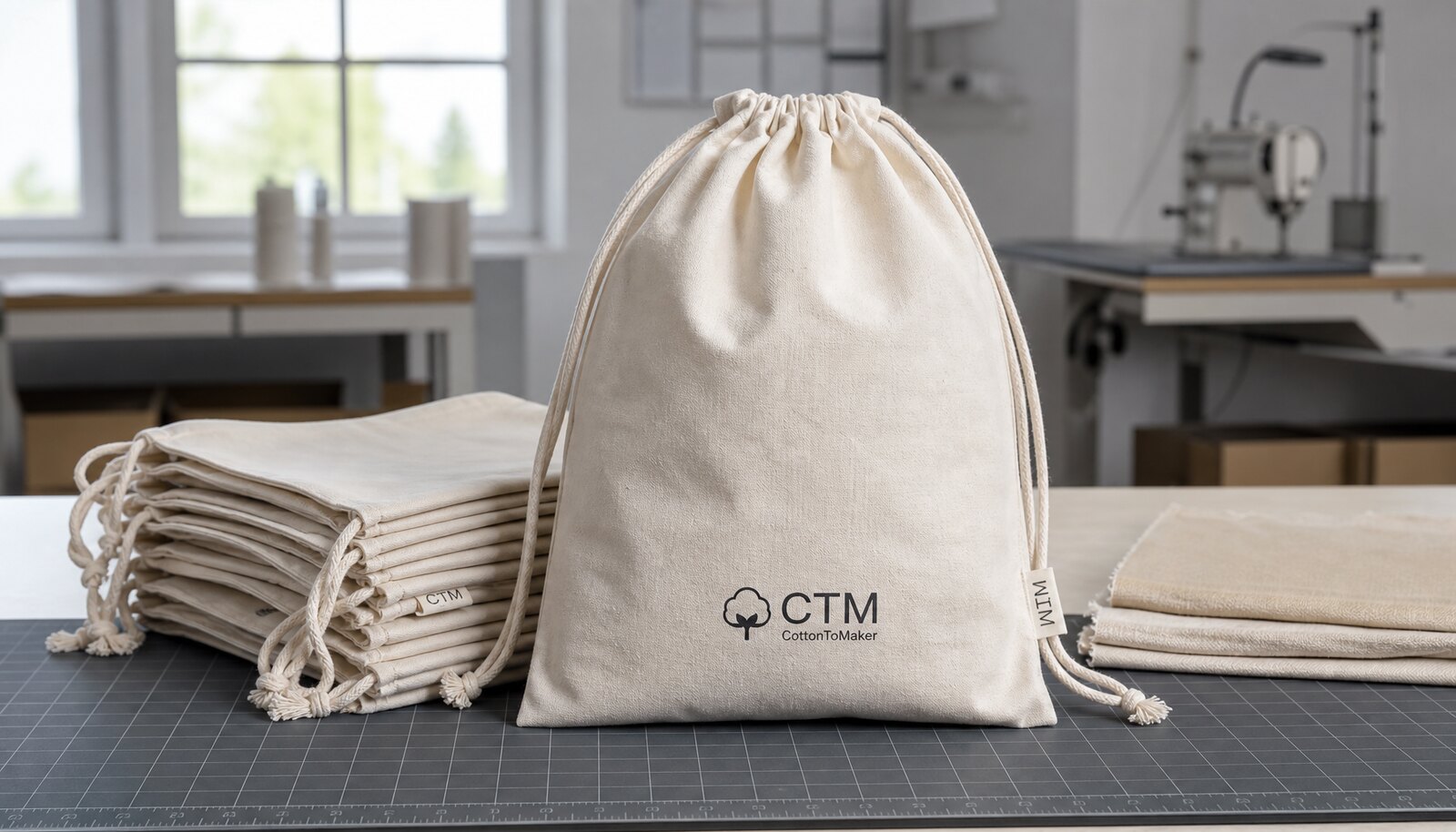
Why quotes for cotton drawstring bags are hard to compare
Most sourcing problems with custom printed cotton drawstring bags start in the quote request, not in production. A buyer sends a logo file, a rough size, and a target price, then receives three quotes that look similar but are not actually the same product. One supplier may be pricing 100 GSM natural cotton with a small one-color logo. Another may assume 140 GSM bleached fabric, a larger print area, and a sewn label. A third may bury cord or packaging upgrades inside an all-in number. The quotes are not wrong. They are incomplete in different ways.
That is why this item should be treated as a spec-driven textile component, not a generic promo giveaway. The cost changes with fabric weight, fabric color, bag size, seam construction, cord type, print method, label requirements, and packing format. Each choice affects landed cost, lead time, and defect risk. If the spec is not fixed before pricing, the supplier will fill gaps using a standard build that may not match your use case.
For procurement teams, the goal is not to over-specify every millimeter. It is to remove the hidden assumptions that make supplier quotes look comparable when they are not. A quote becomes useful only when the buyer can see what is included, what is optional, and what the supplier has assumed about the final product. That is the difference between a true unit price and a number that only works on paper.
- Do not compare quotes until GSM, size, print area, and packing are fixed.
- Avoid sending only a logo; specify the full bag build and the expected use case.
- Ask for line-item pricing when you need to compare more than one supplier route.
Start with the job the bag has to do
The right bag spec depends on what the bag is actually doing in the supply chain. A drawstring pouch used as secondary packaging for a boxed candle is not the same as a retail gift bag, a trade-show handout, or a reusable accessory pouch. If the bag is only carrying a light insert for a short period, a lighter GSM may be fine. If it is part of the customer-facing product experience, the buyer needs better shape retention, cleaner stitching, and stronger print durability.
Size should be chosen from the product fill, not from a catalog template. A bag that is too small is hard to load and tends to distort around the logo. A bag that is too large looks wasteful and increases material cost. For boxed sets, the internal carton size matters more than the promotional dimensions on a supplier page. For loose items, think about the open mouth, not just the flat measurement. The bag should close cleanly without forcing the seams or crushing the print area.
Construction should follow the item weight and shape. A flat pouch is usually enough for documents, soft goods, and light inserts. A gusset adds useful depth for bulky or rigid contents. A reinforced bottom makes sense when the bag needs to stand up better or hold hard-edged items. The buyer should ask which pattern the factory already runs well. Standard constructions usually deliver more stable quality than a fully custom build that has never been repeated before.
- Match bag dimensions to the real product or box, not to a generic catalog size.
- Use gussets only when the contents need extra depth or easier insertion.
- Treat reinforcement as a functional choice, not a decorative upgrade.
Fabric, finish, and cord should be chosen together
Fabric weight is the first technical decision that usually matters. For most retail and gifting programs, 120-140 GSM is the safest working range because it balances appearance, hand feel, and cost. It is thick enough to avoid looking flimsy once printed, but not so heavy that it inflates freight or pushes the bag into a premium cost bracket that the channel may not support. If the bag carries cosmetics, accessories, candles, or boxed gifts, that range is usually the most practical starting point.
Lighter fabric in the 100-110 GSM range can work for event packs, promo inserts, or short-life packaging. The tradeoff is obvious: lower cost, less structure. Once the print is added, the bag can show more wrinkling and seam distortion. If the contents are angular or heavy, the buyer should test the seams and cord channel before approving a large run. Heavy items do not just stress the bottom; they also pull the opening out of shape.
At the premium end, 150-180 GSM can make sense when the bag is intended for repeated reuse or when the product needs a more substantial feel in hand. That does not automatically mean better procurement value. Heavier fabric increases material use, sewing time, and gross carton weight. The buyer should ask whether the added weight improves customer perception enough to justify the cost. The same logic applies to color. Natural cotton gives an organic look, but shade variation between lots is normal. Bleached white creates a cleaner logo background but may require extra control on stain visibility. Dyed cotton should be used only when the brand standard justifies the added cost and lead time.
Cord choice should not be left as a default. Cotton cord gives a more coordinated textile look, but polyester cord can reduce cost and shrink risk. If the bag is sold as a finished retail item, cord hand feel and color consistency matter more. If it is only secondary packaging, the cord may simply need to function cleanly and close reliably. The supplier should state cord material, diameter, and end finish rather than saying 'matching cord' and leaving the rest open.
- 100-110 GSM: acceptable for light promo use or inner packaging.
- 120-140 GSM: the most practical range for retail, gifting, and repeat handling.
- 150-180 GSM: useful for heavier or premium programs, but check freight and seam stress first.
Printing method should match artwork, quantity, and handling
For custom printed cotton drawstring bags, the decoration method should be chosen by use case, not by habit. Screen printing is usually the best fit for one to three colors, simple logos, and repeat orders. It gives strong edge definition, stable repeatability, and controlled cost once setup is done. On natural cotton, it usually provides enough opacity to keep the logo readable without covering the fabric entirely. For most B2B buyers, that makes screen print the default option to evaluate first.
Heat transfer is more flexible when artwork changes often, when the design has more detail, or when the run is too small to justify a full screen setup. It can be a sensible choice for test orders or SKU variation. The risk is durability. A transfer can look fine when new and still age poorly after folding, abrasion, or repeated opening and closing. That is why buyers should ask for a handling test, not just a visual approval. If the bag is going to live in retail circulation, the print has to survive normal use, not only first inspection.
DTG is best treated as a niche tool for small quantities and artwork that really needs the extra detail. It is not the default choice for every cotton bag. Ask the supplier direct questions about cure, rub resistance, and how the ink behaves on natural cotton with texture variation. A sample that passes on the bench can still disappoint after use if the ink is not bonded well enough to the fabric. The practical question is simple: which method gives the right mix of visual clarity, durability, and unit cost for this specific order?
Whatever method you choose, define the artwork file requirements early. Suppliers should receive vector files where possible, a clear color count, Pantone references if relevant, and exact print dimensions. A logo that is scaled, redrawn, or output from a low-resolution file usually becomes a production problem later. Print failures are often prepress failures wearing a production label.
- Screen print: best for simple logos, medium-to-large runs, and repeat replenishment.
- Heat transfer: useful for short runs or more complex graphics, but confirm folding and rub durability.
- DTG: suitable for smaller quantities and detailed art, but test the cure and handling performance before bulk approval.
Build the RFQ so suppliers quote the same product
A usable RFQ gives the supplier enough detail to price the same item across vendors. At minimum, that should include bag dimensions, fabric weight, fabric color, drawcord material, print method, number of print colors, print size and position, label requirements, packing format, and the destination market if there are compliance or labeling rules. Without those details, the quote is a starting point, not a buying decision.
The fastest way to compare offers is to force a like-for-like structure. If one supplier is pricing 100 GSM and another is pricing 140 GSM, that is a spec mismatch, not a price gap. If one quote includes a small logo and another includes a full-front print, the buyer is comparing two different decoration bills. Ask suppliers to identify base bag cost, print setup, print run cost, label cost, sample cost, and packing cost where they can. Even if the final price is all-in, the assumptions should be visible.
Lead time should also be defined precisely. Many sourcing delays come from vague timing language. The supplier should say whether the clock starts from artwork approval, sample approval, deposit receipt, or fabric availability. If dyed fabric is involved, ask whether the timeline changes because of shade matching or dye lot scheduling. If peak season is a risk, have the supplier state the normal and the stretched lead time separately so the purchasing team knows the range it is really buying.
Do not accept a quote that hides the carton spec. Carton size, gross weight, and inner count are part of the commercial picture because they affect freight density and warehouse handling. A lower unit price can disappear once the carton is oversized or the packing method creates extra cubic volume. Procurement should look at the landed cost shape, not only the factory number.
- Quote the same GSM, size, print area, and packing format across vendors.
- Ask for line-item pricing where setup charges are material.
- Treat missing carton, lead-time basis, or sample detail as an incomplete quote.
MOQ, lead time, and supplier route should be read as one decision
MOQ is usually a production planning issue, not a standalone buying rule. The minimum changes with the number of print colors, the bag size, the fabric color, the label type, and the packing format. A plain natural bag may run at a lower threshold than a printed bag with a sewn label and custom carton marks. That is normal. What matters is whether the MOQ reflects a real production setup or just a sales policy.
For a test order, a higher unit price can be acceptable if it reduces the risk of committing to the wrong size or finish. For a repeat program, the buyer should ask whether the factory can hold the same cutting pattern, fabric standard, and print placement on reorder. That matters more than chasing the absolute lowest initial run. If the bag is going to be replenished monthly or quarterly, consistency beats a bargain MOQ that cannot be repeated.
Supplier route affects this decision. Factory-direct sourcing usually gives the best visibility into fabric, sewing, printing, and inspection. It is the strongest route for repeat programs and spec control. A trader or intermediary can help when the order mixes several product types, artwork versions, or factories, but the buyer should verify who actually makes the bag and who signs off the approval sample. Local stock conversion is useful when the order is urgent and customization needs are limited. It can solve speed problems, but it is usually not the right path for a long-term branded packaging standard.
Lead time should be stated from a fixed milestone. If the quote says '15 days,' ask whether that is after sample approval, after deposit, or after fabric is ready. If the supplier cannot state that clearly, the timeline is not actionable. For B2B buyers, the real question is not just how fast the first order can ship. It is whether the supplier can keep the program stable when the second and third orders arrive.
- Separate MOQ by bag body, printing, labeling, and packing when those thresholds differ.
- Use factory-direct for repeatability, trader support for coordination, and local stock conversion for urgent one-offs.
- Ask for lead time from a specific milestone, not from a vague order date.
Sampling should prove the production bag, not just the artwork
A useful sample process mirrors the final production flow. Start with artwork confirmation, then review a physical blank or base-material sample if the fabric choice is important, and then approve a pre-production sample built with the final fabric, print, cord, label, and packing method. A single PDF proof is not enough because it cannot show how the print sits on the cotton, how the cord behaves, or how the seams interact with the final product weight.
When reviewing the sample, test more than the logo. Open and close the bag several times. Fill it with the real product or a realistic weight. Check whether the seams pull, whether the cord channels twist, and whether the print stays readable after handling. Cotton texture can make a design look slightly different under warm and cool light, so review the sample under lighting similar to the intended sales or warehouse environment. If the bag is sold in retail, the presentation needs to be judged in retail light, not only on a production bench.
Retention samples matter. Keep one sealed approved sample as the production reference and one open sample for receiving inspection. That small discipline is useful when the buyer, supplier, and warehouse team all need to compare against the same standard. It also reduces disputes when the shipment arrives and someone wants to argue over whether a shade or print shift was acceptable. If the approved sample is not preserved, the standard becomes a memory, and memories are a poor quality-control system.
- Approve measured print placement, not just visual alignment.
- Test the sample with the actual product weight before bulk sign-off.
- Retain both a sealed golden sample and an open receiving sample.
QC standards need to be measurable, not broad promises
Quality control for cotton drawstring bags should focus on defects that are easy to see, easy to measure, and costly if missed. Fabric should meet the agreed GSM and should not show major lot-to-lot shade differences beyond the approved range. Construction should be checked at the side seams, bottom corners, and drawcord channel, because those are the first places a weak build will fail. Instead of asking for 'strong stitching,' write a minimum stitch density or a seam standard the factory can actually follow.
Print quality needs measured limits as well. Define the print position from the top seam and side edge. If the artwork must sit within a certain window, say so. Ask the supplier to confirm the cure method and the target opacity on natural cotton. If the bag will be handled frequently, inspect a folded or rubbed sample to see whether the ink cracks, flakes, or transfers. If the bag is meant to be washed, request a wash test reference that matches the intended use, rather than assuming the print will survive by default.
Inspection at the carton level matters just as much. Use an AQL-style approach even if the order does not carry a formal AQL contract. Check random cartons, confirm outer marks, verify inner counts, and compare the shipment against the approved sample. Set the reject logic before goods ship. Small thread tails may be acceptable. Broken cords, mixed sizes, oil stains, mold odor, or a misprinted logo are not. The point is not to chase perfect textiles. It is to make incoming inspection decisive enough that the warehouse is not left arguing with purchasing after the truck arrives.
- Stitching: require a minimum stitch density and no skipped stitches in load-bearing seams.
- Print: define placement tolerance and test rubbing, folding, or washing based on actual use.
- Cartons: verify outer labels, random counts, and reject thresholds before shipment release.
Packing and freight can move the landed cost more than the bag price
Packing is not a minor detail. It affects cubic freight, receiving speed, and damage risk. For most B2B shipments, flat-packed bulk cartons are the most efficient format because they reduce volume and make counting easier at the dock. If the buyer asks for individual polybags, retail hangtags, or printed cartons, that can be the right choice for a shelf-ready item, but it should be treated as a deliberate packaging decision, not a default upgrade. Each added layer changes cost and handling.
Ask for carton dimensions, gross weight, and inner count before accepting the price. Two suppliers can quote the same unit price and still produce very different freight outcomes because one packs tightly and the other ships air. If the warehouse uses barcodes, purchase-order labels, or carton routing marks, include those requirements in the packing spec. Otherwise the factory may save a little labor and the warehouse may pay it back in manual sorting.
Receiving quality is often determined by packing discipline. A clean carton with stable inner counts, clear marks, and manageable gross weight is easier to inspect and store. A sloppy carton spec creates friction even when the bags themselves are fine. For procurement teams, the lesson is simple: packing is part of the product system, not a separate logistics afterthought.
- Use flat-packed cartons for most bulk orders to reduce cubic freight.
- Add unit polybags only when the bag is sold as a retail item or needs extra protection.
- Require carton size, gross weight, and inner count before you treat the quote as complete.
A workable buying standard is one the warehouse can actually enforce
The best sourcing spec is not the longest one. It is the one that production, receiving, and purchasing can all use without interpreting it differently. For custom printed cotton drawstring bags, that means a simple but complete package: a fixed size, a defined GSM range, a stated print method, a measured print position, a packing format, and a short list of rejection rules. If those items are clear, most of the avoidable disputes disappear before they start.
The final check is whether the order can be repeated. A good supplier should be able to reproduce the same bag on the next order without re-litigating the entire spec. That means the fabric standard is recorded, the print file is controlled, the sample is retained, and the carton spec is not left to memory. If the supplier can support that, the program has a chance of becoming stable. If not, every reorder becomes a new project.
That is the practical standard procurement should aim for: a bag that is easy to quote, easy to inspect, and easy to reorder without drift. For a simple textile item, that is where the real value sits. The bag is not just a print surface. It is a small production system that needs enough discipline to stay consistent across lots.
- Keep the spec short enough to use, but complete enough to quote and inspect.
- Retain samples and recorded dimensions so reorders do not drift.
- Prioritize repeatability over cosmetic detail that does not affect the use case.
Specification comparison for buyers
| Spec decision | Recommended option | When it fits | Buyer risk to check |
|---|---|---|---|
| Fabric weight | 100-110 GSM for light promo use; 120-140 GSM for most retail and gifting; 150-180 GSM for heavier or premium programs | Choose based on what the bag carries, how often it will be reused, and how much structure the bag needs after printing | Too-light fabric can distort at the seams or show through; too-heavy fabric can raise freight and cost without adding real value |
| Fabric color | Natural cotton for an organic look; bleached white when logo contrast matters; dyed cotton only when a brand standard requires it | When visual consistency, print readability, or shelf presentation matters more than the lowest material price | Natural lots vary in shade; dyed lots need color approval and can add lead time |
| Print method | Screen print for one to three colors and repeat runs; heat transfer for short runs or more detailed art; DTG only for small, complex orders | When the artwork is simple or the program needs stable repeatability | Poor cure, low-resolution art, or wrong fabric prep can cause cracking, weak opacity, or uneven color |
| Bag structure | Flat pouch for simple inserts; gusseted body for bulkier products; reinforced bottom for hard-edged contents | When the product has fixed dimensions or needs more room and shape retention | A generic size can be too shallow or too narrow; weak seams can fail on sharp or heavy items |
| Cord type | Cotton cord for a coordinated look; polyester cord for lower cost and less shrink risk | When the bag is sold as a finished item or needs a specific brand feel | Cord fraying, shrinkage, or color mismatch can create appearance problems and complaints |
| Labeling | Woven side label, printed care label, or sewn-in brand tab | When retail presentation or care instructions are needed | Wrong placement, frayed edges, or text that does not meet destination-market rules |
| Packing | Flat-packed bulk cartons with clear inner counts and carton marks; individual polybags only when retail-ready presentation is required | When freight cost, warehouse speed, and receiving accuracy matter | Loose packing increases cubic volume; unclear counts can trigger receiving disputes |
| Supplier route | Factory-direct for repeat programs; trader for multi-item coordination; local stock conversion for urgent short-term needs | When the buying goal is either tighter process control or faster turnaround | Trading quotes can hide subcontracted production; stock conversion limits customization and reorder consistency |
Buyer checklist before sampling
- Lock the final bag dimensions, gusset depth, and expected loading weight before asking for price.
- Specify fabric type, GSM, color standard, and shrinkage allowance, and say whether the bag should be natural, bleached, or dyed.
- Send vector artwork and define print position, logo size, color count, and Pantone targets if the artwork uses spot colors.
- Ask for a physical pre-production sample, not just a PDF proof or a blank bag reference.
- Confirm packing format, inner counts, carton size, gross weight, and whether barcode labels or hangtags are included.
- Set acceptable defect limits for stitching, stains, print registration, cord issues, shade variation, and carton count.
- Request one approved golden sample for production reference and one retained sample for receiving inspection.
- Ask the supplier to break out factory price, print setup, packaging, and freight-related costs where possible.
Factory quote questions to send
- What fabric GSM, fabric width, and shrinkage allowance are included in this quote, and is the cotton natural, bleached, or dyed?
- Which print method is included, how many colors are covered, and what setup charges apply per screen, plate, or pass?
- Does MOQ change if I adjust bag size, print coverage, cord type, label type, or carton packing?
- What sample stages do you provide: artwork proof, blank sample, pre-production sample, and shipment reference sample?
- How are the bags packed per carton, what is the carton size and gross weight, and are inner polybags or barcode labels extra?
- What is the standard production lead time after sample approval, and how does it change during peak season or for dyed fabric?
- What inspection standard do you use for print placement, seam strength, cord length, stain tolerance, and carton count?
- Can you hold the same fabric lot or shade standard for repeat orders, and what happens if the next lot differs?
- If a carton fails receiving or a print issue appears, what is your corrective-action process and who pays for rework or replacement?
Quality-control points to confirm
- State fabric weight tolerance in the PO, not just the nominal GSM; a practical working tolerance is about +/-5% unless the program needs tighter control.
- Specify stitch density for load-bearing seams, such as a minimum stitches per inch or stitches per 3 cm, rather than writing only 'strong stitching.'
- Require seam checks at the side seams, bottom corners, and drawcord channel; look for skipped stitches, loose thread tails, puckering, or open ends.
- Define print placement with measured distances from the top seam and side edge instead of a visual-only approval.
- Use rub and handling checks that match the bag's use case: dry rub for everyday retail handling, and wash testing only when the bag is expected to be laundered.
- Check print opacity on natural cotton and look for cracking, flaking, or transfer after the sample is folded several times.
- For reusable or heavier bags, ask for a pull check on the cord channel and stress points so the opening does not twist or tear under normal hand force.
- Set carton-level inspection rules with an AQL-style sampling plan, including carton marks, inner counts, random carton picks, and a clear reject threshold for shortages or mix-ups.
- Reject major defects such as oil spots, mold odor, broken cords, wrong logo placement, color shade outside the approved range, or missing labels.
- Keep one sealed approved sample and one open reference sample so production and receiving teams are checking against the same standard.