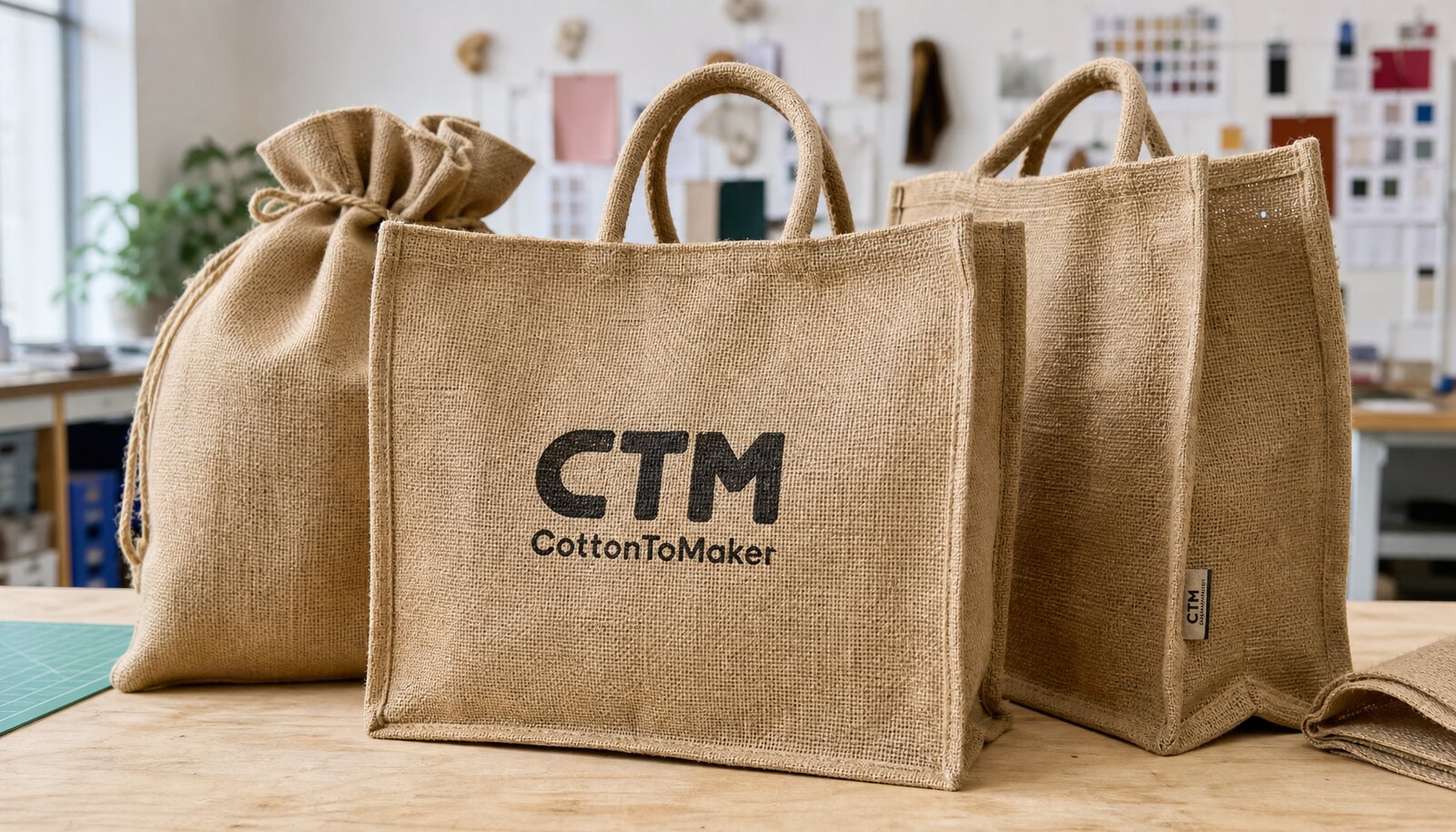
What Buyers Are Actually Buying
Custom printed burlap sacks sit in the same buying family as jute tote bags, but the sourcing logic is different. A sack is usually chosen for packaging, seasonal presentation, produce, gift sets, or rustic merchandising, while a tote is expected to carry repeated hand use and often needs cleaner stitching, stronger handles, and a more finished internal build. That difference matters because the spec, quote structure, and QC plan should follow the function, not just the material name. If you call everything a burlap bag, suppliers will fill in the missing details with their own assumptions and you will end up comparing mismatched offers.
The fastest way to tighten an RFQ is to define how the item will be used in the hand, on the shelf, and in transit. A decorative outer sack can tolerate a rougher seam or a more open weave than a retail pack that must stand upright, survive warehouse handling, and present well under store lighting. If the contents are heavy, sharp, moist, oily, or food-adjacent, the buyer should tighten the fabric, lining, odor, and pack requirements before asking for prices. That is where commercial value begins: not in the logo, but in the operational fit.
- State the use case: packaging, retail insert, gift sack, produce sack, or display pack.
- Decide whether the product is a true sack, a drawstring pouch, or a jute tote-style bag with handles.
- Define what the bag must survive after approval: stacking, storage, retail display, or repeated reuse.
Material Weight and Construction Decide Most of the Cost
For custom printed burlap sacks, fabric weight and construction drive much more of the quote than many buyers expect. A supplier can use the same artwork and still land on a very different cost if the fabric is lighter, the weave is more open, the seam is simpler, or the bag is assembled from a converted blank instead of cut-and-sewn panels. Ask for both ounce weight and GSM, because one without the other hides too much variation. A lighter sack around 200-270 GSM is usually enough for light gifting and promotional use. A heavier build around 300-400 GSM gives more body, better opacity, and a stronger retail feel, but it also increases fabric cost, sewing time, and freight.
Construction details are not cosmetic; they affect defect risk. A tubular body is usually faster to make than cut-and-sewn panels, which can improve cost and throughput. A double-turned top hem costs more than a raw fold, but it reduces fraying and gives a cleaner silhouette. If you need a drawstring, the cord material, the channel width, and the exit reinforcement matter as much as the cord itself. Cotton cord looks more natural and premium. PP cord is usually cheaper and more consistent. For branded packaging, a sewn patch or woven label can outperform direct print when the burlap weave is too coarse for small type.
- Ask for GSM, weave density, and fiber content instead of only the word `burlap`.
- Specify seam type, hem finish, and any reinforcements at corners or drawstring exits.
- Use heavier fabric when print clarity, opacity, body, or shelf presentation matter more than lowest unit cost.
Print Method Has to Match the Weave
Burlap is a difficult print surface because the weave is open, uneven, and absorbent. That means a clean artwork file is not enough; the print method must be chosen for the substrate. For most custom printed burlap sacks, one- or two-color screen printing is the most practical choice because it can lay down opaque ink and stays cost-effective over bulk volume. Fine digital detail often looks better in the proof than on the actual sack, where the weave breaks up thin lines and small text. If the artwork is detailed, consider simplifying it, enlarging it, or moving the branding to a sewn patch or woven label rather than forcing a weak direct print.
Do not approve artwork without first locking the usable print area and the registration tolerance. A logo can look centered in a PDF and still shift once it hits rough burlap and a real sewing line. Ask the factory for a strike-off on the actual fabric, not a paper simulation. If color matters, request a physical sample under normal daylight and warehouse lighting, because burlap can make the same ink look flatter, darker, or less saturated depending on the weave and background tone. The goal is not artistic perfection; the goal is repeatable, legible branding that survives a production run.
- Send vector artwork and specify the print size in millimeters or inches.
- Keep text and fine lines large enough to survive the weave texture.
- Approve a fabric strike-off when color, registration, or edge sharpness is important.
Supplier Type Changes Landed Cost and Risk
The quote source matters as much as the quoted number. A direct factory with in-house sewing and printing usually offers the cleanest path for repeat bulk orders because fewer handoffs means fewer chances for spec drift. The tradeoff is that the buyer has to be precise on the RFQ and attentive during sampling. A trading company can be the right choice when the program includes multiple bag styles or a complex shipping schedule, but you should still ask who actually makes the item and who signs off on QC. If the middleman cannot answer that clearly, the price may hide a coordination layer rather than real manufacturing value.
A local decorator using imported blanks can be a good option for urgent or low-volume work, but the landed-cost picture changes quickly. The blank bag may be sourced from one factory, printed by another, and packed by a third. That can work for short runs, but it makes repeatability harder and can increase the risk of variation in stitch quality, fabric weight, or smell. When you compare supplier types, look beyond unit price. Add freight, sample cost, setup cost, remakes, inspection time, and the cost of a bad receiving cycle. In procurement terms, a lower ex-factory quote is not a lower landed cost if the packing, defect, or reorder rate is worse.
- Verify whether the supplier is the producer, the print house, or an order manager.
- Compare unit price only after you align fabric, closure, packing, and incoterms.
- Treat unusually low quotes as a request for more evidence, not as a buying decision.
MOQ Should Follow Setup Economics, Not Sales Pressure
MOQ on custom printed burlap sacks is usually tied to setup work: screen preparation, sewing adjustments, packing configuration, and inspection time. That is why two suppliers can quote very different minimums for what looks like the same bag. One may be quoting a standard blank with local decoration. Another may be quoting a fully custom sewn item with a new print screen, new label, and a tighter packing format. If you only ask for the minimum number of pieces, you may get a number that is technically true but commercially useless for a repeat program.
The better procurement question is whether the MOQ includes the same structure you will reorder later. If the first run is a test, the sample should match the intended bulk route as closely as possible. Otherwise you approve a light sample and then discover the reorder needs a new screen, a different cord, a changed carton count, or a different seam allowance. Break the quote into sample charge, setup charge, unit price, and repeat-run price. That separation makes vendor comparison much cleaner and exposes who is charging for engineering work versus who is simply discounting the first order.
- Ask whether screens, plates, or label tooling are retained for repeat orders.
- Separate sample cost, setup cost, unit price, and repeat-run pricing in the RFQ.
- Make the sample match the intended bulk fabric, closure, and print route.
How to Compare Quotes Without Missing the Hidden Cost
A cheap quote for custom printed burlap sacks can become expensive after freight, damage, and rework. The comparison has to be like-for-like. Same size, same fabric weight, same print area, same color count, same closure, same carton pack, and same incoterm. If one supplier quotes EXW and another quotes FOB, the numbers are not comparable. If one includes moisture-protected cartons and another ships loose in a bulk case, the cheaper option may create the higher claim rate later. A buyer should ask for a complete quote sheet, not a single unit price.
The quote file should show enough evidence to support a decision. Ask for current fabric photos, an unedited print sample, and a short note about who handles sewing, printing, finishing, and final inspection. If the supplier cannot name those steps clearly, there is a risk that the order is being assembled across disconnected subcontractors. That does not automatically disqualify the quote, but it does change how much margin for error you need in the schedule and QC plan. The best commercial decision is the one with the fewest surprises after award.
- Compare on the same incoterm, pack quantity, and material spec.
- Ask for actual production photos, not only polished sales images.
- Include freight, inspection, and remade pieces in the landed-cost view.
Sampling and Approval Need to Catch Reorder Failure Early
A clean sample process saves more money than aggressive price negotiation. For custom printed burlap sacks, ask for at least one strike-off and one preproduction sample from the same production route you expect to use in bulk. The sample should be measured, folded, and packed the same way the shipment will be handled. If the item is retail-facing, check it under the kind of lighting it will actually see in store or warehouse receiving, not only under a bright inspection lamp. Burlap can look acceptable in a close-up photo and still feel scratchy, unbalanced, or poorly finished in hand.
Sample approval should be based on the product you actually want, not the best hand-built example the factory can produce. Keep one sealed gold sample with your team and one with the supplier. Mark the approved fabric weight, print placement, closure finish, and carton pack on that record. Reorder failures often come from small changes that sound harmless on their own: a different fabric lot, a slightly narrower hem, a new cord supplier, or a carton count that forces a different packing method. If those details are not locked in the sample record, every later dispute becomes subjective.
- Approve measurements, print placement, and closure function before bulk release.
- Keep one sealed reference sample with both the buyer and supplier.
- Record the exact print route and packing method on the approval sheet.
QC Should Use Tolerances, Not Vague Opinions
Quality control for burlap sacks should be written in measurable terms. Start with the finished dimensions and define a tolerance that reflects the use case. A small gift pouch often needs a tighter tolerance than a large utility sack because the display appearance and packing fit are less forgiving. Do the same for fabric weight, stitch density, and placement of the logo. The factory needs to know what counts as a minor issue versus a rejectable defect. If you want an AQL-style inspection, state the sampling plan in the PO or inspection brief instead of assuming the supplier will apply your standard automatically.
The most common failure modes are predictable: uneven seams, weak corners, misregistration, loose fibers, poor print opacity, and odor or contamination from storage and transit. Test the bag the way the customer will use it. Fill it, close it, carry it, stack it, and open it again. For print durability, use a dry rub and a light damp rub with a white cloth over a fixed number of strokes. For seams, inspect whether the stress points remain intact after the load test. For cartons, open random cases and check count accuracy, internal protection, label accuracy, and moisture condition. If the product is food-adjacent or sold in premium retail, tighten the odor and cleanliness checks before release.
- Write acceptance criteria for size, seam quality, print placement, and closure function.
- Use a dry rub and damp rub test on the print before shipment approval.
- Inspect random cartons for count, smell, moisture, and pack integrity, not only the outer case labels.
Packing, Cartons, and Transit Can Change the Complaint Rate
Burlap sacks are bulky, textured, and more vulnerable to scuffing and moisture pickup than many buyers expect. That makes packing part of the product spec. For retail or distribution programs, an inner polybag helps protect the print from rub and keeps the bag clean in transit. For longer lanes or humid routes, moisture control inside the carton matters because burlap can pick up odor or feel damp when it arrives. If the bags are compressed too hard, the body can crease permanently and the print can mark against neighboring units. Many arrival issues are really packing issues that were never priced correctly.
Carton configuration also affects your landed cost and your warehouse efficiency. Smaller cartons protect shape better, but they add handling, pallet count, and receiving time. Larger cartons may improve cube efficiency, but they can increase crush risk or make it harder to count cases accurately. A useful quote should include unit count per carton, carton dimensions, gross weight, and palletization status. If your warehouse uses case labels, barcodes, or retail-ready intakes, include those requirements up front. Otherwise the supplier will make a packing choice that is cheap for them and expensive for your receiving team.
- Specify inner bags or moisture protection when transit is long or humid.
- Require carton dimensions, gross weight, and unit count in every quote.
- Match the case pack to your warehouse receiving process and retail intake rules.
Lead Time and Reorder Planning Need a Real Buffer
Lead time for custom printed burlap sacks depends on fabric availability, print complexity, sample approval, packing requirements, and shipping mode. The sample stage is often the longest part because the supplier has to confirm the fabric, set the print, and lock the finishing details before bulk production can move. Seasonal programs can stretch that timing further when raw material supply tightens or export capacity gets crowded. The procurement mistake is assuming production time and calendar time are the same thing. They are not, especially when the first sample needs revision.
For reorder planning, keep the approved setup alive. That means the artwork file, print screens or labels, packing spec, and gold sample should all be retained by both sides. If the supplier wants to change fabric batch, cord supplier, carton size, or labeling on a reorder, treat that as a new approval point. For seasonal retail, work backward from shelf date, not ship date. Freight transit, customs, and warehouse intake can absorb more time than the bag itself takes to make. A safe reorder plan is not just about lead time; it is about preserving the same approved conditions so the second order behaves like the first.
- Build the schedule around sample approval, bulk production, and transit as separate blocks.
- Retain artwork, screens, and the gold sample for repeat orders.
- Add buffer for seasonal congestion, fabric variability, and freight delays.
Specification comparison for buyers
| Spec decision | Recommended option | When it fits | Buyer risk to check |
|---|---|---|---|
| Supplier route | Direct factory with in-house sewing and printing | Repeat bulk orders where you need stable construction, traceable QC, and fewer handoffs | Confirm the quote is from the actual production site, not a trading office relaying specifications |
| Supplier route | Trading company coordinating multiple bag factories | Multi-SKU programs or buyers who want one account manager across different packaging formats | Verify who owns sampling, who signs off on QC, and whether margin is already embedded in the unit price |
| Supplier route | Local decorator using imported blank burlap sacks | Small test runs, regionally urgent deadlines, or event programs where speed matters more than landed cost | Blank quality can vary between lots; compare fabric weight, seam strength, and odor before printing |
| Fabric weight | 6-8 oz burlap, roughly 200-270 GSM | Light gift sacks, giveaways, and lower freight programs | Thin burlap can show gaps, curl at the seam, and let ink sink unevenly on open weave |
| Fabric weight | 10-12 oz burlap, roughly 300-400 GSM | Retail sets, heavier fillers, and premium presentation | Higher unit cost and freight; check that the sack still folds, closes, and stacks cleanly |
| Lining | No lining | Decorative use, low-risk contents, or short retail life | Rough inside finish can shed fibers and may not suit food, cosmetics, or delicate goods |
| Lining | Cotton or nonwoven lining | Cleaner presentation, lower shedding, better protection for printed items | Adds labor and cost; confirm the lining does not shrink or twist the outer shell |
| Closure | Open top with stitched hem | Fast packing and simple insert use | Contents may spill or look unfinished if the sack is displayed upright |
| Closure | Drawstring with cord channel | Gift packs, hospitality kits, and reusable retail packaging | Drawstring exits can fray if the channel stitching is weak or the cord spec is vague |
Buyer checklist before sampling
- Define the use case first: gift packaging, retail insert, promotional bag, produce sack, or seasonal display pack.
- Specify fabric weight in GSM or ounce weight, plus weave density and whether the sack needs a lining.
- State the closure type clearly: open top, drawstring, stitched hem, top flap, button loop, or another finish.
- Send vector artwork and define the maximum print area, color count, and acceptable registration tolerance.
- Ask for a strike-off or preproduction sample on the actual burlap route, not only a paper proof.
- Request the exact repeat-order policy for screens, plates, labels, and retained sample references.
- Separate sample charge, setup charge, unit price, and repeat-run cost so the quote can be compared properly.
- Compare quotes on the same incoterm, the same packing spec, and the same defect assumption.
- Ask for carton count, carton dimensions, gross weight, moisture protection, and pallet or non-pallet packing.
- Keep one approved gold sample with the supplier and one with your team for reorders and QC reference.
Factory quote questions to send
- What is the exact fabric specification, including GSM, fiber content, weave density, and acceptable lot-to-lot tolerance?
- Is the sack made from tubular fabric, cut-and-sewn panels, or a converted blank, and what changes in seam construction follow from that choice?
- What print method are you using, how many colors are included, and what setup charge applies to each design or size?
- What is your minimum order quantity by size, print color, and closure type, and does a repeat order reuse existing screens or labels?
- Can you show unedited photos or a live video of the current fabric roll, stitch line, print sample, and packing line from your own production site?
- What is included in the sample charge, and is that charge credited back after bulk order confirmation?
- What carton pack quantity, carton dimensions, and gross weight per carton are you quoting, and can you add desiccant or inner bags if needed?
- Which incoterms can you quote: EXW, FOB, CIF, or DDP, and what is excluded from each line?
- What is the production lead time after sample approval, and what usually pushes it out during peak season or raw material tightness?
- What inspection standard do you support at shipment, and will you accept an AQL-style plan with named major and minor defects?
Quality-control points to confirm
- Measure finished size against the approved spec and set a tolerance that matches the use case; many buyers use a tighter window for small sacks and a looser one for large utility bags.
- Check raw burlap for weave consistency, weak spots, loose fibers, oil marks, moisture damage, and storage odor before production starts.
- Inspect seam finish, stitch density, thread tension, and corner reinforcement, especially where the load will pull the hardest.
- Test closure points, including drawstring exits, hem folds, flap joins, and bar-tacks, to make sure they do not fray or open under use.
- Review print opacity, edge sharpness, placement, and color registration on the real burlap surface, not only on a proof sheet.
- Run a dry rub and a light damp rub test with a white cloth to see whether the print smears, sheds, or loses definition on the rough weave.
- Pull a filled-unit stress check to confirm the seam and closure hold when the sack is actually loaded, handled, and stacked.
- Open random cartons to confirm count accuracy, pack method, inner protection, label placement, and carton damage.
- Check odor, dust, and moisture condition after carton opening; treat musty smell or visible condensation as a packing failure, not a cosmetic issue.
- Keep a sealed reference sample from approval and compare bulk lots against it before shipment release, especially on repeat orders.