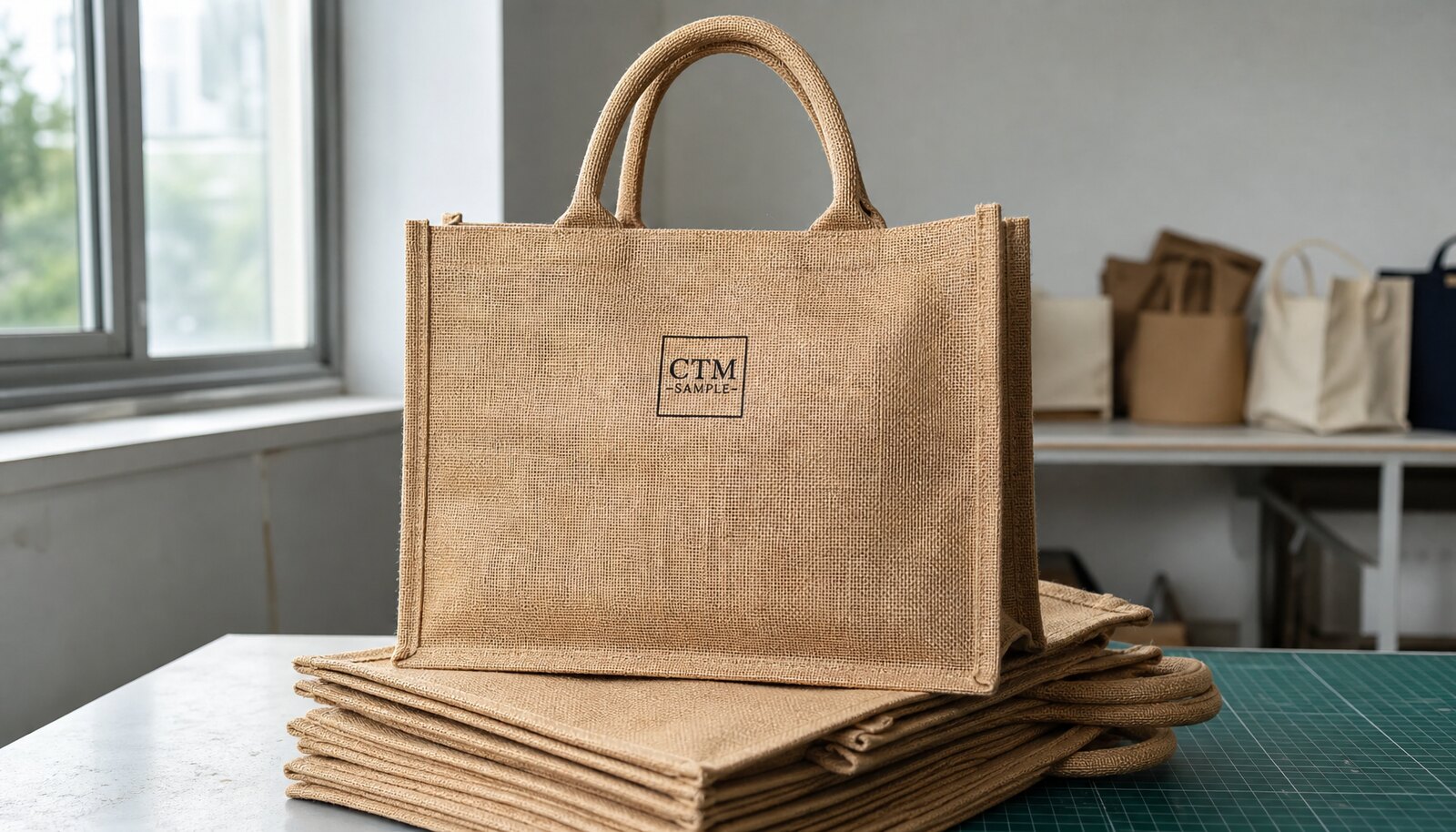
1. What “custom printed burlap” should mean in your RFQ
For procurement, the main mistake is treating burlap as a single material. In supplier language, you may be getting natural jute, jute canvas, jute laminated fabric, or a mixed fiber construction that only looks like burlap. Those options behave very differently in print clarity, seam strength, odor, and price. If you want comparable quotes, define the fabric by construction and GSM, not by appearance alone.
For most retail or promotional tote programs, a practical starting point is 280–320 GSM for laminated-look jute or 300–360 GSM for a heavier natural burlap/jute body. Lighter fabric can work for giveaways, but it wrinkles more, tends to distort under print, and may feel too soft for shelf-ready retail. Heavier fabric improves hand feel and structure, but it adds cost, slower sewing, and higher freight per carton.
- State bag size in cm or inches, including gusset depth and handle length.
- Name the fabric type: natural jute, jute canvas, laminated jute, or mixed burlap-style weave.
- Include target use: retail carry bag, gift packaging, event giveaway, or grocery-style reusable bag.
- Note any odor, shedding, or lining expectations if the bag touches apparel or food-adjacent items.
2. Print method drives both quote and appearance
On coarse burlap, the print method matters more than many buyers expect. Screen printing is usually the best commercial choice when the artwork is simple, the logo is solid, and the run is repeatable. It gives better unit economics at volume and generally holds up better than buyers assume, provided the mesh, ink viscosity, and fabric flatness are controlled. For one- to three-color logos, this is usually the factory default worth benchmarking first.
If the artwork changes often, or if the order is small with many colorways, transfer printing or digital print can reduce setup friction. The tradeoff is that very fine details may soften on the textured jute surface, and the feel can differ from the natural fabric. For premium branding, a sewn patch, woven label, or embroidered badge may be more durable visually, but it is not always the cheapest or fastest route.
- Use screen print for bold logos, big text, and stable repeat orders.
- Use transfer or digital print when artwork revisions are likely or the run is short.
- Use sewn-on patches or woven labels when the brand story matters more than the lowest unit price.
- Always request a strike-off on the actual bag fabric before bulk approval.
3. MOQ logic: why the same bag can quote very differently
MOQ is rarely just a factory rule; it is a cost recovery calculation. Jute bags carry setup costs in fabric cutting, screen preparation, handle cutting, stitching jigs, and packing. If you change size, handle type, color of print, or packaging count, the factory may need another setup and another batch of material. That is why a simple logo change may have a small price effect, while a second colorway can raise the effective MOQ sharply.
For a brand launch, the cleanest sourcing route is usually one base construction with one print setup per artwork. If you need market testing, ask suppliers to quote three levels: a sample batch, a pilot production batch, and a repeat order batch. This shows where the real price break sits and prevents you from comparing a low MOQ quote against a factory quote built for 5,000 pieces.
- Separate MOQ by size, colorway, and artwork version.
- Ask whether mixed assortments can be packed in one master carton or only in separate cartons.
- Clarify if the price includes one print setup or if each side print is charged separately.
- Avoid adding options that do not support the sales channel in the first order.
4. Supplier routes: direct factory, trader, or local printer
The best supplier route depends on what problem you are trying to solve. Direct factories usually win on repeat-cost control, consistency, and the ability to lock in fabric, stitching, and packing details. They are the right choice when you already know the spec and want a stable production partner. A trading company can help if you are consolidating multiple product lines or need someone to manage communication across several factories, but the quote must be unpacked carefully to see where the margin sits.
Local printers are useful when speed matters more than landed cost, especially for final artwork proofing or urgent sample development. They are not always the best route for bulk jute sourcing because the fabric quality may be inconsistent, and they may subcontract sewing anyway. The smart buyer compares not just unit price, but the entire route cost: sampling, revisions, freight, carton packing, and the risk of a second production run.
- Direct factory: strongest for repeat programs and spec control.
- Trader or sourcing office: useful for multi-item consolidation and easier communication.
- Local printer: useful for urgent art proofing, not always for best bulk economics.
- Compare landed cost, not factory price alone.
5. Product-specific supplier comparison for custom printed burlap
When you compare suppliers, do not let each one quote a different interpretation of burlap. One may quote a thin promotional jute bag with loose weave; another may quote a heavier retail tote with reinforced handles and binding. If you do not control the comparison, the cheapest quote usually hides a thinner body or simpler packing. A buyer-friendly comparison should force all suppliers onto the same material, print area, and carton assumptions.
The table below is designed for sourcing decisions, not just spec memorization. It helps you decide which supplier route fits your program and what hidden issue to watch before you award the PO.
- Write decisions in measurable language, not only descriptive wording.
- Ask for sample photos plus one physical approval sample for important orders.
- Keep quotation, sample approval, and inspection notes tied to the same spec version.
6. Use this comparison table to align quotes before awarding
Define the measurable checks around odor check, fiber shedding, lamination peel, handle pull, print coverage, stain review, and carton humidity control. Add tolerance ranges only where the buyer truly cares, and ask for photos that show the measurement point, not just a finished product overview.
For procurement decisions, the inspection note should say who checks, when they check, and what evidence is required. Photos without measurements are often not enough for remote approval.
- Write decisions in measurable language, not only descriptive wording.
- Ask for sample photos plus one physical approval sample for important orders.
- Keep quotation, sample approval, and inspection notes tied to the same spec version.
7. Sample approval: what the pre-production piece must prove
A good sample is not just a miniature version of the final bag. It should prove that the chosen jute GSM holds the shape, the print lands cleanly on the textured surface, and the handle reinforcement is strong enough for actual use. For custom printed burlap, the sample often reveals the real tradeoff between print sharpness and fabric texture. If your artwork has thin lines or small type, the sample is the point where you decide whether to simplify the design before bulk.
The approval step should cover measurements, material hand feel, print placement, and construction details. Compare the sample against the agreed spec sheet, not against memory or a PDF alone. If the sample shows a slight size variation, note whether the change is within tolerance and whether it affects shelf display or pack-out. A small deviation in bag width may be acceptable; a shifted print or weak seam is not.
- Approve the strike-off only on actual fabric, not on paper artwork.
- Record exact sample measurements and compare them with the agreed tolerance.
- Test handle pull, seam strength, and print visibility in normal lighting.
- Freeze the sample reference before the factory cuts bulk fabric.
8. QC thresholds that prevent avoidable claims
Jute and burlap bags are forgiving in appearance, but they are not forgiving in structure if the sewing is weak. The most common claims come from poor stitch density, loose handle anchors, print misalignment, and fiber shedding that makes the bag look unfinished. For buyers, the acceptance standard should be practical: the bag must look consistent on shelf, hold the intended load, and pack cleanly without excess waste or breakage.
Set a clear inspection priority. Size and print placement are usually visible issues, but handle seam quality is what determines functional failure. If the bag is meant for retail resale, also pay attention to fiber shedding, raw edge finishing, and carton presentation. A neat bag inside a damaged carton still creates receiving problems.
- Check all visible seams for skipped stitches, loose ends, and uneven tension.
- Verify that the print sits centered and does not crack badly on the weave.
- Confirm handle attachment is reinforced with consistent stitch pattern or bartacks.
- Inspect carton labels, pack counts, and outer carton strength before shipment release.
9. Packing, lead time, and landed-cost pressure points
Packing can change your true cost more than a small unit-price difference. Bulk-packed jute bags are cheaper to produce, but retail programs may need individual polybags, barcode labels, or set packing for gift kits. Each extra packing step adds labor and may slow production. If your buyer channel is retail stores, ecommerce, or promotional fulfillment, define the pack format early so the factory does not quote an unrealistic bare-bag price and then add chargeable packing later.
Lead time usually starts after sample approval, not after artwork submission. A realistic planning window is often 7–14 days for sample development and 25–40 days for production after approval, with freight and customs added separately. Peak seasons, print revisions, and fabric shortages can extend that. When comparing quotes, treat faster lead time as a value only if the supplier can show it is built on real capacity, not on optimistic promises.
- Specify bulk pack or retail pack in the RFQ.
- Ask whether polybags, hangtags, and barcodes are included or charged separately.
- Build buffer time for strike-off revisions and shipment booking.
- Compare quotes on the same Incoterm and packing assumption.
10. A practical buying workflow for the first order
For a first custom printed burlap order, the cleanest workflow is simple: lock the spec, sample once, approve the sample, then place a pilot batch before scaling. That approach reduces the chance of buying a full container of bags that look right in photos but fail in hand. It also gives your team a chance to test print durability, customer response, and carton handling before a larger repeat order.
If you need to compare suppliers quickly, insist on a matched quote sheet and ask each factory to price the same construction. The real comparison is not who writes the lowest number, but who can repeat the same bag consistently. Once you know the right construction, you can negotiate better on repeat runs because the factory no longer has to guess at your spec.
- Start with one base spec and one artwork version.
- Approve a sample with written tolerance notes.
- Release a pilot run before committing to a larger forecast.
- Save all final approved artwork, measurements, and packing notes for repeat orders.
Specification comparison for buyers
| Spec decision | Recommended option | When it fits | Buyer risk to check |
|---|---|---|---|
| Fabric weight | 280–320 GSM laminated-look jute or 300–360 GSM natural burlap/jute canvas | Retail bags, promo programs, and reusable shopping bags that need body and print clarity | Too light and the bag wrinkles, prints distort, and seams pucker; too heavy and unit cost plus freight rise fast |
| Print method | Screen print for 1–3 solid colors; heat transfer or digital for small runs with artwork changes; woven/embroidered patch for premium branding | Simple logos, short runs, multicolor designs, or premium gift positioning | Overly detailed art can blur on the coarse weave; confirm ink coverage and edge sharpness on actual fabric |
| Handle construction | Self-fabric handles or cotton webbing handles with reinforced cross-stitch | Retail use, grocery carry, and higher load expectations | Thin handles cut into hands and fail early if stitch count is low or bartacks are missing |
| Closure and lining | Open top for cost-sensitive retail, or cotton lining if small items and print show-through matter | Trade shows, gift packaging, and higher perceived value programs | Unlined jute can shed fibers and show reverse-side ink bleed if the print penetrates too much |
| MOQ approach | Start with 1–2 base constructions and 1 print setup per artwork to control setup cost | Brands testing a new SKU or distributors comparing multiple markets | Mixing too many colors, sizes, and handle types multiplies setups and raises MOQ per variant |
| Supplier route | Direct factory for repeat programs; trading company or sourcing agent for multi-category consolidation; local printer only for urgent sampling | When you need best factory cost, easier consolidation, or faster local proofing | Middlemen may hide fabric, print, or packing details; local printers may not control jute fabric quality well |
| Packing spec | Bulk packed with size/count labels, or polybagged in set counts for retail-ready programs | Wholesale cartons, e-commerce prep, and gift kit assembly | Loose packing can increase scuffing, moisture pickup, and carton damage during sea transit |
| Lead time profile | Sample 7–14 days, production 25–40 days after approval, plus freight buffer | Normal seasonal planning and most standard custom orders | Artwork delays, strike-off revisions, and peak season capacity can add 1–3 weeks |
| Quote comparison method | Compare on same fabric, print area, handle, packing, and carton spec | Any RFQ with multiple suppliers | Lowest price may hide thinner fabric, fewer stitches, or non-comparable packing that changes landed cost |
Buyer checklist before sampling
- Confirm the exact bag size, gusset, handle length, and target weight load before requesting quotes.
- Specify fabric construction and GSM, not just “burlap” or “jute,” so suppliers quote the same material.
- Lock the print method, number of colors, print coverage, and artwork placement on the RFQ.
- State whether the bag needs lining, lamination, binding tape, inner pocket, or closure.
- Request sample photos, measurements, and print strike-off approval before bulk production.
- Define packing count per carton, carton test expectation, and any retail polybag or barcode needs.
- Compare quotes on a matched basis including tooling, sampling, freight terms, and extra color charges.
Factory quote questions to send
- What exact burlap or jute fabric weight, weave type, and finishing are you quoting?
- Is the quoted print method screen print, transfer, digital, or a sewn-on patch, and what is included in setup cost?
- What is the MOQ per colorway, per size, and per artwork version?
- How many free pre-production samples or strike-off revisions are included before bulk?
- What is the handle construction, stitch count, and reinforcement spec at the stress points?
- What packing is included per inner pack and per carton, and are carton marks or barcode labels extra?
- What lead time applies after sample approval, and what can extend it during peak season?
- Which quality tolerances do you apply for size variance, print registration, and stitch defects?
Quality-control points to confirm
- Measure bag body and gusset against the approved spec, allowing only a small agreed tolerance on width and height.
- Inspect print registration, color density, and edge sharpness on the actual jute weave, not on artwork proof alone.
- Pull handles and stress-test seam reinforcement at the top edge and handle anchor points.
- Check for fiber shedding, loose threads, broken stitches, and exposed raw edges inside and outside the bag.
- Verify carton count, outer carton condition, and packing consistency across all cartons before shipment release.
- Review pre-production sample against approved materials, logo placement, and any special finishing such as lining or binding.