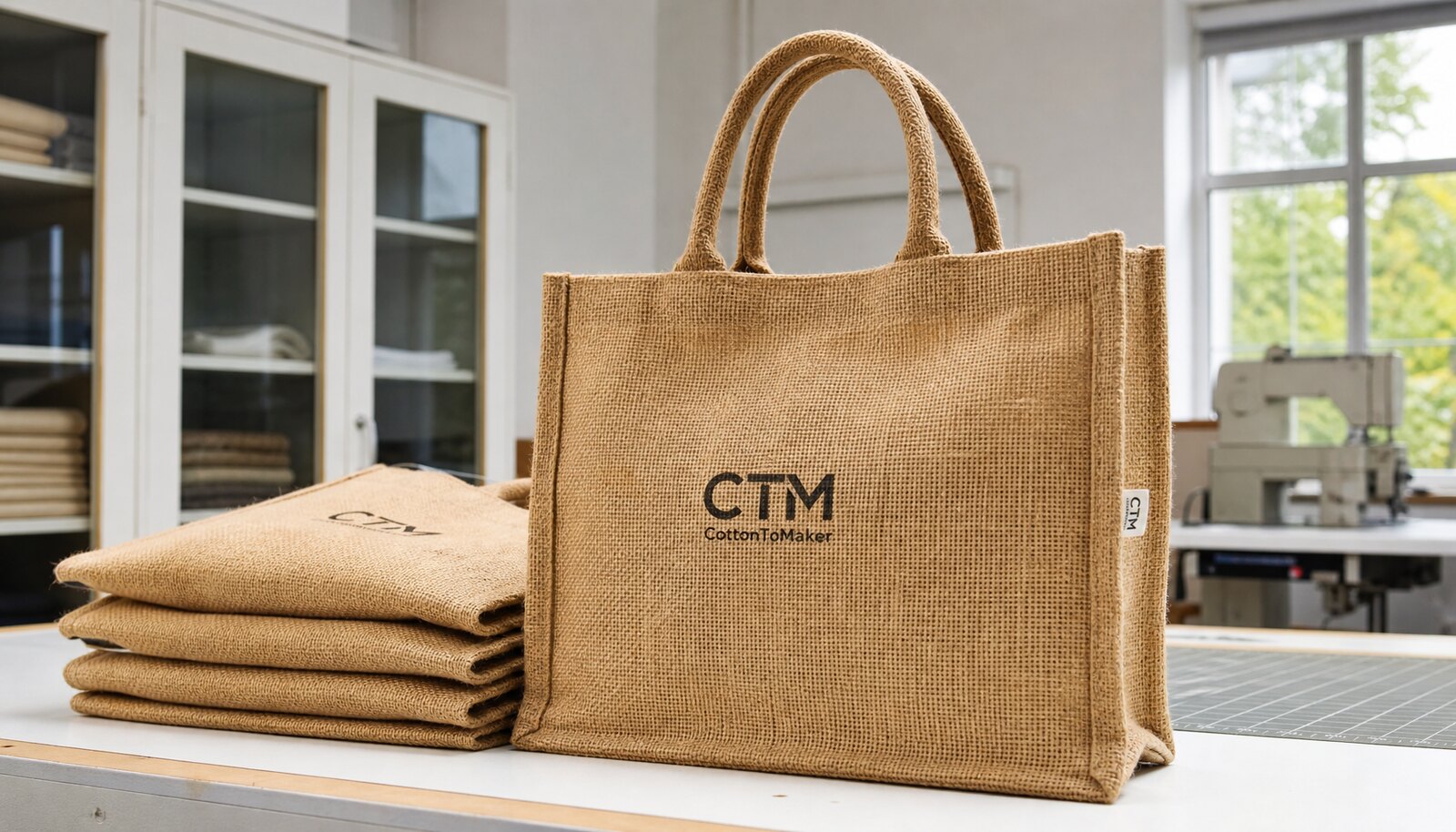
Start with the use case, not the artwork
The easiest way to waste time on custom printed burlap bags is to open with the logo and leave the rest vague. The use case drives the specification. A retail SKU, a farm-shop gift bag, a bottle carrier, a seasonal hamper, and a trade-show giveaway all tolerate different levels of texture, shedding, structure, and print sharpness. If the product must hold weight, be resold as a standalone item, or survive repeated handling, the bag needs a different build than a low-cost insert that is only meant to leave the carton once.
Procurement teams get better quotes when the commercial job is clear. A supplier can price a rustic promo bag quickly, but a retail bag needs more detail: expected contents, carry weight, shelf presentation, reuse expectations, and whether the bag must stand upright. Those details determine whether the factory should quote a lighter unlined construction, a denser weave, stronger handle reinforcement, or a lined interior. Starting with the use case also helps stop the common problem where the cheapest sample looks acceptable but fails in the actual environment.
A practical brief is short but specific. State the end use, the target market, the required feel, and the failure modes you want to avoid. For example: 'gift bag for boutique retail, should feel premium, must not shed heavily, must carry two wine bottles, print should remain readable from one meter.' That is much more useful than 'nice burlap tote with logo.'
- Write the use case in one line before sending the RFQ.
- Define what the bag must carry, not just how it should look.
- Decide whether shelf presentation or unit cost is the primary priority.
Turn the brief into a spec a factory can quote
A usable spec sheet is usually more valuable than a long email thread. It should list the finished width, height, gusset depth, handle drop or handle length, fabric weight, lining requirement, print area, closure type, and packing format. If the bag must fit a box, bottle pack, or retail insert, include those product dimensions too. The factory then knows whether the bag can be built without guesswork, and the buyer can compare offers on the same basis.
The spec should also carry tolerances. If dimensions are not written down, factories will assume their own commercial standard, which may be fine for a promo item but not for a retail program with packaging constraints. The same is true for print placement. If the logo must avoid a seam, say so on the art board. If you need a centered mark at a specific offset from the top edge, write that offset in the document. Small instructions prevent expensive sample revisions later.
Avoid vague procurement language such as 'good quality' or 'strong handle.' Those terms do not tell a sewing line how much reinforcement to use or how much stitch density to apply. Better specs create better pricing because the factory is not protecting itself with broad assumptions.
- Use a dimensioned sketch or tech pack, even for a simple tote.
- Put print window, seam margin, and handle placement on the drawing.
- Record tolerances for key dimensions and keep them attached to the PO.
Choose construction by load, feel, and retail position
Fabric weight is the first real cost lever. For many retail and promotional programs, a bag in the 260 to 320 GSM range is a workable starting point. That range usually gives enough body for a branded tote without pushing the price too high. Once the bag has to carry bottles, boxed products, or repeated daily use, the buyer should look at a denser fabric, stronger seams, or both. A lower GSM bag may save money, but it can sag, wrinkle around the print, and feel thin in the hand.
The interior finish matters as well. An unlined bag is cheaper and closer to the classic rustic look, but it sheds more fibers and offers less protection for contents. A cotton or PP lining adds labor and material cost, yet it improves the user experience and can make the bag easier to sell at retail. For sharp, small, or premium contents, lining is often the cleaner commercial choice. For low-value promotions, unlined may be enough if the buyer accepts the rougher feel.
Handle construction should be selected by load and comfort, not just appearance. Self-fabric handles are cost-effective and keep the design simple, but webbing handles often feel more comfortable and can distribute weight better. The important detail is reinforcement at the stitch points. If the bag is intended to be reused, the handle attachment should be one of the first things you ask the supplier to explain.
- 260 to 320 GSM: common for promo and light retail use.
- 350 GSM and above: better for heavier loads and a more structured feel.
- Unlined: lower cost, more rustic, more fiber shedding.
- Lined: cleaner interior, better for retail and sharp contents.
Compare supplier routes by control, not only by unit price
The lowest unit price is not the same thing as the lowest landed cost. A direct factory quote can be the cleanest option when the spec is stable and repeat orders are likely. You usually get clearer visibility into sewing, printing, packing, and final inspection. That matters when a private-label bag must look the same every season. It also makes corrective action easier because one party owns the build.
A trading company can be useful when the order is broad, the spec is still moving, or the buyer wants sourcing help across categories. The tradeoff is transparency. If the print is outsourced and the sewing happens elsewhere, root-cause analysis gets slower when something goes wrong. The buyer can still use a trader effectively, but the quote has to name the actual maker and identify the outsourced steps. Otherwise, the apparent convenience hides a control problem.
A hybrid converter model can work when the best fabric source, the best print shop, and the best sewing line are not the same company. That can improve quality, but it also creates handoff risk and more freight movement. For that model, lot traceability matters more than usual. Know who owns the fabric lot, who prints it, who sews it, and who signs the final release.
- Use a factory when the spec is stable and repeatability matters.
- Use a trader when the order is broad and sourcing support is valuable.
- Use a hybrid model only if traceability and responsibility are explicit.
- Ask which step is outsourced before comparing the total price.
Read the quote like a commercial document
A good quote should show what is being bought. At minimum, ask for fabric weight, size, handle type, print color count, packing format, and carton details. If the supplier sends only one total price, the buyer cannot tell whether the lower number comes from thinner fabric, smaller print coverage, weaker reinforcement, or looser packing. That makes the quote hard to compare and easy to misunderstand.
Quote structure also reveals risk. A low base price with a high setup fee may be fine for a long run, but not for a test order. A low print charge with no art review may mean the supplier has not budgeted for corrections. A low packaging cost with no carton spec may leave the buyer paying freight penalties later. The useful comparison is price per finished specification, not price per bag in isolation.
It is also worth separating commercial terms from product terms. Sample charges, revision rounds, plate or screen setup, payment terms, freight terms, carton labeling, and export docs should all be visible. That way, the buyer can see whether the order is cheap because the product is simple or because key costs have been pushed downstream.
- Ask for fabric, sewing, printing, packing, and carton costs separately when possible.
- Confirm whether sample fees and setup charges are refundable or credited to the order.
- Compare only like-for-like specs, including packing and labeling.
Verify compliance and origin before you approve the sample
Supplier verification should go beyond a logo on a presentation deck. Ask for the legal business name, factory address, ownership of the production line, and any current audit report the supplier is willing to share. If the supplier claims a certification, ask for the full report or certificate number, not just a marketing screenshot. The goal is to confirm that the business shown in the quote is the same business that will actually produce the bag.
For dyed fabric, printed surfaces, or glued components, request the relevant safety documents. That usually means an ink or adhesive SDS or TDS, plus any market-specific test report if the order needs to meet REACH, Prop 65, or another regulatory framework. If the bags will be sold with sustainability claims or origin claims, ask for lot traceability from raw material through finished carton. For jute and burlap, origin transparency matters more when the buyer is making a claim that depends on the supply chain.
Odor control is a practical quality issue, not a cosmetic one. Ask how the supplier stores raw fabric, how long printed goods cure before packing, and what they consider an acceptable odor level at packing. If the bags leave the plant with a solvent, oil, or mildew smell, the problem is much easier to prevent than to fix later.
- Request the supplier's legal name, factory address, and who actually owns the production steps.
- Ask for audit evidence, certificate numbers, or full reports instead of marketing screenshots.
- Collect SDS or TDS for inks, adhesives, and any finish treatment used on the bag.
- If origin matters, require lot traceability for fabric and finished goods.
- Define odor limits before production and ask how the supplier controls storage and curing.
Use sampling as a control gate, not a courtesy step
The sample stage should resolve every important uncertainty before bulk production starts. For burlap and jute bags, that means checking the actual fabric feel, seam straightness, handle attachment, print placement, and interior finish under ordinary lighting. The sample should also be measured, not just judged by eye. If the bag is supposed to stand upright, test it with the actual intended load. If the print must clear a seam or fold, check that on the physical sample rather than on the mockup file.
For serious orders, keep a signed gold sample and a one-page approval sheet. That sheet should record dimensions, tolerances, artwork version, fabric weight, handle style, and any special packing requirement. If the factory later changes the handle width, ink shade, or thread color, the approved sample becomes the reference point. That is more effective than relying on memory, which usually becomes inconsistent the moment the bulk order is in motion.
If the order is new or high risk, a pilot run is worth the time. A small quantity can show whether the print cures correctly, whether the bag shape holds, and whether the cartons survive the route to your receiving dock. A few extra days at sampling often prevent a much longer delay later.
- Measure the sample and record the values, not only the visual impression.
- Test the bag with the actual intended fill weight if load matters.
- Keep a signed gold sample tied to the PO and spec version.
- Use a pilot run when the design, decoration, or packing is new.
Set QC rules the factory can actually inspect to
Quality control needs numbers or it becomes a debate after the shipment arrives. A good starting structure is to define critical, major, and minor defects. Critical defects are safety or usability failures: mold, infestation, wrong SKU, handle failure, or contamination that would make the bag unsuitable for sale. Major defects change the product materially: an open seam, a broken stitch pattern on a load point, a print outside the approved window, or a strong odor that would trigger customer complaints. Minor defects are surface issues such as loose threads or small shade variation that do not affect function.
AQL targets should be written into the purchase agreement or inspection plan. Many buyers use a target such as AQL 2.5 for major defects and AQL 4.0 for minor defects, with zero tolerance for critical defects. That is a practical framework, not a universal law, and it should be adjusted if the bags are going into a higher-risk retail channel. If the brand is strict on presentation, the major-defect threshold can be tightened.
Concrete test language helps a lot. Ask for seam stitch density on the load seams, bar-tack reinforcement at the handle ends, a static pull test on sample units, a dimensional check across a random sample, and an odor check before packing. If the supplier cannot explain how those tests will be run, the QC standard is too vague.
- Use critical, major, and minor defect classes in the spec.
- Set AQL targets before production, not after the shipment is late.
- Define seam and handle tests in plain language.
- Inspect dimensions, print position, odor, cleanliness, and carton accuracy.
Treat packing and logistics as part of the product cost
Burlap bags are bulky, so packing choices affect freight more than many teams expect. Bulk export cartons are usually the most efficient default, but retail polybags, inserts, size stickers, and hangtags can all change labor time and cube. If the bags are going to a warehouse or a fulfillment center, the packing spec should be written into the quote from the start. Otherwise the order can arrive technically correct but awkward to receive and store.
Carton dimensions, gross weight, and estimated CBM should be requested before the PO is finalized. A low ex-factory price can be offset by poor carton planning or unnecessarily large packing volume. Moisture control matters as well. Jute and burlap can pick up warehouse odor or humidity damage if cartons sit poorly stored. Ask the supplier how finished goods are protected before shipping and whether cartons are kept off the floor, wrapped, or palletized.
For seasonal orders, lead time should include sampling, print approval, production, packing, and any rework buffer. If the order is tied to an event or retail launch date, that buffer matters as much as the unit price. A cheaper bag that arrives late is not a cheaper bag.
- Ask for carton size, gross weight, and estimated CBM before approving the order.
- Write any retail packing or barcode requirement into the quote.
- Confirm moisture protection and storage conditions before shipment.
- Include a schedule buffer for art approval and pre-production signoff.
Use lead time and MOQ as design levers, not fixed obstacles
Lead time for custom printed burlap bags usually depends on three variables: fabric preparation, decoration, and sewing or packing. If the bag uses a standard size and a simple logo, the schedule can stay short. Once the order adds multiple print colors, lining, special closures, or retail-ready packaging, the timeline lengthens. The most reliable way to manage that is to separate sample timing from bulk timing and to treat artwork approval as a critical milestone, not a side note.
MOQ is also a function of complexity. A standard tote with a single-color logo is easier to produce in smaller quantities than a fully finished retail bag with multiple colors and custom packing. That is normal. The right response is to simplify the first order, test the market, and then lock the spec for the repeat program. A pilot run should be as close as possible to the final build, but not so complex that the MOQ becomes impractical.
If the order is seasonal, reorder planning matters. Burlap bags are simple on paper, but they still depend on material availability, print scheduling, and carton capacity. Buyers who place a test order and then wait too long to reorder often pay for rushed freight or missed launch windows.
- Treat artwork approval as a schedule gate.
- Expect MOQ to rise as decoration and packing become more complex.
- Use a simpler first run if market demand is uncertain.
- Plan the reorder window before the first production order ships.
Specification comparison for buyers
| Sourcing route | Typical quote shape | Landed-cost tradeoff | Risk to verify |
|---|---|---|---|
| Direct factory | Best when sewing and printing are in-house and the spec is stable | Usually the cleanest base price on repeat orders and the easiest path to cost control | Confirm the actual factory address, in-house processes, and who signs final QC |
| Trading company | Useful for multi-item orders or when the brief is still changing | Convenient, but usually adds a margin layer and can hide subcontracting costs | Ask for the real maker, outsourced steps, and the name on inspection records |
| Hybrid converter | Common when fabric, printing, and sewing are split across specialists | Can optimize each step, but handoff costs and lead-time risk can rise | Verify lot traceability between suppliers and who owns defect responsibility |
| Regional or local supplier | Faster communication and easier sample review | Higher unit cost is common, but revision risk and freight complexity can be lower | Check capacity, stable access to raw jute, and whether the supplier relabels imported goods |
| Material | laminated or unlaminated jute, cotton-jute blend, inner coating, odor control, yarn thickness, and color shade variation | Before price comparison | Different cloth weights, backing, or certification claims make quotes hard to compare |
| Construction | handle stitching, side gusset, lamination edge control, inner seam cover, and fiber shedding tolerance | Before sampling | Weak stress points create returns and failed inspections |
| Decoration | screen print, transfer patch, cotton label, or embroidery selected for rough fiber texture and ink holdout | Before artwork approval | The wrong method can crack, bleed, pucker, or fail on the chosen fabric |
| MOQ | Base MOQ plus change drivers | During quote review | Custom colors, trims, and packing can change minimums |
Buyer checklist before sampling
- Write the use case in one line: retail resale, bottle carry, gift packaging, warehouse insert, or event giveaway.
- Lock the finished dimensions, gusset depth, handle drop, print window, and closure type before asking for quotes.
- Choose the fabric weight, lining requirement, handle construction, and finish based on load, reuse expectations, and shelf presentation.
- Ask for separate pricing on fabric, sewing, printing, packing, cartons, and any setup charges so the quote can be compared line by line.
- Request compliance documents and traceability evidence before sample approval if the order includes regulated markets or sustainability claims.
- Approve a gold sample tied to the final spec version and record all tolerances on the approval sheet.
- Set defect classes, AQL targets, pull-test requirements, and odor limits before bulk production starts.
- Confirm carton dimensions, carton count, label format, palletization needs, and moisture protection before release.
Factory quote questions to send
- Which steps are done in-house, and which steps are outsourced for fabric, sewing, printing, and packing?
- What is the exact GSM, weave description, and finish of the burlap or jute fabric you are quoting?
- Can you share your dimensional tolerance for width, height, gusset, and handle drop, and is that tolerance written into the PO?
- What is the MOQ by size, print color count, handle type, and packing format?
- Can you break the price into fabric, labor, printing, packing, setup, and export carton cost?
- What compliance documents can you share, including business license, audit report, material declarations, and ink or adhesive SDS/TDS?
- Can you provide traceability for jute or burlap origin, fabric lot numbers, and carton markings tied to the production batch?
- What sample fees apply, how many revision rounds are included, and is the pre-production sample fee refundable on order?
- What carton dimensions, gross weight, and estimated CBM should we use for freight planning?
Quality-control points to confirm
- Set defect classes in the spec: critical defects such as mold, infestation, wrong SKU, or handle failure are zero tolerance; major defects such as open seams, broken stitches, incorrect size beyond tolerance, strong odor, or misprint outside the approved window should run to an agreed AQL target such as 2.5; minor defects such as loose threads, slight shade variation, or minor label drift can be managed separately, often at AQL 4.0.
- Measure finished dimensions on a sample set, not one piece only; a practical starting point is plus or minus 5 mm for smaller bags and plus or minus 8 mm for larger bags unless the design requires tighter control.
- Require seam construction that is visible in the sample and written into the spec, such as double stitching on load seams, seam allowance of at least 8 mm, and bar-tacks or reinforcement stitching at handle stress points.
- Set a handle pull requirement in the PO, commonly a static load test of 15 to 25 kg for 60 seconds depending on bag size and intended use, with no seam separation or stitch burst on the test sample.
- Limit print offset from the approved art box, typically no more than 3 mm on simple logos and no more than 5 mm on larger artwork if both sides are intentionally allowed to vary.
- Check for loose fibers, dusting, oil stains, mildew smell, solvent odor, insect contamination, and any visible handling marks that would fail retail presentation.
- Confirm that the bag mouth opens cleanly, the gusset forms correctly, and the bag sits upright if upright presentation is part of the approved requirement.
- Inspect carton count, SKU label, size label, and packing method against the packing list and make sure the carton spec matches the freight booking.
- If colored fabric, prints, or trims are used, request evidence that dyes, inks, and adhesives meet the target market requirement and do not create odor or bleed problems after curing.
- Keep a signed gold sample, one reference set for the factory, and one reference set for the buyer so that disputes are resolved against the same physical standard.