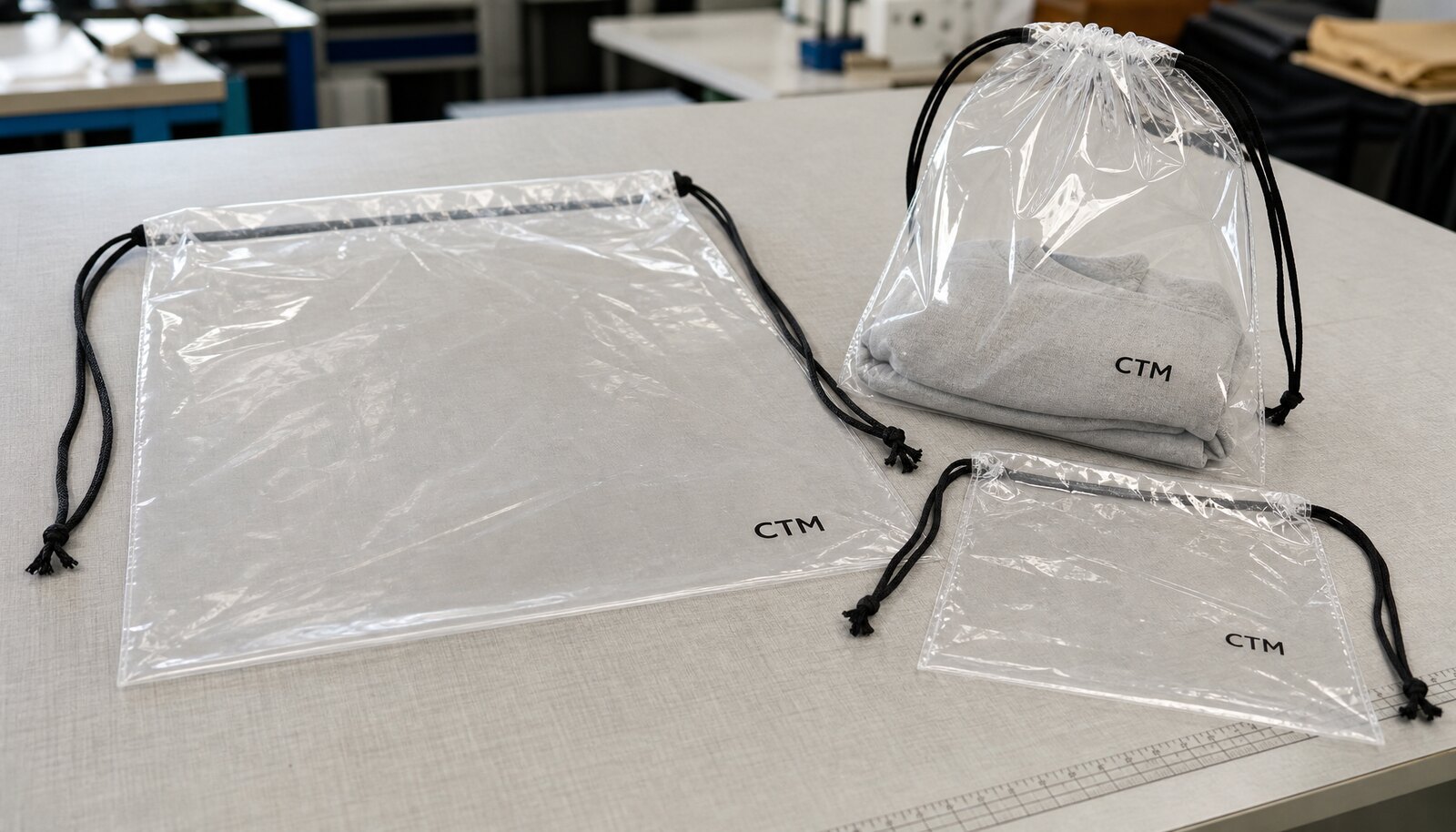
Start With the Use Case and the Handling Chain
Custom plastic drawstring bags are bought for very different jobs, even when they look similar in a catalog. A bag used to present folded apparel on a retail shelf has to look clear, clean, and premium. A bag used for event collateral or promotional kits can usually tolerate simpler film and a more basic closure if the only requirement is short-term containment. If you start with the artwork instead of the downstream use, the quote may look fine and the bag can still fail where it matters: in the hand, in the warehouse, or at the point of sale.
The first procurement question is not what the bag should look like, but what it must survive. Will it be handled once or many times? Does it need to be opened and reclosed? Will it sit under lights, be packed into cartons, or travel through a distribution center with other items that can scuff it? Those answers decide the film type, thickness, print method, closure style, and packing method before price is even discussed. Buyers who define the use case early get more usable samples and fewer surprises later.
- State the item that goes inside the bag and its approximate weight.
- Say whether the bag is for retail display, gifting, storage, or shipping.
- Flag whether the bag needs repeated opening and closing or only one-time use.
- Call out sensitivity to odor, haze, static, or cosmetic scuffing.
Build the Bag Spec From Geometry, Not Guesswork
A useful RFQ starts with real dimensions. For custom plastic drawstring bags, specify flat width, length, channel depth, seam allowance, and whether the stated dimensions are inside or outside dimensions. That matters because a factory can easily quote the same nominal size with a different usable opening or a different finished body length. The buyer should also specify whether the drawstring channel is part of the body measurement or an added construction element. Without that detail, two quotes may look aligned while the finished bags are not interchangeable.
Thickness should be written in microns for standard PE film bags. If the supplier proposes laminated PP, woven PP, or another hybrid construction, then GSM may also matter, but only in addition to the substrate description. Do not accept a generic bag name as the spec. Ask for the exact construction, the target thickness, the tolerance, and the finished feel you need. A premium retail bag and a utility bag can both be called drawstring bags and still perform very differently.
- Use microns for PE film and ask for the permitted tolerance across the lot.
- Ask whether the drawstring channel thickness is included in the quoted gauge.
- Confirm seam width and whether the closure uses heat sealing, ultrasonic sealing, or another method.
- If the bag is semi-transparent or clear, state the clarity expectation instead of assuming the factory knows it.
Choose Materials With Clarity, Odor, and Recycled Claims in Mind
The main material choice for custom plastic drawstring bags is usually virgin LDPE, recycled-content PE, or a blend. Virgin LDPE usually gives the cleanest clarity, softest hand feel, and most predictable color. Recycled-content PE can be a valid sourcing path when the buyer needs a lower-virgin-content story, but it can also introduce haze, odor, and color shift. Those tradeoffs are not abstract. They show up in shelf appearance, customer acceptance, and sometimes in the length of time it takes to get an approved sample.
If the supplier claims recycled content, do not treat that as a marketing line. Request the percentage, the resin source, a lot-specific declaration, and the document chain that supports the claim. If the claim matters commercially, ask for the resin batch number or mill reference and retain the approved sample with that shipment record. For import programs, the buyer should also confirm whether the target market expects a recycled-content declaration on the carton or in the shipping paperwork. A claim you cannot document is a procurement risk, not a sustainability advantage.
- Ask whether the film is virgin, PIR, PCR, or a blend, and require the percentage in writing.
- Request a lot-level declaration or certificate for any recycled-content claim.
- Compare haze and odor against a signed master sample before mass production.
- If the bag is retail-facing, reject obvious gray cast, clouding, or chemical odor unless it was explicitly approved.
Control Print Quality Before the Factory Cuts Plates
Print method is one of the biggest hidden cost drivers in this product category. Flexo and gravure usually make sense when the artwork is stable and the order will repeat, because setup cost gets spread over volume. Digital print is useful for samples, test launches, or low-volume programs, but it usually carries a higher unit cost and can be less efficient when the run becomes large. The buyer should compare those options on the same basis: setup charge, print area, color count, and expected repeat volume, not just on the headline unit price.
The artwork itself needs production rules. Thin lines, small reverse type, rich solids, and full-bleed coverage can all look fine on screen and fail on flexible film if the supplier does not control registration and ink behavior. Ask for a digital proof, then a physical print sample, and agree on the acceptable registration drift before plates or cylinders are made. For clear film, even a one-color logo can look poor if it is off-center or too close to the seal area. The right standard here is not design taste; it is reproducibility.
- Keep artwork simple if the bag is a volume item and not a short-life promotion.
- Ask for minimum line weight and minimum type size before approving the file.
- Separate setup charges from unit price so short runs and repeat runs can be compared fairly.
- Require a signed print proof and a retained physical reference sample.
Compare Supplier Routes on Real Landed Cost
The comparison table below should be used as a sourcing decision tool, not as a spec sheet. For procurement buyers, the key question is which route produces the lowest acceptable landed cost after you include setup, packing, freight, duty, and the cost of defects. A direct factory quote may look cheapest at the unit level, but the first order can become expensive if setup, overrun, and export packing are not included. A trading company may look more expensive, yet it can save time if it can combine multiple SKUs into one shipment or manage communication better across a complex order.
When you compare quotes, force every supplier onto the same basis. Use the same Incoterm, the same carton count, the same print assumption, the same overrun rule, and the same sample scope. Then compare cost per acceptable bag, not cost per ordered bag. If one supplier has a lower ex-works price but a higher defect rate, the apparent savings disappear. If one quote hides handling or does not show the real factory, the price is not yet procurement-ready.
- Compare direct factory, converter, trader, and distributor quotes on the same Incoterm.
- Ask for setup cost, sample cost, and packing cost as separate lines.
- Check whether the quote assumes the same carton count and pallet format.
- Treat hidden margin and unlisted handling as a sourcing risk, not a minor accounting issue.
Write the RFQ So Quotes Are Actually Comparable
A usable RFQ for custom plastic drawstring bags needs more than artwork and quantity. The supplier should receive the final dimensions, thickness target, material choice, print process, color count, print placement, closure type, packing count, destination, and desired ship date. If any of those are left vague, the factory will fill in assumptions and the quotes will no longer be comparable. The result is a spreadsheet that looks tidy but does not support a real award decision.
The other half of a good RFQ is commercial structure. Ask the supplier to separate unit price from tooling, sample charges, export packing, special pallet needs, and any documentation fees. If you expect more than one build option, ask for both on the same line set, for example virgin LDPE versus recycled-content PE, or 80 micron versus 100 micron. That makes the tradeoff visible and gives procurement a defendable reason for the final selection.
- Include flat width, length, channel depth, and whether dimensions are finished or cut size.
- State one-sided or two-sided print, the number of colors, and the acceptable color standard.
- Identify the target destination, Incoterm, and any warehouse or broker constraints.
- Ask for separate pricing on samples, setup, packaging, and freight rather than one blended number.
Approve Samples Like a Production Buyer, Not a Brand Reviewer
A sample is not only a visual approval. It is the first chance to catch the problems that become expensive at volume. For custom plastic drawstring bags, the sample review should cover clarity, odor, seam quality, drawstring movement, print alignment, and how the bag behaves when filled to the intended use level. If the bag is transparent, inspect it under normal room lighting, not only under a bright inspection lamp. If the bag is colored or contains recycled content, check for haze, tint shift, and uneven color near the seal or channel area.
Use three stages when the order matters: blank sample, printed sample, and pre-production sample. The blank sample confirms material feel, gauge, and closure behavior. The printed sample confirms artwork size, color, and registration. The pre-production sample is the final sign-off before the factory commits the line. Each approval should be dated and versioned. If you do not keep a controlled sample, you lose your reference point when a later shipment is challenged.
- Check that the drawstring opens and closes smoothly without snagging or slipping.
- Confirm the seal line is straight, continuous, and consistent across the sample.
- Fill the bag to the expected use level and make sure the geometry still holds.
- Approve the sample in writing with notes on size, color, print placement, and packing format.
Set QC Thresholds Before Mass Production Starts
If you want the factory to police quality, define the measurable points in advance. For this product, the most useful checks are thickness, dimensions, print registration, seal strength, drawstring performance, odor, and carton accuracy. Set the inspection method before production so there is less room for argument when the first lot is checked. A procurement-ready QC plan should identify what counts as a major defect, what counts as a minor defect, and what is unacceptable under any condition.
A practical starting point for many import programs is ANSI/ASQ Z1.4, normal inspection, General Inspection Level II, with AQL 2.5 for major defects, 4.0 for minor defects, and zero tolerance for critical defects. The exact sample size comes from the lot-size table, which should be chosen before the inspection starts. Do not let the supplier shrink the sample size to protect yield. The inspection result is only meaningful if the sample plan is fixed before anyone opens cartons.
- Define major defects versus minor defects in writing before the run starts.
- Use the lot-size table from the agreed inspection standard rather than a supplier-proposed count.
- Check samples from top, middle, and bottom cartons, not just the first carton opened.
- Keep one retained sample at procurement and one at the factory for later comparison.
Pack for Transit, Warehouse Intake, and Customs Clearance
Packing matters because plastic bags are easy to crush, scuff, and miscount. The usual import-ready approach is inner packs or tied bundles inside master cartons, with carton labels that show the product name, size, color, quantity, carton number, and purchase order reference. If the bags are intended for retail distribution, the inner pack count should match the downstream handling process rather than whatever is easiest for the factory to bundle. A clean packing spec reduces warehouse rework and makes receiving faster.
For export shipments, the documentation package should be ready before the truck leaves the plant. In most cases that means commercial invoice, packing list, bill of lading or air waybill, and any country-specific origin or compliance document. If the market requires recycled-content support, include the declaration or certificate with the shipment. If the shipment uses wood pallets, they should be ISPM 15 compliant where required. Also confirm the HS code with your broker before shipment, because the product construction and intended use can affect classification in some markets.
- State the inner pack count, carton count, and pallet format before the quote is accepted.
- Require carton labels to match the buyer SKU system and purchase order reference.
- Ask for moisture protection or stretch wrap if cartons will ride long freight lanes.
- Confirm whether your market needs a certificate of origin or recycled-content paperwork.
Award the Supplier on Control, Not Only on Price
The best supplier is rarely the lowest quoted line on the first email. For custom plastic drawstring bags, the real award decision should weigh price, process control, documentation quality, lead time reliability, and the supplier's response when something changes. A supplier that quotes cleanly, answers setup questions directly, and produces a sample that matches the final shipment is usually safer than a cheaper supplier that leaves every technical point open to interpretation. Procurement should score the response, not just the unit cost.
After the first order, keep score. Track defect rate, carton accuracy, response time on change requests, and whether the factory held the approved spec without silent substitutions. If a material or print change is needed later, require written approval before the change is made. That sounds strict, but it is the normal control standard for a repeatable sourcing program. Once the process is stable, repeat orders become simpler, faster, and more predictable.
- Award on total landed cost per acceptable bag, not on ex-works price alone.
- Weigh process ownership, documentation discipline, and sample fidelity heavily.
- Require written approval for any substitute resin, print change, or packing change.
- Keep a simple scorecard for defect rate, on-time delivery, and communication quality.
Specification comparison for buyers
| Supplier route | Commercial structure | Landed-cost profile | Best fit and buyer risk to check |
|---|---|---|---|
| Direct factory with in-house film, printing, and sealing | Lowest ex-works price potential, but setup charges, sample cost, and freight must be separated cleanly | Usually the lowest total cost at repeat volume because tooling and process steps stay in one plant | Best for stable artwork and repeat programs. Verify the plant really owns extrusion or film supply, print, and sealing instead of outsourcing the critical steps. |
| Integrated converter or trading company with a named factory | Middle price point, often with more flexibility on packing, small changes, and mixed-SKU orders | Can look competitive at quote stage, but margin may be embedded in the unit price or hidden in handling lines | Best when you need coordination across multiple products. Verify the actual producer, the exact Incoterm, and whether setup charges are passed through or marked up. |
| Regional stock printer or converter | Higher unit price, lower tooling burden, and faster turnaround for simple branding on stock bodies | Often best for launch tests or urgent replenishment because freight and setup are lower, but unit cost is usually higher | Best when speed matters more than perfect spec control. Check whether the supplier can swap film, thickness, or closure details without saying so in the quote. |
| Importer or domestic distributor | Highest unit price, but minimal buyer administration and usually simpler domestic delivery | Can win on landed simplicity for small orders, yet the buyer pays for inventory risk, limited customization, and fewer cost levers | Best for small runs or emergency buys. Confirm documentation quality, carton accuracy, and whether the bag spec is truly custom or only relabeled stock. |
| Material | 6-10 oz cotton canvas, 210D polyester, rPET, or blended cotton with shrinkage and colorfastness expectations set before sampling | Before price comparison | Different cloth weights, backing, or certification claims make quotes hard to compare |
| Construction | cord diameter, eyelet or reinforced channel, bottom corner reinforcement, seam allowance, bar-tack position, and load target | Before sampling | Weak stress points create returns and failed inspections |
| Decoration | screen print, transfer, embroidery, woven label, or drawstring tag tested against folding and abrasion | Before artwork approval | The wrong method can crack, bleed, pucker, or fail on the chosen fabric |
| MOQ | Base MOQ plus change drivers | During quote review | Custom colors, trims, and packing can change minimums |
Buyer checklist before sampling
- Finished bag width, length, channel depth, and whether dimensions are inside or outside measurements
- Target film thickness in microns, plus the allowed tolerance across the bag and across the lot
- Resin type, virgin or recycled-content split, transparency target, and any odor restriction
- Drawstring material, cord diameter, stopper style, and expected pull performance
- Print method, number of colors, Pantone targets if relevant, print area, and whether artwork is on one side or both sides
- Artwork file version, who owns final approval, and whether the printer must return a digital proof
- Quantity by SKU, forecast for repeat orders, and any allowed overrun or underrun
- Requested sample sequence: blank sample, printed sample, and pre-production sample
- Packing spec, including inner pack count, carton count, carton label text, and pallet requirement
- Destination port or warehouse, Incoterm, and name of the freight forwarder or customs broker
Factory quote questions to send
- What exact construction are you quoting for this bag, including film type, thickness, closure method, and stopper?
- Is the quoted material virgin LDPE, recycled-content PE, or a blend, and what percentage can you document?
- What setup cost applies for print plates, cylinders, screens, or digital prep, and what does that fee cover?
- What is your MOQ by size, color count, and packing format?
- Can you quote blank samples, printed samples, and pre-production samples as separate lines?
- What tolerance do you hold for thickness, dimensions, and print registration?
- What test method do you use for seal strength and drawstring pull performance?
- What is the print color tolerance, and how do you handle a mismatch against the approved sample?
- What are the standard inner pack count, carton count, carton dimensions, and gross weight?
- Can you quote both FOB and DDP, with inland freight, export charges, and destination-side charges shown separately?
Quality-control points to confirm
- Use ANSI/ASQ Z1.4, normal inspection, General Inspection Level II unless your risk profile requires tighter control
- Set AQL 2.5 for major defects, 4.0 for minor defects, and 0 for critical defects
- Determine sample size from the lot-size table in the standard rather than letting the supplier choose the count
- Thickness average should be within plus or minus 8 percent of the approved target, with no sampled point below minus 10 percent
- Overall dimensions should be within plus or minus 3 mm for small bags or plus or minus 5 mm for larger bags, with channel depth within plus or minus 2 mm
- Seal strength should meet the agreed method and should not open under a 2 kg static hang for 30 seconds on light retail bags or 3 kg on heavier-use bags unless your engineering spec says otherwise
- Drawstring should pass 10 open-close cycles without slip, jam, tearing, or stopper failure
- Print registration should stay within plus or minus 1.5 mm or the approved visual tolerance, with no crop, double image, or visible skew
- Color should match the signed master sample under daylight-equivalent lighting, within the agreed visual tolerance
- No punctures, contamination, burn marks, gels, foreign particles, or visible seal voids