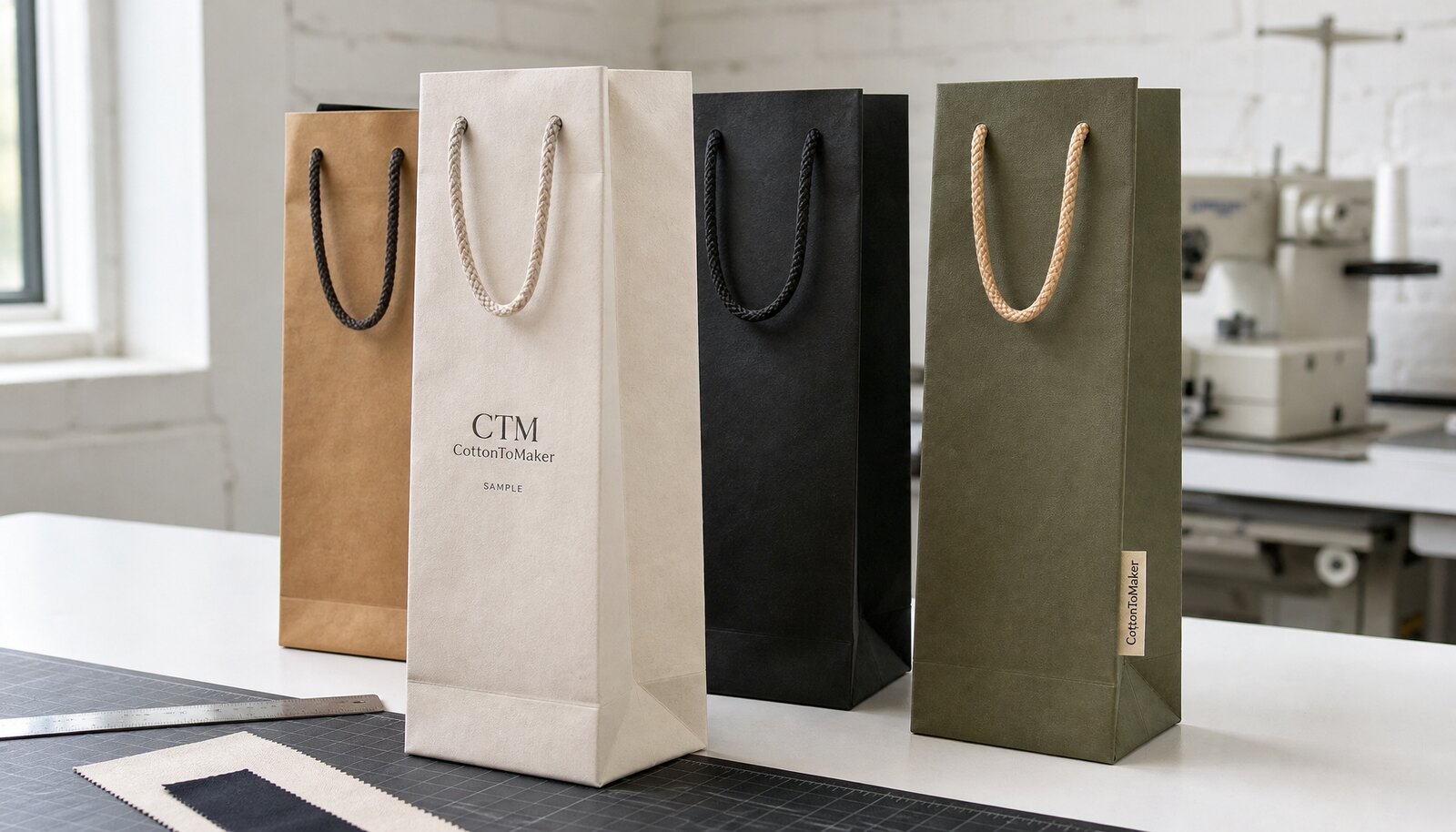
Start With the Bottle and the Sales Channel
The wrong starting point is to buy a paper bag and then try to force a bottle into it. For custom paper wine bags, the bottle format comes first, because a 750 ml Bordeaux bottle, a wider Burgundy bottle, and a sparkling wine bottle do not share the same shoulder profile or top clearance. If the bag is for retail shelves, the buyer also needs to think about how the bag looks standing upright next to competing packaging, because shelf appeal and bottle protection are not the same requirement.
This is where many RFQs fail. The supplier gets a generic size request, quotes a common wine-bag template, and the buyer only discovers the issue after the first sample. Write the use case into the spec: gift shop, winery tasting room, distributor giveaway, seasonal retail promo, or e-commerce add-on. That single line changes the choices around GSM, handle style, print finish, and how much reinforcement the factory should build into the bag.
- State the exact bottle type and height range in the RFQ.
- Say whether the bag must sit on a retail shelf, travel as a gift, or ship inside a master carton.
- If you sell several bottle shapes, decide whether you need one universal size or multiple SKUs.
Choose Paper Structure, Not Just a Paper Name
Paper wine bags are usually priced by paper type, GSM, print complexity, and converting time, not by one simple bag label. Kraft paper is common for a natural look and is usually the most forgiving choice for buyers who want a lower-cost run. White kraft or coated art paper can lift the print quality, while duplex board or laminated paper is more suitable if the brand needs a sharper retail appearance. The tradeoff is stiffness, crack risk at the folds, and cost.
For most buyers, the important decision is not whether the bag is 'eco' or 'premium'; it is whether the structure matches the bottle and the route to market. A 120 to 150 GSM kraft body may work for a light single-bottle carry if the handle and bottom board are properly reinforced. If the bag uses a heavier surface finish, the factory may need a stronger caliper or a better glue line to keep the folds clean. Ask for the exact GSM on the body, handle patch, and base insert, because those are often different even when the supplier speaks about one paper spec.
- Natural kraft works well for low-ink branding and rustic wine labels.
- White or coated paper suits sharper graphics and richer color blocks.
- If the bag is premium retail packaging, request a sample bend test at the fold lines before approving the paper.
Printing and Finish Decide the Real Selling Price
The cheapest quote is often the one with the most assumptions hidden inside it. One-color flexo on kraft is usually the most efficient route for a simple logo, because it keeps setup light and the finish stable. Offset printing is better when the design needs more detail, gradients, or tighter color control. Hot foil, embossing, spot UV, and lamination can all work on wine bags, but each finish adds process time, waste risk, and a chance for scuffing if the bag is handled heavily in store.
A buyer should treat the print method as a commercial decision, not just an artwork decision. If the brand name is short and bold, flexo or a single foil stamp may be enough. If the pack must look gift-ready in a premium channel, an offset-printed outer with foil detail can make sense, but only if the factory can control fold cracking and glue contamination. When comparing quotes, separate the base bag price from plates, dies, foil blocks, varnish, and any extra setup. A quote that looks 15 percent lower can become more expensive once those extras are added back in.
- Use flexo for simple logos and repeat orders where cost control matters.
- Use offset when the brand needs higher image quality or multi-color art.
- Treat foil and embossing as premium features that need sample approval on the exact paper grade.
Handles and Reinforcement Need a Load Target
A wine bag fails in two places: the handle and the bottom. Buyers often focus on print and paper color, then discover the bag tears where the handle joins the mouth. Rope handles, twisted paper handles, ribbon handles, and die-cut handles all have different failure points. Rope handles usually feel better for gifting and can carry more weight if the attachment is reinforced. Twisted paper handles can match a kraft look and reduce component cost, but they need a secure glue area and consistent attachment placement. Die-cut handles keep the bag simple, yet they are not the best choice for heavier bottles unless the board is strong and the grip zone is reinforced.
The useful way to write the spec is to set a load target instead of saying 'strong handle'. For a single 750 ml bottle, many buyers target a practical carry load in the 4 to 6 kg range with a margin above the bottle weight; for double-bottle or heavier-format packs, the target should be higher and confirmed by a pull test. Ask whether the factory tests the handle attachment or only inspects it visually. The same applies to bottom reinforcement. If the bottom board is too thin or too short, the bag can sag even when the handle survives.
- Choose rope handles when the bag needs a more premium carry feel.
- Choose twisted paper handles when cost and a paper-only look matter most.
- Request a visible pull-test method in the sample stage so the approval is not based on appearance alone.
Compare Supplier Routes Before You Compare Unit Prices
For custom paper wine bags, the supplier route changes the quote more than many buyers expect. A direct specialist factory is usually the best option when you want consistent structure, repeatable print, and a stable cost curve on reorders. An integrated packaging converter can be efficient when the wine bag must match cartons, inserts, or a wider packaging system. Traders and sourcing agents are useful when the buying team needs coordination support, but they can obscure the real factory capability if you do not ask for proof of the production line.
Short-run local print shops can work for events and urgent activations, yet many of them outsource the converting stage, which means print quality may be good while the bag shape, glue, or handle strength is only average. Low-cost general paper bag plants can be fine for simple giveaways, but they are often a poor fit for premium wine packaging. The right comparison is not 'who is cheapest'; it is 'who can meet the actual bag, bottle, and brand requirements with the least hidden risk.'
- Ask each supplier whether they make the bag body, handle, and reinforcement in-house.
- Verify what the supplier owns: printing line, die-cutting tools, gluing equipment, and sample room.
- Treat the first sample as a proof of process, not just a proof of artwork.
Build an RFQ That Produces Comparable Quotes
If the RFQ is vague, suppliers will fill the gaps in different ways and the quotes will not compare cleanly. A good RFQ for paper wine bags includes bottle type, bag size, paper GSM, print method, handle type, finish, reinforcement, pack-out, carton spec, and the target quantity per order. It should also state what is optional and what is fixed. For example, if you are open to either white kraft or natural kraft, say so, but do not leave the paper grade open while expecting the supplier to infer your target cost ceiling.
A useful quote sheet separates the unit cost from the setup cost. Example structure: 5,000 pcs, 120 GSM kraft body, one-color flexo print, twisted paper handles, bottom board, 25 pcs per inner pack, 100 pcs per carton, sample lead time 5 to 7 days, production lead time 20 to 30 days after approval, plates charged separately. That level of detail lets procurement compare suppliers on the same basis. If one supplier omits the plate charge, the sample fee, or the inner pack configuration, the apparent price advantage is not real.
- Send artwork in vector format and confirm the Pantone references if color matters.
- State whether you need a production sample, a pre-production sample, or both.
- Ask for one quote on the intended spec and one quote on a cost-down alternative so you can compare tradeoffs.
Approve the Sample on Fit, Finish, and Failure Points
A sample should answer three questions: does the bottle fit, does the bag look right, and does it survive handling? The sample stage is where buyers should test the full pack, not just hold the empty bag. Insert the intended bottle, close the top area, carry it by the handle, and inspect the structure after a short load period. Look for creasing at the side seam, slippage at the handle attachment, glue squeeze-out, and any print distortion where the paper folds. If the bag uses premium finishing, check the surface under different light angles because foil, laminate, and embossing can all look different once the bag is flat versus when it is full.
The best sample approval is written. A buyer should sign off on the approved bag size, paper spec, artwork version, color standard, handle type, and packaging configuration before mass production starts. That record matters when the factory changes a component during scaling. If the sample passed with one paper lot and production uses another, the buyer should have a clear reference point for rejecting or reworking the run. A small mistake in sample approval becomes a large dispute when the order is in cartons.
- Test the sample with the exact bottle you will ship.
- Check side seams, top edge trim, bottom board, and handle anchoring.
- Retain one signed sample on both sides so you can compare the production lot later.
Use QC Points That Catch Bag Failures Before Shipping
Paper wine bag QC should go beyond visual inspection. The bag must hold shape, align artwork, and stay intact through a normal retail handoff. Key control points include paper thickness, handle attachment, glue bond, print registration, fold accuracy, and carton count. If the design includes a side gusset or a reinforced base, inspect those areas first because they often reveal the factory's real process control. A bag can look clean from the outside and still fail in the fold or the base after a small load is added.
A practical QC plan uses the same language the factory uses on the line. Define acceptable color drift, the maximum allowed misalignment on the logo, and the defect types that require rework versus replacement. If the order is for retail wine gifts, scuff marks and glue stains matter more than a minor paper shade variation. If the order is for a trade promotion, structural strength may matter more than perfect finishing. The point is to tie the defect standard to the channel, then inspect against that standard consistently.
- Set a simple acceptance line for print position and handle placement.
- Require random carton opens during inspection, not only outer-carton checks.
- Reject bags with open seams, lifted laminate, or visible glue contamination on the front panel.
Plan Packing, Cartons, and Export Protection
Packing is part of the product cost, not an afterthought. Paper wine bags can be packed flat, nested, or partially inserted with a stiffener, and each choice affects labor, carton size, and shipping efficiency. If the bag is printed on a delicate finish, a protective inner pack can reduce scuffing. If the design is simple kraft, a flatter pack-out may be better because it lowers carton volume and keeps freight cost down. Buyers should decide whether the priority is presentation on arrival or cube efficiency in transport.
Carton packing also affects claim handling. A well-labeled master carton with SKU, size, quantity, and production date makes receiving easier and helps the warehouse separate variants. If the shipment is going to retail distribution, ask the factory to confirm whether the bags are packed with moisture protection or corner support. Paper products do not like humidity or compression, especially when the order crosses a long sea route. The cheapest unit price can turn expensive if the carton spec is weak and the goods arrive warped.
- Agree the number of bags per inner pack and per export carton before production.
- Ask for carton dimensions and gross weight in the quotation.
- Use clear SKU labels if multiple print versions or bottle sizes are shipping in the same order.
Use MOQ and Lead Time as Design Inputs
MOQ is not a random factory demand; it is usually tied to paper waste, printing setup, and finishing time. A simple kraft bag with one-color printing and a standard handle often has a lower MOQ than a laminated, foil-stamped, or embossed version. Custom sizes, special paper colors, and nonstandard handle builds can push the minimum higher because the factory has to set up separate materials and may lose efficiency on the line. If your demand is uncertain, ask the supplier to quote both the exact spec and a simplified fallback version so the commercial team can compare sell-through risk against unit cost.
Lead time should be broken into stages. Sample production may take only a few days, but mass production can still slip if artwork approval is late or paper stock is not in house. A realistic plan includes sample timing, pre-production approval, production window, and export booking. If the product is tied to a seasonal wine promotion or holiday gift program, build the schedule backward from the sell date, not from the factory's earliest promise. That avoids paying for air freight because the packaging ran late.
- Expect lower MOQ on standard kraft builds and higher MOQ on premium finishes.
- Separate sample time, production time, and shipping time in the project plan.
- If the launch date is fixed, choose the safer spec instead of the most complex one.
Specification comparison for buyers
| Spec decision | Recommended option | When it fits | Buyer risk to check |
|---|---|---|---|
| Direct specialist paper bag factory | Best for repeat orders when you need control over GSM, handle reinforcement, and print alignment | Retail programs, seasonal gifting, and SKU-level reorders | Confirm they actually convert wine bags in-house, not just generic paper bags |
| Integrated packaging converter | Useful when the bag needs matching cartons, inserts, and retail packaging across one supplier | Brands that want one vendor for bag, box, and shipper coordination | Quote may hide margin inside other packaging items, so separate each line item |
| Trading company or sourcing agent | Works for small teams that need supplier management and bilingual RFQ handling | First-time buyers, multi-item purchases, or buyers without China sourcing staff | Check who owns the factory audit, sample control, and after-sales responsibility |
| Local print shop with outsourced converting | Good for very short runs or urgent event orders | Launches, tasting events, and local activations with low volume | Print quality may be fine while bag structure and glue strength are weak |
| Low-cost general paper bag plant | Acceptable only when the bag is simple and the wine bottle is light | Basic retail giveaways with minimal branding and no premium finish | Risk of handle failure, weak bottom board, and poor bottle fit |
| Eco-focused specialist supplier | Best when recycled content, FSC claims, or low-ink branding matter to the buyer | Wine brands positioning around sustainability or export-market packaging rules | Verify the exact paper content and claim support before you print packaging statements |
| Hybrid pilot-then-scale route | Start with one supplier for samples and a second for volume if the project is new | New artwork, new market, or uncertain sell-through | Keep dieline, artwork, and spec sheets identical so the scale supplier can match the sample |
| Domestic emergency replenishment supplier | Use for rush replacement orders when stock must move fast | Promotions, distributor shortages, or retail reorders close to launch | Unit cost is usually higher, and you may lose control over exact paper shade or finish |
Buyer checklist before sampling
- Define the bottle format first: 750 ml Bordeaux, Burgundy, Champagne, or a wider specialty bottle, because the bag width and gusset follow the bottle footprint.
- Lock the paper grade and GSM for the body, handle, and reinforcement, not just the outer paper name.
- State whether the print is one-color flexo, multi-color offset, hot foil, embossing, or a mixed finish.
- Confirm handle type, handle length, and the pull-strength target you want the supplier to test.
- Specify whether the bag needs a top insert board, bottom board, side reinforcement, or both.
- Write the packing count per inner pack and carton so the factory does not choose a random pack-out.
- Ask for sample, plate, and tooling charges separately from the unit price.
- Request the lead time split into sample time, production time, and shipping time.
Factory quote questions to send
- What exact paper spec is included in the quote, including GSM, coating or lamination, and any reinforcement board?
- Which print method is quoted, how many colors are included, and are plates or dies charged separately?
- What handle type is included, what is the handle attachment method, and what pull test do you run?
- Does the price include dieline setup, sample approval, and one round of pre-production adjustments?
- What is the MOQ per size, artwork, and finish, and does the MOQ change if we use foil, embossing, or special paper?
- How are the bags packed per inner pack and carton, and what carton size and gross weight should we expect?
- What is the production lead time after sample approval, and what can delay it in real production?
- What defect standard do you use for printing, glue, handle placement, and carton pack-out?
Quality-control points to confirm
- Confirm bottle fit with the exact bottle shape you will ship, not just a generic 750 ml sample.
- Check top opening, gusset width, and base flatness so the bag stands properly and does not twist under load.
- Measure handle attachment strength and look for glue squeeze-out, loose knots, or uneven stitching on reinforced handles.
- Inspect print registration, color density, and edge sharpness on logos, especially near folds and the side seam.
- Open random bags and check whether the bottom board sits flush and does not buckle after the first insertion.
- Rub the print and surface finish to see whether ink scuffs, foil lifts, or laminate cracks at folds.
- Count inner packs and cartons to ensure the factory respects the agreed pack-out and label format.
- Check outer cartons for correct SKU, size, quantity, and moisture protection before pallet or export loading.