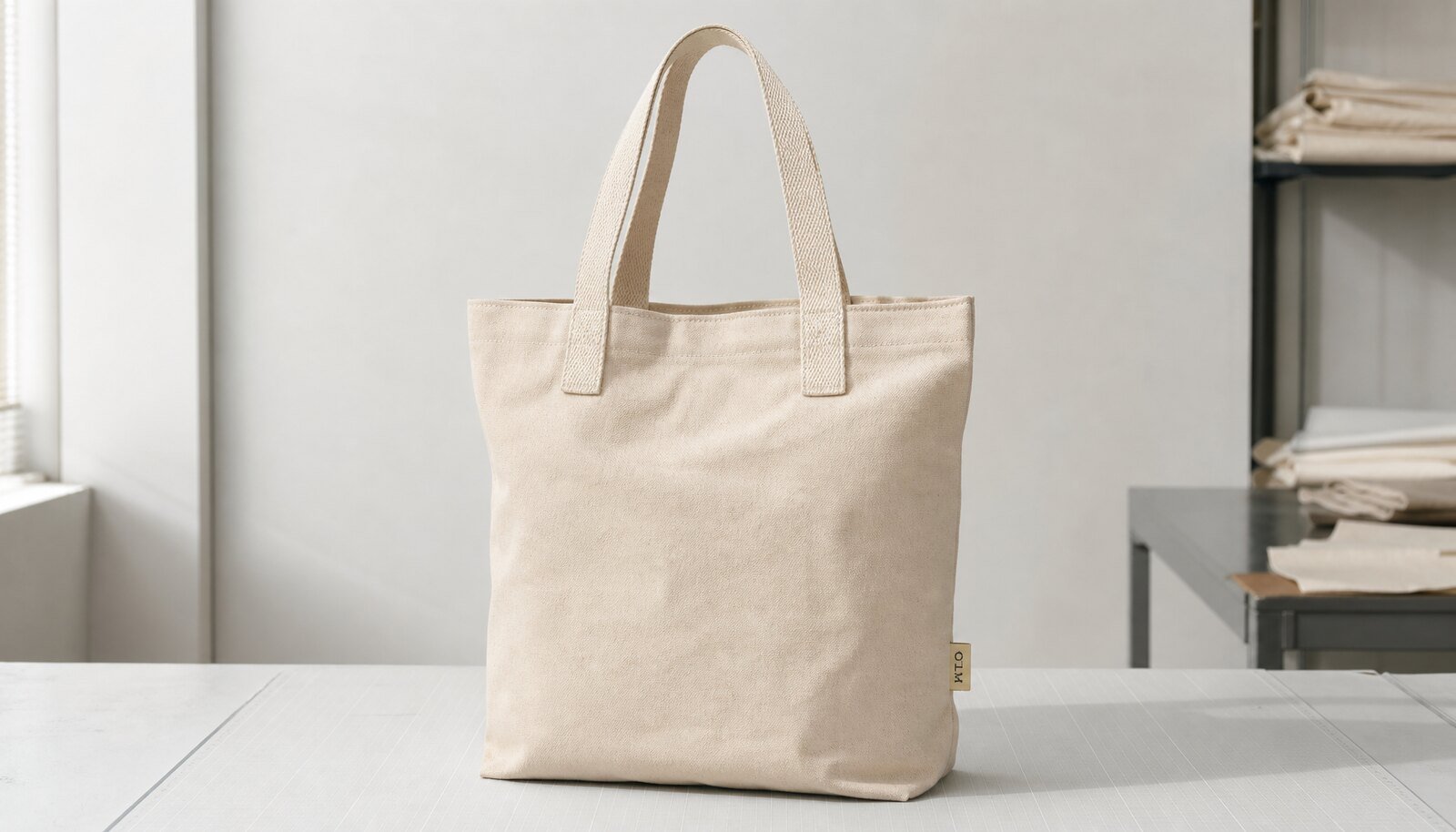
Start With The Gift Program, Not The Tote Spec
Corporate gifting fails when the tote is treated like a generic retail carry bag. Start from the actual gift program: what is being packed inside, how the tote will be handed out, and whether the bag needs to look premium on arrival or simply survive distribution. A lightweight conference insert, a boxed client gift, and a retail-style welcome pack all create different requirements for structure, handle length, and print placement.
Once the use case is clear, the spec becomes much easier to write. You can decide whether the tote needs a flat base, a gusset, a reinforced opening, or a softer foldable build. That first decision controls cost more than most buyers expect, because it affects fabric consumption, cutting yield, sewing time, and how many units fit in a master carton.
- Define the gift contents first, then work backward to tote dimensions.
- Separate what must be visible on the bag from what can stay inside the tote.
- If the tote is part of a premium handout, prioritize shape retention and clean finishing over the absolute lowest GSM.
Pick A Fabric Weight That Matches The Handout
For custom organic cotton totes, the fabric weight is usually the first number that tells you whether the bag will feel cheap or credible. Around 140 to 160 GSM works for light giveaway use, but it can feel soft and transparent if the tote is large or the contents are dense. The common corporate gifting range is 180 to 220 GSM, because it gives a more dependable hand feel without pushing the bag into a heavy, expensive category.
Above 240 GSM, the tote starts behaving like a premium structured item. That can be right for executive gifts, retail resale, or programs that want the bag to be reused often, but it also increases cutting waste, sewing effort, and freight weight. Organic cotton does not remove the need to specify weave, finish, and shrinkage control; two totes with the same GSM can still handle very differently if one is loosely woven and the other is tightly woven or pre-washed.
- Use 140 to 160 GSM only when the gift contents are light and the bag is not expected to hold shape.
- Use 180 to 220 GSM for most corporate gifting programs that need a dependable everyday tote.
- Use 240 GSM or above when the tote itself is part of the perceived gift value.
- If the bag is natural unbleached cotton, ask how visible specks or flecks will appear under print.
Compare Supplier Routes Before You Compare Prices
A low unit price is not useful if the supplier cannot control the order. Direct factories usually give the cleanest path on cutting, sewing, printing, and packing because one production owner is responsible for the result. Trading companies can be useful when you need to compare factories or when the order is too small to attract a top-tier mill, but the buyer needs more evidence because the real production source sits one layer away.
For corporate gifting, the safest route is usually the one that matches your risk profile, not the one that sounds cheapest. If your order depends on traceability, ask who controls the cotton purchase records, the print screens, and the packing list. If your schedule is tight, ask who holds capacity in the sewing line and whether print is in-house or outsourced. The more handoffs there are, the more likely you are to inherit delays, shade drift, or packaging mistakes.
- Ask for the actual production site, not only the sales office name.
- Request photos or a recent production record that matches your tote style.
- If the supplier offers many bag categories, confirm they still run a dedicated tote line and do not treat your order as filler capacity.
- For organic claims, ask who keeps the lot traceability records from incoming cotton to final cartons.
Build An RFQ That Produces Comparable Quotes
Most tote RFQs fail because they do not separate the bag spec from the decoration spec. A useful RFQ should lock the size, fabric construction, GSM, color, handle details, print area, print colors, packing method, and destination terms. If any of those are missing, suppliers will fill the gaps with their own assumptions, and the quotes will look comparable when they are not. That is how buyers end up comparing a bare tote price against a fully packed, labeled, and carton-controlled quote.
The quote request should also force the supplier to show hidden cost drivers. Ask for setup charges, screen fees, artwork revisions, sampling fees, carton charges, testing costs, and any special packing or labeling surcharge. Then ask for the same quote at multiple quantities, such as 1,000, 3,000, and 5,000 units, so you can see where the breakpoints are. A real sourcing comparison shows how pricing behaves, not just one polished number on one volume.
- Attach one technical sketch or reference image with dimensions marked clearly.
- State whether you want FOB, EXW, or delivered pricing before the quote starts.
- Request separate lines for blank bag cost, decoration cost, and packing cost.
- Ask the supplier to list assumptions, not hide them in small print.
Approve The Sample Against Real Use, Not Just Looks
A good sample is not one that simply looks close to the artwork. It should prove the tote can survive the way the gift will actually be used. Check the bag structure when it is empty and when it is loaded, because a tote that hangs nicely on the table can still distort badly once it holds a boxed gift. Handles should feel balanced in the hand, seams should lie flat, and the bag opening should not twist after a few folds.
The approval process should move in stages when the order matters. First review the blank sample if the buyer is still deciding on fabric weight or size. Then review the printed strike-off or decorated sample for logo scale, color, and placement. Only after that should the supplier cut the production sample or proceed to mass production. If a supplier tries to skip the sample stage on a new tote style, the risk is usually transferred to the buyer in the form of rework or delayed shipment.
- Reject any sample with off-center print, uneven handle length, or visible seam tension.
- Load the sample with the real gift weight before approval.
- Check fold memory if the tote will be packed flat and reopened by the recipient.
- Record the approved sample with photos and notes so the factory can mirror it in production.
Choose Printing Based On Artwork Complexity And Run Size
For organic cotton totes, screen printing is still the most practical option for simple corporate logos because it holds up well, looks clean, and is usually economical at volume. If the artwork is one to three solid colors, screen printing typically gives the best balance of durability and unit cost. When the artwork gets more complex, such as gradients, fine type, or photographic detail, digital printing or transfer methods may be possible, but the buyer should ask how the print will behave on textured cotton and whether the result will still look premium after handling.
Embroidery and woven labels can work when the brand wants a softer, more understated look, but they change the product structure and often add cost and lead time. Avoid forcing a high-detail full-color logo onto a tote that is meant to be cost-controlled and widely distributed. The more decoration layers you add, the more you need to watch registration, hand feel, curing, and wash behavior. On cotton, a print that looks sharp in sample photos can still fail if the ink sits too heavy or the fabric weave pulls the edge of the logo out of alignment.
- Use screen print for clean logos, solid fills, and repeat corporate programs.
- Use digital or transfer only when artwork complexity justifies the extra risk and cost.
- If the tote is meant to feel premium, test print hand feel on the actual fabric weight.
- Ask the supplier whether the print is on one side only or if the reverse side shows strike-through.
Pack The Totes The Way The Gift Will Ship
Packing is not an afterthought in a gifting program. A tote that is carefully sewn but badly packed can arrive wrinkled, contaminated, or short-counted. Decide early whether each bag should be folded with tissue, nested in bulk, sealed in individual polybags, or bundled with an insert card or belly band. If your brand cares about sustainability, individual plastic bags may be the wrong answer, but you still need a packing method that protects the surface print and keeps counts accurate.
The carton plan should be written into the quote request. Ask for pack count per inner bundle, master carton quantity, carton dimensions, gross weight, and label placement. If the order is going to multiple office locations or event venues, carton marks and pallet logic matter as much as the tote itself. Many disputes after shipment are not about fabric quality; they are about missing counts, unclear labels, or cartons that are too heavy for the receiving team to handle efficiently.
- State whether you want flat pack, folded pack, or retail-ready presentation.
- Confirm if inserts, tissue, or belly bands are supplied by the factory or by you.
- Ask for carton photos before dispatch if the order is going to multiple sites.
- Check whether the supplier can keep the bag print protected from carton scuffing.
Set MOQ And Lead Time Expectations Early
MOQ is rarely just one number. For custom organic cotton totes, the real minimum can change by fabric width, color, print method, and packing format. A factory may quote one MOQ for a natural tote with one-color print and a higher MOQ for dyed fabric, multiple print positions, or premium gift packing. If you do not separate those variables, the supplier may give you a quote that looks acceptable but later refuses the exact combination you need.
Lead time should also be broken into stages. Sampling, fabric booking, print setup, sewing, inspection, and shipping each take time, and a delay at any one stage can move the whole order. Ask the supplier to anchor the schedule to sample approval, not to quote acceptance. That makes the timeline realistic and prevents the common problem where production starts before the artwork, carton marks, or packaging are fully approved. For seasonal gifting, the best safety buffer is usually in the fabric and print stages, not just in the freight booking.
- Request MOQ by size, print colors, and packing style rather than only by model.
- Ask for separate lead times for sample, production, and dispatch.
- Build time for any third-party inspection or compliance review into the schedule.
- Treat last-minute art revisions as a change order, because they usually affect print setup and delivery dates.
Compare Landed Cost, Not Only Unit Price
A tote quote that looks cheap at the factory gate can become expensive once you include setup, freight, duty, inland delivery, and inspection. The buyer should compare landed cost per usable tote, not the headline ex-factory price. This matters even more for corporate gifting because the bags are often distributed in one event window, which means late freight or damaged cartons can create both cost and reputational pressure.
The best negotiation points are usually spec choices, not blunt price cuts. A simpler print, one fewer packaging layer, a more efficient tote size, or a cleaner carton pack pattern can save more than pressing the supplier for a discount that is too small to matter. If the supplier understands that you are evaluating landed cost, they will usually quote more honestly on setup charges, overrun policy, and packing assumptions. That is the point at which the quote becomes usable for procurement instead of only useful for sales comparison.
- Compare ex-factory price, decoration cost, packaging cost, freight, duty, and inland delivery together.
- Ask for a cost delta when changing fabric weight, print colors, or packing method.
- Use a side-by-side landed cost sheet if you are comparing factories in different regions.
- Look for hidden charges around lab dips, screens, carton marks, and split shipments.
Specification comparison for buyers
| Spec decision | Recommended option | When it fits | Buyer risk to check |
|---|---|---|---|
| Direct factory sourcing | One factory that cuts, sews, prints, and packs in-house | Best for repeat orders, clear accountability, and tighter QC control | Confirm the factory is not passing sewing or printing to an unknown subcontractor |
| Organic-certified factory | Supplier with traceable organic cotton documentation and lot-level records | Needed when your brand must substantiate an organic claim or answer retail audits | Verify which standard applies and whether the quote includes document handling and transaction support |
| Trading company route | A buying office that sources from multiple tote factories | Useful when you need options across price points, capacities, or factories in different regions | Ask who actually owns QC and what happens if the producing factory changes mid-order |
| Local decorator plus imported blanks | Blank organic totes shipped in, then printed domestically | Works for rush branding, local language approvals, or very small decoration runs | Check landed cost, local decoration setup charges, and whether blank bag quality matches the final gift standard |
| Low-MOQ sample workshop | A small supplier optimized for prototypes and first runs | Good for launch programs, stakeholder approval rounds, and test gifting campaigns | Risk is quote creep later if the pilot supplier cannot scale without changing fabric or trim |
| Large export factory | A high-capacity tote supplier with formal production planning | Fits big corporate gifting campaigns, seasonal peaks, and tight ship windows | Watch minimums, lead time drift, and whether smaller artwork or packaging changes are treated as a new order class |
| Nearshore supplier | A factory closer to the delivery market | Useful when freight volatility or delivery timing matters more than the lowest ex-factory price | Confirm availability of the exact organic fabric and whether unit cost stays stable at lower volumes |
| Packaging-integrated supplier | A factory or partner that can add inserts, bands, tissue, and master carton labels | Best for premium gift sets where presentation and unboxing matter | Check whether packaging is controlled in-house or outsourced, because that can create missing pieces and carton mix-ups |
Buyer checklist before sampling
- Lock the finished tote size, including seam allowance and acceptable tolerance.
- State the fabric weight in GSM and whether it is bleached, natural, pre-shrunk, or washed.
- Define handle width, handle length, and reinforcement method at the stress points.
- Provide artwork in vector format and specify print area, number of colors, and Pantone targets if needed.
- Specify the required organic claim language and any document you need from the supplier.
- Set the sample approval step: blank sample, printed sample, or pre-production sample.
- Confirm packaging format, inner count, carton pack pattern, and any retail or gift labeling.
- Ask for MOQ by color, print method, and packaging combination, not only by bag style.
- Request lead time split into sampling, material booking, production, inspection, and dispatch.
- Ask for overrun and underrun tolerance before you compare quotes.
Factory quote questions to send
- What exact fabric construction and GSM are you quoting, and is that measured before or after washing?
- Is the cotton genuinely organic, and what document set can you supply for the order lot?
- Which print method are you recommending for this artwork, and what setup or screen charges apply?
- What is the MOQ by color, size, print color count, and packing method?
- What size tolerance do you allow on finished bags, and how do you handle shrinkage?
- What are your stitching standards for handles, side seams, and bottom seams?
- Can you share carton dimensions, unit weight, and packing count per carton?
- What is the production lead time after sample approval, and what part of that time is material booking versus sewing and printing?
- What is your overrun or underrun policy, and do you quote by exact quantity or by production lot?
- What inspection steps are included before shipment, and can I add a third-party inspection if needed?
Quality-control points to confirm
- Fabric GSM should stay within the agreed range, with no thin spots or obvious uneven weave.
- Handle attachment must show clean reinforcement, with no loose threads, broken stitches, or weak bar-tacks.
- Finished size should stay within the agreed tolerance in width, height, and gusset depth if used.
- Print placement must match the approved sample and stay centered or aligned within the agreed visual tolerance.
- Print should not smear, crack, or bleed on contact when rubbed under normal dry handling conditions.
- Seams should be straight, secure, and free of skipped stitches, puckering, or needle damage.
- Cartons must match the specified count, label format, and pack orientation so the gift set can be distributed without recounting.
- If an organic claim is used, the production lot and paperwork must match the order record with no gaps.