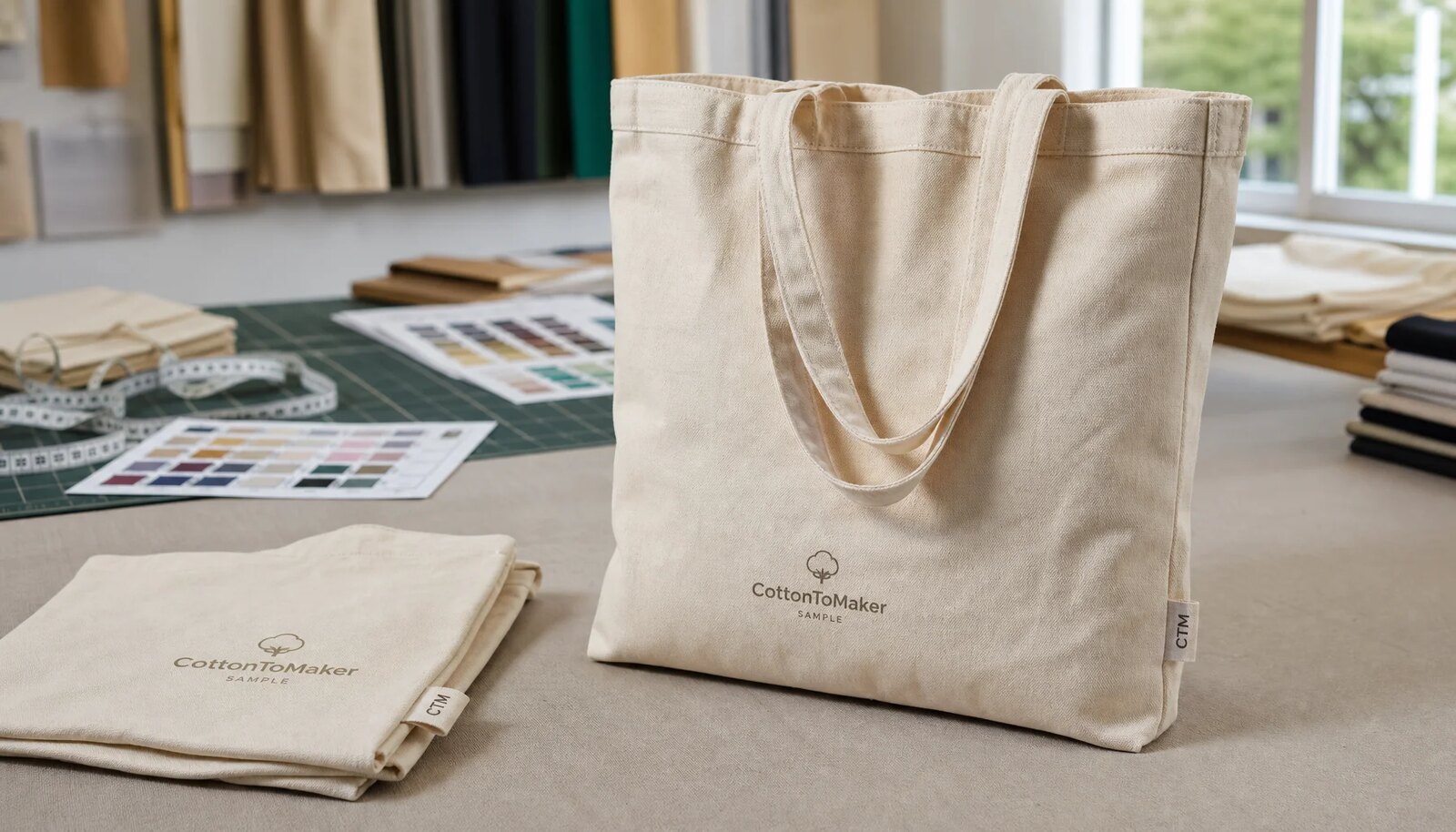
Why Craft Fair Tote Compliance Belongs in Procurement
Custom organic cotton totes for craft fairs can look like a simple merchandise or packaging buy. In practice, procurement teams are managing several risks at the same time: claim accuracy, fabric performance, sewing strength, print durability, packing readiness, and a fixed event deadline. Two suppliers may both quote an organic cotton tote, yet one is pricing a stock lightweight blank with a one-color logo while another is pricing a fully custom canvas bag with gusset, reinforced handles, labels, hangtags, barcodes, and export cartons.
The most common problem is not a shortage of suppliers. It is uneven quoting. If the RFQ does not define GSM, finished size, handle drop, reinforcement, print method, organic evidence, sample approval, packing method, tolerances, and inspection criteria, suppliers will fill the gaps in different ways. The lowest unit price may simply exclude the controls that make the order usable at the booth, shop, or warehouse.
Craft fair timing raises the stakes. If bags arrive late, handles tear, carton marks are wrong, print rubs off, or the organic claim is unsupported, there may be no time for a second production run. A supplier compliance checklist gives buyers a repeatable way to compare bids and lock decisions before deposit, before cutting, before printing, and before shipment.
- Treat the tote as an event-critical item with a required in-hand date, not only a low-cost promotional accessory.
- Separate organic cotton evidence from construction quality, print quality, and packing compliance.
- Use one written specification so every supplier quotes the same bag, artwork, packing, and inspection scope.
- Define tolerances before purchase order release instead of debating defects after delivery.
- Compare landed readiness, documentation, and rework risk alongside unit price.
Start With Use Case, Then Choose GSM
The first specification decision should be the tote's intended use. A free bag for brochures and small samples can use a lighter fabric than a resale tote expected to carry candles, ceramics, books, glass jars, packaged food, apparel, or several handmade purchases. A vendor packaging bag may need fast folding and easy handout at a booth. A retail tote needs cleaner sewing, stronger hand-feel, consistent print, and presentable labeling.
Fabric weight affects more than cost. It changes handle performance, print appearance, carton weight, shipping cube, shrinkage behavior, and perceived value. GSM is common for plain cotton fabrics, while canvas is often quoted in ounces per square yard. Buyers should not compare a 150 GSM plain cotton tote with an 8 oz canvas tote unless the intended load, landed freight, and packing requirements are also compared.
Ask suppliers for swatches or samples that represent the actual production lot, or make them state clearly when the sample is only an equivalent. Organic cotton fabric can vary by lot in shade, slub level, shrinkage, and surface smoothness. A logo that prints sharply in the sample room may look different on the final lot if the weave, absorbency, or natural color shifts.
- 120-140 GSM: economical for brochures, light giveaways, small textile items, or low-load event handouts.
- 150-160 GSM: practical for reusable-looking giveaways when freight and budget are still sensitive.
- 160-180 GSM: stronger middle range for craft fair shopper bags carrying several small purchases.
- 8 oz canvas: common starting point for branded resale totes, museum shops, and stronger vendor packaging.
- 10 oz canvas: better hand-feel for books, jars, apparel, and repeat-use positioning, with higher freight impact.
- 12 oz canvas and above: premium route, but confirm sewing capability, carton weight, needle strength, and freight cost first.
Control the Organic Cotton Claim
Organic cotton is not one fixed procurement requirement unless the buyer defines the claim. A supplier might source organic yarn, buy organic cotton fabric, hold a fabric mill certificate, or support a finished-product chain-of-custody route. Those are different levels of evidence. The right requirement depends on what the buyer plans to say on the tote, hangtag, invoice, product page, booth signage, retailer listing, or internal sustainability report.
Avoid broad language such as eco tote or certified organic bag unless the evidence supports that exact wording. If a certification logo or formal certified claim will appear on artwork or packaging, confirm scope, license approval, and chain-of-custody rules before printing. If the supplier can only provide organic cotton fabric evidence, the claim may need to be narrower and reviewed by the buyer's compliance team.
Order-specific evidence matters. A general supplier certificate does not prove the fabric used for a specific purchase order is covered. Ask how fabric lot numbers connect to the PO, cutting tickets, rejected panels, packed carton quantities, and invoice quantities. If dyeing, printing, sewing, or packing happens outside the certified chain, ask whether the finished claim remains valid.
- Claim wording: provide the exact phrase planned for product, packaging, ecommerce, booth, and retailer materials.
- Scope check: confirm whether evidence covers yarn, fabric, dyeing, sewing, printing, trims, or finished packed goods.
- Lot link: request documents tied to the production fabric lot, not only a general supplier capability certificate.
- Logo approval: do not add certification marks until usage rights and chain-of-custody scope are confirmed.
- Record trail: connect fabric lot numbers to cutting quantity, rejects, packed cartons, and final invoice quantity.
- Destination rules: check retailer, marketplace, or local regulatory requirements before approving labels.
Lock Construction Specs Early
A craft fair tote gets real handling. It may sit under a booth table, carry uneven products, hang from a hook, travel outdoors, or be reused long after the event. The construction specification should reflect that use. A large tote with weak handles creates more complaints than a smaller tote designed around a realistic load. A premium organic cotton claim will not rescue twisted seams, stretched handles, or a body that collapses when filled.
Write finished dimensions clearly. Include body width, height, gusset depth, handle width, handle drop, seam finish, reinforcement method, thread color, and label placement. Define the measurement condition: flat, expanded, relaxed, washed, conditioned, or unwashed. Gusseted totes often create disputes when one party measures the flat panel and the other measures expanded volume.
Set tolerances in the RFQ and PO. For many tote programs, body dimensions within about ±1 cm for smaller bags and ±1.5 cm for larger bags are practical. Handle drop often needs tighter control around ±1 cm. Print placement is commonly controlled within ±0.5-1 cm depending on print size and method. Agree these numbers with the supplier before the order is released.
- Body: specify width, height, gusset, measurement method, and tolerance.
- Handles: define width, drop, attachment position, reinforcement, and intended carry style.
- Reinforcement: specify X-stitch, bartack, box stitch, stitch count, or another approved method.
- Seams: choose overlock for economy or bound, folded, or French-style seams for cleaner presentation.
- Labels: control woven label, care label, hangtag, or inside tag position before bulk sewing.
- Shrinkage: state whether dimensions are required before washing, after washing, or after a defined conditioning process.
Approve Artwork, Ink, and Placement as Measurable Specs
Many craft fair tote designs use one to three colors, so screen printing is often practical and predictable. It works well for solid logos, spot colors, repeat programs, and stable unit cost. Water-based ink can give a softer feel that suits natural cotton positioning, but opacity may be weaker on darker dyed fabrics. Plastisol can provide strong coverage, though some buyers avoid it because of hand-feel or internal chemical policies. The ink route should be confirmed before quoting, not after sample rejection.
Digital printing can suit detailed illustrations, gradients, or smaller runs, but it must be tested on the approved fabric. Look at edge sharpness, color accuracy, fabric show-through, rub resistance, wash behavior, and appearance after folding. Heat transfer can support low MOQs and fine detail, but film edge, shine, cracking risk, and hand-feel may not fit a premium organic cotton tote. Embroidery can work for small marks, yet high stitch density may distort lightweight fabric.
Artwork approval should be dimensional, not just visual. Provide vector files, print dimensions, Pantone or other color references, placement from top seam and side seams, orientation, and approval responsibility. Request a printed strike-off on production fabric or a very close equivalent before bulk printing. Confirm screen ownership, screen storage period, and whether repeat orders will use the same placement jig.
- Screen print: strong fit for simple logos, solid colors, repeat orders, and predictable scale pricing.
- Water-based ink: softer feel, but confirm opacity, curing, rub resistance, and final color on the production fabric.
- Digital print: useful for detailed artwork, but test color, edge sharpness, rub resistance, and cost at quantity.
- Heat transfer: flexible for low volume, but inspect film edge, cracking, shine, and perceived quality.
- Embroidery: suitable for small logos if backing, stitch density, and fabric distortion are controlled.
- Placement: define print size and distance from top seam, side seam, and centerline with an agreed tolerance.
Make Quotes Comparable Before Choosing MOQ
MOQ is shaped by fabric availability, cutting efficiency, printing setup, sewing-line scheduling, trim purchasing, packing materials, documentation work, and export handling. A stock natural organic cotton blank with one-color printing may be possible at a few hundred units. A custom-dyed canvas tote with gusset, woven label, hangtag, barcode, individual packing, and sorted cartons normally needs more quantity because every step has setup work.
Ask for price breaks that reveal the real cost curve. Use the same specification at 300, 500, 1,000, 3,000, and 5,000 pieces. If the price drops sharply at 1,000 or 3,000 pieces, savings may come from spreading setup charges, improving fabric yield, or scheduling a more efficient sewing run. If the price barely moves, the supplier may be quoting from stock blanks or using a fixed margin.
Incoterms and included services matter just as much as the unit price. EXW may exclude inland transport, export handling, inspection coordination, export cartons, or branded packing. FOB may include more factory-side work but still exclude destination costs. DDP can reduce buyer workload, but duty, tax, and delivery responsibility must be checked. For craft fairs, a slightly higher quote that arrives sorted, labeled, and inspection-ready may cost less than a cheaper shipment that needs warehouse rescue work.
- Fabric: affected by organic cotton availability, GSM, yarn count, dyeing, shrinkage, wastage, and lot size.
- Sewing: affected by gusset, seam finish, handle reinforcement, pockets, labels, thread color, and output rate.
- Printing: affected by color count, screen charges, print area, ink type, curing, registration, and reject allowance.
- Packing: affected by folding, paper bands, hangtags, barcodes, inner packs, carton limits, and SKU sorting.
- Compliance: affected by documentation, testing, certification support, inspection handling, and record preparation.
- Freight: affected by carton cube, gross weight, Incoterms, delivery market, and air versus sea feasibility.
Use Sampling to Remove Specific Risks
One sample cannot answer every sourcing question. Separate material, construction, print, and packing approvals so each risk is checked at the right time. A fabric swatch confirms shade, GSM, weave, slub level, hand-feel, and surface suitability for printing. A blank construction sample confirms size, gusset, handle drop, reinforcement, seam finish, label position, and overall shape.
A printed strike-off confirms artwork scale, opacity, registration, color match, ink feel, curing, and placement on the selected fabric. The pre-production sample should then combine all approved elements: production fabric, final dimensions, final handle construction, approved label, approved print method, and intended packing. If the order includes hangtags, barcodes, paper bands, carton marks, or plastic-free packing, make a packing mockup before bulk packing begins.
Once approved, the pre-production sample becomes the inspection reference. Keep one sealed sample at the factory and one with the buyer or third-party inspector. Any change after approval should require written confirmation. That includes changing fabric lots, thread color, handle length, print workshop, ink, carton quantity, or packaging materials.
- Fabric swatch: verifies GSM, shade, hand-feel, weave, slub level, and print surface.
- Blank sample: verifies size, gusset, handle drop, seam finish, reinforcement, and label position.
- Print strike-off: verifies artwork scale, color, opacity, registration, placement, ink feel, and curing.
- Packing mockup: verifies folding, paper band, hangtag, barcode, carton label, and plastic policy.
- Pre-production sample: confirms the final approved combination before bulk production.
- Sealed sample: gives the factory, buyer, and inspector the same physical reference.
Set QC Thresholds for Event-Safe Delivery
Craft fair tote orders usually have a deadline that cannot move, so QC criteria need to be agreed before production. Use critical, major, and minor defect classes. Critical defects can include safety risk, wrong product, unsupported claim labeling, severe contamination, broken needle risk, or handle failure that makes the bag unusable. Major defects can include dimensions outside tolerance, weak handle attachment, open seams, poor print curing, severe shade mismatch, unacceptable stains, wrong labels, and incorrect carton count. Minor defects may include small thread tails or slight cosmetic variation inside the approved limit.
Natural organic cotton may show texture and small flecks. That does not mean every mark is acceptable. Small seed flecks may be part of the approved fabric character. Oil stains, water marks, large dark contamination, holes, heavy panel mismatch, mildew odor, and visible dirt from workshop handling should not be treated as normal natural variation. If the tote will be resold, the cosmetic threshold should be tighter than for a free giveaway.
Inspection should cover both loose goods and packed goods. Measuring samples from the sewing line does not prove carton quantity, SKU labels, barcode accuracy, folding presentation, carton strength, or event-location sorting. If bags ship to multiple craft fair sites, carton-level accuracy is as important as sewing quality. The final report should include photos, measurement data, defect counts, tested samples, accepted and rejected quantities, corrective actions, and release status.
- Dimensions: inspect body width, height, gusset, handle width, handle drop, and print placement.
- Load: test handle attachment against expected product weight plus a practical safety margin.
- Print: reject wrong color, poor curing, smearing, visible off-registration, cracking, and incorrect placement.
- Fabric: separate acceptable natural flecks from stains, holes, oil marks, contamination, and shade mismatch.
- Sewing: reject skipped stitches, open seams, weak reinforcement, needle holes, and excessive loose threads.
- Packing: verify carton count, SKU, barcode, event-location mark, gross weight, and master carton quantity.
Specify Packing, Labels, and Receiving Rules
Packing is often treated as an afterthought, but it directly affects receiving cost and event readiness. A distributor may need cartons sorted by event city, booth, design, color, or delivery date. A retail buyer may need hangtags, barcodes, inner packs, carton marks, country-of-origin wording, and master carton limits. If these requirements appear after sewing, the supplier may need to reopen cartons, refold bags, reprint labels, and charge extra labor.
Start from the buyer's receiving process. Decide whether totes are bulk packed, folded, paper-banded, hangtagged, barcode-labeled, or individually bagged. Many organic cotton buyers prefer reduced plastic, but export shipments still need protection from dirt, moisture, and rough handling. A paper band can improve presentation without a polybag, but it does not protect against moisture. For some shipments, clean cartons with inner liners are a better compromise than individual plastic bags.
Carton rules should be measurable. Set carton quantity, maximum gross weight, carton dimensions, carton mark format, SKU separation, and pallet or courier instructions. Heavy canvas totes can make cartons too heavy if quantity is not adjusted. For marketplace or retailer programs, confirm material description, care information, retail barcode, country-of-origin text, and claim wording before printing labels.
- Bulk pack: lowest cost for internal event teams, giveaways, and non-retail distribution.
- Folded pack: improves booth presentation and makes counting faster during event preparation.
- Paper band: supports plastic reduction while keeping each tote organized for handout or resale.
- Hangtag or barcode: needed for retail programs, inventory tracking, museum shops, and fulfillment centers.
- Carton control: define quantity, weight limit, dimensions, carton mark, SKU separation, and location label.
- Moisture control: use dry storage, clean cartons, inner liners where needed, and pre-loading checks.
Protect the Lead Time Backward From the Event
Craft fair demand often clusters before spring markets, summer festivals, museum events, holiday markets, and year-end pop-ups. Suppliers may face compressed capacity for fabric, printing, sewing, packing, and inspection during these periods. Build the schedule backward from the required warehouse in-hand date, not from the public event date. The in-hand date should leave room for receiving, carton count, allocation, local delivery, booth setup, and final sorting.
A realistic schedule includes RFQ clarification, quote comparison, organic claim review, fabric confirmation, artwork cleanup, sample making, sample shipping, buyer comments, strike-off approval, pre-production approval, fabric booking, cutting, printing, curing, sewing, trimming, inline QC, final inspection, packing, export documents, freight, customs, and destination delivery. Many delays start before bulk production because artwork, claim wording, or packing instructions are incomplete.
When timing is tight, simplify before placing the PO. Stock natural fabric, a standard size, one-color screen print, bulk packing, and standard cartons are usually safer than custom dyeing, complex artwork, multiple labels, or retailer-style packing approved too late. Air freight can rescue small urgent quantities, but heavy canvas totes can become expensive to ship by air. Split shipment helps only when the first released quantity covers the actual event need.
- Backward plan: schedule from the warehouse in-hand date, not the public craft fair opening date.
- Artwork: reserve time for vector cleanup, color approval, strike-off review, and screen preparation.
- Materials: confirm fabric availability before promising delivery to event teams or retailers.
- Approval trigger: do not start the bulk lead-time clock if final sample approval is still pending.
- Buffer: allow time for holidays, rework, inspection sorting, customs, local delivery, and carton relabeling.
- Simplification: reduce fabric, print, label, or packing complexity when deadline certainty matters most.
Specification comparison for buyers
| Supplier option | What to verify | Commercial advantage | Buyer risk to control |
|---|---|---|---|
| Direct sewing factory | fabric batch documents, dye-lot photos, approved sample archive, and final QC record | Better sample-to-bulk control and faster production feedback | May be weaker on export paperwork or branded packing unless checked early |
| Trading company | Factory name, production photos, trim-source proof, and who owns QC decisions | Can coordinate small mixed orders and extra services | Markup can hide real factory capability and slow defect decisions |
| Specialized bag workshop | seam allowance, handle reinforcement, label attachment, fabric pre-shrink note, and batch shade control | More practical for detailed construction, trims, and repeat programs | Capacity may be limited during peak seasons |
| Low-price general supplier | organic cotton canvas, batch documentation where available, undyed or low-impact dyed fabric, and shrinkage control | Useful for simple promotional runs with loose specs | Material downgrades, weak packing, and vague inspection scope can erase savings |
| Retail-ready supplier | plastic-reduction request, recycled carton note, bundle count, carton mark, and moisture protection without overpacking | Can handle labels, SKU separation, carton marks, and receiving rules | Higher unit cost must be compared against reduced warehouse work |
| Compliance-focused supplier | Fabric records, labeling review, test plan, and production traceability | Safer for retail programs and repeat brand orders | Documentation claims need evidence, not only sales language |
| Local sample room plus bulk factory | Signed sample, bulk factory handoff, first-piece photos, and deviation owner | Good for complex branding before large production | Sample room quality may not match bulk line unless handoff is controlled |
Buyer checklist before sampling
- Define the tote's real job first: free giveaway, booth shopping bag, vendor packaging, resale item, membership gift, maker kit, press gift, or retail add-on. That choice drives GSM, handle strength, print durability, packing, and budget.
- Write the exact organic cotton claim before asking for quotes. Include wording planned for the bag, hangtag, invoice, product page, booth signage, retailer listing, or sustainability report so the supplier can confirm what evidence supports it.
- Separate organic cotton material evidence from finished product certification. Ask whether documents cover yarn, greige fabric, finished fabric, dyeing, sewing, printing, trims, or packed finished tote bags.
- Specify finished dimensions in width, height, and gusset depth, plus handle width and handle drop. State whether measurements are taken flat, expanded, relaxed, washed, conditioned, or unwashed.
- Set tolerances before quoting: body size commonly around ±1 cm for small totes or ±1.5 cm for larger totes, handle drop around ±1 cm, print placement around ±0.5-1 cm, and carton quantity with no shortage unless approved.
- State target fabric weight in GSM or ounces, weave or canvas type if known, color, acceptable natural slub level, shrinkage expectation, and whether the supplier must use stock fabric or a fresh production lot.
- Provide artwork as vector files with Pantone, CMYK, LAB, or approved color references where relevant. Include print size, placement from top and side seams, ink preference, and acceptable color variation under consistent lighting.
- Break sampling into useful stages when risk is high: fabric swatch, blank construction sample, printed strike-off, pre-production sample, sealed approval sample, and packing mockup for retail labels or barcodes.
- Request itemized quote lines for fabric, cutting, sewing, printing, labels, hangtags, packing materials, cartons, testing, documentation, inspection support, inland transport, setup charges, and Incoterms.
- Ask for price breaks at realistic quantities such as 300, 500, 1,000, 3,000, and 5,000 pieces. Also ask which specification changes reduce MOQ, shorten lead time, or improve repeat-order pricing.
Factory quote questions to send
- What organic cotton evidence can you provide for this exact order, and does it apply to yarn, greige fabric, finished fabric, dyeing, trims, sewing, printing, or finished tote bags?
- Can you provide lot-specific documents tied to the production fabric, and when will they be available: before deposit, after fabric booking, before cutting, before shipment, or only with the final invoice?
- Are you certified for the claim we plan to make, or are you sourcing organic cotton material from another certified supplier? Please explain the scope limits in writing.
- Which fabric weights are in current stock, which GSM or ounce options require fresh weaving or dyeing, and what shade, slub, and shrinkage variation should we expect by lot?
- Can you quote three comparable options: 140-160 GSM plain cotton, 160-180 GSM heavier cotton, and 8-10 oz canvas, using the same size, handle, print, and packing assumptions?
- What is your practical MOQ for this tote size, fabric weight, color, and print method, and how does unit cost change at 300, 500, 1,000, 3,000, and 5,000 pieces?
- Which charges are one-time and which repeat on every order, including screens, plates, artwork cleanup, sampling, courier, labels, certification support, testing, and packing setup?
- Will printing be completed in-house or by a subcontractor, and who controls ink selection, curing time or temperature, registration, color matching, placement jigs, and final print inspection?
- What are your standard tolerances for body width, height, gusset, handle drop, handle width, print placement, fabric GSM, shade lot, and carton quantity?
- Which handle load test do you use, how many pieces do you test, what weight and duration are applied, and can the test be adjusted to our expected craft fair product load?
Quality-control points to confirm
- Check production fabric GSM before bulk cutting, not only from an early swatch. Use an agreed cut-sample method and record the measured result against the quoted GSM or ounce weight.
- Measure finished width, height, gusset, handle drop, and handle width on relaxed bags using the same method defined in the purchase order. Record individual deviations, not only averages.
- Use written tolerances: body dimensions commonly need ±1-1.5 cm depending on size, handle drop around ±1 cm, print placement around ±0.5-1 cm, and carton quantity with no shortage unless agreed.
- Test handle attachment against the expected craft fair load. Focus on X-stitching or bartacks, stitch density, backstitching, seam allowance, and whether reinforcement catches all required fabric layers.
- Inspect seams for skipped stitches, broken stitches, loose thread tails, open seams, seam slippage, uneven topstitching, raw edges, needle damage, and untrimmed thread contamination.
- Check print adhesion and curing with dry rub, damp rub, tape pull, and wash or wipe tests when the tote will be sold as reusable merchandise or handled outdoors.
- Measure print placement from the top seam, side seam, and centerline. Check that the logo remains visually level when the tote is filled, not only when it lies flat on a table.
- Inspect natural organic cotton appearance separately from true defects. Small seed flecks may be acceptable if approved; oil stains, large dark contamination, holes, panel shade mismatch, and dirt should be rejected.
- Review labeling accuracy: material wording, country of origin where required, care label text, hangtag claim, barcode, SKU, event-location mark, and carton label must match the PO and artwork approval.
- Packing inspection should include folded presentation, inner pack count, master carton count, carton dimensions, gross weight, carton strength, shipping marks, moisture protection, and pallet or courier limits.