Start with the buying use case
A useful RFQ for custom organic cotton totes starts before fabric and logo placement. It starts with the job the bag has to do. A new-member welcome tote, paid retail tote, yoga retreat gift, spa gift-with-purchase bag, corporate wellness giveaway, and distributor-packed opening kit can all look similar in a mockup, yet they need different specifications in production.
Tell the supplier what the tote will carry and how it will be handled. A bag holding a towel, stainless bottle, journal, and supplement pouch needs more handle security and bottom stability than a bag used for brochures. A spa retail tote with boxed skincare may need a smoother fabric face, cleaner folding, and individual packing. A multi-location studio rollout may need cartons sorted by destination, not just by SKU.
The RFQ should also state where the customer first sees the bag. Reception retail requires a cleaner unpacking appearance. Backroom kit assembly can usually accept simpler folded bulk packing. Ecommerce bundles may need barcodes, clean individual wraps, and carton quantities that match warehouse picking rules. These details affect cost and lead time, so they belong in the first RFQ, not in a late email thread.
A short project summary is enough if it is specific: target launch date, first order quantity, annual forecast if known, artwork count, intended filled weight, retail or giveaway positioning, packing preference, destination, and required documents. With that context, a factory can quote the right tote instead of guessing toward the lowest possible construction.
- State the use case: retail sale, membership kit, event giveaway, retreat gift, subscription box, distributor stock, or corporate wellness program.
- List expected contents and estimated total weight, including towel, bottle, apparel, candle, journal, boxed skincare, or supplements.
- Clarify the sales channel: studio reception, ecommerce bundle, wholesale distribution, trade event, retreat welcome table, or multi-location opening kit.
- Define presentation needs: folded for shelf display, individually wrapped for allocation, barcode-ready, or bulk packed for internal assembly.
- Include launch date, delivery destination, shipment split, and whether the order is tied to a fixed event date.
Specify fabric weight and cotton status
Fabric language causes many quote mismatches. One supplier may write “10 oz cotton canvas,” another may quote GSM, and a third may describe only “natural cotton.” Those offers are not automatically comparable. Ask for both oz/yd² and GSM, plus the measurement basis and tolerance. If ounces are measured as ounces per square yard, 8 oz is about 271 GSM, 10 oz is about 339 GSM, and 12 oz is about 407 GSM.
For wellness studios, 8 oz cotton can work for light giveaways, brochure bags, or low-load campaigns. A 10 oz canvas is often a balanced reusable tote weight because it gives better opacity and structure without becoming too bulky. A 12 oz canvas feels more substantial for paid merchandise, towels, bottles, journals, candles, and boxed retail products. Heavier 14 oz canvas can feel premium, but it also increases fabric cost, carton weight, storage volume, sewing difficulty, and freight impact.
Separate “organic cotton” from “natural cotton.” Natural unbleached cotton is not automatically organic. If the finished tote will be described as organic on retail tags, ecommerce pages, invoices, or membership-kit materials, define the claim level. The order may require a certified finished product, certified organic-content fabric, documented organic cotton fabric, or simply natural cotton with no organic claim.
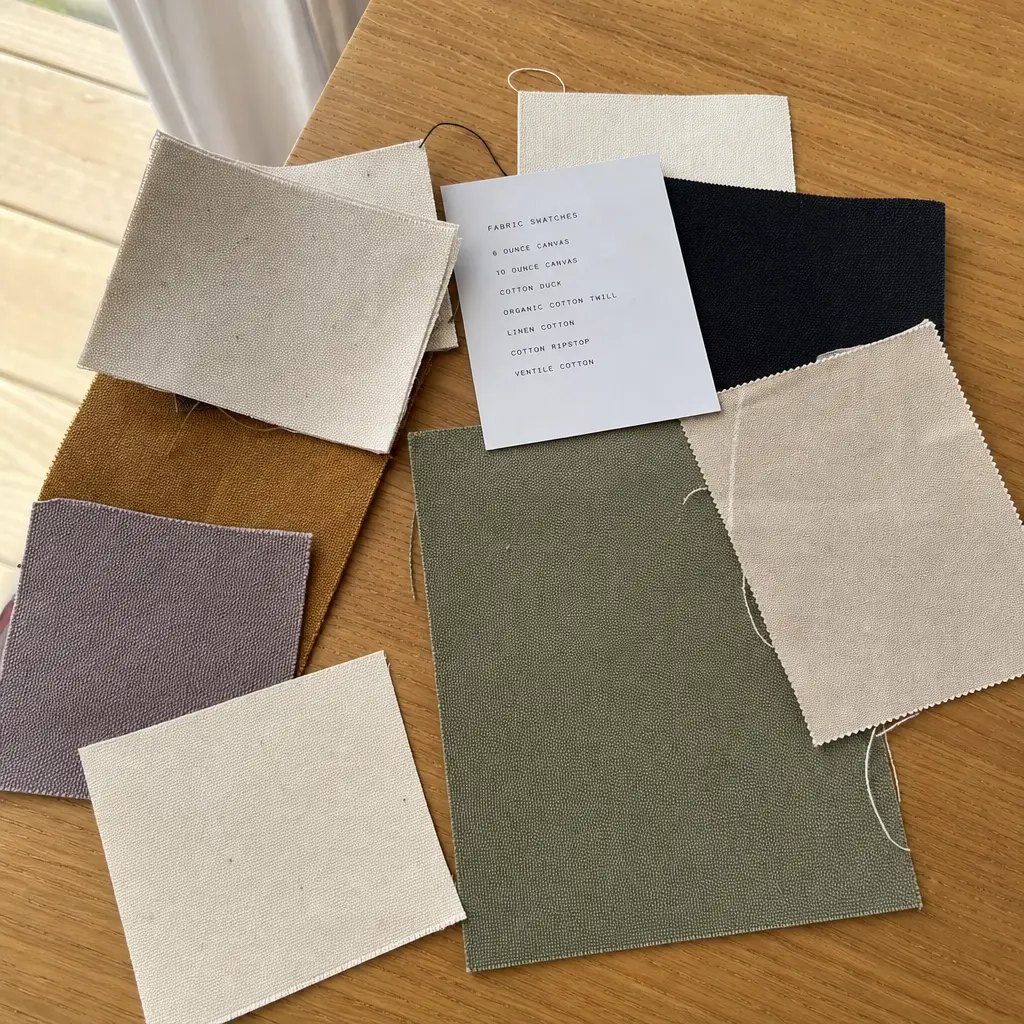
Natural unbleached fabric often shows seed flecks, small slubs, and shade variation. That can fit a wellness brand, but it must be approved at swatch stage. If the brand needs a cleaner ivory, sage, clay, oat, black, or other dyed shade, require lab dip approval and shade tolerance before bulk material is purchased.
- 8 oz cotton, about 271 GSM: suitable for light giveaways, brochures, samples, and low-load campaigns.
- 10 oz cotton, about 339 GSM: balanced option for reusable wellness studio totes with improved opacity and structure.
- 12 oz cotton, about 407 GSM: stronger retail feel for towels, bottles, journals, boxed skincare, and paid merchandise.
- 14 oz and heavier: premium handfeel but higher cost, carton weight, storage volume, and sewing complexity.
- Organic claim level: define certified product, certified fabric, documented organic cotton lot, or no organic claim before quoting.
Lock construction details early
A reference photo helps, but it is not a production specification. The RFQ should state finished width, height, gusset depth, bottom style, seam allowance, stitch type, seam finishing, handle material, handle width, total handle length, finished handle drop, and reinforcement pattern. If the tote will carry wellness products, an 8-12 cm gusset or boxed bottom often performs better than a flat tote because bottles, apparel, candles, and boxes sit more evenly.
Handle construction deserves extra attention. Shoulder handles are popular because customers can carry the bag over outerwear or while holding a yoga mat. Still, weak self-fabric handles can stretch, twist, or tear if the attachment is poor. Cotton webbing handles usually give more consistent strength and appearance. Self-fabric handles can look more integrated, but they need proper folding, stitching, and anchoring.
Avoid vague instructions such as “strong handles.” Give the expected filled weight and the typical contents. If the tote may carry two bottles, a towel, and a journal, the supplier can recommend heavier canvas, wider webbing, stronger reinforcement, and a deeper gusset. Ask whether the pre-production sample can undergo a static load or pull check based on that intended load.
Inner seam finishing also changes perceived quality. Basic lockstitch construction may be acceptable for simple totes, but raw edges can fray and look unfinished. Overlocked seams are neater. Bound inner seams look cleaner but add cost and labor. For a wellness brand selling a calm, premium experience, loose threads and rough interiors can hurt the product impression even if the bag technically functions.
- Give finished dimensions as width x height x gusset with a drawing or measurement method for flat and filled bags.
- Specify handle total length, finished drop, handle width, material, and tolerance instead of relying on a photo.
- Require reinforcement for totes carrying bottles, books, towels, apparel, candles, or kit contents.
- Choose inner seam finishing: standard, overlocked, or bound, depending on retail quality target and budget.
- Ask the supplier to confirm intended load, reinforcement method, stitch density target, and sample load-check method.
Match printing to artwork risk
Most custom organic cotton totes for wellness studios use screen printing because it works well for clean logos, simple icons, and one to three solid colors. Water-based screen print can give a softer handfeel than heavier ink systems and often suits natural cotton branding. The RFQ should include vector artwork, Pantone or approved color references, print dimensions, print location, number of sides, number of colors, and whether screens, setup, strike-off, curing, and underbase are included.
Do not choose the print method from the logo file name alone. Wellness brands often use fine-line botanical marks, small serif type, watercolor textures, or low-contrast tonal designs. These can be difficult on textured canvas. Digital or pigment printing may handle more colors or gradients, but it can change handfeel, edge sharpness, color brightness, durability, and unit cost. Embroidery can look premium for small logos, yet it may pucker lighter canvas and is rarely the right choice for large artwork.
Large ink areas need testing. A solid block on natural cotton can feel stiff, show uneven coverage on textured yarns, or crack if curing is poor. White or pale ink on dyed fabric may need an underbase or extra pass for opacity. Dark canvas can reduce brightness. Ask the supplier to state the ink system, curing method, opacity expectation, and any artwork limitations before production.
Measure print placement instead of approving it by eye. Define distance from the top edge, side seam, bottom seam, and centerline. If the tote has a gusset, clarify whether the print is centered on the front panel only and whether printing happens before or after sewing. For studio groups with multiple locations, treat each logo version as a separate print setup so charges and changeovers are clear.
- Use water-based screen print for solid logos, simple icons, typography, and soft-hand branding on natural cotton.
- Test pigment or digital print for gradients, full-color art, tonal designs, and complex botanical graphics before approval.
- Avoid heavy oversized ink blocks if the brand wants a natural fabric texture and flexible handfeel.
- Set print placement tolerance, such as ±3-5 mm where achievable, and confirm the factory’s normal control range.
- List every artwork version, print side, ink color, language version, and studio-location logo as a quote variable.
Make MOQ and SKU logic visible
MOQ is rarely one simple number. It changes with fabric availability, dye lot minimums, cutting efficiency, screen setup, label production, packing labor, and shipment sorting. A natural tote with one logo may have a different MOQ from a dyed sage tote with woven label, hangtag, barcode sticker, individual wrap, and three destinations.
Wellness studio groups often want one shared tote shape with several local studio logos or seasonal messages. From the buyer side, that may feel like one 2,000-piece order. From the factory side, eight designs of 250 pieces behave like eight smaller runs because printing, sorting, inspection, and packing must stay separate. Show both total quantity and SKU breakdown in the RFQ.
Separate first order quantity from annual forecast. If quarterly reorders are likely, the supplier may suggest stock fabric, reserved greige fabric, retained screens, or saved label specifications. If the order is a one-time retreat, the factory may price it differently. Forecasts help planning, but mark them as planning-only unless they are tied to a confirmed commitment.
Ask for practical price breaks. A single price at an unusual quantity gives procurement little room to decide. Request tiers such as 500, 1,000, 2,500, and 5,000 pieces per specification, or use tiers that match the rollout plan. Then compare whether the lower unit price is worth the extra inventory, storage, and cash-flow impact.
- Separate first purchase order quantity from annual forecast and state whether the forecast is binding or planning-only.
- Count SKUs by size, fabric color, print design, print side, label, hangtag, packing method, and destination.
- Ask whether screens, approved samples, labels, or packing materials can be retained for reorders and for how long.
- Request price breaks at practical levels such as 500, 1,000, 2,500, and 5,000 pieces per specification.
- Confirm whether MOQ changes for dyed fabric, custom woven labels, hangtags, barcode stickers, and split shipments.
Compare full landed-cost drivers
The lowest unit price is not always the lowest landed cost. A quote may exclude screen charges, artwork setup, strike-off fees, sample fees, lab dips, organic documentation, custom labels, hangtags, barcode stickers, inner packing, carton upgrades, inspection support, local charges, and domestic delivery. Require the same quote lines from every supplier so the comparison is fair.
Fabric weight, construction, printing, labels, and packing drive most cost differences. Heavier canvas raises fabric consumption and carton weight. A gusseted bottom adds cutting and sewing time. Two-side printing needs more screens and handling. Individual packing improves cleanliness and allocation, but adds material and labor. When these drivers are visible, buyers can make deliberate tradeoffs instead of accidentally accepting weaker stitching or thinner fabric.
Incoterms and logistics data belong in the quote sheet. EXW can look cheaper than FOB, but the buyer must add local pickup, export handling, and coordination. FOB still may exclude ocean freight, destination charges, duties, and local delivery. Ask for carton dimensions, pieces per carton, gross weight, net weight, and estimated CBM per 1,000 pieces, especially for 12 oz or heavier canvas.
Quote validity also matters. Cotton costs, exchange rates, packaging, and freight can move. Ask how long the price is valid and which assumptions could change before deposit. Identify one-time charges that should not repeat if the artwork, screens, construction, labels, and packing stay the same.
- Quote unit price separately from samples, lab dips, strike-offs, screens, labels, hangtags, barcodes, packing, cartons, and documentation.
- Request Incoterm, loading port, payment terms, quote validity, lead time, and shipment-ready date in the same sheet.
- Compare carton CBM, gross weight, pieces per carton, and estimated loading quantity for landed-cost analysis.
- Identify one-time charges that should not repeat on exact reorders.
- Ask suppliers to list exclusions, including taxes, duties, destination charges, inspection fees, and third-party compliance testing.
Use samples as production controls
Sampling should confirm the real production inputs, not just give the buyer something to photograph. A fabric swatch confirms weight, color, weave, texture, and natural cotton character. A lab dip confirms dyed shade before bulk dyeing. A print strike-off confirms ink color, opacity, edge sharpness, curing, and handfeel on the actual fabric. A full pre-production sample confirms size, gusset, handle drop, seam finish, labels, folding, barcode, inner packing, and carton presentation if needed.
Avoid approving bulk production from a digital photo alone when quality matters. Photos can hide fabric thickness, handfeel, print texture, odor, stiffness, shade variation, and small stains. This is especially important for organic cotton totes because natural shade and ink absorption can differ from a clean digital mockup.
The approved sample should become a control reference. Keep one signed sample with the buyer and one sealed sample at the factory. Approval notes should be direct: approved as submitted, approved with listed changes, or rejected with required corrections. If inspection later finds thinner fabric, crooked printing, weak handle stitching, incorrect folding, or wrong label placement, the inspector can compare bulk goods against the sealed reference.
State who pays for sample revisions and what resets the schedule. If the buyer changes artwork, size, fabric color, or label placement after the first sample, added cost and time may be reasonable. If the supplier made the sample incorrectly against the written RFQ, correction responsibility should be handled differently.
- Approve fabric swatch and lab dip before bulk material purchase when shade, GSM, and texture matter.
- Approve print strike-off before full sampling when logo color, opacity, line sharpness, and handfeel are brand-critical.
- Approve full pre-production sample before bulk cutting, printing, or sewing starts.
- Record approval comments in writing, including tolerance decisions and whether a revised sample is required.
- Keep one buyer-approved sample and one sealed factory sample for inspection and reorder matching.
Set QC thresholds before production
Quality control is easier when defect definitions are agreed before production, not argued during final inspection. Common tote defects include stains, oil marks, dirty fold lines, weaving holes, heavy slubs, print pinholes, weak opacity, crooked logos, loose threads, skipped stitches, open seams, poor handle reinforcement, wrong labels, barcode errors, incorrect carton counts, and mixed SKUs.
Some seed flecks and minor slubs may be normal for natural cotton, but stains, holes, odor, and production marks should not be excused as organic character. Put acceptable natural fabric features in writing, with swatch references if possible. Then classify unacceptable issues as critical, major, or minor.
A practical inspection plan for branded wellness totes can use AQL 2.5 for major defects and 4.0 for minor defects as a starting point, with the sampling standard and defect list written into the purchase order. Critical defects should include safety issues, mold, contamination, severe odor, and completely wrong branding. Major defects should cover issues that affect retail appearance, carrying function, brand compliance, barcode readability, or order fulfillment.
Functional checks should be simple and measurable. Inspectors should check width, height, gusset, handle total length, handle drop, print placement, and label placement against the approved tolerances. If the tote is expected to carry heavy contents, include a defined static load or pull check on sampled units. Packing checks should confirm carton quantity, SKU mix, carton marks, barcode scanability, and packing-list alignment.
- Classify wrong logo, severe stains, open seams, weak handles, unreadable barcodes, wrong labels, and incorrect organic claim wording as major defects.
- Define acceptable seed flecks, minor slubs, and slight natural shade variation before inspection.
- Set tolerances for body size, gusset, handle drop, print placement, label placement, and folding size.
- Require random carton checks for quantity, SKU mix, inner packing, carton marks, barcode scanability, and packing-list alignment.
- Use the approved sample, purchase order, artwork, packaging instruction, and defect list as the inspection reference set.
Plan packing around receiving work
Packing is not just an export detail. It affects creasing, cleanliness, barcode accuracy, receiving speed, storage, and retail presentation. Wellness studios may distribute totes to many locations, pack them into welcome kits, sell them at reception, include them in ecommerce bundles, or store them for a seasonal launch. Each path needs a different balance of protection, sustainability preference, cost, and labor efficiency.
Individual packing protects against moisture, dust, and handling marks while making allocation easier. Some wellness brands prefer to avoid conventional plastic, so the RFQ can request recycled-content polybags, paper bands, glassine-style wraps, kraft sleeves, or bulk packing. Each option has tradeoffs. Paper-based or low-plastic options may change moisture protection, folding consistency, carton size, unit cost, and scuff risk.
Carton data should be part of the quote, not a surprise after production. Ask for pieces per carton, carton dimensions, gross weight, net weight, carton ply strength, carton mark format, and whether cartons are single-SKU or mixed. Heavy canvas totes can make cartons difficult to lift when packed too densely, so set a practical maximum gross weight for warehouse handling.
Test retail and distributor requirements on packed samples. If the tote needs a barcode sticker, scan it after folding and packing. If the studio team needs to identify color or logo without opening every carton, define label placement and carton sorting. If cartons ship to several studios, require destination, PO number, SKU, quantity, gross weight, net weight, and carton sequence on the marks.
- Use individual packing for retail allocation, ecommerce bundles, clean welcome kits, distributor receiving, and multi-location shipments.
- Use bulk packing only when the receiving team can tolerate creasing, sorting labor, and higher exposure to handling marks.
- Set a practical maximum carton gross weight, especially for 12 oz or heavier organic cotton canvas.
- Require carton marks with PO number, SKU, color, print design, quantity, gross weight, net weight, destination, and carton count.
- Check barcode placement, folding method, carton quantity, and packing appearance during pre-production or packing approval.
Build lead time with approval buffers
The real production clock starts only after artwork, material, sample, documentation, and deposit approvals are complete. A supplier may quote bulk lead time, but that timing may exclude delayed logo files, Pantone confirmation, lab dip revisions, strike-off corrections, organic cotton document review, fabric dyeing, holiday congestion, final inspection scheduling, and shipment booking.
Wellness launches often connect to studio openings, retreats, membership campaigns, seasonal retail drops, or corporate wellness programs. Late totes can create operational problems beyond product cost. Ask for a milestone schedule instead of relying on one final ship date. Useful milestones include RFQ confirmation, artwork receipt, fabric availability, swatch or lab dip approval, print strike-off, pre-production sample, bulk material purchase, cutting, printing, sewing, packing, final inspection, and cargo handover.
Add buffer for dyed organic fabric, custom labels, hangtags, barcode stickers, multiple artwork versions, retail packing, split shipments, and certification paperwork. Every added component creates another approval path. Four studio logos and two fabric colors require more checking, segregation, and inspection detail than one natural tote with one logo.
Reorders can be faster only when the specification stays stable and materials are available. Ask whether screens, labels, fabric references, packing instructions, and sealed samples can be reused. Also ask how long the factory keeps records. Repeat production is efficient only when the first order was documented well.
- Treat sample approval, final artwork approval, documentation confirmation, and deposit receipt as the true start of bulk production.
- Add time for vector artwork cleanup, Pantone matching, lab dips, print strike-offs, and sample courier transit.
- Add buffer for dyed fabric, custom woven labels, hangtags, barcode stickers, retail packing, and split shipments.
- Avoid fixed promotional dates until final inspection, packing completion, and shipment booking are confirmed.
- Request a milestone schedule with responsible parties, approval deadlines, and risk points.
Specification comparison for buyers
| Spec decision | Recommended option | When it fits | Buyer risk to check |
|---|---|---|---|
| Fabric weight | State both oz/yd² and GSM with tolerance. If measured as oz/yd², 8 oz is about 271 GSM, 10 oz about 339 GSM, and 12 oz about 407 GSM. | Retail wellness totes, welcome kits, yoga studio merchandise, spa retail bags, and reusable boutique shopping bags where handfeel, opacity, and freight weight all matter. | Do not compare quotes that only say “10 oz cotton.” Confirm GSM, test basis, weave, finish, shrinkage expectation, and whether the fabric is certified organic, documented organic cotton, or conventional natural cotton. |
| Bag construction | Use a flat tote for light giveaways; choose an 8-12 cm gusset or boxed bottom for kits. Require reinforced handle attachment with box-X, bartack, or another approved stitch pattern. | Bottles, folded apparel, towels, journals, skincare boxes, candles, supplements, and starter packs that need better load distribution and shelf presence. | A low price may hide narrow seam allowance, weak handle anchoring, or unfinished inner seams. Require seam type, stitch density target, reinforcement method, and intended load check. |
| Handle length | Specify 60-65 cm total handle length or 25-30 cm finished drop for shoulder carry. Use shorter hand-carry handles only when the channel requires them. | Studio retail customers, retreat attendees, and wellness members who may carry the tote over a coat or alongside a yoga mat. | Factories may measure handles differently. Ask for both total handle length and finished drop after sewing, plus tolerance and a simple measuring diagram. |
| Print method | Use water-based screen print for 1-3 solid brand colors, approved by strike-off on actual bulk fabric. | Most wellness logos, typography, simple icons, and natural cotton brand presentations where a softer handfeel is important. | Fine-line botanical art, gradients, large ink blocks, dark dyed fabric, or white ink may need extra screens, underbase, opacity checks, or a different print method. |
| Organic claim evidence | Define whether the order needs GOTS/OCS-certified goods, documented organic cotton fabric, or natural unbleached cotton with no organic claim. Request scope certificate and transaction certificate where applicable. | Retail tags, ecommerce listings, membership kits, branded packaging, and wholesale documents that mention organic cotton. | A supplier’s verbal “organic” statement is not enough for a public claim. Align document type, certificate holder, chain-of-custody need, and claim wording before deposit. |
| MOQ structure | Quote MOQ by fabric color, size, artwork, print position, label, packing method, and shipment split. Typical custom tote MOQs often start around 500-1,000 pieces per SKU depending on materials. | Studio chains, spa groups, wellness retailers, distributors, retreat operators, and corporate wellness campaigns testing seasonal products. | Low MOQ may mean stock fabric only, limited colors, higher unit price, no reserved repeat fabric, simplified packing, or no special certification paperwork. |
| Packing method | Use folded bulk pack for internal kit assembly; individual recycled polybag, paper band, or agreed wrap for retail allocation. Require export carton marks. | Retail sale, ecommerce bundles, warehouse pick-and-pack, opening kits, distributor stock, and multi-location replenishment. | Loose bulk packing lowers unit cost but can increase creasing, dirt exposure, count errors, SKU mixing, barcode problems, and receiving labor. |
| Inspection level | Use AQL sampling with AQL 2.5 major / 4.0 minor as a common starting point, plus a written defect list for fabric, sewing, print, labels, barcodes, and packing. | Branded retail distribution where weak handles, stains, wrong labels, or crooked logos can cause returns, chargebacks, or launch delays. | AQL alone is not enough. Define critical, major, and minor defects, measurement tolerances, approved sample references, and carton acceptance rules. |
Buyer checklist before sampling
- State finished tote size as width x height x gusset, with seam style, bottom construction, fabric weight in oz/yd² and GSM, and finished measurement tolerance.
- Define the organic claim level: certified finished product, certified organic-content fabric, documented organic cotton lot, or natural unbleached cotton with no organic claim.
- List intended contents and estimated filled weight so the supplier can quote suitable canvas weight, handle width, reinforcement, gusset depth, and carton packing.
- Send vector artwork with Pantone references, print size, print position measured from edges, number of colors, print side, acceptable opacity, and handfeel requirement.
- Request separate quote lines for unit price, sample fee, screen charge, strike-off fee, label or hangtag charge, packing material, carton upgrade, documentation, inspection support, and freight term.
- Ask for fabric swatch, lab dip if dyed, print strike-off, blank construction sample if needed, and full pre-production sample before bulk cutting.
- Confirm MOQ and price breaks by size, fabric color, artwork version, print position, label type, inner packing style, and shipment destination.
- Require carton dimensions, gross weight, net weight, pieces per carton, carton marks, palletization if needed, and estimated CBM per 1,000 pieces.
- Set QC limits for stains, holes, GSM variance, shade variation, loose threads, skipped stitches, open seams, print pinholes, print placement, handle strength, barcode scanability, and carton count.
- Define acceptable natural cotton characteristics, such as seed flecks and minor slubs, separately from unacceptable defects such as oil marks, mold spots, weaving holes, odor, and dirty fold lines.
Factory quote questions to send
- What exact fabric are you quoting, including cotton status, certification option, oz/yd², GSM, GSM tolerance, weave, yarn count if available, finish, shrinkage expectation, and color treatment?
- Is the quoted fabric natural greige, scoured and unbleached, bleached, piece-dyed, yarn-dyed, washed, or pre-shrunk, and will the bulk fabric match the approved swatch?
- What proof can you provide for the organic claim: scope certificate, transaction certificate, fabric mill declaration, lot document, or other agreed evidence, and when will it be available?
- What is the finished size tolerance for width, height, gusset, handle total length, handle drop, print placement, and label placement, and how will each dimension be measured?
- Which handle material, width, and reinforcement are included, and can you perform a sample static load or pull check based on our intended filled weight?
- Which print method is included, how many colors and screens are priced, and are underbase, extra passes, curing, strike-off, and wash or rub checks included?
- Can you provide a bulk-fabric swatch, lab dip for dyed fabric, print strike-off on actual fabric, blank construction sample, and complete pre-production sample before cutting bulk?
- What is the MOQ and price break by fabric color, bag size, print design, print position, label, hangtag, packing method, and final shipment destination?
- What timeline applies to swatch, lab dip, strike-off, blank sample, pre-production sample, bulk fabric purchase, printing, sewing, packing, inspection, and cargo handover?
- What Incoterm, loading port, quote validity, payment terms, carton quantity, carton dimensions, gross weight, net weight, and estimated CBM per 1,000 pieces are included in the offer?
Quality-control points to confirm
- Fabric weight should match the approved swatch and purchase order within the agreed tolerance, commonly written as a percentage tolerance such as ±5% unless the supplier proposes another controlled range.
- Finished size should stay within the approved tolerance, often ±0.5 cm to ±1.0 cm for body dimensions and handle drop depending on bag size, fabric weight, washing status, and construction.
- Gusset depth, bottom boxing, seam allowance, and panel symmetry should match the approved sample so the tote sits and folds as intended for retail or kit packing.
- Handle attachment should show the approved reinforcement pattern, with no skipped stitches, loose bartacks, open corners, twisted handles, weak anchoring, or tearing after the agreed load check.
- Print placement should be level, centered, and within the approved tolerance, often measured from top edge, side seam, bottom edge, and panel centerline rather than judged by eye only.
- Print color should match the approved strike-off under consistent lighting, with no unacceptable bleeding, smudging, crocking, poor opacity, rough ink buildup, misregistration, or cracking during normal handling.
- Visible stains, oil marks, mold spots, holes, heavy slubs, dirty fold marks, sharp odor, and contamination should be treated as major or critical defects unless specifically approved as natural fabric character.
- Loose threads should be trimmed around handles, side seams, gusset corners, label attachment points, and inner seam ends, with no fraying that affects appearance or durability.
- Labels, hangtags, barcodes, care wording, organic claim wording, SKU codes, PO numbers, carton marks, and packing lists should match the approved artwork and purchase order exactly.
- Cartons should meet the agreed ply strength, quantity per carton, SKU separation, moisture protection, carton mark format, gross weight limit, and no mixed-SKU rule unless mixed cartons are approved in writing.