What this RFQ has to solve
A useful RFQ for custom organic cotton totes does one job well: it removes assumptions before the supplier starts pricing. Farmers market vendors usually need a bag that carries produce, looks retail-ready, and holds up after repeated use. If the RFQ leaves size, cloth weight, print method, packing, or organic proof open to interpretation, the quotes will not compare cleanly, and the low number on page one will usually move once the factory fills in the missing details.
The cleanest way to prevent that problem is to write the RFQ around the finished tote, not around a vague product name. State the intended use, the quantity ladder, the destination, the approval path, and what is specifically not included. If you want the supplier to quote a tote that can sit on a farmers market stall, go home with a customer, and still be worth restocking, you need the same level of precision you would use for any other sellable product line.
Ask the supplier to repeat the spec back in its own words before it prices the order. If the factory restates the job correctly, you know the RFQ is specific enough to build from. If it cannot, the gaps are already visible before money is committed.
- Define the use case first: produce carry, retail resale, CSA add-on, or branded giveaway.
- Separate must-have spec items from optional upgrades so the quote stays readable.
- State whether the tote must be display-ready on arrival or whether you will repack it in-house.
- Ask the supplier to confirm in writing that no substitutions will be made without approval.
Define the tote as a finished product
Farmers market tote can mean several different things in practice. A bag for produce pickup has different load, shape, and handling requirements than a branded tote sold at the stall as a retail item. If the tote needs to carry tomatoes, jars, greens, and repeat weekly purchases, then the opening width, handle drop, gusset depth, and bottom reinforcement matter more than a decorative finish. A tote that is fine as a giveaway can still fail as a regular carry bag.
Start with finished dimensions, not cut dimensions. The buyer should specify finished width, finished height, gusset depth if any, and a tolerance that the factory can hold. Handle length and handle drop must be written as finished measurements too, because that is what determines whether the bag carries comfortably by hand or on the shoulder. If the tote must stand up on a counter or in a market bin, require a boxed bottom, a stable gusset, or another structural detail rather than assuming the factory will choose one.
A practical RFQ should also name the seam allowance and reinforcement method. For a sewn tote, a seam allowance of about 3/8 in or 10 mm is a common starting point, but the important part is that it is written down and held consistently. For stress points, ask for a bar-tack, an X-box, or an equivalent reinforcement at the handle joins so the factory is not guessing at durability.
- Write the finished size as width x height x gusset, then add the tolerance you will accept.
- Specify handle width and handle drop, not just total handle length.
- State whether the bag needs a boxed bottom, side gusset, or both.
- Ask for the seam allowance and reinforcement method in the quote so the construction is not left open.
Choose fabric, weave, and organic proof deliberately
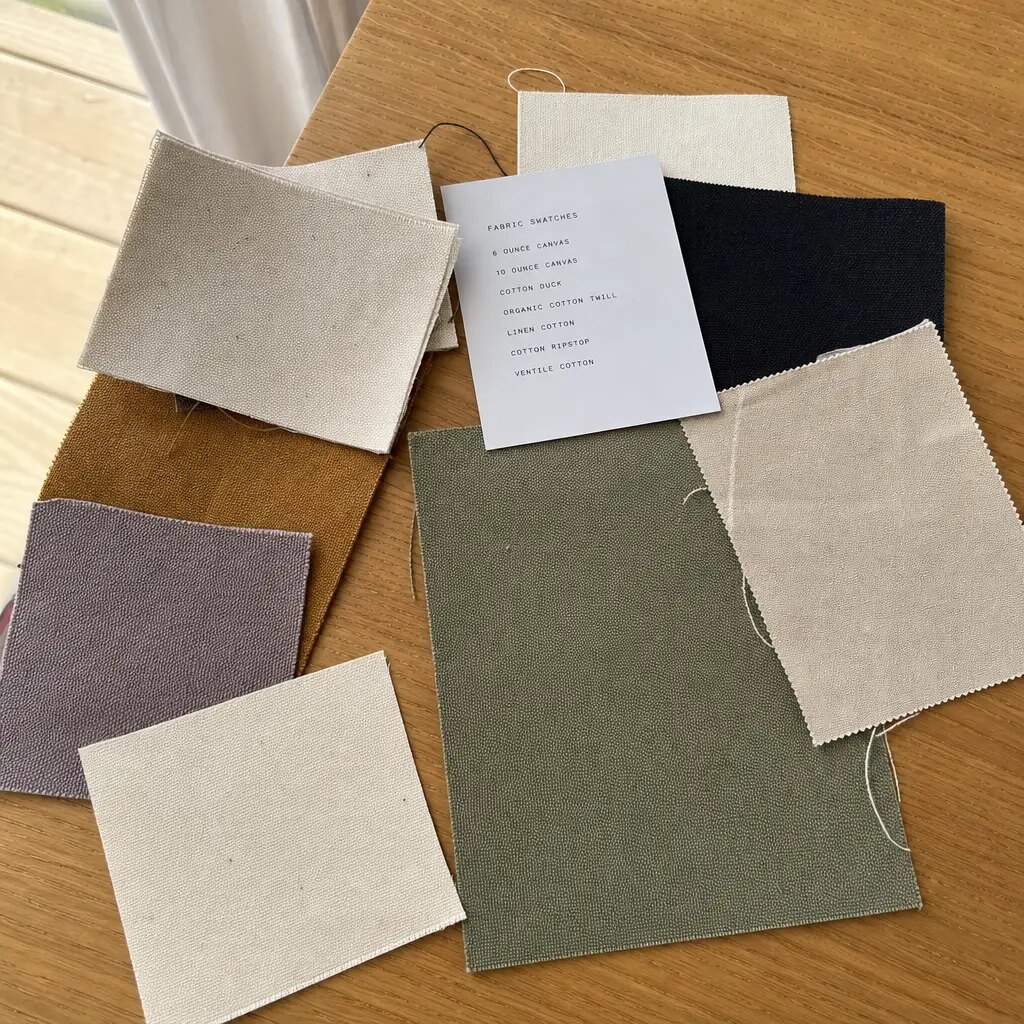
Fabric weight drives nearly every other decision in an organic cotton tote quote. For lighter retail or giveaway use, 160-200 gsm is usually enough to create a soft, foldable tote that keeps freight manageable. For heavier carry, produce, or a more premium retail feel, 220-280 gsm is a safer working range. There is no universal right answer; the right number depends on the load, the selling price, and how much strength the buyer expects from the cloth itself.
Fabric construction matters as much as the GSM. Ask whether the tote body is plain weave, twill, or canvas, and whether the cloth is natural, bleached, or dyed. Each choice affects print behavior, hand feel, and cost. Natural cotton can show the weave more clearly and may feel more earthy on shelf. Bleached or dyed cloth can improve brand presentation, but it can also change ink behavior and add risk if the color consistency is not controlled. If shrinkage matters, ask the supplier to state the expected shrinkage allowance and whether the fabric is prewashed or finished to control it.
If the bag will be sold using an organic claim, ask for the actual documentation that supports that claim. That may include a current scope certificate, a transaction certificate, or other chain-of-custody records depending on the program and market. Do not let the word organic sit loosely in a quote or on a hangtag if the supplier cannot support it. If only the fiber is organic, say that clearly. If the finished item is being marketed as organic, make sure the supplier understands exactly what wording is allowed.
- Specify GSM, weave type, and color state in the RFQ.
- Ask whether the quoted fabric is stock, reserved, or newly sourced for your order.
- Define the shrinkage tolerance if the tote must keep its shape after use or washing.
- Require the supplier to state which documents it can provide if you plan to make an organic claim.
Decoration choices change cost, feel, and failure modes
For custom organic cotton totes, the practical decoration options are usually screen print, a woven label, a sewn patch, or embroidery. Screen print is the most common choice when the logo is simple and the buyer wants the best price-to-clarity ratio. It is especially effective for one or two spot colors. A woven label or patch is better when the buyer wants a quieter premium look, when the artwork is small, or when the brand mark should survive repeated handling without relying on ink on cloth alone.
The RFQ should name the decoration method, the number of colors, the placement, and the exact size of the print or label. A factory saying it can print a logo is not enough. The buyer needs to know whether the method is water-based screen print, another ink system, embroidery, or a sewn-on patch, because each method has different setup cost and different failure points. For example, small text can blur in print, thick embroidery can pucker lighter fabric, and poorly anchored patches can curl at the edges. The method has to match the art, not just the budget.
Always ask for a physical strike-off, sew-out, or sample print before bulk production. This is where placement, size, color density, and cure quality become visible. A tote can look correct in a digital proof and still fail on actual cloth if the ink strikes through, the label twists, or the art sits too close to a seam. If you need small type, state a minimum line width or minimum readable size and ask the supplier to confirm it can hold that detail on the chosen fabric.
- Send vector artwork and a color reference, not a low-resolution image.
- Specify the exact print size and the distance from seams or the top edge.
- Ask for a strike-off or sample print on the actual fabric color you plan to use.
- If the logo uses small text, confirm the minimum readable size in the chosen decoration method.
Quote setup, sample, and MOQ costs separately
MOQ is not usually an arbitrary number. It is shaped by fabric roll usage, print setup, cutting efficiency, label sourcing, and how often the line must stop and reset. That is why a quote can look attractive at 1,000 pieces and become much less competitive at 300. The factory is spreading the same setup cost across fewer bags, so the unit price climbs quickly. Buyers who only look at the headline unit price often miss the real issue: the true comparison is what the order costs at the volume they actually plan to buy.
A clean RFQ separates the pricing elements. The quote should show sample cost, artwork revision cost, screen or plate setup, labels, packing, carton marks, and shipping if it is included. If the first sample uses stock fabric but the bulk order will use a different organic cotton roll, the sample may prove the concept but still not be a valid approval reference. For a serious buying process, request a first sample, then a pre-production sample made with the actual bulk materials, then a sealed golden sample that both sides keep as the production reference.
Ask for at least three quantity tiers so the buying team can see how price changes with scale. A practical set for many tote programs is 100, 300, 500, and 1,000 pcs, but the right ladder depends on your reorder pattern. The best comparison is not just the cheapest piece price. It is the point where the setup cost, sample cost, and freight profile start to make the repeat order efficient.
- Request unit pricing at several quantity tiers, not a single number.
- Separate sample charge from mass-production cost.
- Confirm whether MOQ changes by color, print screen, label style, or packaging version.
- Ask whether the supplier charges again if artwork, placement, or material changes after the first sample.
Write QC thresholds the factory can actually hold
A tote quote is incomplete until it includes acceptance criteria. Buyers should not wait until goods arrive to decide what is acceptable. For custom organic cotton totes, the critical checks are usually finished size, fabric weight, seam quality, print placement, label position, and carton count. A practical QC standard does not need to be complicated, but it does need to be specific enough that a buyer, inspector, and factory would all reject the same defect.
The physical sample is where those limits should be set. Measure the body width, height, and gusset. Check the handle attachment and reinforcement. Verify that the print sits where the drawing says it should. Then test the tote with the kind of load it will actually carry at market. A produce tote should be judged with produce-like weight and shape, not with a generic promotional load that tells you little about real-world performance. A common procurement target is a tolerance of plus or minus 1/4 in, or about 6 mm, on key finished dimensions, with print placement held tighter if the artwork is visually centered. Handle drop often needs a looser or separate tolerance, because it drives usability more than cosmetic symmetry.
If the order is large enough to justify a formal inspection standard, write it into the RFQ. The important part is not the label on the standard; it is the list of defects the buyer will treat as major, minor, or critical. That list should cover measurement drift, stitching defects, contamination, print faults, label misplacement, and pack-out errors. Once that is agreed, final inspection becomes a check against facts instead of a negotiation after shipment.
- Set a size tolerance before production, then measure the sample against it.
- Require clean stitching with no skipped seams or loose thread tails.
- Define what print defects are rejectable: misregistration, strike-through, cracking, or bleeding.
- Treat contamination, odor, oil stains, and visible fabric flaws as explicit reject conditions unless you say otherwise.
Specify packing and labeling in operational terms
Packing is not a clerical detail. It affects freight, warehouse handling, retail readiness, and the condition of the tote when the end customer sees it. Flat-fold bulk packing saves carton volume and usually works best for importers who will repack later. Individual polybags make more sense when the tote is sold directly at retail or needs a cleaner shelf presentation, but they add labor, material, and sometimes compliance questions around plastic use. If the tote is organic cotton, some buyers prefer paper bands or recycled content tags instead of a full plastic presentation.
The RFQ should say exactly how the bag is packed, how many pieces go into each carton, what the carton dimensions can be, and what labels are required. If the buyer needs barcode stickers, country-of-origin labels, fiber content labels, care instructions, or a hangtag, those items should be quoted separately. A supplier that includes labels without naming them creates hidden risk. You want to know which packaging elements are included, which are optional, and which may change the case pack or freight cost.
Warehouse behavior matters too. If the carton is too large, too heavy, or inconsistently folded, receiving teams pay the cost later. As a working target, many buyers try to keep master cartons under about 15 kg or 33 lb unless their warehouse prefers heavier cartons. Ask for a fold method that is consistent across the whole run, and state any moisture protection required for long transit or humid storage. This is especially important if the totes will travel by ocean freight or sit in a warehouse before seasonal release.
- State the preferred carton dimensions and maximum carton weight.
- Specify fold direction if retail presentation matters.
- Name all required labels, tags, and barcode formats.
- Ask whether the supplier will use an inner bag, belly band, or shelf-ready insert.
Build the lead time around approval gates
A realistic tote schedule is a sequence, not one number. It starts with artwork approval, then sample production, then bulk material confirmation, then cut and sew, then decoration, then final inspection, then packing and shipping. If any one of those steps slips, the ship date moves. Buyers often receive one lead time number without seeing the path behind it, which makes the quote look stronger than it is. For a seasonal farmers market program, that is dangerous because the launch window is usually fixed.
Ask the factory to show the latest approval date that still protects the requested ship date. That one question exposes whether the schedule is a working plan or a rough estimate. If the tote needs custom fabric, special labels, or extra documentation for an organic claim, add buffer before the order is released. The factory should also tell you where the bottleneck sits, whether that is fabric availability, print line capacity, sample revision, or final inspection.
Keep production time and transit time separate. A quote that looks fast can still arrive late if it ignores shipping lead time, customs delay, or a port miss. The buyer should ask for both dates: ready date and arrival date. That makes it much easier to compare suppliers on the basis that matters to retail planning. As a rough planning band, a first sample for a simple tote often takes about 5-10 business days, while bulk production after approval can take 20-45 days depending on fabric, decoration, and packing complexity. Those numbers move when the program includes custom fabric or extra compliance steps.
- Clarify whether lead time starts at PO, deposit, artwork approval, or sample sign-off.
- Ask for milestone dates instead of one blanket promise.
- Protect time for artwork correction and pre-production sample approval.
- Treat transit time separately from production time so the quote is not misleading.
Compare supplier routes on landed cost, not headline price
Supplier route matters as much as spec. A domestic decorator can be valuable when the buyer needs a very small run or a fast turn, but unit cost is usually higher and the fabric choices can be narrower. A direct factory is often better for repeat production because sewing, printing, and packing are controlled in one place. A trading company can be useful when the buyer wants one contact for several products, but that only works if the actual factory is disclosed and the quote is broken down cleanly enough to compare.
The comparison should always be landed cost per sellable tote. That means the ex-works or FOB price, freight, duties, customs handling, carton charges, sample amortization, and any realistic rework or scrap allowance. A quote that is a few cents lower on paper can still cost more after freight, packing changes, or defect rates are included. If your team is comparing several suppliers, normalize the quotes to the same incoterm and the same packing spec before anyone starts arguing about who is cheaper.
Procurement also needs to compare risk, not only cost. Who owns the fabric? Who is responsible if the print is wrong? Who signs off the golden sample? Who can replace a failed lot quickly? Those questions decide whether the cheapest quote is actually the cheapest outcome. For farmers market vendors, a missed seasonal launch can cost more than a modest per-unit premium, so schedule and replacement ability belong in the comparison alongside price.
- Compare quotes on the same quantity tier and the same incoterm.
- Add freight, duty, broker cost, and receiving fees before ranking suppliers.
- Include sample and setup costs if the buyer will spread them across the first order.
- Watch for hidden differences in carton count, label inclusion, and packing density.
Use a complete RFQ data pack and ask these questions
A good RFQ is short enough to read and complete enough to price. Send the tote drawing, finished dimensions, fabric GSM, artwork, quantity ladder, packing spec, destination, target ship date, and any organic documentation requirement in one file or one sheet. Do not bury key information in email threads. The supplier should be able to open the RFQ and quote without chasing follow-up messages for the same details.
If you want line-by-line comparison, structure the RFQ the way the factory should structure the quote. Ask for separate lines for sample charge, unit price by tier, print setup, labels, packaging, carton markings, and freight if quoted. That way the buyer can compare the real cost of the bag instead of trying to reverse-engineer what the factory included. This is the fastest way to get honest numbers and reduce re-quoting later.
The final RFQ should also ask the supplier to confirm any assumptions that could change the price. That includes whether fabric is stocked, whether the organic documentation is already available, whether the art needs rework, and whether the packing spec can be met without extra labor. The point of the RFQ is not just to request a price. It is to force the supplier to reveal the actual work behind the price.
- Finished size, handle drop, and gusset spec
- Fabric GSM, weave, and color state
- Artwork file, print method, number of colors, and print position
- Quantity ladder and target purchase volume
- Packing method, case pack, and carton labels
- Incoterm, destination, and required delivery window
- Sample and approval steps
- Quality standard and rejection criteria
- Organic documentation requirement, if applicable
- Assumption check: what is excluded from the quote
Specification comparison for buyers
| Spec decision | Recommended option | When it fits | Buyer risk to check |
|---|---|---|---|
| First order sourcing route | Domestic cut-and-sew or local decorator with in-house printing | Under 500 pcs, fast sample turns, or a launch date that cannot slip | Ask what is included in the quote. Label sourcing, print setup, and freight often appear later if they were not itemized upfront |
| Repeat order sourcing route | Direct factory with a stable tote program and clear production owner | 500+ pcs, seasonal replenishment, or a repeat farmers market program | Verify who controls fabric sourcing, stitching, printing, and final pack-out instead of accepting a generic factory claim |
| Multi-SKU buying route | Trading company with disclosed factory and line-by-line pricing | Several bag styles, pack versions, or destination markets must be coordinated | Hidden markups can make quote comparison unreliable unless the factory and all add-ons are disclosed |
| Fabric weight | 160-200 gsm for lighter retail use, 220-280 gsm for heavier carry | Farmers market totes that must feel substantial and carry produce or repeat weekly purchases | Too-light cloth shows through and distorts; too-heavy cloth increases sewing cost and freight weight |
| Handle spec | Self-fabric or webbing handles with 1.25-1.5 in width and a 10-12 in drop | A tote that should carry comfortably by hand or on the shoulder | Handles that are too short or too narrow create comfort and durability problems |
| Stitch reinforcement | Double-needle construction plus bar-tack or X-box reinforcement at handle stress points | Any tote that will carry produce, jars, or repeated loads | If the factory does not define the reinforcement method, seam failure risk is hard to judge |
| Decoration route | 1-2 color water-based screen print at source factory | Simple logo, repeat production, and a cost-sensitive program | Check opacity, registration, cure, and strike-through so the print does not crack or bleed |
| Decoration alternative | Woven label or sewn patch instead of full print | Quieter premium look, smaller brand mark, or better wash durability | Confirm placement, stitch finish, and edge treatment so the label does not twist or pucker |
| Organic proof | Current scope certificate and transaction documentation, if a certified organic claim is being made | Any bag sold or marketed using organic language on pack, hangtag, or product page | Do not build a claim on a supplier statement alone if the paperwork cannot support it |
Buyer checklist before sampling
- Finished width, finished height, gusset depth, and seam allowance are written in the RFQ.
- Handle length, handle drop, and handle width are stated as finished measurements, not cut length guesses.
- The tote use case is named clearly: produce carry, retail resale, CSA add-on, or branded giveaway.
- Fabric GSM, weave type, color state, and expected shrinkage behavior are confirmed in writing.
- If the bag will be marketed as organic, the supplier is asked for the exact documentation it can provide before quoting.
- Artwork is supplied in vector format with Pantone or equivalent color references.
- Print method, number of colors, print size, and placement are separated from unit price.
- MOQ, price breaks, sample fee, artwork revision fee, and re-sample fee are listed separately.
- A first sample, a pre-production sample, and a golden sample approval rule are defined.
- Packing method, case pack, carton dimensions, and label placement are specified.
Factory quote questions to send
- What finished size, handle length, handle drop, and gusset depth did you use in the quote?
- What fabric GSM, weave, and color state are you pricing, and is that before or after finishing?
- Can you support the organic claim with current documentation for the fabric and the finished bag, if the buyer needs one?
- Which print method are you pricing, how many colors, and what is the setup fee for each screen, plate, or embroidery run?
- What MOQ applies per size, per color, per artwork version, and per label style?
- What are the sample charges for the first sample, the pre-production sample, and any revision sample?
- What tolerances will you hold on size, seam alignment, handle attachment, and print placement?
- What stitch spec do you use for handle reinforcement, and do you use bar-tacks, an X-box, or another reinforcement method?
- What packing method, carton size, and case pack are included in the quote?
- What is the price at each quantity tier, and which incoterm is used for each tier?
Quality-control points to confirm
- Finished size should stay within the agreed tolerance, with the same check applied to body width, height, and gusset depth.
- Handle length and handle drop must match the approved drawing so the bag hangs and carries correctly.
- Fabric weight should match the approved GSM with no obvious thin bands, weak areas, or irregular weave defects outside tolerance.
- Stitching must be even, with reinforced handle joins, no skipped stitches, and no loose thread tails longer than the agreed limit.
- If the order uses screen print, placement should stay within the approved window, with no major registration error, bleeding, cracking, or visible strike-through.
- If the order uses a woven label or patch, it should sit flat, centered, and secure, with no twisting, puckering, or exposed raw edges.
- Carton count, fold method, barcode placement, and carton marks must match the packing instruction and packing list.
- Moisture, oil stains, dye marks, and other contamination should be treated as rejectable defects unless the buyer says otherwise.
- Load testing should reflect the actual use case, such as produce, jars, or weekly market goods, not a generic promo bag test.
- If you use AQL, state it in the RFQ. A common structure is AQL 2.5 for major defects and 4.0 for minor defects, but align it with your internal standard.