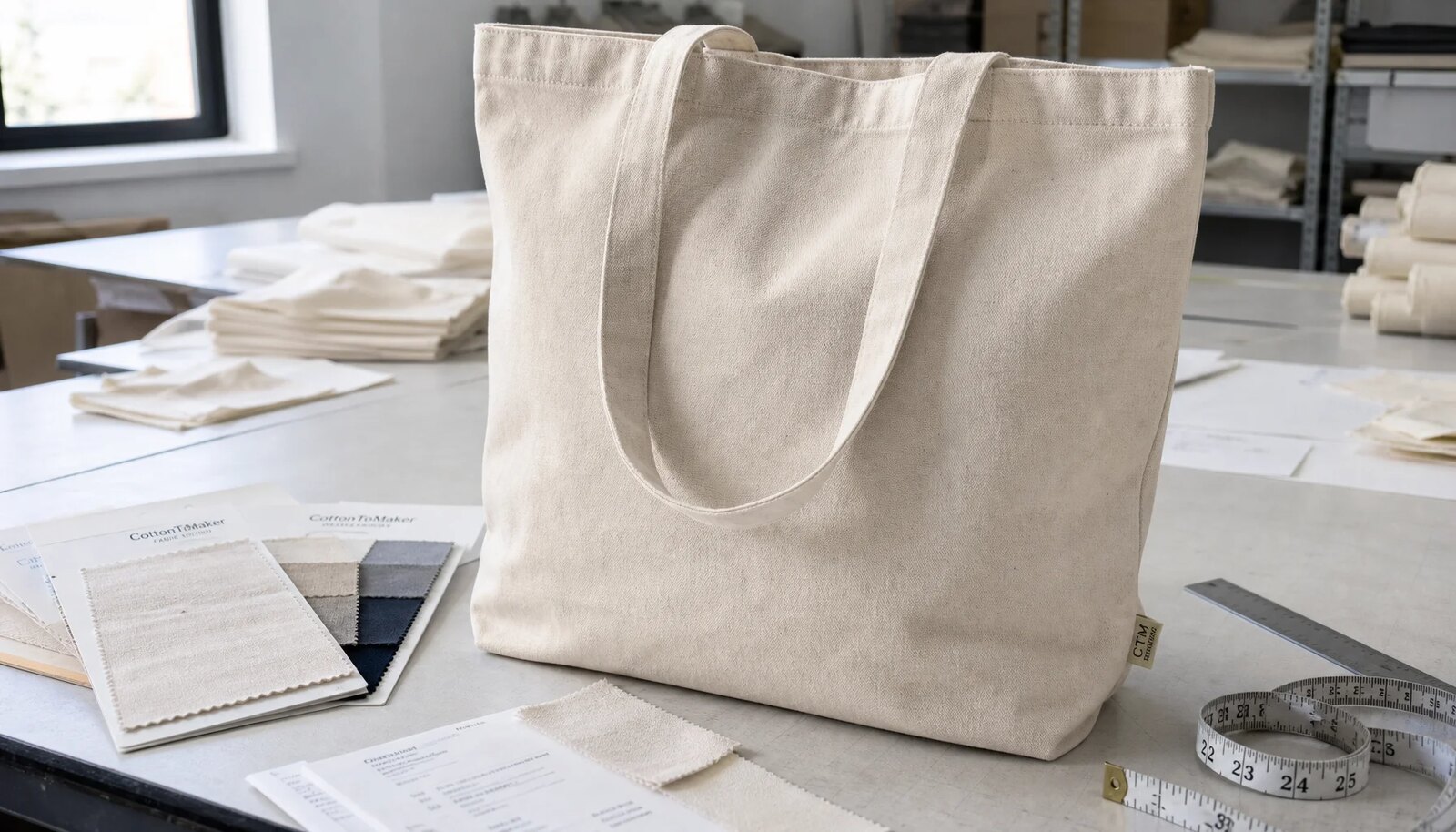
Start With the Event Reality
A useful custom organic cotton totes RFQ template guide for event planners does more than ask suppliers for a bag price. It makes every supplier quote the same physical item, the same documentation standard, and the same delivery obligation. Without that structure, small gaps hide in plain sight: 150 GSM fabric instead of 220 GSM, shorter handles, no handle reinforcement, a smaller print area, excluded screen fees, vague organic cotton evidence, or a delivery term that stops long before the venue warehouse.
The tote has to work inside an event operation. It may need to hold badges, notebooks, bottles, catalogs, apparel, sponsor cards, or a full registration kit. It also has to arrive before a fixed date, move through receiving, match approved sponsor artwork, and support whatever sustainability language your team has already cleared. Those are not afterthoughts. They belong in the RFQ from the first draft.
Treat the RFQ as a control document, not a formality. It should capture finished dimensions, fabric construction, organic cotton documentation, print method, artwork files, sample approvals, QC tolerances, packing rules, carton marks, delivery term, and required arrival date. Good suppliers can still suggest improvements, but they should do so against a shared baseline.
- Define the tote with measurable specs, not style names such as canvas giveaway bag.
- Ask suppliers to list assumptions, exclusions, and optional fees in writing.
- Separate product cost from print setup, packing, freight, duty, delivery, and inspection charges.
- Set the required warehouse arrival date separately from the event opening date.
- Make the approved sample, QC standard, and packing plan part of the purchase order.
Define the Bag Before Price
Tote construction has a direct effect on cost, hand feel, durability, carton weight, and event usefulness. A light 140-160 GSM plain-weave cotton tote may be fine for flyers, badges, and low-load handouts. For reusable conference totes carrying notebooks, chargers, bottles, catalogs, or sponsor kits, 180-220 GSM is often a more practical starting range. A 240 GSM or heavier canvas feels more substantial, but it also raises material cost, sewing difficulty, packed weight, and freight cost.
Do not rely on a photo or a generic product name. Specify finished width, height, gusset depth, handle width, and handle drop. Then define where each measurement is taken. Width may be measured across the top opening. Height may be measured from the top edge to the bottom fold. Gusset depth may be measured at the side panel. Handle drop should be measured from the bag top edge to the inside top of the handle. These details sound small until two suppliers submit prices for bags that are not actually comparable.
The contents matter too. If the tote must hold a boxed item, a folded hoodie, a catalog, a lunch kit, or a registration bundle, say so. Share approximate dimensions and weight where possible. A common event tote might sit around 38 x 42 cm with an 8-12 cm gusset, but the right size depends on what the attendee will carry and how long they are expected to use it.
- Suggested light-use range: 140-160 GSM for flat handouts and low load weight.
- Suggested reusable event range: 180-220 GSM for conference kits and sponsor materials.
- Suggested premium range: 240 GSM and above when structure and hand feel matter.
- Typical cut-and-sew dimensional tolerance: often around +/-1 cm, with supplier confirmation required.
- Handle drop should be specified for hand carry, shoulder carry, or both.
Lock the Construction Details
Sewing details are easy to weaken when a supplier is chasing a lower unit price. That is why the RFQ should ask for seam type, seam allowance, stitch density target, bottom corner finish, handle width, handle drop, and reinforcement method. Bar-tacks and X-box stitching are both common at handle joins, but they are not the same detail. State which one you expect, where it should sit, and whether the reinforcement must appear on all handle attachment points.
Ask whether the tote is side-seamed, bottom-folded, gusseted, or panel-constructed. A flat tote, a bottom-gusset tote, and a side-gusset tote behave differently when packed and carried. If the tote needs an internal pocket, zipper, snap, contrast trim, woven label, care label, hangtag, or barcode, treat each one as a separate line item. That keeps the quote clean and prevents a supplier from assuming a simpler build.
Also ask suppliers to confirm what happens at lower quantity tiers. Some factories will quote the same specification across 500, 1,000, 2,500, and 5,000 units. Others may quietly shift fabric, reinforcement, or packing assumptions to hit a price point. The RFQ should make that impossible to miss. If the unit price changes because the construction changes, the supplier should say so plainly.
- Require handle width, handle drop, reinforcement method, and reinforcement placement.
- Ask for seam allowance and stitch density target where construction consistency matters.
- List pockets, snaps, zippers, labels, trims, and hangtags as separate quote components.
- Require the same fabric weight and stitch standard across all quoted tiers unless clearly marked otherwise.
- Ask suppliers to identify any outsourced steps, especially printing, dyeing, label sewing, and packing.
Clarify Organic Cotton Evidence
Organic cotton is not a checkbox. Some buyers need it as a material preference. Others need documents that support procurement policy, sponsor commitments, product labeling, or public-facing sustainability copy. Your RFQ should state the required level of evidence and ask who issues the document, what lot or order it covers, and when it will be available.
Be careful with claim wording. A supplier declaration may be enough for an internal giveaway where the tote is not carrying a formal claim. A tote printed with organic cotton language, a hangtag, or an event website statement may require stronger chain-of-custody documentation, depending on your organization, claim language, and market. Ask whether the document covers the fabric only, the finished bag, or the full chain through cutting, sewing, printing, and packing.
Separate material claims from chemical and restricted-substance requirements. Natural organic cotton, dyed organic cotton, washed canvas, printed logos, labels, and packaging can involve different materials and partners. If your procurement policy covers dyes, inks, finishes, labels, or packaging, include those requirements as their own RFQ fields. One organic cotton document does not automatically answer every compliance question.
- State whether organic cotton documentation is mandatory or preferred.
- Ask whether documents cover fabric, finished tote, or only a supplier purchase lot.
- Confirm delivery timing for certificates, transaction documents, declarations, or traceability records.
- Review claim wording before printing labels, hangtags, or event copy.
- Include ink, dyeing, finishing, label, and packaging compliance when your policy requires it.
Build a Quote Sheet Buyers Can Compare
A serious B2B quote needs cost lines, not just a unit price. One supplier may include screens, carton labels, export cartons, and export paperwork. Another may quote only ex-factory production. Ask each supplier to show the unit price, sample cost, setup fees, print charges, label or insert costs, packing labor, carton labeling, palletizing, inland freight, export charges, freight estimate, duty if applicable, customs clearance, and final delivery cost.
Request price breaks that match your event forecast. Useful tiers often include 500, 1,000, 2,500, and 5,000 units, but the right tiers depend on registration volume and sponsor commitments. Then ask whether MOQ applies by artwork version, bag color, label version, size, or packing version. A 3,000-unit order split across six sponsor versions may not behave like one 3,000-unit print run.
Delivery terms must be named and understood. EXW usually leaves pickup from the factory to the buyer. FOB should name the port and clarify export documents. CIF includes freight and insurance to the named port but does not necessarily include destination customs or final delivery. DAP and DDP can be useful for event teams, but only when duties, brokerage, delivery appointments, palletization, and accessorial charges are addressed. Comparing EXW to DDP as if both are delivered costs creates a distorted award decision.
- Ask for unit price and every non-unit charge in separate lines.
- Require MOQ by artwork version, bag color, label version, size, and packing version.
- Ask for estimated carton dimensions and weights at quote stage.
- Require final carton data before freight booking.
- State the named place for every Incoterm or delivery term.
- Include inspection, warehousing, relabeling, and rework risk in final award analysis.
Specify Artwork Without Guesswork
Artwork is where many event tote programs become messy. Sponsor logos arrive late. Lockups change. Small text gets approved on a screen and then fills in on textured cotton. The RFQ should require vector artwork, outlined fonts, exact print dimensions, placement from measurable bag edges, number of colors, Pantone or physical color references, and minimum line thickness. If the print is near a seam, gusset, or handle join, ask the factory to confirm that the position is printable before screens or digital setup begins.
Choose the print method according to artwork, fabric, volume, and deadline. Screen printing is often efficient for flat logos, sponsor marks, and medium-to-large event runs. Water-based ink is frequently requested for a softer hand feel, while other ink systems may be chosen for opacity, color, compliance, or factory capability. Digital printing can help with gradients or complex artwork, but natural fabric shade and cotton texture can affect color and detail. Embroidery can look premium for small marks, though it may pull on lighter fabrics. Heat transfer can suit urgent jobs, but edge feel and durability should be checked on the actual fabric.
Do not allow a print method change after sample approval without written re-approval. The approved strike-off or printed pre-production sample should set expectations for color, opacity, placement, hand feel, registration, and edge quality. A Pantone code helps, but it is not magic on natural cotton. Ink absorption, fabric shade, and texture all influence the final result.
- Send AI, EPS, or vector PDF files with fonts outlined.
- State print width, height, and placement from top edge and side seam.
- Identify minimum text size and minimum line thickness for sponsor logos.
- Request strike-offs for color-critical, fine-line, or multi-color prints.
- Confirm setup charges for each screen, color, plate, or artwork version.
- Freeze sponsor lockups before print tooling begins.
Use Samples as Decision Gates
A digital mockup proves layout intent. It does not prove the tote. A fabric swatch helps with hand feel, but it does not confirm stitching, print placement, or handle strength. A print strike-off shows ink behavior, but not packing or construction. For event programs with brand, sponsor, or schedule risk, the pre-production sample should come as close to bulk as possible: same fabric specification, same handle construction, same print method, same label position, same folding method, and preferably the same packing approach.
Write the sample path into the RFQ. A practical sequence may include a digital mockup for layout, a fabric swatch for material approval, a strike-off for print color, and a physical pre-production sample for final approval. If the supplier cannot provide an exact sample before order placement, require a list of differences. Maybe the sample uses available natural fabric while bulk will use reserved fabric. Maybe the print is on a flat panel instead of a finished tote. Those differences are manageable when visible.
Review samples against written tolerances. Measure width, height, gusset depth, handle width, handle drop, print placement, and label position. Load the sample with realistic event contents and inspect the handle joins, bottom corners, side seams, comfort, and shape. Keep approval records simple and dated: approver, sample version, artwork version, fabric reference, approved exceptions, and whether approval covers appearance only or full construction.
- Use photo proof only for layout unless the supplier confirms it represents bulk construction.
- Require the pre-production sample to match bulk fabric, print, stitching, label, and fold method.
- Record sample measurements and take reference photos before approval.
- Test the tote with estimated event contents and weight.
- Keep one approved sample with the supplier and one buyer-side reference when feasible.
- State whether sample cost is refundable after purchase order placement.
Set QC Standards Before Production
Quality control works best when the standard is written before the order is made. For size, list measurement points and acceptable tolerances. For fabric, define GSM range, shade expectations, odor, stains, holes, slubs, broken yarns, and surface defects. For sewing, define open seams, skipped stitches, loose threads, stitch density, handle alignment, and reinforcement placement. For print, define placement tolerance, color reference, opacity, registration, curing, rub resistance, and acceptable versus unacceptable pinholes.
If your organization uses AQL inspection, include the inspection level, acceptable quality limit, and defect categories in the RFQ or purchase order. If you do not use formal AQL, still classify defects. Critical defects might include unsafe contamination, wrong artwork, wrong destination label, or handle attachment failure. Major defects might include visible print misregistration, an open seam, wrong label position, or carton quantity error. Minor defects might include a small loose thread that does not affect function or presentation.
Ask for checks before shipment approval, not after delivery. Useful control points include incoming fabric review, in-line sewing inspection, print approval, final random inspection, and packing verification. For larger or brand-sensitive programs, third-party inspection may be worth the added cost. For smaller orders, supplier photos can still reduce risk when they are specific: fabric close-ups, print close-ups, handle joins, bottom corners, labels, folded units, inner packs, carton marks, and sealed cartons.
- Use the approved sample plus written tolerances as the inspection standard.
- Classify critical, major, and minor defects before production starts.
- Check dimensions on pressed-flat totes using the same measurement method.
- Inspect handle joins and bottom corners because they carry the highest load stress.
- Confirm print curing or drying before packing to avoid transfer or sticking.
- Hold shipment approval until carton labels and packed-carton photos match the packing list.
Make Packing Operational
Packing is part of the product for event buyers. A cheap bulk carton may be fine for one design going to one warehouse. It becomes expensive when staff must count, sort, relabel, or separate sponsor versions under time pressure. State whether totes should be loose bulk packed, folded in fixed inner packs, individually bagged, bundled by 25, 50, or 100 units, or kit-packed with inserts. Individual packaging can improve presentation, but it adds material, labor, carton volume, and waste.
Carton labels should read like an operations requirement. Each carton may need purchase order number, item name, artwork version, bag color, quantity, carton number, total cartons, destination, and event code. For venue or warehouse delivery, ask whether routing labels, appointment references, pallet labels, or advance shipment notices are required. Clear carton marks help temporary staff and third-party warehouses receive the goods without avoidable delay.
Multi-destination programs need stricter rules. Tell suppliers whether mixed cartons are prohibited. If mixed cartons are allowed, define exactly how versions are separated and labeled inside the carton. Require a final packing list that matches carton marks, quantities, gross weights, net weights, carton numbers, pallet count, and destination codes. A tote can be perfectly made and still fail the event if it is packed into the wrong allocation.
- Define loose bulk, fixed inner pack, individual bag, bundle, or kit packing.
- Specify inner pack count such as 25, 50, or 100 units when receiving speed matters.
- Require carton dimensions, gross weight, net weight, carton count, and pallet count.
- Prohibit mixed artwork versions unless the carton-level labeling method is approved.
- Ask for photos of folded units, inner packs, sealed cartons, carton marks, and pallets.
- Confirm venue labels and delivery appointment rules before goods leave the supplier.
Map Lead Time Backward
Lead time is more than sewing days. A realistic schedule includes RFQ clarification, quote revision, sample making, sample freight, sample approval, fabric booking, cutting, sewing, printing, drying or curing, final inspection, packing, export paperwork, freight, customs clearance, delivery appointment, and warehouse receipt. Ask suppliers for a dated production calendar that works backward from the required warehouse arrival date.
Many delays start with buyer-controlled items. Late artwork can trigger new screens or digital setup. Unapproved organic cotton claim wording can hold labels or hangtags. Missing insert files can stop packing. Late deposits or purchase orders can cause the supplier to lose a fabric slot. Special dyed fabric, heavier canvas, unusual handles, multiple sponsor versions, or multi-destination packing can all extend the critical path. Ask the supplier to identify the deadlines your team must hit.
Build buffer around the date that cannot move. Event opening dates rarely shift, and convention center receiving windows can be strict. International freight adds exposure to customs questions, sailing changes, port congestion, carrier delays, weather, and delivery appointment availability. For urgent orders, simpler choices often reduce risk: natural cotton, one-color screen print, standard handle, clear label rules, and fixed inner packs.
- State required warehouse arrival date and latest acceptable ship date.
- Separate sample lead time, production lead time, transit time, and customs time.
- Freeze artwork before screens, plates, or digital setup begin.
- Set buyer deadlines for label files, inserts, payment, and sample approval.
- Ask which spec choices shorten lead time without weakening the tote.
- Require schedule updates at fabric booking, cutting, printing, packing, and shipment.
Specification comparison for buyers
| Sourcing route | Best-fit order profile | Quote detail to require | Procurement risk to control |
|---|---|---|---|
| Direct tote factory | 1,000+ units with fixed bag size, fixed fabric GSM, approved artwork, and repeatable packing | Finished size tolerance, fabric GSM tolerance, stitch type, reinforcement method, print process, carton data, and production calendar | Confirm which steps are in-house versus outsourced, including fabric dyeing, printing, label sewing, final packing, and export documentation |
| Integrated cut-sew-print-packing factory | Event programs needing fast production control, carton accuracy, and warehouse-ready pack-out | One quote covering fabric, cutting, sewing, print setup, packing labor, carton labels, inner packs, and inspection photos | Verify the packing line can separate artwork versions, sponsor versions, destinations, and inner pack counts without mixed cartons |
| Trading company or sourcing agent | Multi-SKU event merchandise, multi-destination delivery, or buyer teams that need supplier coordination | Named production factory, sample responsibility, margin-included pricing, inspection process, and issue-escalation owner | Avoid vague factory identity, weak accountability if bulk differs from sample, and unclear responsibility for rework or late shipment |
| Local printer using imported blanks | Short deadlines, low customization, and domestic delivery where a standard blank construction is acceptable | Blank tote source, current stock quantity, fabric GSM range, available print area, print method, and reorder availability | Check whether future lots use the same blank, shade, GSM, and handle construction, especially for phased events |
| Regional bag specialist | Custom gussets, longer handles, pockets, labels, or sewing details that a general decorator may not control well | Construction drawing, handle drop, seam allowance, bar-tack or X-box reinforcement, label placement, and packing options | Make sure all quantity tiers use the same fabric weight and stitch standard instead of downgrading construction at lower prices |
| Contract decorator with bag mill partner | Programs needing artwork management, sponsor logo coordination, inserts, kitting, or fulfillment prep | Decoration method, blank or custom bag spec, insert handling, version control, sample path, and fulfillment labeling | Confirm the decorator is not substituting a standard blank that misses the requested organic cotton documentation or size tolerance |
| Nearshore supplier | Fixed event date, tight transit window, or replenishment risk where lead-time control matters more than lowest unit price | Fabric availability, production slot, domestic freight options, customs exposure, and proof of organic cotton document availability | Nearshore speed does not automatically solve material documentation; confirm the exact fabric source and paperwork before award |
| Marketplace low-MOQ seller | Pilots, internal meetings, or low-risk giveaways where limited customization is acceptable | Actual finished dimensions, GSM, print area, setup fees, sample option, carton count, and claim documentation | Expect limited control over lot consistency, defect remedies, organic cotton evidence, and event-specific packing |
Buyer checklist before sampling
- Finished tote dimensions: width, height, gusset depth, measurement points, and tolerance such as +/-1 cm for cut-and-sew dimensions unless your program needs tighter control
- Fabric specification: organic cotton claim level, weave type, color, target GSM, acceptable GSM tolerance, pre-shrunk or unwashed status, and whether natural greige shade variation is acceptable
- Construction details: seam type, seam allowance, stitch density target, bottom corner finish, handle width, handle drop, and bar-tack or X-box reinforcement at handle joins
- Intended use: expected contents, approximate load weight, shoulder-carry or hand-carry requirement, event duration, and whether the tote is a giveaway, kit bag, sponsor gift, or retail item
- Artwork package: vector file, fonts outlined, print dimensions, placement from top edge and side seams, Pantone or physical color target, and minimum line thickness for small sponsor marks
- Print specification: method, number of colors, ink type, curing or drying requirement, strike-off requirement, color tolerance, and whether print hand-feel matters
- Quantity breakdown: total units, artwork versions, fabric colors, label versions, destinations, overrun or underrun allowance, and final date for quantity changes
- Organic cotton documentation: supplier declaration, transaction certificate or chain-of-custody document if required, restricted-substance statement, and timing for document delivery
- Labeling and inserts: woven label, care label, hangtag, barcode, sponsor card, kit insert, exact position, language, SKU code, and approval owner
- Packing rules: folding method, loose bulk or inner pack count, individual bag allowance, carton quantity, carton dimensions, gross weight, net weight, pallet requirement, and carton markings
Factory quote questions to send
- What exact fabric are you quoting: organic cotton claim basis, weave, yarn count if known, color, target GSM, and acceptable GSM tolerance?
- Is the quoted fabric natural, dyed, washed, pre-shrunk, or unwashed, and what dimensional change should we expect after pressing, steaming, or washing?
- What finished size tolerance do you apply to width, height, gusset depth, handle width, and handle drop after pressing the tote flat?
- Which seam construction, stitch type, stitch density, and handle reinforcement are included in the unit price?
- Which print method are you proposing, how many colors are included, what ink system will be used, and what curing or drying process is required?
- What print placement tolerance and color tolerance do you normally hold on textured cotton fabric?
- What are the MOQ and price breaks at 500, 1,000, 2,500, and 5,000 units, and do MOQs apply separately by bag color, artwork version, label version, or packing version?
- Which fees are separate from the unit price: sample, screen, plate, color match, artwork adjustment, label sewing, insert handling, carton labeling, palletizing, inspection, export documentation, or inland freight?
- What sample options can you provide, what does each cost, which costs are refundable after order placement, and how many business days does each stage take?
- Will the pre-production sample use the same fabric lot, handle construction, print method, label, folding method, and carton packing as bulk production?
Quality-control points to confirm
- Finished dimensions must match the approved tolerance for width, height, gusset depth, handle width, and handle drop when the tote is pressed flat on a measuring table
- Fabric GSM should be checked against the quoted range using the agreed test method or supplier QC method, with any out-of-range lot held for buyer review
- Fabric surface must be free from critical defects such as holes, oil marks, mildew odor, severe stains, broken yarns, and obvious shade variation within the same order
- Seams should show consistent stitch density with no open seams, skipped stitches, loose threads at stress points, twisted side seams, or uneven seam allowance that affects shape
- Handle joins must match the approved reinforcement method, with bar-tacks or X-box stitching placed consistently and no weak attachment points
- Print placement must stay within the agreed tolerance from top edge and side seams, with centered artwork and no visible skew on flat-packed totes
- Print quality should show even ink coverage, acceptable opacity, clean edges, no major pinholes, no streaking, no registration shift beyond tolerance, and no cracking after normal handling
- Print color should be compared with the approved Pantone, drawdown, strike-off, or physical reference under daylight or controlled light, not only under warm office lighting
- Labels, tags, barcodes, and insert cards must match approved artwork, spelling, SKU code, destination code, orientation, placement, and language
- Packing QC must confirm folding method, inner pack count, carton quantity, carton marks, carton number sequence, gross weight, and no mixed artwork versions unless approved