Start with the coffee program, not just the tote
A strong RFQ for custom organic cotton totes should open with the business use case. Coffee roasters do not all need the same bag. A café retail tote needs clean presentation, a reliable barcode label, and a hand feel customers will accept at the register. A subscription insert may need to fold compactly and keep postage or fulfillment cost under control. A trade show tote may be driven by event timing, high visibility, and a large front print. A distributor program may care more about carton labeling, SKU separation, and repeatable receiving data than about a premium hangtag.
Avoid the vague phrase “standard tote.” It gives the supplier too much room to guess. Instead, name the contents the bag must carry: two 250 g coffee bags, four 250 g coffee bags, two 340 g bags plus a dripper, a mug and coffee bundle, a boxed gift set, or an event sample kit. Once the contents are clear, the supplier can recommend a fabric weight, gusset depth, handle reinforcement, and packing format that make sense. Your QC team also gets a practical load reference instead of a general request for a “strong bag.”
The first page of the RFQ should answer the commercial questions quickly: target order quantity, forecast repeat orders, number of designs, launch deadline, destination country, shipping term, and whether the tote will be sold, gifted, packed with a product, or used internally. If the tote will be sold in cafés or through wholesale retail, hangtags, barcode labels, country-of-origin marking, and organic claim wording become more important. For an internal staff kit, those details may be secondary to cost, lead time, and bulk packing.
- Write the use case in one direct line, such as “Café retail tote for two to four 250 g coffee bags and small accessories.”
- List target quantity by design, not only total quantity, because MOQ and print setup are often design-specific.
- State whether the tote is sold merchandise, a free gift, subscription packaging, event stock, or wholesale support.
- Give the supplier a real launch date and ask them to separate sample, production, inspection, and shipping time.
- Attach photos or dimensions of the coffee bags, boxes, mugs, brewers, or accessories that must fit inside the tote.
Build the specification in measurable terms
A factory can only quote accurately when the creative idea has been translated into measurable specifications. For coffee roasters, common starting sizes include about 380 x 420 mm for a flat shoulder tote and about 350 x 400 x 100 mm or 380 x 420 x 100 mm for a gusseted tote. These are practical reference points, not universal rules. If your coffee bags are tall, boxed, or arranged as a gift set, test the sample with the actual products before approving bulk production.
Finished measurement tolerances should be written into the RFQ. A typical tote program may allow plus or minus 10 mm on body width and height, plus or minus 10 mm on gusset depth, and plus or minus 15 mm on handle length. If the tote must fit a rigid gift box, a counter display, or a fulfillment fixture, you may need tighter control. If it is a simple café shoulder bag, overly tight tolerances can add friction and cost without improving the customer’s experience.
Handles deserve more attention than they usually get. Ask for handle length, handle drop, width, material, and reinforcement method. Shoulder handles around 600 to 700 mm long and 25 to 30 mm wide work for many retail uses, including commuters and farmers market customers. Short handles, often 350 to 450 mm, can suit small gift packaging but are less useful as reusable everyday bags. Also confirm whether the handle is self-fabric or cotton webbing. The choice affects strength, appearance, and unit cost.
- Include finished size in millimeters: body width, body height, gusset depth, and bottom construction.
- State handle length, handle drop, handle width, handle material, and reinforcement stitching.
- Define a target carrying load based on real contents, such as 3 kg or 5 kg, rather than using vague words like “durable.”
- Ask whether the quoted measurement is finished size after sewing, not panel size before sewing.
- Require the supplier to measure the pre-production sample and record actual results before approval.
Choose fabric weight and define natural cotton variation
For most roaster retail totes, 7 oz to 10 oz organic cotton canvas, roughly 237 to 339 GSM, is a practical range. It feels more substantial than light sheeting, gives a better print surface, and still folds and ships reasonably well. A 5 oz to 6 oz tote, around 170 to 203 GSM, can work for event giveaways, lightweight inserts, or lower-cost promotions. It will not feel as structured, and it may not be the best choice for boxed coffee products or heavier retail bundles.
The RFQ should name the fabric construction: canvas, drill, twill, or plain-weave sheeting. “Cotton bag” and “organic tote” are not enough for B2B comparison. Ask the supplier to quote both oz and GSM and to state the normal finished weight tolerance. Fabric weight can vary because of mill practice, moisture, finishing, and measurement method. The point is not to reject a reasonable variation. The point is to prevent one supplier from quoting a materially lighter cloth while another quotes the fabric you actually expect.
Natural organic cotton often includes seed flecks, slubs, and shade variation. Many coffee brands like this look because it feels honest and unbleached. Still, natural character is not the same as poor quality. Your RFQ should separate acceptable variation from rejectable defects. Small cotton flecks and minor yarn slubs may be acceptable when they match the approved sample standard. Oil marks, water stains, mildew odor, holes, dirty fold lines, heavy dark contamination, or severe shade mismatch within one bag should not be accepted simply because the fabric is “natural.”
- Ask for fabric type, weave, oz, GSM, color, and whether it is greige, washed, dyed, or finished.
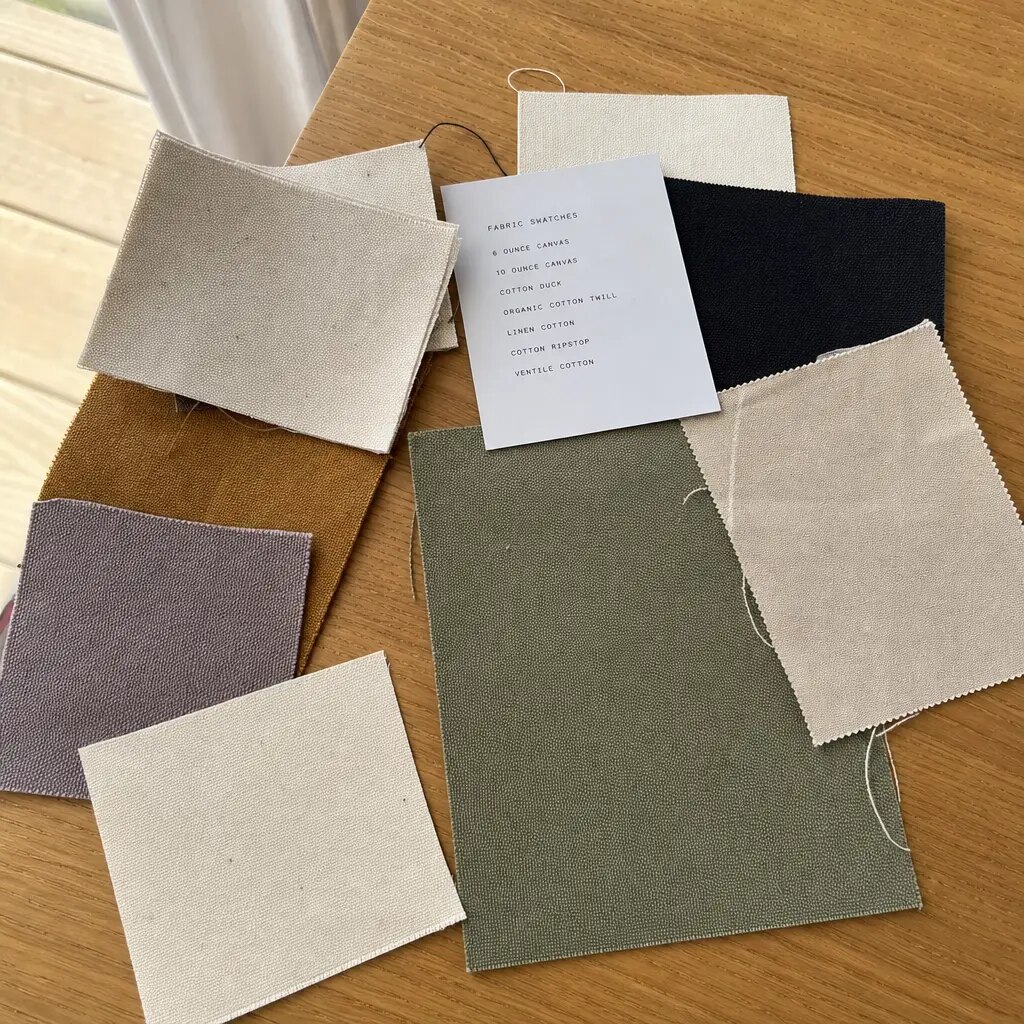
- Request a fabric swatch before sample making if hand feel and shade matter to the brand team.
- Define natural flecks as acceptable only within the approved sample standard.
- Reject oil stains, mildew odor, holes, dirty creases, and heavy contamination even on natural cotton.
- Ask whether bulk production will use the same fabric lot or an equivalent approved lot.
Make organic cotton claims documentable before artwork approval
Organic cotton sourcing is a material issue, but it is also a documentation issue. If the tote, hangtag, invoice, product page, or sustainability report will say “organic cotton,” procurement should ask what evidence is available for the specific order. A supplier may have certified fabric, a certified facility scope, transaction documentation, or only a general supplier statement. Those are different levels of support, and they may allow different wording.
Do not approve artwork that includes certification marks, organic logos, or broad sustainability claims until the documentation route is clear. Some certification systems control logo use, product labeling, transaction certificates, and chain-of-custody wording. A factory may be able to source organic cotton fabric but not be authorized to label the finished tote in the way your marketing team expects. It is much easier to resolve this before screens, labels, hangtags, and web copy are finalized.
A useful RFQ sentence is: “Supplier to confirm whether this order can be documented as organic cotton, what certification scope applies, what transaction or lot documents are available, and what exact wording may appear on the product, invoice, hangtag, carton, and product page.” That one line helps protect the roaster from unsupported claims during retailer review, customer questions, or internal ESG reporting.
- Ask for certification scope, not just a logo image or catalog statement.
- Confirm whether documents apply to fiber, fabric, facility, or finished tote order.
- Do not use certification marks on hangtags unless usage is permitted for your order.
- Match invoice wording, product copy, and hangtag wording to the supplier’s documentation.
- Keep organic documentation in the purchase file with the approved sample and inspection report.
Select decoration based on artwork, fabric, and use
Most coffee roaster tote artwork is a good fit for water-based screen printing, especially when the design uses one to three solid colors. Roaster logos, origin maps, simple café illustrations, brewing icons, roast slogans, and typography usually print well on natural canvas. Screen printing is efficient at volume, but it still needs a strike-off. Cotton texture, fabric absorbency, and the natural shade of the cloth can all change how the ink appears. A digital mockup is useful for layout; it is not proof of print quality.
Transfers, digital print, embroidery, and woven labels can also work. The right method depends on the artwork and the desired finish. A transfer can reproduce fine detail, but it should be checked for edge lift, adhesion, and hand feel. Embroidery can look premium on smaller logos, yet it may pucker lighter fabric and is not ideal for large filled graphics. Woven labels give a subtle retail look, but alignment, edge fray, and claim wording still need inspection. Ask the supplier to recommend a method and explain the risks rather than simply accepting the cheapest print option.
Print placement should be measured from fixed points. For example: “Front print centered horizontally, top of print 120 mm below bag opening, print size 220 x 180 mm.” A practical placement tolerance may be plus or minus 5 mm to 10 mm depending on the artwork and production method. If the print sits close to a gusset, crosses a seam, aligns with a pocket, or must stay visible after folding around a belly band, state that in the RFQ.
- Send vector artwork files and specify Pantone references, print size, and print position in millimeters.
- Require a strike-off on the actual fabric, especially for natural, dyed, or heavier canvas.
- Ask the supplier to identify risks: ink bleed, absorption, cracking, rub-off, registration drift, puckering, or heat marks.
- Define print placement tolerance and whether small color variation on natural cotton is acceptable.
- Inspect decoration after folding and packing because ink transfer and pressure marks can appear later.
Separate MOQ, price drivers, and quote exclusions
Two suppliers can appear to quote the same organic cotton tote while pricing very different products. One quote may assume 5 oz stock cotton, one-color print, no hangtag, bulk packing, and no physical sample. Another may include 10 oz certified fabric, custom label, belly band, barcode sticker, reinforced handles, inspection support, and export cartons. A clear RFQ pulls those assumptions into the open so procurement can compare like for like.
Ask suppliers to separate the base tote price, fabric upgrade cost, print setup, screen fee, sample fee, strike-off fee, label cost, hangtag or belly band cost, carton cost, barcode labeling cost, inspection support, and inland freight if relevant. If you are ordering several café designs, ask whether the same base fabric can be used across multiple artworks to reduce fabric MOQ pressure. Decoration MOQ may still apply by design, even when the fabric is shared.
Request price breaks at quantities that match your forecast, such as 500, 1,000, 2,500, 5,000, and 10,000 pieces if those volumes are realistic. Then ask what changes at each level. A lower price may come from fabric efficiency, print setup amortization, or simplified packing. It may also come from a quiet change in fabric weight or seam construction. To prevent that, the RFQ should state that fabric weight, handle construction, print method, labels, and packing cannot be substituted without written buyer approval.
- Request a cost breakdown instead of only a single unit price.
- Ask MOQ by fabric, color, artwork, label, packing format, and shipment lot.
- State whether multiple designs may share one base fabric and carton format.
- Request price breaks that match realistic reorder quantities.
- Require written approval before fabric weight, handle construction, print method, or packing is changed.
Approve samples with records, not just a casual email
Sample approval should not be reduced to “looks good.” For a custom organic cotton tote, the pre-production sample becomes the physical standard for fabric, size, construction, decoration, label, and packing. For important orders, keep one signed or tagged sample with the buyer and one with the supplier. Both should reference the same sample version, date, artwork version, fabric specification, and approved deviations.
The sample package should include measured photos of body size, gusset depth, handle length, handle drop, print position, label placement, and folded packing. The tape measure should be visible at the measurement point. A polished front-and-back photo is helpful for internal alignment, but it is not enough for production control. Ask the supplier to confirm whether the sample uses production fabric or substitute sample-room fabric. If substitute fabric was used, wait for a production fabric swatch or top-of-production check before treating the sample as the final standard.
Write down accepted deviations before bulk production starts. If the brand accepts that natural cotton is slightly creamier than the digital mockup, record it. If the print is approved even though the Pantone match is not exact because of natural fabric absorbency, record that too. Unwritten deviations often become disputes during final inspection, especially when the person inspecting the order was not involved in the original sample review.
- Approve fabric swatch, print strike-off, and full pre-production sample separately when needed.
- Keep a physical approved sample for repeat orders and claims prevention.
- Record sample version, artwork version, fabric reference, approval date, and approver name.
- Require measured sample photos, not only front and back product photos.
- List approved deviations so QC does not reject what the buyer already accepted.
Set QC tolerances before production starts
Quality control for organic cotton totes works best when the buyer defines checkpoints and defects before the order is on the sewing line. A final inspection using an AQL-style approach can be useful, but the inspector still needs to know what to measure and what to reject. Common checkpoints include fabric surface, shade, odor, dimensions, seam quality, handle reinforcement, decoration, labels, packing, carton marks, and quantity. For larger programs or multi-design launches, ask for in-line photos before the full order is sewn and printed.
Measurement tolerances should be realistic for cotton fabric and manual sewing. A common starting point is plus or minus 10 mm for body width and height, plus or minus 10 mm for gusset depth, plus or minus 15 mm for handle length, and plus or minus 5 mm to 10 mm for print placement. Adjust these numbers if the tote must fit a rigid gift box, a retail display, or a packing fixture. Put the tolerances in the RFQ, confirm them during sample approval, and use them again at final inspection.
Defect classification reduces arguments. Critical defects may include wrong product, wrong artwork, prohibited claim wording, mildew odor, sharp foreign object, or severe contamination. Major defects may include open seams, broken handle stitching, obvious stains, severe print smears, incorrect barcode, missing hangtag, or mixed cartons. Minor defects may include small loose threads, slight natural slubs within the approved standard, or tiny print pinholes that do not affect normal appearance. The exact list should match your sales channel and customer expectations.
- Use measurable checkpoints: dimensions, seam strength, stitch quality, print position, label accuracy, and packing quantity.
- Define critical, major, and minor defects in plain language.
- Ask for in-line photos after first bulk pieces are sewn and printed.
- Require final inspection photos of measurements, defects, carton marks, and packed quantity.
- Hold shipment for wrong artwork, mildew odor, severe stains, open seams, or incorrect retail labels.
Plan packing, carton marks, and warehouse receiving
Packing affects cost, sustainability positioning, and receiving efficiency. For internal events or warehouse storage, bulk folded packing may be the simplest choice. For café retail, a belly band, hangtag, barcode sticker, or kraft sleeve can improve shelf presentation and scanning. If the brand wants reduced plastic, be precise. Say whether individual polybags are prohibited, whether a carton liner is acceptable, and what moisture protection is still required during transit.
A tote can pass product inspection and still create operational problems if cartons are mislabeled or mixed. Multi-design coffee programs should require carton marks with item name, SKU, design, quantity, carton number, gross weight, net weight, and destination reference if applicable. If barcodes are required, confirm barcode type, size, placement, and whether the supplier must perform a scan check before packing. Retail distribution centers can delay or reject cartons with wrong labels even when the bags themselves are acceptable.
Carton quantity should be practical for handling. Very heavy cartons increase damage risk and warehouse labor strain, especially with 10 oz canvas totes. Ask the supplier to propose carton dimensions and quantity per carton after the sample fold is confirmed. If totes are folded around hangtags or belly bands, confirm that the fold does not crack ink, distort labels, or create dirty crease lines on natural cotton.
- Choose bulk folded, bundled, belly banded, hangtagged, sleeved, or individually packed based on channel needs.
- Define plastic-free or minimal-plastic requirements while still allowing moisture protection where needed.
- Require carton marks by SKU, design, quantity, carton number, and destination.
- Ask for packed-carton photos before shipment release.
- Check barcode scan, hangtag accuracy, carton count, and mixed-design separation during final inspection.
Manage timeline, shipping terms, and repeat orders
Coffee roasters often buy totes for seasonal launches, holiday bundles, trade shows, café openings, or wholesale catalog deadlines. Your RFQ should separate each timing step: artwork proof, fabric swatch, print strike-off, pre-production sample, sample shipping, fabric booking, bulk cutting, sewing, decoration, packing-material production, final inspection, export documentation, and freight handover. This prevents a common misunderstanding: “30 days production” may not include sample approval, sample shipping, or freight booking.
Shipping terms need to be clear enough for procurement to compare suppliers. Ask whether the quote is EXW, FOB, CIF, DAP, or another term, and name the port, warehouse, or destination. A unit price without a freight handover term is incomplete. Organic cotton totes are not usually fragile, but they are bulky relative to value. Carton dimensions, gross weight, and packing density all affect landed cost. Request estimated carton data at quote stage and final carton data before freight is booked.
For repeat orders, keep the RFQ, approved sample record, artwork files, fabric reference, organic documentation, inspection report, packing list, and deviation approvals in one purchasing folder. Repeatability is a real B2B advantage. The next order can start from a proven specification instead of a scattered email thread. If you reorder after a long gap, still ask the supplier to confirm fabric availability, shade, certification evidence, artwork screens, and any changes in packing materials.
- Ask suppliers to quote sample lead time, production lead time, inspection window, and export handover separately.
- State the required delivery date and work backward from event, launch, or retail set date.
- Confirm Incoterm, handover point, carton dimensions, carton weight, and packing list format.
- Keep all approvals and deviations in one order file for claims and reorders.
- For reorders, verify that fabric, certification evidence, artwork screens, and packing materials are still available.
Specification comparison for buyers
| Spec decision | Recommended option | When it fits | Buyer risk to check |
|---|---|---|---|
| Fabric weight | 7 oz to 10 oz cotton canvas, commonly about 237 to 339 GSM, for most coffee retail totes; 5 oz to 6 oz, about 170 to 203 GSM, only for light promotional handouts | Balances hand feel, print coverage, seam strength, and freight cost for cafés, roaster merch, farmers market stalls, gift bundles, and wholesale programs | A quote that says only “cotton canvas” can hide a lighter fabric. Require oz and GSM, weave, finished weight tolerance, fabric color, and confirmation that bulk fabric will match the approved sample lot. |
| Fabric type and finish | Organic cotton canvas or drill for structure; plain-weave sheeting only for budget lightweight totes; undyed natural cotton when shade variation is acceptable | Natural canvas works well for roaster branding, low-waste retail displays, and reusable café merchandise without the extra step of custom dyeing | Natural cotton contains flecks, seed marks, and shade variation. Define acceptable slubs versus defects such as oil marks, mildew odor, dirty folds, holes, or heavy yarn contamination. |
| Bag size | Flat 380 x 420 mm for everyday shoulder totes; gusseted 350 x 400 x 100 mm or 380 x 420 x 100 mm for coffee packs, boxes, or gift sets | Flat bags suit café merchandise and event giveaways; gussets help two to four 250 g coffee bags, retail boxes, brewing accessories, or bundled kits sit upright | Do not compare a flat tote and gusseted tote by unit price alone. Confirm finished dimensions, measurement tolerance, loading test weight, and whether the quoted size is before or after sewing. |
| Handle length | Shoulder handles 600 to 700 mm long and 25 to 30 mm wide; hand-carry handles 350 to 450 mm only when the use case is small gift packaging | Shoulder handles work for grocery-style carrying, commuters, event attendees, and café customers wearing jackets | Short or narrow handles reduce comfort and perceived value. Confirm handle drop, handle tape width, stitch density, reinforcement pattern, and whether the handle is self-fabric or webbing. |
| Seam and reinforcement | Lockstitch main seams with overlock or bound internal edges; cross-box or X-box handle reinforcement for retail-weight totes | Needed when bags may carry coffee packs, mugs, books, brewers, or mixed café retail items | Weak handle attachment is a common failure point. Ask for stitch type, SPI range, reinforcement photos, seam allowance, and a practical load test based on your expected contents. |
| Print method | Water-based screen print for one to three solid colors; discharge, pigment, transfer, embroidery, or digital print only when artwork, color count, or texture requires it | Screen print suits roaster logos, origin maps, line art, simple café illustrations, and campaign slogans on natural cotton canvas | Ink behaves differently on unbleached cotton. Approve a strike-off on the actual fabric, define Pantone references with a realistic tolerance, and check rub resistance, cracking, bleed, and placement. |
| Organic cotton evidence | Ask for the supplier’s certification scope, fabric lot traceability, transaction documentation availability, invoice wording, and claim limitations before finalizing hangtags or web copy | Important when your product page, hangtag, invoice, sustainability report, or retail display will state organic cotton | Do not rely on a catalog logo alone. Confirm whether the finished tote order is covered, whether only the fabric is certified, and what exact claim language the supplier can support. |
| MOQ structure | Separate MOQ for fabric, dyeing, printing, sewing, trims, labels, and packing; combine base fabric across designs when possible | Works for roasters with multiple cafés, seasonal blends, wholesale partners, regional distributors, or event batches | A low MOQ may assume stock natural fabric, one print color, no custom label, and bulk packing. Custom dye, certified fabric lots, retail barcode labels, and multiple artworks can raise MOQ and lead time. |
| Packing format | Bulk folded cartons for internal use; paper belly band, hangtag, barcode label, or kraft sleeve for retail programs; avoid individual polybags unless required for logistics | Retail cafés need shelf-ready presentation; warehouse fulfillment and events usually benefit from lower-cost bulk packing | Plastic-free requests still need a moisture and dirt plan. Define bundle quantity, carton liner, carton strength, carton marks, barcode placement, and any acceptable use of protective bags. |
Buyer checklist before sampling
- Define the business use case: café retail, event giveaway, subscription insert, gift set, wholesale promo, staff kit, or distributor program.
- Confirm finished bag size, gusset depth, handle length, handle drop, handle width, and expected contents by weight and volume.
- Specify fabric type, weave, oz and GSM, natural or dyed color, acceptable shade variation, shrinkage expectation, and finished fabric tolerance.
- Require organic cotton evidence: certification scope, traceability documents available for the order, invoice wording, and approved claim language.
- Send vector artwork with Pantone references, print size in millimeters, print position, number of colors, and whether the artwork may be adjusted for seams or folds.
- Ask for a fabric swatch, print strike-off, and one physical pre-production sample made with the intended fabric, print method, handle, label, and packing.
- Request quote lines for unit price, sample fee, setup fee, printing, label, hangtag, packing, carton, inspection support, and freight handover term.
- Agree finished measurement tolerances before production, such as plus or minus 10 mm on body size and plus or minus 15 mm on handle length unless your program requires tighter control.
- Define stitching acceptance: no skipped stitches, broken threads, loose handle reinforcement, open seams, severe puckering, or exposed raw edges beyond the approved construction.
- Define print acceptance: correct position, acceptable registration, no major pinholes, no heavy ink smears, no obvious color mismatch, and no rub-off under a simple dry rub check.
Factory quote questions to send
- What exact fabric is included in this unit price: organic cotton canvas, drill, or sheeting, and what are the oz, GSM, weave, and finished weight tolerance?
- Is the quoted cotton certified organic at fabric level or finished-product level, and what transaction, scope, or traceability documents can be provided for this order?
- Is the quoted fabric stock natural color, stock dyed color, or custom dyed, and what shade tolerance or lab dip approval process applies?
- What is the MOQ for one design, and how does it change if we use multiple artworks, two print colors, custom labels, belly bands, hangtags, or barcodes?
- Can you provide a fabric swatch, print strike-off, and pre-production sample using the same fabric, handle construction, logo method, and packing planned for bulk?
- What finished-size tolerance, handle-length tolerance, print-position tolerance, and carton quantity tolerance do you normally apply for cotton totes?
- What stitch type, seam finish, stitches per inch, handle reinforcement pattern, and load test do you recommend for carrying two to four retail coffee bags plus small accessories?
- Which print method do you recommend for our artwork on natural organic cotton canvas, and what are the risks for ink absorption, bleed, cracking, color shift, or rub-off?
- What costs are excluded from the unit price, including sample fee, screen fee, artwork separation, label fee, packing material, inspection support, export carton, or inland freight?
- How many calendar days are needed for artwork proof, strike-off, sample making, sample shipping, fabric booking, bulk sewing, printing, packing, inspection, and export handover?
Quality-control points to confirm
- Verify fabric roll labels, organic documentation reference, fabric color, hand feel, weave, GSM or weight record, odor, and visible surface defects before cutting.
- Check cutting accuracy and panel direction so front and back panels align, gussets are consistent, and fabric grain or skewing is not visually severe.
- Measure finished body width, body height, gusset depth, handle length, handle drop, handle width, and print placement against the approved sample and RFQ tolerance.
- Inspect seams for skipped stitches, open seams, broken threads, raw edges, seam slippage, puckering, needle damage, and inconsistent stitch density.
- Inspect handle reinforcement for correct position, complete box or cross stitching, no loose thread clusters, and no weak attachment at the upper bag edge.
- Review logo decoration for position, color, registration, ink coverage, pinholes, smears, cracking, transfer lift, embroidery tension, woven label alignment, or heat-press marks.
- Perform a practical dry rub check on printed areas and a light handling check for ink transfer before approving packed goods.
- Check for unacceptable defects: oil stains, water stains, mildew odor, dirty fold lines, holes, heavy yarn contamination, severe shade mismatch, and foreign matter inside the bag.
- Verify hangtags, belly bands, care labels, barcodes, SKU stickers, carton labels, and shipping marks against the buyer’s packing file.
- Confirm carton quantity, bundle method, carton dimensions, carton strength, moisture protection, packing list, mixed-design separation, and final release photos before shipment.