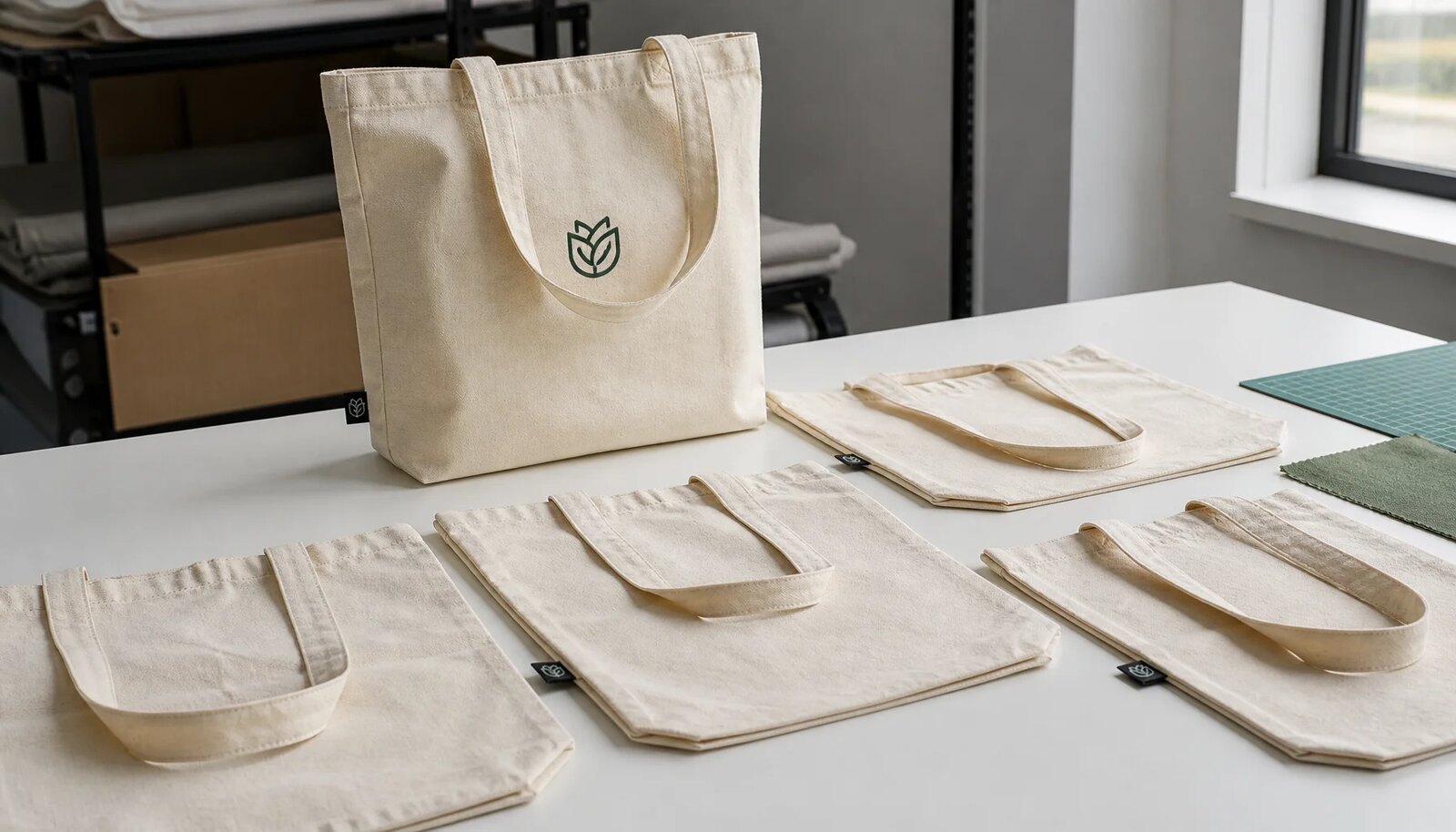
Start With the Event Load, Not the Artwork
A custom organic cotton tote is a branded item, but for procurement it is also a small load-bearing product. That distinction matters. The bag may carry a conference agenda, catalog, drink bottle, apparel item, sponsor gift, sample kit, laptop insert, or retail-style welcome pack. Each combination changes the specification. A tote can look perfect in a flat mockup and still twist, sag, or strain once attendees carry real contents across a venue.
Before you ask factories for prices, build the kit. Use the actual event contents when available, or the closest substitutes you can source. Weigh the full pack and measure the largest item. Paper programs create a different stress pattern than bottles, books, boxed samples, or items with hard corners. If staff need bags to stand open during assembly, gusset structure and fabric body become more important. If attendees will wear the tote over the shoulder, handle drop and handle width are not small details. They decide whether the bag is pleasant to use.
This is where event planners can prevent many late-stage problems. A clear load profile turns a vague request for organic cotton totes into an inspectable product. It also helps suppliers recommend fabric weight, reinforcement, print placement, folding, and carton packing without guessing. A lighter construction may be fine for a registration handout. A sponsor-facing gift bag should be specified for repeated handling and a cleaner presentation.
- Record the expected packed weight in kilograms or pounds, not only the item list.
- Measure the largest insert so finished width, height, and gusset are based on real contents.
- For light paper handouts, 120-140 GSM cotton can be acceptable when handle load is low and reuse expectations are modest.
- For standard conference totes, 160-180 GSM is often a practical balance of cost, body, opacity, and repeated use.
- For books, bottles, heavy samples, or premium kits, consider 180-200 GSM or higher with reinforced handle anchors and a stronger bottom seam.
- Test handle drop with a filled sample; a flat measurement can feel very different once the bag is loaded.
Turn the Tote Into a Measurable Spec
The phrase custom organic cotton tote sounds clear, but it is not a buying specification. It does not define size, fabric, weave, finish, construction, decoration, packing, or inspection tolerances. Two suppliers can quote it honestly and still price different products. One may assume stock natural cotton blanks and bulk cartons. Another may include custom cutting, heavier canvas, a sewn side label, and individual packing. Until the RFQ is precise, price comparison is mostly noise.
A useful RFQ states finished bag width, height, gusset type, handle drop, handle width, fabric weave, target GSM, fabric color, thread color, top hem depth, seam type, label position, print size, print placement, packing style, carton quantity, and required delivery term. It also states tolerances. Cotton cutting and sewing allow normal variation, so the point is not to demand impossible precision. The point is to define what variation your event, brand team, and receiving process can accept.
Measurement points deserve special attention. Body width might be measured at the top opening, mid-body, or bottom seam. Handle length might mean the full fabric strip, visible loop length, or drop from the top edge to the handle apex. Gusset depth can be measured flat or opened. If these points are not agreed in advance, factory QC and third-party inspection can disagree even when everyone is acting in good faith.
- Use finished dimensions in the purchase order, not only pattern dimensions or catalog dimensions.
- Define body width, body height, bottom gusset, side gusset if any, handle drop, handle width, top hem depth, and print placement reference points.
- Common commercial tolerances may be plus or minus 1.0 cm for body dimensions and plus or minus 0.5 cm for handle or print placement, but adjust based on program risk.
- State whether natural seed flecks, small slubs, and slight shade variation are acceptable for unbleached organic cotton.
- Attach final artwork files with print size, color references, placement distance from top hem or centerline, and minimum readable text size.
Document the Organic Cotton Claim
Organic cotton is a fiber claim. It does not, by itself, prove that the finished tote is strong, clean, color-consistent, or well sewn. The bag still needs ordinary product controls: fabric GSM, weave, seam quality, handle reinforcement, print curing, odor, cleanliness, and packing. For B2B buyers, the organic claim also needs a document trail that can sit in the purchase file and stand up to internal review.
Ask which documents apply to the actual order. Depending on the supply chain and the wording of the claim, useful support may include certification scope documents, transaction certificates where applicable, fabric lot records, mill declarations, supplier invoices, or other traceability records. The connection is the critical part. A supplier's general ability to make organic cotton products is not the same as documentation tied to the fabric lot used for your shipment.
Wording should be settled before labels, hangtags, inserts, or printed claims are approved. Some programs need a certified organic cotton claim. Others only need a product made with organic cotton fabric supported by supplier records. If your company, sponsor, retailer, university, or legal team has required language, confirm it early. A claim printed on 10,000 bags is much harder to correct than a line in an RFQ.
- Ask whether documentation covers fiber, yarn, fabric, finished product, or only facility scope.
- Keep the purchase order, approved sample record, fabric documentation, inspection report, and packing list together.
- Do not approve hangtag, label, or insert wording until internal compliance language is confirmed.
- Check that documented quantity is consistent with order quantity and expected fabric consumption.
- Remember that organic cotton documentation does not replace normal tote quality inspection.
Choose Fabric, Weave, and Construction Together
GSM matters, but it is not the whole story. A tight plain weave, canvas, lighter open weave, and twill can behave differently at the same nominal weight. Weave affects hand feel, print sharpness, opacity, shrinkage behavior, folding, and seam stability. A 180 GSM fabric with a loose structure may feel less stable than a slightly lighter fabric with a tighter construction.
Color and finish also change the control plan. Natural organic cotton often has a warm base shade with seed flecks. That can support an organic look, but buyers should decide what level of flecking and shade variation is acceptable against the approved sample. Bleached or dyed cotton may look cleaner or closer to brand colors, but it raises shade-control questions across lots and repeat orders. If the same tote will be ordered again for future events, ask how the supplier records and matches the standard.
Construction is where many tote failures begin. A heavy fabric with weak handle stitching can perform worse than a medium fabric with good reinforcement. Define top hem construction, seam allowance, stitch density, thread color, thread type, bottom seam finish, and handle attachment. Handle anchors should be even and reinforced. The bottom seam should not pull open under the agreed event load. Loose threads may be cosmetic; open seams and broken stitches are functional defects.
- For economical giveaways, use lighter fabric only when expected load is low and short-term use is acceptable.
- For general event bags, 160-180 GSM often gives better body and less show-through than very light cotton.
- For premium kits or heavier contents, specify heavier fabric plus reinforced handle anchors rather than relying on GSM alone.
- Ask whether side seams are overlocked, folded, French seamed, bound, or otherwise finished.
- Define stitch density, for example stitches per inch or stitches per 3 cm, when durability is important.
- Confirm handle width as well as handle drop; narrow handles can feel uncomfortable with heavier kits.
Treat Print Method as a Quality Decision
Print method affects cost, appearance, hand feel, lead time, and inspection criteria. Screen printing is often practical for simple logos, solid sponsor marks, and larger quantities. It can give strong coverage and repeatable color when artwork, screen setup, ink, and curing are controlled. Still, it needs approval for opacity, registration, hand feel, and color. An undercured screen print can crack, rub, or transfer onto another bag in the carton.
Digital, DTF, and transfer methods can help with short runs, many colors, gradients, variable sponsor versions, or artwork that would be expensive to separate into screens. The tradeoff is that decoration may sit on the cotton surface differently. A large transfer can stiffen the front panel. Fine text may lose clarity on textured fabric. Edge marks or film residue can appear under angled light. These issues are easier to judge on a physical strike-off than on a digital proof.
Print placement needs its own tolerance. A tote front panel is visually simple, so a slightly tilted or off-center logo is easy to notice. Define whether artwork is centered on the panel, aligned to a side seam, or positioned a fixed distance below the top hem. For multi-color work, define registration tolerance. For brand colors, use Pantone or another approved reference, while recognizing that ink on natural cotton will not look identical to coated paper or a screen.
- Use screen print for simple one to three color logos when quantity and artwork support screen setup.
- Use digital, DTF, or transfer print for gradients, many colors, short quantities, or multiple sponsor versions.
- For dark bags, confirm whether an underbase is required and how it affects color, opacity, and hand feel.
- Approve minimum line width and minimum text size before screens or transfers are made.
- Request dry rub checks and basic adhesion checks on the approved print sample.
- Define print placement tolerance from fixed points such as top hem to artwork top edge and centerline to logo center.
Normalize Quotes Before You Rank Suppliers
A low unit price can be useful. It can also mean the supplier quoted a different bag. Procurement buyers should normalize every quote before comparing suppliers. Check that each price includes the same finished dimensions, fabric GSM, organic cotton documentation, print method, number of colors, setup charges, labels, packing, carton marks, delivery term, and inspection support. The cheapest quote may simply be the one that leaves out costs you will need later.
MOQ is usually shaped by fabric availability, cutting efficiency, color, print setup, label sourcing, packing labor, and versioning. One natural-color tote with one logo and bulk packing is straightforward. A multi-city event order with five sponsor versions, sewn labels, hangtags, inserts, barcode stickers, and destination packing is not the same project. Ask where MOQ changes: by fabric color, bag size, print version, label, packing method, or shipment split.
Freight terms change the meaning of the price. EXW, FOB, CIF, DDP, and domestic delivery are not interchangeable. A low unit price under one term may not be cheaper after inland transport, export handling, duties, customs brokerage, and final delivery are included. For event planners, the key date is the in-hand date at the receiving location, not the factory completion date.
- Request line-item pricing for bag cost, print setup, screens or plates, sample fee, sample freight, labels, hangtags, inserts, packing, carton marks, inspection, documents, and freight term.
- Ask for a price grid at the target quantity plus one lower and one higher quantity.
- Confirm whether sample fees are credited after bulk order placement or charged separately.
- Ask how costs change for multiple artwork versions, label versions, or destination splits.
- Require every quote to state the same delivery term and named place.
- Do not compare a stock blank overprint quote directly with a full custom OEM quote unless the differences are intentional.
Approve Samples as Production Controls
A sample is not just a nice prototype. For B2B procurement, it becomes the control reference for bulk production and inspection. The most useful sample is a pre-production sample made with final fabric, final thread, final handles, final label, final print process, final curing, final fold, and proposed packing. A catalog sample or sales mockup can help early discussion, but it should not release bulk production for an event order.
Sample approval should be measured, not just liked. Record body width, height, gusset, handle drop, handle width, print size, and print placement in the same way bulk inspection will measure them. Compare fabric hand feel and shade against expectations. Fill the bag with the planned event kit and carry it. Look for seam strain, handle twisting, panel distortion, uncomfortable handle pressure, and whether the printed panel creases badly when packed or folded.
The print needs physical checks too. Rub the printed area with a dry white cloth. Bend it gently and look for cracking, lifting, or flaking. For transfer or DTF decoration, inspect the edges and feel the transition between print and fabric. If bags will be folded at registration tables or packed into kits, approve the fold direction and confirm the logo is not placed on a hard crease unless that is acceptable.
- Keep one signed or dated approval sample with the buyer and ask the supplier to retain a matching sample at the production site.
- If multiple samples are provided, measure at least three and record actual values.
- Approve side labels, care labels, hangtags, inserts, barcode labels, and fold method before bulk production starts.
- Close every sample comment in writing, especially dimensions, print placement, handle reinforcement, shade, odor, and packing.
- Do not approve production from a photo alone when the event deadline leaves little room for rework.
Inspect Bulk With Defect Categories
Bulk inspection should compare finished goods against the purchase order, approved sample, artwork approval, packing instruction, and tolerance table. The inspection plan should state who selects cartons, how many units are checked, what measurements are taken, how defects are classified, and who can approve shipment, request rework, or reject goods. For larger orders, many buyers use ANSI/ASQ Z1.4 or a similar sampling approach, but the AQL level should match the event risk and be agreed with the supplier.
Defect categories keep decisions consistent. A loose thread that can be trimmed may be minor. An open side seam, missing handle reinforcement, wrong print color, severe stain, strong odor, incorrect artwork, or undercured print should usually be major. Mold, sharp foreign objects, contamination, or anything that makes the tote unusable should be critical. The category should reflect both function and brand presentation.
Do not inspect only the easiest cartons. Open cartons from different packed positions and check shade, print color, fold, count, sewing quality, labels, and carton marks across the shipment. If the order has multiple artwork versions, sponsor versions, colors, or destinations, inspect each version separately. A well-made bag in the wrong carton can still create a receiving problem on event day.
- Measure finished dimensions from fixed reference points and record pass or fail against the tolerance table.
- Check handle reinforcement visually and, when agreed, with a simple load-hold test using the intended event weight plus a reasonable margin.
- Check print placement, tilt, registration, opacity, cracking, smearing, bleeding, transfer residue, and rub resistance.
- Classify defects as minor, major, or critical before shipment so rework decisions are not improvised.
- Photograph defects with carton numbers, quantities checked, quantities failed, and supplier rework proposal.
- Verify total quantity, carton count, carton marks, artwork version, destination split, and packing list before shipment release.
Make Packing Easy to Receive and Count
Packing is part of the product specification. A well-made tote can still disappoint if it arrives dusty, damp, short-counted, mislabeled, over-compressed, or mixed by artwork version. Event teams often move bags quickly from receiving to kit assembly, registration desks, sponsor areas, or storage rooms. Clear packing instructions reduce handling time when the event schedule is already tight.
Decide whether bags should be bulk packed, bundled by fixed quantity, individually packed, tagged, folded with an insert, or sorted by destination. Bulk packing can reduce cost and material, but bags still need inner protection and count control. Individual packing can improve presentation and receiving accuracy, but it adds labor, cost, and packaging waste. For many events, bundles of 25, 50, or 100 inside marked cartons are easier for staff than loose mixed cartons.
Carton details should be confirmed before production finishes. Ask for quantity per carton, carton dimensions, estimated gross weight, carton strength, inner liner or moisture protection, and shipping marks. Natural cotton should be packed dry and clean. Cartons should not be so heavy that venue teams struggle to move them or so compressed that totes arrive deeply creased. If the shipment travels by ocean or sits in storage, moisture protection and clean inner packing become more important.
- Mark cartons with PO number, item name, bag color, artwork version, quantity, carton number, destination, and event receiving code.
- Keep different artwork versions, sponsor versions, and destination splits in separate cartons unless a mixed-carton plan is documented.
- Ask for photos of first folded bags, inner packing, carton marks, and the first sealed carton before all cartons are closed.
- Align carton quantity with event workflow, such as 50 or 100 bags per carton when that helps counting.
- Require an accurate packing list showing carton count, quantity per carton, gross weight, net weight if needed, and destination split.
Plan Backward From the In-Hand Date
Event tote schedules should start with the required in-hand date, not the factory's estimated completion date. Bags may need to arrive days or weeks before the event for receiving, counting, kit assembly, sponsor review, regional redistribution, or venue staging. A factory ship date is not enough if customs clearance, local delivery, or internal receiving takes longer than expected.
Break the timeline into stages: RFQ clarification, artwork finalization, sample making, sample transit, buyer review, sample revision if needed, material booking, bulk cutting, sewing, printing, curing, trimming, final inspection, packing, export handling, transit, customs, local delivery, and receiving check. Each step may seem manageable alone. Together, they form the real procurement schedule. Ask suppliers what begins only after sample approval and what can safely happen in parallel.
Approval delay is one of the most controllable risks. If stakeholders need to sign off on artwork, organic wording, sponsor placement, or sample quality, schedule those reviews before the sample arrives. For immovable event dates, maintain a realistic backup such as a stock blank, simplified print, reduced version count, or domestic decoration route. A backup only helps if decision-makers have already accepted the tradeoffs.
- Set the required in-hand date first, then subtract time for receiving, counting, kit packing, and movement to the event site.
- Separate sample lead time, sample shipping, approval window, bulk production, inspection, packing, export, transit, customs, and final delivery in the quote.
- Add time for custom dyeing, special labels, hangtags, inserts, barcode setup, organic documentation, split shipments, or re-sampling.
- Do not release bulk production until sample approval, artwork approval, documentation wording, and packing approval are all closed.
- Treat rush freight as a contingency, not a plan; it cannot fix late artwork, failed samples, or goods held for rework.
Specification comparison for buyers
| Sourcing or spec decision | Recommended B2B approach | When it fits | Procurement risk to control |
|---|---|---|---|
| Finished size and carried load | Start with the real event kit, then write finished width, height, gusset, handle drop, handle width, target load, and tolerances into the RFQ | Conference bags, retail-style welcome kits, campus events, sponsor packs, product samples, books, bottles, or apparel bundles | A clean mockup can hide short handles, undersized panels, weak seams, and sagging once the bag carries the actual contents |
| Fabric GSM and weave | Specify organic cotton type, weave, color, finish, target GSM, and accepted GSM tolerance, commonly plus or minus 5% unless your buyer sets another limit | You need comparable supplier quotes and a tote that feels consistent across cartons and repeat orders | Suppliers may quote pre-finished fabric GSM, finished-bag fabric GSM, or a lower substitute unless the measurement basis is written down |
| Organic cotton documentation | Ask for order-specific traceability support such as certification scope, transaction certificate where applicable, fabric lot records, mill documentation, or invoice links tied to the order | Your company, sponsor, university, retailer, or compliance team needs records behind the organic cotton claim | A general supplier certificate does not prove that the exact fabric lot used for your shipment is organic cotton |
| Screen printing | Use for solid logos, one to three color artwork, larger runs, and repeatable brand marks when curing can be controlled | You want predictable color blocks, moderate cost, and durable decoration on a textured cotton surface | Wrong mesh, ink, underbase, registration, or curing can cause bleeding, cracking, poor opacity, rough hand feel, or transfer marks in packing |
| Digital, DTF, or transfer print | Use for gradients, many colors, short runs, variable sponsor versions, or artwork that is not practical to separate into screens | You need detail or version flexibility more than the lowest unit cost on a simple logo | Large transfers can stiffen the panel; edge marks, film residue, poor adhesion, and weak rub resistance must be checked on the final fabric |
| Direct factory with sewing and print control | Best for repeat programs, custom sizing, custom labels, and a controlled pre-production approval process | You need visibility across fabric inspection, cutting, sewing, printing, curing, final QC, and packing | Confirm which steps are actually in-house and which are subcontracted, then assign responsibility for sample-to-bulk matching |
| Trading company managing production | Useful when you want one commercial contact for fabric, trims, printing, packing, documentation, and logistics | You value coordination, sourcing breadth, or multi-component order management more than direct factory access | Ask for the production factory name, inspection plan, approval authority, and who pays for rework if bulk goods do not meet spec |
| Stock blank tote with local decoration | Good for urgent events, small domestic runs, and simple logo application when the blank already matches the requirement | The available blank has the right GSM, size, handle drop, shade, print area, and delivery timing | Blank inventory can vary by lot; check shade, shrinkage, panel size, handle length, and cleanliness before approving decoration |
| Custom OEM tote with label and packing | Best for branded event kits, attendee gifts, campus programs, sponsor merchandise, and repeat procurement across locations | You need controlled sizing, fabric, labels, carton marks, version splits, and receiving references | MOQ and lead time rise with custom dyeing, special labels, hangtags, inserts, individual packing, barcode stickers, and split shipments |
Buyer checklist before sampling
- Build the actual event kit first. Weigh the full contents in kilograms or pounds and measure the largest insert before choosing fabric GSM, gusset depth, handle drop, and seam reinforcement.
- Write finished width, height, gusset depth, handle drop, handle width, top hem depth, label position, and measurement points in the spec sheet, with tolerances such as plus or minus 1.0 cm for body dimensions and plus or minus 0.5 cm for smaller placement details when appropriate.
- Specify fabric as organic cotton with weave, color, finish, target GSM, accepted GSM tolerance, and whether natural seed flecks, slubs, or shade variation are acceptable against the approved sample.
- Confirm whether quoted GSM is measured before sewing, on the finished bag fabric, or as a supplier nominal value, and require the same basis from every supplier.
- Approve artwork with final file format, print size, color references, placement from fixed measurement points, number of colors, minimum line width, minimum readable text size, and registration tolerance for multi-color work.
- Require a pre-production sample made with final fabric, final handles, final thread, final label, final print method, final curing process, final fold, and proposed packing.
- Ask for line-item pricing for bag cost, print setup, screens or plates, sample fee, sample shipping, labels, hangtags, inserts, packing, carton marks, organic cotton documentation, inspection, inland transport, and freight term.
- Confirm where fabric inspection, cutting, sewing, handle reinforcement, printing, curing, trimming, final inspection, needle control if used, and packing will happen, and who signs off each stage.
- Define carton quantity, carton dimensions, estimated gross weight, inner protection, moisture protection, carton marks, barcode labels, destination split, and receiving references before production ends.
- Build the schedule backward from the required in-hand date, including sample lead time, sample transit, approval window, material booking, production, print curing, inspection, packing, export handling, transit, customs, and local receiving.
Factory quote questions to send
- What exact fabric are you quoting: organic cotton type, weave, color, finish, target GSM, GSM tolerance, and whether GSM is measured before sewing or on the finished bag fabric?
- What finished measurements are included in your price for body width, body height, gusset, handle drop, handle width, seam allowance, and top hem depth?
- What dimensional tolerances do you recommend for body size, gusset, handle drop, print size, and print placement, and can you meet our inspection tolerance in bulk?
- What documentation can you provide that ties the organic cotton claim to this order, such as certification scope, transaction certificate where applicable, fabric lot records, supplier invoice, or mill declaration?
- Will cutting, sewing, printing, curing, inspection, and packing be completed in one controlled facility, or will any process be subcontracted? If subcontracted, who owns QC approval and rework cost?
- Which print method are you quoting, what setup charges apply, what minimum line width is safe, and what color-matching limits should we approve before production?
- For screen print, what ink system, underbase requirement, curing method, curing temperature range, and registration tolerance will be used?
- For digital, DTF, or transfer print, what adhesion, rub, wash, hand-feel, edge-mark, and film-residue checks will you perform on the final fabric?
- What stitch density, seam allowance, top hem construction, handle reinforcement, thread type, and thread color are included in the quote?
- Can you make a pre-production sample using final fabric, final print, final label, final handles, final fold, and proposed packing before bulk production starts?
Quality-control points to confirm
- Fabric GSM is checked against the agreed method and tolerance, with readings taken from representative bags or cuttings rather than one convenient sample.
- Fabric appearance matches the approved sample for shade, weave, hand feel, and natural cotton character, with no holes, weak areas, unacceptable slubs, oil marks, water marks, mildew odor, or dirty handling stains.
- Finished width, height, gusset, top hem depth, handle drop, and handle width are measured flat from the agreed reference points and recorded against the tolerance table.
- Handles are the correct length and width, positioned symmetrically, attached at the approved distance from side seams, and reinforced with the specified bartack, box-X, or other approved construction.
- Top hem, side seams, bottom seams, gusset seams, and inner seam finishes are straight and secure, with no open seams, skipped stitches, broken threads, raw edges where not approved, or excessive puckering.
- Stitch density and seam allowance match the approved sample closely enough to support the intended event load and repeated handling.
- Print size, placement, centering, tilt, and distance from the top hem or centerline match the approved artwork tolerance.
- Print surface is even, opaque enough for the approved design, properly registered for multi-color artwork, and free from pinholes, smears, bleeding, scorch marks, cracking, transfer residue, adhesive outlines, and undercured areas.
- Print color and fabric shade are compared against the approved physical sample under consistent lighting, with carton-to-carton variation checked before release.
- Dry rub and basic adhesion checks are performed on printed areas, especially for dark fabrics, large ink areas, DTF transfers, and sponsor artwork with fine text.