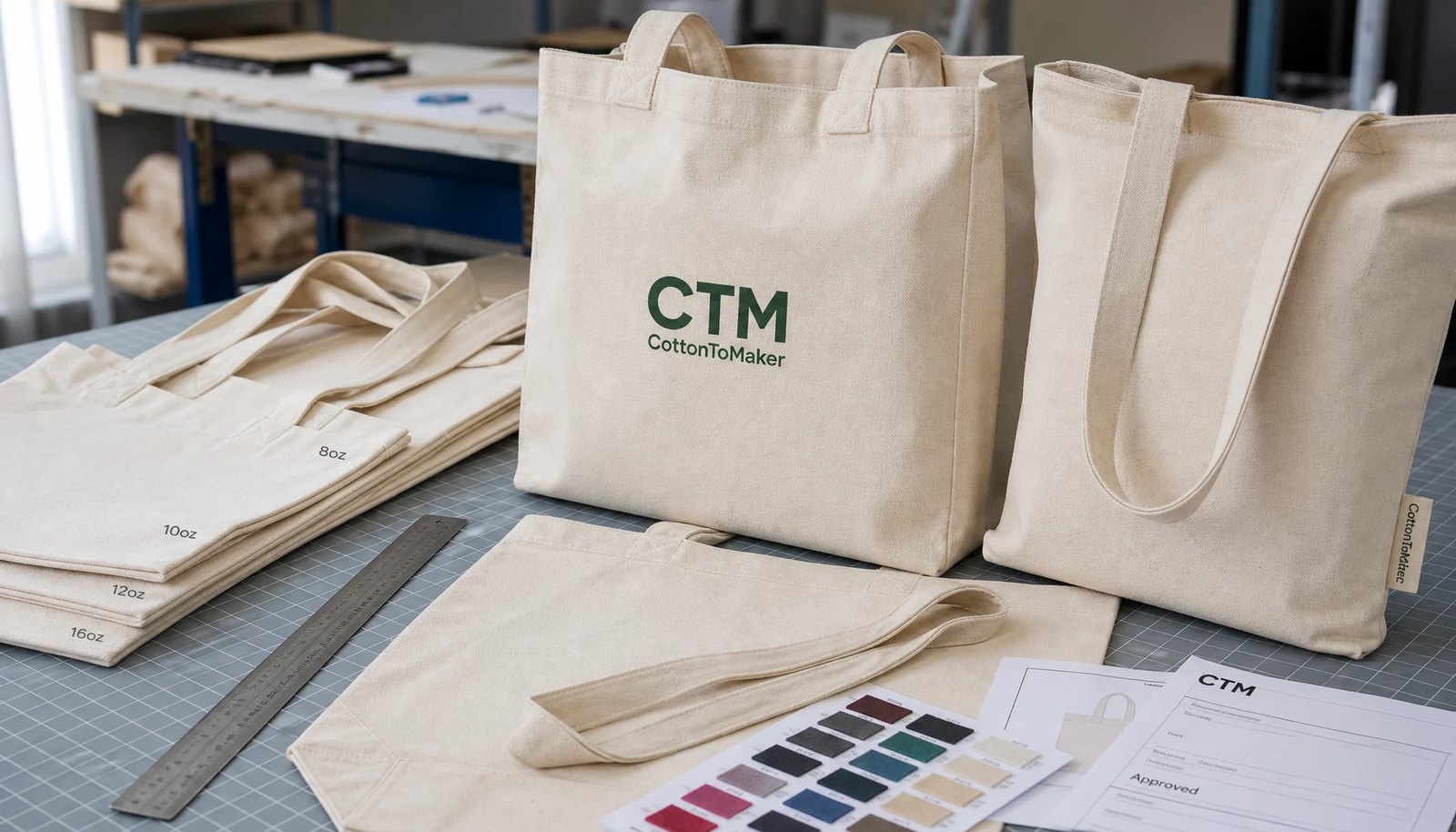
Proofing Is The Real Control Point
Custom organic cotton totes look straightforward on a trade show buying list. The shape is familiar, the material sounds simple, and most teams already know where the logo should sit. In production, though, the risk is rarely the idea of the tote. The risk is everything that was assumed: fabric weight, organic cotton documentation, logo scale, ink behavior, handle length, carton packing, and the fixed delivery date that cannot move once the exhibit hall schedule is set.
For procurement buyers, the proof should function as the production rulebook. A polished mockup is helpful for internal approval, but it is not enough for bulk manufacturing. A strong proof defines the finished bag size, fabric GSM, color, print method, artwork version, Pantone reference, placement measurement, tolerance, sample route, packing plan, and delivery expectation. If those details are missing, the factory may still produce a tote that looks reasonable to them and wrong to the exhibitor.
Trade show orders have less forgiveness than normal promotional merchandise orders. If the logo is too small, the print is too low, or cartons arrive mixed by sponsor version, the problem is discovered when the event team is already under pressure. Rework may be impossible. Rush freight may cost more than the original savings. That is why a custom organic cotton totes print proofing checklist for trade show exhibitors should be written like a manufacturing document, not like a creative note.
- Use the proof to lock production details, not only visual approval.
- Write sizes, distances, GSM, Pantone codes, and tolerances in measurable terms.
- Keep artwork approval separate from bag construction approval so changes stay traceable.
- Put the event date and latest acceptable arrival date on the RFQ, proof, sample approval, and purchase order.
- Make one final proof version the controlling document if email comments, samples, and artwork files conflict.
Start With What The Tote Must Carry
The fastest way to improve a tote specification is to describe the real load. A visitor giveaway that carries a badge insert and a flyer does not need the same fabric or handle construction as a VIP kit holding a catalog, bottle, charger, and boxed product sample. When an RFQ only says custom organic cotton tote, suppliers fill in the blanks differently. One quote may use 5 oz cotton, another 8 oz canvas, and another 10 oz canvas with reinforced handles. The unit prices will not be meaningfully comparable.
For most exhibitor giveaway programs, 7 oz to 8 oz organic cotton canvas is the practical middle. It has more structure than thin promotional cotton, usually gives a cleaner print surface, and keeps cartons manageable for venue handling. Lighter 5 oz to 6 oz cotton can work for budget handouts, but buyers should watch for transparency, less body, and more print-through. Premium kits, retail merchandise, and sponsor gift bags often justify 10 oz to 12 oz canvas, especially when the bag will be photographed, reused, or sold.
Do not choose fabric weight from a product description alone. Test the bag with the contents it must actually carry. If the show team will load each tote with a folder, two catalogs, a water bottle, and a sample box, put those items in the sample before approving handle drop and seam reinforcement. An empty tote can look neat on a table and still twist, sag, or strain when used all day on the show floor.
- Budget handout: 5 oz to 6 oz cotton, lower cost, lighter feel, higher risk of print-through.
- Standard exhibitor tote: 7 oz to 8 oz organic cotton canvas for folders, catalogs, and light samples.
- Premium kit or resale tote: 10 oz to 12 oz canvas for stronger hand feel and longer reuse.
- Heavy sample carrier: add a gusset, wider handles, and reinforced stitching before simply increasing GSM.
- Approval test: load the sample with the heaviest expected booth contents and check shape, comfort, and seams.
Define The Organic Cotton Claim
Organic cotton is not a single purchasing instruction. One buyer may need organic cotton fabric because it aligns with a brand preference. Another may need certification documents for retail labeling, internal ESG reporting, or customer compliance. A third may need transaction certificate support that connects the order to a certified supply chain. Those requests carry different paperwork, timing, and cost. The quote should say which level is required before the supplier prices the order.
Natural organic cotton also has visual variation. Unbleached fabric can show seed flecks, a warmer base color, and a more textured surface than a white digital proof suggests. That affects print color. A dark green, navy, or red logo may look slightly warmer or softer on natural cotton than it does on a bright screen. If the brand color is strict, the buyer should proof on the actual bulk fabric or an approved equivalent, not on a random showroom tote made from a different cotton batch.
Dyed organic cotton adds another decision point. Lab dips, dye lot approval, and fabric minimums may extend the schedule beyond the sewing MOQ. If the event date is close, stock natural, black, or other common colors may be safer than a custom shade. The procurement team should separate the fiber requirement, the fabric color, and the documentation requirement in the RFQ so the supplier can quote the right product rather than the cheapest interpretation.
- State whether the buyer needs organic cotton material, certified organic cotton documentation, or transaction certificate support.
- Ask for fabric GSM, composition, available colors, certificate scope, and fabric batch minimums before artwork approval.
- Approve print color on the selected fabric surface, especially for natural, unbleached, black, or custom dyed cotton.
- For custom dyed fabric, add time for lab dip approval and confirm whether fabric MOQ exceeds finished bag MOQ.
- Avoid making public sustainability claims unless the documentation supplied supports the exact claim.
Match Print Method To Artwork And Fabric
Screen printing is usually the strongest default for organic cotton trade show totes with one to three solid colors. It is efficient at volume, works well with Pantone references, and gives a familiar branded merchandise finish. It still needs proofing. Woven cotton is not a coated paper surface. Very thin strokes, small legal copy, tight sponsor marks, and reversed type can fill in or lose sharpness, especially on heavier canvas with a more pronounced texture.
For complex campaign art, gradients, photographic graphics, or many small versioned runs, DTF transfer, heat transfer, or digital print may be the better route. The buyer should not approve those methods from image clarity alone. A transfer can reproduce color well but may create a visible film edge or a heavier feel. A digital print can feel softer but may have lower opacity on natural fabric. Physical review matters because event visitors will touch the bag, fold it, and carry it under bright lighting.
The right method is the one that holds the artwork cleanly on the chosen fabric within the deadline. A one-color sponsor logo on natural 8 oz canvas will often suit screen print. A multi-color event illustration with gradients may need transfer or digital. A luxury retail tote might use embroidery or a woven label, but those choices change cost, placement, and lead time. The proof should name the method that will be used in bulk, including ink type, curing expectation, and any print area limits.
- Use screen print for solid brand marks, sponsor logos, repeat programs, and Pantone-driven artwork.
- Use transfer or digital print for gradients, photographic art, small quantities, or many artwork versions after physical approval.
- Check minimum line thickness, reversed text, registration, opacity, and maximum print area before approving artwork.
- For two-sided prints, specify whether both sides share the same size, placement, ink color, and tolerance.
- If the tote will be folded tightly, ask how the ink or transfer performs after curing, packing pressure, and shipment.
Build A Production-Ready Proof
A useful tote proof should be boringly specific. It should show the finished body size, handle drop, gusset depth, print side, print width and height, distance from the top edge, distance from side seam or center line, ink colors, label position, and artwork version. It should also state the placement tolerance. A centered logo is not a measurement. A logo centered horizontally and placed 90 mm below the top edge, with plus or minus 5 mm tolerance, is production guidance.
Gussets deserve extra attention. Artwork that looks centered on a flat panel may bend into the bottom fold once the bag is filled. If the tote has a bottom gusset, define whether the print sits fully above the fold line or whether distortion near the gusset is acceptable. The same applies to side seams and handle reinforcement. Oversized artwork placed too close to structural stitching is more likely to look crooked or cramped in bulk.
Digital proofs are excellent for spelling, scale, layout, and internal sign-off. They do not prove ink absorption, color on fabric, print texture, curing, or hand feel. For first-time orders, strict brand colors, co-branded programs, retail-quality bags, or large solid prints, a printed pre-production sample is the better approval point. The final proof file, approved sample, and purchase order should match so the factory is not left choosing between different instructions.
- Artwork file: AI, EPS, PDF, or SVG with fonts outlined and linked images embedded.
- Color data: Pantone references, print method, and note that fabric ground color affects final appearance.
- Print size: exact width and height in millimeters, not a percentage of the bag body.
- Position: distance from top edge, side seam, center line, bottom fold, or other fixed reference.
- Tolerance: plus or minus 5 mm for placement and within 2 degrees for print angle is a practical mass production target.
- Version control: mark the final proof revision on the file name, sample tag, purchase order, and approval email.
Approve Samples In The Right Order
A two-step sample workflow prevents many late disputes. First, approve the blank construction sample. This confirms fabric weight, body size, handle drop, gusset, seam type, reinforcement, label location, and overall feel. Second, approve the printed sample or print strike-off. This confirms ink color, logo size, placement, line clarity, opacity, curing, and hand feel. When buyers try to approve all of that from one rushed image, small assumptions become bulk production defects.
The approved sample should become the reference standard. Ideally, one sample stays with the buyer and one stays with the factory. Photos help with communication, but fabric texture, handle comfort, color warmth, and print feel are easier to judge physically. If the calendar forces photo approval, request ruler shots, close-up print detail, a full front and back view, and consistent lighting. The purchase order should also state which risks are accepted by photo approval and which defects remain unacceptable.
Versioned artwork needs disciplined approval. A single tote program may include the same bag body with different sponsor logos, booth numbers, languages, URLs, or regional dates. Each version should have a sign-off line, even if the placement is identical. Otherwise, the factory can print the correct tote with the wrong logo lockup simply because one email thread carried too many files.
- Blank sample approval: fabric GSM, body dimensions, gusset, handle drop, seam construction, reinforcement, and label position.
- Printed sample approval: logo size, ink color, print location, edge sharpness, opacity, curing, and hand feel.
- Photo approval: require ruler placement, close-ups, full-bag views, and confirmation of fabric used for bulk.
- Sealed sample: keep an approved reference with the factory and, when possible, with the buyer.
- Multiple versions: approve each logo, sponsor name, event date, QR code, and URL before bulk printing begins.
Make Quotes Comparable
A low unit price is useful only when the underlying tote is the same. Organic cotton tote pricing changes with fabric weight, bag size, handle length, gusset, stitch type, organic documentation, print method, number of colors, print area, packing, and inspection requirements. If one supplier quotes stock natural 7 oz cotton and another quotes certified 10 oz custom dyed canvas with individual packaging, the prices are not competing offers. They are different products.
Ask suppliers to break out the cost drivers. Fabric may have its own MOQ. Sewing may have a different MOQ. Screen printing may include setup charges that become efficient at volume, while many sponsor versions can multiply setup time. Custom dyed fabric can require lab dips and a fabric batch minimum before the sewing line is even considered. Certification paperwork, testing, hangtags, individual polybags, carton barcodes, palletizing, and courier samples may sit outside the unit price unless requested.
The quote should also identify what changes if the buyer adjusts the spec. If moving from 8 oz to 10 oz changes carton weight, fabric MOQ, and sewing speed, procurement needs to see that. If reducing print size lowers risk but not price, that is useful to know too. The goal is not simply to push the lowest FOB number. The goal is to buy a tote that meets the event need, arrives on time, and does not create surprise charges after sample approval.
- Material: GSM, fabric color, fabric availability, organic documentation, and any dyeing minimum.
- Printing: method, number of colors, print size, one side or two sides, setup charge, and sample charge.
- Construction: gusset, handle width, handle length, reinforcement, pocket, label, binding, and special stitching.
- Packing: inner bundle quantity, individual packaging, carton quantity, carton marks, pallet labels, and barcode labels.
- Documents: certificate support, inspection report, test report, buyer compliance forms, and shipment documents.
- Commercial terms: separate one-time setup charges from recurring per-unit costs.
Set QC Standards Before Printing
Quality control works best when the factory knows the acceptance standard before bulk starts. Organic cotton has a woven texture, so tiny irregularities may be normal. That does not mean crooked logos, uncured ink, smears, missing print areas, peeling transfers, wrong sponsor artwork, or weak handles should pass. The approved sample gives the visual target; the purchase order should define the measurable tolerances and defect limits.
Print QC should cover position, color, registration, opacity, curing, and surface defects. For trade show exhibitors, visible branding defects are especially damaging because the tote is used in public, often under strong booth lighting. A logo that is 15 mm off center or tilted across the front panel can make the entire event giveaway feel careless. Functional QC matters just as much. Visitors will load the tote immediately, so handle attachment, seam strength, and skipped stitches must be checked before cartons leave the factory.
A formal AQL standard can be used if the buyer has an established inspection process, but even a simpler written standard is better than verbal expectations. Classify defects in plain language. Wrong artwork version, severe color mismatch, uncured ink, and handle failure should be treated as critical or major. A small loose thread that can be trimmed may be minor. This gives the supplier a clear target and gives procurement a fair basis for acceptance or rejection.
- Measure print position from fixed references on samples from each batch or carton group.
- Compare color to the approved sample under consistent lighting, allowing for the fabric ground shade.
- Reject severe smears, ghosting, misregistration, missing logo areas, transfer peeling, and uncured ink.
- Inspect construction for handle reinforcement, seam strength, stitch density, body symmetry, loose threads, and skipped stitches.
- Check quantity by inner bundle and carton before goods are released.
- For co-branded orders, verify sponsor spelling, logo order, event dates, QR codes, and URLs before final packing.
Pack For The Event Team
Packing is not an afterthought for trade show totes. It determines how quickly a warehouse, show decorator, or booth team can receive, count, stage, and distribute the order. Flat packing in consistent inner bundles of 25 or 50 pieces is often the easiest format for booth giveaways. It keeps counting simple and avoids the mess of loose bags in oversized cartons. If the tote is retail merchandise or part of a kit, individual packaging may be justified, but it should be chosen deliberately.
Printed cotton totes can crease if they are compressed too tightly, packed before ink is fully cured, or stacked under heavy cartons. Large solid print areas and transfer prints deserve extra caution. Individual polybags are not always needed. Paper bands, counted bundles, or protective sheets may be enough depending on the print method and receiving process. Buyers should ask the factory how the packing method protects the print surface and whether carton weight remains practical for manual handling.
Carton marks should match the event allocation plan, not just the factory order number. A good carton label tells the receiving team the PO, item, artwork version, quantity, destination, and carton sequence. If one sponsor version goes to Booth A and another goes to a hotel suite or distributor warehouse, do not mix them casually. Clear packing reduces setup labor and prevents a small labeling problem from becoming an event-day scramble.
- Use counted inner bundles of 25 or 50 pieces for fast booth distribution.
- Keep carton gross weight manageable, especially with 10 oz or 12 oz canvas.
- Avoid over-compression across large print areas or transfer prints.
- Mark cartons with PO, item, artwork version, quantity, destination, carton number, and total carton count.
- Do not mix sponsor versions in one carton unless the allocation sheet requires it.
- Confirm pallet labels, ASN data, carton barcodes, and warehouse receiving rules before shipment.
Protect The Lead Time
Trade show delivery should be scheduled backward from the latest acceptable arrival date. The factory lead time is only one part of the path. Artwork correction, digital proofing, blank sample, printed sample, sample courier, buyer comments, fabric preparation, printing, curing, sewing, QC, packing, export booking, transit, customs, warehouse receiving, and final delivery all need calendar space. A late sponsor logo change can reset screens, proofs, samples, and carton allocation.
A good timeline separates decision deadlines from production deadlines. Lock the bag construction before print proofing. Lock artwork before sample printing. Lock packing before cartons are ordered. Lock receiving details before freight is booked. If the event is close, discuss a partial air shipment early rather than treating it as an emergency after production. Sometimes the first quantity can arrive for booth opening while the balance moves by sea to a distributor or post-show warehouse, but that option needs to be quoted and planned.
Proofing is a schedule control tool because it prevents expensive late corrections. A day spent clarifying print size, fabric batch, and carton marks before bulk production can save several days of rework later. Once goods are printed and packed, the remaining options are limited: accept defects, reprint at high cost, ship partial quantities, or upgrade freight. Procurement protects the event by making the proof clear before the production clock starts.
- Build time for artwork correction before sample printing.
- Reserve extra days for custom dyed organic cotton, certificate paperwork, and buyer compliance review.
- Do not approve mass printing until ink color, print size, placement, and artwork version are final.
- Discuss partial air shipment and sea shipment split before production begins.
- Request first-piece production photos and packed carton photos before shipment release.
- Align freight booking with warehouse, decorator, hotel, or show site receiving windows.
Specification comparison for buyers
| Spec decision | Recommended option | When it fits | Buyer risk to check |
|---|---|---|---|
| Fabric weight for broad exhibitor giveaways | 7 oz to 8 oz organic cotton canvas, about 237-270 GSM | Best balance for brochures, catalogs, badge inserts, small samples, and all-day visitor use without making cartons too heavy | Below 6 oz can feel disposable and may show print-through; above 10 oz raises material cost, carton weight, and booth handling effort |
| Fabric weight for premium kits or merchandise | 10 oz to 12 oz organic cotton canvas, about 340-407 GSM | Useful for VIP kits, retail resale, sponsor gift packs, heavier catalogs, or boxed product samples | Heavier canvas may need adjusted needle, thread, stitch density, and print pressure; confirm MOQ and load performance before approval |
| Organic cotton documentation level | Organic cotton fabric with certificate support only when required by the buyer's claim | Fits ESG reporting, retailer compliance, branded sustainability claims, and controlled procurement programs | Do not assume every organic cotton tote quote includes transaction certificates, testing, or chain-of-custody documents |
| Logo print method for solid artwork | Screen print with Pantone-referenced water-based or low-impact pigment ink where suitable | Strong choice for one to three solid colors, sponsor logos, booth numbers, and repeat event programs | Fine lines, reversed type, and large solid areas must be proofed on the actual fabric surface, not only on a PDF |
| Print method for gradients or complex art | DTF transfer, heat transfer, or digital print after reviewing hand feel and rub resistance | Works for photographic artwork, multi-color campaign graphics, small batches, or many versioned designs | Transfer edges, surface shine, heavier hand feel, and color shift on natural cotton need physical approval |
| Artwork placement tolerance | Centered within plus or minus 5 mm; print angle within 2 degrees for normal mass production | Practical for manual loading on print boards and sewn tote variation | Oversized artwork near side seams, handle stitching, or gusset folds has higher shift and distortion risk |
| MOQ logic | Use stock natural or common-color organic cotton for lower MOQ; use custom dyed fabric only when volume and timing support it | Good for trade show deadlines, distributor replenishment, and sponsor programs with fixed delivery dates | Custom dyeing can add lab dip approval, shade variation, fabric batch minimums, and longer lead time than bag sewing |
| Sample approval route | Digital proof, blank construction sample, then printed pre-production sample for first orders or high-visibility events | Best when color, logo size, sponsor lockup, handle feel, or packing format affects acceptance | Skipping the printed sample saves calendar days but transfers ink color, placement, and hand-feel risk into bulk production |
| Packing for booth distribution | Flat pack in counted inner bundles of 25 or 50 pcs, with carton quantity and marks aligned to the event allocation plan | Helps warehouse teams receive, count, stage, and distribute totes quickly before the show opens | Over-compressed cartons can crease prints; mixed versions in one carton can slow booth setup and create allocation errors |
Buyer checklist before sampling
- Define the tote's job first: general booth giveaway, VIP kit bag, retail merchandise, press pack, employee swag, or sample carrier.
- State the organic cotton requirement precisely: organic cotton fabric, certified organic cotton documentation, transaction certificate support, or no external claim beyond material composition.
- Choose the target fabric weight by use: 5-6 oz for budget handouts, 7-8 oz for practical exhibitor totes, 10-12 oz for premium kits or resale.
- Specify finished body width, height, gusset depth, handle drop, handle width, seam construction, and whether the bag must fit A4 folders, catalogs, bottles, or boxed samples.
- Provide vector artwork in AI, PDF, EPS, or SVG format with fonts outlined, linked images embedded, and Pantone references listed separately.
- Set print size in millimeters, print side, distance from top edge, distance from side seam or center line, and acceptable placement tolerance.
- Choose the print method from the artwork and fabric, not only from price: screen print for solid colors, transfer or digital for complex art, embroidery or woven label only when the brand style supports it.
- Approve a physical printed sample when logo color, edge clarity, ink opacity, hand feel, or position will be visible in the booth environment.
- Define bulk QC standards before production: fabric GSM tolerance, dimension tolerance, print defects, color standard, stitching defects, and carton quantity checks.
- Plan packing by event allocation: pieces per inner bundle, individual packaging if needed, carton quantity, carton marks, version separation, pallet labels, and warehouse requirements.
Factory quote questions to send
- Which organic cotton fabric options are available from stock, and what are the GSM, width, color, shrinkage expectation, and minimum fabric quantities?
- Can you provide certification documents, transaction certificates, or other traceability paperwork if our marketing or compliance claim requires it?
- Which print method do you recommend for this artwork on this fabric, and what line thickness, ink coverage, print size, and curing limits apply?
- What is the MOQ for this tote style, and does it change by fabric weight, dyed color, handle length, print color count, artwork version, or packing method?
- What sample steps are included in the quote: digital proof, blank sample, print strike-off, printed pre-production sample, sealed sample, or courier photos?
- How many working days are needed for artwork proofing, sample making, buyer approval, fabric preparation, printing, curing, sewing, QC, packing, and export handover?
- What placement tolerance, color tolerance, fabric GSM tolerance, and print durability standard will you use for bulk inspection?
- What carton size, pieces per carton, gross weight, net weight, and CBM should we use for freight planning and booth receiving?
- Can you quote the standard sea freight ready date and a separate air shipment option for an urgent partial quantity?
- Which items are excluded from the unit price: sample courier, screen or plate charge, testing, certification paperwork, individual polybags, hang tags, carton barcodes, palletizing, or inspection support?
Quality-control points to confirm
- Fabric GSM should be checked against the approved specification with a realistic tolerance, commonly plus or minus 5%, unless the buyer requires a stricter range.
- Finished bag dimensions should be measured flat after sewing, including body width, height, gusset depth, handle drop, handle width, and any pocket or label position.
- Print placement should be measured from fixed references such as top edge, side seam, center line, or bottom fold, not judged only by eye.
- Pantone color should be reviewed under consistent light, with the understanding that natural cotton ground color can warm, dull, or soften the apparent ink shade.
- Ink curing and rub resistance should be checked before packing, especially for dark ink on natural organic cotton, large solid print areas, and transfer prints.
- Stitch density, handle reinforcement, seam strength, loose threads, skipped stitches, and trimming quality should be inspected before cartons are sealed.
- Print defects such as pinholes, ink smears, ghosting, misregistration, transfer peeling, uneven coverage, and blurred fine lines should have agreed rejection limits.
- Cartons should be checked for correct quantity, inner packing, carton marks, gross weight, version separation, and whether prints are protected from heavy creasing.
- If the tote has a gusset, inspect print distortion near the fold line because flat artwork can bend or visually shift when the bag is filled.
- For co-branded orders, verify every logo version, sponsor spelling, event date, URL, QR code, and lockup against the approved file before final packing.