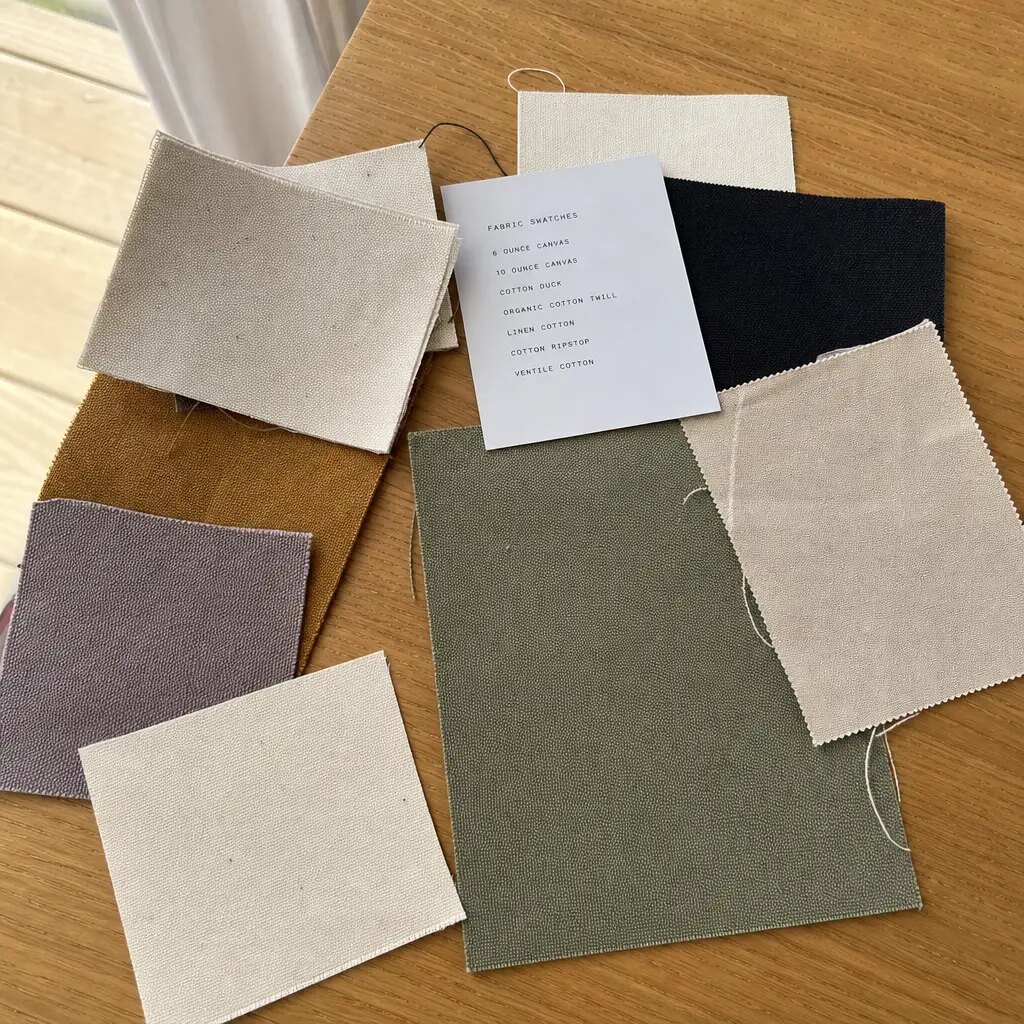
The Buying Problem: A Nice Tote Can Fail at Print Proofing
Hotel retail buyers often approve a custom organic cotton tote from a clean digital mockup, then discover the real bag behaves differently. Natural cotton is not a flat white artboard. The base shade can be creamy, slubby, or slightly uneven. Seams pull the panel, handles affect the visible area, and a retail logo that looked centered on screen may sit too low once the bag is filled and hanging in a shop.
For hotel retail, the tote is not only packaging. It may sit beside spa products, resort apparel, wine, books, beach towels, or local gifts. Guests judge it like merchandise. The print proofing checklist must therefore cover the whole production object: fabric GSM, bag size, print method, sewing, handle reinforcement, packing crease control, barcode application, and carton handling. A proof is useful only when it proves the same materials and process that will be used in bulk.
- Treat the approved proof as a production control sample, not a design suggestion.
- Do not approve logo placement without measuring from seams and handle base points.
- Do not compare suppliers using only unit price if one quote includes proofing, packing, and labels while another does not.
- Keep one signed sample with the buyer and one with the factory before cutting bulk fabric.
Choose Fabric Weight by Retail Use, Not by Habit
The biggest early mistake is selecting organic cotton fabric by a familiar description such as 6 oz, 10 oz, or 12 oz without defining the selling use. A 6 oz organic cotton tote can work well for folded guest amenity bags or light resort giveaways. It usually feels soft and packs compactly. For a hotel boutique tote expected to carry books, sandals, bottled drinks, or spa items, many buyers move to 10 oz or 12 oz canvas because the bag feels more stable and retail-worthy.
GSM is easier for cross-supplier comparison than ounces alone. As a practical range, 6 oz often falls around 170 GSM, 8 oz around 220-240 GSM, 10 oz around 280 GSM, and 12 oz around 320-340 GSM, depending on weave and finishing. These are not fixed laws, so the RFQ should state both the target and acceptable tolerance. If a supplier quotes only an ounce weight, request the GSM and whether the fabric is plain weave, canvas, washed, unwashed, dyed, or natural.
- For lightweight amenity use: consider 170-240 GSM where folding and price matter.
- For hotel retail shelves: consider 280-340 GSM for better structure and perceived value.
- For premium resort merchandise: request a heavier canvas sample before committing, because freight and sewing cost rise.
- For large solid prints: avoid very open weaves unless the artwork accepts texture and ink variation.
Organic Cotton Documentation Must Match the Claim
Organic cotton claims create a documentation question as well as a fabric question. Some hotel brands only need the product to be made from organic cotton fabric with a supplier declaration. Others require recognized chain-of-custody documents or transaction certificates. A factory cannot price this correctly unless the buyer states the required claim language and document level before quotation.
If the tote will be sold in a hotel shop, printed with sustainability messaging, or distributed by a retail buyer, the documentation should be handled before sample approval. Changing the claim after production can affect fabric sourcing, label wording, hangtags, and invoice documents. It can also change MOQ because certified fabric stock may not be available in small quantities or in the exact natural shade first sampled.
- State whether the product label will say organic cotton, made with organic cotton, or a more restricted claim.
- Clarify whether certification documents are required for the fabric only or for the finished goods supply chain.
- Separate brand marketing copy from factory documentation requirements in the RFQ.
- Keep approved label wording with the artwork file so the supplier does not improvise.
Print Method Decisions That Affect Proof Approval
For most hotel logos and retail tote graphics, screen printing remains the safest method. It handles one to three solid colors well, gives controlled placement, and can be cost-effective at normal wholesale quantities. The proof must show the actual ink on the actual cotton color. A Pantone color printed on natural organic cotton will not look identical to the same Pantone on coated paper, so the buyer should approve a fabric result, not a paper chip alone.
Digital print, DTF, heat transfer, and embroidery can be useful in specific cases, but they introduce different proofing risks. Digital printing may work for multi-color souvenir artwork but can appear weaker on textured cotton. DTF or transfer can hold detail but may create a plastic hand feel that conflicts with a natural organic cotton story. Embroidery looks premium for small marks but can pucker lighter fabric and is rarely suitable for large front-panel artwork.
- Use screen print for clean hotel logos, line art, and solid brand marks.
- Use embroidery for small premium marks, not large filled graphics on thin cotton.
- Use DTF or digital print only after confirming hand feel, wash behavior, and edge definition.
- Specify whether the print must be water-based, plastisol, discharge-style, or another ink system available to the factory.
Artwork Placement Needs Physical Measurements
A tote bag front panel changes visually after sewing. The top hem, side seams, bottom fold, and handle attachment points all influence what looks centered. A common hotel retail problem is a logo placed correctly on a flat pattern but too low on the finished bag. Another is artwork printed too close to the side seam, making the bag look cheap when displayed full of merchandise.
The artwork sheet should include print size, print position, color references, and placement tolerance. For example, the buyer can define the logo as 180 mm wide, centered horizontally, with the top of the print 90 mm below the top edge, tolerance plus or minus 5 mm. That is more useful than saying center logo on front. If the bag has a gusset, the proof should show whether the printed panel remains flat when filled.
- Measure placement from the finished top edge, not from the cut panel.
- Define whether artwork prints on one side, two sides, gusset, pocket, or label.
- Keep print away from heavy seams unless distortion is accepted.
- Approve both flat view and filled or hanging view for hotel retail presentation.
Sample Approval Should Prove the Production Route
A useful pre-production sample is not just a pretty sample. It should be made with the intended fabric weight, actual handle style, final print method, correct thread, correct label position, and the packing method if retail presentation is important. If the factory makes a sample using substitute fabric because the bulk fabric is not ready, the buyer should label it as a construction reference only, not a final approval sample.
Procurement teams should separate prototype, salesman sample, and pre-production sample. A prototype can confirm size and general layout. A salesman sample can support internal hotel or retail approval. The pre-production sample is the real control item for bulk. Only the last one should lock the standard for inspection unless all substitutions are clearly written and accepted.
- Approve fabric hand feel, thickness, shade, and shrinkage expectation on the physical sample.
- Photograph the sample with a ruler for print placement and handle length records.
- Write any accepted deviations directly on the sample approval form.
- Do not release bulk cutting if logo color, panel size, or handle reinforcement is still undecided.
MOQ Logic Behind Custom Organic Cotton Totes
MOQ is not only a factory preference. It depends on fabric availability, cutting efficiency, print setup, color count, labor scheduling, packing complexity, and documentation requirements. A 300-piece order using stock natural organic cotton and one-color screen print may be feasible. A custom-dyed organic cotton canvas tote with two sizes, three print versions, hangtags, barcodes, and individual retail packing has a different MOQ logic.
Buyers comparing supplier quotes should request tiered pricing and note what changes at each tier. Sometimes the price drops at 1000 pieces because screen setup, cutting loss, and carton handling are spread over more units. Sometimes the price barely drops because the main cost is certified fabric. A good quote should show whether the MOQ is driven by fabric roll quantity, printing setup, or assembly efficiency.
- Separate MOQ by fabric color, size, artwork, and packing version.
- Ask whether repeat orders can use the same screens and whether screen storage has a time limit.
- Check whether sample cost is refundable or credited after bulk order, if that matters to your buying process.
- Avoid mixing many hotel property logos in one small order unless the supplier confirms print setup cost by version.
Quote Data Needed for Fair Supplier Comparison
A vague quote for custom organic cotton totes is difficult to compare because suppliers may include different assumptions. One supplier may quote 10 oz organic cotton canvas with screen print and individual bags. Another may quote a lighter sheeting fabric, no proof sample, and bulk packing. The unit price looks attractive until the missing items return as separate charges or quality compromises.
A better RFQ asks suppliers to show fabric specification, print method, included colors, sample terms, packing method, carton size, lead time, MOQ breaks, and optional charges. The buyer can then compare landed cost instead of ex-factory unit price only. For importers and distributors, carton dimensions and carton weight matter because a bulky tote order can create avoidable freight cost even when the product unit price is low.
- Require the quote to state EXW, FOB, CIF, or DDP basis instead of assuming.
- List setup charges separately: screens, artwork adjustment, sample, label, hangtag, barcode, and special carton marks.
- Request carton quantity, carton dimensions, gross weight, and estimated CBM.
- Ask whether the quoted lead time starts after deposit, artwork approval, sample approval, or fabric arrival.
Packing Choices Can Damage the Proofed Print
Print proofing does not end when the ink looks correct. Hotel retail totes often fail presentation because the printed panel is creased, dusty, moist, or pressed against a rough hangtag edge during export. Natural cotton can also pick up warehouse odor or carton dust if packing is too loose or cartons are weak. Retail buyers should decide whether each tote needs individual polybag, paper sleeve, belly band, hangtag, barcode sticker, or bulk folded packing.
The lowest-cost packing may be acceptable for back-of-house amenity distribution, but retail shelves need cleaner control. Individual packing protects the printed surface but adds labor, material cost, and sometimes sustainability concerns. Paper belly bands look better for natural products but can rub against ink if the bag moves in transit. The sample pack-out should be reviewed before mass packing starts, especially if the bag will go directly to hotel gift shops or distributor warehouses.
- Define folding method so the main logo is not sharply creased.
- Keep barcode stickers off the printed cotton surface unless tested for residue.
- Use carton liners or moisture protection when shipping during humid seasons.
- Limit carton weight so lower cartons are not crushed and printed panels are not permanently marked.
Lead Time Risks and Approval Timing
Custom organic cotton totes usually move through artwork confirmation, fabric preparation, sample making, proof approval, bulk cutting, printing, sewing, trimming, pressing, packing, inspection, and shipment booking. The schedule risk is highest when the buyer approves artwork late, changes logo color after proofing, or requests documentation after the supplier has already selected fabric. A hotel opening, resort season, or retail launch date should be worked backward from the required arrival date, not from the desired order date.
A realistic schedule should leave time for sample revision. If the first print proof is slightly off, the factory may need to adjust screen tension, ink mixing, curing, or artwork position. Rushing directly into bulk production can save a week and lose the whole order if the printed logo is wrong. Procurement teams should write the approval deadline into the PO and identify who has authority to approve the physical sample.
- Reserve time for one sample revision when the logo color or placement is critical.
- Confirm whether the factory can start fabric booking before final print approval without creating risk.
- Set an inspection date before the shipment booking window, not after cartons are already sealed and waiting.
- During peak season, ask which step is the bottleneck: fabric, printing, sewing, packing, or vessel space.
Specification comparison for buyers
| Spec decision | Recommended option | When it fits | Buyer risk to check |
|---|---|---|---|
| Fabric weight for hotel boutique retail | 10 oz to 12 oz organic cotton canvas, about 280-340 GSM | Good for paid retail bags, welcome amenity bags, and gift shop merchandise that must feel durable | If quoted in ounces only, request GSM and fabric construction because two 10 oz fabrics can feel different after washing and calendaring |
| Lower-cost amenity tote | 6 oz to 8 oz organic cotton sheeting or light canvas, about 170-240 GSM | Fits in-room gifts, spa promotions, and lower retail price points where foldability matters | Large solid prints may show fabric slub and ink unevenness; proof on actual fabric, not paper |
| Logo print method | Screen print for 1-3 solid colors with Pantone matching | Best for most hotel logos, resort icons, and clean boutique retail graphics | Confirm ink hand feel, curing temperature, and tolerance for natural cotton shade variation |
| Detailed artwork method | DTF or digital print only after wash and rub testing | Useful for gradients, small batches, or multi-color souvenir artwork | May create a different hand feel from screen print and can look too plastic on organic cotton if not sampled |
| Handle construction | Self-fabric handles with reinforced X-stitch or box stitch | Suitable for hotel shop totes carrying towels, books, bottles, or resort purchases | Handle length and reinforcement must be measured on the sample; a weak bar tack is hard to fix after production |
| MOQ planning | Separate MOQ by fabric stock color, print color count, and size | Helps buyers compare quotes across 300, 500, 1000, and 3000 piece tiers | A low MOQ may use stock fabric and manual cutting; color consistency and unit cost can change at repeat order |
| Proof approval format | Physical pre-production sample plus digital artwork placement sheet | Needed when the bag will be sold at retail or photographed for a hotel brand store | Digital proof alone cannot verify cotton shrinkage, seam alignment, ink penetration, or packing crease marks |
| Packing for retail delivery | Individual recycled polybag or paper belly band, then export carton with inner moisture protection | Useful for hotel retail shelves, front desk inventory, and distributor resale | Over-tight carton packing can crease the printed panel; request carton drop and compression logic before shipment |
Buyer checklist before sampling
- Define the bag use case: paid retail merchandise, guest amenity, event giveaway, or in-room packaging, because fabric weight and packing standard should change by use.
- State the required organic cotton standard in the RFQ and whether transaction documents, fabric scope certificate, or supplier declaration are required.
- Specify fabric weight in GSM and ounces, fabric type, color, shrinkage expectation, and whether the tote must stand with contents or fold flat.
- Provide final artwork as vector files with Pantone references, print size in centimeters, placement from seams, and allowed position tolerance.
- Request a physical print proof on actual production fabric, not only a paper color proof or digital mockup.
- Approve handle length, seam allowance, reinforcement method, stitch density, and loading expectation before bulk cutting.
- Set acceptable tolerances for bag size, print position, color variance, sewing defects, stains, and carton quantity.
- Clarify MOQ by size, fabric color, artwork version, and print method so quote comparisons are fair.
- Require packing details including individual packing, carton dimensions, carton weight, barcode or hangtag needs, and moisture control.
- Lock the approval timeline: artwork confirmation, sample lead time, bulk lead time, inspection date, and shipment booking window.
Factory quote questions to send
- What exact fabric will be used: organic cotton canvas or sheeting, GSM, ounce weight, yarn count if available, and stock or custom woven?
- Is the quoted fabric already available, or does it require dyeing, washing, or separate organic cotton documentation?
- Which print method is quoted, how many colors are included, and what is the maximum printable area on the selected tote size?
- Will the physical proof be made with actual bulk fabric, actual ink, actual handle construction, and actual sewing method?
- What are the MOQ breaks for 300, 500, 1000, 3000, and 5000 pieces, and what changes at each break?
- Are setup charges, screen charges, sample charges, artwork adjustment, hangtag application, and carton labeling included or separate?
- What tolerances does the factory apply for fabric GSM, bag dimensions, print position, Pantone color, and carton quantity?
- What packing is included in the unit price, and what is the extra cost for individual bags, belly bands, hangtags, barcodes, or retail cartons?
- What is the production lead time after sample approval, and which steps create the biggest risk during peak season?
- Can the factory provide pre-shipment inspection photos or third-party inspection support using an AQL standard agreed before production?
Quality-control points to confirm
- Fabric weight should match the approved sample within the agreed tolerance, commonly plus or minus 5 percent unless the buyer sets a tighter standard.
- Finished bag dimensions should be measured after sewing and pressing, not only from the cutting pattern.
- Print position should be checked from top edge, side seams, and bottom seam with a written tolerance such as plus or minus 5 mm for retail totes.
- Pantone color should be judged on the actual cotton ground under consistent lighting because natural organic cotton is not a pure white base.
- Ink curing should pass dry rub and basic scratch checks before packing, especially for dark ink on natural cotton.
- Handles should be pull-tested by sampling across cartons, with focus on the stitch box, seam catch, and thread breakage.
- Seams should show consistent stitch density, clean backstitching, no skipped stitches, and no loose threads visible on retail-facing panels.
- Packing should protect the printed face from hard creases, moisture, dust, and barcode or hangtag abrasion during export transit.