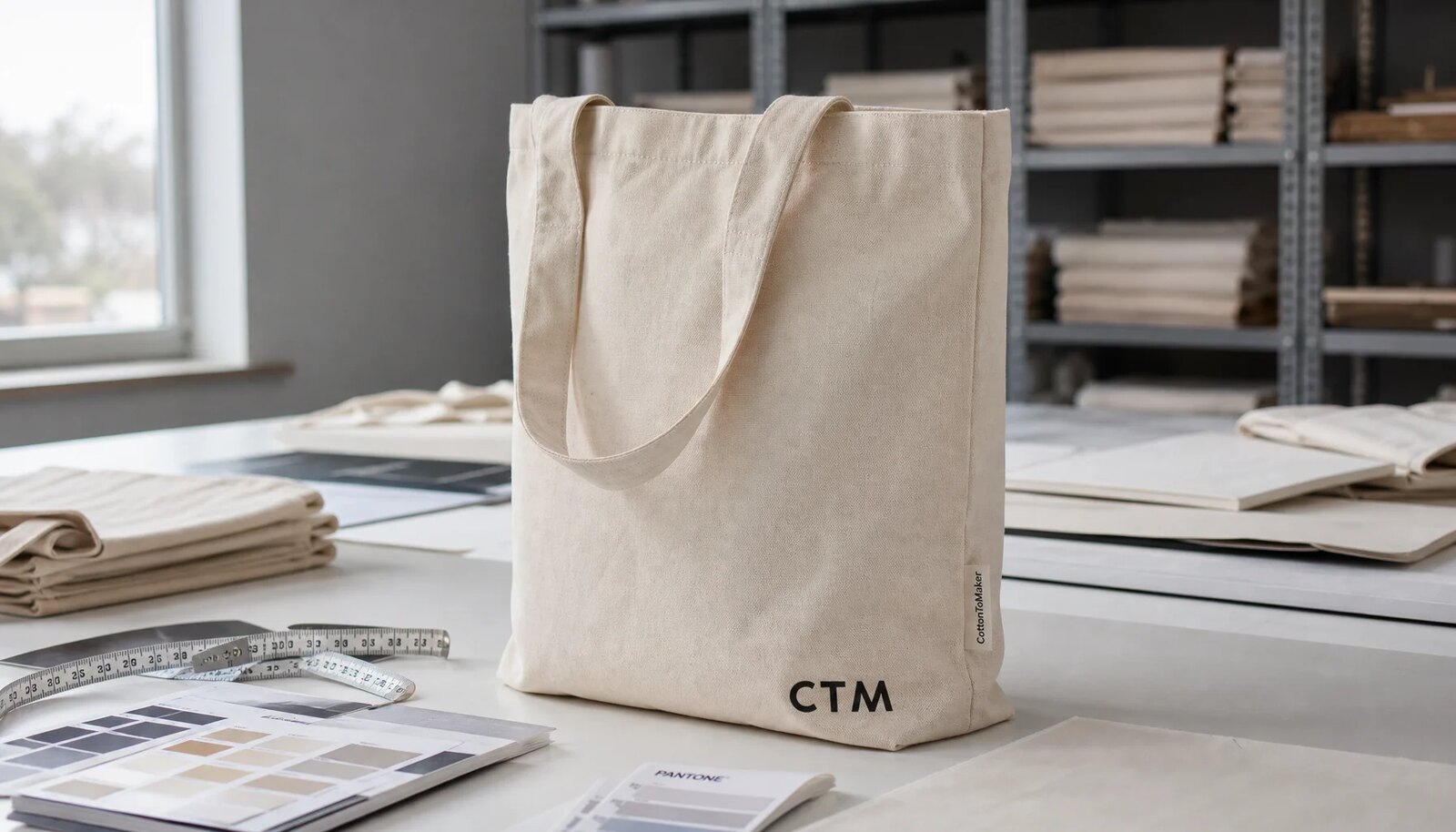
Start With Artwork Risk
Most tote problems begin before the first sample is made. A logo that looks clean on a screen can become soft, heavy, or uneven once it is printed on organic cotton canvas. The surface is not the same as coated paper or a synthetic promotional blank. Yarn thickness, weave density, fabric weight, and finishing all affect how ink sits on the panel. That is why a custom organic cotton totes print proofing checklist for eco apparel brands should start with artwork risk, not with unit price.
Sort the artwork into risk levels before asking factories to quote. A bold one-color mark with open spacing is usually straightforward. Fine type, thin outlines, reversed lettering, large solid blocks, tonal fills, and halftones need closer control because the fabric can absorb ink unevenly and reduce edge clarity. If the supplier is quoting from a screenshot, flattened PNG, or compressed PDF, the proof may reflect guesswork rather than the final artwork. Send the clean file once, name the version clearly, and make the factory confirm the print limits in writing.
The most useful supplier answer is specific. Ask for the minimum positive line weight, smallest reversed text, smallest open gap, and maximum solid print area they are comfortable holding on the selected fabric. Those answers should come back in millimeters or points, not as loose phrases such as no problem or high quality. If the artwork is close to the limit, treat the first strike-off as a technical test, not a final approval.
- Provide vector artwork whenever possible, with fonts outlined or packaged correctly.
- State the exact print width and height in millimeters or inches.
- Identify knock-out text, halftones, gradients, overprint areas, dense solids, and fine-line details.
- Mark a safe area so artwork does not cross a seam, gusset edge, fold line, or handle stitch line.
- Ask the factory to confirm the smallest line, smallest text, and tightest gap it can reliably reproduce on the chosen tote fabric.
Freeze the Tote Spec
A print proof is only meaningful when the tote specification is stable. Body width, bag height, gusset depth, handle length, seam allowance, reinforcement, and fabric weight all change how the artwork lands on the front panel. Move one of those details after artwork approval and the approved proof may no longer match the production bag. This is a common source of extra sample rounds: the print was approved, but the tote body changed underneath it.
Fabric weight matters more than many buyers expect. A looser or lighter fabric can make ink spread slightly and look less crisp. A denser fabric may hold sharper edges but can change hand feel, folding behavior, and carton volume. Natural cotton shade also affects perceived print color. Black ink on undyed cotton reads differently than the same ink on bleached white or dyed cotton. If GSM changes after the strike-off, the proof should be reviewed again.
Treat tote construction as part of the print approval. A logo that sits well on a flat panel can look wrong once the bag is folded, loaded, or displayed. A long handle may pull the top edge into a different shape. A deeper gusset can change the visible front area. Procurement teams should freeze the pattern before sample approval and document any later change as a formal revision with a new quote, new proof, or written waiver.
- Lock final body dimensions, handle length, gusset depth, seam allowance, and reinforcement before sample approval.
- Specify fabric weight by GSM and ask for the acceptable GSM tolerance.
- Confirm whether the tote is unbleached, bleached, prewashed, dyed, or otherwise finished.
- Ask for the sample to be cut from the same pattern piece planned for bulk.
- Record handle reinforcement, side seam build, bottom seam build, and label position before the strike-off is made.
Choose the Print Route
For many custom organic cotton totes, screen print is the most dependable route for repeat retail programs. It works well for solid logos, limited colors, and artwork that needs stable opacity across a larger run. It can also be cost-effective once setup is spread across enough units. Still, screen print is not one single standard. Ink family, mesh count, underbase use, squeegee pressure, drying time, and curing all influence the result.
Water-based and low-cure options can be appropriate, especially when the brand wants a softer hand feel, but the factory must prove the finish on the actual tote fabric. Poor curing can cause cracking, transfer, or marking inside the carton. Too much ink can feel stiff or make a large solid print look heavy. Too little ink can look weak on natural cotton. Ask the supplier to explain the intended setup rather than simply naming the method.
Digital transfer, heat transfer, or other short-run methods can make sense for low quantities, full-color graphics, or market tests. Their risks are different: edge lift, film feel, abrasion at fold points, and inconsistent adhesion if the fabric surface is uneven. If the artwork is simple and the program is likely to reorder, a controlled screen print usually gives buyers an easier approval path. If the artwork is detailed and the order is small, a short-run method may be worth the added QC checks.
- Use screen print for strong solid logos, repeat orders, and limited-color artwork.
- Use digital or transfer routes when low quantity or artwork detail justifies the tradeoff.
- Confirm ink type, color count, underbase needs, curing method, and expected hand feel.
- Avoid ultra-thin lines unless the factory can show a comparable tote sample.
- Require the same ink family and curing route on sample and bulk, not a substitute that only looks similar in photos.
Compare Supplier Routes
The lowest quote is not always the lowest sourcing risk. A direct bag factory with in-house printing can give a cleaner approval loop because fabric, sewing, printing, and packing sit under one production plan. When the tote is a retail accessory or part of an apparel brand program, that control matters. You want the proof to behave like the bulk lot, not like a one-off sample made under easier conditions.
A bag factory that outsources printing can still be a good partner, especially if the outside printer has stronger decoration capability. The buyer just needs clear ownership. Who approves color? Who decides whether a print is pass or fail? Who pays if the printer changes a setting and bulk does not match the sample? If those answers are vague, problems tend to appear late, when rework is expensive and the ship date is already under pressure.
Trading companies and regional converters have real uses. They can simplify communication, support smaller launches, or help with faster replenishment near the destination market. The tradeoff is visibility. A sample may be made by one plant while bulk is assigned to another. Before comparing quotes, ask where the sample is made, where the bulk will be made, and whether any part of sewing, printing, labeling, or packing is subcontracted. This is not a trust issue. It is basic proof control.
- Ask which site made the sample and which site will make the bulk order.
- Request photos or video of the actual print table, curing setup, sewing line, and packing area.
- Identify whether subcontracting is allowed for print, washing, labeling, or packing.
- Tie each supplier route to a specific approval, QC, and rework process.
- If a trading company fronts the quote, ask for the real production factory name on the sample record.
Build a Better RFQ
A strong RFQ makes supplier comparison cleaner because it removes room for quiet assumptions. Instead of asking for a price on custom organic cotton totes, send the tote body spec, fabric target, artwork file, placement drawing, print method preference, color reference, packing requirement, inspection expectation, and delivery term. The more complete the brief, the less likely you are to compare one factory quoting a basic blank with another quoting a finished retail item.
Ask for line-item pricing. Separate the blank bag cost, setup charge, unit print cost, label cost, packing cost, carton cost, sample fee, inspection fee, and freight basis. This helps you see whether a cheap unit price is balanced by high setup fees, downgraded packing, or loose QC. For a one-color tote, fabric use and sewing efficiency may drive the economics. For a multicolor or large-area print, setup, alignment, drying time, and rework risk can matter just as much.
MOQ should also be linked to the real production route. A simple one-color print on a standard tote may have a different practical MOQ than a custom-dimension bag with multiple colors, special labels, and retail folding. Ask for price tiers at realistic volumes: test order, target launch order, and repeat order. That gives procurement a cost curve instead of a single number that may not survive the next artwork revision.
- Send one RFQ pack with tote spec, artwork, placement, packing, QC, and delivery requirements.
- Request tier pricing at test, launch, and repeat quantities.
- Separate setup charges from production unit price.
- Ask for the cost impact of changing color count, tote size, handle length, gusset depth, fabric weight, or packing format.
- Clarify whether sample fees are credited back on bulk orders and what happens if the first approval fails due to supplier error.
Know What a Strike-Off Proves
A real strike-off proves the artwork, ink, fabric, color, placement, and curing route can work together. A logo printed on a random scrap of canvas may be useful for an early discussion, but it is not enough for final approval. The actual tote fabric may absorb ink differently. The finished bag may have a different panel tension. The folded product may create rub points that a loose swatch never shows.
The best proof uses the same fabric weight, tote color, weave, print method, and curing path planned for bulk. If the program includes multiple tote colors, test each meaningful color group. Natural, off-white, bleached, and dyed cotton can all shift how ink appears. A dark green print on undyed cotton may look muted; the same print on bleached cotton may look sharper. Do not approve one colorway and assume every other colorway will behave the same.
Label the proof carefully. The approved sample should show artwork version, approval date, fabric color, tote spec, print method, ink reference, and placement measurements. Keep clear photos as backup, but do not rely on photos alone for final color decisions. Screens, lighting, and camera correction can make an unacceptable sample look fine. For reorders, the labeled golden sample is often more useful than a long email thread.
- Require the strike-off on the actual tote body or a final production fabric panel.
- Capture front, back, packed, folded, and close-up photos of the approved sample.
- Mark the approved sample with date, artwork version, fabric color, print method, and placement measurements.
- Reject any final approval proof made on a different construction, fabric, or print line unless it is clearly labeled as reference only.
- Keep one golden sample for each approved artwork, fabric color, and print color.
Set Tolerances Early
Tolerances turn visual approval into a production standard. Without them, every small shift becomes an argument. With them, the factory knows what to measure and the buyer knows what to accept. For printed totes, the key tolerances usually include placement, print size, color, registration, fabric shade, and defect classification. A practical placement tolerance in millimeters is far more useful than saying centered or neat.
Color needs a physical reference whenever possible. Pantone references can help, but the approved sample on the final fabric is often the better production master because organic cotton shade changes the visual result. If color must match a brand standard closely, say whether the supplier should match the Pantone chip, the approved strike-off, or another physical swatch. Do not make final color approval from phone photos unless the order risk is very low.
Defects should be split into no-go issues and minor irregularities. Pinholes, heavy smear, registration breaks, weak curing, print overlap onto seams, and cracking after a simple fold test should normally be treated as serious defects. Tiny natural-fabric irregularities may be acceptable if they are limited and do not affect the logo or retail presentation. The important part is to decide before bulk starts, not after cartons are packed.
- Set written placement tolerance before sample approval.
- Define the color master: Pantone chip, physical swatch, approved strike-off, or golden sample.
- List zero-tolerance defects such as uncured print, heavy smear, seam overlap, severe bleed, cracking, and major registration error.
- Define what counts as minor, major, and critical for print, sewing, fabric, and packing.
- Ask the factory to explain how it checks placement, color, curing, and registration during production.
Approve Production Samples
A good approval chain has at least two steps: strike-off and pre-production sample. The strike-off tests whether the artwork and print route are workable. The pre-production sample proves the factory can repeat the result after the real cutting, sewing, printing, labeling, finishing, and packing setup is in place. Buyers who approve only an early mockup often miss the defects that appear once the tote moves through the full process.
The pre-production sample should be treated like the first sellable unit. Check the print placement, ink coverage, hand feel, handle symmetry, bartacks, seam strength, label position, fold direction, packing method, and carton mark format. If anything is accepted as a variance, document it clearly. A slightly shifted logo may be acceptable within tolerance. A weak cure or print transfer is not a harmless variation; it can worsen in transit.
Do not release bulk production from a photo alone when the order is material to the season or retail launch. Photos are useful for speed, but they cannot fully show hand feel, cure quality, fabric shade, or carton compression. When timing is tight, ask the factory to send a sealed pre-production sample and hold the production decision to a specific approval deadline. A rushed sample process can save a few days and cost far more once rework begins.
- Approve one golden sample and keep it in the production file.
- Require the pre-production sample after the first full production setup, not before.
- Check print placement, ink cure, handle symmetry, seam build, label position, folded presentation, and packing.
- Document any acceptable variance before bulk release.
- Do not release the order until the sample is signed, dated, and matched to the artwork version and tote spec.
Inspect Bulk Quality
Bulk QC should start before the final carton count. Print drift often appears during the run, not at the beginning. Screens can load with ink, pressure can change, fabric panels can shift, and operators may adjust placement to speed up production. Ask the factory to check first, middle, and last units from the run, then compare them against the approved sample. A clean first sample does not guarantee the last cartons are clean.
Inspection should cover fabric, print, sewing, and packing together. A print can pass on a flat table and fail once the bag is folded. A seam can pass visually but distort the logo when the bag is loaded. A carton can be correctly counted but packed so tightly that print faces rub against each other. For organic cotton totes, inspect the whole sellable unit rather than treating decoration as a separate afterthought.
Use simple physical checks. Measure placement. Look at the print under normal and angled light. Rub the printed surface with clean white cloth. Fold the bag along the intended packing line and check for cracking or transfer. Load the handles lightly and look at how the print sits when the bag has shape. These checks are not complicated, but they catch the kinds of problems that make retail teams lose confidence in the shipment.
- Check first, middle, and last cartons against the approved golden sample.
- Measure placement and print size on a random sample of units.
- Inspect ink coverage under normal light and angled light.
- Rub, fold, and lightly crease printed areas to catch cracking, transfer, flaking, or weak cure.
- Inspect seams, handle bartacks, gussets, label position, fold size, carton count, and carton marks as part of the same QC review.
Control Packing and Cost
Packing is part of print proofing because it can damage the approved print. A tote folded the wrong way may press ink against a seam, label, or another printed panel. A carton packed too tightly can mark fresh ink before the shipment reaches the warehouse. If the tote is sold at retail, fold size, label position, barcode placement, and presentation are part of the product specification, not shipping trivia.
The right packing method depends on the channel. A paper belly band may fit a lower-waste retail story. An individual polybag may be needed for dust protection, warehouse handling, or resale requirements. Flat packing may protect the print better but increase carton volume. Folded packing can reduce freight cost but adds abrasion risk. There is no universal answer, so choose deliberately and quote the same packing method across suppliers.
Lead time and landed cost should be read together. Break timing into artwork freeze, strike-off, correction round, pre-production sample, bulk production, inspection, packing, inland transport, and international freight. Break cost into unit price, setup, sample freight, packing upgrade, carton spec, inspection, rework allowance, and delivery term. The number that matters to procurement is landed cost per sellable unit, not the first unit price shown in a quote.
- State whether totes ship flat, folded, banded, tagged, or polybagged.
- Define fold direction, print-facing direction, carton count, carton dimensions, carton marks, and barcode position.
- Ask for a packed presentation sample before bulk packing starts.
- Compare EXW, FOB, or another chosen delivery term on the same basis across suppliers.
- Include setup fees, sample freight, packing upgrades, inspection cost, local handling, and likely rework time in the landed-cost view.
Specification comparison for buyers
| Spec decision | Recommended option | When it fits | Buyer risk to check |
|---|---|---|---|
| Direct factory with in-house screen print | Strong choice for repeat programs where one factory controls fabric, sewing, printing, and packing | You need a proof that should closely match bulk output and want fewer production handoffs | Confirm the strike-off is made on the same tote body, same screen setup, same ink family, and same curing route as bulk |
| Bag factory plus outside print partner | Useful when the tote factory sews well but needs a specialist printer for complex artwork or ink requirements | You need more colors, a special ink, or decoration capacity the sewing factory does not keep in house | Agree who owns color approval, who pays for rework, and whether the print partner may change mesh, ink, cure settings, or placement setup |
| Trading company with multiple factories | Practical when buyers want one quote channel across several possible production plants | You are comparing countries, lead times, MOQ levels, or mixed bag programs | Check whether subcontracting is hidden and whether the sample came from the final bulk factory |
| Sample-room prototype first | Best for new tote dimensions, first-time artwork, or a launch where the print area is not yet proven | You want to solve construction and artwork risk before booking the production line | Do not approve a prototype unless it uses the final fabric weight, print method, seam build, and finishing route |
| Organic-certified factory with controlled yarn stock | Appropriate when the program needs stronger material traceability and document discipline | You need stable quality across reorder cycles and clearer control of approved fabric lots | Expect stricter MOQ structure, less flexibility on late color changes, and tighter control over fabric substitutions |
| Regional converter near the destination market | Helpful for urgent replenishment, small retail drops, or simpler freight management | You need faster reorders and can accept a higher unit cost | Watch for fabric shade variation, smaller print tables, limited custom packing, and weaker repeatability if blanks change |
| Low-MOQ digital or transfer print route | Good for market tests, detailed graphics, or short runs that cannot absorb screen setup costs | You need fewer units or artwork detail that is not practical for standard screen print | Check hand feel, edge sharpness, curing quality, fold marks, and abrasion durability before scaling |
| Split-source run with a second-source backup | Useful for larger retail programs that cannot stop if one supplier slips | You are managing seasonal launch risk or need backup capacity for reorders | Make sure both suppliers use the same approved artwork file, tote spec, packing standard, tolerance sheet, and golden sample |
Buyer checklist before sampling
- Freeze final tote size, handle length, gusset depth, seam allowance, reinforcement, and target fabric weight before requesting a strike-off.
- Send one vector artwork file, one physical or Pantone color reference, and one placement drawing with exact print dimensions and safe zones.
- State whether the tote should use a light, midweight, or heavier fabric range, then ask the factory to confirm the actual GSM and GSM tolerance it will source.
- Confirm the print method, number of colors, ink type, curing method, screen mesh or transfer route, and whether an underbase is required.
- Require the sample to be made on the same fabric color, weave, construction, and finishing route planned for bulk production.
- Define placement tolerance, color target, and no-go defects such as pinholes, bleeding, weak curing, mottling, cracking, heavy smear, or print over seam lines.
- Request a quote that separates blank bag cost, print setup, unit print cost, sample fee, labels, packing, carton charge, inspection fee, freight basis, and rework policy.
- Agree on inner packing, fold direction, master carton count, carton dimensions, carton marks, barcode position, and retail presentation before bulk starts.
- Require a pre-production sample after the real cutting and printing setup, not only an early mockup, loose fabric strike-off, or photo proof.
- Get the production calendar in writing, including artwork freeze, strike-off timing, pre-production sample timing, bulk start, inspection window, rework buffer, and ship date target.
Factory quote questions to send
- What exact fabric weight, weave density, yarn type, color, and finish will you use for the sample and the bulk order?
- Will the print be screen print, digital transfer, heat transfer, or another method, and how many colors are included in the quoted price?
- What is the actual GSM tolerance on the fabric you will source, and how do you verify incoming rolls before cutting?
- Is the sample made in the same workshop line as bulk production, or is it a separate sample-room build?
- What is the MOQ at each price tier, and does the price change if we adjust tote size, handle length, gusset depth, fabric weight, or print area?
- What is included in the unit price: blank tote, print, woven or care labels, hangtag, inner packing, master carton, carton marks, and basic inspection?
- How many working days are needed for strike-off, pre-production sample, bulk production, packing, and final inspection after artwork approval?
- What placement tolerance, fabric shade tolerance, and color reference will your team use for final approval?
- If the first print approval fails, what is the correction process, how many days does it add, and who bears the cost?
- Are any parts of sewing, printing, washing, labeling, or packing subcontracted, and if so, which factory actually handles the bulk goods?
Quality-control points to confirm
- Verify fabric weight against the approved range and inspect the print zone for slubs, thin spots, stains, fold lines, or visible weave distortion.
- Confirm the print placement is centered or intentionally positioned within the agreed tolerance on every approved size, colorway, and panel orientation.
- Check ink coverage under normal light and angled light to catch patchiness, bleeding, weak edges, uneven opacity, mottling, or cure problems.
- Rub, fold, and lightly crease the tote to see whether the print cracks, transfers, flakes, or marks the opposite panel.
- Inspect seams, handle bartacks, side gussets, and bottom corners because print issues often become visible when the bag is folded, loaded, or stacked.
- Review one sealed pre-production sample against the artwork file, placement drawing, fabric approval, and packing standard before bulk release.
- Randomly measure packed units for fold size, label position, barcode position, carton count, carton dimensions, and carton marking accuracy.
- Test the print on the final fabric color because natural, bleached, off-white, dyed, and undyed cotton can change the apparent ink tone.
- Check first, middle, and last cartons so you can see whether print density, registration, or placement drifts during the run.
- Keep one approved golden sample for each print color, fabric color, and tote construction in the production file for reorder control.