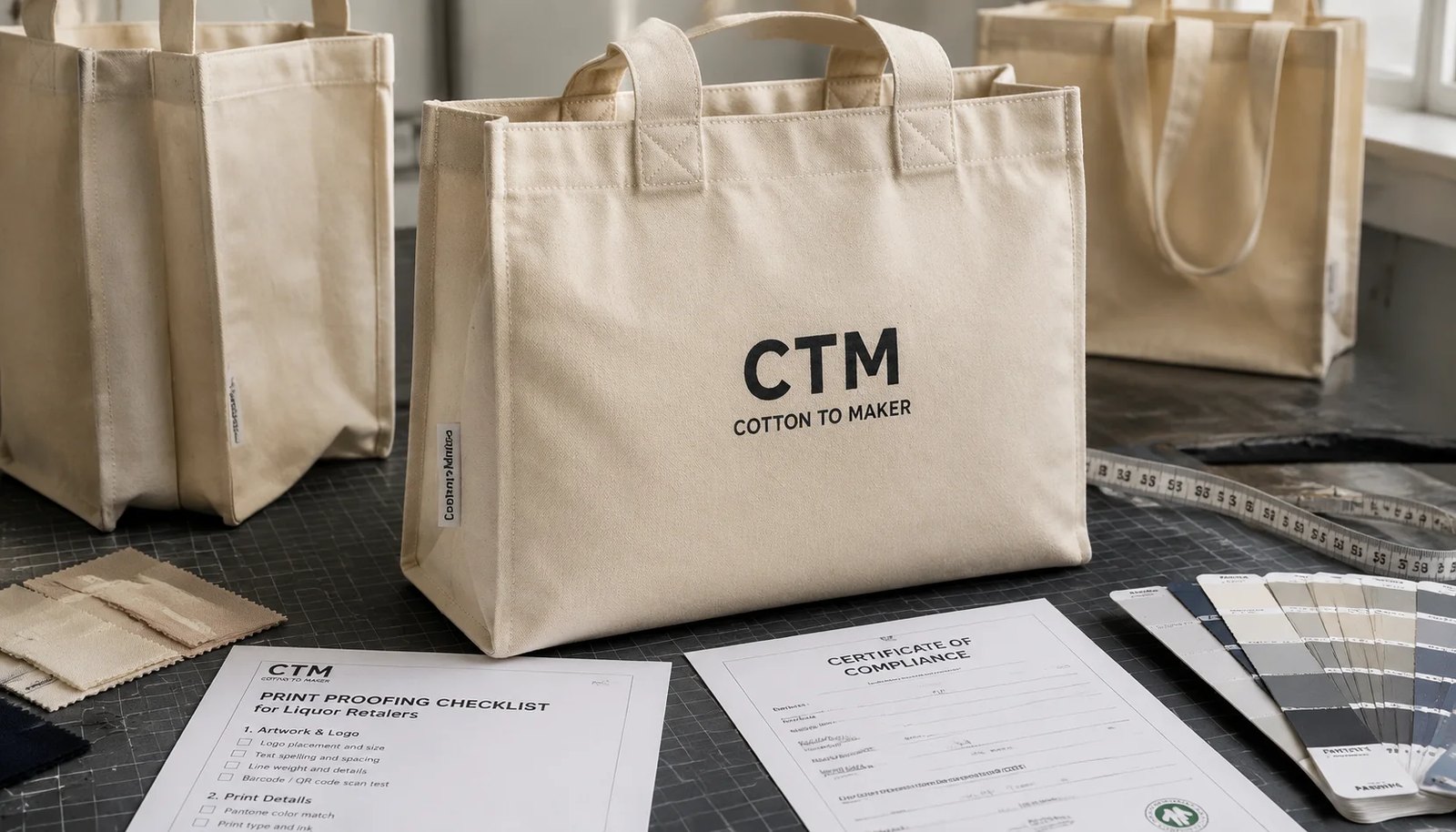
Why liquor retailers need a stricter print proofing checklist
A custom tote for liquor retail is not just a promotional canvas bag. It is a load-bearing item that sits at checkout, appears in gift programs, and is handled at close range by store staff and consumers. That creates two approval pressures at once: the bag has to carry glass safely enough for its intended use, and the print has to look clean enough for a retail environment.
That is why proofing errors are expensive in this category. A logo can look fine on a digital PDF but become soft on textured cotton. A centered print can look off once a bottle pulls the front panel under tension. A natural cotton base can shift brand color enough to trigger complaints from marketing even when the printer followed the ink formula. For procurement, the goal is not a perfect art file alone. The goal is a specification and approval path that reflects real production conditions.
- Loaded bags behave differently from empty sample-table bags.
- Gussets, seams, and handle placement reduce usable print area.
- Natural cotton affects color perception and fine-detail sharpness.
- Retail-facing defects are more visible on gift and checkout bags than on generic promo totes.
Start with the organic claim before you start with the print
For the Organic Cotton Bags category, the biggest avoidable mistake is treating 'organic' as a simple fabric description. Procurement should confirm what claim is actually needed. Some retailers only need internal sourcing preference. Others intend to say 'organic cotton' on product pages, POS material, or sewn labels. Those uses can require different documentation expectations depending on your market, compliance team, and brand policy.
Ask early whether the supplier is offering certified material under a recognized standard such as GOTS or OCS, or whether they are making a more limited supplier-declared claim. Also ask whether the certified entity in the paperwork is the same entity manufacturing, converting, or exporting your goods. If your business requires transaction certificates for each order, confirm that before placing production, not after bulk is finished. A factory may hold a valid certificate, but that does not automatically mean every order can be marketed in the same way.
- Request a current certificate copy and check the scope holder name.
- Confirm whether your order can be supported by transaction certificate paperwork if required.
- Match the marketing claim language to the actual chain-of-custody support.
- Do not assume any 'organic cotton' quote supports retail-facing certification claims.
Choose fabric and construction before approving artwork placement
Buyers often jump to logo size and Pantone matching too early. In practice, fabric and bag construction determine how well the print will perform. For liquor retail, organic cotton canvas around 280-340 GSM is a common quoting range for many one-bottle and general gift-tote uses, but it should be treated as a starting point, not a universal rule. The right weight depends on bottle count, bottle profile, handle reinforcement, and how premium or structured the finished bag needs to feel.
Construction is just as important. A bottom gusset or full gusset usually supports bottle carry better than a flat tote. Reinforced handle attachment is critical because front-panel print quality means little if the bag stretches badly in use. Procurement should also preserve seam and fold clearances around the artwork. If the print lands too close to the gusset fold or stitch zone, even a technically good print run can look crooked or cramped at retail.
- Use the bottle count and bottle dimensions to drive the tote spec.
- Confirm gusset depth with an actual bottle-fit check.
- Keep artwork clear of folds, seams, and handle stitch zones.
- Ask the supplier to recommend fabric and reinforcement based on intended load, not price alone.
Match the print method to the order profile
For most custom organic cotton totes used by liquor retailers, screen printing remains the default benchmark for simple spot-color logos. It usually balances cost, speed, and a textile-appropriate finish well at moderate and larger volumes. It is commonly suitable for one- to three-color store branding, event logos, and seasonal campaign art where crisp but not ultra-fine detail is required.
Transfer-style methods can still be useful for low-volume pilots, multi-color graphics, or designs with more image detail than standard screen printing can handle economically. But procurement should compare like with like. If one supplier quotes screen print and another quotes transfer, unit pricing alone is misleading because handfeel, durability, and approval appearance may differ. Also avoid treating any suggested line-weight rule as universal. Instead, ask the factory to confirm the minimum printable detail that is realistic for your exact fabric and process.
- Use screen print as the base comparison for simple brand graphics.
- Use transfer methods only when artwork or order size clearly justifies them.
- Get fabric-specific guidance on line weight and reverse detail.
- Make sure the approved proof route matches the likely bulk production method.
Build a proofing sequence that reflects real production
A useful approval flow usually has three stages. First, a digital artwork layout confirms spelling, scale, and placement concept. Second, a print strike-off or swatch shows how color and detail sit on the actual organic cotton fabric. Third, a sewn pre-production sample reveals the production realities that flat proofs miss: panel skew, seam interaction, handle alignment, gusset effect, and the visual balance of the print on a finished bag.
For liquor retail, the third stage matters most. Do not review the sample only when empty. Insert the actual bottle, or at least a bottle with the same dimensions and weight range, then view the bag from normal checkout and gifting distance. If the logo buckles into the gusset, drops too low under load, or loses readability because the panel collapses, that is a proofing failure. It is cheaper to catch this in sample review than in claims discussion after a full production run.
- Approve print size in millimeters, not only by visual impression.
- Use actual fabric and actual print method in the pre-production sample.
- Review the tote both flat and bottle-filled.
- Record placement from hem, side seam, and centerline for repeatability.
Set measurable acceptance criteria for print and appearance
Many tote disputes happen because approval comments stay subjective. Terms such as 'centered,' 'good color,' or 'looks clean' are too loose for procurement use. The approved specification should state the print width and height, target distance from top hem, and acceptable left-right deviation. If the bag has a gusset, note whether centering is judged on the flat panel or on the visual front face when the tote is assembled.
Color approval also needs context. On natural organic cotton, the base tone influences the final look. Instead of asking for a generic Pantone match, define the Pantone reference and note that final evaluation is visual on the approved fabric base under agreed lighting conditions. If the artwork contains small text or reverse elements, add a readability requirement. The factory should know that maintaining open counters and clean negative spaces is part of acceptance, not an optional improvement.
- Define placement numerically, not verbally only.
- Approve color against the fabric base, not just the ink formula.
- Add readability criteria for legal copy and fine detail.
- List visible retail-facing defects that are unacceptable on arrival.
Sample review should test function as well as looks
A liquor tote can pass a print approval and still fail commercially if the function is wrong. Sample review should include a simple use test. Fill the tote with the intended bottle type, lift it repeatedly, and observe the handle comfort, opening width, bottom support, and panel distortion. This is especially important for gift totes and paid add-on bags because consumer expectations are higher than for free promotional giveaways.
Procurement should also review the inside finish and overall bag presentation. Visible loose threads, rough seam finishing, or poor top-hem appearance can reduce perceived value at checkout even if the print itself is acceptable. If the retailer plans to sell the tote as a reusable accessory, these details matter more. The sample is the point where merchandising, store operations, and sourcing should align before the order is committed.
- Test with real bottle dimensions and approximate filled weight.
- Check whether the opening easily accepts the intended bottle shape.
- Observe how the print reads when the tote is lifted and carried.
- Review visible sewing quality inside and out for premium retail programs.
Compare supplier quotes on certification, landed cost, and risk
A reliable quote comparison should go beyond unit price. For this category, buyers should normalize the offers by fabric weight, bag size, gusset, handle spec, print size, print method, packing, and document support for the organic claim. If one supplier quotes a heavier canvas, includes a sewn sample, and can support the required certification paperwork, that quote is not directly comparable to a lighter, digitally approved, non-certified offer.
Add commercial rows to your comparison. Ask each supplier to separate EXW or FOB pricing, setup and screen charges, sample fees, carton dimensions, estimated gross weight, and any packing upgrade costs. Also confirm the intended Incoterm. Small differences in carton efficiency and chargeable weight can materially affect landed cost on bulky cotton bags. For procurement, the best value is usually the quote that reduces approval ambiguity and claim risk while remaining commercially workable.
- Normalize every quote to the same technical specification.
- Separate one-time setup cost from repeat-order unit cost.
- Compare certificate support and sample scope, not just fabric and print.
- Include carton and Incoterm data when estimating landed cost.
Packing, receiving, and final QC often decide whether the order succeeds
Packing can either protect a good print run or damage it before arrival. Freshly printed cotton can scuff during sea transit if bags are packed too tightly or before full drying and curing are complete. In many cases, simple fixed bundle counts and careful flat packing are enough. In higher-risk designs, such as dark heavy prints or premium retail presentations, basic interleaving may be justified. Procurement should ask for the rationale rather than applying extra packing by habit.
Receiving requirements also belong in the RFQ. Liquor retail distribution may involve a central warehouse, a 3PL, or direct store allocation. Carton markings, barcode labels, bundle counts, and mixed-carton rules should be decided before production so the supplier can pack accordingly. Final QC should include both visual inspection and a practical bottle-fill check on sample units. That combination catches the issues most likely to matter in-store: crooked presentation, weak handles, visible stains, unreadable print, or cartons that are hard to receive accurately.
- Use packing specs that protect the print without inflating cost unnecessarily.
- Define carton labels and receiving details before production starts.
- Include bottle-fill checks in final inspection planning.
- Treat odor, stains, scuffing, and print transfer as retail-facing QC concerns.
Specification comparison for buyers
| Spec area | Recommended option | When it fits | Buyer risk to check |
|---|---|---|---|
| Organic claim documentation | Ask what standard applies: GOTS, OCS, or supplier-declared organic cotton; request current certificate copy and confirm whether transaction certificates are available for your order if required | For any liquor retailer making sustainability claims on-pack, online, or at POS | A factory may hold a general certificate, but your specific order may not qualify for the claim language you plan to use; chain-of-custody scope must be checked before marketing approval |
| Fabric weight | Organic cotton canvas commonly quoted around 10 oz to 12 oz, roughly 280-340 GSM, subject to supplier tolerance and end-use testing | One-bottle gift totes, checkout upsell bags, and repeat-use retail programs needing better shape and print holdout | Lighter fabric can show ink strike-through, silhouette show-through, and poor bottle support; heavier fabric raises cost and carton weight |
| Fabric construction | Canvas weave rather than lightweight plain weave | When the front panel needs clearer logo edges and lower show-through from dark glass bottles | Open weave surfaces can make small text fuzzier and create bigger sample-to-bulk variation |
| Bag format | Bottom gusset or full gusset with reinforced handles | For one- or two-bottle loads and heavier liquor gift purchases | Flat totes may print cleanly on the table but distort under bottle load and make artwork look off-square in use |
| Print method | Screen print for simple spot-color art; transfer methods only when artwork complexity, short volume, or trial needs justify it | Most retail logos, event branding, and seasonal one- to three-color designs | Transfer samples can look sharp but feel less textile-like or behave differently in durability testing; quotes are not comparable if print methods differ |
| Artwork tolerance planning | Supplier-confirmed minimum line weight and reverse-space limits for the chosen fabric and print method | For serif logos, legal copy, and badge-style marks on textured canvas | Generic minimum rules are not universal; if not confirmed in writing, fine detail may fill in during production |
| Proofing route | Digital layout plus print strike-off or swatch, plus sewn pre-production sample on actual fabric when launch risk is meaningful | New designs, new suppliers, chain retail launches, or projects with multiple internal approvers | Digital proofs do not show absorbency, skew, handle placement, gusset interference, or loaded-bag appearance |
| Color standard | Pantone reference plus written note that final approval is visual on natural cotton base, with agreed tolerance | For store branding and seasonal campaigns where consistency matters | 'Match Pantone' alone is vague on unbleached fabric; natural base tone can shift perceived color |
| Packing and receiving | Flat packed in fixed bundle counts, with interleave only if print scuff risk justifies it; define carton marks and receiving labels | Standard replenishment orders, warehouse receiving, and store allocation programs | Loose packing can scuff prints; overpacking increases landed cost; unclear carton marks slow receiving |
Buyer checklist before sampling
- Define the actual retail use: one bottle, two bottles, general carryout, or gift-with-purchase, because construction and print placement depend on load.
- State finished bag size, gusset depth, handle length, handle width if relevant, seam construction, and reinforcement method in the RFQ.
- Specify the organic material expectation clearly: for example organic cotton canvas target GSM, desired standard such as GOTS or OCS if required, and whether transaction certificates are needed for your claim.
- Confirm what organic claim will appear in marketing, swing tags, carton labels, or online listings so the factory documentation matches the claim scope.
- Provide vector artwork and show final print size, print position, seam clearances, and maximum acceptable deviation from centerline.
- Ask the supplier to confirm minimum printable line weights, reverse-space limits, and small-text readability for your chosen fabric and print method.
- Set color approval terms using Pantone references plus a note that visual approval is on natural cotton fabric under agreed lighting.
- Require a physical pre-production sample on actual fabric and with actual print method for launch-critical orders or first orders with a new supplier.
- Test the sample with actual bottle dimensions and approximate filled weight before giving final print approval.
- Define packing requirements early: bundle count, carton count, barcode labels, PO marks, carton gross weight target, and whether mixed-SKU cartons are allowed.
Factory quote questions to send
- Which organic standard, if any, applies to this tote: GOTS, OCS, or another claim basis, and which site in the supply chain holds the certificate?
- Can you provide the current certificate copy, scope holder name, and confirm whether a transaction certificate can be issued for this order if we require one?
- If we label or market this bag as organic cotton, what exact wording do you recommend based on your available chain-of-custody documents?
- What fabric weight and weave are you quoting, and what supplier tolerance do you normally use for GSM and finished size?
- What print method are you pricing for this artwork, how many colors and sides are included, and what artwork limitations should we accept on this fabric?
- What minimum positive line, reverse line, and text size do you recommend for this specific print method on this canvas?
- Will you provide only a digital layout, or also a strike-off and sewn pre-production sample using actual fabric and actual print method?
- What tolerances do you use for bag width, height, gusset, handle placement, and logo centering on sewn cotton bags?
- What reinforcement is included at handle attachment points, and what realistic bottle-load range do you suggest for this construction?
- How soon after printing are bags packed, and what measures do you use to prevent offset, rubbing, moisture exposure, or odor build-up in cartons?
Quality-control points to confirm
- Verify that the supplied organic documentation matches the approved claim basis and shipment paperwork, and that certificate details are consistent with the supplier entity actually producing or exporting the goods.
- Check fabric handfeel and GSM consistency against the approved sample and agreed tolerance; avoid mixed lots with visibly different weight or surface texture in one shipment.
- Measure finished bag width, height, gusset depth, and handle drop against the approved specification because bottle fit and visual logo position both depend on these dimensions.
- Inspect handle attachment reinforcement and stitch quality under light load testing; weak reinforcement may not show in flat inspection but can fail quickly with glass bottles.
- Compare print color to the approved standard on the natural cotton base tone, not against an isolated ink drawdown only.
- Inspect print edges for bleeding, pinholes, smudging, ghosting, excessive ink build-up, and uneven coverage on textured canvas areas.
- Confirm that small text, negative spaces, and legal copy remain open and readable after curing on bulk pieces, not just on the sample proof.
- Check front-panel skew and side-to-side logo alignment because gusseted bags can look centered when flat but twisted when filled.
- Run a simple bottle-fill evaluation on inspection samples to see whether the print remains commercially presentable when loaded.
- Reject visible retail-facing defects such as oil marks, needle damage, seam grin, loose threads, contamination, strong odor, or obvious panel stains.