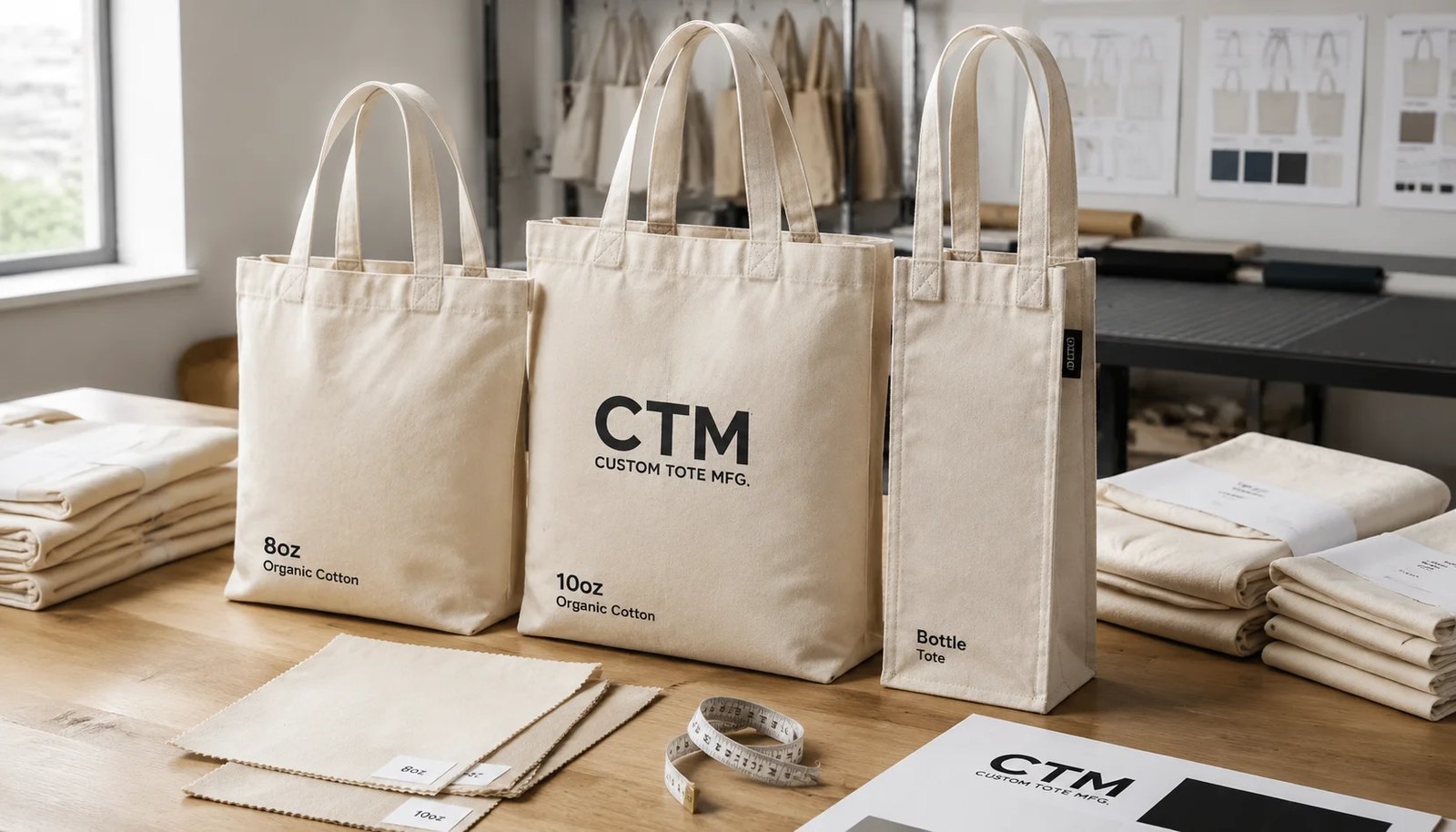
Why MOQ negotiation is different for liquor retailer tote programs
MOQ on a custom organic cotton tote is not just a sales number. For liquor retailers, it is usually the outcome of four operational constraints working together: material availability, construction complexity, print setup, and packing labor. If a buyer asks for a generic organic tote, a supplier may answer with a broad minimum that is only loosely tied to the final product. Once the actual use case becomes clear, that minimum often changes. This is why many first-round quotes look inconsistent.
Liquor retail creates a more demanding specification than a general grocery or event tote. Glass bottles create concentrated point load at the base, more downward stress on side seams, and higher shock load at handle joins when the bag is lifted from a counter. A tote that performs acceptably for flyers, snacks, or apparel can fail quickly with one to three bottles if seam allowance, stitch reinforcement, or gusset geometry are too light. MOQ negotiation therefore cannot be separated from performance requirements.
Another source of confusion is terminology. Buyers and suppliers may both say 'organic cotton tote' while meaning very different products. In RFQ practice, 140 GSM plain weave, 180 GSM cotton shopping tote, 220 GSM canvas tote, and 280 GSM bottle tote are not interchangeable. Nor are flat, bottom-gusset, and full-gusset constructions. The MOQ attached to each is different because cutting yield, sewing time, and material sourcing are different.
For B2B procurement teams, the goal is to identify the specific driver behind the minimum. Is the constraint a mill lot on organic fabric? A custom dye lot? An inefficient print run? A store-ready packing process with manual labeling? Or a factory decision not to run a bottle bag below a certain quantity because QC risk rises? Once that driver is known, you can negotiate with alternatives instead of bargaining blindly.
The practical takeaway is simple: the best MOQ negotiation starts after the bag specification is narrowed enough to reflect how the tote will actually be sold or used in store. Until then, every minimum is provisional.
- Treat MOQ as an outcome of production constraints, not a fixed catalog number
- Bottle-carry use changes structural requirements and often changes the practical minimum
- 'Organic cotton tote' is too broad for quote comparison without GSM and construction detail
- Ask suppliers what operational factor sets the minimum before trying to push it down
- Negotiate spec alternatives, not just quantity alone
Lock the use case first: gift-with-purchase, paid retail, or bottle-carryout
Before discussing target quantity, define the commercial role of the bag. Liquor retailers usually buy totes for one of three broad programs. The first is promotional use, such as a gift-with-purchase, tasting event, or seasonal campaign. The second is paid retail resale, where the bag itself becomes part of the merchandise offer. The third is practical bottle carryout, where the tote is expected to function at checkout for wine, spirits, or mixed purchases. Each program points to a different acceptable cost band and a different construction floor.
In gift-with-purchase programs, the bag still needs to survive the first carry home, but buyers often prioritize lower unit cost, shorter lead time, and simple artwork. In paid retail programs, customers judge the bag as a product, not just a package. Fabric hand feel, print sharpness, and neat seam finishing matter more. In bottle-carryout programs, function becomes critical. A customer may place one heavy spirits bottle, two wine bottles, or a bottle plus boxed items into the tote immediately after purchase. That load profile should be stated in the RFQ.
A useful sourcing habit is to state the intended bottle count in plain terms. For example: 'Bag intended for occasional carry of one to two 750 ml wine bottles' or 'Bag intended for repeated use with up to three 750 ml bottles.' This does not replace formal testing, but it gives the supplier a practical performance target. It also makes it easier to discuss whether 140-180 GSM is enough, whether a 10-12 cm bottom gusset is required, and whether handle reinforcement should be upgraded.
Buyers should also note how the bag will be handled in store. If associates fill it across a busy checkout counter, the mouth opening and gusset behavior matter. If stores keep folded stock at the register, pack size and stiffness matter. If the same program runs across several banners or regions, there may be value in standardizing one base bag specification and varying only labels or barcode stickers. That kind of standardization can materially improve MOQ flexibility.
The strongest procurement briefs do not ask for a 'premium eco tote' or a 'heavy-duty organic bag' in vague terms. They define the business use, expected load, display or resale route, and any store handling requirements. That turns MOQ from an abstract negotiation into a sourcing decision based on function.
- State whether the bag is promotional, resale, or operational carryout
- Define expected bottle count and whether use is occasional or repeated
- Specify if stores need easy-fill gussets or compact folded stock at checkout
- Use one standard base bag across banners where possible
- Avoid vague terms like 'heavy duty' without load and construction detail
Fabric specifications that matter in RFQ: GSM, weave, stock status, and tolerance
Fabric is usually the largest cost component, so it often sets the first real MOQ threshold. In organic cotton tote sourcing, buyers commonly receive options around 140, 180, 220, and 280 GSM. Those figures are useful, but procurement should not rely on GSM alone. A tote's practical performance depends on fabric weight, weave density, seam construction, handle attachment, and bag shape working together. A heavier cloth with weak reinforcement can still underperform.
For promotional liquor retail programs, 140-180 GSM may be acceptable if the tote is mainly a brand carrier and bottle use is limited. However, this range has trade-offs. Lighter fabrics can show more body sag under bottle weight, may print less evenly in large solid areas, and can feel less substantial in a paid retail context. For repeated use or resale, 220-280 GSM organic canvas is often more suitable. The heavier range improves body, perceived durability, and often print coverage, but it can raise both material cost and shipping weight.
The stock status of the fabric matters as much as the GSM. A factory may be able to sew 1,000 bags, but if the required organic fabric construction is not stocked and the mill requires a fresh run, the practical MOQ may move much higher. Buyers should explicitly ask whether the quoted material is stock-supported in natural or dyed form, or whether it must be specially woven or dyed. Natural or off-white stock fabric typically gives the best chance of lower MOQ and shorter lead time because it avoids custom dye-lot constraints.
Terminology should also be standardized inside the RFQ. If the team uses ounces in some documents and GSM in others, quote comparison becomes messy. Use GSM in the PO and technical sheet, and if needed include the approximate ounce equivalent only as a reference. Also request a stated GSM tolerance. A common buyer-side control method is to agree a tolerance band and require the supplier to measure on conditioned fabric rather than by feel or nominal mill statement alone.
For B2B procurement, the right question is not 'What is your heaviest fabric?' It is 'Which organic fabric constructions do you hold or source regularly, in what GSM range, and with what tolerance and minimum?' That answer gives more sourcing value than a generic heavyweight offer.
- Use GSM as the controlling unit in RFQ and PO documents
- Ask whether the fabric is stock-supported or made to order
- Natural/off-white usually gives better MOQ flexibility than custom dyed shades
- Request a stated GSM tolerance and measurement basis
- Do not assume heavier GSM alone guarantees better bottle performance
Construction details that affect bottle performance and MOQ at the same time
Construction is where many procurement mistakes happen because bag drawings often look simpler than they are in production. For liquor retailers, the most important construction choices are bag shape, gusset type, seam allowance, handle width and length, and reinforcement at the handle joins. Each of these affects both usability and production efficiency, which means each can influence MOQ.
A flat tote is the easiest style for factories to cut, sew, and pack. It often supports the lowest minimum, but it is not always the best choice for bottle use. Bottles tend to force the base open, which can distort the side seams and make loading less stable. A bottom gusset, often around 10-12 cm for many wine-bottle applications, is frequently the best compromise. It improves standing behavior and checkout filling without adding as much complexity as a full side-and-bottom gusset. A full gusset can improve capacity and shape but typically consumes more fabric, increases cutting complexity, and requires tighter dimensional control.
Handle construction deserves more scrutiny than many buyers give it. A quote should not simply say 'self material handles.' Ask for width, finished length, attachment method, and reinforcement method. For bottle-carry styles, self-fabric handles with box stitch plus back-tack at stress points are common practical requirements. Cross stitch can also be acceptable if the reinforcement area and stitch consistency are adequate. What matters is not the name alone but whether the join can tolerate repeated load without seam slippage or skipped stitches.
Seam allowance is another hidden quality variable. On a bottle tote, narrow seam allowance may reduce fabric use slightly but increases the chance of seam failure under load. Buyers should request the supplier's standard seam allowance for side and bottom seams and check that the approved sample matches what will be run in bulk. Similarly, if the inside seam is overlocked or otherwise finished, that should be stated. A clean seam finish improves appearance, but more importantly it helps control fraying in repeated use.
From a negotiation standpoint, the key is to simplify where the customer will not notice and protect where the bag truly works hard. That usually means choosing bottom gusset instead of full gusset if suitable, keeping standard handle widths where possible, and avoiding custom structural details unless they solve a real retail problem.
- Bottom gusset often offers the best function-to-MOQ balance for bottle totes
- Full side-and-bottom gusset usually costs more in fabric, labor, and control
- Request handle width, length, and join reinforcement as explicit specs
- Check side and bottom seam allowance, not just outer appearance
- Do not reduce structural details first when trying to lower MOQ
Print method, artwork limits, and how decoration can quietly raise the minimum
Decoration is one of the easiest areas to simplify, yet it is also one of the most common hidden sources of cost creep. For most liquor retailers, a one-color front-panel screen print on natural organic cotton is the most efficient route. It is relatively stable in production, usually durable enough for reusable tote programs, and widely supported by factories. It also tends to support the lowest practical MOQ because setup is straightforward and run speed is predictable.
Complexity enters when artwork moves beyond that standard route. Multiple print colors, fine reversed text, halftones, distressed textures, metallic inks, large solid fills, side-gusset prints, inside prints, and handle prints all increase risk. Some raise only setup time, but others also reduce output speed or increase the reject rate. On natural cotton, exact brand color matching can be especially challenging because the base cloth is not pure white and may vary slightly from lot to lot. That does not mean color consistency is impossible; it means it should be discussed realistically before approval.
For quote comparison, buyers should ask suppliers to separate screen charges or setup charges from run-rate unit pricing. That helps reveal whether the MOQ is driven by print economics or by material and sewing. If alternative print methods such as heat transfer or DTF are proposed for lower quantities, procurement should compare more than visual detail. Film edge, hand feel, rub resistance, and long-term adhesion can matter on a reusable retail tote. A highly detailed logo that feels plasticky or cracks after use may not support the retailer's brand position.
Strike-offs are particularly important when artwork contains large solids or thin typography. A logo that looks fine in a digital file may spread or break on textured canvas. Reversed text that reads well on a screen may fill in on fabric. Procurement teams should require a print strike-off on the actual fabric or equivalent substrate before final sample approval where artwork difficulty warrants it. This avoids expensive disagreement later about what was 'printable.'
The practical negotiation rule is this: if MOQ flexibility matters, simplify decoration before compromising structure. A clean one-color print on the right bag is commercially stronger than a visually complex print on a bag that is underbuilt for bottle use.
- Best low-risk route: one-color screen print on the front panel
- Artwork complexity can affect setup, output speed, and reject rate
- Natural cotton base can shift perceived PMS appearance
- Request strike-offs for fine text, reverses, and large solids
- Compare decoration options on durability and hand feel, not just setup cost
A practical RFQ framework: what liquor retailers should send before asking for MOQ
Many MOQ problems start with incomplete RFQs. If the technical brief is loose, suppliers fill gaps with their own assumptions, and buyers later compare offers that are not equivalent. A stronger RFQ does not need to be complicated, but it should define the specifications that materially affect material planning, production method, and QC. This is particularly important when the bag is intended for bottle carry.
At minimum, the RFQ should state finished dimensions in centimeters, gusset type and depth, target fabric GSM, handle length and width, handle attachment style if known, print location, artwork size, color count, and desired packing route. If the fabric must support a specific organic claim, state that requirement clearly and ask whether the quoted fabric is stock-supported under the supplier's certification scope. If the business only needs an organic content route for procurement policy rather than consumer-facing labeling, make that distinction clear as well.
It is also useful to include functional notes such as intended load. For example: 'Designed for one to two 750 ml bottles plus small boxed accessory' or 'For resale tote, repeated use expected.' These notes help suppliers avoid under-specifying reinforcement. Without them, some will quote the lightest acceptable construction to win the inquiry, creating risk later when samples are reviewed.
For quantities, do not request one number only. Ask for tiered quotes such as 1,000, 2,000, 3,000, and 5,000 pieces, with any one-time charges broken out. Request alternate pricing where commercial flexibility exists, for example: natural stock fabric versus custom dyed fabric, one-color print versus two-color print, bottom gusset versus full gusset, or flat export packing versus retail individual packing. This turns the quote into a decision tool instead of a single price point.
A good RFQ also asks for tolerances. Buyers should request standard tolerances for finished size, handle length, print position, and GSM. If the supplier avoids giving tolerance ranges, that is an early signal to tighten clarification before sampling. Clear tolerances make later inspection and claim handling far easier.
- Include dimensions, GSM, gusset, handles, print, and packing in every RFQ
- State intended load so suppliers quote suitable reinforcement
- Ask for tiered quantities and alternate spec routes
- Separate one-time charges from per-piece costs
- Request stated tolerances before approving samples
MOQ negotiation moves that reduce cost without weakening the bag
The most effective MOQ negotiation is usually specification editing, not aggressive price pressure. Factories are more likely to support lower or more flexible minimums when buyers remove friction from the production plan. In organic cotton totes, the biggest levers are often fabric route, artwork simplicity, SKU consolidation, and pack-out simplification rather than construction downgrades.
The first lever is stock material. If brand standards allow natural or off-white base fabric instead of a custom dyed shade, buyers often gain lower MOQ, shorter lead time, and less shade risk. The second lever is artwork simplification. Moving from two print colors to one, or from multi-position graphics to a standard front-panel print, can materially improve run efficiency. The third lever is base-bag standardization across regional or banner variants. If multiple SKUs can share one fabric lot and one construction while varying only with barcode stickers, inserts, or carton labels, suppliers can often plan production more efficiently.
Packing is the fourth and often underused lever. Retail-ready individual bagging, inserts, and mixed assortments create manual labor. If the bags will be distributed through a DC and unpacked there anyway, flat standard export packing may produce better total economics. Likewise, if a separate hangtag is not essential, printing required information on a care label or applying a simple barcode sticker can reduce touchpoints.
What should not be the first concession? Structural basics that make the tote work for liquor retail. Reducing gusset support, weakening handle attachment, or dropping to an unsuitable fabric weight simply to hit a smaller minimum usually pushes cost and risk into returns, complaints, or brand damage. A bag that fails with bottles is not a successful MOQ negotiation.
A disciplined buyer often gets better results by asking, 'Which changes would reduce your minimum without affecting bottle-carry performance?' That phrasing tells the supplier you are willing to simplify intelligently, but not at the expense of product function.
- Use stock natural fabric first if MOQ flexibility is the goal
- Simplify print before changing structure
- Consolidate multiple SKUs onto one base bag where possible
- Challenge retail-ready pack-out requirements that add manual labor
- Protect bottle-carry performance while removing non-essential customization
How to normalize supplier quotes and identify hidden assumptions
When MOQ numbers differ widely between suppliers, the first task is normalization. A lower minimum from one factory does not necessarily mean a better offer; it may mean that supplier assumed lighter fabric, looser tolerances, no retail labeling, or a simpler construction. Procurement should build a quote comparison sheet that forces each supplier onto the same basis before internal review.
Separate the quote into categories: material, printing, sewing, packing, sampling, one-time setup charges, and lead-time assumptions. Then compare whether the same fabric construction is being quoted, whether the same print method and artwork size are included, whether the same packing counts are assumed, and whether the same organic documentation route applies. If one quote includes hangtags, barcode application, and retailer carton marks while another does not, the unit prices are not directly comparable.
Lead time also needs normalization. Some suppliers count production time from deposit, others from artwork approval, and others only after pre-production sample approval. This can create a misleading appearance of speed. Procurement should note the trigger event for the quoted lead time and identify any buyer-supplied items that could delay material release, such as final barcode files, carton marks, importer details, or approved artwork.
One-time charges deserve special attention in smaller programs. Screen setup, sample fees, print separations, labeling charges, and carton mark fees can materially affect the economics of a 1,000-piece order. They matter less on a larger annual reorder, but for a short seasonal run they can change the true landed cost. Ask whether sample charges are refundable against bulk order and whether screen charges repeat on future orders if artwork stays unchanged.
The result should be a fact-based comparison, not a price-only ranking. In many B2B sourcing decisions, the better supplier is the one with clearer assumptions, stock-supported fabric, realistic tolerances, and fewer downstream surprises, even if the headline MOQ or first-round unit price is not the absolute lowest.
- Normalize GSM, dimensions, print, and packing before comparing MOQ
- Record what event starts the lead time clock
- Separate setup and sample charges from run-rate price
- Check whether organic claim support is the same across suppliers
- Use a comparison sheet so internal stakeholders can see real differences
Sampling, tolerances, and QC checkpoints for bottle-carry tote orders
Sampling is where buyers convert an RFQ into a controlled production standard. For liquor retailer totes, a useful sequence is fabric swatch approval, print strike-off where needed, pre-production sample, and if retail packing is complex, a packed sample. This order matters because many disputes begin with fabric appearance or print behavior, not with sewing alone.
Fabric swatches should be checked for base shade, surface cleanliness, visible specking, hand feel, and approximate weight expectation. Natural organic cotton can show variation, and if the retailer considers that acceptable it should be documented early. If not, the supplier needs to say whether a cleaner or more uniform construction is available and at what cost or MOQ impact. Where the artwork is sensitive, especially with fine text or large fills, a strike-off on actual or equivalent fabric is worth the time. It confirms ink opacity, edge definition, and realistic color appearance before full sample making.
The pre-production sample should be measured and function-checked, not just visually approved. Buyers should verify width, height, gusset depth, handle length, and print position against the agreed tolerances. Common practical tolerances that buyers ask factories to declare include a size tolerance in millimeters or centimeters, handle length tolerance, print position tolerance, and GSM tolerance. The exact range should be agreed with the supplier and recorded on the approved sample or tech pack rather than assumed later.
For bottle use, a basic functional check is essential. Load the sample with the intended number of bottles and lift it repeatedly in a consistent way. Observe whether the base distorts excessively, whether the handles twist, and whether stitching at the joins shows strain. This is not a substitute for formal lab testing, but it is an effective pre-production control. If the supplier has an in-house load test routine, ask them to explain it and document the method used for the approved sample.
Final QC should cover both product and packing. Product checks include GSM verification against the agreed tolerance basis, dimensional measurement, handle attachment consistency, seam allowance consistency, skipped-stitch review, print clarity, and cleanliness. Packing checks include inner-pack count, carton count, gross carton weight if specified, barcode application, carton marks, and any approved label wording related to organic claims. Clear acceptance criteria are one of the best protections against repeat disputes on custom tote orders.
- Approve swatch, strike-off, PPS, and packed sample in sequence
- Measure size, gusset, handle length, and print position against stated tolerances
- Function-check the sample with real bottle load before bulk approval
- Inspect seam allowance and handle reinforcement, not just appearance
- Verify packing execution and label wording during final inspection
Packing, logistics, and quote questions buyers should ask before placing the PO
Packing is often treated as an administrative detail, but in tote sourcing it can materially affect MOQ, labor cost, freight efficiency, and receiving accuracy. Standard export packing is usually the most efficient route: bags are folded flat, packed by style into inner poly if required, and then loaded into export cartons according to count or weight limit. This format supports lower labor cost and easier freight planning. It also reduces the chance that pack-out becomes the hidden reason a supplier resists a smaller run.
Retail-ready requirements change that equation. Individual polybagging, hangtags, barcode stickers, warnings, inserts, and exact store assortments all add manual steps. On a large order this may be manageable; on a modest run it can become the effective MOQ driver because the sewing line is no longer the bottleneck. Buyers should therefore ask not just whether a supplier can do retail-ready packing, but whether that packing changes the minimum, the unit cost, or the lead time trigger.
Carton planning should also be specified early. Heavier 220-280 GSM totes can create cartons that exceed preferred handling weight if packed only for volume efficiency. If the retailer uses a distribution center, 3PL, or parcel network with handling limits, state the maximum gross carton weight in the RFQ or PO. Also specify whether mixed-SKU cartons are permitted, whether inner packs are required, and what shipping marks are needed. These details influence labor and should not be left to assumption.
Strong quote questions help surface hidden cost before commitment. Ask what exactly drives the MOQ: mill minimum, fabric availability, print setup, line efficiency, certification paperwork, or packing labor. Ask whether multiple logo versions can share one fabric lot. Ask what tolerances the supplier works to as standard. Ask what sample fees are refundable, and whether the same screens can be reused on reorders. Ask what final inspection basis is used and whether any function check is performed for bottle-carry bags.
Procurement results improve when the PO reflects these answers clearly. A well-written PO for custom organic cotton totes should lock approved spec, tolerances, sample reference, packing counts, carton limits, labeling details, and the event that starts lead time. That is what turns a negotiated MOQ into an executable supply plan.
- Standard export packing usually supports better MOQ flexibility than retail-ready pack-out
- Retail labels, inserts, and assortments can become the real minimum driver
- Set carton weight limits and carton marking rules in the PO
- Use quote questions to expose cost drivers before commitment
- Reference approved sample and tolerances directly in the purchase order
Specification comparison for buyers
| Spec decision | Recommended option | When it fits | Buyer risk to check |
|---|---|---|---|
| Fabric weight for promo retail tote | 140-180 GSM organic cotton | Best when the bag is a gift-with-purchase, event tote, or low-cost brand carrier | Too light for 2-3 wine bottles unless handle stitch count, seam allowance, and load expectations are clearly upgraded |
| Fabric weight for paid retail tote | 220-280 GSM organic cotton canvas | Works for in-store resale and repeat-use programs where durability affects brand perception | Heavier GSM raises fabric cost, carton weight, and often MOQ if the mill does not hold stock organic fabric in that construction |
| Bag construction | Bottom gusset only, 10-12 cm | Good balance for wine and spirits retail because bottles stand better and packing remains efficient | Side-and-bottom gusset increases cutting complexity, fabric consumption, and dimensional control issues that can push factory minimums on custom sizes |
| Print method | 1-color screen print | Most cost-efficient choice for liquor retailer logos, tasting events, and simple campaign artwork | Halftones, distressed art, metallic inks, or fine reversed text can cause strike-off delays, lower print consistency, and extra setup charges |
| Logo placement | Front panel print within standard print area | Best for MOQ flexibility because it uses standard screen setup and common operator workflow | Side gusset, inside print, bottom print, or handle print may trigger higher labor cost and a higher practical MOQ |
| Handle style | Self-fabric handles, cross-stitched, 60-70 cm length | Suitable for shoulder carry and easier for mixed user groups in retail programs | Short handles save material but may reduce usability for customers carrying bottle purchases or wearing outerwear |
| Organic claim route | Factory uses stock certified organic greige or dyed fabric already in its supply chain | Best way to keep MOQ lower on custom projects because the mill lot already exists | If certification scope, transaction records, or labeling rules are unclear, your organic marketing claim may need to be limited |
| Packing route | Flat packed, 25-50 pcs per inner poly by style, export carton by weight limit | Best for retail distribution centers and lower freight cost per unit | Retail-level individual packing increases labor and material cost and often creates a hidden MOQ on pack-out |
| Bottle-use reinforcement | Box stitch plus back-tack at handle joins, with seam allowance suitable for bottle carry | Useful when the tote is expected to hold one to three glass bottles repeatedly | Some suppliers quote heavy fabric but keep light-duty stitching; fabric weight alone does not guarantee real carrying performance |
Buyer checklist before sampling
- Define whether the tote is for gift-with-purchase, paid retail sale, bottle carryout, loyalty reward, or event use before negotiating MOQ
- State target fabric weight in GSM, not only ounces, because suppliers quote differently by market and fabric weave
- Specify whether the fabric must be certified organic, organic content from stock fabric, or a broader sustainability claim without retail label use
- Confirm finished bag size, gusset, handle length, and target carrying use such as 1 bottle, 2 bottles, 3 bottles, or mixed retail items
- Clarify whether bottle carry is occasional or repeated; this affects stitch reinforcement and acceptable fabric range
- Limit artwork complexity if MOQ flexibility matters; one-color front print is usually the easiest route
- State if exact Pantone matching is required or if a close visual match is acceptable on natural cotton base
- Declare whether individual polybagging, hangtags, barcode labels, carton marks, inserts, or store-ready assortments are required
- Request quote breaks at multiple quantities so MOQ negotiation is based on real cost steps, not only a single threshold
- Ask the supplier to identify what drives the MOQ: mill minimum, dye lot, print setup, sewing efficiency, or packing labor
Factory quote questions to send
- What is your MOQ by bag size, fabric GSM, print color count, and packing method?
- Is the MOQ driven by fabric mill minimum, dye lot, print setup, cutting efficiency, certification paperwork, or carton packing requirement?
- Do you have stock organic cotton fabric in 140, 180, 220, or 280 GSM that can reduce the minimum?
- If we use natural fabric instead of custom dyed fabric, how much can the MOQ, unit cost, and lead time be reduced?
- What changes if we switch from side-and-bottom gusset to bottom gusset only?
- Can you quote the same bag in one-color screen print versus heat transfer or DTF, with setup and run charges separated?
- Can multiple logo versions share the same fabric lot and construction while using different carton labels or barcode stickers?
- How many pieces are included in your sample process, and which sample fees are refundable against bulk order?
- What are your standard tolerances for bag size, handle length, print position, and fabric GSM?
- What stitch pattern and reinforcement do you use at handle joins for bottle-carry styles?
Quality-control points to confirm
- Fabric GSM should remain within an agreed tolerance band and be measured on conditioned fabric, not estimated by feel
- Finished bag dimensions should follow approved tolerance, especially gusset width, base width, and handle drop for bottle-carry use
- Handle attachment must show consistent stitch count, back-tack security, balanced box stitch shape where specified, and no skipped stitches at stress points
- Seams should be straight, with no raw edge exposure where overlock or binding is specified
- Side seams and bottom seams should be checked for seam allowance consistency because narrow seam allowance increases failure risk under bottle load
- Print position must be centered within agreed tolerance and match approved artwork size
- Print coverage should be even, with no pinholes, ghosting, blurred edges, major shade variation, or unacceptable registration shift across the lot
- Natural cotton shade variation should stay within approved range if undyed fabric is used; approve this in the sample stage
- Carton packing count, inner pack count, barcode labels, and shipping marks must match packing list and PO requirements
- Needle control, metal contamination prevention, and final cleanliness should be documented for retail-ready programs