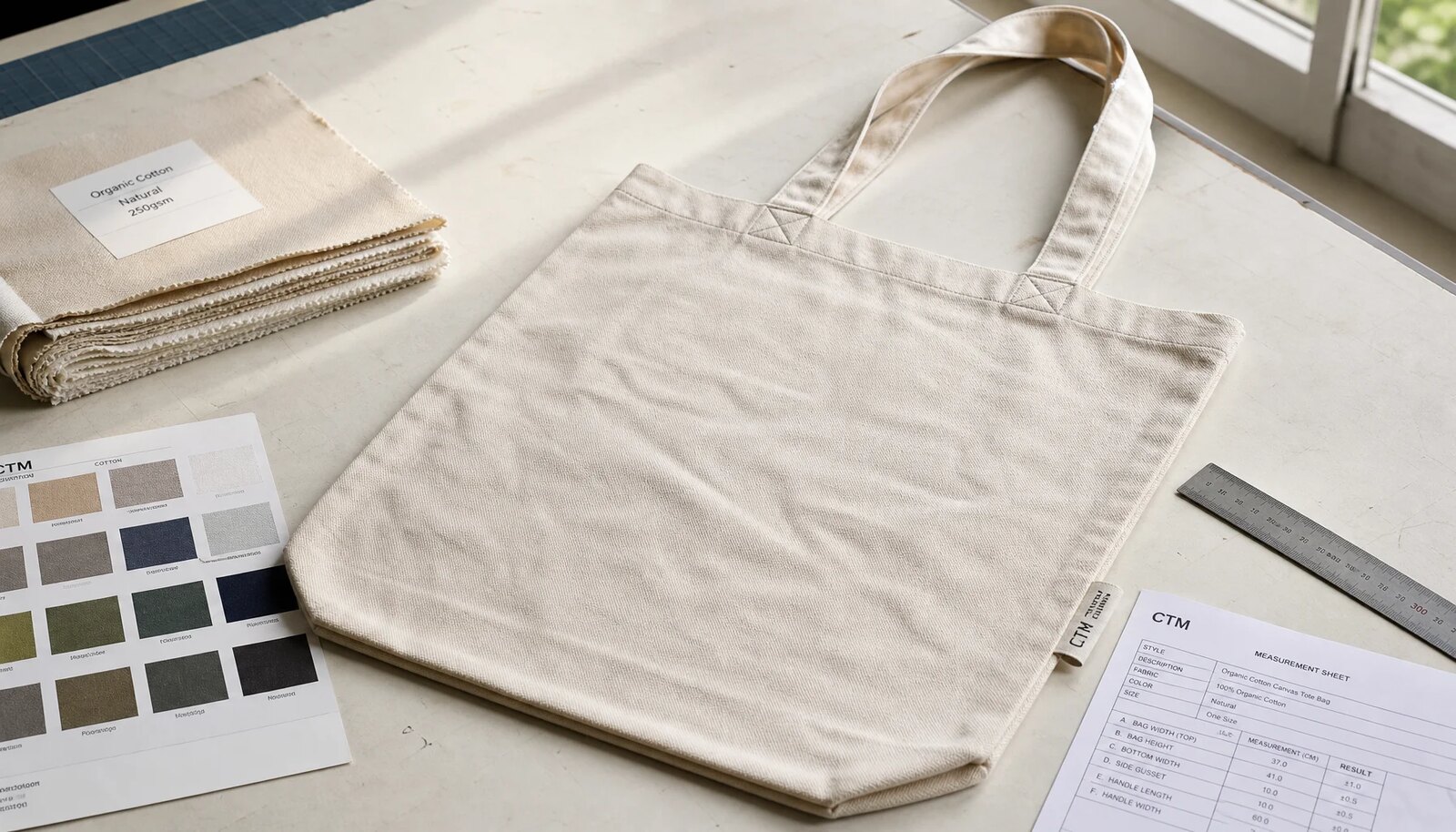
1. Why MOQ Is Harder on Organic Cotton Totes Than It Looks
A custom organic cotton tote looks straightforward from the outside: one body, two handles, a logo, and a fold. In production, it is a stitched textile item that depends on fabric lot control, cutting efficiency, print setup, sewing labor, packing rules, and documentation. That is why the MOQ is rarely a simple sales choice. It reflects the amount of work the factory must lock in before the first bag is finished.
Organic cotton adds another layer. Buyers may need traceability, a documented fabric lot, and a product that matches the approved sample without substitutions. The supplier has less room to swap in a similar cloth, mix leftover stock, or improvise on sourcing. For procurement teams, the useful question is not “what is your MOQ?” It is “what part of this spec creates the minimum, and what can we simplify without changing the product’s job?”
That framing changes the negotiation. A tote with one natural fabric color, one print location, and bulk packing may be achievable at a lower opening quantity than a dyed canvas bag with a woven label, hangtag, barcode sticker, and retail insert. The bag may still be the same size, but the number of setup steps is not. If the supplier can explain the constraint clearly, the buyer can decide whether to accept the MOQ, redesign the order, or compare another factory on a like-for-like basis.
- MOQ is usually driven by fabric booking, print setup, and packing complexity as much as by sewing capacity.
- Organic cotton claims reduce the supplier’s freedom to substitute material, which can tighten minimums.
- One clean spec is more useful than three loosely defined options.
- Lower MOQ only helps if the factory explains exactly what stays unchanged and what changes.
2. Build the RFQ Around a Real Spec, Not a Marketing Phrase
The fastest way to get unreliable quotes is to ask for a “custom organic cotton tote” and stop there. Suppliers will fill in missing information with their own defaults, and those defaults vary. One factory may quote a thin flat shopper, another a heavier canvas bag, and a third a different finish entirely. You cannot negotiate MOQ sensibly until every supplier is pricing the same bag.
A procurement-grade spec sheet should define finished body width, finished body height, gusset depth, handle width, handle drop, top hem, seam construction, reinforcement, label placement, print position, print size, fabric construction, fabric weight, color state, packing method, and acceptable tolerances. If a tote is washed, dyed, or pre-shrunk, say so. Those choices affect shrinkage, hand feel, shade, lead time, and sometimes the MOQ itself.
Do not overcomplicate the first order. The first purchase should prove the commercial and quality model, not showcase every possible embellishment. If the brand needs a lighter entry price, simplify artwork or packing before you weaken the body fabric or handle reinforcement. Procurement should protect the useful part of the product first, then trim cost from the parts the customer is least likely to notice.
- Quote finished measurements, not only artwork mockups.
- Name fabric in gsm or oz/yd² plus weave and finish.
- Write tolerances into the RFQ so sample approval is measurable.
- Separate must-have features from optional upgrades before pricing starts.
3. Fabric Weight, Construction, and Tolerance Targets
Fabric weight is one of the biggest levers in both MOQ and unit cost. A lighter tote around 170-205 gsm suits packaging inserts, event use, and lower-load applications. A midweight canvas around 235-270 gsm is a common fit for reusable retail totes and folded apparel bundles. Heavier canvas around 340-410 gsm creates more structure and a premium hand, but it also raises material usage, sewing difficulty, freight weight, and the risk of bulk defects if the line is not set up for it.
Construction matters as much as weight. A plain weave usually feels more flexible; canvas or duck gives more body. A flat bag is simpler to cut and sew than a gusseted tote. Add a gusset and you gain volume, but you also add operations, measurement points, and more opportunities for variance. If the order is MOQ-sensitive, the simplest shape that meets the use case usually wins.
Tolerances need to be written before the sample is approved. Finished stitched bags will vary slightly because they are cut, sewn, pressed, and packed by hand or semi-hand methods. That is normal. What is not acceptable is ambiguity. Ask the factory to confirm its achievable tolerance for body dimensions, handle drop, print placement, fabric weight, and shade. If it cannot state those ranges, it will be hard to reject an off-spec bulk shipment later.
For many export tote programs, a practical starting point is around ±1 cm on body width and height and around ±0.5 cm on smaller components such as handle width, but the final tolerance should match the factory’s process and the bag’s use. The tighter the bag and print placement need to be, the more you should expect that at sampling and final inspection.
- 170-205 gsm can work for lighter promotional use if load and transparency are acceptable.
- 235-270 gsm canvas is often the most balanced option for reusable branded totes.
- 340-410 gsm should be chosen only when the program can absorb the extra weight, cost, and sewing complexity.
- Agree measurement, gsm, shade, and print-placement tolerances before pre-production approval.
4. Choose the Sourcing Route That Matches the Order Size
A direct factory relationship is usually the strongest choice for repeat tote programs. It gives the buyer clearer visibility into fabric sourcing, cutting, sewing, print setup, packing, and inspection. That matters when the brand cares about exact materials and reorders. The trade-off is that the buyer has to manage more technical detail and give the factory a clean brief. If that discipline is in place, the factory can negotiate around the true cost drivers instead of hiding them in a generic unit price.
A trading company or sourcing agent can be useful when the brand is still refining the spec, needs help finding a lower opening quantity, or is buying several accessory categories at once. That route can be helpful, but the buyer should still ask who actually makes the bags, who controls the sample, and how the production records will be shared. Lower MOQ through a middle layer is not automatically lower risk; it often just moves the visibility elsewhere.
A local decorator or converter can work for pilots or urgent launches when blank organic cotton totes are already available in-market. That can shorten lead time and reduce the opening quantity. The limitation is simple: the pilot bag may not reflect what can be made at scale later. If the program is likely to grow, keep the exact measurements, weight, and sample in a controlled file so the first-order decision does not become a long-term sourcing mismatch.
- Use a direct factory for repeatable programs and cleaner cost visibility.
- Use an agent when flexibility and supplier access matter more than maximum transparency.
- Use local decoration for short-run tests, but keep the blank tote documented for later scaling.
- Compare options by repeatability, documentation access, QC control, and landed cost.
5. The Best MOQ Levers Lower Complexity, Not Quality
The easiest way to lower MOQ is to remove setup friction while keeping the bag itself intact. One body size, one fabric color, one artwork, one print method, and one packing method are the most reliable starting point. If the supplier already has an organic cotton fabric quality in stock or a standard pattern that fits your use case, ask whether it can be used without changing the bag’s function. A standard base product usually negotiates better than a completely custom shape.
Artwork is often the cleanest place to simplify. One-color screen print is easier to set up, cure, and repeat than a multi-color layout. A single-side print reduces handling. A smaller logo with less ink coverage may also lower the risk of transfer or curing issues. For an eco apparel brand, that is usually a better trade than thinning the fabric or weakening the handle stitch. The customer will notice a flimsy bag faster than a simpler logo.
Avoid hidden concessions. If the supplier offers a lower MOQ by changing fabric weight, handle width, seam allowance, or packing rules, treat that as a formal spec revision, not an informal favor. Re-approve the sample if needed. That is the cleanest way to avoid later disputes about whether the bulk bags match the sample. Negotiation works when the buyer knows which concessions are acceptable and records them plainly.
- Simplify color, artwork, and packing before reducing body strength or handle reinforcement.
- Ask whether a standard pattern or stocked fabric can be used without changing the use case.
- Keep the first-order tote visually on-brand, but technically straightforward.
- Record every agreed concession in writing and re-sample if the spec changes.
6. How to Read a Quote Without Getting Trapped by the Unit Price
A useful quote shows the logic of the price, not just the number. Ask for the base tote cost, fabric assumption, sewing cost, print setup, recurring print cost, label or hangtag cost, packing cost, sample cost, testing or documentation cost, carton size, gross weight, incoterm, and lead time. If all of that is compressed into one unit price, you cannot tell whether the MOQ is coming from setup, fabric booking, or a packing requirement that should have been optional.
Tiered pricing is essential. Request the exact same specification at several realistic quantities, such as 300, 500, 1,000, 2,000, and 5,000 pieces, or whatever matches your forecast. The spec should not drift between tiers. If the 500-piece price uses bulk packing and the 2,000-piece price includes individual retail bags, the comparison is not useful. Separate one-time charges from repeat charges so the real reorder economics are visible.
You also need the same incoterm before comparing suppliers. EXW, FOB, CIF, DAP, and DDP push different costs into different places. A quote that looks cheaper on paper can still cost more once freight, duty, customs clearance, local handling, and warehouse receiving are included. Procurement should compare landed cost at the actual buy quantity, then layer in the risk of overbuying inventory just to win a lower piece price.
- Ask for line items, not only a single all-in price.
- Compare the same spec across several quantity tiers to expose true break points.
- Keep one-time setup charges separate from recurring production costs.
- Normalize incoterms and destination before judging who is actually cheaper.
7. Organic Cotton Documentation Needs to Be Part of the RFQ
If the product is going to be described as organic cotton, the documentation question has to be resolved before the purchase order. The needed paperwork depends on the claim the brand intends to make and the market where the product will be sold. That may involve supplier records, fabric lot traceability, declarations, transaction records, or certification-related documents. The key point is that the paperwork should correspond to the actual bulk fabric lot, not a general marketing statement from the factory.
This is where procurement and compliance need to work together. If the brand wants a specific organic claim, spell that out in the RFQ. If the brand only needs organic cotton material from a known source without a certification claim on product, say that too. Overstating the requirement can raise cost and MOQ for no reason. Understating it can create legal, marketplace, or marketing problems later. Both errors are avoidable if the requirement is documented early.
Documentation can affect minimums because organic cotton is often tied to controlled fabric booking. A mill may have minimums for weaving, finishing, or releasing the relevant paperwork. The factory may need to reserve a lot after deposit. Buyers can reduce friction by choosing a stock natural fabric quality, avoiding unusual weights, and matching the order to the supplier’s normal organic cotton flow. What they should not do is accept vague paperwork and hope the file will look complete later.
- State the exact organic claim and evidence required before quoting starts.
- Ask for documents tied to the actual production fabric lot.
- Expect traceability and lot reservation to influence MOQ and timing.
- Keep sample approvals, fabric documents, and inspection records together in the PO file.
8. Sampling Should Prove the Bag in Stages, Not All at Once
Sampling works best when each step has one job. A proto sample checks shape, proportions, handle drop, gusset behavior, and seam construction. It does not have to use final fabric unless the fabric itself is a key risk. A strike-off or print proof checks logo size, placement, color target, edge quality, ink coverage, registration, curing, and rub behavior. The pre-production sample is the real control sample. It should use the final fabric, final thread, final reinforcement, final label, final print method, and final packing.
That last point matters. A tote can look approved in a loose proto state and still fail in production once it is folded, stacked, packed, or shipped in carton volume. The pre-production sample should show the bag exactly as it will be delivered. If the supplier substitutes fabric or components for the sample, the approval note must state what is final and what remains open. Otherwise bulk approval becomes a guessing game.
Measure samples consistently. Use the same reference points for body width, body height, gusset depth, handle drop, print placement, and label placement. Then test the bag with realistic load. Watch for handle twist, seam pull, print cracking, and distortion after folding. Once approved, seal one reference sample with date, version, and written comments so the bulk team is working from the same standard, not a memory of what was discussed in chat.
- Use proto samples for fit and construction, not final material approval unless final materials are used.
- Use strike-offs to approve print color, registration, coverage, and rub behavior.
- Use the pre-production sample as the final production reference.
- Do not treat a sample as approved if any substitute material or unresolved comment remains open.
9. QC Needs to Cover Fabric, Sewing, Print, and Packing
The common failure modes on organic cotton totes are predictable: weak handles, dirty fabric, wrong dimensions, crooked bodies, open seams, off-center prints, poor curing, wrong labels, and carton mistakes. A useful inspection plan catches those problems before shipment, not after the goods arrive. That means checking fabric on intake, checking sewing during production, and checking the finished pack before cartons are closed.
Defect definitions matter. Critical defects should include wrong material, wrong artwork, severe contamination, or construction failure that makes the bag unusable or non-compliant. Major defects usually include broken handle stitching, open seams, severe print shift, unreadable barcode, wrong label, or carton shortage. Minor defects can include a small loose thread or natural slub variation that sits inside the approved standard. If the brand uses AQL, define it. If it does not, still define what stops shipment and what can be reworked.
Handles and print deserve special attention because they are the most visible brand failures. Ask the factory to show the handle pull-check method and use a repeatable load and duration. For print, check shade, registration, placement, edge sharpness, curing, and whether the ink transfers when folded or rubbed. A tote that passes a flat photo review can still fail once it is packed into cartons and handled in transit, so fold-line and dry-rub checks should be part of the final approval routine.
- Inspect fabric, inline sewing, print, and packing instead of relying only on final carton checks.
- Define critical, major, and minor defects before production starts.
- Require a repeatable handle pull check and a print rub/fold check when relevant.
- Confirm carton counts, SKU labels, and shipping marks before release.
10. Packing, Lead Time, and Landed Cost Are Part of the MOQ Decision
Packing can create as much MOQ pressure as the tote itself. Bulk packing is the simplest option: bags are folded to a defined method, bundled in a fixed count, placed into export cartons, and marked for warehouse receiving. Retail packing adds labor and often brings in extra components such as belly bands, hangtags, barcode stickers, tissue, inserts, or individual polybags. If those pieces are added late, the factory may need to reprice or extend the schedule.
Folding should not be left vague. A fold through a large logo can create a permanent crease or visible stress in the print. Tight carton compression can leave natural cotton heavily wrinkled, which may be fine for some channels and unacceptable for others. For marketplace or retail warehouse delivery, add barcode standards, carton weight limits, and carton mark requirements to the first RFQ. That prevents the supplier from designing a pack format the receiving team cannot use.
Lead time should be broken into gates, not one vague promise. Fabric booking, strike-off approval, sample approval, cutting, sewing, printing, curing, inline inspection, packing, final inspection, export booking, and transit all take time. Buyer delays in approval can shift the ship date even if the factory is ready. When the order is finally on the table, compare landed cost, not only unit price. Include sample costs, testing, documents, freight, duty, customs fees, inspection, and the cost of carrying excess inventory. A higher MOQ can still be the better business decision if the reorder path is cleaner and the defect risk is lower.
- Include fold method, bundle count, carton quantity, and retail packing components in the RFQ.
- Ask whether packing materials have separate MOQ and lead time.
- Break lead time into approval, production, inspection, booking, and transit stages.
- Negotiate from landed cost and execution risk, not opening MOQ alone.
Specification comparison for buyers
| Spec decision | Recommended option | When it fits | Buyer risk to check |
|---|---|---|---|
| Opening MOQ strategy | One tote body size, one natural fabric color, one print location, one packing method | Best for launch orders where the brand needs a commercially realistic entry quantity without weakening the bag | Confirm whether MOQ is per total PO, per style, per fabric color, per artwork, per ink color, or per packing version |
| Lightweight fabric | 5-6 oz/yd², approximately 170-205 gsm organic cotton plain weave | Event giveaways, apparel inserts, low-load packaging, short-term promotional programs | Can feel thin or transparent; verify finished gsm tolerance, shrinkage after finishing, seam allowance, and maximum expected load |
| Midweight retail fabric | 7-8 oz/yd², approximately 235-270 gsm organic cotton canvas | Reusable customer totes, retail add-ons, folded apparel bundles, higher perceived-value gifting | Higher fabric commitment may raise MOQ; confirm cutting yield, needle size, sewing speed, and print curing compatibility |
| Heavy canvas option | 10-12 oz/yd², approximately 340-410 gsm organic cotton canvas | Premium reusable totes, heavier merchandise, structured brand bags | MOQ, unit weight, freight cost, and sewing defects can increase; check handle reinforcement, edge bulk, and carton compression |
| Finished size tolerance | Typical target: ±0.5 cm for small dimensions, ±1 cm for body width/height, agreed before PO | Most export tote programs where hand cutting and sewing create normal variation | Do not rely on mockup dimensions only; define measuring points after pressing or packing |
| Handle specification | Self-fabric or cotton webbing handles, 2.5-3.0 cm width, 25-30 cm drop for shoulder use, box-X or bartack reinforcement | Reusable totes expected to carry garments, accessories, books, or daily items | Weak handle attachment is a high-visibility failure; request stitch density, reinforcement type, and pull-check method |
| Print method | 1-2 color screen print with Pantone target, artwork size, placement tolerance, and curing requirement | Clean logos, simple brand marks, stable reorders, predictable setup cost | Large ink coverage, fine lines under 0.3 mm, and tight registration increase risk; approve strike-off before bulk print |
| Print tolerance | Placement tolerance commonly ±0.5-1.0 cm depending on print size and bag construction | Most branded totes where centered logo placement matters | If tolerance is not written, off-center prints become subjective; define measurement from top edge, side seam, or center line |
| Organic cotton documentation | Documents tied to the production fabric lot, not generic supplier claims | Brands using organic content claims, sustainability reporting, or marketplace compliance | Ask what documents are available before quoting; documentation requirements can affect fabric sourcing and MOQ |
Buyer checklist before sampling
- Issue one controlled spec sheet with finished body width, body height, gusset depth, handle width, handle drop, top hem, seam construction, reinforcement, label placement, and measurement tolerance.
- Specify fabric by gsm or oz/yd² plus construction, such as organic cotton plain weave, duck, or canvas; do not request only “organic cotton tote.”
- State whether fabric is natural, bleached, piece dyed, yarn dyed, washed, pre-shrunk, or untreated because each route changes lead time, shade control, shrinkage, and MOQ.
- Define acceptable finished measurement tolerance, for example ±1 cm on body width/height and ±0.5 cm on handle width, or request the factory’s standard tolerance for approval.
- Ask whether MOQ is calculated per total order, per size, per fabric color, per artwork, per print color, per label, per packing format, or per shipping destination.
- Freeze artwork details before final negotiation: file format, print size, print location, number of colors, Pantone references, minimum line thickness, and placement tolerance.
- Request quote tiers at realistic levels such as 300, 500, 1,000, 2,000, and 5,000 pieces if relevant, using the exact same specification for every tier.
- Require separation of one-time costs and recurring costs, including pattern charge, screen charge, strike-off, sample fee, fabric, sewing, print, labels, packing, testing, and documentation.
- Confirm whether the pre-production sample will use final production fabric, final thread, final handles, final logo method, final label, and final packing.
- Ask what organic cotton documentation can be provided for the actual fabric lot used in bulk production and when those documents will be available.
Factory quote questions to send
- What is the MOQ for this exact tote size, fabric gsm, fabric color, handle construction, print method, label, and packing format?
- Which part drives the MOQ: fabric mill minimum, available stock fabric, dye lot, printing setup, sewing line changeover, packing material MOQ, or carton/SKU handling?
- Is the MOQ per PO, per style, per size, per color, per artwork, per ink color, per label type, or per delivery destination?
- Can you quote the same spec at three to five quantity tiers so we can identify the real price break points?
- Which charges are one-time charges, and which repeat on every order or every artwork change?
- Is the organic cotton fabric in stock, reserved after deposit, or woven/dyed to order? What quantity must be booked to secure the lot?
- What fabric width will be used, and does the tote pattern cut efficiently from that width?
- What finished measurement tolerances do you hold for body width, body height, gusset, handle width, handle drop, and print placement?
- What gsm tolerance do you apply to the fabric, and is the weight measured before or after finishing/washing?
- What shrinkage, skew, and shade variation controls do you use before cutting?
Quality-control points to confirm
- Verify the approved reference sample is identified, dated, photographed, and available to production, QC, and final inspection teams.
- Measure finished body width, body height, gusset depth, handle width, and handle drop at agreed points and compare with written tolerances.
- Check fabric weight against the approved gsm or oz/yd² range and confirm whether variation is within the agreed tolerance.
- Inspect fabric or cut panels for stains, oil marks, odor, holes, foreign fibers, heavy slubs beyond approval, broken yarns, weaving bars, shade mismatch, and skew.
- Confirm fabric color or natural shade against approved swatch or production standard under consistent light conditions.
- Inspect top hems, side seams, bottom seams, gusset corners, and handle joins for skipped stitches, broken stitches, uneven seam allowance, loose thread ends, puckering, and open seams.
- Verify stitch density and reinforcement type at handles, such as box-X stitching, bartack, double row stitch, or specified alternative.
- Perform or witness an agreed handle pull check using a repeatable load and duration appropriate to the bag’s intended use.
- Check print artwork, size, orientation, registration, Pantone match or approved shade, edge sharpness, ink coverage, pinholes, smudges, bleeding, ghosting, and placement tolerance.
- Run dry rub checks and fold-line checks on printed areas before bulk packing, especially when bags are stacked or folded logo-to-logo.