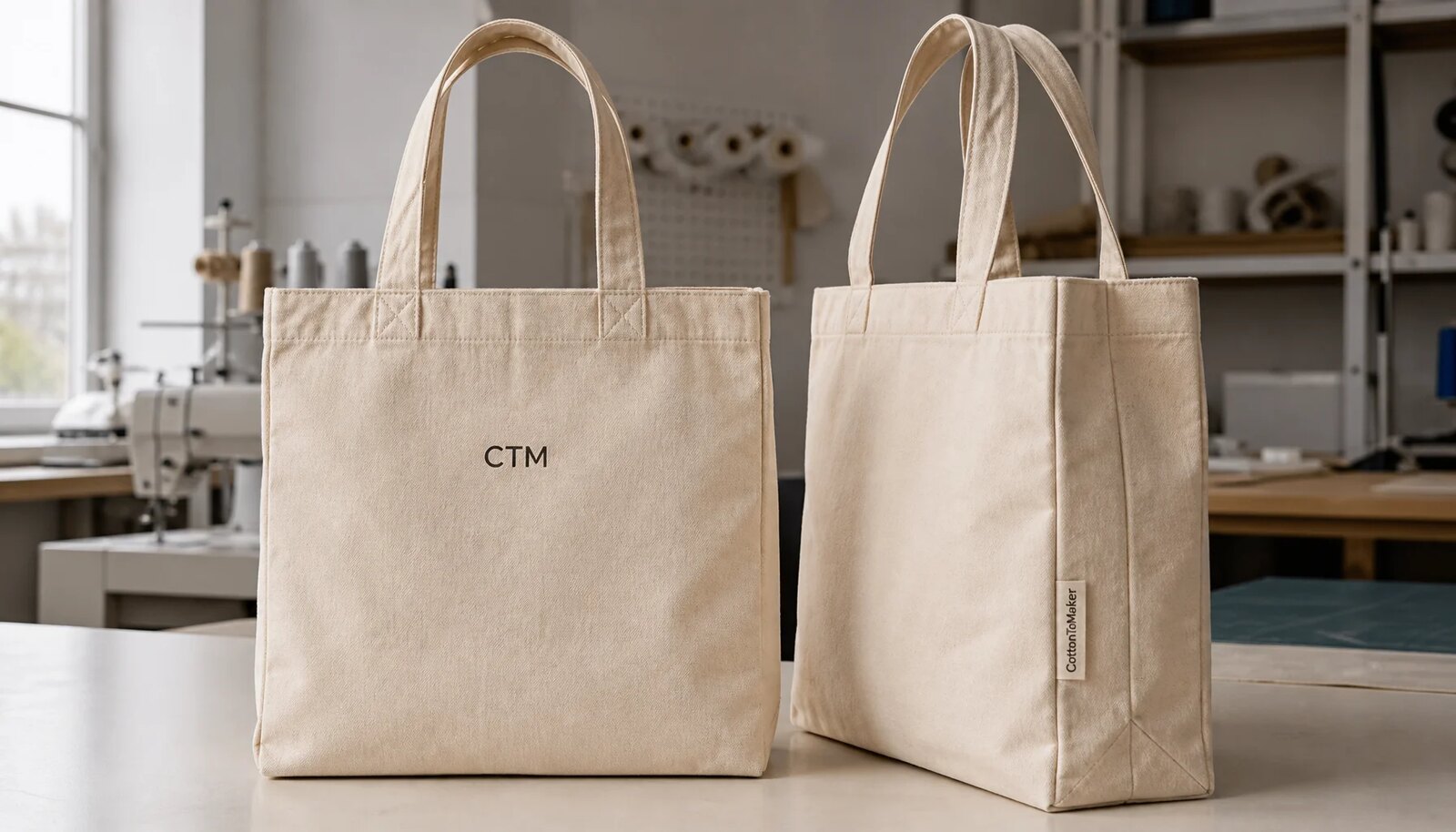
Start With the Event Job, Not the Tote Photo
A strong custom organic cotton totes material selection guide for event planners has to begin with the job the bag will perform. Event buyers often start with a reference image, a budget target, or a sponsor logo, but the material decision depends on how the tote will be used on the event floor. A bag for a badge, agenda, and one flyer is a different product from a bag carrying a water bottle, three catalogs, a folded shirt, and boxed sponsor samples. The same size can feel either efficient or flimsy depending on load, handle drop, and fabric opacity.
Procurement teams should define the use case before requesting quotes because suppliers will otherwise fill in the missing details themselves. One factory may quote a lightweight flat tote with a simple top edge. Another may quote heavier fabric, reinforced handles, and a gusset. Both quotes can look like the same organic cotton tote at a glance, yet the cost, carton weight, production risk, and user experience are not comparable. A good RFQ states the event context in plain language so the supplier understands whether the priority is price, presentation, reuse, or retail-style durability.
The clearest starting point is a simple load profile. List what the attendee or recipient will receive at pickup and what may be added during the day. Include dimensions for the largest insert, the weight of the heaviest item, and whether the bag must fit over a shoulder while someone is wearing a coat. That information guides fabric weight, gusset depth, handle drop, and reinforcement. It also prevents the common mistake of choosing a low-cost fabric that looks acceptable when empty but collapses or stretches when used.
- For light conference handouts, prioritize clean print area, low unit cost, efficient flat packing, and a fabric that is opaque enough for the brand image.
- For registration kits, balance GSM with handle strength because attendees may carry the bag for several hours before reaching a hotel or vehicle.
- For VIP packs or retail merchandise, treat the tote as a reusable product and specify stronger fabric, neater finishing, and more controlled packing.
- For booth giveaways, consider distribution speed, carton handling at the venue, and whether the bag needs to be opened quickly by staff.
- For sponsor-heavy events, check that the print area can hold multiple logos without crowding or losing readability on textured cotton.
Match GSM and Weave to Real Carry Weight
Fabric weight is usually the first cost split in an organic cotton tote quote. For event programs, 140-160 gsm is common for light handouts where the contents are mostly paper inserts, small samples, or event literature. This range can be practical when the quantity is high and the bag is expected to serve a short event purpose. The tradeoff is that lighter fabric may show more wrinkles, more transparency, and less structure once filled. It can also make dark or detailed artwork harder to control if the weave is open or uneven.
For reuse-focused programs, 180-220 gsm is a safer range. It gives the tote more body, improves perceived value, and usually supports a cleaner presentation when the bag is held or hung at registration. If the event kit includes bottles, catalogs, boxed products, notebooks, or apparel, this weight range is often worth quoting. Above this level, buyers should be more deliberate. Heavier cotton canvas can feel premium, but it increases unit cost, carton weight, and freight volume. It may also require different folding and packing to avoid hard crease lines.
GSM alone is not enough. Two fabrics with the same weight can behave differently because of yarn quality, weave density, finishing, and shrinkage. A loose plain weave may feel soft and low cost but stretch more at seams and show more print irregularity. A tighter weave gives a better print surface and better opacity but may cost more or feel stiffer. Procurement buyers should ask suppliers to define the fabric beyond a single number and should approve a swatch before bulk production.
- Use 140-160 gsm for agendas, flyers, lightweight sponsor inserts, and one-day handout programs with controlled load weight.
- Use 180-220 gsm for reusable conference totes, premium giveaways, heavier catalogs, bottles, and merchandise-style bags.
- Ask whether the quoted fabric is plain weave, canvas, twill, washed, preshrunk, bleached, dyed, or natural unbleached cotton.
- Check opacity by placing printed materials or a dark insert inside the sample under normal indoor light.
- Confirm shrinkage expectations if the fabric is washed, steamed, dyed, or otherwise finished before or after cutting.
Define Organic Claims and Certification Scope
Organic cotton claims need more discipline than ordinary fabric descriptions. A supplier may say a tote is organic because the fiber is organic, because the fabric was purchased from an organic cotton source, or because the finished product can be supported with a certification document. Those are not the same claim. For B2B procurement, the question is not only whether the cotton is organic. The question is what paperwork supports the order, what stage of the supply chain it covers, and whether the documentation can be connected to the actual shipment.
Event planners working for corporate brands, universities, public institutions, or retailers should clarify the required claim before the RFQ goes out. Some programs only need internal assurance that organic cotton fabric is being used. Others need formal certification support, transaction documentation, or finished-goods traceability. If the bag will be resold or promoted with environmental language, the buyer should involve the brand, legal, or compliance team early so the supplier quotes the correct route. Adding documentation requirements late can change supplier eligibility, lead time, and cost.
Certification scope can also affect material choice. Natural unbleached cotton often supports a simple, honest event look and avoids some finishing steps. Bleached or dyed organic cotton can be appropriate when brand color or high print contrast is important, but it introduces additional process control questions. Buyers should ask whether dyeing, bleaching, washing, and printing are included in the supplier's certification or documentation scope when that matters to the claim being made.
- Write the required wording into the RFQ, such as made with organic cotton, certified organic cotton fabric, or finished product certification support.
- Ask which company name will appear on certificates or transaction documents and whether that matches the supplier issuing the quote.
- Confirm whether documentation applies to fiber, yarn, fabric, printed fabric, or finished sewn totes.
- Do not compare a certified-documentation quote with a generic organic cotton quote as if they are equal.
- Keep certification review in the schedule because document corrections can delay shipment release or customer approval.
Choose Natural, Bleached, or Dyed Fabric Deliberately
The base fabric color has a direct effect on both brand appearance and production control. Natural unbleached organic cotton is popular for event totes because it communicates a simple, low-intervention look. It pairs well with black, navy, forest green, warm gray, and other solid inks. It can also hide minor handling marks better than bright white fabric. The buyer should remember, however, that natural cotton is not a fixed color. It may shift from cream to beige to light tan depending on the lot, crop, yarn, and finishing process.
Bleached cotton gives a brighter background and sharper contrast for some logos. It may be the better choice when the artwork includes fine type, light ink colors, or a clean retail aesthetic. Dyed cotton can support strong brand programs, especially if the tote itself must match an event palette. These choices bring additional checks. Dye shade, colorfastness, rub resistance, shrinkage, and odor all become more important. Dyed fabric may also affect print opacity, especially if the decoration uses light colors on a dark base.
Procurement buyers should set color expectations in a way that can be inspected. A digital mockup is not a color standard. For natural cotton, approve a physical shade band or reference swatch. For dyed fabric, ask for a lab dip or fabric swatch before bulk dyeing if time allows. For bleached fabric, check whether the whiteness level makes the tote look clean without feeling overly processed for the event's sustainability message. The goal is to align the brand story with a measurable production spec.
- Use natural unbleached fabric when the desired look is neutral, simple, and compatible with slight shade variation.
- Use bleached fabric when artwork contrast, clean white presentation, or fine print readability is the priority.
- Use dyed fabric when the tote color is part of the event identity, but add shade, rub, and colorfastness checks.
- Approve physical swatches under normal indoor event lighting, not only under bright factory light.
- Specify whether shade variation is acceptable across cartons, especially for multi-venue or staged deliveries.
Select Print Method Around Artwork and Durability
Print method should be chosen after the fabric and artwork are both understood. For most event totes, screen printing is the most practical method. It works well for one- to three-color logos, sponsor marks, simple slogans, and larger quantities. It can produce a clean, durable result on cotton when the screen setup, ink choice, and curing process are controlled. Screen print is also easier to inspect because color placement, opacity, and print position can be measured against a physical strike-off.
Digital transfer, heat transfer, and hybrid methods are useful when artwork includes gradients, many colors, photographic images, or fine detail that would be expensive or difficult to separate into screens. These methods can be sensible for smaller runs or highly customized event designs. The risk is hand-feel and durability. A transfer may create a heavier patch on the fabric, a visible edge, or vulnerability to cracking and peeling after folding. For bags that will be compressed in cartons or reused repeatedly, that risk should be tested before approval.
Artwork complexity should not override function. A tote carried around a trade show floor is touched, folded, rubbed against clothing, stacked in cartons, and sometimes exposed to moisture during transport. Buyers should ask for a decorated sample or strike-off on the actual fabric when the print is central to the event. Fine sponsor logos, QR codes, and registration details need special attention because cotton texture can break thin lines. If a QR code is required, test it after printing, folding, and normal viewing distance handling.
- Choose screen print for simple vector artwork, solid logos, high-volume orders, and programs where durability matters most.
- Choose transfer or hybrid decoration when the design has many colors, gradients, or photographic detail that screen printing cannot handle efficiently.
- Specify print size, placement from top and side seams, color references, and whether print is one side or both sides.
- Require a print strike-off for brand-critical colors, QR codes, small sponsor marks, and fine typography.
- Check cured ink for rubbing, cracking after folding, tackiness, odor, and poor opacity on darker or textured fabric.
Specify Construction Before Comparing Price
Construction details are where many tote quotes become misleading. A bag may be described as the same size and GSM, yet differ in top hem, handle width, seam type, gusset, stitching, and reinforcement. Those differences change labor cost and performance. A basic flat tote with narrow handles and a simple top stitch may be fine for a low-load giveaway. A registration kit carrying heavier contents needs a more deliberate build, especially at the handle join and side seams.
Handle drop is one of the most overlooked details. A short handle may work for hand carry but feel awkward over the shoulder, especially when attendees are wearing jackets. A longer handle improves usability but changes the way the bag hangs and can increase fabric consumption. Handle width also matters. Narrow handles can cut into the hand when the bag is loaded, while wider self-fabric or cotton tape handles feel sturdier. If the tote is meant to be reused, the handles should look and feel like part of the product, not an afterthought.
The top edge and gusset should match the event use case. A folded top hem gives a cleaner opening and better durability than a raw or minimally finished edge. A gusset adds capacity for boxed items and bottles but increases sewing complexity and affects carton packing. Reinforcement can include box stitching, cross stitching, bar tacks, or a defined stitch pattern at handle joins. The buyer does not need to over-engineer a simple giveaway, but the construction should be written clearly enough that every supplier is quoting the same bag.
- State finished bag width, height, gusset depth, handle drop, handle width, seam type, and top hem construction.
- Use a gusset when the tote must hold boxed samples, bottles, apparel, or catalogs without distorting the bag shape.
- Require reinforced handle joins for medium or heavy event kits, especially if the bag will be carried for hours.
- Check stitch density and thread quality on samples, not only the general appearance of the bag.
- Ask the supplier to identify any construction changes they recommend for the stated load weight.
Understand MOQ, Setup Charges, and Quote Basis
MOQ for custom organic cotton totes is shaped by more than supplier preference. It can depend on fabric roll width, cutting efficiency, fabric availability, dye lot size, print setup, certification paperwork, and packing requirements. A standard natural cotton tote with one-color print may be available at a lower minimum than a custom-sized dyed tote with four-color decoration and individual packing. That difference is normal, but it should be explained in the quote so procurement can understand the cost drivers.
Buyers should separate production minimums from commercial minimums. A supplier may technically accept a smaller order, but the unit cost can rise sharply once screen setup, sampling, artwork preparation, cutting loss, and carton handling are included. For event planners, this matters because budgets are often built around attendee count. Ordering exactly the attendee count may look efficient, but it leaves no room for sponsor additions, damaged cartons, staff use, or late registrations. A modest overage can be less expensive than a rushed reorder.
Every quote should be compared on the same basis. A unit price without incoterm, packing method, setup charges, and documentation scope is only a partial number. One supplier may include screen charges and bulk cartons; another may list them separately. One may quote EXW, while another quotes FOB or delivered terms. Procurement teams should normalize the quotes before deciding. The lowest unit price can be the most expensive option once missing charges and freight assumptions are added.
- Ask MOQ by bag size, fabric weight, fabric color, print method, print color count, and packing format.
- Request separate lines for unit price, sample fee, screen or setup fee, labels, special packing, certification support, and freight.
- Compare quotes using the same incoterm, destination, carton configuration, and delivery deadline.
- Build an overage for event staff, late registrants, damaged pieces, and sponsor requests.
- Question unusually low quotes by asking what construction, fabric finish, inspection, or packing detail has been excluded.
Use Sampling as a Production Control Tool
A sample is not just a sales preview. It is the control standard for the bulk order. For custom organic cotton totes, buyers should approve a fabric swatch and, when timing allows, a pre-production sample that reflects the final fabric, dimensions, handle construction, print method, and packing fold. If artwork is important, a print strike-off on the selected fabric should be approved before bulk printing. A sample made from substitute cloth or a different decoration process can be useful for shape review, but it should not be treated as the final standard.
The sample approval process should be documented in measurable terms. Width, height, gusset, handle drop, print position, print size, GSM, shade, and stitching should be checked against the spec sheet. If any detail is accepted with a concession, that concession should be written down. For example, a buyer may approve a slight natural cotton shade variation but not a crooked logo. Clear approval notes prevent later disputes when bulk goods are inspected.
Timing matters. If the event date is fixed, the buyer may feel pressure to skip sampling. That is risky when the tote has custom size, certified material requirements, complex artwork, dyed fabric, or important sponsor branding. Sampling is usually the cheapest point to catch problems because fabric has not been cut and bulk printing has not begun. Once production starts, corrections can mean reprinting, resewing, air freight, or accepting a weaker product.
- Approve a physical reference sample whenever the order includes custom size, custom print, dyed fabric, or nonstandard packing.
- Keep one sealed sample with the buyer and one approved sample with the supplier for production comparison.
- Check the sample loaded with realistic event contents, not only empty on a desk.
- Measure print placement from fixed points such as top edge and side seam, not by eye alone.
- Do not release bulk production until artwork, fabric, construction, tolerances, and packing are all approved in writing.
Build QC Around Measurable Failure Points
Quality control for event totes should focus on the ways bags actually fail. The most common problems are weak handle joins, open seams, crooked or under-cured print, shade mismatch, wrong size, dirty fabric, and packing damage. A visual inspection alone is not enough for a program where thousands of attendees may receive the same item in a short window. The inspection plan should include measurements, load checks, print checks, and carton checks.
Fabric and sewing checks should happen before final packing. Inspectors should verify GSM within tolerance, review fabric for stains or odor, measure finished dimensions, and check stitch security at stress points. Handle joins deserve extra attention because they carry most of the load. A simple pull check or static load test on sampled units can reveal weak stitching before shipment. The test does not need to be complicated, but the expected load and pass/fail condition should be agreed in advance.
Print QC should be performed under consistent light and against the approved strike-off. The inspector should check position, color, opacity, curing, smudging, and readability of fine details. For QR codes or small sponsor logos, scanning and legibility should be part of inspection. Packing QC should verify carton counts, carton labels, moisture protection, fold method, and gross weight. This is especially important for event planners because cartons often go directly to a venue, warehouse, or kit-packing partner where there is little time to sort problems.
- Set AQL or sampling expectations if the order size justifies formal inspection, and define critical defects before production ships.
- Check handle strength with a stated load and time, then inspect for seam opening, fabric tearing, or thread breakage.
- Measure a sample of bags from different cartons to confirm size consistency and print placement stability.
- Rub and fold printed areas to identify poor curing, transfer, cracking, or edge lift before shipment.
- Verify carton marks against the packing list so venue staff can identify style, quantity, destination, and event name quickly.
Plan Packing, Freight, and Venue Handling Early
Packing is often treated as an afterthought, but it can change both landed cost and event execution. Flat bulk packing is usually the most efficient choice for conference and trade show programs. It reduces unnecessary individual packaging, keeps carton volume controlled, and makes distribution easier for staff. However, the fold method still matters. Heavy organic cotton can hold sharp creases if over-compressed, and natural fabric can pick up marks if cartons are damp or dirty.
Individual packing, belly bands, hangtags, barcode labels, or retail-ready folds may be appropriate for VIP gifts, merchandise tables, or sponsor kits. These options add labor, materials, and space. They can also slow packing and increase the chance of mixed versions if an event has multiple designs. If the tote is part of a larger kit, coordinate packing dimensions with the kit-packing vendor before approving carton counts. A bag that looks efficient from the factory may create extra labor if it arrives folded in the wrong orientation for assembly.
Freight decisions should be made with the event date in mind. Ocean freight may be economical for large programs with enough lead time. Air freight can rescue a late order but may eliminate savings from a lower unit price. Buyers should ask suppliers for carton dimensions and gross weight before final comparison because fabric GSM and packing method both affect freight. The receiving plan is just as important: confirm delivery address, appointment needs, palletization, liftgate requirements, event warehouse hours, and shipping marks.
- Use flat bulk packing for most event distribution unless presentation requirements justify individual packing.
- Set maximum carton gross weight so cartons can be handled safely by venue, warehouse, or kit-packing staff.
- Confirm carton dimensions before freight booking, especially when comparing 160 gsm and 220 gsm options.
- Use clear shipping marks with event name, PO number, style, color, print version, carton count, and destination.
- Avoid late packing changes because they can affect carton count, freight cost, production time, and inspection scope.
Specification comparison for buyers
| Spec decision | Recommended option | When it fits | Buyer risk to check |
|---|---|---|---|
| Event use case | Light flat tote for agendas, flyers, and small sponsor inserts | One-day conferences, campus events, trade show booth giveaways, and large attendance programs where cost per piece matters | Confirm expected fill weight. A low-GSM bag can look acceptable empty but sag, wrinkle, or feel transparent once loaded. |
| Event use case | Reusable tote with gusset, reinforced handles, and higher fabric weight | VIP registration kits, retail-style event merchandise, association conferences, and sponsor programs meant to be kept after the event | Check that stronger fabric is matched with stronger stitching. Heavy cloth with weak handle joins still fails at the stress point. |
| Sourcing route | Direct factory with organic cotton experience, bag sewing, and controlled decoration workflow | Best for repeat event programs, custom sizing, custom labels, and buyers who need one accountable production owner | Confirm what is made in house, what is subcontracted, and whether the organic paperwork covers the exact fabric or finished-goods lot. |
| Sourcing route | Trading company, distributor, or sourcing agent bundling bags, print, labeling, and freight | Useful when the event team needs simplified vendor management or a smaller order with standard specs | Ask whether the quote uses stock fabric or made-to-order fabric. Subcontracted printing and packing can hide lead time and quality risk. |
| Fabric weight | 140-160 gsm plain-weave organic cotton | Budget-sensitive event handouts carrying brochures, badges, notebooks, and light inserts | Risk of show-through, corner sag, weaker perceived value, and more visible wrinkles after folding or carton compression. |
| Fabric weight | 180-220 gsm organic cotton canvas or tighter plain weave | Premium giveaways, reusable conference totes, merchandise tables, and bags carrying catalogs, bottles, or boxed samples | Higher unit cost and freight weight. Verify handle width, stitch density, and carton count so the stronger fabric does not create packing problems. |
| Fabric finish | Natural unbleached cotton with controlled shade band | Events that want a low-intervention look, neutral branding, and simple one- or two-color print | Natural shade varies by crop and lot. Approve a shade tolerance range, not just a photo, before bulk cutting. |
| Fabric finish | Bleached or dyed organic cotton base | Programs requiring brighter print contrast, brand-matched fabric color, or a cleaner retail presentation | Dyeing and bleaching add process variables. Confirm colorfastness, shrinkage, rub resistance, and whether certification claims still match the finished article. |
| Print method | 1-3 color screen print with cured water-based or suitable textile ink | High-volume event orders with logos, sponsor marks, slogans, QR codes, and simple vector artwork | Check opacity, print position, curing, scuff resistance, and whether fine text remains readable on the selected weave. |
Buyer checklist before sampling
- Define the event use case first: booth giveaway, registration kit, VIP pack, retail merchandise, or sponsor fulfillment.
- Estimate realistic fill weight, including catalogs, bottles, apparel, boxed samples, and any inserts added at the venue.
- Lock bag width, height, gusset depth, handle drop, handle width, target GSM, fabric finish, and print area before asking for price.
- State whether the order needs certified organic cotton documentation, finished-product certification support, or only organic cotton fabric sourcing.
- Ask suppliers to quote the same fabric weight, weave, finish, print method, color count, packing format, carton count, and incoterm.
- Request a fabric swatch, print strike-off, or pre-production sample using the same or clearly identified fabric basis as bulk production.
- Approve tolerance ranges for dimensions, GSM, shade, print position, seam allowance, and shrinkage before bulk cutting begins.
- Confirm handle reinforcement, stitch density, top hem construction, side seam type, and whether the bag is flat or gusseted.
- Define packing details: flat or folded, inner pack count, polybag policy, carton dimensions, carton gross weight, pallet needs, and shipping marks.
- Require a written production timeline that separates material sourcing, sampling, artwork approval, bulk sewing, printing, QC, packing, and handover.
Factory quote questions to send
- What exact fabric weight, weave, yarn count or construction description, finish, and expected shrinkage are you quoting?
- Is the cotton certified organic, and can you provide paperwork that connects the claim to the quoted fabric lot or finished-goods order?
- Are you quoting natural, bleached, dyed, washed, or preshrunk fabric, and what shade tolerance will apply in bulk?
- What is the MOQ by size, fabric weight, fabric color, print color count, and packing format, and what changes the MOQ?
- Which processes are handled in house and which are subcontracted, including weaving, dyeing, sewing, printing, labeling, inspection, and packing?
- Which print method and ink system will you use, and what setup charges apply for screens, plates, artwork preparation, or color matching?
- What print size, print position tolerance, color tolerance, and curing standard will you apply during production?
- What are the approved tolerances for bag dimensions, handle drop, seam allowance, fabric weight, shrinkage, and carton quantity?
- How will handle strength be checked, and what load or pull test can be performed before shipment?
- How are the totes packed, how many pieces are in each inner pack and carton, and what are the carton dimensions, gross weight, and moisture controls?
Quality-control points to confirm
- Fabric weight should be checked against the agreed GSM tolerance using samples from different parts of the lot, not only one top-layer piece.
- Fabric shade should match the approved standard or agreed shade band, especially for natural unbleached cotton where lot variation is normal.
- Fabric hand-feel, weave density, visible slubs, odor, stains, oil marks, and excessive lint should be reviewed before printing and after packing.
- Bag dimensions should stay within written tolerances for width, height, gusset depth, handle drop, and handle width after sewing and any finishing process.
- Stitching should be straight, secure, and consistent, with no skipped stitches, loose threads, open seams, or distorted top hems.
- Handle joins should be reinforced with the agreed stitch pattern, and a sample pull or load check should show no tearing, seam opening, or thread breakage.
- Print should be centered, cured, opaque enough for the fabric color, and free from smudging, pinholes, ghosting, crooked placement, and color drift.
- Fine text, QR codes, sponsor logos, and registration marks should remain readable on the actual weave, not only on a digital proof.
- Packing should prevent moisture, crushing, sharp crease lines, carton bursting, label mismatch, and mixed styles or print versions inside the same carton.
- Final inspection should verify quantity, carton marks, carton dimensions, gross weight, approved sample match, and document consistency before shipment release.