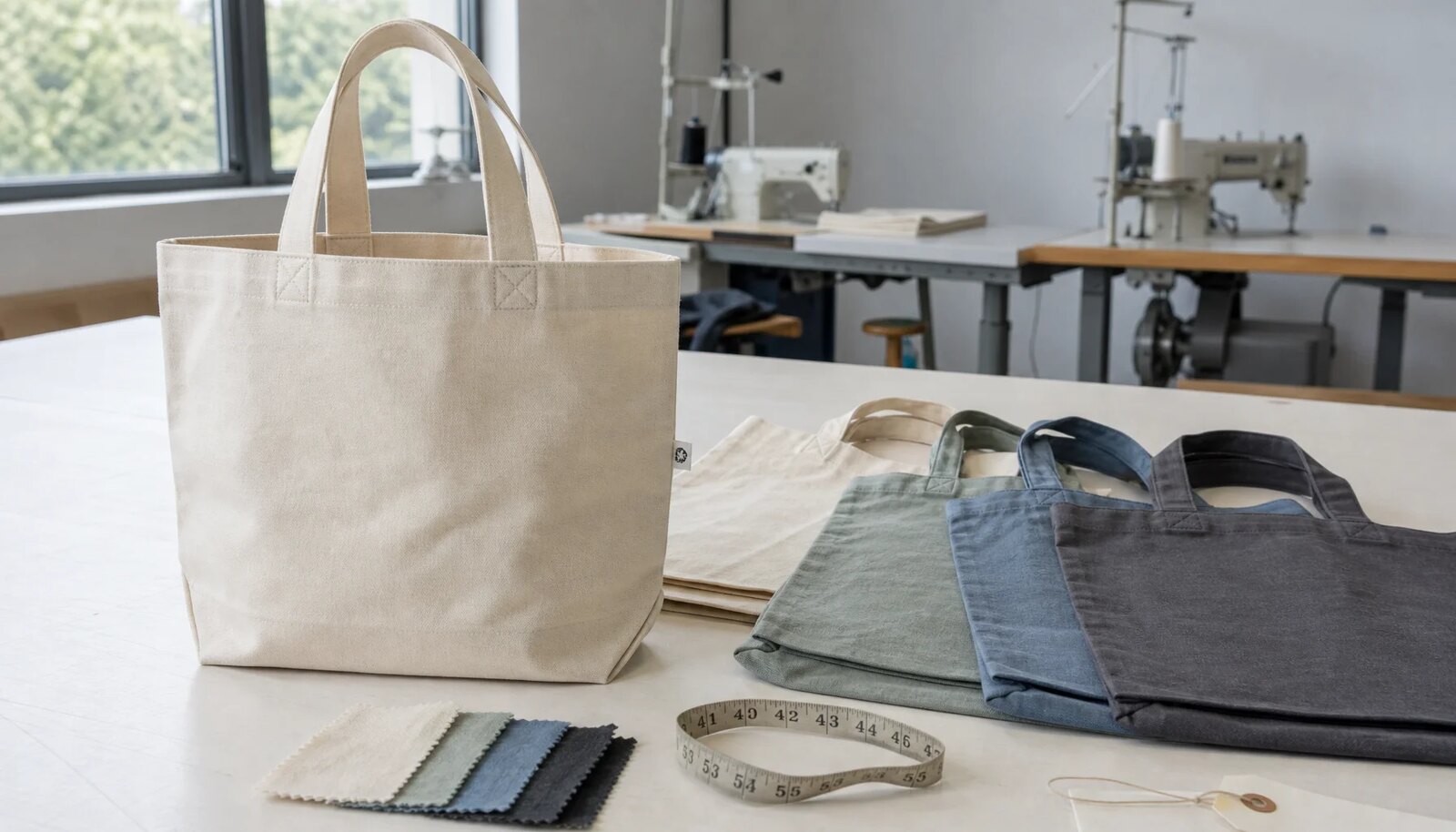
Why material selection matters more than the word organic
The word organic is important, but it is not a complete tote specification. It tells you something about the cotton claim. It does not tell you how heavy the fabric feels, how tightly it is woven, whether it will shrink, how the handles are reinforced, how the logo will age, or how the finished bag will arrive at your warehouse. Two custom organic cotton totes can carry the same fiber description and still feel like completely different products.
For eco apparel brands, totes often appear in very visible places: retail counters, online order inserts, trade show booths, influencer packs, wholesale programs, and seasonal launches. In those moments, the bag becomes part of the brand experience. A thin panel, fuzzy logo edge, weak handle, or messy fold can make the whole program feel less considered. Sustainability language helps, but it will not offset a product that looks under-specified.
Start the buying process with the use case and expected load. A light event giveaway can prioritize controlled cost, compact folding, and simple artwork. A retail tote sold as merchandise needs better structure, cleaner stitching, and stricter print alignment. A grocery or book-carrying tote needs heavier fabric and stronger handle attachment. If the RFQ does not explain how the bag will be used, suppliers will quote their default construction, and the prices will not be comparable.
If the tote carries an organic claim, raise documentation early. Ask whether the supplier can support the claim with scope documentation, mill records, transaction certificates where relevant, or other chain-of-custody paperwork accepted by your compliance team. Do not leave this to the end of the order. A verbal organic claim may not be enough for a retailer, internal audit, or claim review.
- Retail tote: prioritize hand feel, print clarity, shape retention, and clean folding for customer presentation.
- Event tote: prioritize controlled cost, fast sampling, acceptable branding area, and simple packing.
- Online order insert: prioritize compact folding, low carton volume, dust protection, and brand consistency.
- Heavy-use tote: prioritize GSM, handle reinforcement, seam strength, and abrasion resistance.
- Claim-bearing tote: prioritize traceability documents, approved labeling language, and a clear file trail for the brand team.
Choose fabric weight, weave, and finish with the end user in mind
Fabric weight is usually the first material decision buyers discuss because it affects hand feel, cost, packing volume, and freight. For custom organic cotton totes, 120-140 GSM is an entry-level range for lightweight promotional bags. It can work when the tote is not expected to carry much weight, but it may feel thin, wrinkle easily, or show contents. The 150-180 GSM range is a practical middle ground for many eco apparel programs because it balances feel, printability, unit cost, and foldability. For premium merchandise, reusable grocery bags, or heavier carry loads, 200-240 GSM gives more structure, although it increases material cost, sewing effort, carton weight, and often MOQ pressure.
GSM alone can mislead. A loose 180 GSM fabric may print worse than a tighter 160 GSM fabric because ink sits unevenly on the yarns and logo edges look fuzzy. A tight plain weave is often the safest choice for clear screen printing, stable cutting, and predictable sewing. If your artwork includes fine typography, a centered logo, or a large solid ink area, approve a real strike-off on the chosen fabric instead of relying on a digital mockup.
Finish changes the look and the production risk. Natural unbleached organic cotton gives a simple low-impact appearance and usually avoids extra color processing, but it brings normal shade variation, seed specks, and a less uniform surface. Bleached white fabric gives a cleaner retail look, but it may not fit every brand’s sustainability language. Dyed fabric can support a strong color story, yet it adds lab dip approval, shade tolerance, colorfastness checks, and usually higher MOQ or longer lead time.
Softening, washing, or pre-shrinking can improve hand feel and control dimensions, but those processes should be part of the approved specification. They may change panel size, handle drop, fabric texture, and fold behavior. If the tote will be folded into e-commerce packaging or displayed in retail, review the packed appearance before production, not after shipment.
For repeat orders, keep a signed swatch with the approved sample and spec sheet. Ask the factory how it controls lot matching. If the supplier cannot explain how fabric shade, hand feel, and finish will be repeated, expect some drift. The practical procurement question is not only whether the cotton is organic. It is whether the same bag can be reproduced across purchase orders.
- 120-140 GSM: suitable for light giveaways where cost and speed matter more than structure.
- 150-180 GSM: a strong default for daily retail totes, apparel packaging, and branded merchandise.
- 200-240 GSM: better for premium totes, grocery use, books, or bags expected to carry heavier loads.
- Tight plain weave: preferred when logos, typography, or solid ink coverage must look clean.
- Natural finish: expect shade variation and seed specks unless the supplier offers additional sorting or finishing.
- Dyed finish: require shade approval, dye lot control, and colorfastness expectations before PO release.
Build a tote spec sheet before you ask suppliers for prices
A production-ready RFQ should say more than organic cotton tote with logo. That phrase leaves too much room for interpretation. At minimum, your spec should cover the fiber claim, GSM, weave, finish, finished dimensions, gusset structure, handle construction, print or label method, thread color, packing method, carton marks, and inspection criteria. When those details are missing, suppliers fill the gaps themselves. The lowest quote may simply be the weakest specification.
Finished dimensions need shared measurement rules. Width, height, side gusset, bottom gusset, and handle drop should be measured from the same reference points by the buyer and the factory. If the tote must fit a folded hoodie, shoebox, lookbook, event kit, or gift set, test those items before approving the bag size. A small dimension difference can affect real warehouse and retail use, especially on narrow bags or tight e-commerce packing lines.
Handles are a common hidden cost difference. Self-fabric handles create a matched look and may be efficient for simple totes. Cotton webbing handles can feel stronger and more comfortable, especially for heavier use. Define the handle width, total length, shoulder drop, attachment location, reinforcement method, and thread color. If shoulder carry matters, do not leave the handle drop to factory judgment.
Sewing details deserve clear wording. A double-fold top edge improves appearance and helps strength. Bar tacks, box stitches, or box-X stitches at handle points help manage stress. Thread type, stitch density, seam allowance, and loose-thread trimming all influence the finished product. Procurement does not need to over-engineer a basic tote, but it should remove enough ambiguity that each supplier is quoting the same product.
- Include fiber claim, GSM, weave, finish, dimensions, gusset, handle, print, label, packing, and QC criteria in one RFQ sheet.
- State finished size in centimeters or inches and define the measurement tolerance for sewn production.
- Specify whether the tote must fold flat, stand upright, fit a garment box, or carry a defined content set.
- Define handle width, handle drop, handle material, attachment method, and reinforcement style.
- Name thread color and whether seams should match fabric, contrast intentionally, or remain hidden.
- Attach artwork placement drawings with distance from top edge, side edge, and center line.
Match construction to the program, not to a generic tote standard
Eco apparel brands do not all need the same tote. A store shopping bag, capsule collection merch item, grocery tote, and conference giveaway may all use organic cotton, but the best construction is different for each. Over-specifying a short-life giveaway can waste budget. Under-specifying a premium retail tote can weaken brand perception. The useful question is simple: how will the customer receive, carry, store, and reuse this bag?
For fashion retail and apparel packaging, the tote usually needs to photograph well and feel aligned with the item inside. A 150-180 GSM tight plain weave with a clean screen print or woven label is often a sensible starting point. If the bag is sold rather than given away, consider 200 GSM or higher, stronger handle reinforcement, and more controlled folding. Premium brands may also care about seam symmetry, label placement, thread trimming, and whether the tote looks polished when hanging or stacked.
For groceries, books, event kits, or heavy gift sets, strength matters more than a soft drape. Heavier GSM, wider handles, and reinforced stitching are worth evaluating. Ask the factory to run a practical load check on sample units using the actual contents or a comparable weight. It does not need to be an extreme test. It should reflect real use. A tote designed for a T-shirt purchase should not be built the same way as a tote expected to carry several books.
For large promotional runs, simplify intelligently. One fabric color, one size, one logo placement, and efficient bulk packing can keep cost and lead time under control. The tote can still support an eco brand story if the material, stitching, and documentation are consistent. Add complexity only when it creates visible value for the end customer or a clear operational need for the buyer.
- Store purchase tote: clean print, easy folding, reliable handle drop, and tidy carton handling.
- Premium merch tote: heavier GSM, stronger construction, controlled label detail, and stricter visual inspection.
- Event giveaway tote: simple artwork, standard size, efficient MOQ, and fast production path.
- Grocery or book tote: higher GSM, wider handles, reinforced handle points, and practical load testing.
- Mailer insert tote: compact folding, low bulk, dust protection, and a logo that stays visible after packing.
Compare sourcing routes without getting trapped by a low unit price
A trading company, print shop, stock blank supplier, and direct sewing factory can all sell custom organic cotton totes. They do not offer the same level of control. A print shop may be strong on artwork but rely on outside sewing. A trader may coordinate several suppliers but have less direct technical visibility. A stock blank route can be fast, though size, GSM, and traceability options may be limited. A direct factory may give better control over cutting, sewing, and packing, but buyers still need to verify organic cotton sourcing and documentation.
The lowest unit price is often based on a different product. One supplier may quote 140 GSM stock natural cotton while another quotes 180 GSM organic cotton with reinforced handles and retail folding. One quote may include screen setup; another may list it separately. One may assume bulk packing while another includes individual polybags, barcode labels, or inner cartons. If procurement compares only the headline FOB price, missing details can look like savings.
Create a quote comparison sheet and make every supplier complete it. Ask for the same bag size, GSM, finish, handle, print method, label, packing, MOQ, sample type, lead time, and documentation. If a supplier proposes a cheaper alternative, ask them to mark it as an alternate specification. That keeps cost-saving ideas visible without confusing them with the approved product.
For repeat programs, consistency can matter as much as first-order price. Ask how the supplier controls fabric lots, shade, handle material, label stock, print color, and approved samples across reorders. If the supplier cannot retain a reference sample or signed spec sheet, the first order may look fine while the second order drifts.
- Compare quotes only after standardizing GSM, dimensions, handles, print, packing, and sample requirements.
- Treat missing quote fields as risk indicators, not administrative details.
- Separate unit price from setup fees, screen charges, label development, packing labor, and sample freight.
- Ask whether the supplier is producing from stock blanks, custom cutting, or outsourced sewing.
- For reorders, require the supplier to keep an approved sample, fabric reference, and production specification on file.
Select the logo method for durability, feel, and MOQ
Logo method is more than a design choice. It affects sample timing, unit cost, defect risk, durability, and the way the tote feels in the hand. Screen printing is usually the practical default for solid logos, simple typography, and medium-to-high volume tote programs. It offers controlled cost and good repeatability when the fabric surface and ink are matched well. For large solid areas, check ink hand feel, coverage, edge clarity, and whether the print cracks after folding.
Heat transfer can look sharp at sample stage, especially for multicolor artwork, gradients, or photographic designs. Use it carefully on organic cotton totes. Transfers can feel less integrated with the fabric and may crack, peel, or lift depending on the material and use conditions. If a transfer is necessary, approve a sample after folding, rubbing, and light stress checks. A flat studio photo is not enough.
Embroidery, woven labels, and sewn side labels can make a tote feel more premium when the logo is small. Embroidery adds texture, but it can pucker lighter fabrics or feel stiff on thin panels. Woven labels are useful for subtle branding and can reduce ink coverage, though label MOQ and lead time must be included in the schedule. Side labels require close placement control because crooked, upside-down, or poorly stitched labels are highly visible.
Artwork placement should be measured. Define logo size, distance from the top edge, side-edge reference, center line, and whether placement is based on the flat panel, the finished bag, or the folded retail presentation. If the bag has a gusset, the artwork can appear different when filled. For apparel programs, test the tote with the actual garment or package inside so the logo stays readable and balanced.
- Screen print: best for solid logos, repeat runs, controlled cost, and clean brand color work.
- Water-based or soft-hand inks: may support a softer feel, but require testing for coverage and color strength on the chosen fabric.
- Heat transfer: use for complex artwork only after fold, rub, and adhesion checks.
- Embroidery: suitable for small premium logos, but check puckering on lighter GSM fabric.
- Woven label: good for subtle branding, side labels, and premium positioning with less ink coverage.
- Placement drawing: include logo size, top-edge distance, side-edge distance, and acceptable alignment tolerance.
Use sampling to catch problems before they become bulk defects
Sampling should move from concept reference to production confirmation. A stock blank sample can help the team judge approximate size, fabric weight, or handle comfort. It cannot approve a custom order. Final approval should come from a pre-production sample made from the actual or confirmed bulk fabric, with the final handle construction, logo method, label placement, thread color, and intended packing method.
Review the sample in a practical way. Measure width, height, gusset, handle length, handle drop, print placement, and label position. Compare the fabric to the approved swatch. Look at the tote flat, hanging, folded, packed, and filled with likely contents. Many issues are invisible when the bag is laid flat but obvious when the handles carry weight or the bag is placed into a carton.
Handle the print, not just the sample photos. Fold the print area. Rub it with a clean cloth. Check for ink transfer, cracking, peeling, edge lifting, smudging, or bleeding into the weave. If the tote will be stored folded, confirm whether the fold line crosses the logo. If the bag will be sold or displayed, approve the folded presentation and pack format as part of the sample.
Document the approval clearly. A signed sample comment sheet should list what is approved, what must change, and what remains open. If the sample is approved with exceptions, those exceptions need to be added to the production spec before bulk starts. Avoid vague comments such as looks good or proceed if improved. The factory needs measurable instructions, and the buyer needs a reference point for final inspection.
- Use a stock sample for early reference only; use a pre-production sample for final approval.
- Measure the actual sample and record dimensions against the spec sheet.
- Approve fabric, handle, stitching, logo, label, thread, and packing together before bulk release.
- Check the tote flat, filled, hanging, folded, and packed to reveal different defect risks.
- Keep the approved physical sample as the standard for bulk inspection and reorder comparison.
- If the sample is approved with changes, update the written spec before production starts.
Plan MOQ and lead time around fabric availability
MOQ is often presented as a factory rule, but for totes it usually comes from several inputs: fabric buying, cutting efficiency, print setup, label sourcing, sewing line setup, and packing labor. Standard natural organic cotton, one size, one print color, and bulk packing usually create less MOQ pressure. Custom dyed fabric, multiple artwork versions, retail folding, barcode packs, and sewn labels push MOQ and lead time upward.
Lead time should not be one vague number. Break it into fabric sourcing or reservation, lab dip or shade approval if needed, sample making, sample revision, bulk cutting, printing, sewing, trimming, finishing, inspection, packing, and export handoff. When a supplier says production is 25-35 days, ask when the clock starts. It may start only after deposit, artwork confirmation, fabric arrival, sample approval, or label completion.
Fabric availability is often the schedule risk that buyers underestimate. A factory may have sewing capacity but not the exact organic cotton fabric ready. If fabric is sourced after PO, ask whether it is greige fabric waiting for finishing, finished natural fabric, dyed fabric, or supplier stock. Each route has different timing and risk. If the launch date is fixed, reserve fabric early and do not let artwork delays block material booking.
Multiple SKUs also change the economics. One tote size with one print is straightforward. Three sizes, two fabric colors, and four logo versions create separate setups even if the total quantity is large. Ask for MOQ by color, size, artwork version, and packing method before the design team locks the program.
- Ask whether MOQ is driven by fabric, dyeing, cutting, print setup, label sourcing, or packing complexity.
- Confirm MOQ per color, per size, per artwork version, and per packing version.
- Break lead time into fabric, sample, revision, bulk, inspection, packing, and shipment handoff.
- Reserve fabric before final artwork approval when launch timing is tight.
- Avoid late SKU splits unless the supplier confirms cost, MOQ, and schedule impact.
- For reorders, ask whether the same fabric construction and shade can be repeated or only approximated.
Put packing, carton marks, and warehouse rules in the RFQ
Packing is part of the product specification. A tote can be sewn correctly and still cause receiving problems if cartons are mislabeled, fold sizes vary, barcodes fail, or pack counts do not match the purchase order. Organic cotton totes can also pick up dust, moisture, odor, and compression marks if packing is poorly planned. The RFQ should state how the tote is folded, whether it is individually packed, how many pieces go into an inner pack, and how many pieces go into each master carton.
Bulk packing is often the most efficient option for event programs, warehouse stock, and simple giveaways. It reduces labor, plastic, and carton volume. It may not work for retail-facing totes, e-commerce inserts, or distribution centers that require individual barcodes. Individual polybags can protect against dust and simplify picking, but they add cost, labor, plastic use, and carton space. If your brand restricts polybags, say so in the RFQ and ask for an alternate protection method.
Folding method affects presentation. A hard crease through a screen print can leave a visible mark. Uneven folding can make a premium tote look messy on arrival. If the logo must face outward or remain visible, provide a folding diagram or approve a packed sample. For heavier totes, carton compression can distort shape, so ask the supplier to confirm carton size, pack count, and gross weight before shipment.
Carton markings should match your receiving process. At minimum, carton labels usually need PO number, style code, color, quantity, carton number, and destination details as required by the buyer. Retail and warehouse programs may also require barcode labels, ASN compliance, or fixed label placement. Quote these requirements before PO release. Relabeling after production wastes time and can delay shipment.
- Define fold method, logo orientation after folding, inner pack quantity, and master carton quantity.
- State whether individual polybags are required, prohibited, or allowed only for specific channels.
- Include barcode format, carton label placement, PO number, style code, color code, and carton sequence requirements.
- Check carton dimensions and gross weight so the shipment fits warehouse and freight expectations.
- Ask for packing photos before shipment if the order goes directly to a distribution center.
- Use an approved packed sample when retail presentation or barcode receiving is critical.
Set QC and acceptance criteria before production starts
Quality control should be written before bulk production, not negotiated after defects appear. A custom organic cotton tote order needs clear acceptance criteria for fabric, dimensions, sewing, print, label placement, odor, contamination, packing, and carton count. The approved physical sample provides the visual standard. The spec sheet provides the measurable limits. Together, they are much stronger than relying on photos or broad phrases such as good quality.
Define defect severity in advance. Critical defects may include unsafe contamination, a wrong material claim, severe mildew odor, or incorrect artwork. Major defects may include weak handle attachment, open seams, visibly off-center print, wrong size outside tolerance, front-panel stains, or missing labels. Minor defects may include small loose thread tails or slight natural shade variation within the agreed range. This classification helps factories inspect the right issues and helps buyers make consistent release decisions.
Functional checks matter because handle failure creates immediate customer complaints. Agree on a practical pull or load test based on expected use. Inspectors should look at bar tacks, box stitches, seam openings, thread pull, and fabric tearing after stress. The check should be run on representative bulk pieces, not only on the showroom sample. If the tote is intended for heavier use, strengthen the construction instead of hoping a light tote will perform beyond its design.
Print inspection should compare bulk against the approved artwork and strike-off. Check color, placement, scale, edge clarity, ink coverage, hand feel, rubbing, folding behavior, and signs of cracking or peeling. Organic cotton’s natural texture can affect ink appearance, so approve realistic print samples on the selected fabric. For labels, check orientation, placement, stitch security, and lifting corners. Final inspection should also cover carton count, packing accuracy, and barcode scanability when the order ships into a warehouse or retail system.
- Set critical, major, and minor defect categories before bulk production begins.
- Inspect GSM, shade, weave appearance, dimensions, gusset, handle drop, and seam symmetry.
- Check handle reinforcement with a practical pull or load test based on intended use.
- Reject open seams, broken stitches, twisted handles, oil marks, mildew odor, and severe discoloration.
- Inspect print color, placement, ink coverage, rubbing, cracking, bleeding, and folding behavior.
- Verify label orientation, label placement, stitch security, and loose threads around label edges.
- Confirm carton count, carton marks, barcode scanability, inner pack count, and packing list accuracy.
- Use the approved physical sample and signed spec sheet as the inspection reference, not only the purchase order title.
Specification comparison for buyers
| Spec decision | Recommended option | When it fits | Buyer risk to check |
|---|---|---|---|
| Fabric weight | 150-180 GSM for daily retail totes; 200-240 GSM for premium, grocery, book, or heavier-use totes | When the bag must feel substantial, print cleanly, fold predictably, and hold up to repeat use | If GSM tolerance is not written into the RFQ, a quoted 160 GSM fabric can vary between lots; ask for a measurable band such as 160 GSM +/- 5 GSM |
| Weave and construction | Tight plain weave organic cotton with stable warp and weft and a documented finishing method | When buyers need a clean print surface, stable panels, and predictable sewing across repeat orders | Loose weave can distort logo edges, create uneven ink coverage, and cause panels to twist after humidity exposure, steaming, or handling |
| Fabric finish | Natural unbleached for a low-impact look; bleached or dyed only when retail presentation or brand color requires it | When the brand must balance eco positioning, color consistency, lead time, and cost | Natural shade and seed specks vary by lot; dyed fabric adds shade approval, colorfastness checks, and often higher MOQ and longer lead time |
| Shrinkage control | Pre-shrunk fabric or an agreed post-finish shrinkage target, supported by test data on the approved fabric | When the tote may be laundered, steamed, pressed, folded tightly, or stored in humid conditions | Uncontrolled shrinkage can change finished width, height, gusset, and handle drop; ask for a target such as under 3-5% after the agreed test method |
| Handle spec | Self-fabric handles for a matched look or 25-38 mm cotton webbing for stronger carry comfort, with box stitch or bar-tack reinforcement | When the tote will carry apparel, books, groceries, event kits, or customer purchases | Short handle drop, narrow handles, or weak reinforcement can cause tearing at the top seam or an uncomfortable carrying experience |
| Seam construction | Double-fold top edge, aligned side seams, reinforced handle attachment, and defined stitch density | When the bag is expected to be reused, retailed, or shipped directly to customers | Open seams, loose threads, twisted handles, uneven top edges, or weak bar tacks make the tote look low quality even when the fabric is acceptable |
| Logo method | Screen print for solid logos and repeat production; woven label or side label for small premium branding; transfer only when artwork complexity requires it | When artwork is simple, brand color control matters, and production volume is stable | Transfers can crack or feel plasticky; screen print can bleed on loose weave if the fabric and ink are not tested together |
| Supplier route | Direct factory or supplier with clear organic cotton sourcing, sewing control, and sample-to-bulk documentation | When you need repeatable specs, transparent quote logic, and fewer hidden substitutions | Low-price routes may rely on stock blanks, outsourced sewing, or incomplete traceability, making reorders inconsistent |
| Packing method | Bulk pack for freight efficiency; individual polybag, barcode pack, or retail fold only when the sales channel requires it | When warehouse receiving, freight cost, plastic reduction, and retail presentation all need to be balanced | Overpacking increases labor, plastic use, and carton volume; underpacking can cause dust, deformation, barcode issues, or warehouse delays |
Buyer checklist before sampling
- Define the end use first: retail tote, online order insert, trade show bag, grocery bag, staff uniform accessory, premium merchandise, or wholesale gift-with-purchase.
- State the organic claim requirement in writing: 100% organic cotton, GOTS- or OCS-linked supply chain, or another documentation path approved by your compliance team.
- Set the fabric weight target in GSM and include an acceptable tolerance band in the RFQ instead of using vague phrases such as medium cotton or heavy canvas.
- Specify weave type, fabric finish, and shrinkage expectation, especially if the tote will be washed, steamed, pressed, folded hard, or stored in humid conditions.
- Lock finished dimensions: width, height, side gusset, bottom gusset, top edge construction, seam allowance expectation, and measurement tolerance.
- Define handle material, handle width, handle length, handle drop, stitch density expectation, and reinforcement method before comparing quotes.
- State the logo method you can accept: one-color screen print, multi-color print, embroidery, woven label, side label, heat transfer, or a combination.
- Provide artwork size, print placement, color reference, and whether the logo must remain visible after folding, retail packing, or e-commerce insertion.
- Require a pre-production sample that reflects final fabric, handle, print, label, thread, and packing, not a generic blank sample from stock.
- Ask suppliers to confirm whether quoted fabric is in stock, reserved, or sourced after PO, and whether any substitution requires written approval.
Factory quote questions to send
- What exact organic cotton fabric construction, weave, GSM, and finishing method are you quoting, and what tolerance do you allow in bulk production?
- What documentation supports the organic claim: scope certificate, transaction certificate, mill record, purchase record, or another traceability file?
- Is the fabric already in stock, reserved, or sourced after PO? If sourced after PO, what is the lead time and what substitution risk should we plan for?
- Can you state the fabric finish: natural unbleached, bleached, dyed, washed, or softened, and what shade variation should we expect?
- What finished bag size, gusset type, seam allowance, and measurement tolerance are included in the quoted price?
- What handle material, handle width, handle length, handle drop, and reinforcement method are included in the quoted price?
- What stitch density do you use on the seams and top edge, and how do you control skipped stitches, broken threads, or loose thread tails?
- Which print method is included, and what extra cost applies for additional colors, screen setup, ink matching, proofing, or print placement changes?
- If we use a woven label or side label, what is the MOQ, label lead time, sewing charge, and placement tolerance?
- What is the MOQ per fabric color, per bag size, per artwork version, and per packing version, and how does MOQ change if we request custom dyeing or retail folding?
Quality-control points to confirm
- Fabric weight must stay within the agreed GSM tolerance, verified on a cut swatch from bulk fabric rather than only from a development sample.
- Fabric shade, texture, and finish should match the approved reference within an agreed visual tolerance; natural seed specks and minor variation must be defined as acceptable or unacceptable before production.
- Panel width, panel height, gusset depth, handle length, and handle drop must match the approved spec sheet within practical sewn-product tolerances, such as +/- 0.5 cm on smaller retail totes or +/- 1.0 cm on larger formats if the buyer approves that band.
- Cut panels should be aligned with the grain where required so the tote does not twist, skew, or look lopsided after sewing, pressing, or packing.
- Stitching should be even, with no skipped stitches, broken threads, loose thread tails, open seams, or visible needle damage on the front panel.
- Handle attachment should use the approved bar tack, box stitch, box-X, or reinforcement method, and the bag should pass a practical load or pull check using the agreed contents or a representative test weight.
- Top edge and bag opening should be symmetrical; uneven top folds and twisted handles are common reject points in tote production.
- Print placement must sit within the agreed tolerance; check center line, height from top edge, logo scale, and alignment after the bag is folded.
- Print quality should show no ink bleeding, pinholes, smudges, poor coverage, color mismatch, cracking, peeling, or transfer edge marks beyond the agreed limit.
- Labels must be sewn in the approved location and orientation, with no upside-down labels, loose corners, or needle damage through the brand mark.