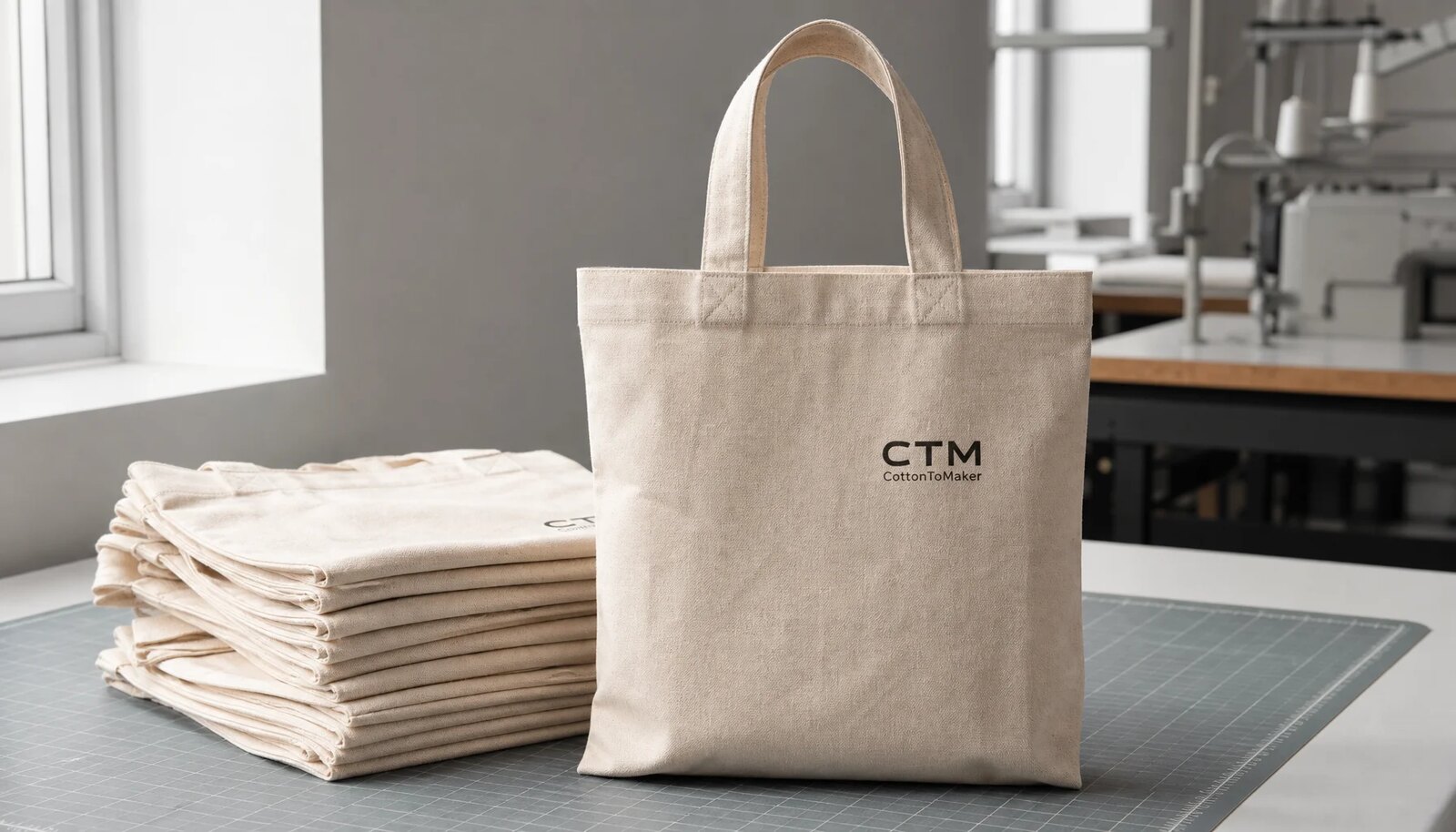
Specify for real farmers market use, not a clean mockup
A farmers market tote is rarely seen as a flat rectangle. It hangs from a stall peg, sits folded in a basket, swings from a shopper’s shoulder, and bulges around tomatoes, bread, herbs, eggs, jars, flowers, or boxed produce. That use changes how a logo reads. A mark that looks centered in a digital proof may look high once the handles pull upward, or too low once the bottom of the bag fills and rounds out.
For procurement buyers, logo placement should be treated as a production specification rather than a design note. The decision affects how suppliers quote, how samples are approved, how inspectors measure, and how repeat orders are controlled. This is especially important for farmers market vendors because the tote often serves several jobs at once: a shopping bag, a walking advertisement, a retail merchandise item, and sometimes a sponsor or event giveaway.
Start by defining the tote’s job. A free handout can usually use a lighter fabric and moderate logo size. A paid merchandise tote needs better perceived value, cleaner print execution, and a placement that still looks intentional when stacked on a table. A CSA pickup bag may need sturdier construction and a logo that remains visible when the bag is full. Those tradeoffs should be decided before the RFQ is sent, not after samples arrive.
- Define the primary use: giveaway, retail item, CSA pickup, vendor merchandise, or event sponsor bag.
- Judge logo readability from 3-6 feet away in outdoor light, not only in a close-up PDF proof.
- Review how the logo looks when the tote is flat, hanging, lightly filled, and folded for packing.
- Keep the logo away from handle attachments, top hem seams, side seams, and gusset folds.
- Turn the preferred placement into measured instructions so every supplier quotes the same bag.
Choose the tote body before approving the logo zone
Logo placement depends on construction. A flat tote gives the simplest print field because the front face is usually one broad panel. A bottom-gusset tote adds carrying capacity while keeping a mostly stable front panel, which is useful for produce, bread, and jars. A side-gusset or boxed-bottom tote can carry more and stand better, but the apparent front panel may be narrower than the finished width. If the artwork is centered to the wrong reference, the bag can look off even when the factory followed a measurement.
For market vendors, the main construction tradeoff is cost versus carrying performance. Flat totes are efficient for promotions and easy to stack. Bottom-gusset totes are more practical for real shopping because they accept bulkier produce and packaged goods. Boxed-bottom designs can feel more retail-ready, but they require extra sample review because the front face changes when the bag is filled or set upright.
Fabric weight should be decided at the same time. Many promotional organic cotton totes fall around 5-7 oz, while more substantial retail or repeat-use totes are often specified around 8-10 oz. These ranges are practical market benchmarks rather than universal rules; the right choice depends on finished size, expected load, print method, and freight cost. Ask suppliers to quote fabric in GSM or oz and to state tolerances, because two quotes that both say “cotton canvas” may not represent the same bag.
- Flat tote: lowest complexity, easiest logo alignment, best for simple campaigns.
- Bottom gusset: stronger choice for produce and jar carrying without overcomplicating the print panel.
- Side gusset: useful capacity, but define whether placement follows fold lines or outer seams.
- Boxed bottom: good retail feel, but sample it filled and standing before approving logo position.
- Heavier fabric: better perceived value and stability, but higher unit cost, carton weight, and freight impact.
Define placement with measurements a printer and inspector can share
The phrase “center front” is too vague for a purchase order. A usable placement spec should show the finished bag size, logo size, vertical position, horizontal centering reference, and no-print areas. For many standard 15-17 in tall market totes, a practical starting point is to place the top of the artwork about 3-4 in below the finished top hem. This keeps the logo below the handle attachment area while leaving enough lower space for the bag to fill without swallowing the artwork. Shorter or taller bags need proportional adjustment.
Measure from sewn references, not from raw fabric or a loose fold. Use the finished top hem to the top edge of the artwork for vertical placement. For horizontal placement, state whether the logo centerline is measured from the outer side seams, the visible front-panel edges, or the gusset fold lines. On flat totes, full-width centering is usually clear. On gusseted totes, visual centering on the usable front panel is often safer for market display because shoppers see the front face, not a technical pattern width.
Clearance matters. The logo should not crowd the top hem, handle reinforcement, side seams, or gusset folds. A small premium logo may need more white space to feel intentional. A sponsor or market badge may need to be larger and more central for visibility. If placement is intentionally offset, label it as offset and provide the exact distance. Otherwise, the factory or inspector may “correct” the design back to center.
- State finished bag width and height before stating logo placement.
- Measure vertical placement from the finished top hem to the top of the artwork.
- Define horizontal reference: outer seams, front-panel edges, gusset fold lines, or intentional offset.
- Leave practical clearance from handle stitching, seams, gusset folds, and the top hem.
- Ask the supplier for a placement drawing or marked sample photo with ruler references.
Set logo size based on visibility, artwork complexity, and cotton texture
A useful logo size is large enough to read but not so large that it fights the fabric. For many simple one-color farmers market logos, a width around 5.5-7.5 in works well on common tote sizes. A smaller 4.5-6 in wide mark can look more premium for farm shops or boutique vendors. A larger 7.5-9 in graphic may improve visibility in crowded outdoor traffic, but it should be tested because large solid ink areas can wrinkle, feel stiff, or show fold lines.
Artwork complexity often matters more than total size. Natural organic cotton can show fiber flecks, slubs, and slight surface unevenness. These are part of the material character, but they reduce forgiveness for tiny text and thin strokes. If the logo includes a location line, website, seasonal slogan, social handle, or certification statement, ask the supplier for the minimum readable text height and line width on the actual fabric and print method. Do not assume a font that works on paper will work on woven cotton.
Buyers should also decide whether the tote is meant to look branded or heavily promotional. A bold oversized logo can work for event giveaways and sponsor programs. A smaller centered logo may better fit paid retail merchandise because it feels less like advertising. For farmers market vendors selling handmade or local goods, the tote’s perceived authenticity often matters. A clean one-color mark with open space can communicate the brand without turning the bag into a stiff printed billboard.
- Use smaller marks for premium retail feel and larger marks for sponsor or event visibility.
- Avoid very small secondary text unless the supplier confirms it on the final fabric.
- Increase line weight for cotton texture instead of relying on delicate digital strokes.
- Check large solid areas for hand feel, curing, cracking, and fold marks.
- Approve the physical strike-off if color, opacity, or small text legibility matters.
Match print method to order size, artwork, and hand feel
Screen printing is usually the most practical method for farmers market totes with one- or two-color logos. It is repeatable, scales well for volume orders, and works with simple farm names, market badges, and sponsor marks. The quality still depends on setup: mesh selection, ink deposit, fabric stability, and curing. A low quote is not enough if the supplier cannot hold edge sharpness or consistent placement across the run.
Water-based screen printing is often attractive for organic cotton because it can create a softer feel and a more integrated finish than a heavier surface deposit. The tradeoff is process sensitivity. Natural cotton absorbency, fabric shade, drying conditions, and curing can influence the final color and feel. If your brand color is strict, a Pantone callout should be treated as a target, not a substitute for a physical strike-off on final fabric.
Heat transfer or digital methods can be useful for short runs, complex full-color artwork, or personalization. They are not automatically wrong, but they require different checks. Transfers may have a visible edge or a surface feel that conflicts with the organic cotton message. Digital prints may need extra review for wash or rub performance, depending on the application. The best method is the one that fits the artwork, order quantity, repeatability need, and vendor brand position.
- Choose screen print for repeatable simple logos and larger volume programs.
- Consider water-based ink when soft hand feel and natural appearance matter.
- Use heat transfer or digital methods only after checking edge feel, fold behavior, and durability.
- Ask for minimum line width, smallest text height, and whether halftones are recommended.
- Confirm curing control so the print does not transfer, crack, smear, or remain tacky.
Build an RFQ that exposes real cost drivers
Suppliers cannot quote fairly if the request says only “organic cotton tote with logo.” That wording lets each supplier assume a different fabric weight, size, handle length, print area, packing method, and QC standard. A stronger RFQ names the exact bag construction, finished dimensions, fabric weight, fabric color, logo size, logo placement, print method, print color count, sample process, packing method, carton details, and delivery terms.
Separate the cost drivers. Ask for sample fee, screen or setup charge, unit price, packing cost, carton quantity, estimated carton dimensions, gross weight, and export or delivery charges. If you are comparing a small centered logo against a larger sponsor logo, quote them as separate options. If you are comparing flat totes against bottom-gusset totes, separate them as different builds. This makes internal approval easier and prevents a supplier from hiding a spec change inside a unit price.
MOQ should be tied to the exact specification. A low advertised MOQ may apply only to stock natural fabric, a standard flat tote, one print color, and bulk packing. Custom dyed cotton, special handle length, heavier fabric, individual retail packing, multiple print colors, or an unusual placement can raise the MOQ or lead time. Ask what changes trigger a new setup charge, sample, or MOQ before the design is approved internally.
- Quote one fixed specification first; price alternatives as separate line items.
- Require fabric weight in GSM or oz, finished size, handle drop, and construction details.
- State logo size, placement measurements, print method, and color count in the RFQ.
- Ask whether print setup fees repeat on reorder or only apply to the first run.
- Compare landed cost using carton cube, gross weight, packing method, and delivery terms.
Approve samples in the same conditions vendors will use the tote
Sample approval should not stop at a digital mockup. If the tote body is new, approve a blank construction sample first. Check fabric feel, finished dimensions, handle drop, strap width, gusset shape, stitching, and whether the bag suits the intended load. Then approve a printed strike-off or pre-production sample using the final fabric, final artwork, and final placement. This sequence prevents buyers from approving decoration on a body that later proves unsuitable.
Review the printed sample like a shopper would. Lay it flat and measure it. Hang it by the handles and check whether the logo sits too close to the top. Lightly fill it with representative items, such as produce, jars, bread, or boxed goods, to see whether the lower logo area distorts. Fold it the way it will be packed and check whether the fold line cuts through the main artwork. Photograph it from normal market distance, not only close up.
Document the sample. Record the top hem to artwork distance, logo size, side-to-side centering reference, handle clearance, fabric weight, print method, and any approved deviations. Ask the supplier to keep one approved sample at the factory as the production reference. If approval happens only through informal chat photos, the bulk team and inspection team may not share the same standard.
- Approve the blank tote body first when construction, fabric, or handle design is new.
- Approve a printed strike-off or pre-production sample on final fabric before bulk starts.
- Check the sample flat, hanging, lightly filled, folded, and photographed from shopper distance.
- Measure from sewn references and record the numbers in the purchasing file.
- Keep approved sample photos and written supplier confirmation for repeat orders.
Use QC criteria that cover both decoration and bag performance
Quality control for organic cotton market totes should cover more than whether the logo looks nice. Placement depends on cutting, sewing, fabric movement, print setup, curing, folding, and carton handling. A tote can fail receiving inspection because the logo is crooked, but it can also fail customers because the handle seam is weak, the print remains tacky, or the fabric has stains through the logo area.
Placement tolerance should be agreed before production. Many general market tote programs can work with about +/- 0.5 in from the approved placement, but this is a commercial tolerance, not a universal rule. A small premium logo may require tighter control; a large event graphic may tolerate slightly more variation. The important point is to define the reference and tolerance in writing so the inspector, supplier, and buyer judge the same target.
Print QC should include edge sharpness, opacity, blocked detail, pinholes, smearing, ghosting, tackiness, color consistency, and adhesion after normal folding. Construction QC should include handle reinforcement, top hem, side seams, gusset seams, skipped stitches, loose threads, holes, stains, and finished size. Packing QC should confirm count, carton strength, dry cartons, correct marks, and fold direction. These checks are practical because farmers market totes carry uneven loads and are often distributed quickly after delivery.
- Inspect placement height, horizontal centering, logo size, and handle clearance.
- Check print edges, opacity, small text, curing, rub resistance, color, and fold behavior.
- Inspect fabric defects in the logo zone more strictly than hidden interior areas.
- Check handle stitching and seam strength because produce loads are uneven.
- Verify carton counts, dryness, fold direction, shipment marks, and packing photos before shipment.
Decide packing and distribution before the purchase order is final
Packing affects both landed cost and presentation. A large logo may look approved at sample stage but arrive with a hard fold across the center if packing was not specified. Organic cotton can crease, and deep export folds can make the print look damaged even when the ink is sound. Ask the supplier to show the proposed fold during sample approval and confirm whether the printed face is protected inside the carton.
Bulk flat packing or bundled packing is usually practical for farmers market vendors because bags can be unpacked quickly at a stall or event booth. Retail channels may require a more controlled fold, hangtag, barcode, belly band, or individual unit packing. Individual polybags can protect against dust and handling marks, but they add cost and may conflict with the sustainability message of an organic cotton bag. Paper bands or counted bundles may be a better compromise when the channel allows it.
Carton details should be part of the quote, not an afterthought. Pieces per carton, carton dimensions, gross weight, and destination labels influence freight quotes and warehouse receiving. A 5 oz flat tote and a 10 oz gusseted tote will not have the same cube or weight, even if the logo is identical. If the order will be split among several market vendors, specify carton marks, inner bundle counts, SKU labels, and destination information before production is packed.
- Approve fold direction so the main logo is not sharply creased.
- Confirm pieces per carton, carton dimensions, gross weight, and carton strength.
- Use bundles, paper bands, hangtags, barcodes, or individual packing only when the channel needs them.
- Specify PO number, SKU, destination, carton numbering, and shipping marks.
- Request final packing photos before shipment, especially on first orders or split deliveries.
Freeze the spec so repeat orders stay comparable
A good first order should become a repeatable purchasing standard. Once the sample is approved, freeze the fabric weight, finished size, handle drop, construction, logo size, placement measurements, print method, ink color, packing method, and carton plan. If marketing changes the logo, adds a sponsor, adjusts the color, or moves the placement, treat it as a formal revision with possible cost, sample, MOQ, and lead-time impact.
This discipline protects landed cost. Small gaps create expensive surprises: shorter handles make the tote less comfortable, lighter fabric changes hand feel, larger artwork adds setup or curing risk, and missing carton data makes freight estimates unreliable. If printing is subcontracted without clear sample control, corrective action can also be slower. The purchase file should therefore include the final quote, artwork file, placement drawing, approved sample photos, QC criteria, carton details, and inspection notes.
For farmers market vendors ordering seasonally, documentation is especially valuable. The next reorder may happen months later, handled by a different buyer, supplier contact, or production team. A clear specification prevents silent substitutions and keeps quote comparisons honest. The result is not just a better-looking tote; it is a cleaner procurement process for custom organic cotton bags that need to perform at real markets.
- Freeze the specification before bulk production begins.
- Record every artwork, fabric, handle, placement, print, or packing revision in writing.
- Keep approved sample photos and measurements with the purchase order.
- Use carton cube, gross weight, setup charges, and inspection results in landed-cost review.
- Base repeat orders on the final approved spec, not on a catalog description or old email thread.
Specification comparison for buyers
| Spec decision | Recommended option | When it fits | Buyer risk to check |
|---|---|---|---|
| Primary logo placement | Center on the usable front panel; for many 15-17 in tall totes, place the top of artwork about 3-4 in below the finished top hem | Market display, shoulder carry, table stacks, and front-facing product photos | If printed too high, the logo competes with handle stitching; if too low, it can distort or disappear when filled |
| Centering reference | Flat totes: center to full front width. Gusseted totes: define whether centered to outer seams, gusset fold lines, or visible front panel | Prevents disputes between design proof, sewing team, printer, and inspector | A logo can be measured correctly but look off-center when the gusset opens |
| Logo size range | 5.5-7.5 in wide for most simple one-color marks; smaller for premium minimal branding; larger only after strike-off approval | Farm names, CSA marks, sponsor logos, and market badges | Oversized solids can feel stiff, wrinkle, crack at folds, or overwhelm natural cotton texture |
| Print method | Screen print for repeatable one- or two-color logos; water-based ink for softer hand feel when suitable | Most farmers market vendor, CSA, grocery, and local event programs | Fine lines can fill in, color can shift on natural cotton, and poor curing can cause tackiness or transfer |
| Artwork format | Vector AI, EPS, SVG, or press-ready PDF with outlined fonts, final size, and color callouts | Clean quote comparison and repeat orders | Raster art, unoutlined fonts, tiny slogans, and low-resolution badges increase prepress changes |
| Fabric weight | 5-7 oz for economical promotional distribution; 8-10 oz for paid merchandise, CSA reuse, or heavier shopping | Balances unit cost, hand feel, durability, and freight weight | Very light fabric can shift during printing; heavier fabric increases carton weight and landed cost |
| Bag construction | Flat tote for low-cost giveaways; bottom-gusset or boxed-bottom tote for produce, jars, bread, and flowers | Farm stands, market vendors, food co-ops, and CSA pickup programs | Gussets reduce the apparent print panel and require clearer placement measurement |
| Handle drop | About 11-13 in for shoulder carry on many market totes; confirm strap width and attachment style | Shoppers carrying produce while walking between stalls | Short handles feel cramped; long handles can visually crowd the upper logo zone |
| Packing method | Bulk flat-packed or bundled for vendor distribution; retail fold, band, barcode, or hangtag only when needed | Controls freight cube, receiving speed, and presentation | Tight folds through the logo can create crease marks; unnecessary individual packing adds cost and waste |
Buyer checklist before sampling
- Define the program use first: free giveaway, paid merchandise, CSA pickup, sponsor promotion, grocery retail, or multi-vendor market campaign.
- Confirm finished bag width, height, gusset depth, handle drop, strap width, seam style, fabric weight, fabric color, and intended carrying load before setting logo size.
- Specify organic cotton weight in oz or GSM, whether natural, bleached, dyed, or custom dyed, and whether certification or chain-of-custody documents are required for your purchase file.
- Send vector artwork with outlined fonts, final logo size, approved color reference, minimum readable text requirements, and any areas that must not be altered by factory prepress.
- State placement from fixed sewn references: finished top hem to top of artwork, side reference to centerline or artwork edge, and clearance from handle reinforcement and seams.
- For gusseted bags, define whether the logo is centered to the full bag width, outer side seams, visible front panel, or gusset fold lines.
- Ask for a blank construction sample when the tote body is new, then approve a printed strike-off or pre-production sample on the final fabric before bulk production.
- Review the sample flat, hanging from the handles, lightly filled, folded as packed, and photographed from a normal shopper distance.
- Set written QC expectations for placement tolerance, print edge quality, curing, color consistency, fabric defects, stitching, handle strength, finished size, carton count, and packing condition.
- Confirm whether printing is in-house or subcontracted, who owns sample approval, and whether one approved sample stays at the factory as the bulk production reference.
Factory quote questions to send
- What finished tote size are you quoting, including width, height, gusset depth, handle drop, strap width, and seam construction?
- What is the fabric weight in GSM or oz, and what tolerance do you apply to incoming fabric rolls and finished bags?
- Is the cotton natural, bleached, dyed, or custom dyed, and what shade variation should we expect between lots?
- Can you provide organic cotton certification, transaction documents, or chain-of-custody paperwork if our procurement policy requires it?
- Where exactly will the logo sit from the finished top hem, side references, gusset fold lines, and handle attachment area?
- Will you provide a placement drawing or marked sample photo before we approve the printed sample?
- Is the logo centered to the full width, the visible front panel, the gusset fold lines, or another reference?
- Which print method and ink type are included in the quote, and are there limits for line width, small text, halftones, or large solid areas on this fabric?
- Is printing done in-house or by a subcontractor, and who signs off on strike-off, pre-production sample, and bulk start?
- What color matching process do you use for natural cotton, and will the bulk be judged against the physical approved sample?
Quality-control points to confirm
- Logo position tolerance: define the agreed tolerance from the approved placement drawing; many buyers use about +/- 0.5 in for general market totes, but tighter control may be needed for small premium logos.
- Centering control: inspect from the same reference used in the spec, such as outer side seams, visible front-panel edges, gusset fold lines, or marked centerline.
- Logo size: confirm printed width and height match the approved artwork size within the agreed tolerance, especially after any factory art adjustment.
- Print sharpness: reject missing strokes, blurred edges, pinholes in key logo areas, smearing, ghosting, blocked fine lines, and unreadable small text compared with the approved sample.
- Ink adhesion and curing: printed areas should not transfer, remain tacky, crack under normal folding, or show abnormal rub-off after curing and packing.
- Color consistency: judge bulk against the approved physical sample under consistent light; natural cotton shade variation should be agreed in advance, not debated at receiving.
- Fabric defects: reject holes, weak yarns, oil marks, stains, contamination, foreign fibers, or excessive slubs in the logo area that affect brand appearance.
- Stitch quality: handle seams, top hem, side seams, and gusset seams should be secure, even, and free of skipped stitches or broken threads at load-bearing points.
- Handle alignment: handle length, spacing, strap twist, and reinforcement stitching should be consistent so handles do not cover or visually crowd the logo.
- Finished size: bag width, height, gusset depth, and handle drop should stay within the written tolerance so capacity, display, and packing remain predictable.