Why Logo Placement Is A Procurement Spec
For coffee roasters, a tote is rarely just a blank bag with artwork added at the end. It may be retail merchandise, a subscription insert, a wholesale onboarding gift, a market-day giveaway, or part of a seasonal bundle with beans, filters, and brewing tools. Each use case changes the value of the logo position. A tote hung on a cafe wall needs the mark to read from across the room. A tote sold in a gift set may need restrained branding that feels deliberate instead of promotional. A bag handed out at a trade show needs the logo to be visible quickly, even when the bag is folded or packed flat.
That is why logo placement belongs in the procurement spec, not in a loose design note. The print location has to work with the tote pattern, fabric weight, stitching method, print process, and packing method. A centered logo in a PDF can shift once the bag is filled, folded, or sewn with a slightly different seam allowance. If the buyer does not convert the design into measurable points, the factory has too much room to interpret the result.
The biggest mistakes happen before sampling. One supplier may price a 150 x 150 mm logo on a flat 8 oz tote. Another may quote a 280 x 280 mm screen print on a 12 oz gusseted shopper. Both can call the product a custom organic cotton tote, but the visual result, print risk, cost, and freight profile are not the same. The right guide for coffee roasters should start with construction, then move into artwork placement.
- A logo position should be defined by millimeters from fixed seams, hems, folds, or centerlines.
- The same artwork can require different placement on flat totes, gusseted shoppers, and compact gift bags.
- Retail resale usually needs tighter placement control than a short-run giveaway.
- Quote accuracy improves when print size, print position, fabric weight, and packing style are specified together.
Lock The Tote Construction Before You Place Artwork
Logo placement only makes sense after the bag pattern is fixed. Common coffee roaster tote formats include a flat merchandise tote around 380 x 420 mm, a gusseted shopper around 350 x 400 x 100 mm, and a smaller event or gift tote around 300 x 350 mm. These are not universal standards; they are simply useful starting points for RFQ discussions. The safe print zone changes when the body width, body height, gusset depth, top hem, or handle attachment changes.
Fabric weight matters as much as overall size. Organic cotton totes are often described by ounce weight, such as 8 oz, 10 oz, 12 oz, or 14 oz, or by GSM. As a rough commercial reference, 8 oz may sit around 270 GSM, 10 oz around 340 GSM, and 12 oz around 407 GSM, but the weave and finish affect the actual feel. Buyers should not treat ounce conversion as exact. Ask the supplier to state the actual GSM target and the tolerance they can hold.
Handle construction reduces usable print area more than many first-time buyers expect. Self-fabric handles inserted into the top hem create a thicker top zone and a stronger stitch area. Cotton webbing handles can look clean and durable, but the stitch box still creates a no-print or low-risk zone. If the logo sits too close to the handle reinforcement, the print can look crowded or pull visually off center once the bag is sewn.
- Confirm finished body size, not only cut panel size.
- Record top hem depth and handle stitch box dimensions before approving a high logo position.
- For coffee bags, mugs, or gift bundles, decide gusset depth before final artwork placement.
- Use the same body pattern for repeat orders when possible, because changing the tote shape changes logo balance.
Define Safe Print Zones In Millimeters
A safe print zone is the part of the tote where artwork can be printed with a lower risk of distortion, sewing interference, or folding damage. On a standard front panel, the top of the artwork is often placed about 60-90 mm below the finished top hem. That range is not a rule for every bag. It is a practical starting point that usually keeps artwork away from the top fold and handle stitch area on many cafe totes. The final value should come from the approved bag pattern.
Side clearance matters just as much. Large front logos should avoid running close to the side seams or gusset folds because cotton canvas can pull during sewing and use. On a 380 mm wide flat tote, a 240 mm wide logo leaves about 70 mm on each side if perfectly centered. That is usually easier to control than a 320 mm wide graphic with narrow margins. On gusseted bags, the visible front panel may be narrower than the full bag width once the side folds are formed.
Buyers should ask for a measurement drawing instead of relying on a rendered mockup. The drawing should show the finished outline, handle location, stitch boxes, seam allowances, gusset folds, artwork size, top margin, side margins, and centerline. If the supplier cannot provide that, require a pre-production sample with ruler photos and written measurements. A clean diagram saves time later because there is less room for interpretation.
- Measure from finished top hem to the top of artwork, not from the top of the handle.
- Measure left and right from fixed side seams or visible gusset fold lines.
- For centered logos, specify both artwork centerline and allowed left-right deviation.
- For lower-corner marks, define distance from bottom seam and side seam, not only visual placement.
- For gusset prints, define the artwork start point from the top hem and the distance from fold or seam.
Match Placement To The Coffee Sales Channel
The best logo position depends on where the tote earns its value. For cafe retail, centered front placement usually makes the most commercial sense because it reads well on a wall hook, in a product photo, and while being carried. A one-color logo or illustration between 220 and 280 mm wide often works on medium and large totes, provided the panel has enough side margin. This option is also easier to compare between suppliers because front printing is a routine production route.
For premium merchandise, a smaller logo can feel more intentional. A mark around 80-120 mm wide, a woven side label, or a lower-corner patch may suit roasters with restrained packaging. The main risk is legibility. Organic cotton canvas has texture, slub, and shade variation, so small type and thin lines disappear faster than they would on coated paper. If the mark includes a roast name, founding date, or origin statement, it should be approved physically, not only on screen.
For event giveaways, readability and speed matter more than subtlety. A bold one-color front print is usually safer than a delicate side label or handle detail. For subscription boxes, fold size and packing presentation may drive placement. If the tote is folded into a mailer or gift box, the logo should not sit exactly on the compression fold unless that appearance is acceptable. Side gusset branding works when a roaster wants a clean front but still wants visibility while the customer carries the bag. It is a legitimate production choice, not a decorative afterthought.
Gusset printing does carry more alignment risk because folds, seams, and bag opening change what is visible. That does not make it a bad choice. It simply means the buyer needs a clearer approval sample and a tighter conversation about what the print should look like when the tote is flat versus when it is full.
- Cafe retail usually favors centered front placement with a balanced top margin.
- Premium roaster merchandise can use small marks, woven labels, or lower-corner branding if legibility is protected.
- Event totes should prioritize readable artwork and fewer approval variables.
- Subscription or gift-pack totes should be tested in the actual folded packing format.
- Gusset branding should be used for a clear design reason and approved on a sewn sample.
Choose The Print Method By Artwork Risk
Water-based screen printing is often the practical default for custom organic cotton totes with coffee roaster logos. It suits solid artwork, strong typography, and 1-3 color designs. Once the screens, ink, fabric, and placement are approved, it is relatively repeatable. For larger B2B orders, screen printing is also easier to compare because setup charges and color count are visible in the quote.
Digital printing has its place, especially for short runs, complex illustrations, gradients, or many-color seasonal artwork. The tradeoff is that output depends heavily on pretreatment, fabric shade, printer profile, and curing. Natural cotton is not a bright white paper surface, so color can read warmer, duller, or less sharp than the digital file. Buyers should judge digital print from a physical strike-off on the actual cotton, not from a screen proof.
Heat transfer can solve low MOQ or complex color requirements, but it can change hand feel and may look less integrated on organic cotton canvas. Embroidery can work for small marks, but on totes it may pucker lighter fabrics and add back-side thread visibility. Woven labels, patches, and tabs are excellent for subtle branding, but they add their own MOQ, color, sewing, and lead-time variables. There is no single best method. The right one depends on artwork complexity, volume, and the amount of visual control the buyer needs.
Artwork should be simplified for the selected method. Thin strokes, tiny serif copy, reversed microtext, and small QR codes are common failure points. A supplier should be able to state the minimum line width and text height for the quoted fabric and method. Put those limits into the spec sheet before bulk approval so the factory is not guessing what the artwork has to survive.
- Use screen print for bold logos, icons, store names, and simple campaign artwork.
- Use digital print when color complexity matters more than maximum repeat consistency.
- Use labels or patches for a premium subtle mark, but quote their MOQ and lead time separately.
- Avoid microcopy and delicate reversed text unless proven by strike-off.
- Approve ink color on the final organic cotton shade because natural fabric changes visual contrast.
Set Tolerances Before Bulk Production Starts
Logo placement tolerances should be agreed in writing before production starts. Without a written tolerance, the buyer may reject goods that the factory considers acceptable, or the factory may ship variation that hurts retail presentation. For front-center prints on sewn totes, buyers usually discuss millimeter limits for top margin, left-right centering, and skew. The right tolerance depends on bag construction, artwork size, and sales channel.
A retail merchandise program normally needs tighter control than a temporary event giveaway. For example, a roaster selling totes in cafe stores may require a visible centered logo with defined top margin and centering limits. A giveaway tote may allow a wider range if the logo remains readable and clearly not crooked. The key is not copying a generic tolerance number from another product. The key is agreeing to a measurable standard the supplier can inspect during production.
Tolerances should also cover print defects, not only position. Pinholes, ink drag, double impression, poor opacity, strike-through, and blurred edges can make an otherwise correctly placed logo look wrong. Coffee roaster branding often uses simple wordmarks, so a small defect in one letter can be obvious. If the artwork includes a QR code, barcode support mark, or small website, test readability and scannability on the final fabric before using it in bulk.
Buyers should also define how measurements are taken. A soft tote can shift on the table. Measure the bag flat, smoothed by hand without stretching, aligned to the finished top hem and side seams. For gusseted totes, review the bag lightly opened or filled as well, because the visible face changes in use. That matters if the tote will be sold folded on a shelf but used full of beans, tools, and takeaway drinks.
- Set top margin, side centering, and skew tolerance in writing.
- Use tighter tolerances for retail resale than for low-cost promotional distribution.
- Inspect flat and lightly filled samples when gussets affect visual alignment.
- Define unacceptable print defects such as ghosting, pinholes, smearing, and strike-through.
- Tie tolerance to the approved pre-production sample and final spec sheet.
Build A Quote Sheet Suppliers Can Price Accurately
An RFQ that says custom organic cotton tote with logo is too vague for B2B sourcing. It lets suppliers quote different products under the same name. A stronger RFQ fixes the product specification first: finished dimensions, gusset, fabric weight, fabric color, handle type, handle drop, print method, artwork size, number of colors, placement measurements, sample type, packing method, and target quantity. This does not slow quoting. It removes guesswork.
The RFQ should separate charges. Ask for sample cost, screen or setup cost, unit price, label cost, packing cost, carton data, and any artwork-version surcharge. If a roaster has multiple cafe locations or seasonal designs, ask whether each artwork requires a separate screen charge and how cartons will be sorted. For procurement, a slightly higher unit price can be worthwhile if it includes a stronger sample process and clearer packing data.
It is also useful to request two defined options. Option A might be a 10 oz flat organic cotton tote with a one-color 220 mm front print, bulk packed. Option B might be a 12 oz gusseted tote with the same front print plus a woven side label and retail fold. This shows whether cost is moving because of fabric, branding complexity, sewing, or packing. It also prevents a supplier from quietly substituting a lighter fabric to hit a target price without making that change visible.
Do not leave certification language vague. If the buyer needs organic cotton documentation, specify whether the requirement applies to yarn, fabric, or finished product transaction documentation. Suppliers may source organic cotton through different supply-chain structures, and the buyer should request the exact documents needed for internal compliance or customer claims.
- Include finished dimensions, fabric weight, handle details, and decoration details in one RFQ.
- Break out setup, sample, unit, label, packing, and carton costs.
- Ask suppliers to write all assumptions into the quote.
- Request carton dimensions and gross weight for freight planning.
- State documentation needs for organic cotton clearly and early.
Sampling Should Prove Placement, Not Only Color
A print strike-off proves color, ink behavior, and line detail on the fabric. A sewn pre-production sample proves placement on the finished bag. Both may be necessary when the tote will be sold as merchandise or used in a high-visibility campaign. A digital proof is useful for alignment discussion, but it does not show how fabric texture, seams, handle stitches, or folding affect the logo.
The approved sample should be documented with measurements. Take or request photos with a ruler showing top margin, side margins, logo width, logo height, gusset position, label insertion point, and handle stitch clearance. Record whether the sample was printed before sewing or after sewing. If bulk production will use a different method, the sample is not a full production reference.
For repeat orders, keep the approved sample tied to a SKU and revision date. A tote ordered again six months later may use a different fabric lot, a slightly different natural shade, or a changed handle construction if the specification is not locked. If the supplier proposes a substitute fabric or pattern adjustment, request a new strike-off or at least a revised measured approval sample before bulk production.
Sampling also protects quote discipline. If the buyer approves a 220 mm logo and later increases it to 280 mm, the supplier may need a larger screen, a different jig, more ink, more curing time, or a new strike-off. Artwork changes are commercial changes, not only design changes. Treat them as price and schedule events.
- Use a strike-off to approve ink, color, opacity, and fine detail.
- Use a sewn sample to approve placement, construction, and packing presentation.
- Attach measured sample photos to the PO or technical sheet.
- Repeat orders should reference the same SKU, artwork file, and approved sample date.
- Any change in logo size, fabric weight, or bag pattern should trigger placement review.
Control QC From Fabric Through Carton Packing
Quality control should begin before printing. If the fabric weight, shade, or bag dimensions are off, the logo may look wrong even when the printing itself is clean. Natural organic cotton can vary in shade, and small shade differences can change the appearance of black, brown, green, cream, or white ink. Inspectors should compare bulk fabric or finished bags to the approved swatch before judging print color.
During print inspection, measure multiple pieces rather than relying on one good sample. Check the top margin, left-right centering, skew, edge sharpness, ink opacity, and strike-through inside the bag. For coffee roasters using clean wordmarks, inspect the counters of letters such as o, e, a, and p because ink fill-in can make the logo look heavy or poorly reproduced. If the artwork includes roast names or small location copy, inspect that text separately.
Construction around the logo field matters. Handle stitch boxes should not overlap the print unless the design intentionally allows it. Puckering, skipped stitches, loose threads, or uneven side seams can make placement look crooked. For gusseted bags, open the tote and review whether the side artwork remains readable or collapses into the fold. For labels, check fold direction, insertion depth, exposed raw edges, and twisting.
Packing inspection is the last chance to protect a good print. Freshly printed bags should not be folded or stacked in a way that causes offsetting. Fold lines should avoid the main logo for retail merchandise. Cartons should be marked by artwork version, SKU, quantity, and lot when orders include multiple cafe locations or seasonal designs. Good QC is not only about rejecting bad pieces. It is about stopping the right problems before they leave the factory.
- Check fabric and dimensions before judging print quality.
- Measure placement across the inspection sample set, not only the top piece.
- Inspect inside the bag for ink strike-through or transfer.
- Review sewing quality near the logo because puckering changes visual alignment.
- Confirm carton segregation for multi-artwork orders before shipment.
Packing And Lead Time Affect The Logo Result
Packing is part of the logo decision because the first impression may happen when the tote is removed from a carton, mailer, or cafe shelf stack. If a fold line runs through the center of a high-coverage logo, the tote can look damaged even if the print passed inspection. For retail resale, ask for a folding method that preserves the main logo or presents it intentionally. For event giveaways, bulk packing may be acceptable, but abrasion and ink transfer still need control.
Individual polybags are not always the right answer, especially for brands trying to reduce plastic. Alternatives include counted inner bundles, recycled paper bands, tissue separation for dark prints, or retail folding without individual plastic. The right choice depends on sales channel, freight method, and sustainability position. Buyers should price packing early because it affects labor, carton size, freight efficiency, and shelf presentation.
Lead time risk often sits in artwork approval, label sourcing, and packing details rather than basic sewing. A simple front-print tote can move faster once the fabric and artwork are approved. Add woven labels, custom hangtags, multiple artwork versions, retail-ready folding, or documentation checks, and the timeline expands. Procurement should ask the supplier which component has the longest lead time and which approval step most often delays production.
A realistic timeline separates artwork confirmation, strike-off, pre-production sample, bulk material booking, printing, sewing or finishing, curing, packing, final inspection, and shipment release. The production date is not truly firm while logo size, placement, fabric weight, or label position remain open. That is why a logo placement guide for coffee roasters needs to be tied to the production calendar, not only the brand guide.
- Choose packing style before final quote comparison.
- Avoid fold lines directly through the primary logo unless approved.
- Ask whether prints need curing or rest time before stacking and folding.
- Treat woven labels, hangtags, and multi-artwork assortments as lead-time risks.
- Book final inspection before the ex-factory week for campaign-critical orders.
Specification comparison for buyers
| Spec decision | Recommended option | When it fits | Buyer risk to check |
|---|---|---|---|
| Front panel logo position | Centered on the body centerline, with the top of artwork usually 60-90 mm below the finished top hem on standard cafe totes | Best for retail merchandise, cafe counter sales, wholesale welcome packs, and events where the logo must read from the front | Confirm the measurement point: top of finished hem, not raw fabric edge. Keep artwork clear of handle stitch boxes and top-fold distortion. |
| Large front print size | 220 x 220 mm to 280 x 300 mm on common 380 x 420 mm or 350 x 400 x 100 mm totes | Useful for bold coffee brand marks, seasonal merchandise graphics, and one-color statement artwork | Oversized prints can wrinkle, drift toward side seams, or look off-center when the bag is filled. Approve on the actual bag size. |
| Small front mark | 80 x 80 mm to 120 x 120 mm, preferably one-color with bold strokes | Good for minimalist roaster branding, premium merchandise, subscription gifts, and lower ink coverage | Fine text under about 2 mm stroke width or very small reversed letters can fill in on textured cotton. Require a strike-off. |
| Side gusset branding | One-color vertical print on an 80-120 mm gusset, with artwork kept away from fold lines and seam allowances | Works when the front panel stays clean but the brand should be visible while carried | Gusset print alignment is less forgiving because sewing and folding affect the visible plane. Set top margin and side-to-fold tolerance. |
| Lower corner or side seam label | Woven tab label, folded label, or small sewn patch positioned from a fixed seam reference | Fits premium private label programs, subtle cafe merchandise, and designs avoiding a large printed logo | Label MOQ, lead time, fold type, color matching, and sewing cost must be quoted separately. Label insertion can shift if seam allowance changes. |
| Back panel branding | Blank back, or a small website, QR support line, origin note, or campaign mark under about 120 x 60 mm | Useful when the front is kept clean but the tote needs secondary information | A second print position adds setup, inspection, and approval points. Small copy must remain legible on slubbed natural cotton. |
| Handle logo treatment | Avoid as default; use only simple repeat motifs on stable cotton webbing or herringbone tape | Suitable for premium campaigns where handle detail is part of the design concept | Handle printing has higher abrasion and registration variation. Many suppliers print straps before sewing or outsource the step, affecting lead time. |
| Print method for organic cotton totes | Water-based screen print for most 1-3 color logos; digital print only when artwork complexity or low MOQ justifies it | Screen print is usually the most comparable route for repeat B2B orders and cafe merchandise | Digital output depends on pretreatment, fabric shade, and file handling. Compare physical strike-off to Pantone or approved master sample. |
| Print-before-sewing vs print-after-sewing | Use the supplier's stable production route, but quote and approve placement according to that route | Print-before-sewing can help large panel artwork; print-after-sewing is common for standard front logos | Do not approve a flat cut-panel mockup if bulk production will be printed on finished bags. Tolerances differ. |
Buyer checklist before sampling
- Define finished tote size in millimeters: body width, body height, gusset depth, handle width, and handle drop.
- Specify fabric construction clearly: organic cotton canvas or plain weave, ounce weight or GSM, natural or dyed shade, and whether certification documents are required for the order.
- Lock the decoration route before price comparison: front print only, front plus back, gusset print, woven label, sewn patch, hangtag, or a combination.
- State the exact artwork size in millimeters and include Pantone, CMYK, or approved color target. Do not rely on a scaled mockup only.
- Measure logo placement from fixed construction points such as finished top hem, side seam, bottom seam, gusset fold, or body centerline.
- Confirm whether printing is done before sewing or after sewing, because placement tolerance and distortion risk are different.
- Ask the supplier for maximum printable area after deducting top hem, handle stitch box, seam allowance, and gusset fold zones.
- Set minimum artwork rules for textured cotton: minimum line width, minimum text height, minimum reversed text size, and no unsupported microcopy.
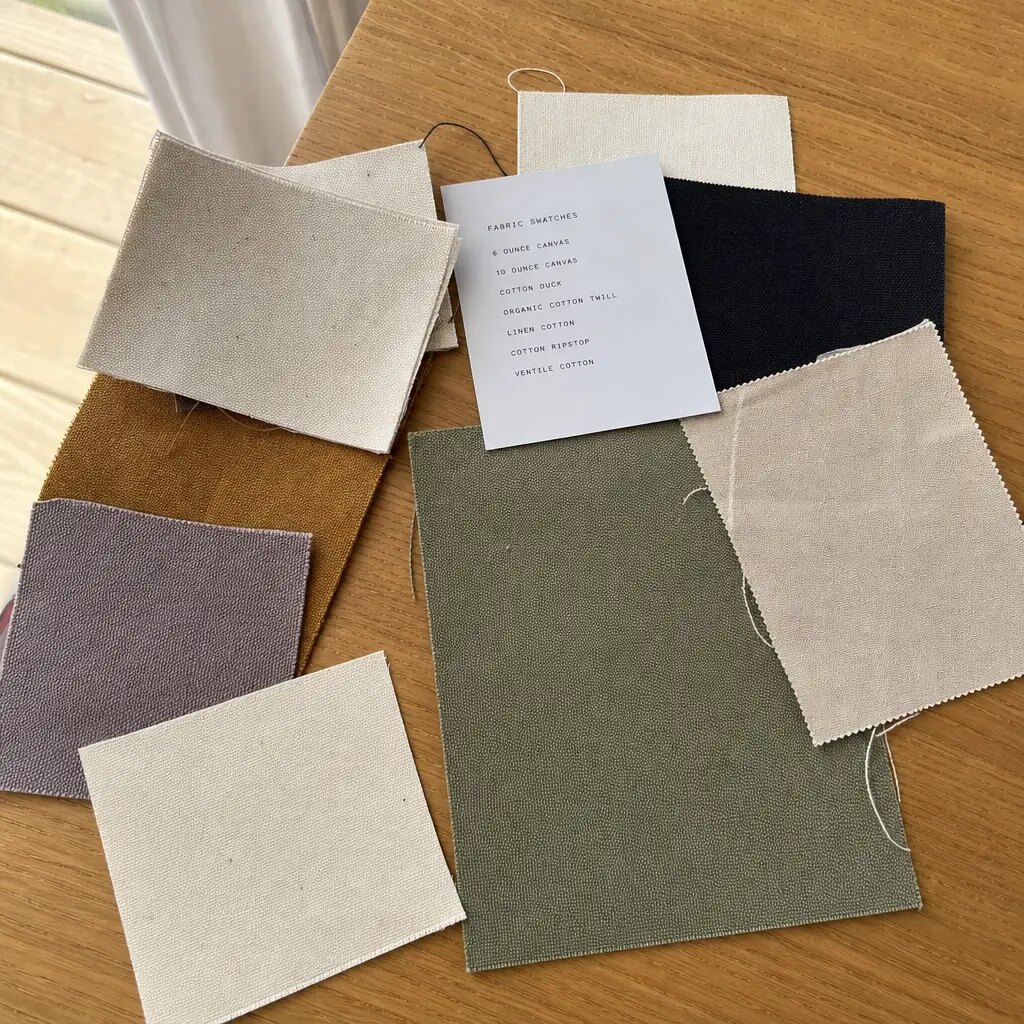
- Request a fabric swatch and print strike-off on the same organic cotton quality, color, and finishing as bulk production.
- Approve a physical pre-production sample when placement matters for retail resale, multi-position branding, or repeat replenishment orders.
Factory quote questions to send
- What exact organic cotton fabric are you quoting: canvas or plain weave, ounce weight or GSM, yarn count if available, natural or dyed shade, and certified organic status for fabric or finished bag?
- What finished bag dimensions are included in the quote, including body width, body height, gusset depth, handle width, handle drop, top hem depth, and seam allowance?
- Is the logo printed before sewing or after sewing, and will bulk production follow the same method used for the approved sample?
- What is the safe maximum printable area on the front panel after deducting top hem, handle stitch box, side seam allowance, bottom fold, and gusset transition?
- What logo size, number of colors, Pantone references, and print coverage assumptions did you use for pricing?
- How many screens, setup charges, color stations, curing steps, and artwork versions are included, and what changes if the print moves to the back panel or gusset?
- What minimum line width, minimum text height, and minimum reversed text size can you hold reliably on this fabric?
- Can you provide a physical strike-off on the exact organic cotton fabric and a sewn pre-production sample with measured placement callouts?
- What placement tolerance do you propose for front centering, top margin, side seam distance, gusset alignment, and print skew?
- If woven labels are used, what are the label MOQ, label material, fold type, size tolerance, color tolerance, lead time, and sewing cost per piece?
Quality-control points to confirm
- Finished bag dimensions checked before print inspection: body width, body height, gusset depth, handle drop, handle width, and top hem depth within agreed tolerance.
- Fabric weight or GSM verified against approved specification, with shade checked against approved swatch because natural organic cotton can vary by lot.
- Front logo measured from finished top hem to top of artwork, left side seam to artwork edge, and body centerline to artwork center.
- Placement tolerance applied consistently, for example agreed millimeter limits for top margin, left-right centering, and visible skew rather than a subjective visual check only.
- Print area clear of handle stitch boxes, top hem fold, side seam puckering, bottom seam, and gusset fold lines unless intentionally approved.
- Print edges clean with no double impression, ghosting, pinholes, ink drag, smearing, blurred fine lines, or visible screen blockage marks.
- Logo color compared to approved strike-off or Pantone target under neutral light, with obvious lot-to-lot shade drift separated for review.
- Ink opacity and hand feel checked on the final fabric, especially for black, dark green, brown, cream, or white ink on natural cotton.
- Fine text, counters of letters, roast names, and small origin statements remain open and legible after curing.
- Inside of bag checked for strike-through, staining, transfer marks, and ink offset caused by stacking or folding before full cure.