Start with the launch date, not the tote
A custom organic cotton tote is easy to underestimate because the product looks simple. In production, the calendar is usually controlled by fabric availability, artwork approval, sample courier time, printing setup, final inspection, and carton release. Sewing is only one part of the schedule.
For a tech startup, the tote often supports a fixed moment: a conference, user summit, recruiting event, onboarding kit, investor day, product launch, or customer gift drop. That makes the in-hand date more important than the purchase order date. A tote that ships on time but arrives after the 3PL receiving window has still failed the launch plan.
Work backward from the first day the bags must be usable. Include internal review time, sample approval, deposit processing, material booking, production, inspection, freight, customs where relevant, and warehouse intake. If the order is for an event, add time for venue delivery or kit assembly. This backward plan shows which decisions need to be frozen early.
The most common startup delay is not a factory refusing to produce. It is a team discovering late that the logo needs another version, the box needs a smaller fold, finance has not approved the deposit, or the warehouse needs labels that were never quoted. Lead time planning is mostly about preventing those small misses from stacking up.
- Set the in-hand date before supplier outreach.
- Separate event date, warehouse receipt date, and ship date.
- Add internal approval windows to the timeline.
- Treat sample approval as a formal schedule gate.
- Keep one owner responsible for timeline decisions.
Write the use case in plain operational terms
The first useful question is not “How should the tote look?” It is “What must the tote carry, where will it go, and how will it be handed out?” A giveaway at a booth can be lighter and bulk packed. A welcome kit bag may need cleaner folding, stronger handles, and a finish that feels intentional when an employee opens the box.
A standard 38 x 42 cm tote works for many programs, but it is not automatically right. If the tote must hold a hoodie, laptop sleeve, notebook, water bottle, or boxed hardware accessory, test that combination before locking size. If it must fit inside a mailer or kit carton, folded thickness may matter more than standing shape.
Use direct language in the brief. For example: “Must hold a T-shirt, notebook, sticker sheet, and 500 ml bottle for one-day event use” is more helpful than “premium conference tote.” A supplier can make better recommendations when the expected load, carry style, and packing route are clear.
Avoid turning one bag into three products. Event handout, retail merch, and employee gifting can share a design, but each has different cost and quality priorities. If one spec must serve all channels, identify the primary use case and accept tradeoffs deliberately.
- List the items the tote must carry.
- State hand-carry or shoulder-carry preference.
- Confirm whether the tote must fold into another box.
- Decide if the bag is giveaway, kit, retail, or replenishment stock.
- Do not let visual mockups replace functional requirements.
Choose fabric with documentation and handling in mind
For most startup programs, 140-180 GSM organic cotton is the practical buying range. The lighter end is easier for high-volume event giveaways and lower freight cost. The heavier end feels more substantial and may suit paid merch or executive gifting, but it also increases material cost, carton weight, and sometimes sewing time.
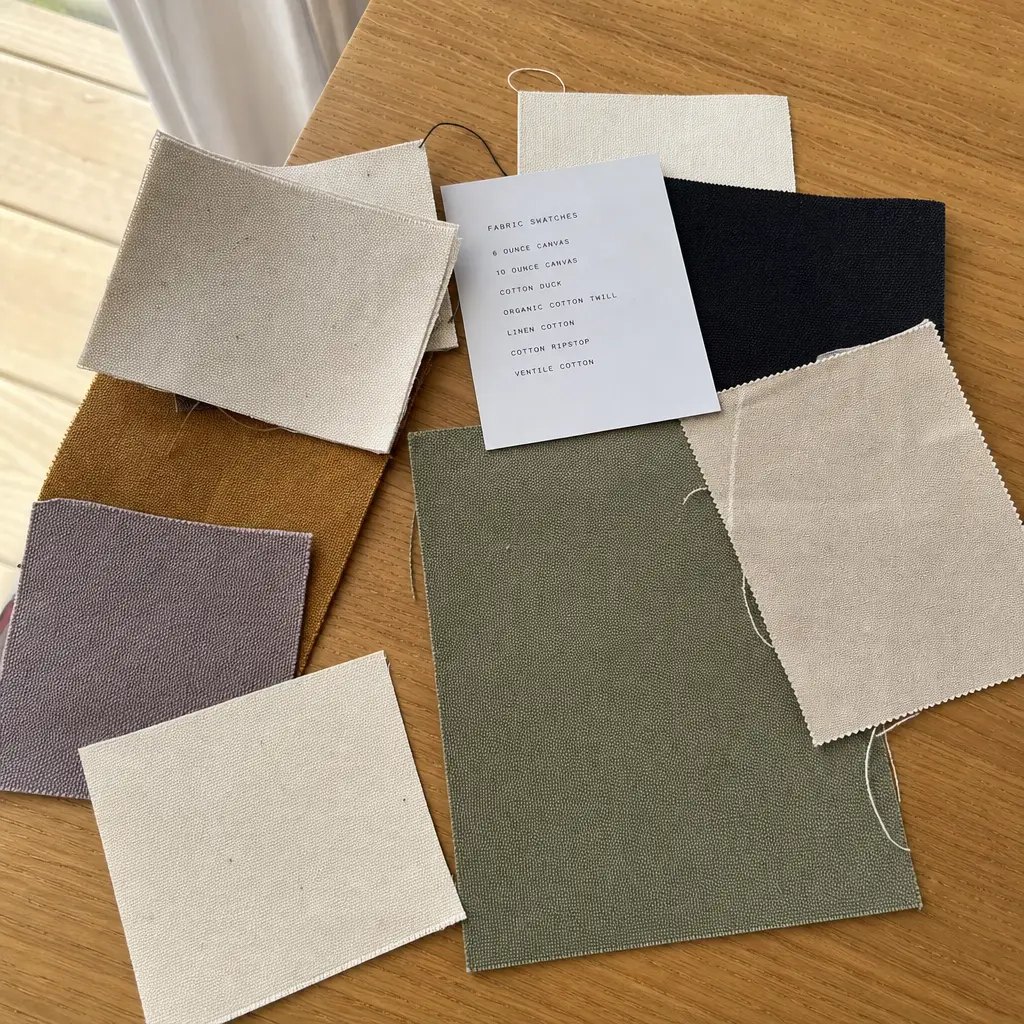
GSM is not the full spec. A 160 GSM plain weave and a 160 GSM canvas-style fabric may feel and fold differently. Ask for weave, finish, shrinkage expectation, and whether the fabric is stocked or made to order. If a supplier cannot describe the fabric beyond “organic cotton,” the quote is not ready for comparison.
The fabric decision affects more than the bag. Heavier fabric can force larger cartons or fewer units per carton. Stiffer fabric may not fold neatly into a kit. Dyed fabric introduces shade approval and colorfastness questions. Natural cotton may be faster, but shade variation can be visible across lots.
If timing is tight, ask whether the factory can reserve the fabric after deposit and whether the quote assumes current stock. Stock that exists today may be gone after a week of internal approvals. When the schedule is fixed, fabric reservation is a real milestone, not a small admin step.
- Request GSM, weave, finish, width, and shrinkage details.
- Ask whether fabric is stocked or newly sourced.
- Match fabric weight to load and packing format.
- Check how fabric choice changes carton count and freight.
- Do not approve fabric from a digital image alone.
Ask for the right organic documents at the right time
Organic cotton claims need a document trail. A supplier may have a certificate for cotton fiber, yarn, fabric, or finished goods, but those are not the same thing. Procurement should know what the certificate covers and whether it applies to the company actually producing and packing the tote.
At PO stage, request the supplier’s current certificate copy or certificate details, including certificate number, certifying body, legal entity, scope, product category, and expiry date. Also ask whether dyeing, printing, sewing, or packing is subcontracted. If another site handles part of the process, confirm whether that site is within the documented chain or merely supplying a conventional service.
Before shipment, request shipment-level proof. Depending on the certification system and supplier setup, this may be a transaction certificate, lot traceability statement, batch reference, material issue record, invoice linkage, or packing list that ties the finished goods to the organic material lot. The key is that the document should connect the specific shipment to the certified material, not only show that the supplier owns a certificate.
This distinction matters when a startup plans to use sustainability language in public materials. A general certificate may support supplier qualification, while transaction or batch documents support the specific shipment. If the supplier cannot provide shipment-level traceability, avoid making claims that exceed the evidence.
- At PO stage, request current certificate, scope, entity, and expiry details.
- Before shipment, request transaction or batch-level traceability where applicable.
- Confirm whether subcontracted steps remain inside the documented chain.
- Match public claims to the documents actually received.
- Keep organic documents with the PO and final inspection file.
Keep decoration simple unless the brand case is strong
Screen printing is usually the cleanest route for simple startup logos, especially one or two colors on a flat tote panel. It still needs production discipline: artwork must be the final size, colors must be defined, screens must be prepared, and cure must be checked. A late logo adjustment can restart more than the art file.
Cotton texture can soften fine lines and small negative spaces. Tiny type, gradients, and thin outlines that look crisp on a slide deck may fill in or look uneven on fabric. Before PO release, ask the factory for minimum line width, minimum text height, and any art elements they recommend changing for the chosen fabric.
A woven side label can be a good alternative when the brand mark is small or the team wants a quieter look. It is not automatically faster. Labels have their own MOQ, artwork approval, sewing placement, and possible color matching. They work best when the label is part of the original construction plan, not added after the sewing line is ready.
For launch programs, decoration should be judged by risk as well as appearance. If the deadline is close, one front print with clear placement is usually safer than multiple placements, edge-to-edge graphics, or several campaign versions. If marketing needs multiple messages, consider keeping the tote constant and changing a hangtag, insert card, or sticker instead.
- Use production-size vector artwork.
- Define Pantone or agreed color references.
- Set placement tolerance before sampling.
- Ask how ink cure or adhesion is checked.
- Quote each artwork version separately.
Use sampling to prevent expensive surprises
Sampling should answer specific questions. A development sample can test size, handle feel, and construction. A pre-production sample should prove the final fabric, print, label, folding, and packing before bulk production. If the supplier sends a generic tote with your logo mocked on it, treat it as a visual reference, not production approval.
One sample round can save time if it catches the right issue. Common findings include handles that feel too short over a shoulder, a logo that lands too low after folding, fabric that looks too sheer in natural light, or a tote that does not fit the kit carton. These are fixable before bulk cutting and painful after production starts.
Define exactly what approval means. If the team approves only print size but not fabric, the supplier may still be waiting for material confirmation. If the team approves the bag but not packing, carton planning remains open. A clean approval note should list what is frozen: dimensions, fabric, artwork, print placement, label, stitching, folding, polybag, carton count, and carton marks.
Do not use endless sampling as a substitute for decision making. For most straightforward tote programs, one well-defined pre-production sample is enough after the brief is clear. If the team keeps changing the use case, the calendar problem is internal, not a supplier issue.
- Separate visual reference samples from pre-production samples.
- Approve the sample against a written spec sheet.
- Include packing in sample approval when it affects the launch.
- Record changes in one revision log.
- Freeze production only after decision owners sign off.
Compare suppliers by control, not only price
A low unit price is useful only if the supplier can explain how the tote will be made, documented, inspected, packed, and released. For deadline-driven startup orders, a supplier with slightly higher pricing but clearer control may be the safer choice.
Direct factory sourcing can work well when the buyer has a finished spec and wants fast answers about fabric, sampling, sewing, and carton release. A trading partner can be useful when the startup lacks sourcing bandwidth or is buying several product categories at once. Neither route is automatically better. The test is whether the person quoting can answer production questions without vague relay delays.
Ask what is handled in-house and what is outsourced. Fabric sourcing, dyeing, printing, label making, sewing, packing, inspection, and export booking may involve different parties. Outsourcing is not a problem by itself, but hidden handoffs are. A reliable quote names the steps that carry third-party lead time.
Also compare communication habits. Can the supplier provide dated milestones? Will they share carton data early? Can they show photos of pre-production sample, in-line production, packed cartons, and final labels? These small controls reduce procurement workload when internal teams are already busy with launch tasks.
- Ask which steps are in-house and outsourced.
- Confirm who owns fabric booking and sample tracking.
- Compare milestone clarity alongside price.
- Avoid suppliers that cannot explain certificate scope.
- Price the internal follow-up effort, not just the tote.
Build an RFQ that makes quotes comparable
A strong RFQ is short but complete. It should include quantity breaks, bag size, GSM, weave, handle drop, decoration method, artwork size, number of colors, packing format, destination, required in-hand date, organic documentation request, and QC expectations. Without those fields, suppliers are not quoting the same product.
Ask for exclusions as clearly as inclusions. Sample freight, screen charges, label setup, certification documents, carton labeling, polybags, palletization, export fees, destination delivery, and inspection support can sit outside the headline unit price. If the quote does not identify those items, procurement cannot build a realistic landed cost.
Tolerances belong in the RFQ, not only in QC later. State expected tolerance for finished width, height, handle drop, print placement, and acceptable GSM variance. Suppliers can then price the quality level they are expected to deliver. A quote based on loose tolerances should not be compared directly with one based on tighter measurement control.
For startup teams, the quote package should also make internal approval easier. A clean side-by-side matrix showing price, lead time, sample timing, documentation, carton data, and risk notes will get faster signoff than a pile of email totals. Faster internal approval protects the supplier schedule you are trying to buy.
- Send the same RFQ format to every supplier.
- Include tolerances and documentation requirements.
- Request sample, setup, unit, packing, and freight assumptions separately.
- Ask for carton data with the quote.
- Use a comparison matrix for internal approval.
Make QC measurable before production starts
The final inspection should not depend on whether someone thinks the tote looks nice. Define measurable acceptance criteria before production begins. That gives the supplier a target and gives procurement a fair basis for approval, rework, or rejection.
Start with dimensions. A practical tolerance for simple totes is often width and height within +/-1 cm and handle drop within +/-1 cm, unless the bag must fit a strict retail package or kit box. Print placement is commonly controlled within +/-5 mm for straightforward logos, but tighter artwork may need a stricter written standard and more careful sampling.
Construction checks should include seam allowance, stitch density, bartack length, loose threads, skipped stitches, seam distortion, and handle strength. If the tote is expected to carry heavier contents, ask the supplier how they validate handle attachment. For many programs this is a simple load check against the approved sample, but the method should be stated.
Print QC should include opacity, smearing, pinholes, ghosting, misregistration, cure, and adhesion. Ask for the supplier’s practical cure or rub test method. If the tote is folded after printing, inspect the print after folding and stacking, not only flat on the inspection table.
Use defect categories. Critical defects include safety risk, wrong product, missing cartons, severe seam failure, or document mismatch on an organic claim. Major defects include obvious print misplacement, weak handles, unacceptable shade variation, or dimensions outside tolerance. Minor defects include loose threads or small folding inconsistency that does not affect use. For larger orders, an AQL-based final inspection such as General Inspection Level II can keep the decision consistent.
- Set size and handle tolerances in writing.
- Check print adhesion and cure, not only appearance.
- Classify defects as critical, major, and minor.
- Inspect carton count, carton labels, and inner counts.
- Keep photos and measurement records with the shipment file.
Plan freight and receiving as part of lead time
Freight is often treated as a separate step after production, but it can make or break a launch. Air freight can rescue some schedules, but it cannot fix late sample approval, missing carton labels, or goods held for document review. Sea or consolidated freight can be cost-effective, but only if production starts early enough.
Ask for estimated carton dimensions, gross weight, units per carton, and shipment volume before the goods are packed. This lets procurement compare air, sea, courier, or domestic trucking options with real data. For totes, carton volume can matter as much as product weight, especially when fabric is heavy or retail folding creates bulk.
Receiving requirements should be confirmed early. A 3PL may need carton labels, SKU labels, appointment booking, pallet height limits, ASN data, or specific carton weight limits. An event venue may have a delivery window and dock instructions. If those requirements arrive after cartons are sealed, the order may need relabeling or repacking.
Build a small but real buffer after the supplier’s quoted production time. Use it for final inspection findings, freight booking, customs documents, warehouse appointments, and internal kit assembly. Do not spend the buffer on late artwork debate. The point of the buffer is to protect the launch, not to extend decision making.
- Compare freight modes using carton volume and gross weight.
- Confirm 3PL labels and receiving rules before packing.
- Do not rely on air freight to solve preventable delays.
- Reserve time for final inspection and carton release.
- Keep buffer for logistics risk, not late design changes.
Specification comparison for buyers
| Spec decision | Recommended option | Lead-time impact | Cost and sourcing tradeoff | Buyer risk to check |
|---|---|---|---|---|
| Fabric weight | 140-180 GSM organic cotton plain weave or canvas-style fabric | Lighter weights are usually easier to source, cut, fold, and ship; heavier fabric may need more sample review for structure and seam handling | 140-160 GSM keeps giveaway cost and carton weight lower; 170-180 GSM improves perceived value but increases material and freight exposure | Do not approve by GSM alone; confirm weave, hand feel, shrinkage, and finished bag dimensions |
| Fabric availability | Use stocked certified fabric when timing is tight; use newly woven or dyed fabric only when the calendar allows | Stock fabric can shorten sourcing time; custom dyeing or fresh weaving adds booking, shade approval, and possible rework time | Stock limits color and finish choices; custom fabric improves brand match but raises MOQ and lead-time risk | Ask whether the quoted fabric is in stock, reserved, greige, dyed-to-order, or still to be procured |
| Organic documentation route | Request scope certificate at PO stage and transaction or batch traceability documents before shipment | Document review can run in parallel with sampling if requested early; late requests can delay release | Better documentation may limit supplier options but protects public sustainability claims | Confirm the legal entity, product scope, expiry date, subcontractors, and shipment-level traceability |
| Bag size | Standard 38 x 42 cm or a close standard pattern unless the kit contents require otherwise | Standard patterns quote and sample faster; custom dimensions add pattern, cutting, folding, and carton checks | Standard sizing lowers development cost; custom sizing may reduce waste inside a kit box or improve retail fit | Check finished width, height, gusset, folded size, and whether the bag fits the actual contents |
| Handle construction | Self-fabric handles with defined handle drop and bartack reinforcement | Simple handles are faster than contrast straps, webbing, padding, or hardware | Self-fabric handles simplify sourcing; reinforced stitching adds small labor cost but improves reliability | Measure handle drop after sewing and define bartack length, seam allowance, and load expectation |
| Print method | 1-2 color screen print for simple artwork; woven label for small brand marks or fine detail | Screen setup adds time but runs efficiently after approval; labels add sourcing and sewing steps | Screen print is often economical at volume; labels may reduce print defects but cost more per unit at small runs | Confirm line width, ink opacity, cure method, placement tolerance, and whether the logo crosses fold lines |
| Artwork complexity | Use production-size vector artwork with Pantone or agreed color references | Clean files reduce sampling loops; gradients, tiny text, and multi-color registration extend approval time | Simpler artwork lowers setup and rejection risk; complex decoration may be justified for retail merch | Ask the supplier to mark any art element that cannot hold cleanly on the selected cotton texture |
| Sampling rounds | Plan one development sample if needed and one pre-production sample on actual fabric before bulk | Each round adds calendar time, but controlled sampling prevents larger delays after cutting or printing begins | Skipping samples saves days only if the spec is already proven; failed bulk production is more expensive | Define which approval freezes size, fabric, color, print placement, packing, and tolerances |
| MOQ structure | Separate MOQ by fabric, color, print version, and packing format | Split colors or artwork versions create additional setup and handling time | Lower MOQ helps launch testing but may carry setup surcharges or looser fabric options | Ask what drives MOQ: fabric roll, print screen, cutting efficiency, label run, or commercial policy |
Buyer checklist before sampling
- State the in-hand date, event date, and receiving location before asking for quotes.
- Define bag size, GSM, weave, handle drop, print area, packing, and target use case in one brief.
- Ask whether organic cotton is certified at fiber, yarn, fabric, or finished-goods level and which documents support the quoted lot.
- Request scope certificate details at PO stage and shipment-level transaction or batch traceability before release.
- Require a spec sheet with tolerances for body size, handle length, print placement, seam allowance, and GSM.
- Approve a pre-production sample made with actual fabric, actual decoration, and actual packing format when timing allows.
- Separate quote lines for sample fees, setup charges, unit price, packing, carton data, freight assumptions, and documentation.
- Confirm carton dimensions, units per carton, gross weight, carton marks, and 3PL label requirements before bulk packing.
- Name the owner for each gate: artwork freeze, fabric booking, sample approval, production start, inspection, carton release, and freight booking.
- Use a written defect standard so final approval is not based on whether the tote simply looks acceptable.
Factory quote questions to send
- Is the quoted fabric organic cotton plain weave, canvas, or another construction, and what GSM tolerance applies?
- Is the fabric stocked, reserved for our order, greige, dyed-to-order, or still to be procured?
- Which organic documents can you provide at PO stage, and which shipment-specific documents can you provide before release?
- Does your certificate scope cover the legal entity sewing the bags, or are dyeing, printing, sewing, or packing handled by another site?
- What are the MOQ rules by fabric color, bag size, print version, woven label, and packing format?
- What finished-size tolerance do you allow for width, height, gusset, and handle drop?
- What print method is quoted, how many colors are included, and what minimum line width can you hold on this fabric?
- What sample stages are included, and which sample freezes fabric, dimensions, artwork, print placement, and packing?
- What are the carton dimensions, units per carton, gross weight, estimated shipment volume, and carton marking format?
- What AQL level or inspection method do you use, and how do you classify critical, major, and minor defects before shipment?
Quality-control points to confirm
- Check incoming fabric against agreed GSM, width, shade, visible defects, and roll identification before cutting.
- Use finished-bag measurement tolerances such as width and height within +/-1 cm unless the buyer requires tighter control.
- Measure handle drop on finished bags, with a practical tolerance such as +/-1 cm, because sewing changes the final carry length.
- Confirm seam allowance, stitch density, bartack length, and handle attachment quality against the approved sample and written spec.
- Inspect print placement against the approved artwork, commonly within +/-5 mm for simple logos unless a stricter tolerance is specified.
- Check print adhesion and cure with a suitable rub, scratch, tape, or wash-related method agreed before bulk approval.
- Record print defects separately: smearing, pinholes, poor opacity, ghosting, misregistration, bleeding, and ink transfer in packing.
- Classify critical defects as safety risk, wrong product, severe seam failure, missing cartons, or organic-document mismatch.
- Classify major defects as obvious size variance, weak handles, serious shade variation, incorrect logo placement, or unacceptable print finish.
- Use an agreed AQL framework, such as General Inspection Level II with defined critical, major, and minor limits when order value justifies it.