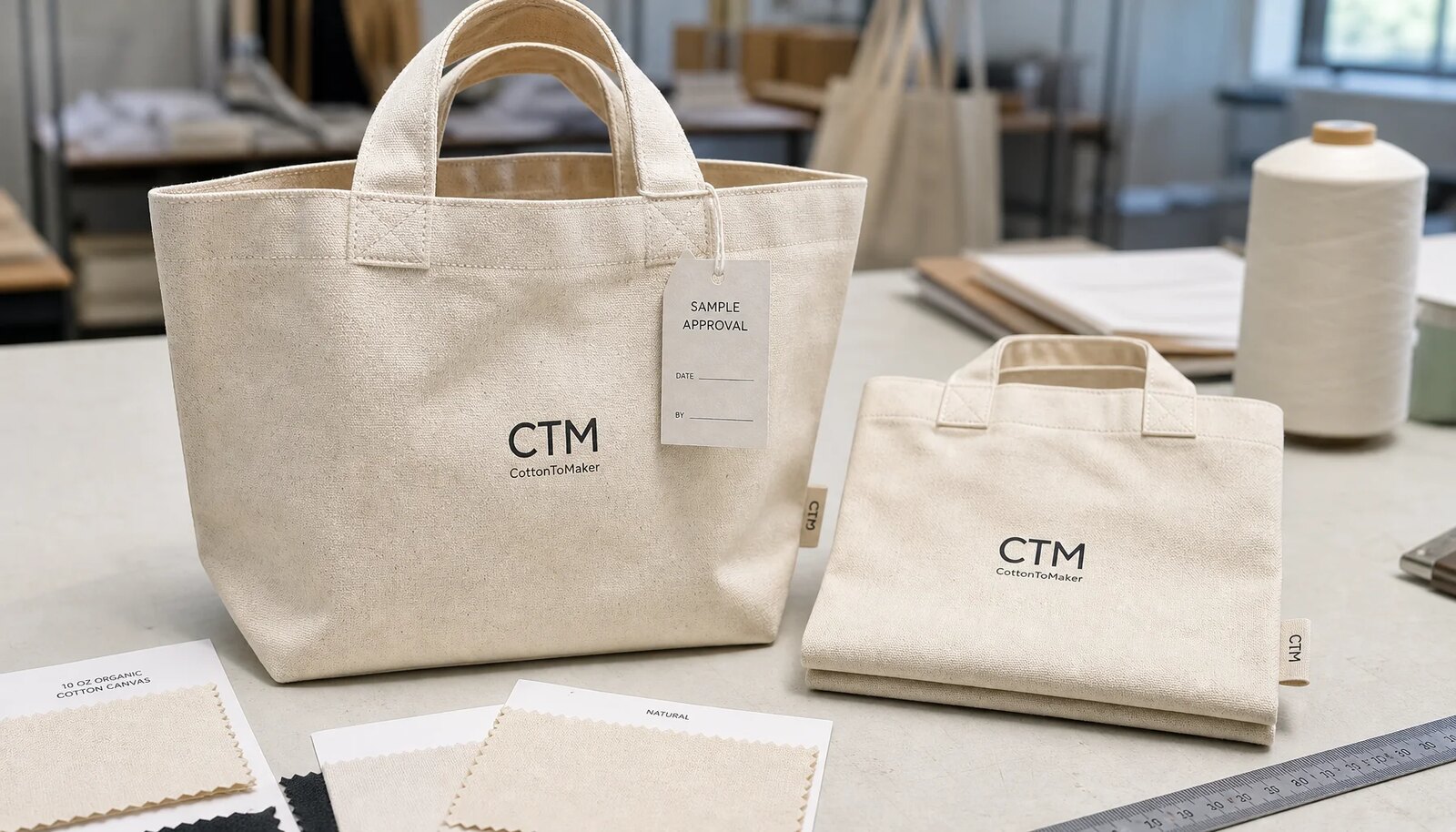
Start With The Event Date, Not The Factory Calendar
Craft fair tote planning works backward from the date the bags must be usable, not from the date the fair opens. If the venue needs cartons staged on Wednesday for a Friday opening, Wednesday is the real deadline. If a warehouse must receive, count, relabel, kit, or redistribute cartons before the event, add those days before asking any factory for production timing.
A supplier quote that says 30 to 45 days usually means only part of the schedule. Artwork review, organic fabric reservation, strike-off approval, sample courier transit, inspection, export booking, customs clearance, and local delivery may sit outside that number. The safer procurement question is: What date can finished, inspected, correctly packed cartons be handed to the forwarder, and what assumptions must hold for that date to stay valid?
For a new custom organic cotton tote using in-stock fabric and a simple one-color screen print, buyers commonly plan around 8 to 12 weeks from RFQ to in-hand delivery when international freight is involved. Dyed-to-order fabric, new construction, complex artwork, multiple logo versions, certification support, or ocean freight with domestic redistribution can push planning closer to 12 to 16 weeks. Repeat orders can move faster only when fabric, trim, print method, packing, and inspection standards are unchanged.
- Build the schedule from booth setup, warehouse receiving, domestic dispatch, freight cutoff, inspection, packing, and production start.
- Ask what triggers production timing: deposit, PO, artwork approval, fabric arrival, strike-off approval, or PPS approval.
- Reserve 10 to 20 calendar days of buffer for organic fabric availability, revised artwork, sample shipping, customs, or rework.
- Do not release bulk cutting until fabric, dimensions, handles, print position, packing, and organic claim language are approved in writing.
Translate The Craft Fair Use Case Into Specs
A giveaway tote and a paid merchandise tote should not share the same requirements just because both are organic cotton bags. A sponsor giveaway may prioritize low unit cost, quick booth distribution, and a bold logo. A merchandise tote must feel clean, durable, and consistent because the buyer is paying for it. A vendor kit tote may need to carry catalogs, badges, boxed samples, and printed material without handle distortion.
The RFQ should convert that use case into measurable details: finished width and height, gusset depth, handle drop, handle width, top hem height, seam type, reinforcement, fabric weight, fabric color, print size, print location, label placement, fold method, pieces per carton, and carton mark. Use finished measurements after sewing and pressing, not cutting dimensions. For many commercial tote orders, +/- 1 cm for body dimensions and +/- 0.5 cm to 1 cm for handle drop are more realistic than zero-variance language.
Handle comfort deserves attention at craft fairs. Shoppers may carry ceramics, candles, books, packaged food, apparel, or catalogs for hours. Ask for handle width, handle drop, stitch type, reinforcement method, and a practical load-test expectation. If the tote must carry heavy goods, list sample contents or target load instead of asking generally whether the bag is strong.
- Giveaway tote: lighter fabric, simple print, bulk packing, low cost, fast counting, and acceptable fold creases.
- Merchandise tote: heavier canvas, cleaner seam appearance, stronger handles, hangtag or barcode control, and better presentation.
- Vendor kit tote: gusseted shape, load-tested handles, carton sorting by group, accurate counts, and destination labels.
- Comparison rule: evaluate prices only when GSM, finished size, handle construction, print area, packing, and carton data are comparable.
Choose GSM With Landed Cost In Mind
Fabric weight affects more than feel. It changes material cost, sewing speed, carton weight, carton cube, freight cost, and late-shipment options. A 5 oz to 6 oz organic cotton plain weave, often about 170 to 200 GSM depending on weave and mill conversion, can work for brochures, maps, lightweight samples, and sponsor handouts. It folds small and keeps freight exposure lower, but it may wrinkle, show contents, or distort under heavy ink coverage.
An 8 oz organic cotton canvas, often around 270 GSM, is a practical middle option for reusable craft fair totes. It feels more substantial than a thin giveaway bag while staying manageable for carton planning. For retail resale, museum shops, VIP sponsor packs, or premium maker merchandise, 10 oz to 12 oz canvas, roughly 340 to 410 GSM, can improve structure and perceived quality. The tradeoff is higher material cost, slower sewing, heavier cartons, and greater cost if the schedule forces air freight.
Do not buy by GSM alone. A tightly woven 8 oz canvas with a strong folded top hem and X-box handle reinforcement may perform better than a loose 10 oz canvas with weak stitching. Ask for actual GSM range, fabric width, finished bag weight, shrinkage expectation, and whether the fabric is in stock. If the supplier converts between ounces and GSM, request the mill spec rather than relying on a generic conversion.
- 5 oz to 6 oz: useful for budget giveaways, light contents, low freight weight, and compact folding.
- 8 oz: balanced for reusable market totes, sponsor bags, and general craft fair merchandise.
- 10 oz to 12 oz: better structure and retail feel, with higher landed cost and more logistics risk if delayed.
- Gussets add capacity but also increase fabric use, folding complexity, carton cube, and print-placement control needs.
Keep Organic Claim Language Accurate
Organic cotton requirements should be settled before artwork, labels, hangtags, invoices, and packing files are approved. Some buyers only need fabric made with organic cotton fiber. Others need supplier declarations, certified fabric documents, chain-of-custody support, transaction certificate support, or finished-goods certification support. These are different levels of evidence and may depend on the supplier’s certified scope and the certifier’s rules.
A factory may be able to source organic cotton fabric but not support a certification logo on the tote or finished-goods claim on the invoice. If a retailer, museum, sponsor, or marketplace requires proof, request relevant scope documents or sample documentation before deposit. If certification wording or marks appear on the product, hangtag, care label, belly band, or carton, approval must happen before printing.
Also define what the claim covers. It may apply only to the cotton shell fabric, while sewing thread, woven labels, hangtags, inks, and packaging remain outside the claim. That can be acceptable when stated clearly, but it should not be left for final inspection. Late changes to claim language can cause fabric changes, label reprints, artwork revisions, invoice corrections, and missed event deadlines.
- Separate organic cotton material declaration from certified fabric documents, transaction certificate support, and finished-goods certification support.
- Confirm whether trims, thread, labels, hangtags, inks, and packaging are included in or excluded from the claim.
- Do not print certification marks or regulated wording until license use and approval path are verified.
- Keep documentation with the PO, approved sample, invoice, packing list, inspection report, and shipment file.
Approve Artwork Before It Becomes A Delay
Printing often creates more schedule risk than sewing. Water-based screen printing is usually efficient for bold logos, sponsor marks, city names, and one- or two-color artwork. It can give a softer hand than heavy ink deposits, but it still requires proper screen setup, ink mixing, registration, drying, curing, and packing discipline.
Detailed illustrations, gradients, photographs, and artist collaborations may require digital printing or transfers. These can work for limited editions, but organic cotton canvas is textured and absorbent. Fine lines may soften, color may shift on natural fabric, and transfer edges or hand feel may not match the buyer’s expectation from a PDF mockup. The approval tool that matters is a strike-off on the actual bulk fabric, at the intended print size, using the intended method.
Provide vector artwork where possible, Pantone references for spot colors, print dimensions, placement diagrams, and durability expectations. Define print location from measurable points such as top edge, side seam, centerline, or bottom of the top hem. A 5 mm to 10 mm print-position tolerance is often realistic for totes, depending on bag size, fabric movement, and print area.
- Use water-based screen print for simple logos, solid spot colors, sponsor marks, and repeat orders.
- Use digital print or transfer after reviewing hand feel, opacity, edge sharpness, color output, and durability expectations.
- Approve a strike-off on actual organic cotton fabric before bulk printing when the calendar allows.
- Check curing before packing; tacky or under-cured prints can block, transfer, smell, or mark adjacent bags.
Reduce MOQ Friction With A Shared Base Tote
MOQ is tied to fabric purchasing, cutting efficiency, print setup, sewing changeover, labels, carton marking, inspection, and order administration. Craft fair programs often need several versions for sponsors, cities, booth zones, artist groups, or event weekends. That can stay efficient if the base tote remains the same and only the artwork changes. It becomes slower and more expensive when each version changes GSM, fabric color, handle length, label, hangtag, packing, and carton mark.
A clean approach is to approve one or two base bodies first. For example, one natural 8 oz flat tote with the same handle drop, print size, and print position can support several sponsor logos. If a premium paid merchandise version is needed, treat it as a separate SKU with its own cost, sample, carton data, and inspection checks.
Ask the factory to break MOQ by variable. MOQ per body is not the same as MOQ per artwork. MOQ per fabric color is different from MOQ per ink color. A quote saying MOQ 500 pieces may mean 500 pieces per logo, not 500 pieces total across ten logos. Confirm this before promising sponsor-specific or city-specific versions.
- Consolidate body size, base color, GSM, handle construction, print position, and packing wherever practical.
- Separate MOQ for body, fabric color, artwork, ink color, label, hangtag, packing format, carton mark, and destination.
- Group artwork versions by the same print method and ink color to reduce setup time and color-matching risk.
- Avoid mixed cartons unless downstream sorting is documented, labeled, and checked during inspection.
Use Samples To Test Production Risk
A tote sample should prove the order can be made consistently, not just look acceptable in a photo. For custom organic cotton totes, sample review should include fabric weight, shade, texture, finished dimensions, handle comfort, print color, print position, seam quality, fold method, and cleanliness. Natural cotton can show flecks, slubs, and shade variation; these may be acceptable when judged against an approved standard.
A strong approval path starts with fabric swatches, then a print strike-off on the actual fabric, then a pre-production sample made with correct construction, label, print method, and packing fold. This avoids the common problem of approving a full sewn sample and later discovering the ink color, fabric shade, handle drop, or print size is wrong.
Compressed calendars sometimes require skipped steps. If a full sewn PPS is skipped, document the substitute control. For example, the buyer may approve the fabric swatch and strike-off, then allow production against a technical sheet with defined measurement and QC checks. That saves time but increases the importance of inspection before shipment release.
- Measure sample width, height, gusset, top hem, handle drop, handle width, seam allowance, and print location.
- Compare shade and GSM against the approved swatch, not only a photo or supplier description.
- Rub the cured print with clean white fabric or tissue to check transfer, tackiness, smearing, cracking, or blocking.
- Load the sample with realistic contents such as books, jars, candles, catalogs, apparel, or boxed products.
- Keep one approved sample with the buyer and one sealed reference sample with the factory.
Compare Suppliers By Landed Cost And Risk
The lowest FOB unit price can mislead tote buyers. Cotton totes are bulky relative to value, and small decisions affect freight and handling. Heavier canvas, gussets, individual folding, hangtags, retail bands, or polybags can increase carton cube and gross weight. A slightly higher unit price may be better if the supplier offers clearer carton data, stronger QC, faster approvals, lower defect risk, and more reliable documentation.
Ask for carton dimensions, gross weight, net weight, pieces per carton, packing method, and estimated carton count during quoting. Without these details, the buyer cannot compare air freight exposure, ocean freight, pallet storage, warehouse handling, parcel surcharges, or event redistribution. For fixed-date fairs, also ask whether partial air shipment is possible for launch or sponsor quantities while the balance moves by ocean or ground freight.
Quote comparison should include setup and compliance costs: screen charges, artwork preparation, sample fees, courier fees, label setup, hangtag printing, documentation support, export documents, inspection support, special carton marks, and split-shipment handling. For multi-location fairs, add relabeling, kitting, palletizing, and destination sorting to the cost model.
- Request EXW and FOB pricing separately when your forwarder manages consolidation or factories quote from different regions.
- Compare cost per usable piece after inspection, expected defect allowance, rework risk, and replacement timing.
- Model freight by carton volume and gross weight, especially for 10 oz to 12 oz canvas or gusseted totes.
- Add repacking or redistribution cost when cartons must be split by sponsor, city, booth group, vendor, or warehouse route.
Pack For Booth Readiness
Natural and bleached organic cotton show dirt, oil, water marks, and handling stains easily. Packing must protect the fabric and print while fitting the buyer’s event workflow. Bulk flat packing can work well for distributors and booth teams that need fast counting. Individual polybags can help with retail handling, kitting, humid routes, or dirty warehouses, but they add cost, packing time, plastic use, and carton volume.
Event readiness should be specified before production. If mixed designs arrive in unmarked cartons, the buyer may spend more on sorting than was saved on packing. If hard folds cross the logo, booth staff may need steaming or may reject the presentation. If cartons are over-compressed, handles and hems can look distorted at point of sale. Approve fold method, carton quantity, carton marks, and SKU labels before bulk packing.
Print protection matters. Rushed packing can cause prints to transfer, block, or mark neighboring bags. Large water-based prints should not be packed face-to-face unless curing and rub resistance are verified. For sensitive prints, request print-out folding, paper interleaving, longer curing, lower carton compression, or fewer pieces per carton. These choices affect lead time and freight cube, so include them in the RFQ.
- Use bulk flat packing for lower labor cost, easier counting, and distributor handling.
- Use paper bands, hangtags, individual folding, or polybags when retail presentation or kitting requires it.
- Specify pieces per carton, carton strength, moisture protection, carton marks, PO number, SKU, quantity, and destination code.
- Request packed-carton photos and random open-carton photos before shipment release.
Specification comparison for buyers
| Quote item | Low-price quote to verify | Balanced procurement option | Risk or cost tradeoff |
|---|---|---|---|
| Fabric and construction | 5 oz to 6 oz organic cotton plain weave, flat body, basic top hem, simple handle stitch | 8 oz organic cotton canvas with folded top hem, reinforced handles, and agreed finished-size tolerance | Lower fabric cost can be offset by weaker hand feel, higher defect sensitivity, or poor suitability for paid merchandise |
| Premium tote option | 10 oz canvas quoted without carton weight or freight model | 10 oz to 12 oz canvas quoted with finished bag weight, carton dimensions, pieces per carton, and load-test method | Premium canvas improves perceived value but raises sewing time, freight weight, storage cube, and air-freight exposure |
| MOQ basis | MOQ shown only as one total order quantity | MOQ separated by body style, fabric color, artwork, ink color, label, hangtag, packing format, and carton mark | A low headline MOQ may become expensive when each logo or destination is treated as a separate production lot |
| Lead time start point | Production days listed without trigger date | Timeline states whether days start after deposit, PO, artwork approval, fabric arrival, strike-off approval, or PPS approval | A short quoted production time can hide two or more weeks of buyer approvals and sample courier time |
| Print method | Cheapest print listed without curing, rub test, or strike-off requirement | Water-based screen print for simple logos; digital or transfer only after fabric strike-off and hand-feel review | Under-cured or unsuitable prints can block, transfer, smell, crack, or delay packing and inspection |
| Organic documentation | Supplier says organic cotton without defining evidence | Material declaration, fabric certificate support, chain-of-custody documents, or finished-goods certification support clearly separated | Certification wording, transaction certificate availability, and logo use depend on supplier scope and certifier rules |
| Packing | Bulk packed with no carton specification | Packing method, fold style, pieces per carton, carton marks, SKU labels, moisture protection, and destination codes quoted | Poor packing can cause creased logos, mixed versions, dirty fabric, re-sorting cost, and late event staging |
| Freight comparison | Unit price only, often FOB or EXW with no carton data | EXW/FOB pricing plus carton count, gross weight, net weight, cube, ready date, and split-shipment option | Totes are bulky; landed cost can change materially with GSM, gusset, folding, and individual packing |
| Quality control | General factory QC included | AQL or agreed inspection method with defect classes, measurement points, print checks, load test, and carton audit | Unclear QC standards make rework disputes harder and can leave no time to replace goods before the fair |
Buyer checklist before sampling
- Set the real deadline first: booth setup date, warehouse receiving date, domestic redistribution date, and factory handover date.
- Define tote use before choosing GSM: giveaway, paid merchandise, retail shopping bag, sponsor kit, vendor welcome bag, or attendee program bag.
- Issue one measurable spec sheet with finished width, height, gusset, handle drop, handle width, fabric weight, color, seam construction, reinforcement, print size, print position, label, packing, carton marks, and destination split.
- Clarify the organic claim: organic cotton material only, certified fabric documentation, transaction certificate support, finished-goods certification support, or no claim beyond supplier declaration.
- Ask for MOQ by variable: body, fabric color, GSM, artwork, ink color, label, hangtag, packing method, carton mark, and shipment destination.
- Request actual GSM range, GSM tolerance, finished bag weight, fabric availability, shrinkage expectation, and whether fabric is in stock, reserved, dyed to order, or woven to order.
- Approve fabric swatch, print strike-off, and pre-production sample when the calendar allows; if a step is skipped, record the buyer-approved substitute control.
- Confirm whether quoted lead time starts from deposit, PO, artwork approval, fabric arrival, strike-off approval, PPS approval, or receipt of trims.
- Set inspection criteria for size, GSM, shade, stains, odor, print color, print placement, print adhesion, handle strength, stitching, labels, carton marks, and packing count.
- Collect carton dimensions, gross weight, net weight, pieces per carton, carton count, ready date, Incoterm, and freight handover point before comparing suppliers.
Factory quote questions to send
- Which organic cotton fabrics can you offer in 5 oz, 6 oz, 8 oz, 10 oz, and 12 oz, and what is the actual GSM range for each?
- Is the quoted fabric in stock, reserved for us after deposit, dyed to order, or woven to order? How many days does each option add?
- What documentation can you support: supplier material declaration, certified fabric documents, transaction certificate support, or finished-goods certification support within your actual scope?
- What MOQ applies per tote body, fabric color, GSM, print design, ink color, label, hangtag, packing method, carton mark, and destination?
- Can multiple craft fair logos use the same base tote, and what setup charge, screen charge, sample charge, or added lead time applies per artwork?
- Which print method do you recommend for this artwork, and what are the print area limit, setup cost, curing requirement, rub-test expectation, and expected hand feel?
- Can you make a strike-off on the exact bulk fabric before bulk printing, and how many days including courier time should we allow?
- What are the sampling days for fabric swatch, strike-off, pre-production sample, revised sample, buyer approval return, and sample shipment?
- Please break down bulk timing by fabric preparation, cutting, printing, curing, sewing, trimming, packing, inspection, and export handover.
- What finished-size tolerance, handle-drop tolerance, GSM tolerance, print-position tolerance, and color tolerance will you use for acceptance?
Quality-control points to confirm
- Check fabric GSM against the approved swatch and PO tolerance; a common commercial starting point is +/- 5 percent unless the buyer and supplier agree otherwise.
- Compare fabric shade, weave density, slubs, cotton flecks, nep level, cleanliness, and lot consistency to the approved fabric standard before cutting and at final inspection.
- Measure finished width, height, gusset depth, top hem height, handle drop, handle width, and print position after sewing and pressing.
- Test handle attachment against the agreed load expectation, with no seam opening, top hem distortion, bartack failure, stitch popping, or fabric tearing at stress points.
- Inspect seam quality for stitch density, skipped stitches, broken threads, loose threads, raw edges, uneven hems, inconsistent seam allowance, and reinforcement consistency.
- Compare print color under consistent lighting against the approved strike-off or Pantone reference, allowing for realistic variation on natural cotton texture.
- Measure print placement from agreed reference points such as top edge, side seam, centerline, or bottom of top hem; check skewing, blur, double image, bleeding, and off-center placement.
- Verify curing and adhesion with agreed dry rub testing; add wet rub, tape pull, or wash checks if the tote is marketed for repeated use.
- Reject or rework oil marks, needle stains, water marks, mildew, strong odor, foreign fibers, sharp contamination, mixed fabric lots, and loose metal fragments.
- Audit labels, hangtags, care instructions, barcode stickers, SKU codes, PO numbers, certification wording, carton marks, quantities, and destination codes against approved files.