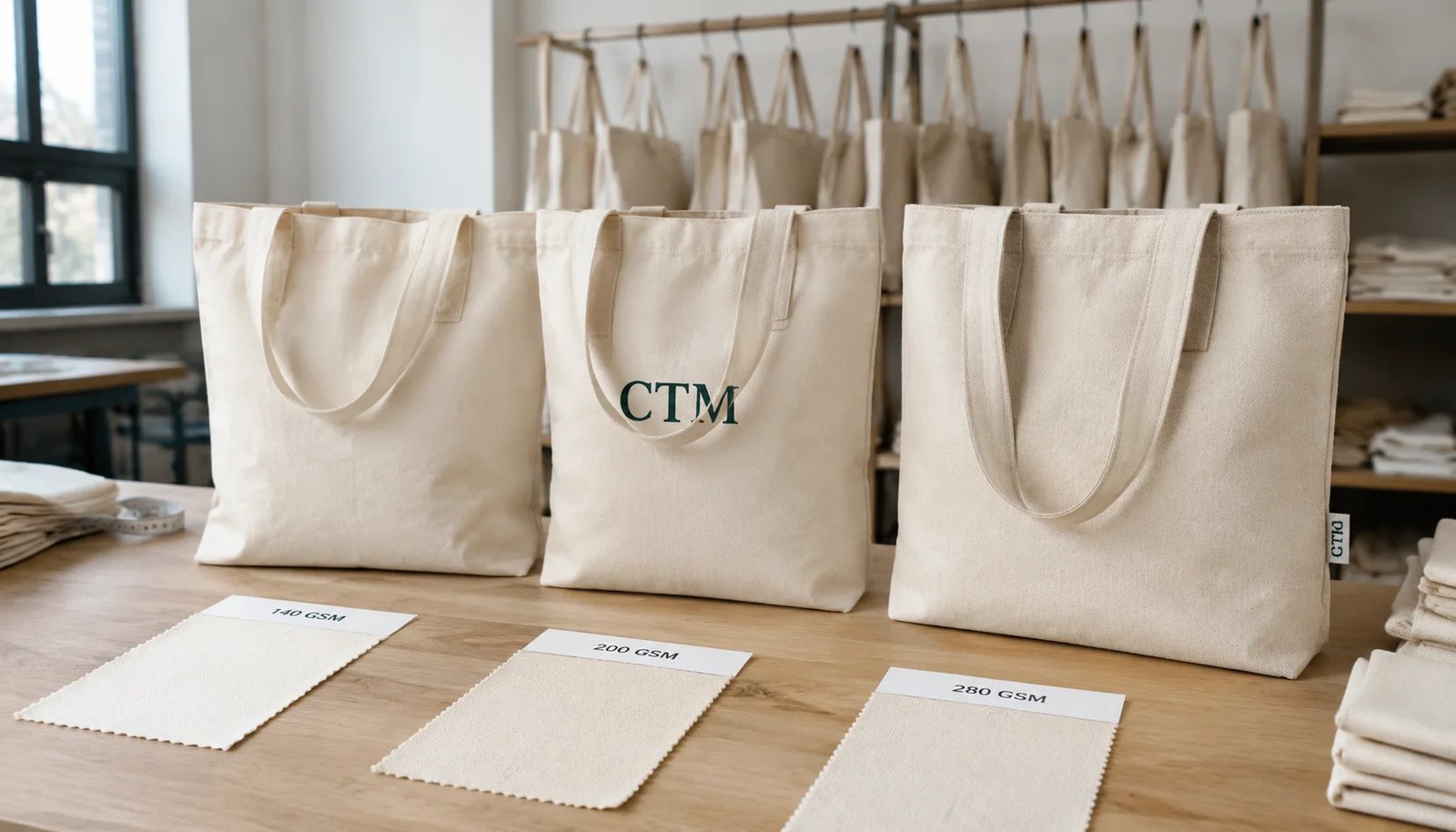
Why fabric weight matters more for natural grocers than for general promo totes
Natural grocers usually put more stress on a tote than a trade show or apparel brand does. A bag sold or given away at a grocery checkout may carry jars, produce, boxed items, and bottles in one trip. That changes the fabric decision immediately. If the tote is underbuilt, buyers see seam failure, stretched handles, and customer complaints well before the reorder cycle. If it is overbuilt, the landed cost rises, the print hand gets heavier, and the bag may miss the target retail price.
The practical issue is not simply 'lightweight vs heavy.' The useful decision is matching GSM and construction to basket type, repeat usage, and retail positioning. For most natural grocers, the best RFQ starts with use case and load expectation, then moves to fabric weight, bag dimensions, gusset, and print method. Fabric weight is only one variable, but it influences nearly every other line in the quote, including carton count, freight cost, and print result.
- Promo checkout bag: lower budget, lighter loads, less frequent reuse
- Standard store-branded reusable bag: weekly shopping, mixed grocery weight
- Premium resale tote: heavier loads, stronger body, higher retail margin opportunity
- Bottle-friendly tote: often needs gusset depth and stronger handle reinforcement, not just more GSM
A practical GSM range for organic cotton totes used in grocery retail
For natural grocers, 140-160 GSM organic cotton works when price is the lead factor and the bag is closer to a promotional reusable item than a heavy-duty grocery carrier. This range can perform acceptably for produce, bakery items, packaged snacks, and light household purchases. It is not the right default for mixed grocery loads with jars or multiple bottles unless the bag is small and customer expectations are modest.
The most commercially useful middle ground is usually 180-220 GSM. This range gives a noticeable step up in body, durability, and customer-perceived quality without pushing cost and freight as high as 240-300 GSM. Above that, 240-300 GSM suits premium resale bags and larger formats, especially where the bag is part of a sustainability or loyalty program and is expected to last through frequent weekly use. Buyers should note that 220 GSM plain weave and 220 GSM canvas can feel different, so GSM must be tied to weave and finished bag weight.
- 140-160 GSM: entry-level reusable, budget promotions, lighter-use checkout programs
- 180-220 GSM: standard grocery reusable sweet spot for many store brands
- 240-300 GSM: premium tote, larger body size, higher retail price point, heavier use
- GSM alone is incomplete; add weave type, finished dimensions, and target bag weight in grams
How bag size and gusset can matter as much as heavier fabric
A common sourcing mistake is trying to solve every durability concern by raising GSM. Many grocery totes fail in real use because the shape is wrong, not because the cloth is too light. A flat tote with a wide printed face can look attractive in artwork approval but perform poorly when shoppers load boxes and produce. The bag twists, the base collapses, and weight concentrates at the handle seams. A bottom gusset often improves utility more efficiently than moving up one full fabric weight tier.
For natural grocers, practical dimensions often beat oversized dimensions. An extra-large tote encourages overloading, which can increase claims even if the bag uses heavier fabric. Mid-size totes with a 10-12 cm bottom gusset usually carry groceries more predictably, stack better in cartons, and print more consistently. If bottles are part of the expected use, side gussets and a slightly narrower opening can improve load stability.
- Flat totes are cheaper but less stable for mixed groceries
- Bottom gusset improves usable volume without making the bag look oversized
- Side gussets help bottles and boxed items stand more securely
- Larger size increases overload risk even when fabric is heavier
- Include handle drop in the RFQ; short handles can make full bags uncomfortable
Print method should be chosen with GSM and fabric texture, not artwork alone
Natural grocers often want an earthy, low-gloss print style that fits an organic or low-waste brand image. Water-based screen print is usually the most practical choice for simple logos and one to three spot colors on natural cotton. It supports medium and large runs, gives a softer hand than many transfers, and aligns with the aesthetic many grocer buyers prefer. But the result depends heavily on the fabric surface. Coarser or heavier weaves may soften edges and reduce small text clarity.
If the artwork includes fine line detail, small legal text, or a denser graphic block, the buyer should not assume the same print method will work on all GSM ranges. Heavy canvas can hold a premium structure but may not produce the cleanest detail unless mesh selection, underbase, and curing are controlled carefully. The safest approval path is a print strike-off on the actual production fabric, not a previous sample on a different weight or weave.
- Water-based screen print: best for simple logos, natural look, scalable production
- Pigment print: usable, but hand feel and color appearance should be reviewed carefully
- Heat transfer: helpful for detail or multicolor art, but can look less natural and feel heavier
- Approve print on actual fabric weight, fabric color, and finished surface
- Set print placement tolerance, especially on gusseted bags where panel shape affects centering
MOQ logic: when stock fabric saves money and when custom fabric is justified
Not every organic cotton tote program needs custom fabric from the first order. If the main objective is to launch a store-branded reusable bag with fast validation, stock natural organic cotton in a standard weight can reduce MOQ and shorten setup time. This route is especially useful when the brand is testing store adoption, checkout sell-through, or logo response. Buyers often gain a cleaner first quote by choosing stock greige or standard natural color, one print location, and a standard handle width.
Custom dyed fabric, special weave, unusual size, and added trims make sense when the program is proven and reorder visibility is stronger. That is where a buyer can justify higher MOQ because repeat demand will absorb setup cost and color-control work. The key is to separate launch-stage requirements from scale-stage requirements. Many RFQs become expensive because buyers combine pilot volume with full custom specifications that belong in a mature program.
- Lower MOQ route: stock natural fabric, standard size, standard handle, simple screen print
- Higher MOQ route: custom dye, custom weave, custom trim, woven label, special packaging
- Pilot programs should focus on function and retail acceptance before adding complex custom features
- If custom dye is required, account for lab dip approval and possible reorder shade variation control
What buyers should compare in supplier quotes beyond the GSM number
A weak quote comparison happens when procurement teams line up only unit price, stated GSM, and sample freight. Better comparison starts with finished bag weight, actual dimensions after sewing, handle construction, seam reinforcement, print method, and packing density. Two suppliers can both quote 200 GSM and still deliver different products because one uses a looser weave, lighter handle tape, fewer stitches, and tighter carton compression. That gap appears later as quality claims, not at quote stage.
For organic cotton grocery totes, it is useful to convert the quote into a practical cost structure. Buyers should isolate body fabric cost, printing cost, sewing complexity, trim and labels, packing method, sample charges, and shipment efficiency. Even if the supplier does not give a full cost breakdown, the buyer can force apples-to-apples comparison by standardizing the RFQ and requesting details on assumptions. This is especially helpful when one factory quotes a low ex-works price but uses bale packing that increases wrinkle risk or changes receiving labor at destination.
- Compare finished bag weight in grams, not just fabric GSM
- Note whether gusset, inner seam finish, and reinforcement are included
- Separate print setup from print run cost when comparing small and repeat orders
- Review carton quantity and carton gross weight because freight cost shifts quickly on heavier bags
- Watch for quote gaps around labels, retail tags, barcodes, and individual packing requirements
Sample approval: what to test before mass production starts
A sample should do more than confirm whether the logo looks acceptable. For grocery-use totes, the sample stage should answer four practical questions: does the fabric feel right for the retail position, does the bag carry the intended load without distortion, is the print suitable on the selected weave, and does the packing plan preserve presentation? A blank prototype can confirm dimensions and construction, but a printed pre-production sample is the point where most avoidable issues are visible.
The best sample evaluation is physical and task-based. Load the bag with realistic grocery items. Check whether the base collapses, whether handles roll or cut into the hand, and whether the print cracks or distorts across the fold. If the bag is for resale, compare sample weight and hand feel against the intended retail price bracket. A premium-priced tote that feels too soft or too thin will fail at shelf level even if it passes a technical seam test.
- Approve a fabric swatch before full sample if color or hand feel matters
- Use actual grocery items in sample load testing, not just pull-force assumptions
- Measure body width, height, gusset, and handle drop after sewing and finishing
- Check print opacity on natural cotton, especially for light green or muted brand colors
- Review folded presentation if the bag will be sold hanging or banded in-store
QC thresholds that prevent the usual failures on reusable grocery totes
Quality control for organic cotton totes should focus on the defects that affect end use, not only cosmetic uniformity. Natural cotton can include small slubs and slight shade movement, especially in unbleached or minimally processed fabric. Those should be managed by agreed tolerance rather than treated as automatic defects. The higher-value checks are seam integrity, handle alignment, dimensional consistency, print legibility, and visible stains or moisture damage.
For procurement teams, the useful step is to convert general QC language into pass-fail points that a factory, third-party inspector, and receiving warehouse can all apply the same way. For example, if the center logo can shift no more than 5 mm left or right from the approved placement, write that. If handle drop tolerance is 1 cm, write that. If natural cotton shade variation within the same order is acceptable within an approved sample range, state it before production rather than during claim negotiation.
- Set GSM tolerance and measurement method
- Set dimensional tolerance for body and handles separately
- Define acceptable natural fabric characteristics versus rejectable weaving defects
- Specify no oil marks, no mildew smell, no water stains, no major print smudging
- Include random load testing or seam stress verification in final inspection plan
Packing and shipment details that affect both freight and store readiness
Packing is often treated as an afterthought, but it directly affects freight efficiency, wrinkle level, receiving speed, and retail presentation. Heavier GSM totes lower units per carton, so the cost effect shows up twice: in ocean volume and in handling. Over-compressed packing can save carton count but flatten the print, crease handles sharply, and create a tired shelf appearance if the bags are resold in-store. Natural cotton also needs sensible moisture protection for sea transit, especially in humid lanes.
For natural grocers distributing to multiple stores or a retail DC, bundling logic matters. Flat-packed bundles by style, color, and count are usually easier to receive than mixed compressed packing. If the bags are for direct shelf sale, the buyer may need paper bands, hang tags, barcodes, or outer carton labeling by store or SKU. Those details belong in the quote stage because they affect labor and lead time, even if the unit bag specification stays the same.
- Set pieces per carton and maximum carton gross weight to match warehouse handling rules
- Use moisture barrier or inner poly liner where transit humidity is a risk
- Avoid excessive compression on printed bags intended for retail resale
- Specify carton marks, SKU labeling, and bundle count format for easier receiving
- If sustainability policy limits polybags, define the approved alternative clearly
Lead time risks and a realistic sourcing workflow for grocer programs
Lead time for custom organic cotton totes is rarely just one number. The safer approach is to map the order into stages: artwork review, fabric confirmation, sample making, print approval, material booking, sewing, final inspection, and shipment release. Delays usually come from approvals, not sewing. Custom dyed fabric adds lab dip time. Detailed artwork adds screen preparation and strike-off time. Retail ticketing and assortment packing can slow the last production week more than buyers expect.
For repeat grocery programs, the best workflow is to seal the construction and packing standard early, then only update artwork, quantity split, and delivery destination by order. That removes avoidable re-approval cycles. If the order is seasonal or tied to a store campaign, build buffer for sample courier time, correction rounds, and port cut-off risk. A low-priced supplier quote is less attractive when the timeline has no margin for approvals.
- Stock natural fabric usually shortens setup compared with custom dyed fabric
- Printed pre-production approval is often the critical path
- Packing customization can add more time than buyers expect
- Build schedule buffer for corrections, especially on first orders
- Use a sealed sample and final packing photo standard for repeats
Specification comparison for buyers
| Spec decision | Recommended option | When it fits | Buyer risk to check |
|---|---|---|---|
| Fabric weight for promo checkout tote | 140-160 GSM organic cotton plain weave | Short-trip grocery carry, event giveaway, budget-focused seasonal program | Feels too thin for glass jars or repeated weekly use; confirm max load target and seam strength |
| Fabric weight for standard reusable grocer tote | 180-220 GSM organic cotton | Best balance for most natural grocer private label programs and store resale | Quotes may look similar while finished bag body size and handle reinforcement differ; compare net bag weight and stitch count |
| Fabric weight for premium heavy-use tote | 240-300 GSM organic cotton or cotton canvas | For higher retail price points, loyalty programs, and heavier basket loads | Higher freight cost, thicker seams, and reduced print smoothness on coarse weaves; confirm carton quantity and print clarity |
| Handle construction | Self-fabric handles with box stitch or X reinforcement | Daily grocery use with 8-12 kg working load range depending on body size | Some suppliers quote folded top seam only without reinforcement; request handle attachment photo and load test method |
| Print method for simple logo | Water-based screen print | 1-3 spot colors on natural fabric, medium to large runs, eco-positioned store program | Ink penetration and shade variation on natural cotton; approve print strike-off on actual GSM fabric, not paper simulation |
| Print method for fine detail artwork | High-mesh screen print or heat transfer only if artwork requires it | Small text, fine line logo, barcode area, or multicolor campaign graphics | Heat transfer can affect hand feel and wash appearance; confirm crack resistance and adhesion after cure |
| Bag gusset choice | 10-12 cm bottom gusset, with optional side gussets | Better shelf utility and more realistic grocery volume than flat totes | Suppliers may quote flat body dimensions that look large on paper but carry less in use; compare usable internal volume |
| Packing format | Individual bags stacked flat in master carton with size and color count by bundle | Store distribution, easier receiving, less wrinkle risk than compressed bale packing | Over-compression can distort print and crease handles; specify carton weight limit and moisture protection |
| MOQ route | Use stock fabric for lower MOQ; dyed custom fabric for repeat programs | Good way to launch test quantity before annual rollout | Custom dye lots raise MOQ and lead time; verify whether organic claim covers stock greige fabric and later processing |
Buyer checklist before sampling
- Define the tote's real working use: promo giveaway, checkout resale, or premium weekly grocery bag.
- State target fabric weight in GSM range, not just 'thick cotton' or 'canvas'.
- Specify finished bag size, gusset depth, and handle drop in centimeters.
- Set a realistic load expectation such as produce only, mixed groceries, or bottle-and-jar use.
- Match print method to artwork detail and expected hand feel.
- Request fabric swatch and print strike-off on the same GSM and color as production.
- Confirm whether quoted fabric is plain weave cotton or heavier canvas structure.
- Add seam reinforcement requirement at handle attachment points.
- Set carton packing method, carton weight limit, and moisture protection standard.
- List acceptable shade tolerance for natural cotton if exact bright white is not required.
Factory quote questions to send
- What is the exact fabric construction behind the quoted GSM: plain weave, canvas, yarn count, and finished weight tolerance?
- Is the fabric certified organic at fabric stage, and what transaction documents can be supplied with shipment if requested?
- What finished bag weight in grams do you expect for this size and construction?
- What handle attachment method is included: cross stitch, box stitch, bartack, or plain seam?
- What safe working load do you recommend for this tote construction based on your internal testing method?
- Is the print quoted as water-based screen print, pigment print, transfer, or digital, and how many colors/screens are included?
- Can you provide a print strike-off on the actual production fabric weight before mass production approval?
- What is the MOQ difference between stock natural fabric, custom dyed fabric, and custom size?
- What are the sample stages available: blank proto, printed pre-production sample, and sealed production sample?
- How many pieces per carton, carton dimensions, gross weight, and whether polybags or paper banding are included?
Quality-control points to confirm
- Fabric GSM within agreed tolerance, commonly plus or minus 5 percent unless otherwise specified.
- Finished bag dimensions within agreed tolerance, often plus or minus 1 cm for body and handle length.
- Handle attachment reinforcement present on all units and aligned symmetrically.
- No open seams, skipped stitches, broken threads, or obvious seam puckering.
- Print position centered within approved tolerance and color matches approved strike-off under standard light.
- No major oil marks, mildew odor, water stains, or heavy weaving defects on visible panels.
- Carton count matches packing list and bundle count by style and color is correct.
- Moisture protection applied for sea shipment, especially for natural unbleached cotton.
- Barcode, care label, country of origin label, and retail ticketing inserted exactly as approved if required.
- Random load test on finished bags reflects the intended retail use, not only a seam pull test on empty fabric.