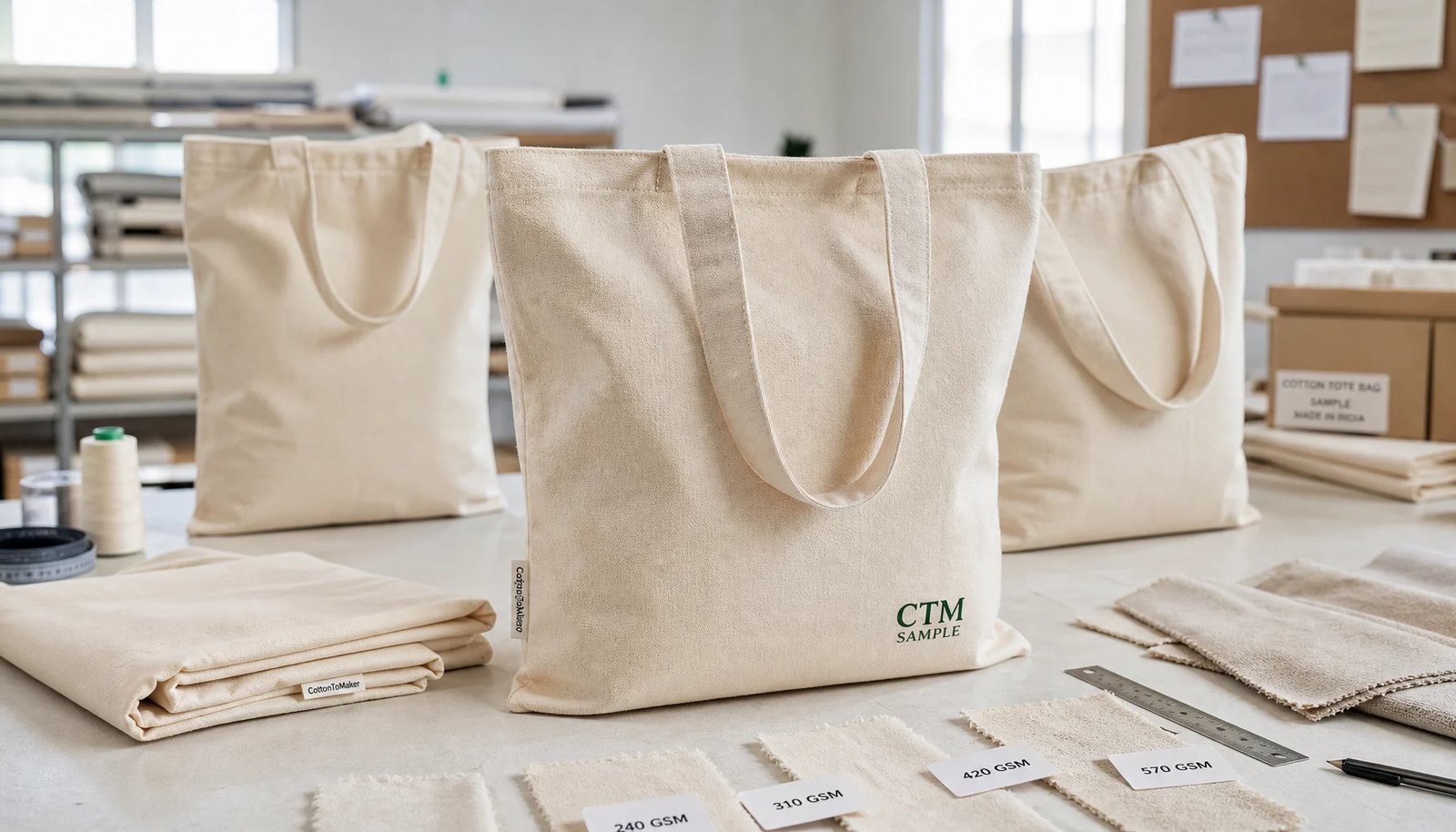
Start With The Selling Role
For craft fairs, the tote is not just packaging. It is either a giveaway, a resale item, or a visible piece of brand merchandising, and the right fabric weight changes with that role. A bag handed out with a brochure can be lighter, flatter, and simpler. A tote sold across a booth needs enough body to feel intentional and enough structure to display well on a peg, table, or shelf.
The sourcing mistake is to ask for "an organic cotton tote" and stop there. One factory will assume a promotional bag. Another will quote a canvas retail item with reinforced seams. The numbers will not be comparable, and neither quote will be useful until the buyer defines the use case, target sell price, expected load, and whether the bag must survive repeated daily use.
If you are building a line for craft fairs, decide where the tote sits in the assortment. Is it a low-risk add-on at checkout, a branded item that supports the rest of the table, or a standalone product that has to earn its own margin? That answer drives every other spec choice. It also tells the factory how to balance look, cost, and durability instead of guessing.
- Free handout: prioritize low unit cost, easy folding, and simple logo placement.
- Mid-price retail tote: prioritize body, neat finishing, and a balanced handfeel.
- Premium merch tote: prioritize durability, shape retention, and stronger reinforcement.
Treat GSM As A Buying Spec
GSM is the fastest shorthand, but it can hide more than it reveals. A supplier can quote greige cloth, finished cloth, or the final bag after wash and print. Those numbers are not identical. If the buyer does not define which one matters, one sample may feel thin, another may feel heavy, and both can still technically be "correct".
Finished GSM is the number that matters for procurement because it reflects what the customer handles. It influences opacity, drape, seam behavior, how the bag folds in pack, and how the print sits on the cloth. On a natural fiber bag, the same GSM can feel firmer or softer depending on weave density, yarn twist, and finishing, so ask for a swatch or sample sheet alongside the spec.
A useful RFQ should state the target range and the tolerance in the same sentence. That makes the quote easier to compare and reduces the temptation to substitute a lighter fabric that looks fine in a photo but feels too delicate in person. It also gives your quality team a hard number to check at receipt.
- Ask whether GSM is measured before finishing, after finishing, or after washing.
- Ask which tolerance the factory uses for bulk production and whether it changes by order size.
- Ask for a swatch from the same lot that will be used for the sample and bulk run.
Match The Weight To The Use Case
In a custom organic cotton totes fabric weight guide for craft fairs, the practical answer is a range, not a single number. For lightweight event distribution, 140-170 GSM can work if the buyer is clear that the item is a handout, not a retail bag. It folds small, keeps freight lower, and can still carry a simple logo cleanly.
The middle zone, 180-220 GSM, is where most craft fair retail orders land. It gives the tote enough body to look intentional, hold shape on display, and feel worth paying for without making it bulky. This range usually balances cost, sewing speed, and customer perception better than pushing straight into heavyweight canvas.
The premium tier, 250-320 GSM, is for buyers who want the bag itself to feel like the product. It makes sense when the tote must carry heavier handmade goods, function as a reusable shopping bag, or support a higher retail price. The trade-off is obvious: more fabric, more freight volume, slower sewing, and a bag that can crease if it is packed too tightly.
- Use 140-170 GSM when the tote is a giveaway or a low-cost add-on.
- Use 180-220 GSM when the tote is being sold as a standard retail item.
- Use 250-320 GSM when carry strength and perceived value matter more than cube efficiency.
Translate The Brief Into Factory Language
The easiest way to get a useful quote is to write the bag as a production spec, not a marketing idea. A factory needs dimensions, construction, print area, and finishing details. If those are vague, the supplier will fill in the blanks with its default bag, and that default may not match the craft fair plan.
Your RFQ should define finished width, height, gusset depth if any, handle length, handle width, seam allowance, reinforcement method, and whether the bag is flat or boxed. Also state whether the measurements are before or after wash and whether the quoted size includes seam shrinkage. The more explicit you are here, the fewer surprises you will have at sampling.
If the tote must support a specific merchandise mix, say so. A bag meant for ceramics or glass needs a different load path than one used for catalogs or apparel. This is where a buyer saves money: not by selecting the cheapest bag, but by selecting the lightest bag that still works for the actual sale.
- Finished size: width, height, and gusset, with the measurement point noted clearly.
- Handle spec: length, width, drop, and whether the tote is hand carry or shoulder carry.
- Construction: flat body or gusseted body, single-layer or lined, folded top edge or bound edge.
- Decoration: print size, print position, number of colors, and any clear space around the logo.
- Labeling: woven label, printed label, hangtag, or internal care label, if required.
- Packing: flat pack, folded insert, bundle count, carton count, and moisture protection.
Construction Details That Change Performance
Fabric weight does not carry a bag by itself. Handles fail first, seams open second, and only then does the buyer discover that the tote was underbuilt. That is why the spec sheet should call out the exact handle construction and seam method instead of leaving them to factory preference.
Self-fabric handles are common on organic cotton totes because they keep the material story simple, but they need width and reinforcement to be practical. Box stitch, cross-stitch, and bar tack are the reinforcement patterns buyers should ask about. If the tote will be filled with books, jars, or handmade goods, the attachment points deserve more attention than the artwork.
The gusset changes both capacity and shelf presence. A flat bag is cheaper and simpler, but a gusseted bag stands more upright and usually sells better when the buyer wants the tote to look like a finished retail item rather than a promotional flat pack. That extra volume should be deliberate, not accidental.
- Confirm handle drop so the tote works in hand or on the shoulder, depending on the use case.
- Ask for the stitch type and stitch density at the side seam, bottom seam, and handle ends.
- Check whether the top edge is double-folded, topstitched, or bound, because this changes durability and finish.
Print Behavior On Natural Cotton
Print method has to match both artwork and fabric. Screen printing is still the most straightforward option for solid logos, one-color marks, and repeat runs because it is durable and economical once the setup is done. Digital pigment printing is better when the artwork has multiple colors, gradients, or a more illustrative style that would lose clarity in separations.
The important point is that print performance changes with fabric weight and weave. Fine lines can close up on textured canvas, and dense ink coverage can make lighter cloth feel stiffer or show through on the reverse side. Buyers should request a strike-off on the actual fabric weight and actual natural shade, not on a generic white mockup.
Natural cotton also varies from lot to lot. That variation is normal, but it needs to be bounded. Define the print position, maximum print area, Pantone target if the method supports it, and whether a slight shade shift in the base cloth is acceptable. If the logo depends on precise color contrast, say that clearly before the factory starts screening.
- Send vector artwork so the factory can separate clean edges from low-resolution files.
- Provide Pantone references where the print method can reproduce them consistently.
- State minimum line thickness and smallest text size if the design includes fine detail.
- Approve the artwork on the final fabric shade, not on a white screen mockup.
- Keep one approved strike-off for the order file and for final inspection reference.
Organic Claims, Labels, And Certification Scope
Organic cotton is a supply-chain claim, not just a fabric description. Buyers need to know whether the certification applies only to the base fabric or also covers spinning, weaving, dyeing, printing, labeling, and final assembly. Those scopes are different, and they change what documents the supplier must provide.
If the tote will carry a claim on a hangtag, care label, carton mark, website listing, or invoice, align the claim language before sampling. Ask for certificate holder details, validity dates, scope, and any transaction certificate or chain-of-custody document your compliance team requires. Do not assume the factory can issue those papers after the order is placed.
A good rule is simple: if the claim matters to marketing, it should matter to procurement first. Put the claim scope in the RFQ, then verify that the sample and the final packing documents match it. That avoids awkward corrections once the bags are already in transit.
- Separate fabric-only organic claims from full chain-of-custody requirements.
- Confirm whether labels, hangtags, cartons, and invoices must carry the same claim language.
- Check certificate holder name, validity dates, and scope before approving bulk.
- Ask whether the supplier can support transaction certificates if your market or retailer requires them.
MOQ, Pricing, And Quote Comparison
MOQ is usually a function of fabric sourcing, print setup, and sewing efficiency. A factory can sometimes lower the MOQ if it has stock organic fabric or ready-made blanks, but that trade-off often reduces control over exact GSM, bag size, certification scope, or color consistency. Low MOQ is useful only if the buyer understands what it gives up.
When you compare prices, compare the same product. One quote may hide a thinner fabric, a smaller print area, narrower handles, simpler stitching, or different packing. Another may be based on finished size while a competitor is quoting cut size. If you do not normalize those details, the cheapest quote can become the most expensive order.
For buyers selling at craft fairs, unit price is only one part of the margin. Freight cube, carton count, sample cost, rework risk, and the time required to fold, label, or display the tote all affect the real landed cost. Ask for the full quote basis so you can compare apples to apples.
- Use the same Incoterm across all suppliers.
- Use the same payment terms so cash-flow differences do not distort the comparison.
- Use the same lead time start point, especially if the factory starts counting after artwork approval.
- Use the same sample basis, including fabric weight, print method, and packing format.
- Use the same certification scope, because a weaker claim may be cheaper to source but not acceptable to your customer.
Samples, Strike-Offs, And Approval Workflow
A tote sample is a control document, not a courtesy piece. Before bulk, ask for three approvals: fabric swatch, print strike-off, and a finished bag sample. Each one answers a different question. The swatch confirms feel and shade, the strike-off confirms how the artwork behaves, and the finished sample confirms shape, stitch quality, handle comfort, and fold presentation.
Document the approved sample carefully. Measure the bag, record the handle drop, note the print position, and keep the same reference on both sides of the transaction. If the order includes shrinkage allowance, write down whether the sample was measured before or after any wash or finishing process. That prevents disputes later when the bulk bags arrive slightly different from the mockup.
If the buyer uses a pre-production sample, make sure it is made from the same fabric lot or at least the same final spec. A sample built from a different cloth or a different ink batch can look close enough to approve and still fail in production. That gap is where many orders drift.
- Approve the fabric swatch first so the base cloth is fixed before the print is finalized.
- Approve the strike-off second so logo size, ink coverage, and color can be locked.
- Approve the finished sample third so the factory cannot change seams, handles, or dimensions later.
- Sign one spec sheet and keep one approved sample on each side of the transaction.
- If the design will repeat, save photos and measurements of the approved version for reorders.
Packing, Cartons, And Inspection Readiness
Packing can help or hurt the retail experience. Heavy canvas packed too tightly keeps the freight cube down, but it also picks up fold marks that are hard to remove before a booth opening. Lighter totes packed too loosely can shift around, wrinkle, and arrive looking careless. The right method depends on how the bag will be received, displayed, and handed to the end customer.
Ask for inner bundle count, carton dimensions, net and gross weight, pallet plan if needed, and moisture protection. If the bags are going straight into retail stock, ask the factory to mark cartons with style or SKU data that matches your PO. If you expect store staff to re-pack or hang the product, call out the final presentation format rather than assuming the factory knows your merchandising standard.
Before release, run one final check against the approved sample, the signed spec sheet, and the packing list. If your team uses an AQL plan, write the inspection level into the order so the factory knows what standard you are applying. The goal is simple: bags that arrive clean, counted correctly, and ready for the booth, not a project that continues after the shipment lands.
- Confirm bundle count and carton count before the production carton is closed.
- Confirm carton marks, SKU labels, and purchase order references match exactly.
- Use moisture protection for export cartons if the route includes long transit or humid storage.
- Check whether flat packing creates crease risk for heavyweight canvas and adjust bundle density if needed.
- Verify final piece count against the packing list before shipment release.
Specification comparison for buyers
| Spec decision | Recommended option | When it fits | Buyer risk to check |
|---|---|---|---|
| Fabric weight for giveaway tote | 140-170 GSM organic cotton plain weave | Event handouts, low retail price points, flat packing, and simple one-color logos | May feel too light for paid merchandise; dark print can show through on natural fabric |
| Fabric weight for standard craft fair retail tote | 180-220 GSM organic cotton canvas or heavier plain weave | Best balance for makers, boutiques, museum shops, and brand stalls selling the tote itself | Confirm finished GSM after washing and finishing, not only greige fabric weight |
| Fabric weight for premium merchandise | 250-320 GSM organic cotton canvas with reinforced seams | Higher perceived value, reusable shopping bag use, heavier handmade goods, and gift packaging | Higher freight volume, slower sewing speed, and more visible creasing if packed too tightly |
| Print method for simple branding | Screen print for solid logos and one-color marks | Repeat designs, clean typography, and high-volume orders | Fine lines can fill on textured canvas; request a strike-off on the final fabric weight |
| Print method for detailed artwork | Digital pigment print for multi-color illustrations | Artist-led graphics, gradients, and smaller runs | Color and detail can shift on natural cotton; approve on the actual fabric shade |
| Handle construction | Self-fabric handles with box-stitch or cross-stitch reinforcement | Retail tote where durability and consistent organic material claim matter | Handle GSM and body GSM may differ; define handle width, length, and reinforcement |
| MOQ planning | 300-500 pcs per size/color/print for fully custom totes | Normal starting range for cutting, printing setup, and export packing efficiency | Very low MOQ may use stock blanks with limited size, fabric, and certification control |
| Packing method | Flat packed 25-50 pcs per inner bundle with export carton moisture protection | Keeps shape clean for retail buyers and reduces wrinkles before craft fair display | Compressed cartons reduce freight but may create fold marks on heavier canvas |
| Quote basis | Quote by finished size, GSM, certification scope, print area, and Incoterm | Allows buyers to compare suppliers without hidden upgrades or downgraded materials | A price without certificate scope, carton data, and sample basis is not comparable |
Buyer checklist before sampling
- Define whether the tote is a free event handout, a gift-with-purchase, a low-price add-on, or a standalone retail item.
- Set a target finished fabric weight range: 140-170 GSM for light use, 180-220 GSM for standard craft fair retail, or 250-320 GSM for premium canvas.
- Specify finished bag size, gusset depth, handle length, handle width, seam allowance, and reinforcement method in the RFQ.
- State whether the organic claim must cover fabric only, finished bag production, printing inks, labels, hangtags, cartons, or full transaction certification.
- Send vector artwork with Pantone references, print size, print position, minimum line thickness, and any acceptable tolerance for color variation on natural cotton.
- Request a pre-production sample made in the final fabric weight, final print method, and final handle construction.
- Confirm whether GSM is measured before finishing, after finishing, or after washing, and write that rule into the spec.
- Check handfeel, shrinkage, shade, odor, logo sharpness, seam strength, and handle attachment before approving bulk.
- Require carton dimensions, gross weight, net weight, pieces per carton, inner packing method, and pallet plan if applicable.
- Compare quotes using the same Incoterm, payment term, lead time start point, sample cost, and certification scope.
Factory quote questions to send
- What finished GSM range can you supply for organic cotton tote bags, and is the GSM measured before or after finishing?
- Can you provide organic cotton certification documents for the fabric, and what exactly is covered by the certificate scope?
- What is your MOQ per bag size, fabric weight, fabric color, and print design?
- Which print methods do you recommend for our artwork on this fabric weight, and what is the maximum print area?
- Can you make a sample using the final fabric, final logo size, final handle construction, and export packing method?
- What are the sample lead time, bulk lead time, and the point when bulk lead time begins?
- What seam type, stitch density, and reinforcement pattern will be used on the side seams, bottom seam, and handle attachment?
- How many pieces are packed per inner bundle and export carton, and what are the carton dimensions and weights?
- What tolerances do you apply for finished size, fabric weight, print position, and color shade?
- Which quality checks are performed during cutting, printing, sewing, packing, and pre-shipment inspection?
Quality-control points to confirm
- Finished fabric weight should stay within the agreed GSM tolerance, commonly plus or minus 5 percent unless another tolerance is written.
- Bag size tolerance should be defined by dimension, usually plus or minus 1 cm for standard tote sizes.
- Handle drop, handle width, and handle symmetry should match the approved sample.
- Handle attachment should use the specified reinforcement such as box-stitch, cross-stitch, or bar tack, and both ends should be checked.
- Seam allowance, stitch density, and seam alignment should remain consistent, with no skipped stitches, seam gaps, or needle damage.
- Print position, registration, ink density, and cure should match the approved strike-off.
- Natural cotton shade variation should stay within the approved lot or shade band, especially for repeat orders.
- Loose threads, open seams, holes, stains, oil marks, and strong odor should be treated as defects.
- Cartons should be dry, clean, export grade, correctly marked, and packed to prevent crushing or moisture damage.
- Bulk inspection should compare production against the approved sample, signed spec sheet, and packing list before release.