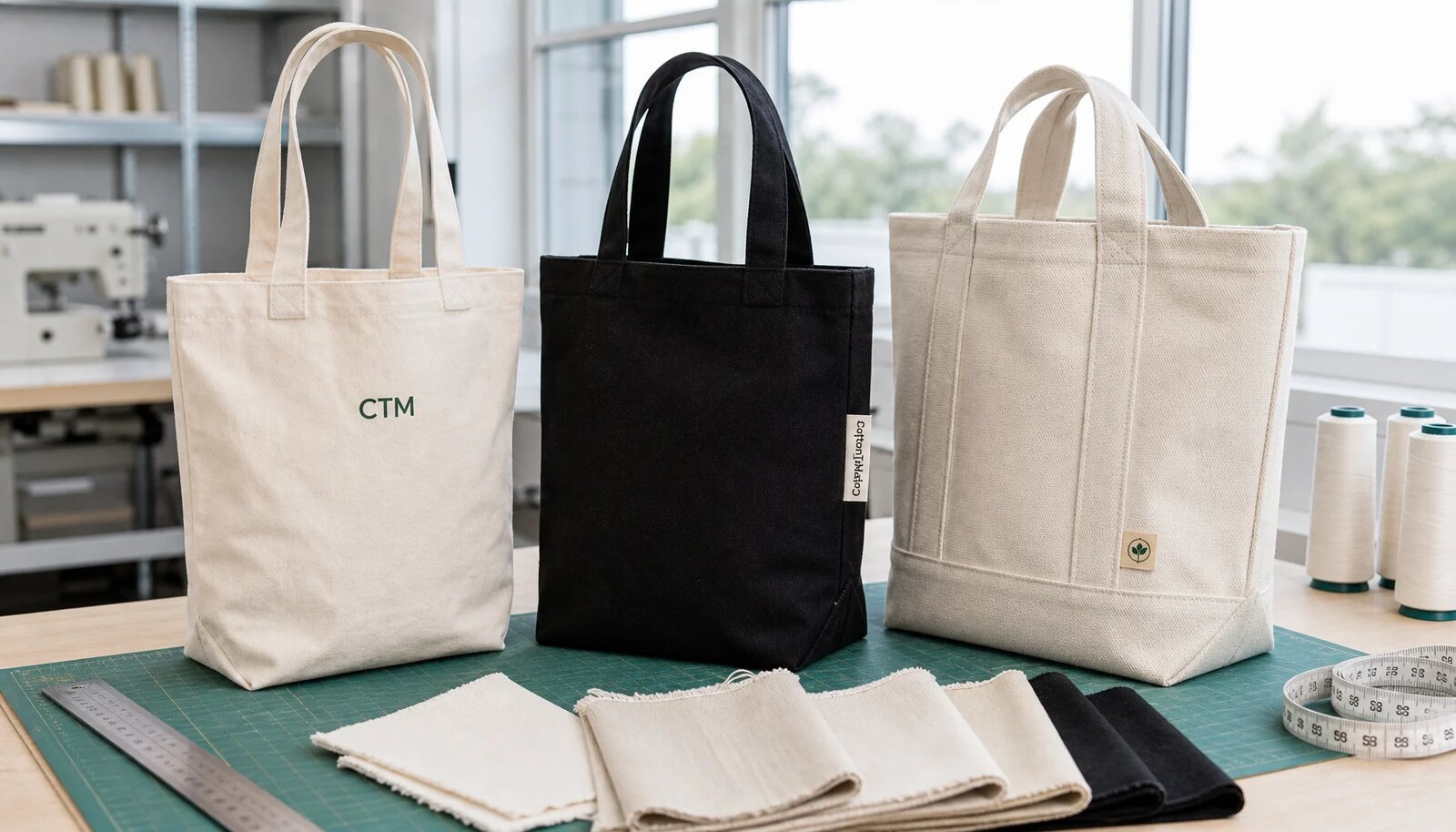
Start with fabric weight because it shapes the whole order
Most sourcing problems on custom organic cotton totes begin with vague material wording. “Organic cotton tote” could mean a soft 120 GSM flat bag for a launch event, a 200 GSM everyday retail tote, or a 340 GSM structured canvas bag sold as merchandise. Those bags may look similar in a digital mockup. In production, they behave very differently. They do not share the same fabric cost, sewing speed, print result, carton density, freight profile, or customer perception.
For an eco apparel brand, the tote often becomes part of the purchase experience. It may leave the store with folded garments, travel in an ecommerce parcel, or sit on a retail shelf as a paid accessory. If it feels too flimsy, the organic claim may not save the impression. If it is overbuilt, the brand may pay for stiffness, bulk, and freight that the channel does not need. The right question is not simply “What is the heaviest GSM?” It is “What fabric weight supports the tote’s job, load, packing method, and price point?”
GSM means grams per square meter. It is a useful control point, but it is not a full quality grade. GSM does not automatically define weave density, yarn evenness, shrinkage, handle strength, print sharpness, or seam durability. A tightly woven 200 GSM canvas may feel more stable than a loose 220 GSM plain weave. A 300 GSM tote can still fail if the handle attachment is narrow or poorly stitched. Treat GSM as one specification inside a complete product brief, not as the whole brief.
- Quote and approve finished GSM, not only a fabric name such as “canvas” or “heavy cotton.”
- State the acceptable GSM tolerance, for example +/-5% if that range suits the program.
- Ask whether the quoted weight is greige, dyed, washed, finished, or measured from completed bulk bags.
- Compare GSM together with weave: plain weave, canvas, twill-like construction, yarn count, and density when available.
- Expect heavier fabrics to affect cost, sewing time, carton weight, freight, and crease control.
- Approve a finished tote sample before bulk production; a swatch alone cannot prove construction.
Match the GSM range to the tote’s real job
A better tote brief starts with use case, not with a favorite number. A free-with-purchase bag for a store opening needs clean branding, acceptable seam quality, and a cost that works at volume. It may not need the firm hand of a paid retail tote. A replacement for disposable store packaging needs enough strength for folded apparel and accessories while still storing neatly behind the counter. A merchandise tote has a different bar: better panel stability, comfortable handles, cleaner inside finishing, and a presentation customers will pay for.
Bag size changes the way a fabric feels. A 200 GSM small tote can feel stable; the same fabric on a large wide-gusset tote may look loose because the panel area is bigger. Gussets add capacity, but they also create bottom corners and fold lines that need stronger sewing control. If the tote will carry denim, knitwear, shoe boxes, catalogs, or outerwear, handle reinforcement and seam allowance deserve as much attention as body GSM.
Channel also matters. Ecommerce inserts should fold cleanly and avoid unnecessary parcel weight. Retail store programs often care about carton count, bundle count, and fast unpacking. Wholesale and franchise programs need specs that are easy to reorder without a new round of interpretation. A tote that looks impressive as one showroom sample can become inefficient if it creates oversized cartons, too many colorways, or complicated packing steps.
- For event giveaways and low-load distribution, review 120-140 GSM first.
- For an entry reusable store bag, 150-180 GSM can improve handfeel while staying compact.
- For a balanced apparel brand tote, 180-220 GSM is often the most practical sampling range.
- For a firmer loyalty or premium store bag, compare 230-260 GSM options.
- For paid merchandise or a boxier silhouette, sample 270-340 GSM organic cotton canvas.
- For oversized totes, do not rely on GSM alone; review gusset, handle, seam, and load expectations together.
Use these fabric-weight bands as a procurement shortlist
Most custom organic cotton tote projects can be narrowed into five useful weight bands. The lightest common range, 120-140 GSM, is suited to high-volume distribution, simple apparel inserts, and event use. It folds small and can reduce freight per piece. The trade-off is obvious in the hand: natural fabric may look more translucent, large printed panels may not sit as cleanly, and the tote should not be positioned as a heavy-duty carrier.
The 150-180 GSM range is a sensible step up for store packaging replacement and light shopping use. It gives more presence than a giveaway tote without making storage or parcel packing difficult. The 180-220 GSM range is often the most useful default for eco apparel brands because it balances printability, perceived value, and landed cost. It is substantial enough for many retail programs but usually avoids the bulk and slower sewing associated with heavy canvas.
When a brand wants more shape, 230-260 GSM can be a good middle path. It adds body for loyalty programs, higher-end store bags, or moderate paid merchandise, while remaining easier to pack than very heavy canvas in many cases. The 270-340 GSM range creates the firmest impression and can work well when the tote itself is a product. Buyers should still check carton weight, fold marks, bulky seam intersections, and the cost impact before committing.
- 120-140 GSM: compact giveaway totes, simple one-side logos, short-term distribution, light loads.
- 150-180 GSM: entry retail bags, light shopping, folded apparel, budget-conscious reuse programs.
- 180-220 GSM: everyday brand tote, cleaner print surface, credible handfeel, repeatable store use.
- 230-260 GSM: more structure, higher perceived value, better body for larger panels.
- 270-340 GSM: premium canvas tote, paid merchandise, heavier contents, firmer silhouette, higher freight exposure.
- At higher GSM, customers expect stronger sewing; handle construction must rise with the fabric story.
Why two bags with the same GSM can feel different
GSM is only the beginning. Two suppliers can quote 200 GSM organic cotton and deliver bags that feel nothing alike. One may use a tighter canvas; another may use a looser plain weave. Weave density affects opacity, stretch, panel stability, and print edge definition. Yarn count and yarn evenness affect surface texture. A natural slub can look appropriate for an organic cotton tote, but excessive irregularity can make the front panel look inconsistent or disrupt fine artwork.
Finishing also changes the final product. Softening makes a tote easier to fold and may improve casual handfeel, but it can reduce crisp structure. Calendering can smooth the print surface but may change how ink sits on the fabric. Washing or pre-shrinking can change both dimensions and handfeel. Dyeing can affect shade, surface touch, and sometimes the measured fabric weight. For that reason, the approved sample should use the same fabric finish planned for bulk production.
Organic documentation is a separate requirement from fabric feel. A supplier may be able to source organic cotton material, but the available certificate support depends on the certified supply chain and what stage is covered. If your retailer, compliance team, or customer-facing claim requires chain-of-custody evidence, define it before quotation. Documents are much easier to plan before the order than to reconstruct after shipment.
- Ask for fabric construction as well as GSM: plain weave, canvas, twill-like weave, yarn count, and density where available.
- Review a physical swatch for opacity, texture, handfeel, shade, and logo suitability.
- Confirm whether the bulk fabric is natural, bleached, dyed, washed, softened, calendered, or otherwise finished.
- If users may wash the tote, ask for shrinkage information and the test condition used.
- Define organic claim support separately: scope certificate, transaction certificate, labeling rules, and product certification needs.
- Use a sealed reference sample for subjective words such as “soft,” “crisp,” “structured,” or “natural.”
Specify fabric and print as one decision
Print quality changes with fabric weight and weave. Lightweight fabric can move more during printing, may show deeper ink penetration, and may not support a large solid logo as cleanly. Medium-weight organic cotton is often more forgiving for water-based screen printing because the panel is stable without being too bulky. Heavy canvas gives a premium look, but pronounced yarn texture can soften the edges of fine lines, small type, and detailed marks.
Natural and light-colored totes are usually simpler to print than black, navy, forest, or other dark dyed colors. Water-based screen print is a common choice for simple artwork on natural cotton, but the factory still needs the final artwork, ink coverage, curing requirements, and destination-market compliance requirements. Dark fabric may require high-opacity ink, an underbase, discharge where suitable, or a tested transfer method. Each route changes cost, handfeel, sampling time, and reject risk.
A strike-off is far more useful than a digital mockup. It should use the final fabric weight, fabric color, print size, artwork, and ink system. Check opacity, registration, edge sharpness, placement, curing, rub risk, and the feel of the ink on the fabric. If the print is near a seam, across a gusset, on both sides, or very large, quote and test that exact layout. A simple front logo is not the same production risk as a two-side print with large ink coverage.
- Send vector artwork at final size, including color references and minimum line weights.
- Define print position by measurements from top seam, side seam, center line, and bottom reference.
- Ask whether the quote includes screen/setup charges, number of colors, ink type, underbase, and curing process.
- For dark dyed totes, test opacity and rub risk on the actual bulk shade, not a similar old sample.
- Review large ink coverage for stiffness, drying time, cracking risk, and carton-transfer marks.
- Inspect first production pieces because bulk print conditions can differ from sampling conditions.
Do not let weak construction hide behind a high GSM
Most tote failures happen at stress points, not across the middle of the fabric. The critical areas are handle joints, top hem, side seams, bottom corners, and gusset folds. A 220 GSM tote with weak handle stitching can perform worse than a lighter tote with better reinforcement. Buyers should specify construction according to load, carrying method, and brand expectation instead of assuming that heavier fabric automatically means better durability.
Handle language needs to be exact. Same-fabric self handles, cotton webbing handles, box stitch, cross stitch, bartack, and folded reinforcement are not interchangeable details. Handle drop determines whether the tote works on the shoulder or only by hand. Handle width affects comfort when the bag carries heavier garments. On heavier canvas, needle selection, stitch tension, seam allowance, and bulky intersections need closer control to avoid puckering, skipped stitches, or fabric damage.
Inside finishing affects perceived quality as much as the front panel. A basic promotional tote may use overlocked seams. A higher-end retail tote may need folded, bound, or otherwise cleaner inside finishing. Natural cotton shows loose threads, oil marks, stains, and lint quickly. Heavy canvas can create uneven corners if seam bulk is not managed. The best spec treats the tote as a system: fabric weight, size, handles, seam finish, print, labels, and packing format all work together.
- Specify width, height, gusset, top hem depth, handle length, handle drop, handle width, and handle material on a drawing.
- Replace “reinforced handles” with exact language: box stitch, cross stitch, bartack, folded seam, or another agreed method.
- Agree stitch density and seam allowance where the tote is expected to carry heavier apparel loads.
- For gusseted totes, inspect bottom corners, side gusset alignment, and seam bulk.
- For shoulder totes, test comfort with the expected product load, not just the flat handle length.
- For premium totes, review the bag after filling, folding, stacking, and hanging.
Understand the real MOQ drivers before adding colorways
MOQ for custom organic cotton totes is rarely one simple number. It can be driven by organic fabric availability, fabric weight, dyeing minimums, cutting efficiency, print setup, label production, packaging materials, and factory scheduling. A standard natural tote in a common size may be available at a lower MOQ than a custom dyed tote with special GSM, two-side print, woven label, barcode sticker, and retail packing.
Color is often the biggest complication. Natural or ecru fabric can be easier to source than custom dyed colors. Custom shades usually require lab dips, shade approval, dye-lot control, and sometimes higher minimums at the fabric stage. If the assortment includes natural, black, and several seasonal colors, ask whether MOQ applies per total order, per color, per artwork, per fabric lot, or per size. A low headline MOQ may apply only to one standard natural option.
Growing apparel brands can reduce risk by standardizing the base tote. Keep one size, one GSM range, one handle construction, one label position, and one packing method. Then vary artwork or color only where demand supports it. This makes quotes easier to compare, sampling faster, and replenishment less error-prone. Complexity is worth adding only when it creates visible brand value or solves a real operational need.
- Ask if MOQ is calculated per color, artwork, size, fabric weight, label type, or total purchase order.
- Request separate pricing for natural, stock dyed, and custom dyed fabric.
- Confirm lab dip timing, number of included rounds, light source for review, and shade approval process.
- Check whether woven labels, hangtags, barcode stickers, and individual packing have separate MOQs.
- Use one base body across multiple SKUs to improve price leverage and reduce repeat-order mistakes.
- For regional programs, consider changing carton labels or packing lists instead of changing the tote itself.
Build a quote-ready specification before comparing unit prices
A low unit price is only useful when suppliers are quoting the same product. Before comparing factories, normalize the specification. The quote file should include finished dimensions, tolerances, fabric composition, organic documentation basis, finished GSM, GSM tolerance, weave, fabric color basis, print method, print size, print colors, handle details, seam finishing, label details, packing method, MOQ, sample cost, lead time, and trade term.
Many cost differences sit outside the basic unit price. Heavy fabric increases material consumption, carton gross weight, and freight per piece. Retail folding, individual plastic-free packing alternatives, barcode stickers, hangtags, tissue, or belly bands add labor and can reduce carton density. Two-sided print, large ink coverage, dark-fabric underbase, and artwork close to seams can increase setup time and reject risk. Dyed fabric can add lab dip time and shade-control risk.
Ask for logistics data during quotation, not after production. Carton dimensions, pieces per carton, gross weight, inner bundle quantity, and carton marks are needed for landed-cost comparison and warehouse planning. If totes ship by air for a launch date, carton volume and weight may matter as much as unit price. If the order enters a retailer distribution center, barcode format, carton labels, assortment ratios, and receiving rules may be mandatory.
- Include the trade basis in every quote: EXW, FOB, CIF, DDP, or another agreed term.
- Ask whether sample charges, screen charges, lab dips, setup fees, and testing fees are included or separate.
- Request estimated carton dimensions, gross weight, pieces per carton, inner bundle count, and packing materials.
- Clarify price breaks by quantity, color split, print placement, fabric option, and packing format.
- Ask for production lead time after sample approval and material lead time after deposit or purchase order.
- Require the same spec version number on the quote, sample invoice, proforma invoice, and production file.
Use sample approval to catch problems while they are still cheap
A pre-production sample should prove the whole tote, not just the logo. Common issues include fabric that feels too limp, handles that are too short for shoulder use, print placed too low, gusset corners that are not square, side seams that twist, a top opening that feels narrow, labels that distort a seam, or inside threads that look unfinished. These details are manageable before bulk cutting. They become expensive once fabric is printed or bags are sewn.
Review the sample with real products inside. Use folded T-shirts, denim, knitwear, shoe boxes, catalogs, or accessories that match the program. Carry the tote by hand and on the shoulder if relevant. Fold it the way it will be packed and leave it folded for several days to check crease behavior. Look at the print after folding, especially on heavy canvas or large ink areas. If the bag will be sold, view it as the customer will see it: on a shelf, peg, folded stack, or ecommerce unboxing.
Approval comments must become measurable revisions. “Move the print up slightly” should become a distance from the top seam. “Make the handle longer” should become a finished handle drop. “Use heavier fabric” should become a finished GSM range and fabric construction. A sealed physical sample, labeled photos, and a revised spec sheet reduce interpretation errors between sales, sampling, production, and inspection teams.
- Measure width, height, gusset depth, top opening, handle drop, handle width, and print position on the sample.
- Check fabric shade under consistent lighting, especially for natural, ecru, black, navy, and seasonal dyed colors.
- Inspect side seams, bottom corners, top hem, handle reinforcement, label placement, thread trimming, and inside finishing.
- Run a practical load check using the intended garment weight and carrying method; define the expected result for bulk.
- Approve print quality on the final fabric weight and color, including opacity, edge sharpness, curing, and handfeel.
- Convert every sample comment into a revised spec sheet before authorizing bulk production.
Set QC tolerances that prevent avoidable B2B claims
“Good quality” is not an inspection standard. Custom organic cotton totes need measurable tolerances, clear defect definitions, and a packing checklist. Fabric weight should be checked against the approved finished GSM range using the agreed method. Finished dimensions should allow normal sewn-product variation while still protecting function and appearance. Many buyers use tighter tolerances for print placement and handle symmetry than for total body dimensions because visible misalignment damages brand presentation quickly.
Print and sewing defects are the main risk areas. Prints can shift, under-cure, vary in opacity, crack, transfer, or look fuzzy on loose fabric. Sewing defects often appear at handle bases, side seams, top hems, and gusset corners. Inspect stitch consistency, skipped stitches, broken threads, seam allowance, reinforcement type, and symmetry. On heavier canvas, pay attention to bulky intersections and needle damage. On natural cotton, look closely for oil marks, stains, dark fibers, lint, and obvious shade variation.
Final inspection should also cover packing and receiving requirements. A tote program can pass product appearance checks and still create a business problem if carton quantities are wrong, color assortments are mixed, barcodes are missing, carton marks are incorrect, or carton weight exceeds warehouse limits. Moisture protection may be important for sea shipment and long storage. Define product defects and packing defects before production starts, not after cartons are sealed.
- Set fabric GSM tolerance, body dimension tolerance, handle tolerance, and print placement tolerance before production.
- Use the same measurement method for sample approval, inline inspection, and final inspection.
- Reject open seams, failed handle reinforcement, skipped stitches at stress points, major stains, oil marks, and obvious front-panel shade mismatch.
- Check print opacity, registration, curing, handfeel, rub risk, and position against the approved strike-off.
- Verify label type, label placement, hangtag position, barcode readability, and carton labeling against the packing specification.
- Confirm carton count, bundle count, assortment ratio, gross weight, moisture protection, and shipping marks before release.
Specification comparison for buyers
| Spec decision | Recommended option | When it fits | Buyer risk to check |
|---|---|---|---|
| Fabric weight for high-volume giveaway totes | 120-140 GSM finished organic cotton, with agreed tolerance such as +/-5% unless otherwise specified | Events, launch campaigns, gift-with-purchase bags, apparel inserts, low-cost retail add-ons, short-term brand distribution | Soft body may not support large print panels; contents can show through; handles and seams need realistic load expectations; confirm finished GSM, not greige GSM |
| Fabric weight for entry retail reusable totes | 150-180 GSM finished organic cotton plain weave or light canvas | Store packaging replacement, light shopping use, small apparel bundles, budget-conscious eco programs | Loose weave can feel thinner than GSM suggests; request swatch, yarn/weave description, shrinkage result if washable, and finished fabric tolerance |
| Fabric weight for everyday apparel brand tote | 180-220 GSM finished organic cotton or cotton canvas | Balanced handfeel, cleaner print surface, reusable store bag, loyalty tote, moderate paid merchandise | Confirm plain weave versus canvas; check handle reinforcement, stitch density, print curing, and panel distortion, not only body GSM |
| Fabric weight for more structured mid-weight tote | 230-260 GSM finished organic cotton canvas | Brands wanting a firmer body than standard retail totes while managing carton weight better than heavy canvas | May require stronger needles, larger seam allowance, and slower sewing; compare carton dimensions and gross weight before approval |
| Fabric weight for premium structured tote | 270-340 GSM organic cotton canvas | Higher perceived value, boxier silhouette, paid retail merchandise, heavier apparel loads, longer-use packaging replacement | Material cost, sewing time, carton weight, and freight rise; bulky seam intersections, handle attachment, and crease control need stricter inspection |
| Print method on natural or light fabric | Water-based screen print for simple artwork, tested on the same fabric weight and color | Eco positioning, natural cotton appearance, one- to three-color logos, medium to high volume | Ink penetration and edge sharpness vary with weave; approve strike-off with final print size, artwork line weight, and curing standard |
| Print method on dark dyed fabric | High-opacity screen print, discharge where suitable, or tested transfer method depending on artwork and market requirements | Black, navy, forest, or seasonal-color totes requiring strong logo visibility | Dye lots and ink systems can react differently; check opacity, dry/wet rub where relevant, heat setting, and shade consistency before bulk |
| MOQ strategy for multi-color assortments | Use one body size, one GSM, one handle construction, and one label location across all colors | Brands needing color variety without turning each color into a separate sourcing project | Custom dye minimums, lab dips, separate print setups, and label MOQs can increase cost when color runs are small |
| Handle construction choice | Same-fabric self handles or cotton webbing with defined box stitch, cross stitch, bartack, or folded reinforcement | Most retail, promotional, and everyday reusable tote programs | Vague “reinforced handles” is not enough; specify handle drop, handle width, stitch type, seam allowance, and acceptable load-check method |
Buyer checklist before sampling
- Define the tote’s commercial role: giveaway, store packaging replacement, paid retail item, ecommerce insert, loyalty reward, wholesale add-on, or regional distributor SKU.
- State the target finished fabric weight in GSM with an agreed tolerance, for example +/-5% for fabric weight if acceptable; do not request only “organic cotton canvas” or “heavy cotton tote.”
- Clarify whether GSM is measured on greige fabric, finished fabric before cutting, washed fabric, or material taken from completed bulk bags; use one method at sample and inspection stages.
- Specify fabric construction where possible: plain weave, canvas, twill-like weave, yarn count if available, weave density if available, and whether the handfeel should be soft, crisp, or structured.
- Confirm organic claim requirements before quoting: scope certificate, transaction certificate, certified organic material declaration, product labeling rules, hangtag wording, and whether the finished product itself must be certified.
- Lock dimensions with tolerances: width, height, gusset depth, handle drop, handle width, top hem depth, print position, and label placement; include a simple technical drawing.
- Match print method to fabric weight, fabric color, artwork detail, ink coverage, compliance requirements, and intended use before requesting final prices.
- Provide scaled vector artwork and define print size, number of colors, Pantone or brand color references, one-side or two-side print, and whether print goes near seams, gussets, or bottom panels.
- Decide if the tote must stand up, fold compactly, fit in an ecommerce parcel, hang comfortably on the shoulder, or carry heavier garments; each goal changes the GSM and construction choice.
- Ask for sample photos or video showing front panel, side seam, bottom corners, handle joint, inside finishing, label placement, print close-up, folded packing, and carton packing if relevant.
Factory quote questions to send
- What finished GSM are you quoting, and what bulk tolerance do you control, such as +/-5% or another agreed range?
- Is the fabric plain weave cotton, cotton canvas, twill, or another construction, and can you provide yarn count, weave density, or a mill fabric reference?
- Is GSM measured before dyeing, after finishing, after washing, or on the fabric ready for cutting? Will inspection use the same method?
- Is the quoted material certified organic at fiber, yarn, fabric, or finished product stage, and what documents can be provided with shipment?
- Can you provide current scope certificate details and transaction certificate support if our buyer or retailer requires chain-of-custody documentation?
- Does the unit price assume natural fabric, stock dyed fabric, or custom dyed fabric, and what is the MOQ difference by color and by fabric lot?
- What is the lab dip process for dyed fabric, how many approval rounds are included, what light source is used for shade review, and how much time should we allow?
- Which print method are you pricing for this artwork, and what print size, number of colors, ink type, coverage area, setup charge, and curing process are included?
- If the logo is printed on both sides, wraps near seams, or includes gusset or bottom print, how does that change price, sampling time, and reject risk?
- What sewing reinforcement is included at the handles: box stitch, cross stitch, bartack, folded seam reinforcement, cotton webbing, or another method?
Quality-control points to confirm
- Finished fabric weight should be checked against the approved spec using an agreed method and tolerance, such as testing cut fabric from bulk bags and accepting a defined range rather than vague “medium canvas” wording.
- Bag body dimensions, gusset depth, opening shape, handle drop, and handle placement should be measured after sewing on a flat surface using the same measurement points at sample, inline, and final inspection.
- Practical sewn-product tolerances should be agreed in advance; many buyers use tighter tolerances for print placement and handle symmetry than for overall body dimensions because visible misalignment affects brand appearance.
- Handle attachment should be checked for reinforcement type, stitch density, seam allowance, skipped stitches, broken threads, needle damage, and symmetry; inline load checks should match the tote’s intended garment load rather than unrealistic claims.
- Print registration, ink coverage, edge sharpness, position, curing, opacity, crocking or rub risk, and handfeel should be reviewed on first production pieces and again during final inspection.
- Dark dyed totes should be checked for colorfastness risk and visible transfer where the ink system, fabric color, and intended use make that relevant; document the test method agreed with the supplier or third-party inspector.
- Natural cotton shade variation should stay within an agreed tolerance; mixed fabric lots can create visible front-to-front differences when cartons are opened in retail.
- Seam allowance consistency matters on heavier GSM totes because narrow seams, needle damage, bulky intersections, or poor tension can cause splitting under load.
- Inside trimming, loose threads, needle holes, oil marks, fabric slubs, stains, lint contamination, and folded seam cleanliness should be reviewed especially on light natural or undyed cotton.
- Label placement should be verified for brand position, seam stability, and user comfort; side labels or woven labels should not distort seams, scratch the hand, or be hidden after folding.