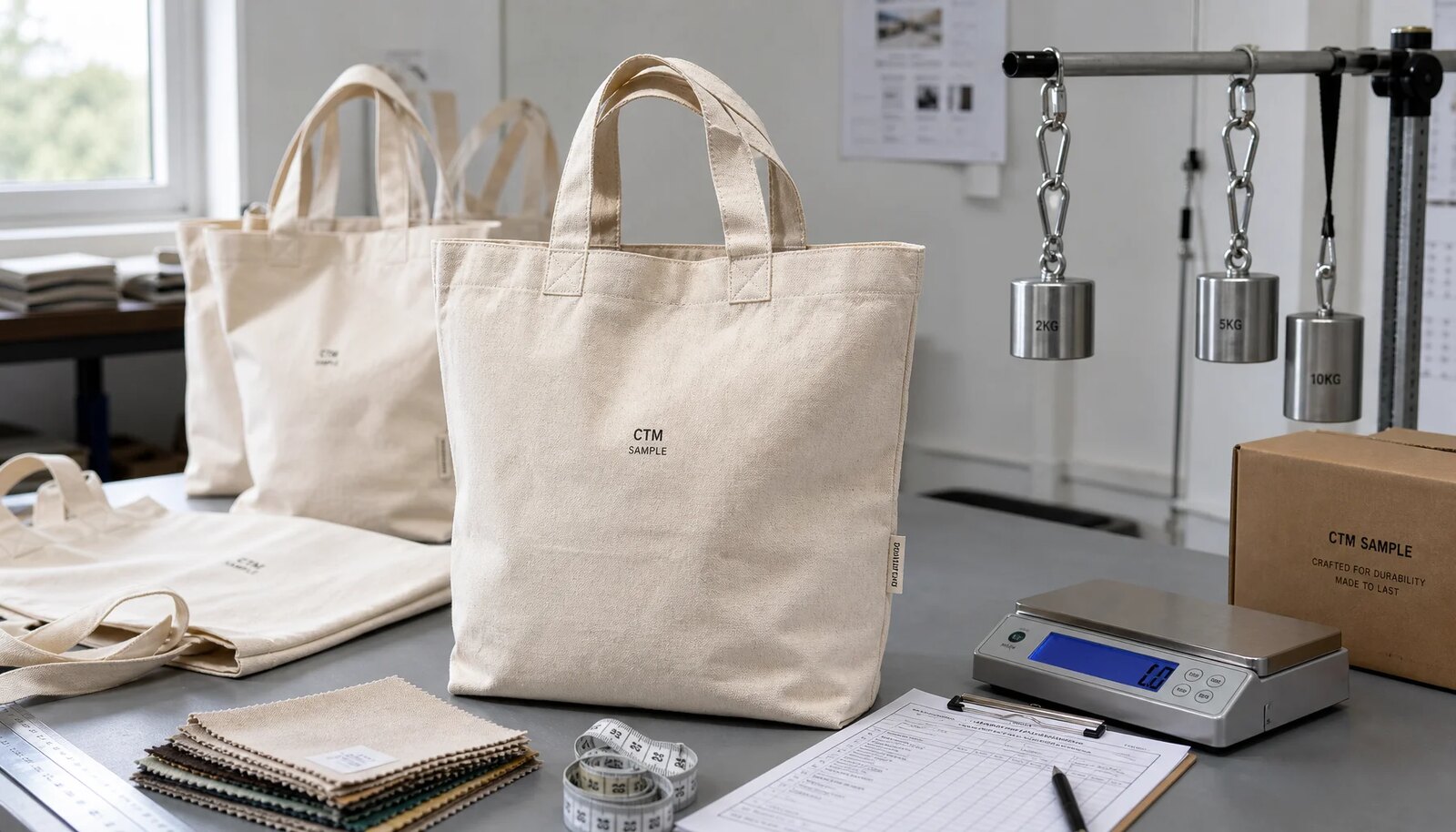
Start with the real craft fair load
A craft fair tote has a harder job than a typical lightweight giveaway bag. One shopper may add a candle jar, a ceramic mug, a paperback book, a framed print, boxed soap, packaged food, and a folded textile before leaving the venue. The load is uneven. Corners press into the bottom seam. Handles are lifted, dropped, twisted, and lifted again while the shopper moves through crowded aisles. If the tote feels flimsy or the logo scuffs before the event is over, the buyer loses both utility and brand value.
For procurement teams, durability should be written as a specification, not described as “good quality.” The RFQ needs to state the expected load, fabric weight, finished size, gusset, handle reinforcement, seam construction, print method, packing format, inspection level, and documentation scope. Once those details are fixed, suppliers can quote the same product instead of similar-looking totes with different performance.
Most failures are not random. Handles tear at the top hem, bottom seams open at gusset corners, thin fabric stretches around boxy goods, and under-cured ink cracks where cartons compress the print. These issues usually surface close to the event date, when remake time is limited. A clear custom organic cotton totes durability testing checklist for craft fairs reduces that last-minute risk.
- Typical mixed load: 2-5 kg, with heavier exceptions such as books, candles, jars, and ceramics.
- Main stress points: handle attachments, top hem, bottom seam, gusset corners, print face, fold line, and carton compression areas.
- Procurement impact: fewer booth complaints, less emergency repacking, cleaner sponsor presentation, and more reliable vendor allocation.
- Quote rule: do not compare prices until fabric, construction, printing, packing, documents, and QC scope are aligned.
- Best sample test: load the tote with actual event products, not only paper inserts or empty display props.
Choose fabric after defining load
Fabric weight matters, but it should follow the load target. A 5 oz to 7 oz organic cotton bag can work for brochures, stickers, jewelry cards, postcards, and other flat items. For general craft fair use, 8 oz to 10 oz is a stronger starting point. When the program includes candles, jars, ceramics, books, boxed gifts, packaged food, or reusable vendor welcome kits, 10 oz to 12 oz organic cotton canvas is usually a more practical range.
GSM helps, but it does not tell the whole story. A fabric listed as 300 GSM may feel different from another 300 GSM fabric because yarn, weave density, finishing, bleaching, moisture regain, and shrinkage are not identical. Ask for ounce weight and GSM, then confirm the finished bag weight. Finished bag weight shows what the buyer is actually receiving: body fabric, gusset, handles, top hem, seam allowance, and reinforcement.
A sensible test target protects real use without overbuilding the bag. Many craft fair orders begin with a 5 kg static hanging test for 30-60 minutes plus 20-50 repeated lift cycles. That is not a universal rule; it is a baseline to adjust against the merchandise mix. Very high load requirements can increase cost, stiffness, carton weight, and freight. Too low a target can leave the buyer exposed to event-day failures.
- Light use: 5 oz to 7 oz for documents, brochures, flat goods, and short-term distribution.
- General craft fair use: 8 oz to 10 oz for mixed small purchases and moderate reuse.
- Durable retail-style use: 10 oz to 12 oz, often about 270-340 GSM depending on weave and finishing.
- Heavy merchandise use: 14 oz or higher only when added cost, sewing time, stiffness, and freight are justified.
- Quote comparison rule: review GSM, ounce weight, finished bag weight, weave, shrinkage, handfeel, and load test result together.
- Sampling note: keep a sealed approved sample so bulk fabric can be compared for thickness, shade, and handfeel.
Engineer the handles and seams
Handles carry most of the visible risk. A wide cotton handle still fails if it is attached with shallow stitching, weak thread, or a single straight line that pulls out under load. For craft fair totes, handles should be inserted into the top hem and reinforced at all four attachment points. Box-X stitching, bar-tack, dense rectangle stitching, or an approved equivalent can all work if the pattern is documented and tested.
Handle comfort also matters. A handle width of about 2.5 cm to 3.8 cm is common for canvas totes. A 25-30 cm handle drop suits hand carry, while 30-35 cm or more may be needed for shoulder carry, especially over coats. Long handles look convenient in a catalog, but they can twist when staff pack quickly. Narrow handles can bite into the hand once the tote is loaded with jars or books. Test the handle drop with a packed sample, not a flat photo.
Seams need the same discipline. Bottom seams and gusset corners take concentrated pressure from square boxes and hard products. Inside overlock plus top stitch is common for standard canvas totes. Bound seams, French seams, or wider seam allowance may be worth the cost for premium merchandise or heavier loads. Whatever method is chosen, it should appear on the approved sample and be named in the purchase order.
- Handle width: specify 2.5-3.8 cm or a buyer-approved alternative, not only “long handles.”
- Handle drop: define finished drop in centimeters with tolerance, commonly plus or minus 1 cm.
- Attachment depth: ensure the handle end sits deep enough inside the top hem for the reinforcement to catch it fully.
- Reinforcement: require box-X, bar-tack, rectangle stitch, or approved equivalent at all four handle joins.
- Seam checks: inspect bottom corners, gusset edges, top hem, seam allowance, skipped stitches, needle cutting, and loose overlock tails.
- Failure rule: any broken stitch, fabric tear, or top hem opening during the agreed load test should trigger hold, sort, repair, or reinspection.
Protect the logo during real handling
Print durability starts before ink reaches fabric. For simple logos, one to four spot colors, and medium to large craft fair runs, screen printing is often a reliable and cost-effective choice. Water-based screen print can fit organic cotton positioning because it usually gives a softer handfeel than heavy plastisol-style prints. Still, a soft print is not automatically a durable print. Ink deposit, fabric absorption, drying, curing temperature, curing time, and stacking pressure all affect performance.
Natural organic cotton has shade and surface variation. Fine lines, pale ink, small type, and large solid panels may look different after printing than they do in a digital proof. The actual fabric should be tested before bulk approval, especially if the artwork crosses a fold line or sits near the bottom where products press against the panel. Fold the printed sample. Rub it with a clean white cloth. Stack it under pressure. Look for powdering, cracking, edge loss, transfer, and opacity variation.
Other branding methods can work when they match the artwork and order size. Digital printing supports detail and gradients, but it needs rub, color consistency, and wash behavior checks. Heat transfer can help with smaller runs or complex logos, yet it may show edge lifting or a plastic handfeel after folding. Embroidery is durable for small marks but can pucker lighter fabric. Woven or sewn labels reduce large print risk, but label stitching and alignment still require inspection.
- Screen print: strong for clean logos, spot colors, repeat orders, and predictable event branding.
- Water-based ink: approve opacity, dry rub, curing quality, and fabric absorption on the actual cotton.
- Digital print: use for detail or gradients, then verify color consistency, handfeel, rub resistance, and optional wash behavior.
- Heat transfer: test edge adhesion, fold cracking, stacking transfer, scuffing, and handfeel before bulk approval.
- Embroidery or label: check puckering, backing, label placement, stitch security, and consistency across cartons.
- Artwork placement: keep critical details away from hard fold lines, deep gusset distortion, and bottom corner stress whenever possible.
Build a pre-production test pack
A durability decision needs a physical pre-production sample. Photos and videos help with communication, but they cannot show load behavior, handfeel, stitch strength, odor, or carton creasing. The approved sample should use bulk fabric, actual handle material, bulk thread, production sewing method, real ink, final curing or fixation process, and intended packing fold. A development sample made from substitute stock fabric is useful for layout checks, not final durability approval.
Start with measurement. Record body width, body height, gusset depth, handle drop, handle width, print size, print placement, and finished bag weight. Use a consistent method: lay the bag flat without stretching, measure handle drop from top edge to handle peak, and weigh the finished tote on a calibrated scale. These values become the bulk inspection baseline and help identify quiet substitutions in fabric, handle length, or construction.
Then test function. Load the tote with agreed products or calibrated weights that mimic the pressure of boxy goods. Hang it by both handles for the defined duration. Inspect handle joins, top hem, bottom seam, and gusset corners. Follow with repeated lift cycles because shoppers rarely carry a tote in one smooth motion. Finish by folding the printed panel as packed, dry-rubbing the logo, and simulating carton stacking if the tote will travel compressed.
- Measurement record: width, height, gusset, handle drop, handle width, print size, print placement, and finished bag weight.
- Static load test: define weight, duration, hanging method, sample quantity, and failure criteria before quotation.
- Lift-cycle test: repeat loaded lifting and setting down 20-50 times or another agreed count based on use.
- Seam stress check: inspect handle insertion points, top hem, bottom corners, gusset edges, and thread tension after testing.
- Print test: review dry rub, folding, stacking pressure, opacity, scuffing, and optional wash behavior if washability is claimed.
- Approval file: keep the sample, test photos, artwork, measurement sheet, packing sample, and signed specification together.
Read MOQ and lead time carefully
MOQ is not only a factory preference. It is shaped by fabric availability, cutting yield, sewing setup, printing setup, documentation work, and packing labor. A supplier may offer a lower MOQ when the order uses available natural organic cotton fabric in a standard width and common weight. MOQ often rises for custom dyed fabric, uncommon GSM, special canvas weave, unusual dimensions, extra-long handles, multi-position printing, sewn labels, retail packing, or formal chain-of-custody documentation.
Craft fair quantities often sit between promotional giveaways and retail merchandise. A single local event may need several hundred to a few thousand totes. A distributor, sponsor program, or multi-market operator may need repeatable seasonal inventory. In that case, first-order MOQ is only part of the decision. Ask whether the same fabric shade, handle drop, print color, packing count, and documentation scope can be repeated. Reorders can become difficult if the first run used leftover fabric that cannot be matched later.
Lead time should be broken into steps. A natural fabric, standard-size tote with one-color screen print and bulk packing may move quickly. Custom dyed fabric with lab dips, special GSM, multi-color registration, individual packing, and third-party inspection takes longer. Ask for milestone dates: fabric booking, pre-production sample, artwork approval, cutting, sewing, printing, curing, inspection, repacking, cargo ready, and shipment. This prevents a quote from showing only sewing days while omitting material, print, QC, and export timing.
- Lower MOQ path: available natural organic cotton, standard size, standard handles, one print position, and bulk packing.
- Higher MOQ path: custom dyeing, special GSM, custom weave, unusual size, multiple colors, labels, or certified document scope.
- Repeat order control: confirm whether shade, handle length, screen setup, packing format, and documents can be repeated.
- Lead time risks: fabric booking, lab dip approval, sample revision, artwork conversion, ink curing, inspection failure, and export booking.
- RFQ requirement: separate base bag MOQ, print MOQ, dyed fabric MOQ, packing MOQ, document charges, and sample costs.
- Scaling strategy: approve a controlled first order with full sample testing before placing larger seasonal or multi-vendor volume.
Ask for quote data that exposes risk
A useful quote makes the tote visible without relying on a photo. If one supplier prices 10 oz organic cotton canvas with box-X reinforced handles and another prices 8 oz cotton with simple handle stitching, the lower price is not a saving. It is a different bag. Every supplier should quote the same fabric weight, finished dimensions, gusset, handle drop, reinforcement, seam method, print method, print size, color count, packing, carton quantity, inspection support, documentation, Incoterm, and lead time.
Exclusions are where many false savings hide. Organic cotton documents, transaction certificates, third-party inspection, reinspection after failed QC, barcode labels, vendor allocation packing, inner carton liners, lab testing, special carton marks, and sample courier charges may not be included in the unit price. If the buyer plans to use organic language on hangtags, websites, sponsor materials, or vendor kits, confirm document availability and cost before production starts.
Landed cost also changes with packing density and carton weight. A 12 oz tote costs more and creates heavier cartons, but it may reduce failures and support premium positioning. A thinner tote may reduce FOB price and freight, then create complaints once loaded with jars or books. Compare total risk across material, sewing, printing, packing, inspection, inland transport, export charges, freight, duty, receiving labor, and emergency event repacking.
- Fabric data: organic cotton claim scope, oz weight, GSM, weave, color process, shrinkage, finishing, and finished bag weight.
- Construction data: body size, gusset, handle width, handle drop, reinforcement pattern, seam finish, thread, and stitch density target.
- Print data: method, ink type, color count, print size, registration tolerance, curing process, screens, and proofing cost.
- Packing data: flat or folded, bundle quantity, polybag or paper band, carton dimensions, carton gross weight, liner, and marks.
- Commercial data: MOQ, sample cost, screen charge, document charge, inspection support, Incoterm, payment terms, and validity period.
- Decision rule: choose the lowest total-risk compliant quote, not the lowest photo-based unit price.
Set QC thresholds before production
Quality control needs numbers, references, and release rules. The inspector should receive the approved sample, specification sheet, artwork file, packing instruction, purchase order, carton mark layout, and organic cotton documentation requirements. Without those references, inspection becomes subjective. A bag can look acceptable on a table and still fail when it is weighed, loaded, folded, or compared against the approved sample.
Defect classification should be agreed before inspection. Critical defects include unsafe contamination, wrong logo, wrong claim, severe mildew odor, metal fragments, or material substitution that affects the organic claim. Major defects include handle failure, open seams, wrong dimensions outside tolerance, severe print cracking, heavy stains, wrong packing, mixed SKUs, unreadable carton marks, or cartons too weak for shipment. Minor defects are smaller appearance issues within tolerance, such as short thread ends or tiny marks away from the logo.
AQL visual inspection is helpful, but it should not be the only control. Durability checks should be treated as special functional tests. If a handle fails during the agreed load test, the order may need to be held even if the visual defect count passes. Randomly selected bags should be measured, weighed, loaded, lifted, dry-rubbed, folded, and checked at stress points. Inspection photos should clearly show measurement tape, handle reinforcement, seam interiors, printed panels, load setup, packing layout, and carton marks.
- Dimension tolerance: commonly plus or minus 1 cm for body width and height unless tighter retail sizing is required.
- Handle test: no broken stitches, top hem opening, fabric tearing, or severe distortion after agreed static load and lift cycles.
- Seam test: no open seam, skipped stitch chain, fraying, loose overlock tail, or weak bottom corner after handling.
- Print test: no obvious transfer, cracking, powdering, flaking, bleeding, or misregistration beyond the approved standard.
- Cleanliness test: no mildew odor, oil stains, dampness, needle mark clusters, loose cotton debris, insects, or foreign matter.
- Release rule: document release, hold, sort, repair, remake, or reinspection based on pre-agreed defect limits.
Make packing part of the specification
Craft fair totes are often unpacked close to the event, sometimes by booth staff, sponsors, warehouse teams, or volunteer coordinators. If cartons arrive with deep logo creases, mixed artwork versions, dusty panels, moisture odor, weak labels, or excessive gross weight, the buyer loses time when there is little margin left. Packing should be approved during sampling, not improvised after production.
Flat packing usually presents the logo better and reduces hard fold marks, but it increases carton cube and may raise freight cost. Folding lowers volume, yet it can create permanent creases on heavier canvas or when ink crosses the fold. If folded packing is required, the fold line should avoid critical artwork where possible. Test the printed sample after curing, then check whether panels stick, scuff, or transfer when stacked under carton pressure.
Packing materials should match both operations and brand positioning. Individual polybags protect cleanliness and make vendor allocation easier, but they add material, waste, and unpacking labor. Paper bands or inner bundles may fit an organic cotton message better, though they provide less protection against moisture and abrasion. Bulk bundles are efficient for event distribution if carton labels clearly identify artwork, color, quantity, booth allocation, and carton sequence. Carton gross weight also needs control so staff can handle cartons safely and the corrugation does not collapse in transit.
- Flat pack: better logo presentation and fewer fold marks, with larger carton volume and possible freight increase.
- Folded pack: lower volume and higher crease risk, requiring fold-line approval against printed artwork.
- Individual polybag: cleaner receiving and easier allocation, but higher waste, cost, and unpacking time.
- Paper band or bundle: stronger sustainability fit, but less protection against moisture, abrasion, and handling dirt.
- Carton specification: state pieces per carton, gross weight limit, dimensions, liner, marks, and corrugation strength if required.
- Arrival inspection: check dampness, compression, odor, carton count, SKU separation, label accuracy, and repacking need.
Control organic cotton claims
Organic cotton sourcing needs careful wording. A tote may contain organic cotton, but the buyer’s ability to make a certified claim depends on certification scope, chain-of-custody rules, labeling requirements, and documents included in the order. Procurement teams should separate four ideas: material composition, supplier declaration, certified organic cotton fabric, and certified finished product claim. They are not the same compliance position.
Before quotation, state exactly which documents are required. Some buyers only need a material declaration for internal purchasing. Others need scope certificates, transaction certificates, chain-of-custody evidence, or certification marks for retail labeling. If finished product certification or specific logo use is required, confirm that the supplier and relevant processors are within scope before production. Do not assume documents can be created after cutting, printing, or sewing.
Documentation should connect to QC. The purchase order should list approved claim wording, prohibited wording, labeling requirements, and document deadlines. Inspection should verify that labels, hangtags, carton marks, and packing lists do not make a stronger claim than the documents support. This protects the buyer, the supplier, and any sponsor or retailer using the tote in public-facing materials.
- Clarify claim level: organic cotton content, certified fabric, chain-of-custody supported order, or certified finished product claim.
- Request documents early: supplier declaration, scope certificate, transaction certificate, material records, or buyer-required evidence.
- Control wording: approve exact claim language for bags, labels, cartons, websites, sponsor materials, and vendor kits.
- Check scope: confirm whether spinning, weaving, dyeing, printing, sewing, and trading steps are covered when certification is required.
- Include cost: document preparation, certification support, audits, special labels, and reissue requests may affect price and lead time.
- Inspect claims: wrong certification logo, unsupported wording, or missing required document should be treated as critical or major.
Specification comparison for buyers
| Spec decision | Recommended option | When it fits | Buyer risk to check |
|---|---|---|---|
| Body fabric weight | 10 oz to 12 oz organic cotton canvas, commonly about 270-340 GSM after weaving and finishing; confirm by finished bag weight | Most craft fair orders carrying candles, books, ceramics, jars, textiles, boxed gifts, and repeat-use branding | GSM alone is not a functional spec. Ask for ounce weight, GSM tolerance, weave, finished bag weight tolerance, shrinkage result, and approved bulk handfeel. |
| Handle construction | Self-fabric or cotton webbing handles, 2.5-3.8 cm wide, inserted into top hem and reinforced with box-X, bar-tack, or approved equivalent | Repeated lifting and uneven loads where shoppers keep adding purchases from several booths | A long handle with weak stitching can fail before the fabric does. Confirm reinforcement pattern, thread, stitch density, attachment depth, and pull or hang-load pass criteria. |
| Seam method | Inside overlock plus top stitch for standard canvas totes; bound seam, French seam, or wider seam allowance for premium or heavy-load programs | Totes that are resold, included in vendor kits, or expected to look clean after multiple uses | Shallow seam allowance, skipped stitches, loose overlock tails, needle cutting, and weak bottom corners can cause fraying or seam opening under load. |
| Print method | Properly cured water-based screen print for simple logos; digital, pigment, heat transfer, embroidery, or label only after fabric-specific sample testing | Branded craft fairs, organic cotton positioning, one to four spot colors, and medium to large event runs | Under-cured ink can crack, powder, transfer, or scuff during carton compression. Test dry rub, fold line, opacity, adhesion, and optional wash behavior. |
| Bag size | Around 38 x 42 cm body with 8-10 cm gusset and 25-35 cm handle drop; adjust after loading actual products | Candles, jars, stationery, apparel, packaged food, books, small ceramics, and booth welcome kits | Flat totes reduce cost and carton cube but concentrate stress at bottom corners and can distort artwork when loaded with boxy products. |
| Sample approval | Pre-production sample using bulk fabric, bulk thread, actual handle material, approved construction, real print process, and final packing fold | Branded event orders, wholesale programs, distributor kits, retail merchandise, and repeat seasonal buying | A showroom sample or substitute fabric sample can hide shrinkage, shade, handfeel, print absorption, seam strength, and packing crease issues. |
| Packing method | Flat packed or controlled folded stacks with inner bundle, paper band, polybag, or carton liner according to cleanliness and sustainability needs | Protecting logo presentation, reducing vendor sorting time, and keeping bags booth-ready on arrival | Over-compressed cartons can crease logos, deform handles, mix SKUs, increase receiving labor, and create moisture or odor risk. |
| Inspection level | AQL visual inspection plus special functional checks: load, handle pull, seam stress, print rub, fold, measurement, packing, and carton review | Importers, event organizers, wholesalers, craft market operators, and brand owners buying at scale | Standard visual AQL alone may miss weak handle reinforcement, low seam strength, under-cured ink, inconsistent bag weight, or unstable packing. |
| Documentation | Organic cotton material documents, approved sample record, artwork approval, packing specification, inspection report, and shipment carton list | Orders where the buyer makes organic claims or supplies multiple vendors, retailers, sponsors, or internal procurement teams | Low quotes may exclude certification scope, transaction evidence, traceability records, lab tests, special labels, third-party inspection, or reinspection support. |
Buyer checklist before sampling
- Define the realistic carrying load in kilograms using actual craft fair products, then specify static load weight, test duration, lift-cycle count, sample quantity, and pass/fail standard.
- Specify organic cotton requirement clearly: certified organic cotton fabric or organic cotton content claim, fabric weight in oz and GSM, weave, color process, finishing, shrinkage tolerance, and documents required.
- Request finished bag width, height, gusset depth, handle drop, handle width, seam allowance, print placement, and finished bag weight with tolerances instead of approving only a photo.
- Require handle reinforcement at every attachment point, including box-X, bar-tack, or equivalent pattern, thread type, stitch density target, attachment depth, and minimum load performance.
- Match print method to artwork detail, cotton shade, print area, fold line, ink curing or fixation method, dry-rub resistance, opacity target, and any washability claim.
- Approve a pre-production sample made with bulk fabric, bulk thread, actual handle material, production sewing method, final print ink, and intended packing format.
- Test the sample with a realistic product load, a calibrated static hang test, repeated lift cycles, seam rubbing, print folding, dry rub, carton compression simulation, and optional wash testing.
- Set measurable QC thresholds for dimensions, finished bag weight, fabric defects, seam slippage, broken stitches, handle strength, print adhesion, stains, odor, shade variation, and carton condition.
- Define defect classifications before inspection: critical for wrong claim or unsafe contamination, major for functional failure or wrong specification, and minor for small appearance issues within tolerance.
- Include carton dimensions, gross weight limit, quantity per carton, packing orientation, bundle method, SKU separation, barcode or label position, shipping marks, and whether bags ship flat or folded.
Factory quote questions to send
- What is the exact fabric specification: certified organic cotton or organic cotton content claim, ounce weight, GSM range, weave, yarn count if controlled, color process, finishing, and expected shrinkage?
- Which organic cotton documents are included in the price, and can you provide chain-of-custody, scope certificate, transaction certificate, or material declaration if required by our claim policy?
- What finished bag weight will the approved pre-production sample target, and what tolerance will apply to bulk production for finished bag weight, GSM, and dimensions?
- Which handle material, handle width, handle drop, reinforcement pattern, attachment depth, seam allowance, thread type, and stitch density are included in the base quote?
- What functional load test can the factory perform before shipment, including weight, duration, lift-cycle count, sample quantity, photo evidence, and pass/fail definition?
- Which print method is quoted, how many colors are included, what is the maximum print area, what ink chemistry is used, and what curing or fixation process controls adhesion?
- Can you test print dry rub, fold cracking, opacity, scuffing, stacking transfer, and wash behavior on the actual organic cotton fabric before bulk printing?
- What is the MOQ for natural fabric, custom dyed fabric, special GSM, custom size, custom handle length, multi-color printing, labels, individual packing, and certified material documentation?
- Can the pre-production sample be made with booked bulk fabric and actual printing instead of substitute stock fabric, and what is the sample lead time including any artwork screen setup?
- What packing method is included: flat or folded, individual polybag or paper band, inner bundle quantity, carton quantity, carton dimensions, carton gross weight, carton liner, and shipping marks?
Quality-control points to confirm
- Finished body width and height should stay within the agreed tolerance, commonly plus or minus 1 cm for standard craft fair totes unless retail inserts or fixture display require tighter control.
- Gusset depth, handle drop, handle width, print placement, print angle, and logo orientation should match the approved sample and artwork file before carton packing begins.
- Fabric weight and finished bag weight should match the approved standard within agreed tolerance; bulk should not feel noticeably thinner, looser, more open, or more uneven than the approved sample.
- Handle joins should pass the agreed pull, hanging, or repeated lift test without broken stitches, fabric tearing, top hem opening, seam slippage, or severe distortion around the attachment area.
- Main seams, bottom seams, gusset seams, and top hems should show no skipped stitches, open seams, loose overlock tails, needle damage, fraying, or unsecured thread chains after handling.
- Print adhesion should pass dry rub, fold, stacking, and handling checks without obvious cracking, powdering, transfer, edge loss, bleeding, unacceptable opacity variation, or misregistration beyond tolerance.
- Natural cotton shade or dyed color should match the approved sample under consistent lighting, especially when orders are split across fabric lots, production lines, or replenishment runs.
- Bags should be clean inside and outside, with no oil marks, mildew odor, dampness, needle stains, embedded cotton waste, loose thread contamination, insects, metal fragments, or foreign matter.
- Cartons should protect print panels from hard creasing, moisture, over-compression, label confusion, mixed SKUs, excessive gross weight, weak corrugation, and crushed corners during receiving.
- Inspection records should include sample size, defect counts, measurement results, load test notes, print rub photos, handle reinforcement photos, carton photos, and a clear release, hold, sort, or reinspection decision.