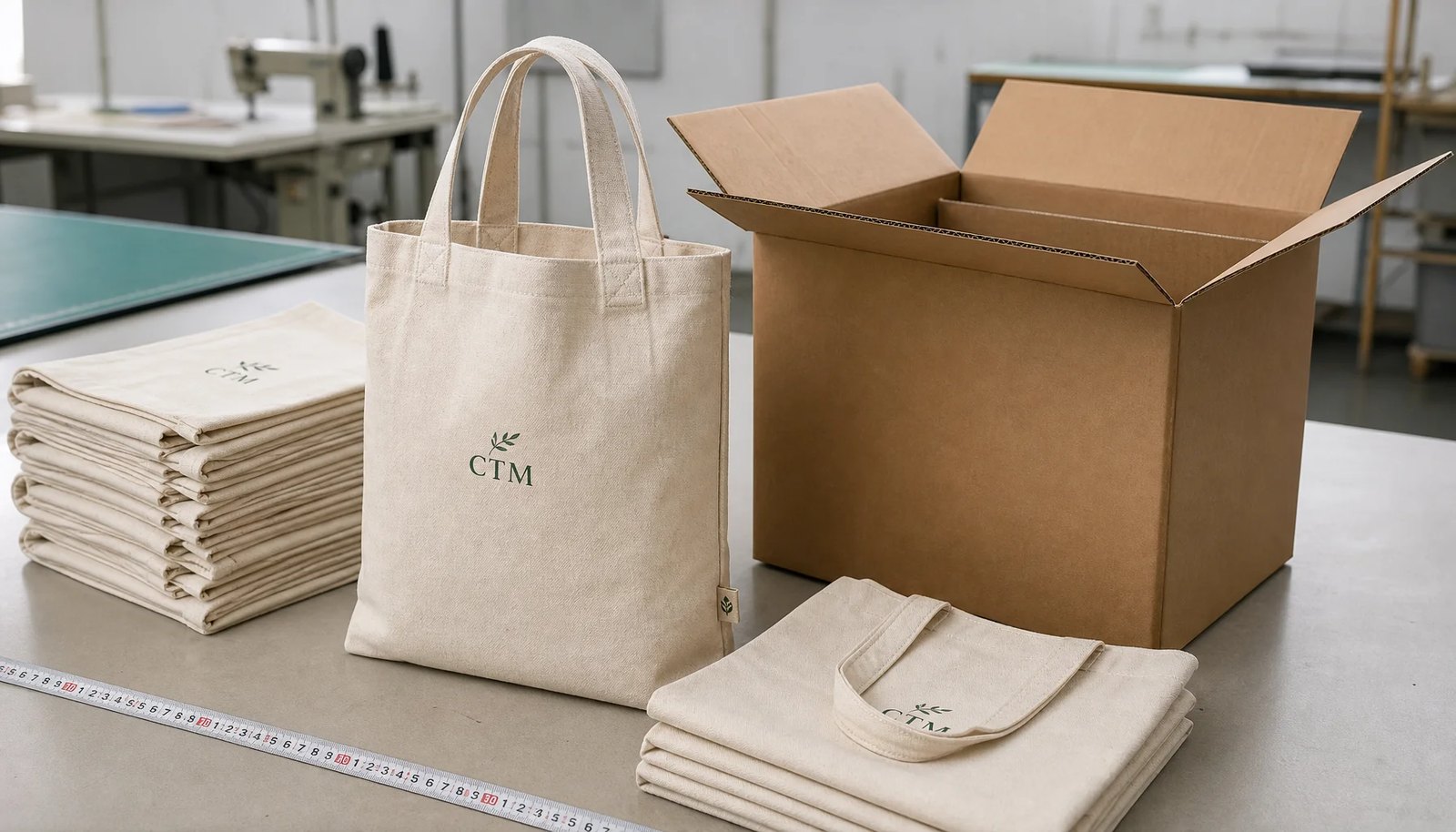
Why carton planning matters for bookstore tote orders
For university bookstores, the bag itself is only part of the purchase. A custom organic cotton tote has to arrive clean, countable, shelf-ready, and easy to split by campus, department, season, or event. Poor carton planning creates receiving problems that do not show up on a unit price comparison. A supplier may quote a lower FOB price, then pack too many pieces into weak cartons, omit inner bundle counts, or mix artwork versions in one carton. The buying team pays later through labor, delayed launch dates, dirty stock, and allocation errors.
The carton packing plan should be written before bulk production, not after the goods are finished. It affects folded size, pieces per carton, carton dimensions, gross weight, barcode placement, carton marks, inspection method, and freight calculation. For organic cotton totes, it also protects the retail value of the fabric. Natural and light-colored cotton shows dust, oil, moisture marks, and carton abrasion more easily than dark synthetic bags. A good RFQ gives the factory a clear packing target so the quote reflects the real receiving requirement.
- Use carton planning as a quote item, not a warehouse afterthought.
- Keep carton weight practical for bookstore and distributor receiving teams.
- Avoid mixing artwork versions unless the carton mark clearly identifies the split.
- Treat packing photos and carton dimensions as part of pre-shipment evidence.
Start with the retail use case, not only the logo
A campus tote sold through a bookstore has a different job from a giveaway tote at an event. It may carry textbooks, hoodies, drinkware, notebooks, and impulse gift items. The buyer should define whether the product is a low-price orientation item, a mid-range bookstore staple, or a premium organic cotton retail bag. That decision drives the fabric GSM, handle reinforcement, print quality, and carton packing density.
For most bookstore retail programs, a practical tote size is around 38 x 42 cm with an 8-10 cm gusset. This size folds efficiently, still carries books, and does not create excessive carton cube. If the tote is meant for apparel and gifts rather than textbooks, a shallower gusset may be acceptable. If the tote is intended as a premium reusable shopping bag, longer handles for shoulder carry and heavier fabric may justify a higher landed cost.
- Orientation giveaway: 6-8 oz cotton may be acceptable, but retail durability is limited.
- Standard bookstore retail: 10-12 oz organic cotton canvas gives better structure and perceived value.
- Premium campus merchandise: 12-14 oz fabric, gusset, reinforced handles, and better finishing may be justified.
- Textbook carrying: prioritize handle width, attachment strength, and gusset construction over decorative extras.
Fabric weight and organic cotton documentation
Organic cotton tote quotes should state both oz and GSM. Buyers often compare 8 oz, 10 oz, and 12 oz bags without realizing that suppliers may use different conversion assumptions or fabric finishing methods. A useful quote should include the finished fabric weight, not just the greige fabric target. As a working range, 10 oz is often suitable for mainstream bookstore totes, while 12 oz gives a firmer handfeel and better retail appearance. Below that, the bag may fold smaller and cost less, but it can look thin when printed and may not support a premium organic positioning.
Documentation must be clarified early. If the bookstore or university requires a specific organic cotton claim, the supplier needs to state what evidence can be provided and whether the product chain supports that claim. Some buyers only need material declaration from the factory; others need transaction certificates or a recognized textile standard. The RFQ should not simply say organic cotton and assume the paperwork is included. Documentation can affect mill choice, MOQ, lead time, and price.
- Quote fabric as 270-340 GSM for many 10-12 oz bookstore tote programs.
- Confirm whether the fabric is natural, bleached, dyed, or washed after sewing.
- Define acceptable shade variation for natural cotton before approving bulk fabric.
- List required organic documentation in the RFQ and PO, not only in email notes.
Print method choices for university artwork
Most university bookstore tote artwork is suitable for screen printing, especially when the design uses one to three solid colors. Water-based screen print is common on cotton because it gives a softer handfeel than heavy plastisol-style prints and fits the sustainability expectation of organic cotton products. For detailed illustrations, gradients, or small art batches, digital print can work, but it may change the surface feel and unit cost. Heat transfer can be useful for complex art, but buyers should test edge durability and handfeel before using it for a retail organic cotton tote.
The print quote should include color count, print size, ink type, setup charge, artwork position, and whether the print is one side or two sides. University marks often have strict brand color requirements, so Pantone targets should be included. On natural cotton, ink color can appear warmer or duller than on white fabric. A lab dip or print strike-off on actual bulk fabric is more reliable than approving color from a digital proof.
- Use screen print for solid university logos, bookstore marks, and simple event artwork.
- Use digital print only when artwork detail justifies higher cost and longer approval steps.
- Measure print placement from fixed bag edges, not by visual center only.
- Approve print on the actual fabric color and GSM used for bulk production.
MOQ logic for multiple campuses and artwork versions
A common bookstore sourcing mistake is asking for one total MOQ while the real order contains several artwork versions. A 3,000-piece order split across five campus logos, two fabric colors, and multiple barcode labels is not the same as one 3,000-piece production run. The factory has separate print screens, setup time, cutting plans, packing allocations, and carton marks. Buyers should request pricing by total order volume and by SKU-level quantity so the cost impact is visible.
MOQ is usually driven by fabric availability, dye lot minimums, print setup, labor efficiency, and packing complexity. Natural organic cotton may have more flexible MOQ than custom-dyed organic cotton, but documentation requirements can reduce supplier options. If the bookstore needs low quantities for many departments, it may be better to standardize the tote body and vary only the print. That keeps sewing production efficient while allowing merchandising flexibility.
- Separate MOQ per fabric color, per print artwork, and per retail label.
- Ask for price breaks at realistic levels such as 500, 1,000, 3,000, and 5,000 pieces.
- Avoid custom fabric dye for very small bookstore runs unless timing and budget allow it.
- Use shared blank tote bodies when many departments need different prints.
Build the carton packing plan before quoting freight
Carton packing is not just a warehouse instruction. It changes the landed cost. A heavier 12 oz tote with a gusset will use more carton space than a flat 8 oz tote. If the supplier quotes only unit price and gives carton dimensions later, the buyer cannot properly compare air freight, LCL, or container loading costs. The RFQ should require estimated carton dimensions, gross weight, net weight, pieces per carton, and total CBM at the quote stage.
For many organic cotton bookstore totes, 100-150 pieces per export carton is a practical starting point, but the final number depends on fabric weight, bag size, folding method, and whether individual polybags or hangtags are used. Overpacking can crease the bags, distort handles, split cartons, and make receiving difficult. Underpacking protects the product but increases freight cube. The best plan balances product condition, warehouse handling, and freight cost.
- Set a maximum gross weight per carton that receiving teams can handle safely.
- Use inner bundles of 25 or 50 pieces for faster counting and partial allocation.
- Require carton marks with PO number, SKU, artwork version, quantity, carton number, and gross/net weight.
- Do not approve final shipment until carton photos and packed dimensions match the packing list.
Unit packing and retail presentation choices
University bookstores differ in how they receive and display totes. Some want flat folded bags bundled for back-room storage. Others need individual barcodes, hangtags, belly bands, or recycled polybags for retail scanning and shelf presentation. Each choice affects labor and cost. Individual polybags protect light organic cotton from dust during transit, but they may conflict with sustainability goals. No-poly packing reduces plastic use, but it requires clean folding, carton liners, and careful moisture control.
The buyer should define the packing format by SKU. If totes are sold at checkout, flat folded bundles may be enough. If they are displayed as gift merchandise, a hangtag or barcode sticker may be needed. If they are distributed to multiple campus outlets, inner cartons or bundle labels may reduce sorting time. Packing should be tested during sample approval by folding the bag the same way it will be packed in bulk.
- Flat folded bundle: lowest packing cost and efficient for stockroom storage.
- Individual polybag: better dust protection, but adds material cost and sustainability concerns.
- Hangtag plus barcode: useful for retail display, but requires placement and scan verification.
- Inner bundle label: helpful when one shipment is split across campuses or departments.
Sample approval should include the carton method
Many buyers approve the tote sample and forget to approve the packed condition. For a bookstore order, the pre-production sample should show the final fabric, handle construction, print, label, hangtag, barcode if applicable, folding method, and carton packing plan. A single loose sample does not prove that 150 pieces can be packed cleanly without heavy creasing or handle distortion. The factory should provide at least photos of a packed carton trial when carton density is important.
The approval file should include measurements and acceptance criteria. For example, finished width and height tolerance may be plus or minus 1 cm, print position tolerance may be plus or minus 5 mm to 10 mm depending on artwork size, and handle length should be controlled because shoulder carry depends on it. Fabric weight should be verified from the same bulk fabric lot when possible. If the approved sample uses substitute fabric, the buyer should treat it as a construction sample only, not a final production standard.
- Keep one signed approved sample at the factory and one with the buyer.
- Photograph the fold, bundle, carton mark, and carton closure method.
- Approve barcode location and scan result before bulk packing.
- Do not release bulk production if artwork color is approved only from a screen image.
QC thresholds that prevent receiving disputes
A bookstore tote inspection should cover more than appearance. The product must be clean, correctly counted, structurally reliable, and packed according to the PO. Inspection should include fabric defects, stains, sewing defects, handle attachment, print clarity, print position, color consistency, label accuracy, barcode scan, carton count, and carton strength. If the buyer uses AQL inspection, the defect categories should be defined before inspection day so the inspector does not treat serious packing errors as minor remarks.
For organic cotton totes, stains and odor deserve special attention. Natural cotton can absorb moisture and warehouse smells. Cartons should be dry, clean, and not stored directly on a wet floor. Print rub tests are also useful because bookstore totes may be stacked, handled, and sold over several months. A simple dry rub and tape adhesion check can catch under-cured ink or poor surface bonding before shipment.
- Classify wrong artwork, wrong SKU, mold odor, and major stains as serious defects.
- Measure handle attachment strength through a practical pull check or agreed load test.
- Verify carton quantity against inner bundle count and packing list.
- Reject mixed-SKU cartons unless the packing plan clearly allows and identifies the mix.
Lead time risks around campus retail calendars
University bookstore demand is calendar-driven. Orientation, back-to-school, homecoming, parents weekend, and graduation create hard deadlines. Organic cotton fabric sourcing, documentation, sample revisions, and print approvals can all add days before production starts. A safe schedule separates artwork approval, sample making, fabric booking, production, inspection, packing, export documentation, and shipping. If the buyer compresses these steps, the factory may still ship on time but quality and packing discipline usually suffer.
A realistic planning model is to work backward from the required in-store date, not the ex-factory date. Importers and distributors should include inland transport, customs clearance, warehouse receiving, allocation, and store delivery. For air shipments, carton dimensions become even more important because volumetric weight may drive cost. For sea or LCL shipments, carton strength and moisture protection matter more because transit and warehouse handling take longer.
- Allow time for a print strike-off when university brand colors must be controlled.
- Do not book final freight using estimated CBM if carton packing has not been approved.
- Add buffer for organic cotton documentation and fabric availability checks.
- Reserve inspection time before the planned cargo handover date.
Specification comparison for buyers
| Spec decision | Recommended option | When it fits | Buyer risk to check |
|---|---|---|---|
| Fabric weight | 10 oz to 12 oz organic cotton canvas, roughly 270-340 GSM | Campus bookstores selling reusable bags for textbooks, apparel, and gift items | Low GSM may reduce carton weight but can look thin after washing and fail handle pull expectations |
| Bag size | Standard book tote around 38 x 42 cm with 8-10 cm gusset | General bookstore retail where buyers need shelf-friendly folded units and enough capacity for books | Oversized totes increase carton cube, freight cost, and shelf storage without always improving retail value |
| Handle construction | Self-fabric handles, 2.5-3.0 cm width, cross-stitch or box-stitch reinforcement | Orders expected to carry textbooks, water bottles, and campus merchandise | Narrow handles save fabric but cut into the hand and may tear at the attachment point |
| Print method | Water-based screen print for 1-3 solid colors; digital print only for complex artwork | University logos, bookstore marks, graduation themes, and department artwork | Unapproved ink standard can cause cracking, color migration, or poor wash fastness on natural cotton |
| Unit packing | Flat folded, 25 or 50 pieces per inner bundle, polybag only if required by buyer | Bookstores receiving mixed SKUs and needing fast counting at store level | Loose packing creates counting disputes, dirty fabric, and uneven carton compression |
| Export carton plan | 100-150 pieces per carton depending on GSM, gusset, and folded size | Balanced plan for LCL, air shipment, and store-room handling | Cartons above practical lift weight may be rejected by warehouse teams or crushed in transit |
| Carton marking | SKU, PO, color, artwork version, quantity, gross/net weight, carton number | Multi-campus or multi-department orders where receiving teams split inventory | Weak carton marks cause receiving delays, wrong allocation, and chargebacks from distributors |
| MOQ logic | Set MOQ by fabric dye lot and print setup, not only by total pieces | Orders with several campus colors or multiple imprint versions | A low total MOQ can still be inefficient if each artwork or colorway is too small |
| Pre-shipment inspection | AQL-based check plus carton drop, count verification, print rub, seam pull, and barcode scan | Importers and distributors that need clean receiving and reliable retail presentation | Passing appearance alone does not prove carton quantity, handle strength, or warehouse readiness |
Buyer checklist before sampling
- Define tote size, gusset depth, handle length, fabric GSM, and organic cotton documentation before asking for price.
- Separate quote lines by fabric color, print color count, artwork version, packing method, and carton quantity.
- Approve a physical pre-production sample with final fabric weight, handle reinforcement, print color, folded size, and label placement.
- Set carton maximum gross weight, carton dimensions, pieces per carton, inner bundle count, and carton marking format in the PO.
- Require photos of packed cartons, carton marks, inner bundles, and one opened carton before shipment booking.
- Confirm whether hangtags, barcodes, retail labels, recycled polybags, or no-poly packing are required for receiving.
- Build the schedule backward from campus events, orientation, homecoming, graduation, and distributor warehouse cutoffs.
- Request fabric consumption, print setup charges, packing cost, carton CBM, gross weight, and Incoterm separately in the quote.
- Use consistent inspection thresholds for print position, color tolerance, seam strength, fabric defects, stains, and short packing.
- Keep one approved sample at the factory and one with the buyer so production can be judged against the same reference.
Factory quote questions to send
- What organic cotton standard or transaction documentation can be supplied, and is it included in the quoted price?
- What is the actual fabric weight in GSM and oz, and is the quoted fabric greige, bleached, dyed, or natural cotton?
- How many pieces fit per export carton for the proposed tote size, and what are the estimated carton dimensions and gross weight?
- Is the price based on flat packing, individual polybagging, inner bundles, barcode labels, hangtags, or retail-ready packing?
- What is the MOQ per fabric color and per print artwork, and what price changes if the order is split by campus or department?
- Which print method is quoted, what ink type is used, and what wash/rub fastness or adhesion checks are available?
- How many pre-production samples are included, how long do they take, and what sample revisions are charged separately?
- What is the production lead time after sample approval and deposit, and how many days are needed for final inspection and carton booking?
- Can the factory provide carton photos, packing list by carton number, and gross/net weight before shipment?
- What tolerance does the factory apply for size, fabric weight, print position, and order quantity overrun or underrun?
Quality-control points to confirm
- Fabric weight should be verified by cutting and weighing a known area, not only by trusting the mill label.
- Finished tote size should stay within agreed tolerance, commonly plus or minus 1 cm for width and height on standard bags.
- Handle attachment should use reinforced stitching with no skipped stitches, broken threads, or weak backtacking.
- Print position should be measured from bag edges and handle base, with a written tolerance before bulk production.
- Ink should pass dry rub and basic adhesion checks suitable for the selected print method and fabric surface.
- Natural cotton shade variation should be reviewed under consistent lighting because unbleached fabric can vary by lot.
- Carton count should match the packing list, with inner bundle quantities easy to verify during receiving.
- Carton strength should match export handling, with no overfilled bulging cartons or crushed corners before loading.
- Retail labels and barcodes should scan correctly and match SKU, color, artwork, and campus allocation.
- Any stain, oil mark, mold odor, damp carton, or heavy fabric contamination should be treated as a shipment risk, not a minor cosmetic issue.