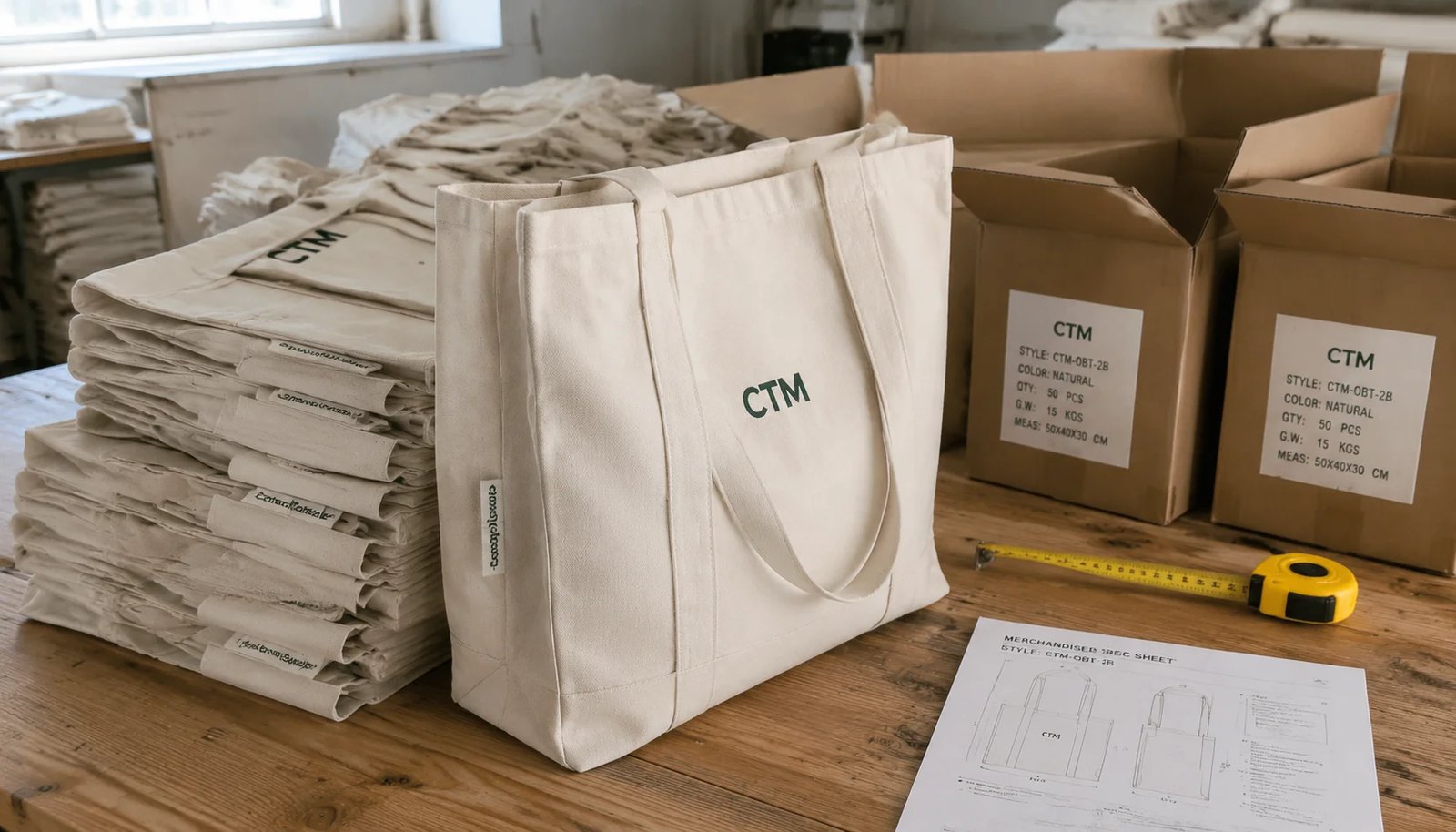
Why carton packing deserves the same attention as fabric and print
Buyers often treat packing as something to settle at the end of development. For liquor retail tote programs, that is usually a mistake. The packing plan changes freight cube, warehouse handling, first-open presentation, and sometimes even the practical life of the bag once it reaches store level.
A custom organic cotton tote used around glass bottles is not a lightweight giveaway. It normally carries more fabric weight, more reinforcement, and more structure than a simple event tote. All of that helps performance in use, but it also changes how the bag folds, how much air it traps, and how many pieces fit safely into a carton.
This is why a low unit price can be misleading. If one supplier quotes a stronger tote at 120 pieces per carton and another quotes a lighter or more compressed version at 180, the FOB numbers are not being compared on equal terms. One offer may save on piece price while quietly increasing the risk of over-compression, weak cartons, logo transfer, or difficult receiving.
For procurement teams, the goal is not maximum carton count by default. The goal is a balanced carton packing plan that protects retail usability, acceptable presentation, and supply-chain efficiency at the same time. In practice, that means locking the end use first, then reviewing fabric, construction, fold method, bundle count, and carton limits as one joined specification rather than separate topics.
- Carton count affects CBM, pallet planning, and receiving labor
- Heavier bottle-use totes create more folded bulk than standard promo totes
- Compression level influences logo appearance and gusset recovery
- Quotes are only comparable when packing assumptions are also comparable
Start with the bottle-load reality, not a generic tote description
The strongest sourcing brief begins with the actual load case. A bag meant for one 750 ml bottle at checkout is not the same as a bag expected to hold two bottles, a boxed spirit set, or mixed merchandise with one heavy bottle added at the counter. If that load case is vague, the supplier will usually quote to the lightest acceptable assumption.
That is where many avoidable problems start. A retailer may approve a quote based on a photo and a rough size description, then stores begin using the tote for heavier combinations than the factory had in mind. The result can be stretched gussets, stressed seams, uneven opening, or customer complaints about handle reliability.
A better RFQ gives the supplier dimensions and loaded weight. Include bottle type, bottle diameter, bottle height, and whether the bottle has a gift box or collar that changes the fit. The shape matters. A tall narrow wine bottle behaves differently from a wider spirits bottle even when the total weight looks similar on paper.
Also state the selling context. Is the tote a premium paid bag, a seasonal gift-pack item, or a standard reusable checkout bag? If the answer is premium gifting, first-open appearance matters more. If the answer is routine checkout use, buyers may prefer a flatter fold and higher packing efficiency as long as the logo remains clean. This one clarification often helps factories propose a more realistic packing plan from the start.
- State bottle type, size, diameter, height, and loaded weight in the RFQ
- Clarify one-bottle, two-bottle, or gift-boxed use
- Note whether the tote needs premium first-open appearance or standard retail utility
- Use dimensions and weight, not reference photos alone
Fabric specification: clear enough for quoting, practical enough for QC
In B2B buying, fabric language needs to be measurable. Terms such as premium cotton, durable canvas, or heavy organic fabric are too loose to control pricing or inspection. A stronger specification lists fabric type, weave, approximate weight in oz and GSM, color, and tolerance.
For example, a buyer may request plain weave organic cotton, natural color, 10 oz or about 340 GSM, with GSM tolerance of plus or minus 5%. That gives the factory a usable starting point and gives the buyer a basis for checking whether delivered bulk matches the commercial promise.
For many liquor retail projects, 8 oz to 10 oz, roughly 270 to 340 GSM, is workable for single-bottle carry, events, and lighter checkout programs. For a heavier-duty or more premium-feeling tote, especially where two 750 ml bottles may be carried, 10 oz to 12 oz, roughly 340 to 407 GSM, is a more common planning range. Still, GSM alone does not decide success. Handle reinforcement, seam allowance, and gusset layout all affect the real carrying result.
Buyers should also pay attention to color status. Natural organic cotton and dyed cotton may not fold the same way. Dyed fabric can feel stiffer, and that can change packed thickness, crease memory, and carton count. If multiple colors will be reordered under one program, it is worth asking whether all shades use the same base fabric and whether packed bulk varies by color.
- Specify fabric in both oz and GSM
- Add a GSM tolerance to the RFQ and PO
- Do not assume dyed fabric will fold like natural fabric
- Heavier GSM usually improves structure but reduces packing density
Construction details that quietly change carton efficiency
Two tote bags with the same finished size can pack very differently. The difference usually comes from construction. In liquor retail programs, the biggest variables are gusset style, bottom shape, handle material, and reinforcement at the load points.
A side-gusset design is often the safest middle ground. It gives bottle clearance while still collapsing relatively flat, which helps bundle consistency and carton stacking. A full boxed bottom may present better on shelf and support the base more clearly, but it typically traps more air and requires a more disciplined fold sequence. That can lower pieces per carton or create unstable stacks if the folding method is inconsistent.
Handle build matters as well. Self-fabric handles often pack flatter than thicker webbing and are a common choice for many branded bottle totes. For heavier programs, buyers may require reinforcement such as box-X stitching, bartacks, or extended attachment runs. These improve confidence during use, but they also build extra thickness near the top of the bag. If the factory does not control the fold direction at that thickened area, bundles can become uneven and cartons can bulge.
The practical fix is simple: ask for more than finished bag dimensions. Request handle width, handle drop, attachment length, reinforcement method, and proposed folded size. Once those details are visible, differences in quoted carton count make much more sense and are easier to compare across suppliers.
- Side gussets usually balance bottle fit and packing density best
- Wide boxed bottoms can reduce carton efficiency
- Reinforced handle zones add strength and stack thickness
- Ask for folded-size estimates, not only finished bag size
Print method and curing: the right review standard is post-fold condition
For many medium and large retail orders, water-based screen print remains the most practical option. It is widely understood by factories, commercially efficient, and usually easier to control in repeat production than many decorative alternatives. It also tends to suit tote-bag programs where the buyer wants simple branding and a softer feel.
The main issue for procurement is not whether the print looks good immediately after decoration. The real question is what it looks like after folding, bundling, carton compression, sea transit, and storage. That is where packing-related defects appear: set-off, blocking, cracking, scuffing, or whitening on heavy fold lines.
Large solid logos, dark dense coverage, metallic effects, puff effects, and other thick applications may still be workable, but they should be treated as higher packing-risk designs. If a program can use a one- or two-color logo with moderate coverage, the buyer often gets a more stable result in both production and storage.
Buyers should therefore ask practical questions during quote review. How long do printed bags rest before bundling? Are goods allowed to cool fully before folding? Does the factory do a post-fold rub check? If digital print or DTF is used for a low-volume test order, does the folded sample still look acceptable after at least 24 hours bundled? For a custom organic cotton totes carton packing plan for liquor retailers, the approval standard should be based on packed condition, not on print-table appearance alone.
- Water-based screen print is usually the safest bulk route
- Heavy-coverage decorative prints raise compression risk
- Curing interval should be reviewed before PO placement
- Approve print based on post-pack performance, not fresh appearance only
Set bundle count and carton count from operations, not guesswork
Packing decisions should start at the destination. First ask what your DC, 3PL, or stores can handle safely in manual receiving. Then decide whether store replenishment happens by full carton or by inner bundle. Those two operational facts should shape the carton plan before suppliers begin pushing for the highest possible count per box.
For heavier gusseted liquor totes, 100 to 150 pieces per carton is often a practical range, depending on size, fabric weight, handle bulk, and fold method. That range is not a rule, but it is a useful benchmark. If a quote comes back much higher, buyers should ask what level of compression is needed and whether the carton board remains stable at that fill level.
Inner bundles of 25 pieces are common because they are easy to count and distribute. They also make random inspection simpler. But the best bundle count is the one that matches actual store issue needs. If outlets typically receive 50 pieces at a time, then two 25-piece bundles may be ideal. If they receive smaller replenishment quantities, another arrangement may be easier operationally.
A useful quote should include the full packing picture: folded bag size, pieces per bundle, pieces per carton, carton dimensions, net weight, gross weight, and CBM per 1000 pieces. Without all of those figures, buyers are not seeing the real landed-cost comparison.
- Set gross weight limits before approving carton count
- Review carton dimensions and CBM per 1000 pcs, not pieces per carton alone
- Use bundle counts that match replenishment flow
- High carton counts are not savings if they create compression or handling problems
A practical quote-comparison table for procurement teams
When several suppliers quote the same project, piece price tends to dominate the first review. That is understandable, but for liquor retail totes it can hide major differences in what is actually being offered. A cleaner method is to compare commercial, technical, and logistics factors side by side.
The table below shows the kind of details buyers should normalize before selecting a factory. It is especially useful when one supplier appears cheaper but is assuming a lighter fabric, fewer reinforcements, or a more aggressive packing density than the rest.
- Use the same bottle-load assumption across all quotes
- Normalize fabric, construction, and packing inputs before reviewing price
- Ask suppliers to explain unusually high carton counts
- Treat missing logistics details as a quote gap, not a minor omission
MOQ strategy works better when the base build is standardized
MOQ pressure often comes from product variation more than from branding itself. If a liquor retailer requests several body sizes, different gusset depths, multiple handle constructions, and varied print positions across sub-brands, the factory has to split production into smaller, less efficient runs. That usually increases MOQ, raises cost, or both.
A more procurement-friendly approach is to standardize the base bag where possible. One body size, one fabric weight, one handle build, and one print position can support several artwork versions with far less disruption to cutting, sewing, and packing. The supplier can then keep one production flow and often one carton format across multiple SKUs.
This has a second benefit: it improves repeatability. If the same base construction is used again, approved fold patterns, bundle counts, and carton dimensions can often be reused. That shortens quote revisions and reduces the risk that a reorder quietly ships with a different packing outcome.
For buyers comparing factories, standardized specs also make price differences more meaningful. Instead of comparing several slightly different manufacturing routes, the team is reviewing how well each supplier can deliver the same commercial brief.
- Standardize fabric, size, handle spec, and print position first
- Vary artwork before varying construction where possible
- Shared carton format can simplify DC handling
- Repeat orders move faster when the base build stays stable
Sample approval should include a true bulk-style packed sample
One loose pre-production sample is not enough for this kind of program. A bag can look correct on a table and still arrive in stores with hard fold lines, logo transfer, flattened gussets, or tangled handles if the bulk packing method is not controlled.
A stronger approval process has two stages. First, approve the standard pre-production sample for size, sewing, and artwork. Second, approve a packing sample made exactly the way bulk will be packed. That means the same fold direction, same handle placement, same bundle count, same banding or approved poly method, and ideally the same style of export carton.
The packed sample should remain folded for a realistic period before review. Buyers can then open it, inspect the logo condition, check gusset recovery, and confirm whether the bag still feels acceptable for the intended retail presentation. If the tote is meant to carry heavier bottles, it is also wise to do a simple load check using the actual bottle or an equivalent weight.
This process does not need to be elaborate. What matters is that the approved standard reflects real packed conditions. Photograph the fold pattern, note the bundle count, and keep those details in the production file so the factory and any inspector are working from the same reference.
- Approve both a PP sample and a packed bulk-style sample
- Keep the sample folded before review to simulate storage
- Open and inspect for print transfer, crease severity, and gusset recovery
- Document the approved fold method with photos and notes
QC should focus on load points, packed condition, and carton accuracy
For liquor retail totes, final quality control needs to go beyond a quick visual check. The main risk areas are fabric weight, bag measurements, handle attachment, seam integrity at bottom and gusset joins, print placement, and the condition of the bag after packing.
Measurement control matters more than some buyers expect. A small increase in gusset depth or handle bulk can reduce the number of bags that fit comfortably into a carton. A small reduction in seam allowance can affect load performance. This is why tolerances should be written into the purchase order and not left as informal expectations.
Packed-condition checks are essential. Inspectors should open random bundles and evaluate first-open appearance, logo condition, gusset recovery, handle tangling, and counting accuracy. If the tote is sold for two-bottle use, random load checks should reflect that exact assumption, not a lighter substitute.
Do not overlook the carton itself. Board strength, carton fill level, shipping marks, and gross weight are part of product quality in B2B terms. Wrong counts, under-strength cartons, or missing markings create downstream cost even when the bags themselves are acceptable.
- Write GSM and size tolerances into the PO
- Inspect random bundles after packing, not just loose bags before packing
- Match load checks to the real bottle-use requirement
- Treat count errors and wrong carton specs as QC failures
Specification comparison for buyers
| Spec decision | Recommended option | When it fits | Buyer risk to check |
|---|---|---|---|
| Fabric weight for one 750 ml bottle or promo checkout use | 8 oz to 10 oz organic cotton, typically about 270 to 340 GSM | Suitable for single-bottle checkout, winery events, branded reuse programs, and lighter-duty retail use | May be underbuilt for two heavy glass bottles; verify seam strength, handle reinforcement, and sample load test with actual bottle weight |
| Fabric weight for two 750 ml bottles or heavier premium feel | 10 oz to 12 oz organic cotton, typically about 340 to 407 GSM | Common range for stronger liquor retail carry bags where reliability matters more than maximum carton density | Higher GSM increases folded thickness, carton cube, and gross weight; require folded-size estimate and carton count confirmation |
| Body construction for better packing density | Side gusset with controlled fold line, or narrow bottom gusset only if approved in sample | Best for bottle clearance while still allowing flatter bundles and more stable cartons | Wide boxed bottoms can trap air, reduce pieces per carton, and create unstable stacks if fold method is not standardized |
| Handle construction for bottle load | Self-fabric handles with reinforcement stitching or box-X at stress points | Useful for most branded bottle totes where flat packing and acceptable strength are both required | If handle attachment area becomes too bulky, upper body stacks unevenly; ask for handle stitch pattern and bartack count if used |
| Print method for bulk retail runs | Water-based screen print, usually 1 to 2 colors | Best for repeatability, cost control, and lower risk of cracking compared with many decorative methods | Require curing confirmation and post-fold rub check to reduce offset transfer inside compressed bundles |
| Low-volume launch route | Digital print or DTF for test orders only | Can work for pilot stores, seasonal tests, or artwork validation before a larger repeat run | Fold durability, hand feel, and repeat color consistency may differ from bulk screen print programs |
| Inner packing method | 25 pcs per bundle, paper banded or polybagged only if buyer policy allows | Easy to count, receive, and allocate across stores or distributor orders | Bundles that are too large can deepen creases, hide print transfer, and slow manual recounting |
| Master carton count | Usually 100 to 150 pcs per carton for heavier gusseted liquor totes, depending on size and GSM | Practical range for export handling, carton strength, and pallet stacking for many B2B buyers | Counts above this may push compression too far or create overweight cartons; require dimensions and gross weight on quote |
| Carton board spec | 5-ply export carton with clear shipping marks and gross weight under buyer limit | Suitable for sea freight, warehouse restacking, and multi-touch distribution | If board grade and weight limit are not fixed in PO, supplier may reduce board strength or alter pack count |
Buyer checklist before sampling
- Define the exact retail use case: one bottle, two bottles, boxed gift set, or general merchandise with occasional bottle use
- List the bottle type in the RFQ: 750 ml wine, 700 ml spirits, 1 L bottle, or boxed set, with bottle diameter, height, and loaded weight
- State fabric target in both oz and GSM, for example 10 oz / about 340 GSM, and specify acceptable GSM tolerance such as plus or minus 5%
- Specify whether the quote is for natural color fabric or dyed fabric, since dyeing can change hand feel, shrinkage behavior, and packed bulk
- Fix finished bag measurements in millimeters or inches for width, height, gusset depth, and handle drop, and state measurement tolerance
- Clarify handle construction: self-fabric or webbing, handle width, attachment length, and reinforcement method at stress points
- Confirm seam requirement such as lockstitch or chain stitch, SPI target if needed, and whether bartack or box-X reinforcement is required
- State print method, print size, position, color count, Pantone references if relevant, and that the approved standard is based on post-fold appearance, not only fresh print appearance
- Ask each supplier to quote folded bag size, pieces per bundle, pieces per carton, carton dimensions, net weight, gross weight, and CBM per 1000 pcs
- Set a maximum carton gross weight that matches your DC, store, or 3PL handling rules before approving carton count
Factory quote questions to send
- What exact fabric are you quoting: plain weave organic cotton, carded or combed yarn, natural or dyed, and what GSM tolerance will you commit to in bulk?
- Do you quote fabric weight before or after washing/finishing, and what test method or internal standard do you use to verify GSM?
- What finished size tolerance do you apply to width, height, gusset, and handle drop after cutting and sewing?
- What seam construction is included: stitch type, stitches per inch or per 3 cm, seam allowance, and reinforcement at handle joints and gusset stress points?
- What is the bag weight per piece in grams for the quoted spec, excluding and including any inner packing?
- What folded size do you plan for bulk packing, and what is the fold direction for gusset, handles, and logo face?
- How many pieces per inner bundle and per master carton are included in the quote, and what carton dimensions, net weight, gross weight, and CBM per 1000 pcs do you estimate?
- What print process is included, and does your price include screen cost, strike-off, color matching, and any extra curing or drying time before folding?
- How long do you hold printed bags before bundling, and what checks do you use to reduce ink set-off or blocking in compressed cartons?
- Can you supply a pre-production sample packed exactly like bulk, including actual fold method, bundle count, carton spec, and shipping marks?
Quality-control points to confirm
- Fabric GSM must be within agreed tolerance, commonly plus or minus 5% unless a tighter PO requirement is stated
- Fabric shade and hand feel must match approved standard, especially when reordering dyed fabric where stiffness can affect folding and carton density
- Finished measurements for width, height, gusset, and handle drop must stay within agreed tolerance, commonly plus or minus 0.5 inch or plus or minus 1.0 cm unless otherwise specified
- Bag body must be square and balanced, with gussets opening evenly and no obvious twisting caused by uneven cutting or skewed sewing
- Handle attachment length, reinforcement pattern, and stitch quality must match approved sample with no skipped stitches, loose ends, seam puckering, or open seams
- Bottom and side seams must support intended bottle load with no seam grin, popping stitches, or visible stress at gusset junctions during random load check
- Print color, size, placement, and registration must match approved artwork and pre-production sample within agreed visual tolerance
- Printed bags must be checked after folding and bundling for set-off, blocking, cracking, scuffing, or gloss change caused by compression
- Random packed samples must be opened during final inspection to assess first-open appearance, gusset recovery, handle tangling, and post-pack logo condition
- Inner bundle quantity must be exact and consistent, with bundle labeling or paper banding method matching approved packing sheet