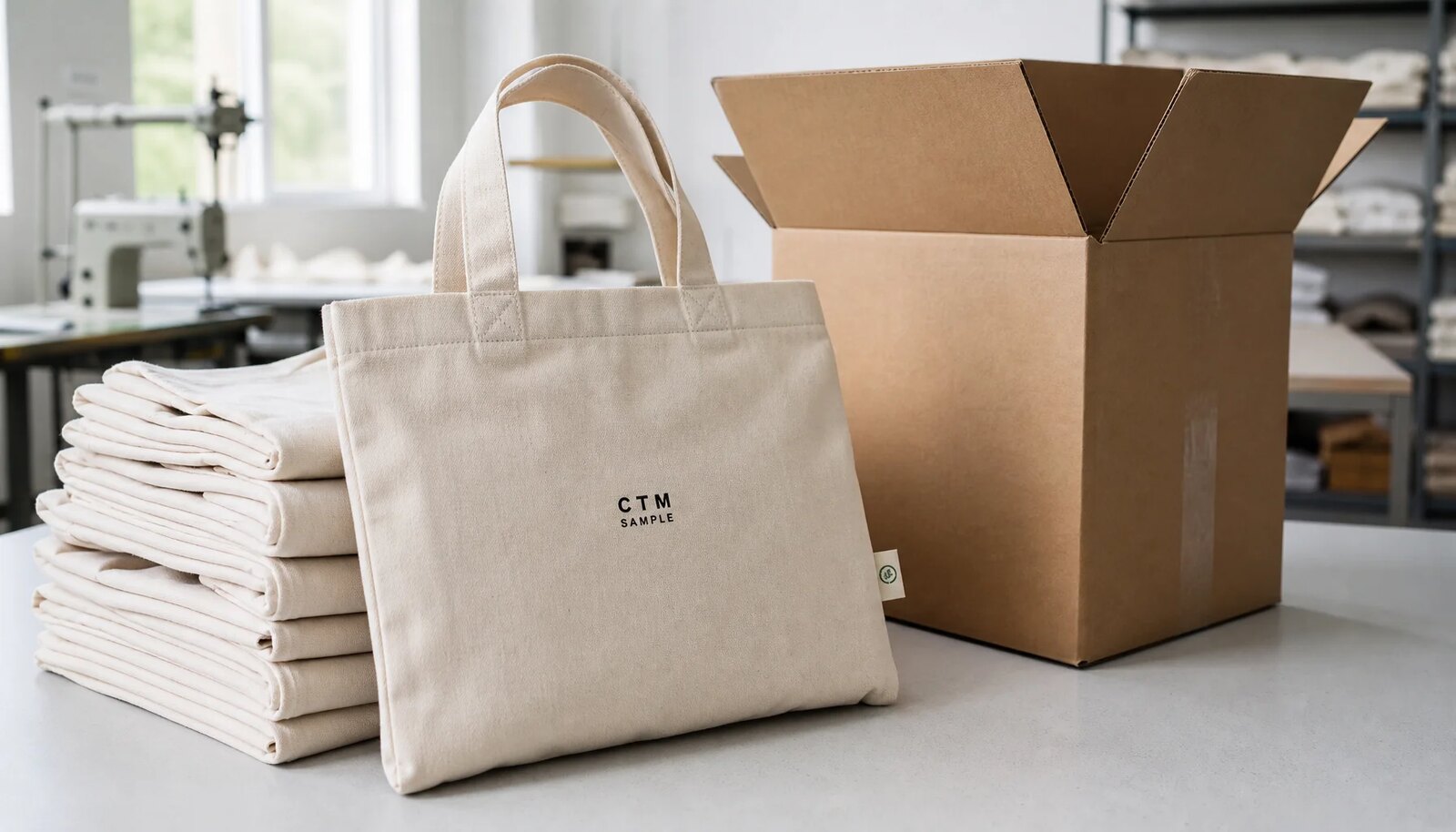
Treat the carton plan as part of the tote specification
For custom organic cotton totes, the carton packing plan should not appear for the first time after sewing is finished. It belongs in the product specification from the RFQ stage. The plan decides how many bags go into each master carton, where the handles sit, whether printed faces touch each other, how the carton is labeled, what the gross weight will be, and how smoothly the shipment will be received at the destination warehouse.
That is especially important for eco apparel brands. A tote may be used as a retail shopping bag, garment packaging alternative, e-commerce insert, event giveaway, loyalty gift, or reusable customer bag. If it arrives with crushed handles, ink transfer, stains, odor, or deep fold marks, the loose sample approval will not save the program. The problem shows up at receiving, store allocation, or final customer presentation.
Procurement teams should evaluate the tote at three levels: the loose unit, the packed carton, and the landed sellable unit. A quote that says only organic cotton tote with logo is incomplete. A useful B2B quote names the target GSM, finished dimensions, logo method, pieces per carton, external carton size, net weight, gross weight, inner packing, carton marks, inspection point, packing responsibility, and lead time by stage. Without those details, the lowest unit price may simply mean the supplier has left out safer packing labor, stronger cartons, or quality-control steps.
- Do not compare quotes unless finished size, GSM, decoration method, and carton count are aligned.
- Require carton dimensions and gross weight in the quote so freight cube can be checked before order placement.
- Approve a packed carton sample or carton mock-up for new programs, not only a loose tote sample.
- Compare cost per sellable packed tote, not only the loose sewn-bag price.
Lock the finished tote details before discussing pack-out
A strong carton plan starts with a controlled tote spec. The factory needs finished body width, body height, gusset depth, handle width, handle length, handle drop, seam construction, and reinforcement method. A flat 38 x 42 cm tote behaves very differently from a 38 x 42 x 10 cm gusseted tote with shoulder handles. Both may be called standard cotton totes, yet their folded thickness, handle bulk, carton weight, and print-protection needs are not the same.
Use a point-of-measure sheet instead of relying on a paragraph description. Body width might be measured across the top edge from side seam to side seam. Handle drop might be measured from the top edge of the bag to the inside top of the handle when laid flat. Cotton bags are soft goods, so hard-goods precision is unrealistic, but the tolerance still needs a number. Many buyers use +/-5 mm for smaller points such as handle width and +/-10 mm for larger body dimensions as a starting point, then adjust after sample review and factory feedback.
Fabric weight changes both the feel of the tote and the carton density. A 140 GSM organic cotton tote can work for light promotional use. A 160 GSM tote is often a safer baseline for apparel-related programs where the bag needs a better hand-feel. For reusable retail bags, heavier garments, or a more structured presentation, 180 GSM, 220 GSM, or heavier canvas may be appropriate. Higher GSM also means more folded volume, more carton weight, and different freight economics.
Color and finishing influence the pack, too. Natural unbleached cotton may show seed flecks and shade variation, which can be acceptable if approved in advance. Bleached cotton looks cleaner but needs shade control. Dyed organic cotton requires lab dip approval, dye-lot planning, and colorfastness consideration. Washed or pre-shrunk fabric may reduce shrinkage risk, but it can add cost, lead time, and thickness. Set these points before the supplier recommends 50, 80, or 100 pieces per carton.
- Specify body size, gusset, handle drop, handle width, handle length, seam type, and reinforcement construction.
- State one target GSM and an acceptable tolerance instead of allowing vague fabric ranges.
- Confirm whether the cotton is natural, bleached, dyed, washed, pre-shrunk, or untreated.
- Ask the factory to confirm final folded size and handle position before cartons are ordered.
Clarify organic cotton claims and paperwork early
The phrase organic cotton tote can mean different things in commercial conversations. Some apparel brands need certified organic cotton with transaction documentation. Others need a supplier declaration for internal tracking. Some programs may accept organic cotton blended with recycled cotton or conventional cotton; others cannot. Even though a carton packing plan sounds logistical, the material claim still affects supplier qualification, labeling, import records, and customer-facing language.
Ask what documentation the supplier can provide and at which level. Depending on the program, useful records may include a supplier scope certificate, transaction certificate where applicable, fabric mill declaration, composition statement, dyeing or finishing information, and third-party test reports if chemical or colorfastness testing is required. Do not assume every tote factory can provide the same paperwork, especially when fabric is bought from stock or routed through an intermediary.
If the tote carries an on-product organic claim, align the wording with your compliance team before sampling. The woven label, hangtag, carton mark, invoice, and product page should not say more than the documents support. If organic cotton is being used for internal sustainability goals only, the paperwork package may be simpler, but it should still be listed in the PO file. Otherwise, teams end up chasing documents after production, when the trail is harder to reconstruct.
Documentation can also change the timeline. Certified fabric may not be available in every GSM, width, or dyed shade on short notice. If fabric is booked after deposit, material sourcing becomes part of the critical path. Ask whether the quoted fabric is in stock, reserved, cut from greige goods, or made to order, and whether the shipment paperwork is included in the stated lead time.
- Define what organic cotton must mean for the program before final pricing.
- Ask for specific document types, not a broad promise of certification.
- Match label, hangtag, invoice, and carton wording to the documentation actually available.
- Confirm whether fabric is in stock or requires booking, dyeing, or special finishing.
Choose the packing format by sales channel, not habit
There is no single best packing format for custom organic cotton totes. Bulk folded packing with no individual polybag often fits eco apparel brands that want to reduce inbound plastic and ship totes into a warehouse, store network, or event inventory. The factory folds each tote to the approved map, stacks the goods in a consistent direction, and packs a fixed count into a master carton. It is efficient, but it depends on clean handling, dry cartons, and a receiving team that accepts non-unit-packed goods.
Inner bundles can be a practical compromise. Paper bands or kraft wraps around bundles of 10, 20, 25, or 50 pieces help warehouse teams count faster and reduce picking errors when cartons are opened. Bundles also stop stacks from collapsing in partially used cartons. The tradeoff is extra material, labor, and sometimes a larger carton. For multi-SKU replenishment, that small added cost may be easier to justify than repeated counting mistakes.
Individual unit protection should be used when the channel needs it, not because it feels safer by default. A tote sold as a retail accessory, inserted into e-commerce parcels, or handled through dusty routes may need tissue, a paper sleeve, glassine, recycled polybag, kraft wrap, or another unit pack. If a polybag is chosen, specify thickness, recycled content if claimed, warning text if required, barcode needs, and sealing method. Sustainability wording must be accurate. Do not call a material recyclable, compostable, or plastic-free unless the buyer has support for that claim in the relevant market.
The fold map is the control document. It should show whether the tote is folded in halves or thirds, where the handles are positioned, whether the gusset is tucked inward, and whether the printed panel faces in or out. Dense prints should not be packed print-to-print unless a blocking test confirms there is no transfer. The carton must close without force. If someone has to lean on the flaps to tape the carton, the count, fold, or carton size needs to change.
- Use bulk folded cartons when the channel accepts non-unit-packed goods and plastic reduction is a priority.
- Use paper-banded bundles when counting speed and partial-carton handling matter.
- Use unit protection for retail presentation, cleanliness, barcode control, or multi-touch distribution.
- Document the fold map with photos and reject bulging cartons or forced closure.
Set carton count, dimensions, weight, and board strength together
Carton density is a sourcing variable. The number of totes per carton changes packing labor, carton cost, freight cube, gross weight, compression risk, and receiving time. A supplier quoting 100 pieces per carton is not quoting the same delivered condition as a supplier quoting 50 pieces per carton. The denser carton may reduce carton count, but it can increase print scuffing, handle deformation, carton bulge, and difficult handling. A lower-density carton may protect the tote better while increasing cube and material cost.
Start with the actual folded dimensions and unit weight. Then test the proposed count in a packed sample. Values vary by tote size and GSM, but many apparel warehouses prefer cartons one person can handle safely. Buyers often set maximum gross weights in the 12-18 kg range, or lower if their receiving network requires it. Do not accept a factory standard carton without checking it against your own warehouse rules.
Carton dimensions should be external dimensions in centimeters or inches. Freight forwarders need external length, width, height, gross weight, and carton quantity to estimate chargeable weight and container or pallet utilization. Air freight is sensitive to volumetric weight, so a loose oversized carton can be expensive even when the goods are light. Ocean freight depends on cube efficiency and pallet stability. Courier and parcel networks may add surcharges at specific dimensional thresholds.
Board strength belongs in the same conversation. Ask for carton ply, flute type if available, and whether the carton is suitable for export handling. Heavy tote programs or tall stacks may need a stronger double-wall carton. Lighter bulk bags may work in good-quality single-wall cartons if the gross weight is controlled and pallets are handled properly. Also specify sealing method, tape quality, straps if used, pallet requirement, and storage expectations. Cotton goods should be kept away from wet floors and strong odors before loading.
- Approve pieces per carton only after checking folded size, unit weight, print protection, and carton closure.
- Set a maximum carton gross weight; 12-18 kg is a common planning range, but the warehouse rule should lead.
- Require external carton dimensions for freight costing and pallet planning.
- Specify carton board quality, sealing method, label placement, and moisture-control expectations.
Control logo decoration before folding and compression
Decoration is not only a branding choice. It affects how the tote survives folding, stacking, and export packing. Screen printing is practical for many one- to three-color logos and repeat programs because it is stable at volume and easy to standardize. Water-based inks may suit an eco-positioned product, but they still need proper curing. Under-cured ink can feel tacky, block inside a stack, transfer onto another tote, or create odor in a sealed carton.
Print placement should be measured from fixed reference points, not judged by eye. For a centered front logo, state the logo size, the distance from the top edge, the center line, and the placement tolerance. For simple artwork, +/-2-3 mm placement or registration tolerance may be realistic where the design allows. On larger flexible cotton panels, a wider tolerance may be needed. The buyer should approve the number before bulk production. If artwork crosses a fold line, expect visible creasing unless the design or fold map is adjusted.
Heat transfer, DTF, and digital print can be useful for complex artwork or lower quantities, but they need adhesion and fold testing. Transfers may crack, lift at the edge, or show pressure marks after compression. Embroidery can feel premium, yet it can pucker lighter fabrics and create a thicker area in the stack. Woven labels, side tabs, or subtle printed labels may be better when the brand does not need a large front graphic. Whatever the method, review the decorated tote after it is folded and packed at the proposed carton density.
Special inks need extra caution. Metallic, puff, high-density, reflective, and large solid ink areas may need lower carton counts, tissue interleaving, longer cure time, or a fold pattern that avoids direct pressure. If the brand wants minimal or plastic-free packing, run the blocking test before committing. A low-material packing plan that causes ink transfer is not sustainable in practice; it creates rejects, rework, and late shipments.
- Approve a print strike-off and a decorated packed sample before releasing bulk decoration.
- State print size, location, Pantone or color reference, placement tolerance, and registration tolerance.
- Check cure, rub resistance, odor, blocking, cracking, edge lift, and pressure marks before packing.
- Adjust the fold map or carton count if the artwork sits on a fold line or dense ink area.
Build MOQ and pricing around the complete packed tote
MOQ for organic cotton totes is rarely controlled by sewing alone. The real minimum may come from fabric booking, dyed fabric lot size, print setup, screen charges, woven label MOQ, hangtag production, carton printing, inner-packing material, or warehouse packing labor. A factory may be willing to sew 1,000 pieces but require a larger order for custom-dyed organic cotton, printed cartons, special paper wraps, or label production. Ask for MOQ by component, not just MOQ by tote.
Request pricing in line items. The quote should separate fabric, cutting and sewing, decoration setup, decoration run charge, labels, hangtags, tissue or paper bands, unit packing if any, master cartons, carton labels, palletization, inspection support, and domestic delivery to port or forwarder. This makes direct factories, trading companies, and full-service suppliers easier to compare. It also shows which costs repeat and which are one-time setup charges.
For apparel launches with multiple artwork versions, standardize the base tote wherever possible. Keep the same body size, GSM, handle construction, fold map, carton count, carton dimensions, and carton mark format. Then vary the print or label. That approach reduces sampling time and prevents every artwork from becoming a separate packaging project. If artwork changes often, ask whether screens are retained, how long they are stored, and what re-screen charge applies after inactivity.
Carton MOQ can also surprise buyers. Plain export cartons with adhesive labels are usually more flexible than custom-printed master cartons. If printed cartons are required, ask for carton MOQ, plate charge if any, and lead time. For multi-SKU programs, adhesive carton labels often reduce waste because they avoid leftover printed cartons when quantities shift.
- Request MOQ by fabric, color, print method, label, hangtag, inner packing, and carton configuration.
- Separate one-time setup costs from repeat production costs.
- Standardize the base tote and carton plan if artwork versions or repeat orders are expected.
- Clarify what happens to unused custom labels, cartons, fabric, or packing materials.
Approve a packed pre-production sample or pilot carton
A loose sample is not enough for a new custom organic cotton totes carton packing plan for eco apparel brands. The loose sample confirms fabric hand-feel, shape, stitching, handle length, and basic decoration. It does not prove that 50, 80, or 100 pieces can be folded into a carton without print transfer, handle crushing, carton bulge, label error, or receiving confusion.
The packed approval should include open-carton photos, half-packed photos, fully packed photos, sealed-carton photos, and label close-ups. Record the fold map, pieces per carton, bundle count, carton dimensions, net weight, gross weight, carton board description, tape or sealing method, and label layout. If a full carton cannot be shipped during sampling, ask for a factory-held pilot carton with dated photos and actual weights. For high-volume or higher-risk programs, inspect the pilot carton before bulk pack-out.
This step catches ordinary problems before they become expensive. Long handles may form a lump on one side. Gussets may stack unevenly. A side seam or label may press into a printed panel. A barcode may not scan on kraft paper or may be placed over a carton edge. A carton may look fine when packed and then bulge after 24 hours under stack pressure. These are much easier to fix before cartons are purchased and bulk packing begins.
Keep the packed sample record for repeat orders and supplier transfers. The file should include the approved loose sample, fabric reference, print strike-off, fold-map photos, carton dimensions, label artwork, gross weight target, and inspection checklist. On the next order, the supplier can reproduce the approved condition instead of recreating the carton plan from memory.
- Approve both the decorated tote and the packed carton condition for new programs.
- Record fold map, carton count, dimensions, net/gross weight, label placement, and sealing method.
- Check barcode scan, carton bulge, print contact points, handle position, and carton closure.
- Use the packed sample file as the baseline for repeat orders and new supplier RFQs.
Write QC standards for construction, decoration, and carton packing
Final inspection should treat the order as packed export goods, not merely sewn bags. The scope should cover fabric, measurements, stitching, handle reinforcement, decoration, cleanliness, odor, carton count, carton labels, carton weights, and carton condition. Common tote defects include size drift, uneven handles, open seams, skipped stitches, weak reinforcement, stains, shade variation, raw edges, loose threads, and odor. Decoration defects include wrong placement, misregistration, color mismatch, under-cured ink, transfer, cracked transfers, edge lift, embroidery puckering, and contamination.
Use numeric tolerances. State acceptable deviation for body width, body height, gusset, handle width, handle length, and handle drop. Define print placement from a fixed edge or center line. Set loose-thread limits, stain rules, and defect classifications as critical, major, or minor. Carton count should be exact. A carton labeled 50 pieces should contain 50 pieces, not 49 or 51, unless overpack rules are documented and accepted by the receiving warehouse.
Many buyers use AQL 2.5 for major defects and 4.0 for minor defects as a starting point for consumer soft goods, but the right sampling plan depends on order size, risk, and buyer policy. If totes are sold at retail, visible stains, odor, and poor print presentation are usually major issues. If they are used as garment packing, count accuracy, cleanliness, and handle strength may carry more weight. Critical defects should include safety issues, contamination, mold, sharp foreign objects, and materially wrong product.
Inspect sealed cartons as well as loose units. Randomly select cartons from different production lots, open them for count and fold verification, scan labels, weigh cartons, and check carton condition. Damp cartons, crushed corners, weak tape, wrong master marks, mixed SKUs, and barcode failures can delay receiving even when the totes themselves are acceptable. The final report should include measurement data, defect photos, carton photos, label scans, carton weights, and a clear shipment recommendation.
- Inspect after final packing, not only before packing.
- Define tolerances for measurements, print placement, registration, carton weight, and carton count.
- Use AQL only with clear critical, major, and minor defect definitions.
- Require rework and reinspection for short packs, mixed cartons, wrong labels, damp cartons, or print transfer.
Plan lead time by stage and freeze carton details early
A realistic lead time is built from stages, not from one optimistic ready date. Organic cotton tote production may include fabric sourcing, document confirmation, lab dip approval, fabric inspection, cutting, decoration strike-off, bulk printing or embroidery, sewing, trimming, cleaning, cure or rest time, folding, carton procurement, carton labeling, final inspection, and dispatch. If fabric is custom-dyed or documentation is required, the material stage can take longer than the sewing stage.
Freeze the carton plan before bulk packing materials are ordered. A late change from 100 pieces per carton to 50 pieces per carton doubles the carton and label quantity. Adding paper bands or tissue changes labor time and carton fit. Changing carton dimensions may require new freight calculations. These changes are possible, but they are production changes with cost and schedule impact, not simple warehouse edits.
Work backward from the required in-warehouse date. Include time for artwork approval, print strike-off review, packed sample approval, final inspection, rework buffer, export booking, and transit. If the tote supports a retail launch, event date, or apparel campaign drop, build in one approval revision. Delays often happen because the loose bag is approved while carton marks, barcode data, or PO carton sequence rules remain unresolved until the final week.
Freight mode should be known before the pack plan is frozen. Air freight penalizes large cartons through volumetric weight. Ocean freight rewards cube efficiency and stable palletization. Courier or parcel networks may impose size and weight limits. Ask the factory for estimated carton data at quote stage and actual carton data after pilot packing. Procurement can then update landed cost before the goods are sealed and loaded.
- Request a stage-by-stage timeline from fabric booking to dispatch.
- Freeze fold map, carton count, label layout, and maximum gross weight before bulk pack-out.
- Build time for one packed-sample revision on new or high-risk programs.
- Align carton dimensions with the likely freight mode before freight is booked.
Specification comparison for buyers
| Procurement decision | Typical B2B specification to request | When it fits | Quote or QC risk to control |
|---|---|---|---|
| Supplier route | Direct bag factory with cutting, sewing, decoration coordination, final folding, carton marking, and export packing under one production file | Best when the buyer wants one accountable party for finished tote quality and carton-level packing accuracy | Confirm which processes are in-house versus subcontracted; state who pays for rework if units are misprinted, short-packed, mislabeled, damp, or packed in unapproved cartons |
| Supplier route | Trading company or sourcing office coordinating fabric mill, sewing unit, printer, and pack-out location | Useful for mixed accessory programs, multi-style procurement, or buyers without time to manage several vendors | Require final inspection location, packing responsibility, carton photo evidence, and confirmation that goods are inspected after final packing, not only before consolidation |
| Fabric basis | Organic cotton canvas or plain weave stated by target GSM, color state, shrinkage expectation, and documentation available with shipment | Needed when eco apparel brands must align material claims, hand-feel, and repeat-order consistency | Avoid vague terms such as eco cotton; ask whether the quote is for certified organic cotton, organic cotton in conversion, recycled cotton blend, or conventional cotton |
| Packing format | Bulk folded master cartons with consistent fold map, no individual polybag, and optional paper bands by bundle | Good for warehouse distribution, store replenishment, event stock, and brands reducing plastic in inbound packing | Check cleanliness route, moisture control, bundle count, carton count, and whether the destination warehouse can receive non-unit-packed goods |
| Packing format | Unit protection such as paper sleeve, kraft wrap, tissue, glassine, recycled polybag, or compostable bag if commercially required | Fits retail sale, e-commerce inserts with multiple handling points, or programs where the tote must remain presentation-clean | Do not approve material claims casually; specify thickness, recyclability or compostability claim support, suffocation warnings where needed, and extra packing labor cost |
| Carton density | Pieces per carton confirmed by actual folded size, maximum gross weight, carton board strength, and carton bulge check | Essential for comparing landed cost and reducing print scuffing, handle crushing, and receiving disputes | A 50-piece carton and 100-piece carton are different quotes; require external dimensions, net weight, gross weight, and photos of sealed cartons |
| Decoration | Screen print with approved strike-off, placement tolerance, cure check, rub/crocking check, and blocking test before folding | Best for simple 1-3 color logos, repeat programs, and stable brand artwork | Control ink cure, odor, tackiness, registration, color drift, and transfer after stacked storage inside cartons |
| Decoration | Heat transfer, DTF, digital print, embroidery, or woven label specified with its own adhesion, wash/rub, and fold-line review | Useful for complex color art, lower order quantities, personalization, or premium subtle branding | Test cracking, edge lift, puckering, needle damage, panel distortion, and pressure marks after final folding and carton compression |
| MOQ logic | MOQ separated by fabric color, fabric booking, print setup, label/hangtag, carton printing, and packing configuration | Best when launch volume is uncertain or several artwork/color versions are planned | The real MOQ may be driven by dyed fabric, woven labels, printed cartons, or minimum ink/screen charges rather than sewing capacity |
Buyer checklist before sampling
- Finished tote body width and height, gusset depth, handle width, handle length, handle drop, seam allowance, reinforcement method, and point-of-measure tolerance; common soft-goods tolerance is often +/-5 mm for small dimensions and +/-10 mm for larger body dimensions, but the buyer should approve the actual limits.
- Fabric target in GSM, weave type, yarn/hand-feel expectation, color state, organic cotton claim basis, shrinkage expectation, and whether fabric is greige, natural unbleached, bleached, dyed, washed, or pre-shrunk.
- Documentation requirement: transaction certificate, scope certificate reference, mill declaration, test report, or other paperwork needed for the buyer's internal organic cotton claim and import file.
- Print or decoration method, number of colors, artwork file format, Pantone or lab dip reference, print placement from top/side/center line, printable area, registration tolerance, cure or transfer requirement, and whether the fold line crosses the artwork.
- Carton count per case, fold direction, final folded dimensions, panel orientation, bundle size, maximum carton gross weight, external carton dimensions, carton board grade, sealing method, and acceptable carton bulge limit after 24 hours stacked.
- Decision on no inner packing, paper bands, tissue, kraft wrap, glassine, recycled polybag, or unit polybag, including material specification, sustainability tradeoff, labeling warnings, and who approves the final presentation.
- Master carton mark format including buyer name or code, PO number, SKU/style, color, size if applicable, artwork version, carton quantity, carton sequence, net weight, gross weight, dimensions, country of origin, barcode/QR code, and any destination warehouse routing text.
- Packed pre-production sample, pilot carton, or carton mock-up approved before bulk carton procurement and final packing; approval should cover fold map, count, gross weight, label position, barcode scan, and print protection.
- Separate pricing for bag body, fabric surcharge, dyeing if any, print setup, print run charge, screen retention, labels, hangtags, inner packing, packing labor, master cartons, carton labels, palletization, and special inspection or testing.
- Confirmed lead time by stage: fabric booking, fabric inspection, lab dip if dyed, cutting, print strike-off, top-of-production sample, sewing, trimming, decoration cure/rest time, folding, packing, final inspection, and dispatch.
Factory quote questions to send
- Please quote the bag body, organic cotton fabric assumption, dyeing if any, print setup, print run charge, labels, hangtags, inner packing, packing labor, cartons, carton labels, palletization, and carton marks as separate line items.
- What exact fabric are you pricing: target GSM, weave, fabric width, color state, shrinkage allowance, and expected GSM tolerance? Please state whether GSM is measured before or after washing/finishing if applicable.
- What organic cotton documentation can you provide with shipment, and at which level: yarn, fabric, finished goods, transaction certificate, scope certificate reference, supplier declaration, or other buyer-required paperwork?
- Is the fabric in stock, booked after deposit, dyed to order, or cut from existing greige goods? What is the fabric MOQ by color and what happens to unused fabric if order quantity is below fabric lot size?
- What finished measurement tolerances do you propose for body width, height, gusset, handle width, handle length, and handle drop? Can these tolerances be written into the production spec and inspection sheet?
- What carton size, board grade, flute type if known, pieces per carton, inner bundle count, net weight, gross weight, and maximum stack height do you recommend for this GSM and fold pattern?
- Why is the proposed carton density safe for the print method and handle construction? Have you checked carton bulge, print blocking, handle crushing, and closure without forced compression?
- Can you provide a packed pre-production carton, pilot carton, or detailed carton mock-up showing actual fold, count, carton dimensions, label layout, sealed carton appearance, and gross weight?
- What is the MOQ by fabric color, print method, number of print colors, woven label, hangtag, carton printing, inner packing material, and carton configuration, not only the minimum sewn tote quantity?
- What is the production lead time after deposit, fabric approval, artwork approval, print strike-off, packed sample approval, and final carton label approval? Which approval is on the critical path?
Quality-control points to confirm
- Fabric weight matches the approved target GSM within the written tolerance; for many tote programs +/-5% is a practical starting point, but the agreed tolerance should be stated in the tech pack and inspection method.
- Fabric shade, natural cotton seed visibility, slub level, hand-feel, weave density, shrinkage behavior, and surface cleanliness match the approved reference sample and do not vary materially across inspected cartons.
- Finished body width, body height, gusset depth, handle width, handle length, handle drop, and symmetry are measured against the point-of-measure sheet; tolerances should be numeric rather than described as normal.
- Stitching is even and secure, with closed seams, stable thread tension, no needle cuts, no open corners, and handle reinforcement suitable for the intended use; bartacks or cross-stitch reinforcement should match the approved sample.
- Loose threads, skipped stitches, broken threads, raw seam exposure, stains, oil marks, lint, foreign fibers, and odor are classified by severity before inspection so the factory and inspector apply the same pass/fail rule.
- Print placement is checked from defined reference points, not by eye only; simple screen print placement and registration are often controlled around +/-2-3 mm where artwork allows, while larger tolerances must be buyer-approved.
- Print cure or transfer adhesion is complete, with no tackiness, blocking, cracking, edge lifting, peeling, strong odor, or visible ink transfer after rub testing, folding, stacking, and carton compression checks.
- Color shade and decoration color remain consistent between approved strike-off, top-of-production sample, and bulk production; any acceptable delta or visual approval method should be defined before production.
- Packed carton count is exact, bundle count is consistent, and no mixed SKU, mixed color, mixed artwork, or mixed PO carton is allowed unless the buyer's packing instruction specifically permits it.
- Carton labels are legible, correctly positioned, and match the PO; barcodes or QR codes scan correctly, carton sequence numbers are continuous, and country-of-origin wording matches buyer/import requirements.