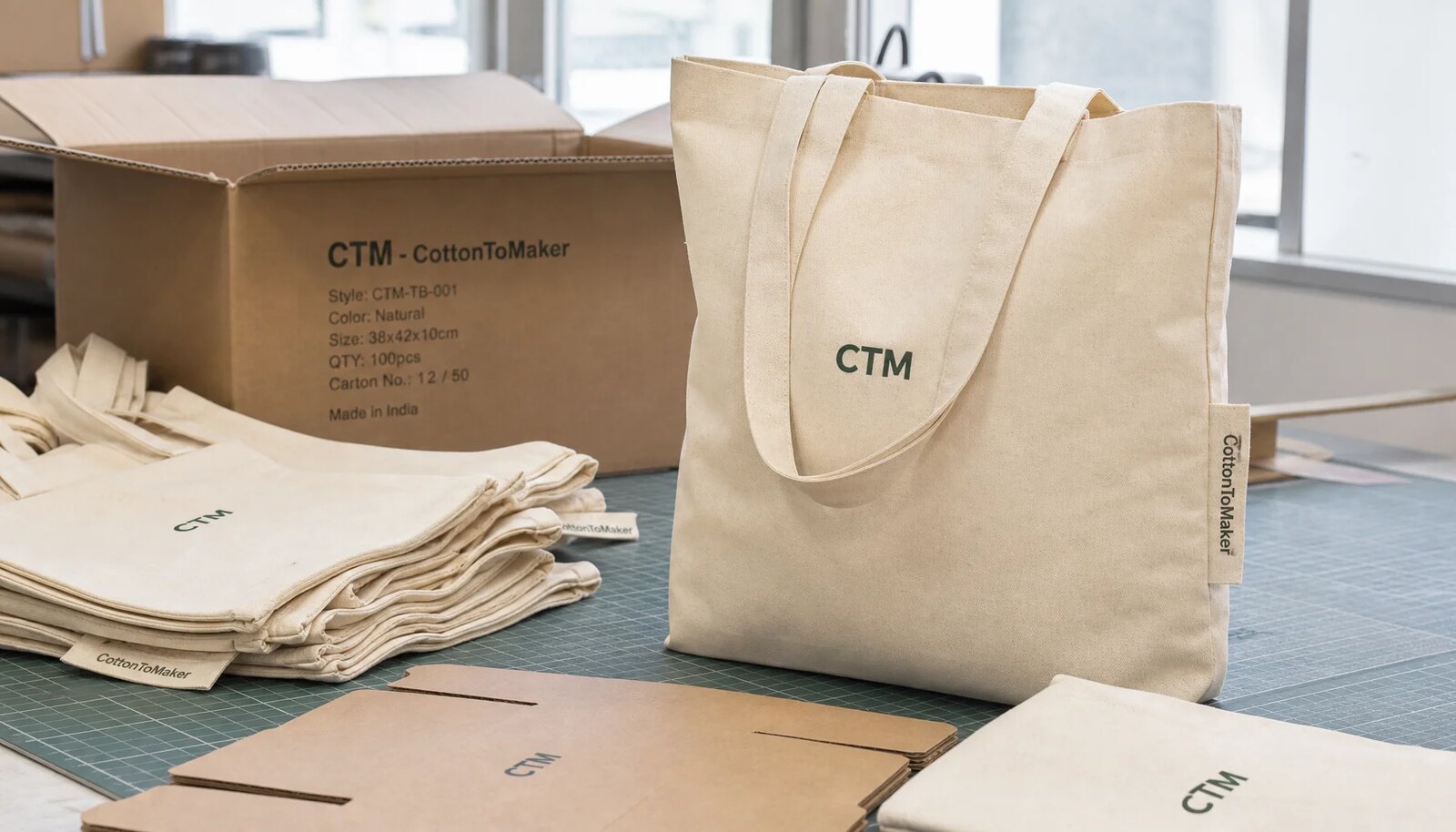
Buying Problem
A custom organic cotton tote order for craft fairs can look simple at first: pick a canvas, print the artwork, approve a sample, and ship the cartons. The trouble usually appears later. A tote may look good as a single piece, yet still cause avoidable cost when the cartons arrive. Cartons may be too heavy for event staff, bundles may not match booth allocations, print versions may be mixed, or fold lines may run through the main logo.
For craft fair programs, packing is not an afterthought. It is part of the specification. The bags may be sold as merchandise, issued to vendors, included in attendee kits, used by retail partners, or split across several fair dates. A 12 oz gusseted organic cotton tote takes more carton space than a flat lightweight bag. Shoulder handles improve use, but they add bulk. A large water-based print may need more curing time before folding. Each choice affects receiving labor, freight, storage, and how the tote looks when a shopper first sees it.
Procurement teams should therefore buy the full handling system, not only the sewn bag. The tote has to move through production, final inspection, export packing, freight, warehouse receiving, domestic allocation, and event-floor distribution without constant sorting. That requires measurable tote specs, carton planning at RFQ stage, and inspection of packed cartons before release.
A strong RFQ asks for finished tote dimensions, fabric GSM, print method, sample stages, pieces per carton, carton dimensions, gross weight, inner bundle quantity, carton marks, and short-carton rules in one package. Then the buyer can compare landed cost instead of just unit price, and the event team receives inventory in a format it can actually use.
- Use this guide for custom printed organic cotton tote orders packed for craft fairs, vendor kits, event merchandise, retail resale, or multi-date distribution.
- Treat pieces per carton, inner bundle count, carton size, carton marks, and maximum gross weight as RFQ fields, not warehouse notes.
- Approve a printed folded sample or packed-carton layout before mass packing, especially when artwork is large or there are multiple print versions.
- Keep packing format consistent across repeat purchase orders so event teams can plan booth storage, receiving space, and labor.
- Write short-carton and mixed-carton rules into the PO so final balance quantities do not become unmarked exceptions.
Core Tote Specification
Most craft fair tote programs sit between a cheap giveaway bag and a heavy retail canvas shopper. For organic cotton, 10 oz to 12 oz canvas is a practical sourcing range, often about 270-340 GSM after finishing depending on fabric construction and supplier convention. It gives enough body for candles, boxed soaps, small ceramics, books, yarn, apparel, packaged food gifts, and handmade accessories without making cartons too bulky or difficult to handle.
Do not rely on ounces alone. Suppliers may interpret fabric weight differently depending on fabric width, finishing, and local mill practice. Ask for both ounces and GSM, and ask whether the weight is greige, finished, or washed. If shrinkage matters, request the expected shrinkage after wash or steam finishing. For standard sewn totes, many buyers start with tolerances such as plus or minus 1.0 cm on body width and height, plus or minus 0.5 cm on gusset depth, and plus or minus 1.0 cm on handle drop. The factory still needs to confirm what is achievable before bulk production.
Body format should follow the items likely to go inside the tote. A flat 38 x 42 cm bag works well for brochures, apparel, prints, and light attendee giveaways. A bottom gusset of 8-10 cm is better for boxed craft goods because products sit flatter and the tote stands more naturally when filled. The tradeoff is clear: a gusset adds fabric, sewing time, folded thickness, carton volume, and freight cost.
Handle design is just as important as fabric weight. Shoulder handles make sense when shoppers will walk the fair for several hours. A handle drop around 25-30 cm is commonly used for shoulder carry, while shorter drops are more hand-carry focused. Define handle width, handle material, handle drop, and reinforcement method. A well-made 10 oz tote with secure reinforced handles may outperform a heavier tote with narrow or poorly attached handles.
- Budget build: 8 oz organic cotton, flat body, one-color print, light attendee giveaway, and higher pieces per carton.
- Balanced build: 10 oz or 12 oz canvas, 8-10 cm bottom gusset, shoulder handles, and water-based screen print for paid or sponsored craft fair totes.
- Premium build: 12 oz to 14 oz canvas, reinforced seams, woven side label, heavier handle tape, hangtag, and lower pieces per carton.
- Confirm whether dimensions are finished measurements after sewing and pressing, not cutting measurements before seam allowance.
- Require a measurement diagram so body, gusset, handle drop, handle width, and print placement are interpreted consistently.
Organic Cotton Claim and Fabric Control
Organic cotton sourcing has two separate parts: the physical fabric and the evidence behind the claim. Some buyers only need a clear material description for event communications or a product page. Others need supplier declarations, certificate copies, transaction certificate support, or chain-of-custody documentation for internal compliance, resale, or retailer requirements. Those requirements affect supplier choice, material sourcing, documentation workload, segregation controls, and price.
Natural organic cotton canvas may show seed flecks, slubs, small neps, and shade movement. These are often part of the look buyers want for craft fair merchandise, but they should not be left undefined. A warm natural canvas may suit a handmade brand story while making a fine sponsor logo harder to read. If the buyer needs a cleaner cream, a bright white, or a brand-colored ground, bleached or dyed organic cotton may be needed. That adds lab dip approval, dye-lot control, possible shrinkage changes, and more lead time.
The approved fabric record should capture fabric weight, GSM tolerance, weave appearance, shade, handfeel, finishing, and acceptable natural characteristics. If several rolls are used, the factory should avoid obvious shade blocks in the same carton or shipment. For reorders, state whether the next lot must closely match the first shipment or whether normal natural cotton variation is acceptable.
Compliance-sensitive buyers should also ask how organic material is received, stored, cut, sewn, and documented. If chain-of-custody matters, the supplier needs to explain whether organic cotton is segregated from conventional cotton. Trims require attention too. Handle tape, sewing thread, woven labels, hangtags, and packaging may not carry the same claim as the body fabric unless they are specified and documented separately.
- Request swatches from the actual fabric weight and finish being quoted, not a generic showroom tote or old sample card.
- Define acceptable seed flecks, slubs, neps, weaving irregularities, and natural shade variation before production inspection.
- For dyed fabric, approve lab dips under agreed lighting and confirm whether bulk shade tolerance follows a named standard or approved swatch.
- List required organic documents in the RFQ so suppliers price the same obligation and do not add compliance costs after order placement.
- Separate claims for body fabric, handle tape, thread, labels, and packaging if not every component has the same organic status.
Artwork and Print Method Selection
Water-based screen printing is usually the most practical commercial option for custom organic cotton totes with one to three solid colors. It gives a softer hand than heavy plastisol and fits the natural look many craft fair buyers want. The limitation is canvas texture. Ink edges can break slightly over slubs and yarn texture, and opacity can vary more than it would on a smooth synthetic surface.
The RFQ should include production artwork in vector format, color references, print size in centimeters, and placement measurements. Avoid vague instructions such as “center the logo.” Instead, define the finished print width and height, the distance from the top edge, the centerline reference, and the clearance from seams or gusset folds. For many tote designs, keeping at least 5 cm from side seams, bottom fold lines, and gusset folds helps reduce distortion and fold damage.
Artwork limits should be discussed before screens are made. As a working starting point, ask the printer to review any lines below about 0.5-0.7 mm, small text below about 5-6 mm cap height, and reversed details inside heavy ink areas. These are not universal limits, but they force the supplier to assess the actual fabric, artwork, mesh, ink system, and operator capability. Final approval should still come from a strike-off on production fabric.
Other print methods can work, but each brings a tradeoff. Heat transfer can handle gradients, many colors, or shorter runs, yet large transfer areas may feel stiff and can crease at fold edges. Digital printing may suit detailed artwork if the supplier has suitable pretreatment and color control. Embroidery can make a small mark feel premium, but it may pucker lighter canvas and add bulk when stacked. Choose the print method after reviewing artwork, fabric, order quantity, handfeel, fold behavior, and inspection criteria.
- Use water-based screen print for simple logos, one to three solid colors, and actual-fabric strike-off approval.
- Use transfer or digital print only after checking handfeel, fold resistance, rub resistance, edge behavior, and cost by print version.
- Avoid printing across gusset folds unless artwork is designed to tolerate distortion when the tote opens.
- Confirm screen charges, repeat-order charges, color-change charges, artwork adjustment fees, and whether a new screen is needed for each event date or sponsor version.
- Add print curing time to the production schedule so bags are not folded while warm, damp, tacky, or odor-prone.
MOQ, Quote Structure, and Landed Cost
MOQ is shaped by more than the number of bags. Fabric availability, dye-house minimums, cutting efficiency, screen setup, label sourcing, trim minimums, packing labor, and version control all matter. A stock natural organic cotton tote with one print color may be straightforward. A dyed tote with custom handle tape, woven labels, hangtags, and several sponsor versions may carry a higher operational minimum because the factory must manage more materials and more changeovers.
Compare quotes only after aligning the specification and shipping term. A low unit price can hide excluded costs such as screen charges, strike-offs, lab dips, labels, paper bands, carton liners, export cartons, barcode labels, inspection support, or domestic delivery. Ask suppliers to separate tote unit cost from setup cost and packing cost. This helps procurement see whether savings come from fabric, construction, print, or reduced service.
For craft fair orders, carton planning changes the landed cost. A 150-piece carton may reduce carton count and export handling, but it can be too heavy for a venue team. A 100-piece carton with two 50-piece bundles may use more cartons but simplify allocation. A 25-piece bundle may be ideal for vendor kits, though it adds banding or labeling work. The lowest ex-factory price is not always the lowest cost once the totes reach the event floor.
Incoterms also need discipline. Ex-works, FOB, CIF, DDP, and domestic delivered pricing assign different responsibilities. Request carton dimensions, gross weight, net weight, and cubic volume with the quote so freight estimates are based on measurable packing data. If exact carton data is not available before sampling, ask for a planning estimate and require final confirmation before mass packing.
- Main cost drivers: GSM, tote size, gusset, handle length, seam finish, print colors, print area, labels, hangtags, and packing format.
- Common setup lines: artwork adjustment, screens, strike-off, lab dip, pre-production sample, woven label MOQ, hangtag setup, courier fee, and document fee.
- Packing cost lines: 25-piece or 50-piece bundles, paper bands, individual polybags, barcode labels, carton liners, desiccants, export cartons, and mixed-SKU sorting.
- Landed-cost comparison: unit price plus setup cost plus packing cost plus estimated freight per piece plus expected domestic allocation labor.
- Ask whether the same total order quantity costs more when split into multiple artwork versions, colorways, event codes, or destinations.
Carton Quantity Logic
For many 10 oz to 12 oz organic cotton totes, 80-150 pieces per master carton is a useful planning range. It is not a rule. The right count depends on finished bag size, gusset depth, handle drop, fabric thickness, print area, fold style, and maximum gross weight. A flat 8 oz tote may fit more pieces. A 12 oz gusseted tote with shoulder handles and woven labels may need fewer pieces to avoid compression marks and unsafe carton weight.
Set the carton weight target before the factory packs. Many buyers prefer a practical handling range around 12-18 kg gross weight, but the correct limit should come from the buyer’s warehouse, carrier, or event-site rule. Heavy cartons are more likely to split, crush, drag, or be mishandled. Underfilled cartons waste freight space and allow bundles to shift, which can leave bags wrinkled or poorly presented.
Carton quantity should mirror downstream allocation. If each vendor receives 50 totes, a 100-piece carton with two 50-piece bundles is easy. If retail partners receive smaller drops, 25-piece bundles can reduce repacking. If the importer palletizes inventory, carton dimensions should be checked for pallet fit and stack stability. Packing chosen only for the factory line often pushes labor cost into the buyer’s warehouse.
Carton data should appear in the quote, the packing confirmation, and the final packing list. Each carton should show PO, SKU or item code, bag color, print version, quantity, carton number, total cartons, gross weight, net weight, and destination or event code if applicable. Short cartons should be deliberately marked and listed. Mixed cartons should be avoided unless the packing list and internal separation make the contents unmistakable.
- Set maximum gross weight, target pieces per carton, and carton dimensions together instead of specifying only pieces per carton.
- Align bundle quantities with booth kits, vendor allocations, retail replenishment packs, or domestic pick-pack units.
- Keep carton quantities consistent for the same SKU, except for clearly marked final short cartons.
- Require carton dimensions, net weight, gross weight, carton count, and cubic volume before finalizing freight estimates.
- Avoid mixed cartons unless the carton mark, packing list, and internal separators identify every SKU and print version.
Fold, Bundle, and Plastic Policy
Folding is a quality-control decision for printed organic cotton totes. A fold line through a fresh or heavy screen print can create a visible crease, ink stress, or transfer mark. The factory should fold only after the ink is fully cured and cool. If the front logo is compact, a half fold may avoid the artwork. If the tote is tall or the handles are long, a third fold may look neater but can add labor and create thicker bundle edges.
Approve the fold direction on the actual printed tote, not as a last-minute packing assumption. Ask for photos or a packed sample showing the folded front face, handle position, bundle height, and how printed panels touch each other. For large solid ink areas, consider interleaving, a revised fold position, or fewer pieces per bundle if the strike-off shows rubbing or offset risk.
Bundle quantity should serve receiving and allocation. Sewing lines may prefer large loose stacks, but craft fair teams usually need fast counts. A 25-piece or 50-piece bundle is easier for vendor kits and booth replenishment. Paper bands, kraft sleeves, cotton ties, or bundle labels can identify quantity without individual plastic. Individual polybags can be justified for retail barcodes, multi-destination shipping, or dust protection, but they add cost, waste, unpacking time, and carton volume.
Moisture protection needs the same practical thinking. Cotton should be dry before packing, and printed bags should be cured. Carton liners and desiccants can help on humid or ocean routes, but they should not seal in production moisture. If the order will sit in pre-event storage, ask the supplier to confirm dry cartons, a clean packing area, and no mildew or sour odor before shipment.
- Approve fold direction, bundle count, bundle height, and handle placement on a printed sample before mass packing.
- Use 25-piece or 50-piece bundles when event teams need fast counting, vendor allocation, or booth replenishment.
- Choose paper bands, kraft sleeves, bundle labels, or carton liners when individual polybags conflict with sustainability goals.
- Use individual polybags only when retail presentation, barcode scanning, multi-destination shipping, or dust protection justifies the cost and waste.
- Mark partial bundles and short cartons separately so balance quantities are not hidden inside full-carton marks.
Sample Approval Workflow
A strong approval workflow prevents most disputes after the order is packed. Start with fabric swatches when choosing between 8 oz, 10 oz, 12 oz, and 14 oz organic cotton. For dyed fabric, add lab dips before bulk dyeing. For detailed artwork or strict brand color, approve a print strike-off on the actual fabric. These early checks stop the factory from cutting the wrong material or discovering too late that the artwork does not suit canvas.
The pre-production sample should use the correct fabric, handle construction, seam finish, label method, print size, print placement, and packing method. Measure it and record photos before approval. For craft fair orders, do not approve only an open flat tote. Ask to see the printed tote folded, bundled, and placed in a sample carton or carton mock-up so the buyer can check logo creasing, handle tangling, bundle count, and carton fill.
The approval record should name the artwork file version, print colors, Pantone or color references, print dimensions, placement measurements, fabric swatch reference, label details, construction notes, measurement tolerances, and packing instructions. This record becomes the standard for inspection and repeat orders. It also reduces subjective arguments about whether a visible fleck, shade variation, or print edge is acceptable.
Factories should not cut bulk fabric or print production panels until the buyer approves the critical sample stages. If the event date is fixed, the safer answer is usually to simplify the program, not remove quality gates. Stock natural fabric, fewer print colors, fewer versions, or bundle packing instead of retail packing can save time while keeping the important approvals intact.
- Fabric swatch approval: weight, GSM, shade, weave, handfeel, seed flecks, slubs, and expected shrinkage.
- Lab dip approval: dyed shade, light source, color tolerance, bulk variation rule, and approval expiry if production is delayed.
- Print strike-off approval: ink color, opacity, line clarity, registration, rub resistance, handfeel, and edge sharpness on actual fabric.
- Pre-production sample approval: finished measurements, handle strength, seam quality, print placement, label position, trimming, and overall finish.
- Packed sample approval: fold direction, bundle quantity, carton fit, carton marks, barcode location, liner or desiccant use, and short-carton rule.
QC Acceptance and Inspection Plan
Inspection should cover the tote and the carton plan. For the bag itself, check fabric defects, stains, odor, finished dimensions, gusset shape, seam strength, handle attachment, print placement, print clarity, ink curing, label placement, and loose threads. Organic cotton can include natural character, so inspectors need an approved swatch that defines acceptable flecks, slubs, and shade variation.
Measurement tolerances must be written before inspection begins. A practical starting point for standard sewn totes is plus or minus 1.0 cm for body width and height, plus or minus 0.5 cm for gusset depth, plus or minus 1.0 cm for handle drop, and plus or minus 0.5-1.0 cm for print placement, depending on print size and construction. These are commercial planning figures, not universal rules, so the buyer and supplier should agree on the final limits and include them in the PO or inspection checklist.
Handle strength deserves close attention because craft fair shoppers may carry several purchases for hours. Inspectors should check stitch density consistency, reinforcement shape, thread breaks, skipped stitches, seam tearing, and alignment at both handle ends. A simple practical pull check on sampled pieces can reveal weak attachments. If the buyer requires a formal load test, the method and load should be agreed with the supplier before production.
Print QC should include both appearance and post-fold behavior. Check color, opacity, registration, small text, edge clarity, rub resistance, odor, tackiness, cracking, and transfer marks after folding. Bags may look fine on the print table but fail after being stacked in bundles. Inspectors should open production cartons and review folded bundles, not only loose pieces prepared for inspection.
Carton inspection is essential for craft fair orders because allocation mistakes can disrupt event operations. Open cartons from each SKU, print version, color, destination, and packing method. Count pieces, confirm bundle quantities, compare carton marks to the packing list, check barcode labels if used, verify gross weight, and look for carton bulging or crushing. Any short carton or mixed carton should be documented and clearly marked before shipment.
- Measurement checks: finished width, height, gusset, handle drop, handle width, print size, and print placement measured from agreed reference points.
- Construction checks: seam alignment, skipped stitches, loose threads, bartacks, handle reinforcement, trimming, label security, and edge finishing.
- Print checks: color, opacity, line clarity, registration, rub resistance, curing, odor, tackiness, cracking, and transfer after folding.
- Carton checks: count accuracy, bundle count, SKU, print version, carton number, gross weight, net weight, carton strength, tape quality, and label placement.
- Sampling scope: open cartons from every SKU, color, print version, destination code, and packing method, not only the easiest cartons near the inspection table.
Lead Time, Shipping, and Reorder Control
Lead time starts when the factory has usable artwork, confirmed specifications, approved material direction, payment arrangement, and complete packing instructions. A realistic schedule includes fabric sourcing, lab dip if dyed, print strike-off, sample approval, cutting, sewing or printing sequence depending on factory process, print curing, trimming, inspection, folding, bundle packing, carton marking, export documentation, and shipment handoff. Buyers often underestimate artwork correction, print curing, carton mark confirmation, and barcode changes.
Shipping risk is partly controlled by carton design. Overfilled cartons can bulge, split, crush, or leave pressure marks on printed panels. Underfilled cartons waste freight volume and allow tote bundles to shift. If cartons are palletized, confirm pallet pattern, stack height, and whether carton dimensions support stable loading. If cartons go directly to a fair venue, labels and weights should be readable and manageable for people who may not be warehouse staff.
For urgent craft fair deadlines, simplify the product before cutting inspection time. Use stock natural organic cotton instead of dyed fabric, limit artwork to one or two screen colors, reduce the number of print versions, avoid custom labels if they are not essential, and choose bundle packing over individual retail packing. Skipping strike-offs, curing checks, or packed-carton verification can create problems that cannot be fixed after export.
Reorder control matters because craft fair programs often repeat seasonally. Keep a production file with approved GSM, swatch, tote dimensions, handle drop, print artwork, print placement, carton quantity, bundle size, carton marks, tolerances, and inspection notes. If a reorder must match the first shipment closely, say so before quoting. If natural cotton shade variation is acceptable, document that too. Clear reorder standards prevent gradual drift in fabric weight, handle length, logo placement, and packing format.
- Build schedule margin for artwork adjustment, swatch approval, strike-off approval, curing, final inspection, carton labeling, and export pickup.
- Do not finalize freight estimates until carton dimensions, carton count, gross weight, net weight, and loading method are confirmed.
- Use clear carton marks for split shipments, multiple destinations, event dates, sponsor versions, colorways, and retail barcode versions.
- For fixed fair dates, reduce specification complexity before reducing sample approval or final inspection time.
- Keep an approved production file so repeat orders match the tote specification, print standard, and carton packing plan.
Specification comparison for buyers
| Spec decision | Recommended option | When it fits | Buyer risk to check |
|---|---|---|---|
| Fabric weight | 10 oz to 12 oz organic cotton canvas, typically about 270-340 GSM after finishing | Paid craft fair merchandise, vendor kits, attendee totes, and reusable shopper programs where the bag must feel substantial but still pack efficiently | If the RFQ states only ounces, suppliers may quote different fabric constructions; confirm GSM, weave, finish, and tolerance before comparing price |
| Body size | 38 x 42 cm flat tote, or 38 x 42 x 8-10 cm with bottom gusset | Flat totes suit brochures and apparel; bottom gussets suit candles, boxed soap, ceramics, books, and mixed craft purchases | A gusset improves use but adds fabric, sewing time, folded thickness, carton volume, and freight cost |
| Handle construction | 2.5-3.0 cm wide self-fabric or cotton webbing handles with box stitch, cross stitch, or bartack reinforcement | Shoulder-carry bags for shoppers walking between booths and carrying several small purchases | Weak handle attachment is a common functional failure; require pull checks at the stitch area, not only visual approval |
| Print method | Water-based screen print for 1-3 solid colors on natural or dyed organic cotton canvas | Simple event logos, sponsor marks, shop branding, and craft fair artwork with moderate detail | Fine reversed text, thin lines under about 0.5-0.7 mm, and large ink blocks need strike-off approval on actual fabric |
| Print placement | Centered front print with 5 cm or more clearance from side seams, gusset folds, and bottom fold line | Keeps branding visible when the bag is stacked, worn, hung at a booth, or folded for cartons | Oversized or low placement may distort when filled, land on a fold, or become hidden by packed contents |
| Unit and bundle packing | Flat folded, 25-piece or 50-piece inner bundles, with paper band or bundle label if needed | Fast receiving, event kit assembly, booth allocation, and controlled domestic redistribution | Loose bags slow counting; over-tight bundles can mark fresh ink, crush labels, or create hard fold creases |
| Master carton loading | Usually 80-150 pieces per export carton for 10-12 oz totes, adjusted to carton dimensions and a maximum gross weight target | Balanced carton count, safer handling, and predictable freight estimates | Using only pieces-per-carton can create cartons that are too heavy or bulging; set maximum gross weight and carton size together |
| Carton marks | PO, item/SKU, fabric color, print version, quantity, carton number, total cartons, gross weight, net weight, destination or event code | Multiple craft fair dates, sponsor versions, retail barcode versions, warehouse allocation, and split shipments | Unclear carton marks create picking errors because natural cotton tote versions often look similar in sealed cartons |
| Moisture protection | Dry cured bags, clean cartons, optional carton liner, and desiccant for humid or ocean routes | Long transit, humid storage, pre-event warehousing, or routes with several handoffs | Plastic liners cannot fix damp production; sealing warm or wet cotton increases odor and mildew risk |
Buyer checklist before sampling
- Define finished bag width, height, gusset depth, handle drop, handle width, seam type, fabric weight in oz and GSM, fabric color, shrinkage expectation, and measurement tolerance before requesting price.
- State the organic cotton claim level required for your market: supplier declaration only, certificate copy, transaction certificate support, or formal chain-of-custody documentation.
- Provide vector artwork, Pantone or equivalent color references, maximum print size in centimeters, print placement from top edge and centerline, and every sponsor, date, or event-version rule.
- Ask the supplier to confirm screen-print limits for minimum line thickness, minimum text height, reversed-out details, ink coverage, registration tolerance, and whether artwork adjustments are included.
- Set target pieces per carton, inner bundle quantity, carton size preference, maximum gross carton weight, short-carton rules, carton-number format, and whether mixed cartons are allowed.
- Approve the tote after it is printed, cured, folded, bundled, and photographed, not only as an open flat sample, because packing can change presentation quality.
- Require pre-production sample approval before bulk cutting when the order includes dyed organic cotton, custom webbing, woven labels, hangtags, multiple print versions, or a fixed event date.
- Include carton marks, barcode label position, event code, destination code, inner bundle method, polybag policy, desiccant or liner requirement, and carton numbering format on the purchase order.
- Request separate quote lines for tote unit price, print cost, screen charge, artwork adjustment, label or hangtag cost, sample fee, packing materials, export carton, bundle labor, inspection support, and shipping term.
- Reserve schedule time for fabric approval, lab dip if dyed, print strike-off, ink curing, trimming, final inspection, carton labeling, export booking, customs documents, and domestic allocation after import.
Factory quote questions to send
- Which organic cotton canvas can you quote in 8 oz, 10 oz, 12 oz, and 14 oz, and what are the approximate finished GSM values, weave types, and GSM tolerances?
- Is the quoted fabric greige, natural, bleached, piece dyed, garment dyed, or washed, and how do you control shade variation between rolls and production lots?
- What documentation supports the organic cotton claim, and are supplier declarations, certificate copies, transaction documents, or chain-of-custody records included in the price?
- What is the MOQ for stock natural fabric, and how does MOQ change for dyed fabric, custom handle tape, woven labels, hangtags, several print versions, or split destinations?
- Can you quote a flat tote and an 8-10 cm bottom-gusset tote using the same fabric weight, artwork, handle drop, carton weight target, and Incoterm for comparison?
- Which print method do you recommend for our artwork on organic cotton canvas, and what limits apply for line thickness, small text, ink coverage, color matching, and registration?
- How many pieces fit per master carton under our maximum gross weight, and what are the estimated carton dimensions, net weight, gross weight, and cubic meters per carton?
- Can inner bundles be packed in 25-piece or 50-piece lots for craft fair distribution, and what extra cost applies for paper bands, bundle sleeves, bundle labels, or barcode labels?
- Can you provide a packed-carton sample, video, or dated photos showing fold direction, bundle count, carton fill level, carton marks, barcode label placement, and short-carton handling before mass packing?
- What sample stages are included in the lead time: fabric swatch, lab dip if dyed, print strike-off, pre-production sample, folded sample, and packed-carton confirmation?
Quality-control points to confirm
- Fabric GSM should be measured against the approved production swatch with a written tolerance, commonly plus or minus 5% for canvas unless the buyer requires a tighter range and the mill confirms feasibility.
- Finished bag dimensions should stay within written tolerance, often about plus or minus 1.0 cm for body width and height and plus or minus 0.5 cm for gusset depth on standard sewn totes.
- Handle drop should be measured from the top opening to the handle apex, with tolerance stated in centimeters; both handles should be checked for symmetry and attachment alignment.
- Handle attachment must show consistent box stitching, cross stitching, or bartacks with no skipped stitches, broken thread, loose tails, seam tearing, or weak attachment under practical pull testing.
- Print position should be measured from the bag centerline and top edge, with tolerance stated in centimeters, often plus or minus 0.5-1.0 cm depending on print size and sewing variation.
- Ink should be fully cured before folding; rubbing, tackiness, solvent or sour odor, offsetting, cracking on fold lines, or transfer marks inside bundles should trigger hold and rework.
- Organic cotton shade should be compared under consistent lighting, and the approved swatch should define acceptable seed flecks, slubs, weaving irregularities, and natural tone variation.
- Stains, oil marks, mildew smell, excessive dust, needle holes, broken yarns, cutting defects, and visible fabric flaws should be removed before packing rather than hidden inside bundles.
- Carton count must match the packing list, inner bundle count, carton marks, barcode labels, SKU code, print version, and destination or event code.
- Export cartons should be clean, dry, strong enough for stacking, taped securely, free of bulging, and sized so totes are held firmly without over-compressing printed panels.