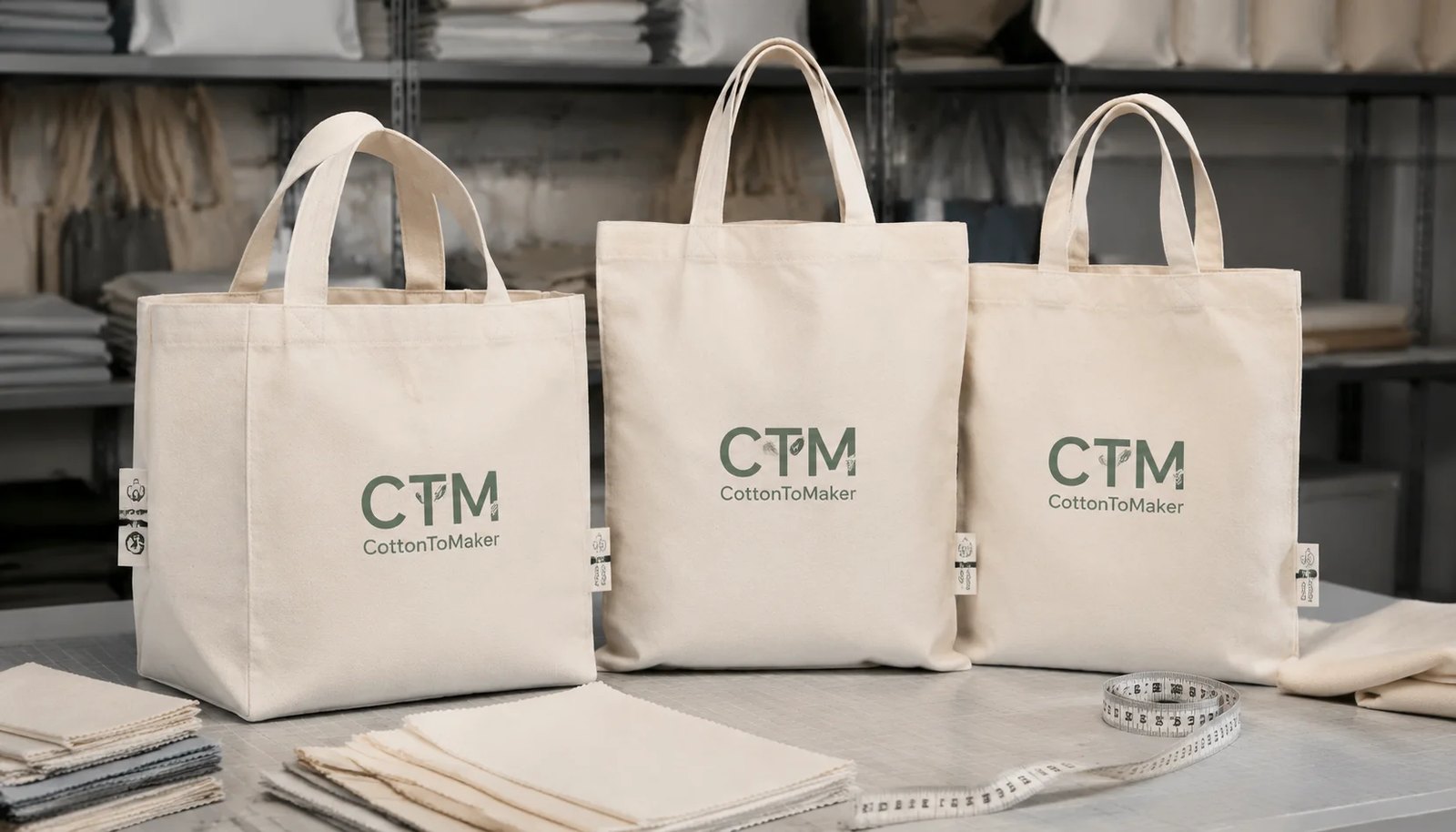
Start the pricing plan with the grocery use case, not the logo
A custom organic cotton tote for a natural grocer can be a checkout bag, a paid reusable shopping item, a membership gift, or a seasonal private-label product. Those uses look similar in a catalog, but they price differently because load capacity, fabric weight, gusset depth, print durability, packing method, and QC level change the real cost. A low-cost flat tote may be acceptable for a local event giveaway. It is usually the wrong choice for weekly grocery carrying because boxes, jars, and produce need volume and seam strength.
For a bulk pricing plan, procurement should first separate promotional demand from retail replenishment demand. Promotional demand often accepts one size, one print, and bulk carton packing. Retail demand usually needs better finishing, barcodes or hangtags, consistent shade, cleaner sewing, and stronger carton documentation. If those two programs are quoted together, the unit price may look attractive but the product will be overbuilt for giveaways or underbuilt for retail shelves.
- Checkout reuse tote: prioritize 10 oz / 340 GSM canvas, gusset, reinforced handles, and bulk cartons.
- Paid retail tote: add cleaner finishing, retail label, UPC or SKU sticker, and tighter shade control.
- Event giveaway: consider 6-8 oz cotton if load expectations are light and budget is fixed.
- Loyalty or opening gift: use visible organic cotton messaging only if the certification evidence supports the claim.
Choose fabric weight using load, hand feel, and freight impact
Organic cotton fabric weight is one of the largest cost drivers. Buyers often request a bag that is both cheap and heavy, but the math does not work. More GSM means more cotton, higher fabric cost, heavier cartons, and sometimes higher freight. For natural grocers, the practical range is usually 8 oz to 12 oz cotton canvas. An 8 oz tote can work for light shopping and brand giveaways. A 10 oz canvas is a stronger middle option for reusable grocery programs. A 12 oz bag feels more premium but may exceed the value customers expect unless it is sold as a durable retail item.
The RFQ should state the weight in either oz or GSM, preferably both, because factories may use different reference systems. A common conversion is approximate, not exact, so the approved swatch matters more than the number alone. Natural unbleached organic cotton can also vary in shade because the fabric is not heavily processed. That is normal, but the acceptable shade range should be approved before mass production if bags will sit together on retail shelves.
- 6 oz / about 200 GSM: light promotional use; not ideal for grocery loads.
- 8 oz / about 270 GSM: economical reusable tote; better for light retail or events.
- 10 oz / about 340 GSM: balanced option for natural grocer bulk programs.
- 12 oz / about 400 GSM: premium, stronger hand feel, higher freight and material cost.
- Natural unbleached fabric: sustainable appearance, but visible cotton flecks and shade variation must be accepted.
Bag dimensions and gusset design drive usability at checkout
Many tote RFQs mention only width and height, then buyers are surprised when the bag is too flat for groceries. For natural grocers, a gusseted tote usually performs better than a flat tote because it holds cartons, jars, produce bags, and refrigerated items with less distortion. A base gusset can help the tote stand open during packing, while side gussets create volume with a simpler sewing structure. The best construction depends on the checkout workflow and carton packing efficiency.
Dimension tolerance is also important. Cotton canvas moves during cutting and sewing, and organic cotton can shrink or relax after finishing. If the bag is 38 x 42 cm with a 10 cm gusset, the supplier should know whether the buyer expects that finished measurement after sewing or a nominal cutting target. When the tote will fit a display hook, shelf box, or branded belly band, tolerances should be tighter and tested during sample approval.
- Common grocery tote size: about 38 W x 40-42 H x 10-12 cm gusset.
- Long-handle shoulder carry: typically 60-70 cm handle length, depending on market preference.
- Hand-carry tote: 35-45 cm handle length, lower material use, less convenient for heavy grocery loads.
- Handle width: 2.5-3 cm improves comfort and durability compared with narrow tape.
- Reinforcement: box cross-stitch or bartack at the handle joint should be visible and consistent.
Build MOQ breaks around fabric, print setup, and cutting efficiency
A useful bulk pricing plan does not stop at one quantity. For custom organic cotton totes, request several price breaks using the same specification so the supplier can show where cost really changes. The most meaningful breaks are usually around 500, 1,000, 3,000, 5,000, and 10,000 pieces. At low quantities, screen setup, sample work, cutting waste, and machine changeover are spread across fewer bags. At higher quantities, fabric purchasing and cutting efficiency improve, but the unit price does not drop forever because cotton cost remains the largest component.
MOQ should be understood per size, per color, and per artwork. A 5,000-piece total order split into five fabric colors and ten store logos is not the same as one 5,000-piece production run. Each split creates more screen setup, more fabric control, more packing separation, and higher risk of count errors. Natural grocers with multiple locations can reduce unit cost by using one master bag design with a small side label or hangtag variation instead of a different front print for every store.
- Quote break at 500 pcs: useful for pilot orders but usually high unit cost.
- Quote break at 1,000 pcs: often practical for small regional chains.
- Quote break at 3,000-5,000 pcs: better for repeat grocery programs and distribution orders.
- Quote break at 10,000 pcs: useful for annual programs if storage and cash flow support it.
- Avoid excessive SKU splits unless retail pricing can absorb the extra handling cost.
Print method should match brand standards and organic positioning
Water-based screen printing is usually the most practical method for organic cotton grocery totes. It gives a matte finish, handles simple brand graphics well, and keeps unit cost predictable in bulk. For one to three colors, screen printing is normally more economical than digital printing and more durable than a low-grade transfer. If the artwork includes large solid areas, fine type, or reversed details, the factory should review ink coverage and fabric texture before confirming production readiness.
Digital printing can be useful for short runs or many designs, but it may not have the same opacity on natural canvas and can cost more per piece. Heat transfer is generally less suitable for natural grocer positioning unless the buyer accepts a different hand feel and verifies washing and rubbing behavior. Embroidery gives a premium look but increases cost, adds weight, and can pucker on lighter cotton. For most natural grocery bulk tote programs, a clean screen print with approved strike-off is the safest commercial choice.
- Provide vector artwork, not only a low-resolution image.
- Specify print size in centimeters and placement from top seam or side edge.
- Use Pantone references, but approve actual ink on actual fabric because natural cotton affects color.
- Define whether ink must be PVC-free, phthalate-free, water-based, or compliant with a specific retailer requirement.
- Require a print strike-off before full bag sampling if color accuracy is critical.
Compare supplier routes by control, not just unit price
Bulk organic cotton totes can be sourced through a direct factory, a trading company, a promotional distributor, or a domestic decorator using imported blanks. Each route can be correct, but they serve different buying problems. A direct factory is usually better when the buyer needs engineered construction, organic material documentation, controlled production, and repeat orders. A trading company can help when the order includes many different bag types and smaller quantities. A domestic decorator is faster for urgent logo work but usually starts from existing blank bags and offers less control over fabric and sewing.
Procurement teams should compare evidence, not claims. A supplier quote that is 8 percent cheaper may become more expensive if the fabric weight is lighter, the carton CBM is higher, the organic evidence is incomplete, or the print setup is excluded. The buyer should also identify who owns QC before shipment. If the seller cannot show where the bag is cut, sewn, printed, and packed, it is harder to resolve defects or repeat the approved standard on the next order.
- Direct factory: stronger for custom dimensions, fabric control, and repeat production.
- Trading company: useful for mixed bag categories, but technical visibility must be verified.
- Promotional distributor: convenient for simple local resale, often less transparent on factory cost drivers.
- Domestic decorator: good for urgent small runs, less suitable for full custom organic cotton construction.
- Best quote comparison: evaluate FOB price, sample quality, document evidence, packing CBM, and QC accountability together.
Sample approval should test construction, print, and packing assumptions
A reliable sample process usually has three steps: blank construction sample, print strike-off, and full pre-production sample. The blank sample proves size, gusset, handles, stitching, and fabric hand feel. The print strike-off proves ink color, opacity, edge sharpness, and adhesion on the actual fabric. The pre-production sample combines everything and becomes the reference for mass production. Skipping straight from artwork to bulk production is risky, especially when the buyer plans to make organic or sustainability claims.
The approved sample should be documented with photos, measurements, fabric weight reading, and comments on acceptable natural cotton variation. Procurement should keep one sealed approval sample and the factory should keep another. If changes are made after approval, such as handle length or print size, the quote may need to be revised because material consumption and production time can change.
- Measure finished bag width, height, gusset, handle length, and handle width.
- Weigh a fabric cutting or finished bag to verify the fabric class against the quoted GSM.
- Load test the sample with the realistic grocery weight, then inspect handle seams.
- Rub the print surface with dry and slightly damp cloth to identify weak ink bonding.
- Fold and pack the sample the same way mass goods will be packed to check crease behavior.
- Record approval comments in writing, not only by message thread.
Packing choices affect sustainability claims and landed cost
Natural grocers often want to avoid unnecessary plastic, so the packing plan should be specified at the quote stage. Bulk carton packing without individual polybags is common and cost-effective, but it requires clean production handling and moisture control. Paper belly bands, hangtags, or recyclable sleeves can support retail presentation, but they add labor, material, and packing volume. Individual polybags protect each bag but may conflict with the retailer's sustainability policy.
Carton data is not a minor detail. A quote should include pieces per carton, carton dimensions, gross weight, net weight, and estimated CBM. Two suppliers with the same FOB unit price can produce different landed costs if one packs loosely into oversized cartons. For importers and distributors, carton strength and pallet compatibility matter because crushed cartons, poor count separation, or missing shipping marks create receiving delays.
- Bulk pack: lowest material use and good for warehouse replenishment.
- Paper belly band: better for retail display, but needs print artwork and application labor.
- Hangtag: useful for care information and organic claim wording, but certification text must be accurate.
- No individual polybag: acceptable if cartons include moisture protection and bags are kept clean.
- Carton marks: PO number, SKU, color, quantity, gross weight, net weight, carton size, and country of origin if required.
Lead time planning should separate approvals from production days
A realistic schedule is built from several stages, not one promised ship date. Artwork review, fabric sourcing, sample production, sample courier time, approval comments, bulk fabric preparation, cutting, printing, sewing, trimming, packing, inspection, and export booking all consume time. Organic cotton may require longer material planning than regular cotton if the fabric weight or color is not in regular stock. A buyer who needs a fixed launch date should approve the specification early and avoid late artwork changes.
The highest schedule risks are usually fabric availability, print approval delays, and carton or label changes after production begins. A supplier can often accelerate sewing with overtime, but cannot always accelerate certified fabric sourcing or ink approval. For natural grocers planning seasonal campaigns, procurement should reserve enough time for sample corrections and inspection rework. A rushed order with no inspection buffer is more likely to ship with inconsistent sewing, shade variation, or packing errors.
- Artwork and spec review: commonly several working days depending on completeness.
- Blank sample: depends on fabric availability and custom pattern work.
- Print strike-off: required when PMS color or ink type matters.
- Pre-production sample: should use actual bulk material whenever possible.
- Bulk production: begins only after deposit, sample approval, and final artwork confirmation.
- Inspection and shipment booking: keep a buffer instead of scheduling pickup the same day production ends.
Quote data must allow landed-cost comparison, not just FOB ranking
A strong RFQ gives the factory enough data to price accurately and gives the buyer enough data to compare suppliers fairly. The quote should show unit price, incoterm, fabric weight, bag dimensions, print method, number of colors, setup charges, sample charges, MOQ, lead time, packing details, carton CBM, and document or testing costs. If one supplier includes water-based print setup and another lists it separately, the comparison should be normalized before a decision is made.
For importers, the cheapest FOB price can lose once inland trucking, ocean freight, duties, inspection, rework, and warehousing are considered. Organic cotton totes are not extremely dense cargo; carton volume can influence landed cost. A slightly higher FOB price with tighter packing, fewer defects, and reliable documentation may be lower cost per usable bag. The best pricing plan uses several order quantities and a landed-cost column for each, so the buyer can decide whether to place one large order or staged releases.
- Unit price should state FOB port, EXW, CIF, DDP, or another agreed incoterm.
- Quote should identify included print colors and extra charge per additional color.
- Sample cost should separate blank sample, printed sample, and courier cost.
- Carton CBM should be used to estimate ocean or air freight impact.
- Inspection cost and expected AQL standard should be included in the sourcing budget.
- Duties and taxes should be estimated by the importer's customs broker using the correct HS classification.
Specification comparison for buyers
| Spec decision | Recommended option | When it fits | Buyer risk to check |
|---|---|---|---|
| Fabric weight | 10 oz / 340 GSM organic cotton canvas for reusable grocery totes | Best balance for produce, pantry goods, bookstore items, and weekly customer reuse | Below 8 oz may feel promotional; above 12 oz raises freight and may not improve retail value |
| Bag construction | Gusseted bottom with 8-12 cm side or base gusset | Useful when grocers want bags to stand open at checkout and hold boxed goods | Flat totes are cheaper but poor for bulky grocery loads and increase customer complaints |
| Handle style | Self-fabric handles, 2.5-3 cm wide, reinforced cross-stitch at stress points | Works for natural grocers that need comfortable carrying without synthetic webbing | Thin handles cut into the hand; weak bartacks fail during load testing |
| Print method | Water-based screen print for 1-3 color natural grocery branding | Good for organic positioning, matte finish, and stable bulk unit cost | Discharge or pigment behavior varies by fabric color; approve printed bulk fabric before mass cutting |
| MOQ logic | Start quote breaks at 500, 1,000, 3,000, and 5,000 pieces per size/color | Lets buyers see real setup absorption, fabric purchasing efficiency, and carton utilization | A single 700-piece quote may hide whether the next 300 pieces reduce cost materially |
| Certification evidence | Transaction certificate or organic cotton scope evidence aligned to buyer requirement | Needed when packaging, hangtags, or product pages mention organic cotton | Do not rely on a supplier saying organic if documents only cover yarn or an expired facility scope |
| Packing method | Flat packed 50-100 pcs per export carton with moisture control and carton drop resistance | Best for warehouse receiving, retail replenishment, and lower CBM than individual rigid packing | Individual polybags may conflict with sustainability policy and increase labor and material cost |
| Supplier route | Direct factory for engineered custom tote programs; trading company for mixed low-volume SKUs | Direct sourcing fits repeat natural grocer programs with stable specs and forecasted reorders | Trading routes can be useful, but quote must reveal factory location, sampling control, and QC ownership |
Buyer checklist before sampling
- Define the tote use case before price collection: checkout bag, loyalty gift, paid retail item, event giveaway, or produce-support bag.
- Specify organic cotton status clearly: certified organic cotton fabric, organic cotton content claim only, or no label claim required.
- Lock one or two fabric weights for quoting, such as 8 oz and 10 oz, instead of asking every supplier to recommend their cheapest cloth.
- State bag dimensions as width x height x gusset, and mention whether dimensions are measured flat or after sewing.
- Include handle length, handle width, reinforcement method, and target loaded weight in the RFQ.
- Send artwork in vector format with exact Pantone or CMYK references and desired print position from bag edges.
- Request quote breaks at practical levels, normally 500, 1,000, 3,000, 5,000, and 10,000 pieces if the program may repeat.
- Require a pre-production sample made in actual bulk fabric, not only a blank size sample and separate print strike-off.
- Define packing: no individual polybag, paper belly band, bulk carton, carton size limit, palletization need, and Amazon or retailer routing label if applicable.
- Set QC acceptance criteria for fabric defects, seam strength, print alignment, color tolerance, odor, carton marking, and needle contamination.
Factory quote questions to send
- What organic cotton evidence can be provided for this order, and at what stage is the material certified: yarn, fabric, finished product, or transaction certificate?
- Which fabric weights are in regular production for organic cotton canvas, and what is the shrinkage range after dyeing or washing if applicable?
- Is the quoted fabric greige, natural unbleached, dyed, or washed, and does the price include fabric pre-shrinking?
- What MOQ applies per bag size, per fabric color, and per print design?
- What are the price breaks at 500, 1,000, 3,000, 5,000, and 10,000 pieces with the same specification?
- Which print method is included in the quoted unit price, and how are extra colors, screens, setup charges, and PMS matching charged?
- Can the bulk fabric be held after sample approval, and for how long before a deposit is required?
- What is the sample charge and lead time for blank prototype, print strike-off, and full pre-production sample?
- What seam construction and reinforcement will be used at the handles and gusset corners?
- What carton quantity, carton dimensions, gross weight, and CBM are estimated for each quote level?
Quality-control points to confirm
- Fabric weight tolerance should be defined, commonly within plus or minus 5 percent of approved GSM or oz specification.
- Finished size tolerance should normally stay within plus or minus 1 cm for width and height, and plus or minus 0.5-1 cm for gusset depending on construction.
- Handle pull strength should be tested against the buyer's intended load; for grocery totes, evaluate repeated carry performance, not only one static pull.
- Stitches should be even, no skipped stitches over 2 cm, no loose thread clusters at visible seams, and reinforced handle boxes should be consistent.
- Print position tolerance should be specified, typically within plus or minus 5 mm for front logo placement on standard totes.
- Print adhesion should pass rubbing and tape tests suitable for the selected ink system and fabric finish.
- Color variation should be compared under standard light against approved fabric swatch and printed strike-off.
- Odor, mold marks, oil stains, needle fragments, and mixed shades should be treated as major defects for retail grocery programs.
- Cartons should pass basic export handling expectations with correct marks, count, moisture protection, and no crushed corners at shipment release.