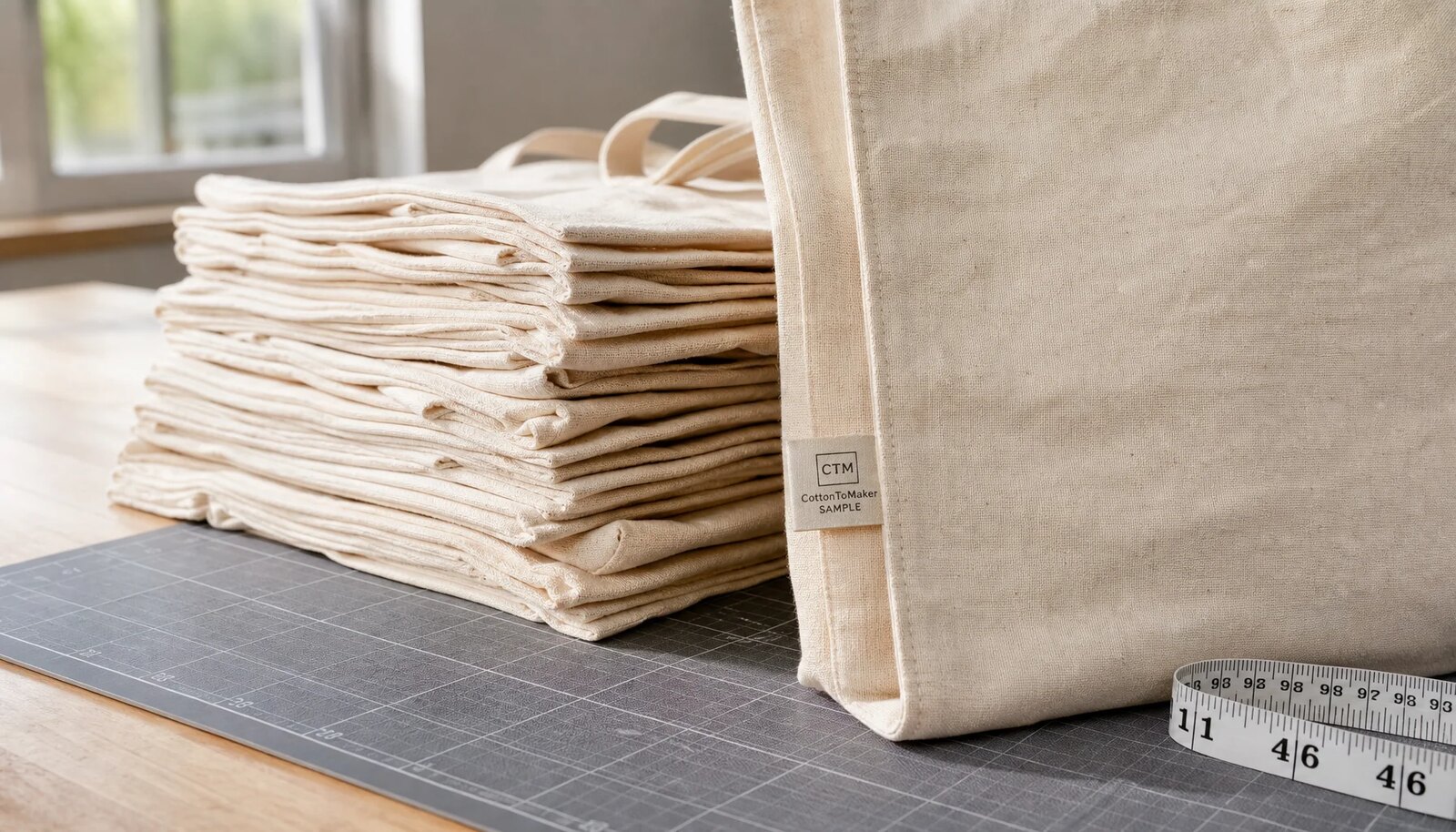
Price the Market Job First
Farmers market tote sourcing starts with a practical question: what will the bag carry on a busy market day? A tote for herbs, flowers, and postcards does not need the same fabric weight or seam strength as a bag holding honey jars, cider bottles, sauces, and root vegetables. Procurement teams get cleaner pricing when the intended job is defined before artwork, GSM, or supplier route.
For farmers market vendors, the buying decision usually splits into three routes. Stock organic cotton blanks with local printing work well for pilots, urgent events, and standard flat totes. Domestic custom production can support tighter oversight but comes with higher labor cost. Offshore custom cut-and-sew offers the most control over size, gusset, handles, label, packing, and repeat spec, but it requires stronger planning and better quote discipline.
A useful custom organic cotton totes bulk pricing plan for farmers market vendors should not push every buyer toward the same answer. A farm ordering 500 logo totes for a spring launch has a different risk profile from a regional market association ordering 5,000 bags for multiple vendors. The right plan compares landed cost, documentation, timing, and usability together.
- Define the tote job before requesting unit prices.
- Use stock blanks when speed, small quantity, and standard dimensions matter most.
- Use custom cut-and-sew when size, strength, certification wording, packing, or repeat consistency matters most.
- Treat paid resale totes as merchandise because hand feel, print finish, and defect control carry more weight.
Use the Quantity-Break Model
The pricing table in this article is an illustrative procurement model, not a market forecast or a promise of supplier pricing. It uses a narrow assumption set: natural undyed organic cotton tote, 140-180 GSM, simple one-side one-color screen print, master-carton packing, Asia-based factory or exporter channel, and FOB base pricing converted into an estimated landed-cost screen. Current quotes must be requested before award because cotton costs, freight lanes, duty treatment, certification scope, and packing details change the result.
The model is still useful because it shows where the money hides. At 500 pieces, setup and freight can weigh heavily enough that a stock blank plus local print route wins even when the printed unit price looks higher. At 1,000 pieces, both sourcing paths deserve comparison. At 2,500 and 5,000 pieces, custom production has more room to spread sampling, screens, carton setup, and documentation across the order.
Buyers should treat the quantity breaks as a decision tool. If the 1,000-piece quote looks attractive but the 2,500-piece quote barely improves, the supplier may be pricing manually or hiding a constraint. If the FOB price drops but landed cost does not, freight cube, packing method, or destination handling may be the issue. Ask for carton data early so the spreadsheet reflects the shipment, not just the bag.
- Quote 500, 1,000, 2,500, and 5,000 pieces using the exact same spec.
- Compare FOB, setup allocation, freight, duty, inspection, and receiving in separate columns.
- Flag any quote that omits packing method, carton dimensions, gross weight, or certification scope.
- Use the table to find missing cost lines before negotiating the final unit price.
Choose Stock or Custom Deliberately
The 500-1,000 piece range is the trap zone. A custom factory can quote it, but the order may not absorb sampling, screens, export packing, documentation, inspection support, and freight efficiently. A local printer using stock organic blanks can have a higher decorated unit cost and still be the better commercial choice when the delivery date is fixed and the design is simple.
Stock blanks also reduce approval complexity. Buyers can inspect the blank before printing, test the logo on the actual fabric, and avoid long international timelines. The tradeoff is limited control. The blank dimensions, handle length, GSM, gusset, color, label placement, and available organic paperwork are determined by the distributor's inventory and documentation path.
Custom production becomes stronger when the tote is part of a repeat program. A market association ordering for multiple vendors can standardize one size, one handle drop, one packing method, and one organic claim. A farm selling the tote as branded merchandise can choose a heavier hand feel, cleaner reinforcement, and retail presentation. Custom is worth managing when those choices affect repeat value.
- For 500 pieces: compare stock blank plus local print before spending time on custom sampling.
- For 1,000 pieces: quote both routes when timing allows.
- For 2,500 pieces: custom cut-and-sew often gives better spec control and cleaner reorder files.
- For 5,000 pieces: build a full supplier file with sample, carton plan, inspection standard, and documentation path.
Specify GSM, Gusset, and Handles Together
GSM is only one part of tote performance. A 160 GSM flat tote with short handles carries differently from a 160 GSM gusseted tote with shoulder handles and jars pressing into the bottom seam. Buyers should evaluate fabric weight together with finished size, gusset depth, handle drop, seam construction, stitch density, and reinforcement.
For light produce, flowers, herbs, paper goods, and giveaways, 120-140 GSM can work when the tote is not oversized. For general checkout use, 160 GSM gives a stronger middle ground without creating a heavy canvas product. For bottles, jars, sauces, olive oil, bakery boxes, and paid resale totes, 180-220 GSM with reinforced handle joins is the more practical specification.
Gusset depth should match the basket. A flat 14 x 15 in tote is inexpensive, packs densely, and works for light goods. A 16 x 18 in tote with a 4 or 5 in gusset carries more but uses more fabric, takes more sewing time, and increases carton cube. Oversizing a lightweight bag is a common procurement mistake because customers load it beyond the construction it was built to handle.
- Light goods: 120-140 GSM, flat or shallow gusset, simple print, tight carton packing.
- General checkout: around 160 GSM, 3-4 in gusset, shoulder handle, reinforced stitch points.
- Jars and bottles: 180-220 GSM, stronger bottom seam, defined load test, conservative handle drop.
- Retail resale: heavier hand feel, cleaner print edge, tighter shade control, stricter cosmetic grading.
Make Artwork Easy to Repeat
Farmers market totes are folded, stacked, carried outdoors, and reordered across seasons. The best print decision is often the one that repeats cleanly. A bold one-color screen print on natural cotton is a dependable choice for bulk programs because it limits setup, registration issues, ink variables, and reorder disputes.
Two-color screen printing can work for a brand mark that needs contrast, but every color adds a screen, setup charge, approval step, and registration tolerance. Natural cotton is not a bright white base. Ink can look warmer or less crisp than it does on a digital proof, so serious buyers should approve color on a physical sample made with the intended cotton.
Transfers, digital print, and embroidery have narrower roles. Transfers can help with complex art or short runs, but the print hand may feel less integrated with the fabric. Digital print can support detail, but production consistency should be tested. Embroidery can look premium on a small logo, yet it can distort lighter fabrics and raise cost quickly.
- Use one-color screen print for the lowest-risk repeat program.
- Approve print size, print side, placement, Pantone reference, and ink type before comparing quotes.
- Set placement tolerance, such as +/- 5 mm for centered logos, when alignment matters.
- Avoid large heavy ink blocks on lightweight natural cotton unless the approved sample proves good hand feel.
Verify the Organic Claim
Organic cotton claims need a documentation path. GOTS and OCS are common references in cotton bag sourcing, but they serve different purposes and depend on certification scope. GOTS covers organic fibers and processing requirements inside the certified scope. OCS verifies organic content through chain of custody. The right route depends on the buyer's claim, retailer requirement, and label wording.
A certificate for a farm, yarn mill, or fabric supplier does not automatically support a finished tote claim. Cutting, sewing, printing, labeling, trading, and export activities can sit outside the certificate that a salesperson sends. Procurement should review the scope certificate holder, expiry date, product categories, covered processes, and whether the shipped order can receive a transaction certificate or lot-level document.
Claim language must be consistent. The tote label, hangtag, carton mark, packing list, invoice, and product page should not tell different stories. Phrases such as natural cotton, eco cotton, and organic-style are not substitutes for a verified organic claim. If the buyer only needs undyed cotton without an organic certification claim, state that clearly so suppliers quote the right product.
- Check certificate number, holder name, expiry date, scope, and product category.
- Confirm whether the shipped PO will receive a transaction certificate or lot-level document.
- Approve organic wording before woven labels, printed labels, hangtags, or carton marks are produced.
- Class wrong certification wording as a major or critical defect, depending on customer and compliance risk.
Build a Landed-Cost Sheet
FOB unit price is the opening number, not the buying decision. A landed-cost sheet should show product price, setup allocation, sample fees, screen charges, label setup, hangtags, packing labor, inland transport, export documents, ocean or air freight, duty, brokerage, inspection, destination trucking, storage, and receiving work. Without these lines, a quote can look cheap while pushing cost into operations.
The math changes quickly by quantity. A USD 250 combined sample and screen cost adds USD 0.50 per bag at 500 pieces, USD 0.25 at 1,000, USD 0.10 at 2,500, and USD 0.05 at 5,000. Freight has a similar pattern, although carton cube and route matter more than pure quantity. A bulky retail fold, belly band, or individual pack can reduce carton density and erase part of the unit-price improvement.
The sheet should also separate first-order economics from reorder economics. First orders carry sample development, artwork approval, screen setup, and supplier onboarding. Repeat orders should show which setup costs disappear and which costs remain. This prevents teams from rejecting a good repeat program because the first order carried unavoidable development cost.
- Use one landed-cost sheet for all suppliers and all quantity breaks.
- Allocate setup and sample costs per unit at each quantity.
- Request carton dimensions, units per carton, gross weight, total cartons, and total CBM.
- Compare first-order cost and reorder cost separately.
Set QC for Real Market Use
Quality control should match the way the tote will be used. Farmers market bags face damp produce, quick packing, shoulder carrying, glass containers, dirt, folding, and repeated handling at outdoor stalls. A purchase order that only says good quality leaves too much room for argument. The spec should define measurements, tolerances, defect classes, and functional tests.
Many B2B buyers use ANSI/ASQ Z1.4 or ISO 2859-1 sampling, with General Inspection Level II and AQL targets such as 0.0 for critical, 2.5 for major, and 4.0 for minor defects. Critical defects can include sharp metal, mold, unsafe contamination, severe odor, wrong artwork, or wrong organic claim. Major defects can include open seams, failed handles, wrong size, visible stains, poor print adhesion, short cartons, or mixed SKUs.
Handle testing deserves specific attention. A light produce tote can be tested at 8-10 kg. A tote intended for jars, bottles, or sauces should be tested at 12-15 kg or another buyer-approved load. The test should state weight, hold time, and pass criteria. Print should be checked for dry rub, light damp rub, coverage, placement, edge quality, and color against the approved physical sample.
- Measure width, height, gusset, handle length, handle drop, GSM, and print placement.
- Inspect handle joins, bottom seam, side seams, gusset corners, stitch density, and loose thread trimming.
- Reject damp cartons, mold risk, oil marks, strong odor, needle fragments, mixed lots, and short counts.
- Keep one signed pre-production sample and one packed carton reference for future inspections.
Control Packing and Reorders
Packing changes cost, freight, and receiving work. Loose master-carton packing is usually the lowest-cost route and avoids individual plastic. It works well for central market offices, vendor pickup points, and warehouse distribution. Inner bundles can make handoff easier when the order is split across several farms, stalls, or event locations.
Retail presentation is a different decision. Belly bands, hangtags, barcodes, retail folds, and individual packs add labor and reduce packing density. They can be worthwhile for paid resale, CSA kits, or direct-to-customer shipments, but they should be quoted as explicit adders. Do not let a supplier include retail packing in one quote and loose cartons in another unless the landed-cost sheet calls that out.
Reorders stay stable when the first order file is complete. Save finished dimensions, GSM, fabric construction, organic standard, artwork file, print method, Pantone references, handle details, reinforcement, packing, carton marks, inspection standard, documentation requirements, quantity breaks, incoterm, and destination. Require written approval before changing fabric, ink, label, packing, subcontractor, or certification claim.
- Choose master carton, inner bundles, retail fold, belly band, hangtag, barcode, or individual pack based on receiving workflow.
- Keep carton gross weight manageable for market staff and warehouse teams.
- Verify carton count, SKU separation, artwork version, and organic wording before shipment release.
- Quote reorders against the approved spec and list which setup charges no longer apply.
Specification comparison for buyers
| Cost line or decision point | 500 pcs | 1,000 pcs | 2,500 pcs | 5,000 pcs |
|---|---|---|---|---|
| Best sourcing route to test first | Stock organic blanks plus local print; custom only if supplier accepts low MOQ | Compare stock print and custom cut-and-sew side by side | Custom cut-and-sew becomes easier to justify for repeat specs | Custom cut-and-sew or managed factory program is usually the cleaner route |
| FOB unit price screening model for simple custom tote | USD 1.80-3.20 | USD 1.30-2.45 | USD 1.05-1.95 | USD 0.88-1.70 |
| Setup, sampling, and screen allocation | USD 0.35-0.70 per unit | USD 0.18-0.40 per unit | USD 0.08-0.18 per unit | USD 0.04-0.10 per unit |
| Estimated freight, duty, brokerage, and receiving allowance | USD 0.45-0.95 per unit | USD 0.32-0.70 per unit | USD 0.22-0.50 per unit | USD 0.16-0.38 per unit |
| Illustrative landed-cost screen | USD 2.60-4.85 | USD 1.80-3.55 | USD 1.35-2.63 | USD 1.08-2.18 |
| Stock blank plus local print comparison | Often competitive when speed matters despite higher unit cost | Still viable for basic logo totes and fixed event dates | Can lose cost advantage unless distributor blank is strong | Usually hard to beat custom unless local control is worth the premium |
| Lead-time expectation | 2-5 weeks for stock route; custom can be tight | 4-8 weeks custom without ocean delays; faster by air at higher cost | 7-11 weeks including sample, production, inspection, and freight | 8-12 weeks with stronger freight efficiency |
| Organic documentation cost driver | Stock documentation varies by distributor | Confirm scope before artwork approval | Lot documents and label wording become more important | Repeat files should lock certificate path and claim language |
| Packing cost driver | Loose master carton preferred for pilots | Inner bundles help vendor distribution | Carton marks and SKU separation matter | Retail folds or hangtags should be priced as adders |
Buyer checklist before sampling
- Define the tote job in one sentence: giveaway, produce checkout, jars and bottles, CSA pickup, paid retail resale, vendor welcome kit, or market association distribution.
- Select the buying route before requesting prices: stock organic blanks with local print, domestic custom production, or offshore custom cut-and-sew.
- Write the base spec: finished size, gusset, GSM target and tolerance, handle drop, reinforcement, fabric color, print method, print area, artwork position, organic claim, and packing method.
- Request the same quote grid at 500, 1,000, 2,500, and 5,000 pieces so setup allocation and freight efficiency are visible.
- Separate unit cost from sampling, screens, artwork work, label setup, hangtags, packing adders, inspection, freight, duty, brokerage, receiving, and storage.
- Record quote date, origin, incoterm, supplier role, certification scope, packing method, carton data, and freight assumption beside every price.
- Confirm whether the organic claim requires GOTS, OCS 100, OCS Blended, or another accepted chain-of-custody document before approving printed labels or hangtags.
- Approve a pre-production sample made with intended bulk fabric, handle reinforcement, stitch method, ink, label, and packing fold.
- Set measurable QC terms: AQL, dimensions, GSM tolerance, load test, seam checks, print rubfastness, odor rules, stain rules, carton count, and certification wording.
- Save the signed sample, artwork proof, label wording, carton mark, inspection report, and supplier quote sheet for repeat orders.
Factory quote questions to send
- Are you quoting stock blanks, semi-custom decoration, or full custom cut-and-sew production?
- What is the quote date, origin country, incoterm, payment assumption, lead time, and supplier role: factory, trader, distributor, or print shop?
- What exact fabric is included: organic standard, weave, GSM target and tolerance, color, shrinkage expectation, and whether the fabric is stock or made to order?
- Does your certification scope cover the finished tote activity being quoted, including processing, manufacturing, labeling, trading, or export as applicable?
- Can you provide a current scope certificate and confirm whether a transaction certificate or lot-level document will be available for the shipped order?
- What finished size, gusset depth, handle length, handle drop, stitch type, reinforcement, seam allowance, and dimensional tolerance are included?
- What are your prices at 500, 1,000, 2,500, and 5,000 pieces for the same spec, and what MOQ applies per artwork, colorway, fabric color, and certified lot?
- Which charges are one-time and which repeat: screen, sample, label, hangtag, carton mark, retail packing, documentation, or artwork adjustment?
- Which print method and ink system are you quoting, what print area is included, and what color and placement tolerance can you hold on natural cotton?
- Where are cutting, sewing, printing, finishing, inspection support, and packing performed, and who is responsible if a subcontracted process fails?
Quality-control points to confirm
- Use ANSI/ASQ Z1.4 or ISO 2859-1 single sampling unless the buyer has its own standard; a common starting point is General Inspection Level II with AQL 0.0 critical, 2.5 major, and 4.0 minor.
- Class critical defects clearly: sharp metal, mold, unsafe contamination, severe odor, wrong organic claim, wrong artwork, or mixed product that could create compliance or receiving risk.
- Measure finished width, height, gusset, handle length, and handle drop against the approved spec; use written tolerances such as +/- 1 cm for main dimensions when the design allows it.
- Check fabric GSM from production material, not only the sales sample; use the agreed tolerance, such as +/- 5 percent, and reject holes, weak weave sections, stains, or unacceptable slubs.
- Run the agreed handle load test for the tote job, such as 8-10 kg for light produce or 12-15 kg for jars and bottles, with no seam opening, tearing, or handle distortion beyond the approved limit.
- Inspect handle joins, side seams, bottom seam, gusset corners, stitch density, loose thread trimming, and reinforcement pattern against the signed pre-production sample.
- Check print placement, print size, edge quality, opacity, and color against Pantone reference or approved physical sample under consistent lighting; natural cotton should not be judged from screen mockups alone.
- Perform dry rub and light damp rub checks on production samples; reject cracking, peeling, heavy transfer, poor coverage, or ink buildup that differs from the approved sample.
- Inspect odor, oil marks, damp cartons, mold risk, dirt, needle fragments, mixed lots, wrong labels, and short cartons as operational defects, not cosmetic preferences.
- Verify carton marks, SKU, artwork version, count, inner bundle count, gross weight, carton condition, packing list match, and organic claim wording before shipment release.