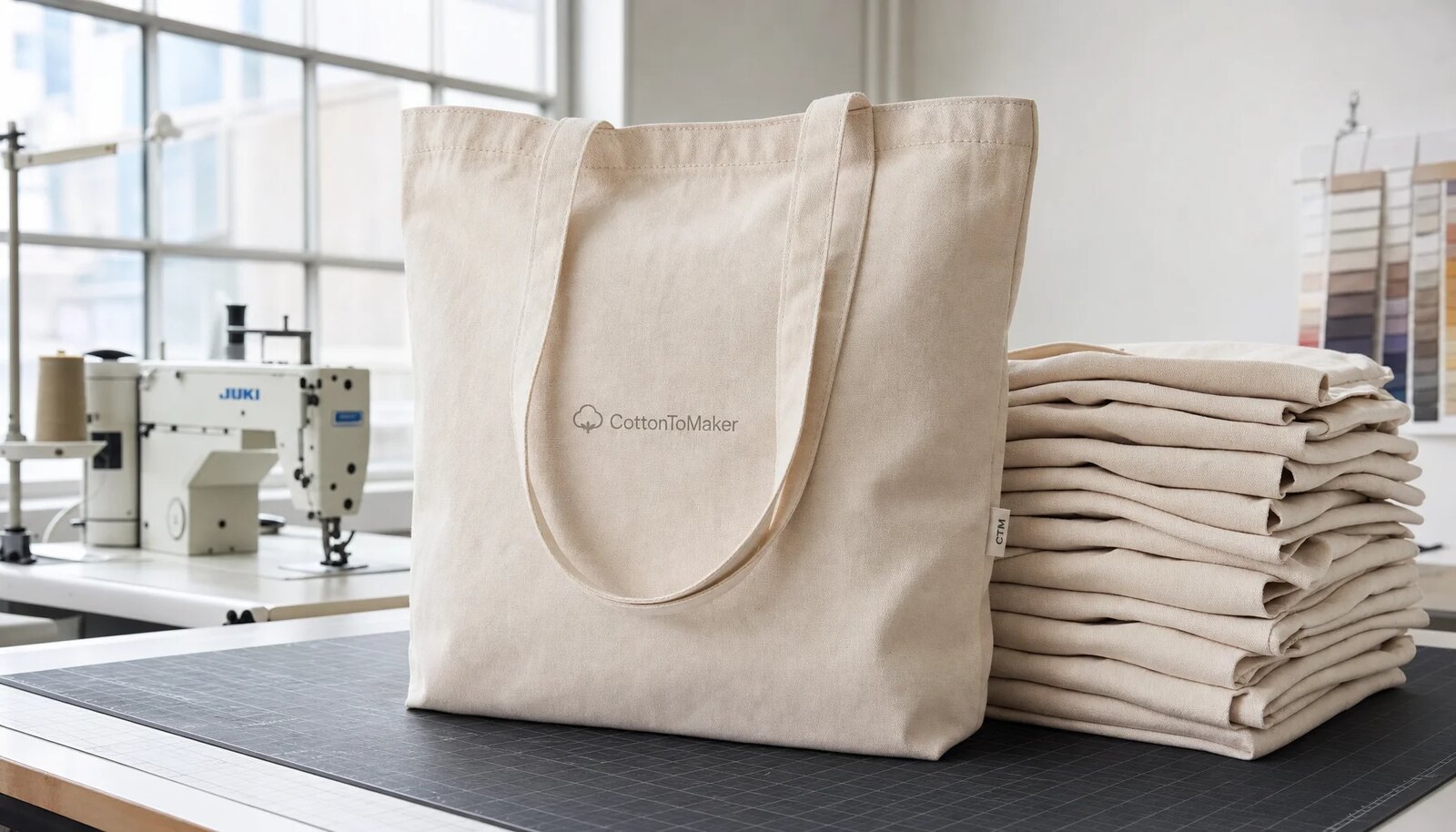
Start with the event job, not the tote photo
A custom organic cotton tote can be a registration kit container, sponsor deliverable, university orientation giveaway, VIP room-drop bag, press pack, resale item, or general trade-show handout. Those uses may look similar in a mockup, but they do not require the same fabric, handle build, gusset, carton plan, or inspection standard.
Before asking suppliers for bulk pricing, define what the bag must carry and how it will move through the event. A tote holding a badge wallet and folded agenda can be lighter than a tote packed with a notebook, bottle, apparel item, catalog, and boxed sponsor sample. The strongest pricing plan starts with the real workflow because every extra centimeter of fabric, longer handle, heavier GSM, and additional print color affects cost.
A photo reference is useful for style direction, but it is not a purchasing specification. If three suppliers quote from the same photo, one may price a flat 140 GSM bag, another a 180 GSM shoulder tote, and a third a gusseted 220 GSM bag with reinforced handles. The spreadsheet will look competitive until samples arrive. Turn the event use case into measurable requirements first.
- Define the bag's role: giveaway, registration kit, sponsor gift, VIP pack, press pack, orientation bag, or merchandise.
- List planned contents and estimated load before choosing GSM and handle construction.
- Confirm where packing happens: factory, 3PL, venue, hotel, campus, or event office.
- Decide whether the design is event-specific, sponsor-specific, reusable across cities, or suitable for future programs.
- Give every supplier the same written specification so the quotes are genuinely comparable.
Specify dimensions, construction, and tolerances
Bulk tote pricing depends on finished measurements, not rough visual size. The RFQ should state finished body width, finished body height, gusset depth, handle length, handle width, fabric weight, fabric color, seam construction, reinforcement method, print size, print position, carton plan, and incoterm. Finished dimensions matter because cotton can shrink during processing and sewing changes usable size.
For many events, a practical tote is large enough for letter-size materials without wasting fabric or freight cube. A gusset helps when the bag must hold apparel, bottles, catalogs, or boxed samples. A flat tote can be more efficient when it only carries papers, lanyards, and light inserts. Shoulder handles are common for conferences because attendees need hands-free carrying, but longer handles add fabric and make uneven placement more visible.
Tolerances should be agreed before the PO is issued. Many buyers use a practical size tolerance around plus or minus 1 cm for body dimensions, but the final tolerance should match the supplier's equipment and construction. Print placement may need a tighter range when a sponsor logo is prominent. If brand approval depends on a centered mark, small type, or exact color placement, make that visible in the RFQ.
- Use finished dimensions, not only cut-panel dimensions or approximate size names.
- Specify whether the tote is flat or gusseted and why that format fits the contents.
- State handle length, handle width, and whether handles are hand-carry or shoulder-carry.
- Define seam finish, handle reinforcement, stitch density expectation, and thread color.
- Add tolerances for size, GSM, handle length, print placement, print registration, and shade.
Choose GSM, color, and organic documentation carefully
GSM is a helpful number, but it is not the whole quality story. It means grams per square meter of fabric. For organic cotton totes, 140 GSM is usually a light promotional level, 180 GSM is a practical event baseline, and 220 GSM gives a sturdier handfeel for premium gifts or resale. Yarn, weave, finishing, shrinkage, stitching, and handle reinforcement also affect performance.
Natural unbleached cotton is often the simplest option for event procurement because it avoids dye matching, lab dips, and additional shade approvals. Dyed cotton can be right for a brand program, but it may add MOQ, lead time, shade tolerance issues, and lot-control checks. If the event uses multiple production batches or ships to several cities, shade control should be handled before fabric is cut.
Organic claims need special care. Procurement should ask what documentation applies to the specific order, not only what appears in supplier marketing. Check certificate scope, product category, facility or supplier name, validity dates, transaction references where available, and whether the documentation supports the wording planned for attendees, sponsors, resale, or reporting. The goal is not to become a certification expert; it is to avoid making a claim the paperwork does not support.
- Use 180 GSM as the default RFQ base for many conferences, trade shows, and sponsor kits.
- Move to 220 GSM for premium gifts, resale merchandise, heavier inserts, or a more structured feel.
- Use 140 GSM only when the load is light and a promotional handfeel is acceptable.
- Ask whether GSM is measured on finished fabric and what tolerance applies.
- Confirm certificate scope, validity, named parties, product coverage, and claim wording before approving public organic language.
Build a quote matrix that shows the real price drivers
A custom organic cotton totes bulk pricing plan for event planners should show more than a unit price by quantity. Ask for 500, 1,000, 3,000, 5,000, and 10,000 units using the same specification, then require suppliers to separate fixed charges and variable charges. This prevents a low unit price from hiding sample fees, screen charges, packing extras, documentation work, or excluded freight.
Use the matrix as a decision tool, not just a discount ladder. A 500-piece order may be right for a pilot or sponsor test even if the unit cost is higher. A 5,000-piece order may be efficient for a recurring program. A 10,000-piece order only makes sense if artwork, storage, and allocation plans support it. Dated logos, city names, and sponsor marks can turn leftovers into unusable stock.
A quote matrix also helps reveal cost drivers. If the price drops sharply between 1,000 and 3,000 units, setup absorption or cutting efficiency may be the reason. If the price barely changes after 5,000 units, fabric and labor may dominate. If a supplier gives a much lower tier than others, ask whether GSM, finished size, handle length, print area, packing, or incoterm changed.
- Quote tiers: 500, 1,000, 3,000, 5,000, and 10,000 units on the same spec.
- Separate: unit product cost, sample fee, screen or setup charge, label charge, packing charge, inspection cost, and freight basis.
- Record assumptions: GSM, fabric color, print colors, units per carton, carton dimensions, incoterm, and delivery destination.
- Compare landed cost per usable tote, not only factory unit price.
- Add inventory risk for dated artwork, sponsor-specific logos, storage, and split allocations.
Use a landed-cost worksheet before awarding the order
The cheapest ex-factory quote can become expensive after freight, duty, handling, storage, or urgent delivery are included. A useful landed-cost worksheet has separate lines for product, samples, setup, labels, packing, inspection, inland transport, export charges, international freight, insurance if used, duty, customs clearance, destination handling, storage, and final delivery.
Normalize incoterms before comparing suppliers. EXW may exclude origin pickup and export work. FOB is often useful for larger shipments because the buyer or forwarder can compare freight and manage consolidation. DDP can be convenient when the seller truly includes duty, clearance, destination charges, and final delivery, but vague delivered pricing should be clarified in writing.
Timeline belongs in the same worksheet. A late shipment can force air freight, rush trucking, venue labor, or replacement goods. Work backward from the latest safe receiving date and include sample approval, fabric procurement, cutting, sewing, printing, inspection, packing, export, transit, customs, warehouse receiving, and event-site delivery.
- Worksheet lines: product, sample, setup, packing, inspection, origin charges, freight, duty, clearance, destination handling, storage, and final delivery.
- Use one incoterm and one destination basis for supplier comparison.
- Ask suppliers to list exclusions, not just inclusions.
- Calculate landed cost per usable tote after rejects, short packs, and buffer stock.
- Keep schedule risk visible next to cost because late goods can destroy apparent savings.
Keep decoration simple unless the brand requires more
Decoration turns a plain tote into an event asset, but it is also a common source of cost and rejects. One-color screen print is usually the most predictable option for bulk event totes. It works well for clear logos, event names, sponsor marks, and simple graphics. It is also easier to inspect for placement, opacity, edge clarity, and consistency.
Two-color screen print can work when artwork is simple and registration tolerance is realistic. Fine type, gradients, halftones, large ink coverage, and full-bleed artwork need physical sampling because organic cotton has texture. A design that looks crisp in a PDF may soften on woven fabric. Sponsor marks with small legal text or tight brand colors should be reviewed on a real sample before production release.
Other methods should be quoted deliberately. Embroidery can feel premium but may pucker lighter cotton and is not efficient for large filled artwork. Woven labels and patches can create a retail look but add component lead time and placement checks. Heat transfers may support complex graphics, but adhesion, handfeel, and edge durability should be approved on production fabric.
- Use one-color screen print when brand rules allow a simple, cost-controlled tote.
- Keep artwork away from seams, gusset folds, and handle reinforcement.
- Provide final-size artwork with Pantone or brand color references.
- State print dimensions, distance from top edge, centerline position, and placement tolerance.
- Approve print opacity, handfeel, skew, edge clarity, and color on a physical sample.
Make the pre-production sample the release gate
A pre-production sample should be treated as the production release gate, not as a courtesy mockup. The best sample uses production fabric, approved GSM, final fabric color, final dimensions, final handle construction, final seam method, final decoration method, and approved carton fold. A sample made from substitute cloth can help visualize the idea, but it should not authorize bulk goods.
Sample review should be practical. Measure body width, body height, gusset depth, handle length, handle width, print size, and print position. Load the tote with real event contents where possible. If it must carry a notebook, bottle, catalog, garment, or boxed product, test that combination. Look at the handle roots after loading and check whether seams stretch or the print panel wrinkles.
Keep one signed sample as the buyer reference and confirm that the supplier keeps an identical reference. Record every approved detail in one spec sheet so marketing, procurement, operations, and the factory are aligned. This avoids the common gap where the tote looks good in approval photos but fails packing, carrying, or sponsor presentation on site.
- Do not release bulk production from a PDF mockup alone.
- Measure the sample against the RFQ and record actual dimensions.
- Test load with planned contents, especially bottles, catalogs, notebooks, apparel, and boxed samples.
- Keep a signed physical sample and photo record with measurement points.
- If the sample fails on load, shade, print placement, or size, revise before production starts.
Set QC standards before fabric is cut
Quality control is easier when acceptance standards are written before production. The PO should define tolerances for fabric weight, finished dimensions, handle length, print placement, print quality, stitching, cleanliness, carton count, carton marks, and required documentation. Without written standards, a defect discussion becomes subjective at the worst possible time.
A practical defect list separates critical, major, and minor issues. Critical defects can include wrong artwork, unsupported product claim, unsafe contamination, or missing documentation required for the buyer's stated claim. Major defects can include open seams, broken handles, missing reinforcement, severe stains, wrong shade, wrong quantity, mixed artwork, or visibly off-center print. Minor defects may include small loose threads, light lint, or shade variation inside the approved range.
For first orders, new suppliers, high-value programs, or event-critical deadlines, pre-shipment inspection may be worth the cost. Inspection can include random measurement, seam review, handle reinforcement checks, print checks, carton count verification, carton-mark review, and simple load checks. If the buyer uses AQL, define the inspection level and defect classification in the PO.
- Define critical defects: wrong artwork, unsupported claim, unsafe contamination, and missing required documentation.
- Define major defects: broken handles, open seams, missing reinforcement, severe stains, wrong shade, wrong print position, and mixed lots.
- Define minor defects: loose threads, small lint, or slight variation within the approved range.
- Use measurable tolerances for body size, handle length, print placement, GSM, and carton quantity.
- Release shipment against the approved sample, written specification, and inspection result.
Plan cartons for receiving, routing, and event labor
Packing affects freight cost, warehouse receiving, venue labor, and the condition of the printed tote. Flat packing is usually efficient for bulk organic cotton totes because it reduces cube and makes counting easier. A typical quote should show units per carton, carton dimensions, net weight, gross weight, total cartons, and packing method. The supplier should confirm actual values for the final spec rather than relying on generic estimates.
Over-compressed cartons can create deep folds, especially across a large printed logo. Loose cartons can increase freight volume and pallet instability. If totes will be kitted with programs or sponsor materials at a warehouse, cartons should be easy to open, count, and reseal. If kitting happens at the factory, the pack plan must account for insert arrival dates, extra weight, damage risk, and carton relabeling.
Multi-city events need disciplined carton marking. Cartons may need destination city, venue, sponsor, event date, PO line, SKU, and 3PL routing code. A mislabeled carton can cost more than a minor sewing defect when goods arrive close to show day. Give split-shipment instructions before packing begins.
- Request units per carton, carton dimensions, net weight, gross weight, and total carton count with every quote.
- Use flat packing unless retail presentation, moisture control, or kitting requires another format.
- Avoid individual polybags unless there is a clear protection, retail, or handling reason.
- Mark cartons on at least two sides when goods move through warehouses, docks, or 3PLs.
- Provide destination, sponsor, event date, PO line, and routing codes before packing starts.
Turn the RFQ into an approvable buying file
A strong RFQ helps suppliers quote accurately and helps internal stakeholders approve quickly. It should read like a production brief: event name, delivery date, destination, quantity tiers, finished dimensions, GSM, fabric color, organic documentation need, handle construction, print method, artwork files, print position, carton plan, inspection requirement, and incoterm.
Ask suppliers to disclose assumptions and exclusions. If the quote is based on natural cotton, one-color print, no individual polybag, a specific carton count, FOB pricing, and a specific sample lead time, those details should be visible. This makes suppliers easier to compare and makes design changes easier to cost.
Before issuing the PO, check that the quote, sample approval, artwork proof, carton plan, inspection standard, organic documentation, and delivery terms all match. The final PO should reference the approved sample, list tolerances, define defect categories, state required documents, and confirm the latest acceptable shipping or delivery date.
- Attach a specification sheet instead of relying on email descriptions.
- Require quote assumptions and exclusions to be shown line by line.
- Use the same RFQ format for every supplier.
- Reference the approved pre-production sample in the PO.
- Award based on landed cost, usable quantity, delivery confidence, documentation fit, and QC clarity.
Specification comparison for buyers
| Supplier or quote option | Cost effect | Lead time and MOQ effect | Buyer risk to check |
|---|---|---|---|
| Direct factory, natural 180 GSM tote, one-color print | Usually the cleanest baseline for bulk comparison because fabric, sewing, print, and packing assumptions can be kept stable | MOQ depends on fabric availability and production schedule; lead time is often easier to control when decoration and sewing are coordinated | Confirm whether printing is in-house or subcontracted, who owns rework, and whether the sample uses production fabric |
| Managed supplier or trading partner with named factory controls | May cost more than a bare factory quote but can reduce coordination work for multi-city events or split shipments | Can help manage carton routing, inspection, documentation follow-up, and supplier communication when timelines are tight | Ask who is contractually responsible for QC failures, late packing data, documentation gaps, and replacement plans |
| Low-MOQ pilot order at 500 units | Higher unit cost because sample, setup, cutting, and admin costs are spread over fewer bags | Useful for small events, sponsor tests, or proof-of-concept runs; may have fewer fabric and color options | Do not assume pilot pricing scales smoothly unless the same GSM, size, handle, print, and carton plan are quoted at higher tiers |
| Program order at 3,000 to 5,000 units | Often a stronger pricing zone because setup and cutting efficiency improve while inventory risk remains manageable | Fits regional conferences, university programs, nonprofit campaigns, and recurring sponsor bags | Check whether price breaks come from real efficiency or from a hidden spec change such as lighter GSM, smaller size, or shorter handles |
| Annual or multi-city order at 10,000 units | Can lower product cost per unit, but storage, artwork obsolescence, and split freight may offset savings | Works when artwork is not date-specific and cartons can be allocated by city, sponsor, or event date | Calculate usable quantity, warehousing, relabeling, destination freight, and leftover risk before awarding on unit price |
| Dyed organic cotton tote instead of natural cotton | Adds possible dyeing, lab dip, shade approval, and waste controls; color matching can affect rejects | May require higher MOQ and extra approval time compared with natural unbleached cotton | Confirm shade tolerance, light-source review, dye lot control, and whether organic documentation still supports the intended claim |
| Two-color screen print instead of one-color | Adds screens, setup time, registration checks, and higher reject risk on textured cotton | Lead time can increase if artwork needs proofing, strike-off samples, or tighter sponsor approval | Check fine type, color registration, ink opacity, placement tolerance, and whether the logo remains acceptable on fabric |
| Factory kitting or destination-sorted cartons | Adds labor, carton complexity, and packing supervision but may reduce venue or 3PL workload | Lead time increases when inserts, sponsor items, or city allocations must arrive before final packing | Provide routing codes early and inspect carton marks, short packs, mixed lots, and damaged insert materials |
Buyer checklist before sampling
- Define the tote's event job: registration kit, sponsor gift, VIP pack, press pack, retail merch, university orientation bag, or light giveaway.
- List expected contents and approximate load, including notebooks, bottles, apparel, catalogs, sample boxes, printed programs, or sponsor inserts.
- Lock finished body width, height, gusset depth, handle length, handle width, target GSM, fabric color, seam construction, and print position before quoting.
- State whether the tote will carry an organic claim to attendees, appear in sustainability reporting, be resold, or be used only as a promotional item.
- Request quote tiers at 500, 1,000, 3,000, 5,000, and 10,000 units with the same specification at every tier.
- Ask suppliers to separate unit price, sample fee, screen or setup charge, packing cost, label cost, inspection cost, freight basis, and excluded charges.
- Require a physical pre-production sample made with production fabric, final stitching, final handle reinforcement, and final decoration method.
- Confirm carton quantity, carton dimensions, net weight, gross weight, carton marks, pallet needs, and whether cartons must be sorted by city, sponsor, event date, or PO line.
- Normalize incoterms before award and list exclusions such as origin handling, customs clearance, duty, destination handling, storage, and final delivery.
- Build the order backward from the latest safe receiving date, not from the event date itself.
Factory quote questions to send
- What exact GSM is included, and is it measured on finished fabric after processing or on greige fabric before finishing?
- What finished body width, body height, gusset depth, handle length, handle width, seam allowance, stitch density, and handle reinforcement are included?
- Can you quote 500, 1,000, 3,000, 5,000, and 10,000 units using the same specification and showing sample, setup, packing, inspection, and freight assumptions separately?
- What are the main cost drivers in your quote: fabric weight, fabric color, cutting yield, print setup, handle construction, packing, or freight cube?
- What organic cotton documentation can be supplied for this order, whose name appears on it, what transaction or product scope does it cover, and what wording can the buyer use?
- Is fabric sourcing, cutting, sewing, printing, inspection, and packing handled in one facility, or are any steps subcontracted?
- Will the pre-production sample use production fabric, final screens or decoration method, final ink, final stitch construction, and the approved carton fold?
- What tolerances apply for finished size, GSM, handle length, print placement, print registration, fabric shade, and carton quantity?
- What are the export carton dimensions, units per carton, net weight, gross weight, maximum carton weight, and packing compression method?
- Can cartons be marked, sorted, or packed by destination, sponsor, event date, purchase order line, SKU, or 3PL receiving code?
Quality-control points to confirm
- Fabric GSM should match the agreed tolerance, and handfeel should match the approved production sample.
- Finished body width, height, gusset depth, handle length, and handle width should be measured after sewing and normal finishing.
- Handle roots should show the approved reinforcement, such as X-box stitching or bar-tacks, with no skipped stitches, loose loops, broken thread, or distorted stress points.
- Side seams, bottom seams, and gusset corners should be secure, clean, and free from open seams, holes, uneven seam allowance, or raw-edge exposure beyond the approved construction.
- Print placement should stay within the approved artwork zone, with no obvious skew, off-center logo, blurred edge, registration shift, wrong color, or stray ink mark.
- Print opacity and ink feel should match the approved sample, with no severe cracking, pinholes, smearing, transfer marks, tackiness, or panel-to-panel inconsistency.
- Fabric shade should match the approved reference under a consistent light source, especially for dyed fabric, multiple lots, or staggered production.
- Finished goods should be clean and dry, with no oil marks, mildew odor, heavy lint contamination, visible stains, insects, metal fragments, or packing debris.
- Carton count should be exact, with no mixed artwork, mixed colors, unmarked cartons, crushed cartons, undocumented short packs, or unapproved substitutions.
- Carton marks should match the purchase order, item code, destination, quantity, gross weight, net weight, event date, and warehouse routing instructions.