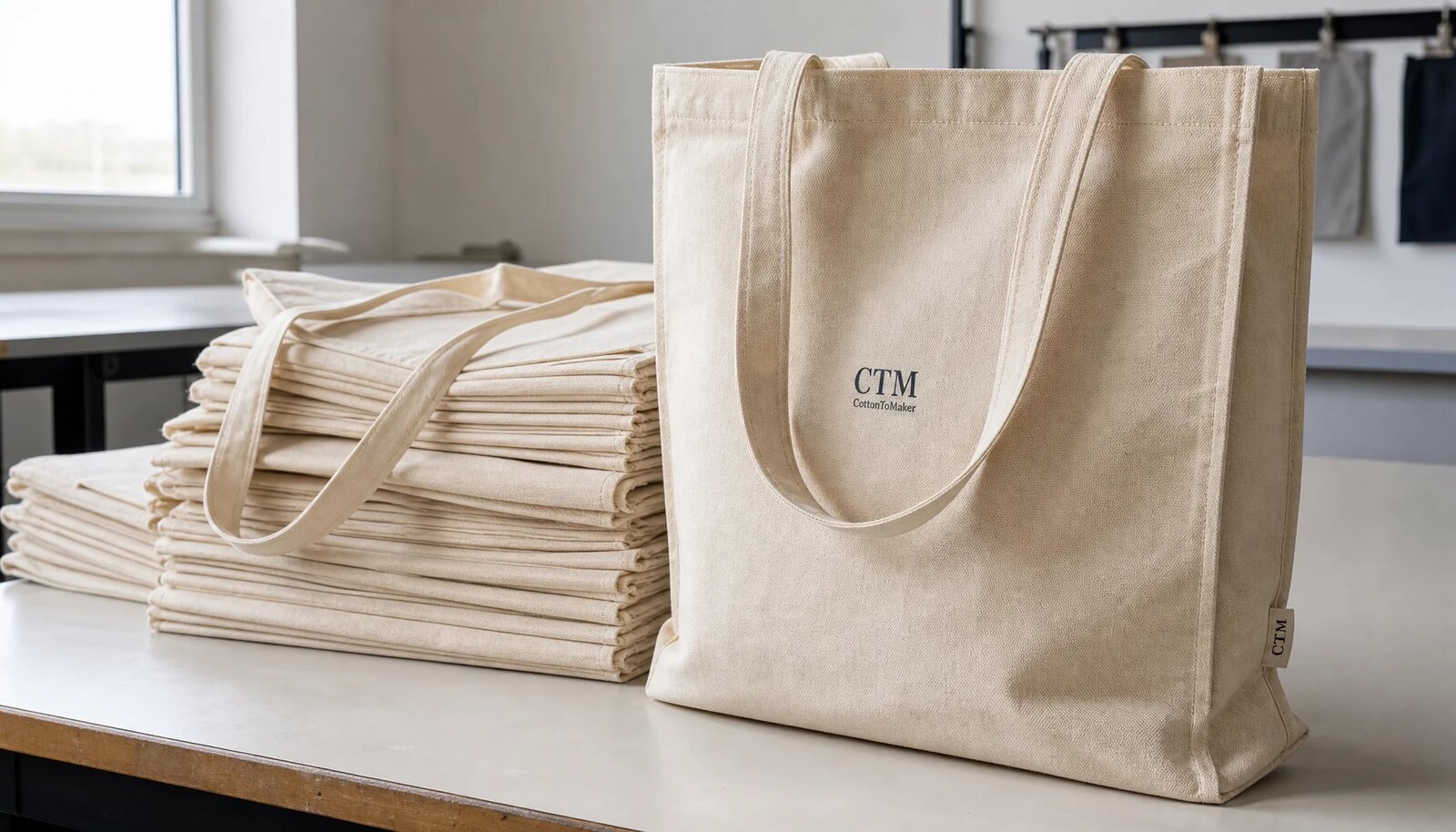
Start with the commercial job
A custom organic cotton tote is not one fixed product with one fair price. For an eco apparel brand, the same-looking bag might be packaging for an online order, a retail carryout bag, a trade-show handout, a gift-with-purchase item, a wholesale showroom tool, or a resale accessory. Those jobs share a visual concept, but they should not share the same pricing assumptions.
The right bulk pricing plan starts with the tote's role in the business. If the bag ships inside apparel orders, folding method, carton cube, and unit-cost control matter more than a premium hand feel. If it is sold as merchandise, the buyer needs better fabric body, cleaner seams, tighter decoration approval, and more careful presentation. If it is for an event, a simple one-color print and a reliable delivery date may be worth more than extra trim detail.
This is also the fastest way to stop vague quotes. Suppliers cannot price accurately when the RFQ says only organic cotton tote with logo. They need to know whether the bag will carry soft garments, boxed accessories, printed matter, or mixed kits; whether it is given away or resold; and whether repeat orders are likely. That context drives GSM, handle drop, reinforcement, print method, packing, and inspection scope.
- Write the use case at the top of the RFQ before listing technical specs.
- Separate must-have requirements from presentation upgrades before negotiating price.
- Decide whether the tote is packaging, marketing collateral, or a retail product.
- Do not compare quotes until suppliers are pricing the same size, GSM, print, and packing.
- For uncertain launch demand, start with one core tote specification and add color or artwork variations only after volume is proven.
Convert brand language into measurable specs
Procurement problems usually start with a good-looking mockup and an incomplete production spec. A logo on the front panel does not define the fabric, finished size, handle length, reinforcement method, print placement, thread color, label position, or carton pack. For bulk sourcing, brand language has to become factory language.
A usable tote spec should include finished body width and height, gusset depth if any, handle width, total handle length, handle drop, target GSM, weave, fabric state, decoration method, print size, print location, label location, thread color, and packing method. Finished measurements matter most. Cut-panel dimensions help the factory, but the buyer receives a sewn bag, and sewing, pressing, and fabric behavior can shift the final size.
Tolerances should be agreed before production, not argued after delivery. For many simple cotton totes, buyers often discuss finished body width and height tolerance around +/-1 cm, gusset tolerance around +/-0.5 cm, handle drop tolerance around +/-1 cm, and print placement tolerance around +/-0.5 cm to +/-1 cm depending on artwork size and factory capability. These are not universal standards. They are practical RFQ starting points. The key is to write the tolerance into the approved spec and use it during inspection.
- Use one unit system across RFQ, sample comments, and PO.
- Define handle drop separately from total handle length so shoulder-carry performance is clear.
- Mark print centerline and distance from top edge instead of saying front print only.
- List thread color, label placement, and inside seam expectation when presentation matters.
- Attach vector artwork and note Pantone, brand color, or approved-sample references for print color.
Build the pricing model before asking for quotes
A strong bulk pricing plan is more than a target unit price. It is a simple model that shows where cost comes from and which variables are worth changing. For custom organic cotton totes, the biggest levers are fabric weight, fabric state, decoration method, construction complexity, packing, and order size. If you know which of those are fixed and which are flexible, supplier quotes become easier to compare.
A practical landed-cost formula is: ex-works unit price plus setup amortization plus samples plus packaging adders plus inland freight plus inspection fees plus export docs plus international freight plus duty or tax plus destination handling. Not every line applies to every shipment, but the buyer should ask for each one explicitly. A quote that only shows sewn unit price hides the real landed cost.
Use this to normalize offers. If Supplier A quotes a lower unit price but excludes screens, cartons, inspection support, and export packing, while Supplier B includes them, the lower number may not be the lower-cost option. The correct comparison is total landed cost at the same spec, same pack-out, same document set, and same delivery term. If a supplier cannot separate included and excluded items, the quote is not yet procurement-ready.
- Normalize every quote to the same spec, same packing, and same delivery term.
- Ask for the exact landed-cost components, not only the ex-works tote price.
- Amortize setup costs over the order quantity before comparing tier pricing.
- Treat samples, screens, label setup, carton changes, and inspection as real cost items.
- If a quote is unusually low, check which cost bucket was moved outside the price.
Choose fabric weight and construction with use in mind
Fabric weight is one of the biggest price drivers. It affects material consumption, cutting yield, sewing behavior, print clarity, carton weight, freight cost, and perceived value. For many apparel-brand tote programs, 140-170 GSM organic cotton canvas or drill is the practical working range. It usually feels substantial enough for branded use while still folding well and keeping freight manageable. Heavier fabrics, such as 180-220 GSM, can make sense for resale totes or more structured merchandise, but they should be chosen for a specific reason, not because heavier sounds better.
A 140-150 GSM tote can work for lightweight event programs, e-commerce inserts, and folded apparel gifts where low bulk and easy packing matter. It should be checked for transparency, wrinkling, and seam visibility. A 150-160 GSM tote is often the balanced option for retail carryout and recurring brand merchandise. A 160-170 GSM tote gives more body and a stronger hand feel, which can help when the tote is part of a premium purchase experience.
GSM alone does not tell the whole story. Two fabrics with the same weight can feel different because of yarn count, weave density, finishing, washing, or bleaching. Ask for a physical swatch from the intended production fabric route, then confirm whether quoted GSM is controlled before or after finishing. The purchase order should state target GSM and acceptable tolerance so a lighter fabric is not substituted quietly to protect margin.
- 140-150 GSM: lighter promotions, apparel inserts, and budget-sensitive programs.
- 150-160 GSM: balanced retail, events, and repeat brand merchandise.
- 160-170 GSM: stronger hand feel for premium carryout, showroom, or light resale use.
- 180-220 GSM: more structured totes, higher cost, higher carton weight, and usually lower pieces per carton.
- Ask for production-roll GSM verification, not only a pre-sale catalog swatch.
Use construction details to protect the price you think you are buying
Low tote prices often come from predictable reductions: lighter fabric, rougher inside finishing, shorter handles, fewer stitches, or weaker reinforcement. That may be acceptable for a very short event handout. It is risky for an apparel brand using the tote to support a sustainability message. Customers do not see the supplier quote. They see handles pulling loose, seams twisting, or a bag that feels disposable.
Handle anchors deserve close attention. The quote should state whether handles are cotton webbing or self-fabric, the handle width, total length, drop, and attachment method. Common reinforcement choices include box stitch, box stitch with cross, multiple rows, and bar-tack reinforcement. The buyer should also ask for stitch density and review the handle angle on the pre-production sample. A handle can be technically attached and still look careless if it is uneven or slanted.
The body format should match the product load. Flat totes are clean, economical, and freight-efficient. Bottom or side gussets help with bulkier garments, boxed accessories, shoes, or gift packs, but they add fabric consumption, sewing time, and dimensional inspection points. If the tote mainly carries folded T-shirts, a gusset may add cost without adding value. If it must stand open at checkout or hold a boxed bundle, the gusset may be worth the extra work.
- Ask for handle width, handle length, handle drop, reinforcement pattern, and stitch density.
- Check whether the handle is comfortable for hand carry, shoulder carry, or both.
- Define seam allowance and inside seam finishing so fraying does not become a bulk defect.
- Use gussets when the product load requires volume, not as a default upgrade.
- Inspect both handle anchors because one good side does not prove the whole run is controlled.
Match decoration to artwork and the buyer's cost target
Decoration changes unit price, setup cost, lead time, defect risk, and the way customers perceive the tote. For bulk organic cotton totes, screen printing is often the most efficient route for simple one-color or two-color artwork. It works well for logos, slogans, capsule marks, and retailer-specific graphics when line widths are realistic and the art file is vector-ready.
Organic cotton has surface texture, so artwork should be checked on the actual fabric, not only on a digital proof. Tiny text, thin strokes, gradients, and large solid ink areas may not reproduce cleanly. Large ink coverage can also change the hand feel of the panel and may create stiffness, blocking, odor, or fold marks if the ink system and curing process are not controlled. A print strike-off is the right gate before bulk printing begins.
Other branding methods can be useful when they support the product goal. A woven side label gives an apparel-style finish with minimal ink. A sewn patch can raise perceived value, but it adds label setup and sewing labor. Embroidery can look premium in a small area, although dense embroidery may pucker lighter cotton fabric. Heat transfer may help with complex designs or smaller runs, but it should be checked for edge lift, cracking, and fold performance.
- Use 1-color screen print as the baseline for cost-efficient bulk pricing.
- Confirm maximum print area and realistic small-text limits on the selected fabric.
- Approve a print strike-off when color, coverage, or placement is important.
- Define print placement by centerline and distance from top edge.
- Consider woven side labels or small patches when subtle branding matters more than a large front graphic.
Plan MOQ and tiered pricing the way factories actually build it
MOQ is tied to production economics, not just supplier preference. Fabric purchasing, dyeing, cutting, print setup, sewing-line planning, label setup, and packing labor all create minimums. A factory may be willing to produce a low quantity, but the unit cost can rise sharply because setup and handling are spread across fewer pieces.
For factory-direct custom organic cotton totes, pricing often becomes more efficient at a few thousand pieces per fabric color and design. Many buyers ask for tiers at 3,000, 5,000, and 10,000 pieces because those levels show where the supplier gains efficiency in fabric purchase, printing, and line planning. The exact breakpoints depend on the supplier, fabric route, and decoration method, so request tiered pricing instead of accepting a single unit price.
MOQ also changes when the order has multiple variables. Two fabric colors, three print designs, and individual barcode packing can behave like several small orders, even if the combined quantity looks large. To improve first-run economics, keep the launch spec simple: one natural fabric color, one size, one print position, one or two ink colors, a standard handle, and flat bulk packing. Add complexity after repeat demand is clearer.
- Ask whether MOQ is by total order, fabric color, bag size, print design, label, or packing format.
- Request price breaks at 3,000, 5,000, 10,000, and the next realistic reorder volume.
- Separate setup charges from unit price so low-quantity economics are visible.
- Keep first orders simple when demand is uncertain.
- For multi-SKU programs, ask how the factory will prevent SKU mixing during packing.
Use sampling and QC as the final pricing test
Sampling should not be treated as a courtesy photo. It is where the quote becomes a production standard. For a bulk tote order, buyers should normally approve a fabric swatch, a lab dip if the fabric is dyed, a print strike-off if decoration quality matters, and a pre-production sample made as close as possible to bulk conditions.
The pre-production sample should be measured, photographed, and commented against the spec sheet. Check finished body width, body height, gusset depth, handle width, handle drop, print size, print placement, label location, seam straightness, stitch density, thread trimming, and packed presentation. If the sample uses substitute fabric, substitute ink, unfinished handles, or approximate labels, it should not be treated as final production approval.
Quality control should define defect classes before the first bulk piece is made. Critical defects include wrong material claim, wrong size beyond tolerance, missing handles, open seams, or mixed SKUs. Major defects include off-center print, weak reinforcement, poor shade match, and unreadable labeling. Minor defects include small thread tails or cosmetic variation within the agreed range. That structure gives the factory a clearer target and gives the buyer a better basis for rework or rejection.
- Approve swatch, strike-off, and pre-production sample in the right order.
- Measure the sample against the spec sheet instead of approving by appearance only.
- Record all approved tolerances before bulk cutting starts.
- Ask the factory to keep one sealed approved sample for production reference.
- Define critical, major, minor, and reworkable defects before production.
Control packing, cartons, and document accuracy
Packing often gets treated as an afterthought, yet it changes both unit price and landed cost. Flat bulk packing usually gives the best carton density and is often the right choice for importers, apparel brands, and fulfillment teams that will distribute totes internally. It also avoids unnecessary packaging when the tote does not need to be retail-ready.
Retail or marketplace channels may require folded packing, hangtags, barcode stickers, paper bands, inner cartons, individual bags, or specific carton marks. Each requirement adds material, labor, and QC steps. Individual bags can protect presentation, but they add packaging cost and may conflict with low-waste positioning. Barcode labels help receiving, but only if SKU discipline is strong. Inner cartons may improve warehouse handling while reducing master-carton density.
Before comparing landed cost, request pieces per carton, carton dimensions, gross weight, net weight, and estimated CBM. A cheaper unit price can become less attractive if the tote is packed inefficiently or if poor carton labeling creates receiving labor. The packing plan should match the purchase order, invoice, packing list, carton marks, and warehouse receiving rules. For buyers under time pressure, document accuracy is not paperwork noise. It is what prevents a clean tote from becoming a receiving problem.
- Use flat bulk packing unless the sales channel requires retail packing.
- Ask for carton dimensions, gross weight, net weight, and CBM before freight comparison.
- Quote polybags, hangtags, barcode stickers, inserts, and inner cartons separately.
- Keep SKU, color, and print-design separation clear in cartons and documents.
- Make carton marks match the purchase order and receiving requirements.
Specification comparison for buyers
| Cost driver | Baseline option | How it changes price | Quote-normalizing question |
|---|---|---|---|
| Fabric weight | 140-160 GSM organic cotton canvas or drill | Higher GSM increases fabric cost, sewing resistance, carton weight, and freight | What GSM will you hold on production rolls, and what tolerance is written into the PO? |
| Fabric state | Natural unbleached | Bleached, dyed, or custom-dyed fabric adds processing, approval steps, and often higher MOQ | Is the quote for natural, bleached, piece-dyed, yarn-dyed, or custom-dyed fabric? |
| Tote format | Flat tote with no gusset | Gussets add fabric consumption, sewing time, and carton cube | Is the quoted price for flat, bottom-gusset, side-gusset, or boxed-bottom construction? |
| Decoration method | 1-color screen print | More colors, embroidery, patches, or transfer work raise setup and labor | What exactly is included in the print price: screens, setup, strike-off, and reprint allowance? |
| Packing method | Flat bulk packing | Retail packing, polybags, inserts, hangtags, and barcode labels add labor and materials | What packing is included, and what is quoted as an add-on? |
| MOQ tier | 3,000-5,000 pcs planning tier | Lower quantities absorb setup over fewer pieces and usually raise unit cost | What are the exact price breaks at 3,000, 5,000, 10,000, and reorder volumes? |
| Sampling and setup | Swatch plus pre-production sample | Sampling, screens, label setup, and courier fees can be material on smaller orders | Which sampling and setup costs are one-time and which are included in unit price? |
| Carton density | Standard flat folding | Poor folding or oversized cartons raise CBM and freight cost | What are the carton dimensions, pieces per carton, gross weight, and estimated CBM? |
| Documentation and QC | Basic export paperwork only | Inspection, test reports, and traceability documents can add cost but reduce claim risk | What organic cotton documentation and QC support are included in the quoted price? |
Buyer checklist before sampling
- Define the tote's job first: retail carryout, wholesale showroom tool, e-commerce insert, gift-with-purchase, event giveaway, staff kit, or resale accessory.
- Write finished dimensions in one unit system and include body width, body height, gusset depth if any, handle width, total handle length, and handle drop.
- Specify material as organic cotton with composition, weave, fabric state, target GSM, and acceptable tolerance.
- State practical load expectations, such as two folded T-shirts, a hoodie, denim, brochures, boxed accessories, or a mixed gift pack.
- Choose the tote format: flat, bottom gusset, side gusset, boxed bottom, self-fabric handle, or cotton webbing handle.
- Define construction details: seam type, seam allowance target, stitch density, reinforcement pattern, thread color, inside finishing, and trimming standard.
- Prepare vector artwork and specify print size, print location, ink color reference, maximum number of colors, and whether registration tolerance matters.
- Decide whether branding uses screen print, woven label, sewn patch, embroidery, hangtag, barcode sticker, or a combination.
- Confirm whether natural, bleached, piece-dyed, yarn-dyed, or custom-dyed organic cotton is required, and request shade approval before cutting for dyed programs.
- Ask what organic cotton documentation can support the intended claim, and keep product copy, purchase order, invoice, packing list, and carton marks consistent.
Factory quote questions to send
- What GSM, weave, and material composition are you quoting, and what tolerance will you hold on production fabric weight?
- Is the fabric natural unbleached, bleached, piece-dyed, yarn-dyed, or custom-dyed, and what approval step is required before bulk cutting?
- What organic cotton documentation can be provided for our intended claim, and will the claim be reflected consistently on quotation, invoice, packing list, and material documents?
- What are the finished dimensions and tolerances for body width, body height, gusset depth, handle width, total handle length, and handle drop?
- How is the tote constructed: side seam, bottom seam, inside edge finishing, seam allowance, stitch density, handle attachment, and reinforcement pattern?
- What MOQ applies by fabric color, print design, ink color count, label type, tote size, and packing method? What price breaks apply at 3,000, 5,000, 10,000, and reorder volumes?
- Which production steps are in-house and which are outsourced: fabric sourcing, cutting, printing, embroidery, label sewing, final QC, packing, and export carton preparation?
- What decoration method do you recommend for this artwork, and what line thickness, small-text size, and maximum print area are realistic on the selected cotton texture?
- Will you provide fabric swatch, lab dip if dyed, print strike-off, and pre-production sample before bulk, and how many approval rounds are included in the quote?
- What sampling cost, screen/setup cost, label setup cost, courier cost, inspection fee, and document cost are separate from the unit price?
Quality-control points to confirm
- Check production fabric GSM from actual rolls, not only from a catalog swatch, and compare it with the agreed tolerance band written into the PO.
- Compare fabric shade and hand feel with the approved swatch or lab dip under consistent lighting before cutting, especially for natural cotton lot variation and dyed programs.
- Measure finished body width, body height, gusset depth, handle length, handle width, and handle drop after sewing and pressing against written tolerances.
- Check handle reinforcement on both sides of the tote, with no skipped stitches, loose knots, broken bar-tacks, uneven box stitches, or off-angle attachment.
- Verify stitch density and seam allowance at side seams, bottom seams, gusset corners, and handle anchors because those areas drive practical durability.
- Inspect inside seams for clean edge control, correct trimming, and no long loose thread ends that become retail defects.
- Check print placement against defined measurements, such as centerline and distance from top edge, rather than visual judgment only.
- Review ink coverage for pinholes, smudging, bleeding, ghosting, registration shift, odor, blocking, or cracking after basic fold and dry-rub checks.
- Check large print areas for stiffness, sticking, surface irregularities, and hand-feel change before the order is packed.
- Verify woven labels, patches, hangtags, barcode labels, and care or composition labels are attached in the approved location, orientation, and SKU sequence.