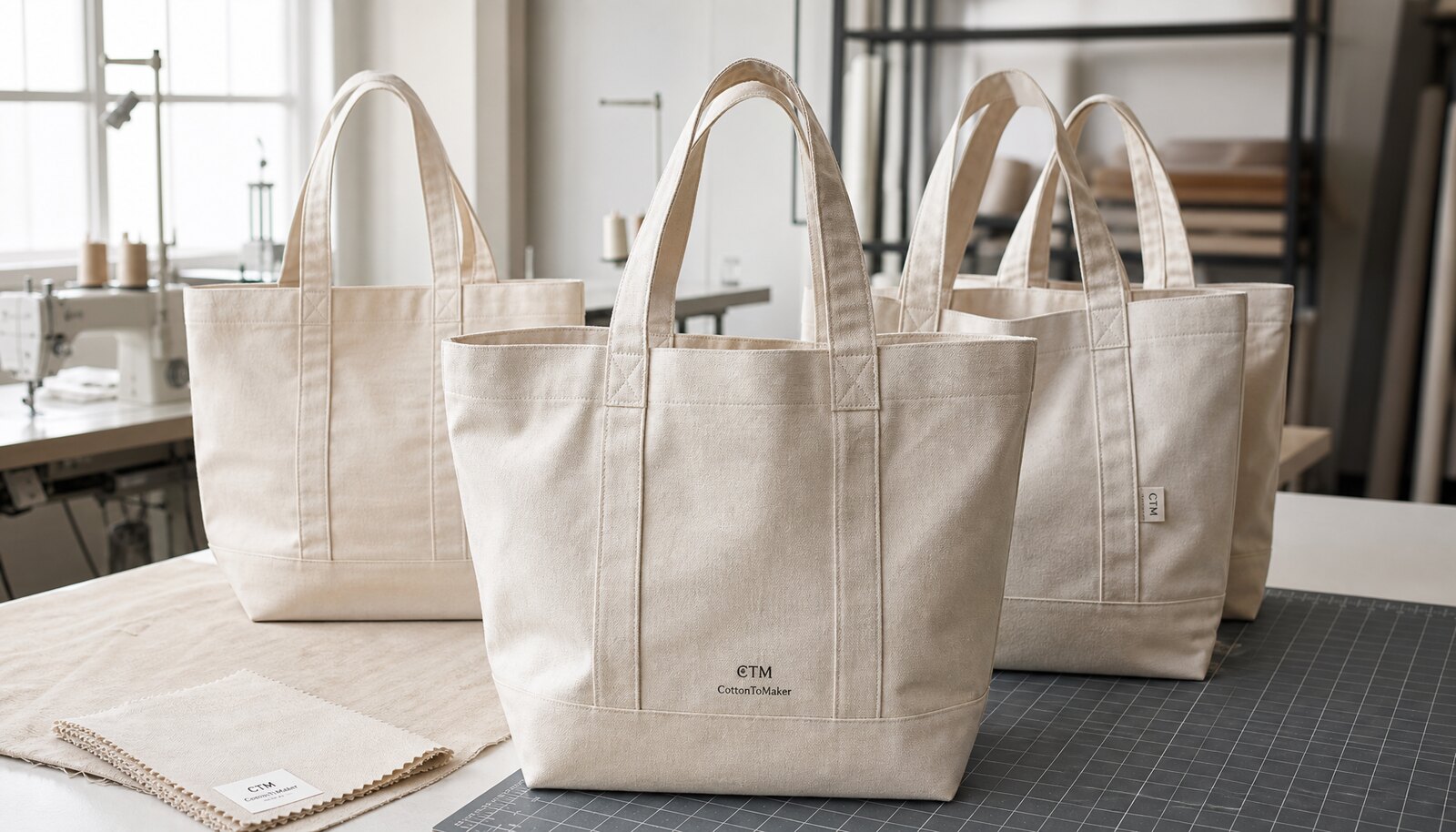
Why the tote should be bought as retail merchandise
For a boutique winery, a custom organic cotton tote is rarely just packaging. It is often a retail accessory, a tasting room upsell, or a gift-ready carrier that needs to look intentional beside bottles, glasses, and cellar-branded items. That changes the buying logic. A buyer who prices the bag only as a giveaway usually under-specs the fabric, accepts weak stitching, and then pays for it later when the tote sits on a shelf looking cheap.
The first procurement decision is simple: will this tote be sold, bundled, or handed out? If it is sold in the tasting room, the bag has to hold up visually and physically like a real product. If it is used for event distribution, the price target can be lower and the construction can be lighter. If the winery expects repeat seasonal orders, the bag should be specified for repeatability, not just for one shipment that happens to be cheap.
That is why a pricing plan matters more than a unit price. Unit price alone hides the real cost drivers, especially when a low quote excludes sampling, print setup, packing, or freight. Procurement gets better results when the tote is treated like a finished SKU with a defined spec, a line-item quote, and a landed-cost view.
- Classify the tote as retail, gift, or event use before you ask for pricing.
- Choose a spec that matches the shelf value of the winery brand, not only the lowest possible cost.
- Plan for repeat ordering if the design will be used every season.
Fix the physical spec before you price it
The fastest way to get inconsistent quotes is to ask suppliers to price an undefined tote. Size, fabric weight, handle length, gusset depth, sewing method, and wash or finish treatment all change the cost. Two bags can share the same dimensions on paper and still behave very differently if one uses lighter cloth or simpler seam construction. For winery buyers, that difference shows up immediately in the hand feel and in the way the bag carries bottles or gift sets.
Start by defining the minimum viable spec. For light event use, 5 oz to 6 oz organic cotton is often enough. For a tote that should feel closer to a sellable accessory, 7 oz to 8 oz gives a more substantial structure and better shelf presence. If the bag must carry a bottle or two, ask the supplier to build in handle reinforcement and a base that does not twist under load. That is a procurement requirement, not an aesthetic preference.
Also define the exact finished dimensions you want after cutting and sewing, not just the fabric width. Ask whether the fabric is prewashed, whether shrinkage is already accounted for, and whether the supplier is quoting raw cloth or finished cloth. If that is left vague, the supplier may price a bag that meets the art file but misses the real merchandising need.
- Define finished size, handle drop, gusset depth, and seam allowance before requesting a quote.
- Choose fabric weight based on use case, not on what sounds premium in a product name.
- Confirm whether shrinkage, washing, or finishing is already included in the cut size.
Fabric weight and construction drive the commercial outcome
Fabric weight is the main price lever, but construction matters almost as much. A 5 oz tote may look acceptable in a quote and still feel flimsy when it is folded, filled, and handed to a customer. A 7 oz or 8 oz version costs more, but it usually holds its shape better, prints more cleanly, and feels more aligned with a boutique winery brand that is trying to sell an experience rather than move a commodity bag.
The comparison should not stop at cloth weight. Buyers should ask about seam construction at the handles, bottom corners, and side seams. A single stitch may be fine for light event use, but a bottle-carry program usually needs stronger reinforcement, such as a bar tack or boxed reinforcement at the handle join. If the supplier cannot explain how the seam is built, the buyer is not comparing like for like.
A practical way to frame the discussion is to ask for three versions of the same bag: light, standard, and premium. Then compare them against the actual use case. For example, a tasting room bag that will carry brochures and one bottle can justify a different build than a retail bag that is meant to sit on a shelf and be sold alongside branded glassware.
- 5 oz to 6 oz works for lighter programs where structure is not the main selling point.
- 7 oz to 8 oz is usually the safer choice when the bag needs shelf presence and better durability.
- Reinforce the handle join and bottom corners if the bag will regularly carry bottles.
Decoration methods and what they do to unit economics
Decoration is where many tote programs go off track because buyers focus on the logo and forget the production method. A simple one-color screen print is often the most cost-efficient choice for bulk organic cotton totes because the setup is straightforward and repeat orders can reuse the same screen. That matters for a winery with recurring seasonal demand or a tasting room replenishment program.
If the brand wants a quieter, more premium look, a small woven label or side label can work better than a large full-panel print. The tradeoff is cost and complexity. A woven label adds sewing time and another line item. A larger print may be cheaper per unit but can dominate the bag visually and make the product feel more promotional than retail. The right choice depends on how the winery wants the tote to sit beside other merchandise.
The quote should spell out the print method in practical terms, not just as a decoration category. Ask for ink type, print size, print placement, and whether the artwork contains fine lines or small text that could break up in production. If the logo has narrow strokes, the buyer should insist on a strike-off and a minimum line width rule before bulk starts.
- Use screen print first for simple logos and repeatable bulk runs.
- Use woven labels when the brand wants a softer, less promotional finish.
- Require a strike-off when the design includes fine type or tight registration.
A practical pricing ladder for 1,000 to 10,000 units
A useful pricing plan starts with a ladder, not a single number. For a boutique winery program, ask the supplier to quote 1,000, 3,000, 5,000, and 10,000 units. At 1,000 pieces, setup charges, sampling, and packing labor usually dominate the per-unit cost. At 3,000, the first meaningful efficiency usually appears. By 5,000, the buyer can often see whether the supplier has true production scale or is just spreading fixed costs more efficiently. At 10,000, freight, storage, and reorder confidence become part of the decision.
A simple planning model can help procurement compare quotes without overfitting to one line item. Example only: if an ex-works bag is $1.05, a print setup amortized across the order is $0.10, packing adds $0.08, and freight plus handling add $0.30, the landed cost is already around $1.53 before duty or brokerage. Another supplier may quote $0.92 ex-works, but if packing is heavier and freight is less efficient, the total can still land higher. That is why buyers need the whole stack, not the factory price alone.
The break point should be visible in the quote. If the supplier cannot show which costs are fixed and which scale with volume, the buyer cannot tell whether a larger order really saves money. This matters for wineries because seasonal programs often repeat, and a bad first-order assumption can distort the next two purchase cycles.
- 1,000 units is a pilot or holiday test, not the best benchmark for efficiency.
- 3,000 units often shows the first real step-down in setup burden.
- 5,000 to 10,000 units is where buyers should test whether the supplier can hold quality while scaling.
Supplier routes and how to compare them fairly
Not all supplier routes should be judged by the same yardstick. A direct cut-and-sew factory is usually the best fit when the winery wants full control over fabric, sewing, decoration, and packing in one PO. That route gives the cleanest spec control, but the buyer has to manage the details carefully because the factory will expect a complete brief. A trading company or sourcing agent can reduce communication overhead, especially when the buyer is running multiple products, but the margin structure may be layered and harder to see.
A local decorator buying imported blanks is the simplest option when the order is very small or when the timeline is tight. It can work for a fast reorder of a basic logo bag, but it is usually weaker on exact fabric control, organic documentation, and custom construction. For boutique wineries, that may be acceptable for a one-off event, but it is usually not the best long-term answer for retail merchandise.
The right comparison is not direct versus indirect. It is repeatability versus convenience. If the winery expects the same tote to return next season, the supplier has to prove that the same fabric, same print placement, and same packing method can be reproduced without re-learning the job.
- Direct factory: strongest control over the finished spec and the best basis for repeat orders.
- Trading company: useful when the buyer values one point of contact, but split costs still need to be visible.
- Local decorator on blanks: best only when speed matters more than customization depth.
Sample approval and QC gates before bulk release
A sample is not a courtesy item. It is the production standard. For custom organic cotton totes, the approved sample should lock fabric feel, print placement, handle length, seam quality, and folding method before bulk cutting starts. If the buyer approves a sample casually, the production lot will often drift in the ways that matter most to retail customers: crooked artwork, uneven handles, or a bag body that looks slightly off compared with the approved reference.
Use a short but strict sample process. First, approve the art strike-off if the design is still being tuned. Then approve the full pre-production sample made from the actual fabric lot. Measure the bag flat, photograph the seams, and compare the print position to the approved drawing. If the tote is meant for carrying bottles, run a static load test using the expected weight and check for seam creep, handle stretch, or twisting at the opening.
For the production run, use a concrete acceptance standard instead of vague language like good quality or acceptable finish. A practical starting point is AQL 2.5 for major defects, AQL 4.0 for minor defects, and zero tolerance for critical defects. The buyer should also define what counts as critical: wrong fabric, missing handles, stained bags, or a print that is materially off-position.
- Approve the actual fabric lot and the actual print strike-off before cutting.
- Measure body size, handle drop, and gusset depth against the approved sample.
- Use a load test that reflects the winery use case, not a generic light-touch inspection.
Packing, freight, and landed cost are where quotes diverge
Many tote quotes look competitive until packing and freight are added. Organic cotton totes are often light but bulky, which means carton volume can matter more than gross weight. If the supplier folds loosely, the carton grows. If the buyer asks for retail folding, barcode stickers, or insert cards, the labor cost grows too. This is why an apparently small packing change can move the landed cost more than a modest fabric price increase.
For import planning, ask the factory to quote carton dimensions, carton count, inner pack count, and gross weight. Then compare those numbers against the destination freight method you actually plan to use. A bulky tote packed too loosely may require more cubic space, which increases freight faster than buyers expect. If the order is small enough that air freight is being considered, the landed-cost penalty can erase the savings from a lower factory price.
Wineries that use seasonal replenishment should also ask about reorder packing consistency. The same tote should fold the same way, fit the same cartons, and ship with the same marks if the brand expects clean replenishment. Otherwise, warehouse receiving becomes a hidden labor cost that never showed up in the quote.
- Request carton dimensions and pack counts as part of the RFQ, not after approval.
- Compare freight on a volume basis as well as a weight basis.
- State whether retail folding, barcode stickers, or insert cards are included or excluded.
RFQ fields that make the quote useful
A buyer-friendly RFQ should force the supplier to price the same product across every bid. The document needs the finished size, fabric weight, color, decoration method, print size, packing standard, inspection standard, target ship date, and the destination basis of trade. Without those fields, every quote becomes a slightly different product and procurement ends up comparing noise instead of cost.
For boutique wineries, it also helps to include the business use case in one sentence. A tote that will be sold in a tasting room is not the same as a tote used for a club shipment insert. The first one may justify better cloth and cleaner finishing. The second one may justify lower cost and simpler packing. The supplier can price more accurately when they understand the use case and not just the dimensions.
A strong RFQ also asks for cost separation by line item. That means fabric, sewing, print, label, packing, freight, and any certification or documentation fees each appear on their own line. This is the only reliable way to see where the supplier is competing on price and where they are absorbing or hiding margin.
- Include finished size, fabric weight, print method, and pack standard in every RFQ.
- Ask for line-item pricing so fabric, labor, and logistics are visible.
- State the winery use case so the supplier does not quote the wrong quality tier.
Reorder strategy for seasonal winery programs
The smartest tote program is one that can be reordered without re-specifying everything from scratch. For wineries, that matters because merchandising cycles are seasonal and club programs often repeat the same item with only a date or label change. Buyers should ask the supplier which setup charges are reusable, which artwork files can be retained, and which production details remain fixed across reorders.
If the brand expects repeat business, lock the spec after the first sample and keep the change log tight. That means the approved fabric weight, thread color, print placement, label style, and packing method all stay the same unless there is a deliberate revision. The more stable the spec, the easier it is to compare pricing across seasons and the less likely the bag is to drift in quality.
A reorder plan should also include the storage and timing question. If the tote is tied to holiday merchandising, the order should be placed early enough that the buyer is not forced into air freight or an emergency alternate supplier. The lowest first-order price is not useful if the replenishment window is too short to make the program work.
- Record which setup costs are reusable on future orders.
- Keep the approved spec stable after the first production run.
- Plan lead time around the winery calendar, not just the factory calendar.
Specification comparison for buyers
| Decision area | Recommended starting point | Why it works for boutique wineries | Commercial check |
|---|---|---|---|
| Fabric weight | 5 oz to 6 oz organic cotton, about 170 to 200 gsm | Good for tasting room giveaways, event bags, and low-cost retail add-ons where the bag carries light content | Confirm finished weight after washing or finishing, not just nominal fabric weight |
| Fabric weight | 7 oz to 8 oz organic cotton, about 240 to 270 gsm | Better shelf presence, stronger hand feel, and a more premium look beside wine accessories | Check whether the stronger cloth needs reinforced handles or a wider seam allowance |
| Bag style | Flat tote with clean hem finishing | Lowest sewing complexity and usually the easiest route for a first bulk order | Make sure the product still fits the bottle or gift format you actually sell |
| Bag style | Gusseted tote with reinforced base | Better when the bag must carry one or two bottles, brochures, or boxed tasting-room gifts | Ask for load testing at the bottom corners and handle join, not just visual approval |
| Decoration | One-color screen print | Best fit for simple winery logos and repeat orders because the setup is reusable | Require strike-off approval and a minimum line width rule for fine text |
| Decoration | Small woven label plus limited print | Works well if the winery wants a quieter, more premium retail look | Check label placement, wash resistance, and whether the label adds sewing steps and cost |
| Supplier route | Direct cut-and-sew factory with print under one PO | Best when the winery wants control over fabric, sewing, decoration, and packing in one spec | Confirm who owns each step and who is liable if print or shade varies |
| Supplier route | Trading company or sourcing agent | Useful if the buyer needs one contact across several products or destinations | Request split pricing for fabric, labor, print, packing, and freight so margin is visible |
| Pricing tier | Quote 1,000, 3,000, 5,000, and 10,000 units | Shows where setup charges stop dominating and where per-unit savings actually begin | If the supplier only gives one price band, you cannot see the break point |
Buyer checklist before sampling
- Confirm tote size, handle drop, seam allowance, gusset depth, and target fabric weight before asking for price.
- State whether the quote must include organic cotton documentation, label stitching, print setup, carton packing, and freight to destination.
- Provide flat artwork and specify print size, placement, ink type, and the exact PMS or CMYK target if color is important.
- Request tiered pricing at 1,000, 3,000, 5,000, and 10,000 units so the setup cost break point is visible.
- Ask for a pre-production sample or strike-off before bulk cutting starts.
- Define acceptable tolerances for body size, handle length, print placement, stitch quality, and carton count.
- Specify whether the quote is EXW, FOB, or delivered, and confirm whether duty, brokerage, and local delivery are included.
- Require the supplier to state what organic documentation they can actually provide for the finished bag and the fabric lot.
Factory quote questions to send
- What exact fabric options can you source, and what is the finished weight after finishing, not just the nominal cloth spec?
- Is the tote produced in your own factory, or is any cutting, printing, or packing subcontracted elsewhere?
- Please split the price into fabric, sewing, print, label, packing, cartonization, inland freight, and export handling.
- What setup charges apply for screens, plates, woven labels, or artwork prep, and which of those are reusable on reorder?
- How does MOQ change if we add a second print side, a woven label, retail folding, or mixed-size carton packing?
- Can you give lead time separately for sample approval, material procurement, production, and shipping?
- What inspection standard do you use for dimensions, stitch defects, print defects, and contamination marks?
- What carton counts, carton dimensions, and gross weight do you expect for this order, and what tolerance do you allow?
- What is the exact cost impact if we request barcode stickers, hang tags, or shelf-ready folding?
- Which documents can you provide for traceability, certification, or transaction records tied to the shipped fabric lot?
Quality-control points to confirm
- Use AQL 2.5 for major defects and AQL 4.0 for minor defects as a practical starting point for consumer tote bags, with zero tolerance for critical defects such as contamination, wrong material, or missing handles.
- Measure body dimensions against the approved sample with a tolerance of plus or minus 0.5 cm, and treat any bag that falls outside the agreed range as a review item.
- Check handle drop against the approved spec with a tolerance of plus or minus 1 cm so the bag hangs and carries consistently in retail use.
- Inspect handle and side seams for reinforcement stitching, even tension, no skipped stitches, and no puckering at load points.
- Run a static load test on the approved sample using the expected bottle or gift weight, and require no seam failure, no handle slippage, and no obvious distortion after the hold period.
- Require print placement to stay centered within the approved tolerance, with no bleed, ghosting, or smear on the finished run.
- Use a tape pull or rub check on the print to confirm ink adhesion before shipment release, especially on simple one-color logos.
- Verify that organic documentation, fabric lot references, label copy, and final carton marks match the purchase order exactly.
- Check carton count, inner pack count, and carton dimensions against the packing list, and reject any shipment with unexplained overages or shortages.