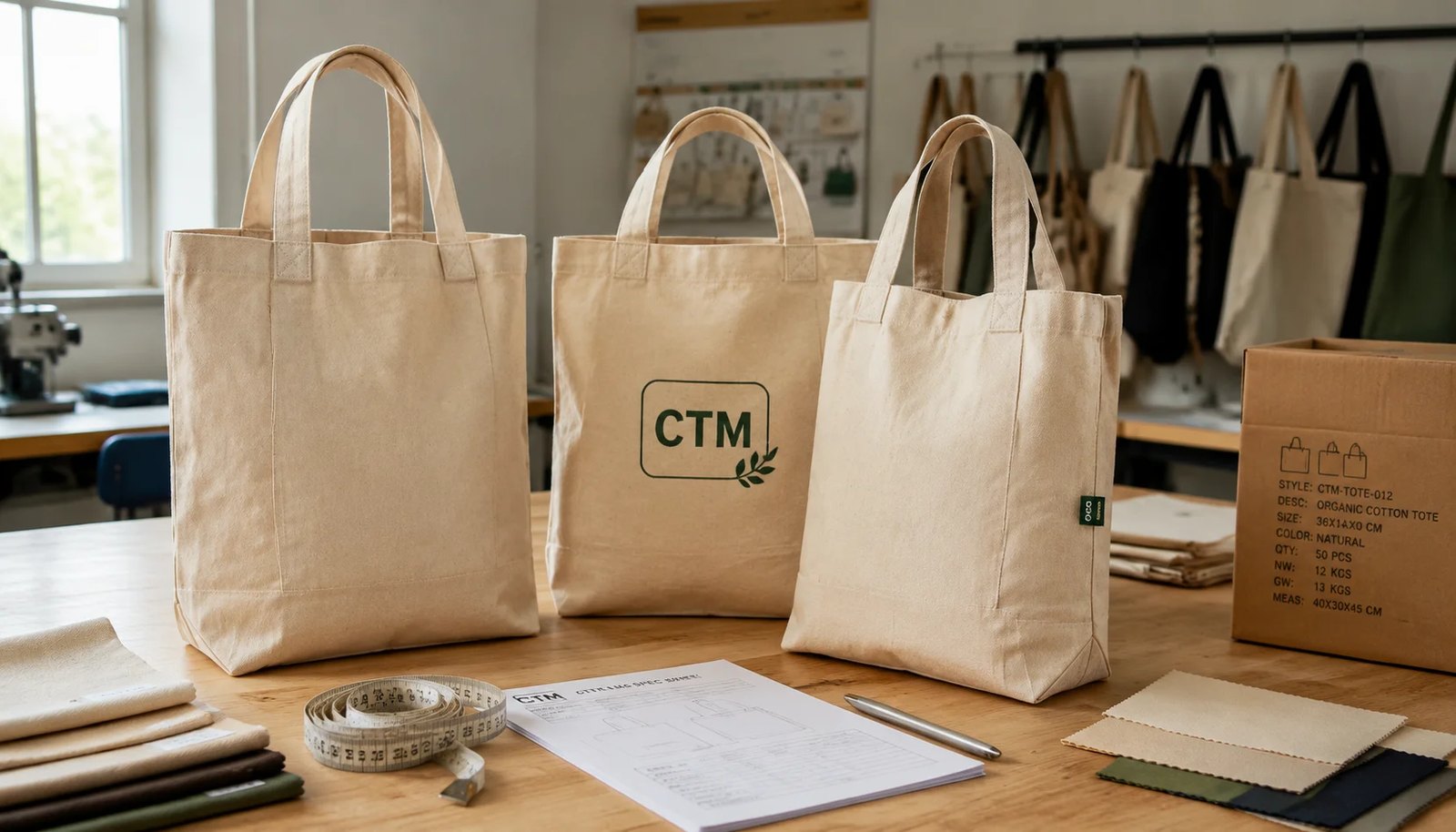
Why natural grocers need a tighter tote RFQ than a normal promo bag brief
The main buying problem with custom organic cotton totes for natural grocers is not finding a factory that can sew a bag. It is getting quotes that look comparable on paper but are built on different assumptions about cotton grade, fabric weight, certification scope, print coverage, packing, and lead time. That is why one supplier appears cheap until the sample arrives too light, too limp, or packed in individual polybags your sustainability team does not want.
Natural grocers also use totes differently from event marketers. The bag may carry produce, glass jars, boxed pantry goods, and weekly shopping loads. It sits near checkout, joins loyalty programs, or sells as a reusable retail item. That means the RFQ has to cover both branding and practical use. If the brief only says 'organic cotton tote with logo,' most factories will fill in the blanks based on their easiest standard, not your shelf and shopper requirements.
- A promo giveaway tote can work at 5 oz to 6 oz; a grocery tote usually performs better at 8 oz to 10 oz.
- Natural fabric variation is normal; if your brand expects a very clean ivory shade, say so early.
- Quote gaps usually come from print area, handle length, gusset style, and packing, not only from fabric.
Choose the tote specification around store use, not around the lowest sample cost
For natural grocers, the body construction should be selected by what the customer will carry. A flat tote is the cheapest pattern and fine for brochures or light dry goods, but it is less stable for mixed grocery items. A bottom gusset, or a side-and-bottom gusset, increases carrying volume and helps the bag sit fuller. It uses more fabric and sewing time, but it usually reduces shopper complaints about shape and capacity.
Fabric weight matters more than many buyers expect. Around 270 to 340 GSM, roughly 8 oz to 10 oz, is the common working range for reusable grocery totes that still need manageable unit cost. Below that range, the bag may look thin after printing and feel too soft under load. Far above that range, cost rises quickly, carton count falls, and the bag starts drifting toward heavy canvas pricing when the retail use may not require it.
- Typical practical grocery size: about 35 to 40 cm width x 35 to 40 cm height, with 10 to 15 cm gusset.
- Handle comfort range: 60 to 70 cm total length for shoulder use, 2.5 to 3 cm width for load comfort.
- Common body finish options: natural unbleached, bleached, piece dyed, enzyme washed, or no wash.
- If the bag will hold wine bottles, jars, or heavier pantry items, request reinforced handle joins.
How to specify organic cotton correctly so quotes do not hide compliance gaps
Buyers often use 'organic cotton' as a broad marketing term, but suppliers may quote very different material chains under the same label. One quote may be based on organic yarn with limited downstream paperwork. Another may include documentation tied through fabric and bag production. If your packaging, website, or retail signage will market the bag as organic, the documentation path matters as much as the fabric itself.
The RFQ should therefore separate the physical tote spec from the compliance claim. State whether you need certified organic fabric only, or whether you need transaction-level support tied to the finished bag shipment. Also state if you need chemical test reports for print and dye inputs because natural grocer programs often face internal sustainability review even when local law does not explicitly require it.
- Write 'organic cotton tote' only if your claim standard is defined internally and understood by the supplier.
- Ask what stage the supplier controls directly: weaving, dyeing, printing, cutting, sewing, or only assembly.
- If the tote is natural unbleached, ask whether seed specks and shade variation are standard and acceptable.
- If hangtags mention organic status, ensure claim wording aligns with the available document chain.
Print method selection: where many grocery tote programs lose time and money
For most natural grocer tote programs, water-based screen printing is the most practical method when artwork is one to three solid colors. It gives a soft hand feel, suits natural fabric aesthetics, and stays cost-effective at volume. But buyers should not assume every logo can be reproduced cleanly on unbleached cotton. Thin serif text, halftones, and very light colors may lose crispness or opacity depending on the fabric surface and print chemistry.
Digital printing can work for photographic artwork or short runs with many colors, but on cotton totes it usually has higher unit cost and less attractive economics once quantities rise. Heat transfer can handle some detailed graphics, yet many grocery buyers dislike the hand feel or perceived durability. A clean RFQ states the preferred print method, maximum print area, Pantone references, and the tolerance for variation on natural cotton.
- For a simple front logo, define print area in centimeters, not 'large logo.'
- If back side print is needed, state whether both sides carry the same art or separate files.
- Natural cotton absorbs ink differently from bleached white; expect some shade shift from Pantone target.
- If exact logo color is critical, approve a physical strike-off rather than only a digital artwork proof.
MOQ logic: reduce cost by standardizing the body, not by squeezing the factory blindly
MOQ on organic cotton totes is usually driven by a mix of raw material booking, print setup, and sewing efficiency. Buyers often try to lower MOQ by asking several factories for exceptions, but the better cost strategy is often to standardize one body size and one base fabric, then split graphics across stores or regions. This keeps material utilization and production planning cleaner while still giving marketing teams some flexibility.
If each artwork also changes size, fabric color, or handle spec, the quote becomes fragmented and each split absorbs setup cost. That is why an importer can get a better landed result from one common 300 GSM natural gusseted tote with four logo versions than from four slightly different tote builds. The unit price may not look dramatically lower on paper, but sample reduction, fewer packing errors, and stronger replenishment planning usually save more overall.
- State MOQ by SKU, but also ask for a blended MOQ if several artworks share one bag body.
- Clarify whether the MOQ is per print colorway, per size, or per order.
- Small test orders often carry higher print and packing cost even when fabric is simple.
- When comparing quotes, check whether overrun or underrun tolerance is stated for bulk production.
Sample approval should cover usability, not only logo appearance
A tote sample is too often approved because the logo looks good in photos. For grocery use, sample review should include loading, handle comfort, shape retention, print rub resistance, and fabric feel after sewing. A bag can look acceptable lying flat on a table yet twist under load because the handles are not aligned well or because the side gusset is cut off grain.
Use at least three sample stages if the program is meaningful in volume: a blank construction sample, a printed sample or strike-off, and a final pre-production sample with approved packing details. If the factory quotes only one sample stage, it may be cheaper initially but much more expensive when artwork, print coverage, or carton count changes after the first review.
- Load test the sample with realistic grocery contents such as jars, produce, and boxed goods.
- Measure actual handle drop from the bag top; shoulder comfort problems often start there.
- Rub the print surface with a dry and slightly damp white cloth if print durability is important.
- Review inside seam cleanliness and thread trimming, especially if the tote is sold at retail.
- Approve carton marks and barcode placement before bulk if goods go through distributor warehouses.
Packing details affect landed cost more than many buyers expect
Packing decisions are not minor admin details on a tote program. They directly change labor cost, carton efficiency, and freight. Many natural grocer buyers want low-waste presentation, so individual polybags may be unnecessary or even rejected. But if units are sold individually on shelf or require barcode protection, some form of inner packing may still be needed. That decision belongs in the RFQ, because suppliers will otherwise quote different assumptions.
Carton count matters too. A thicker 10 oz gusseted tote with long handles may pack far fewer pieces per carton than a light flat tote. If one supplier quotes a slightly higher FOB price but packs more efficiently, the landed cost can still be better. Ask every factory to state units per carton, carton dimensions, and gross weight so freight comparisons are based on math, not assumptions.
- Common bulk packing for grocery totes: folded flat in master carton without individual polybag.
- If adding hangtags, barcode stickers, or belly bands, request separate labor line items.
- Keep carton gross weight practical for warehouse handling; do not optimize only for max fill.
- Request export carton quality level if the program moves through multiple warehouse transfers.
Lead time planning: where organic tote orders commonly slip
Organic cotton tote lead time is usually not just sewing time. It includes fabric availability, certification document flow, print scheduling, sample approvals, and packing material readiness. If the bag is in natural fabric with a simple one-color print, the path can be straightforward. If dyed fabric, multiple store artworks, custom labels, and retailer barcoding are involved, the schedule risk rises quickly even though the product still looks simple from the outside.
A practical RFQ asks the supplier to break lead time into stages rather than giving one final shipping estimate. This exposes whether the real constraint is raw fabric booking, printing capacity, or sample approval. For buyers working to seasonal store rollouts, this matters more than a nominally short bulk lead time that starts only after every approval and material detail is closed.
- Typical stages to separate: sample development, material booking, printing, sewing, final inspection, booking shipment.
- Natural fabric may be faster than custom dyed shades, but shade approval can still cause delay.
- Store-specific barcode or assortment packing often adds hidden days near final packing stage.
- If launch timing is fixed, ask what can run in parallel and what must wait for final approval.
Quote comparison method: build a landed-cost view, not just FOB price ranking
The lowest FOB quote on custom organic cotton totes is often not the best buying result for a natural grocer. One supplier may quote a thinner fabric, smaller print area, shorter handles, or looser packing standard. Another may include stronger sewing, better carton utilization, and cleaner documentation. Without a normalized quote sheet, these offers cannot be compared honestly.
Set up your quote review on at least six lines: unit price, sample cost, print setup if any, packaging adders, carton efficiency, and estimated freight impact. If compliance documentation or third-party testing is required, add that as a visible cost category rather than letting it appear later as a surprise. This method helps procurement defend a higher nominal FOB when it lowers total risk or total landed cost.
- Normalize all quotes to one exact finished spec before negotiating.
- Convert fabric descriptions into comparable units such as GSM and finished dimensions.
- Separate one-time costs from repeat-order costs so replenishment economics stay clear.
- Note which quote includes labels, barcode application, carton marks, or testing support.
- A bag with fewer units per carton may erase a fabric savings once freight is applied.
Practical acceptance criteria that prevent the most common production disputes
Many tote disputes happen because the spec says what the product should be, but not what level of variation is acceptable. Grocery tote programs do not need luxury-bag tolerances, but they do need practical written thresholds. For example, print position tolerance, bag dimension tolerance, and acceptable natural shade variation should be documented before bulk starts. This avoids arguments at shipment stage over issues that were predictable from the material itself.
Quality expectations should also match the retail route. A tote sold folded near checkout can accept some minor natural fabric character. A tote distributed as a premium membership item may need cleaner presentation and tighter trimming. The best RFQ is therefore not the one with the longest spec list, but the one that connects each tolerance to actual end use and retail handling.
- Typical dimensional tolerance example: within about plus or minus 1 cm to 1.5 cm depending on size and construction.
- Print placement tolerance should be stated for horizontal and vertical offset, especially on centered logos.
- Define whether small seed specks are acceptable on natural organic cotton body fabric.
- Set a clear threshold for stain rejection, seam opening, broken stitch, and major skew.
- Keep one sealed approved sample as production reference for factory and buyer-side inspection.
Specification comparison for buyers
| Spec decision | Recommended option | When it fits | Buyer risk to check |
|---|---|---|---|
| Fabric weight | 8 oz to 10 oz organic cotton, about 270 to 340 GSM | Best range for grocery reusability without overpaying for heavy canvas | Suppliers may quote lighter finished weight than requested; state finished GSM tolerance and whether washed or unwashed |
| Fabric color base | Natural unbleached body for core program, dyed colors only for seasonal runs | Works for eco-positioned grocers that want lower material cost and simpler replenishment | Natural shade varies by lot; approve acceptable tone range and seed speck visibility |
| Bag construction | Bottom gusset or side-bottom gusset with cross-stitched handles | Better for produce, jars, boxed goods, and a tote that must stand fuller in use | Flat bags look cheaper in quotes but carry less volume and stress handles faster |
| Print method | Water-based screen print for 1 to 3 solid colors | Best value for grocery logos, slogans, and high-volume repeat orders | Fine lines, halftones, or dark fabric may need pigment adjustment; request print size and placement tolerance |
| Handle length | 60 to 70 cm total handle length, 2.5 to 3 cm width | Comfortable shoulder carry for most adult shoppers | Short handles create retail complaints; wide handles add comfort but change carton count and fabric use |
| MOQ strategy | Use one shared body size across multiple store graphics | Good for chains, regional distributors, and mixed-door programs needing lower print MOQs | Different sizes by artwork split production and raise waste, sampling, and carton complexity |
| Packing style | Bulk packed by style in export carton with inner poly only if required by destination or retailer | Keeps unit cost lower for backroom replenishment and non-gift grocery use | Individual poly may conflict with sustainability goals and adds labor, carton volume, and disposal objections |
| Compliance evidence | Transaction-level organic claim support plus dye and print chemical test reports when required | Needed when buyers market the bags as organic rather than simply cotton reusable bags | Generic 'eco' statements are not enough; ensure certificate scope covers the actual product chain |
Buyer checklist before sampling
- Define finished bag size in centimeters, including gusset depth and handle drop, not only a generic tote description.
- State required finished fabric weight in GSM or oz and whether tolerance applies before or after washing and printing.
- Specify whether the bag must be certified organic as a finished product or only made from organic cotton fabric.
- List print colors by Pantone reference and note if exact visual match is required on natural fabric.
- Clarify print method preference: water-based screen print, pigment print, digital print, or heat transfer, with reason.
- Decide whether natural fabric seed specks and color variation are acceptable as part of the organic look.
- Set handle construction requirements, including handle width, total length, reinforcement stitch pattern, and bartack location if needed.
- State weight-bearing expectation such as produce and pantry use versus giveaway use, so factory can match fabric and stitching.
- Confirm if individual polybags are prohibited, optional, or mandatory for your retail and import program.
- Request carton dimensions, gross weight, and units per carton to compare freight efficiency across quotes.
Factory quote questions to send
- What is the quoted finished fabric weight in GSM, and what tolerance do you apply in bulk production?
- Is the organic claim supported at fabric stage only or through finished bag production documents as well?
- What bag dimensions are included in the quote, including gusset, hem, and handle length?
- How many print colors, print sides, and print area dimensions are included in the unit price?
- Which print method are you quoting, and what artwork limitations apply on natural organic cotton?
- What is the MOQ per size, per color, and per artwork, and can multiple artworks share one fabric lot?
- What sample costs apply for blank proto, printed sample, and pre-production sample, and are any refundable after order?
- What standard packing is included in the quote, and what cost changes if we remove or add individual polybags, hangtags, or barcode labels?
- What carton count and carton dimensions do you estimate for the quoted spec?
- What lead time do you estimate for sampling, material booking, printing, sewing, and final inspection after deposit and artwork approval?
Quality-control points to confirm
- Finished dimensions within agreed tolerance, especially width, height, gusset depth, and handle drop.
- Fabric weight verification against approved standard using finished material, not only greige fabric claim.
- Print color tone and opacity matched to approved strike-off within practical tolerance on natural fabric.
- Print placement centered and square within agreed tolerance; no skewed artwork or major side-to-side drift.
- Seams straight, no open seams, no seam grin at stress points, and no missed stitches at handle joins.
- Handle attachment reinforced consistently on all pieces; cross stitch or bartack must match approved sample.
- No major stains, oil marks, needle damage, mildew odor, or heavy color contamination on natural body fabric.
- Loose thread trimming acceptable for retail presentation without excessive uncut tails inside or outside the bag.
- Carton quantity and assortment match packing list; barcodes and shipping marks readable and placed correctly.
- Drop test or practical weight-load sample retained for reference when bag is intended for grocery carrying use.