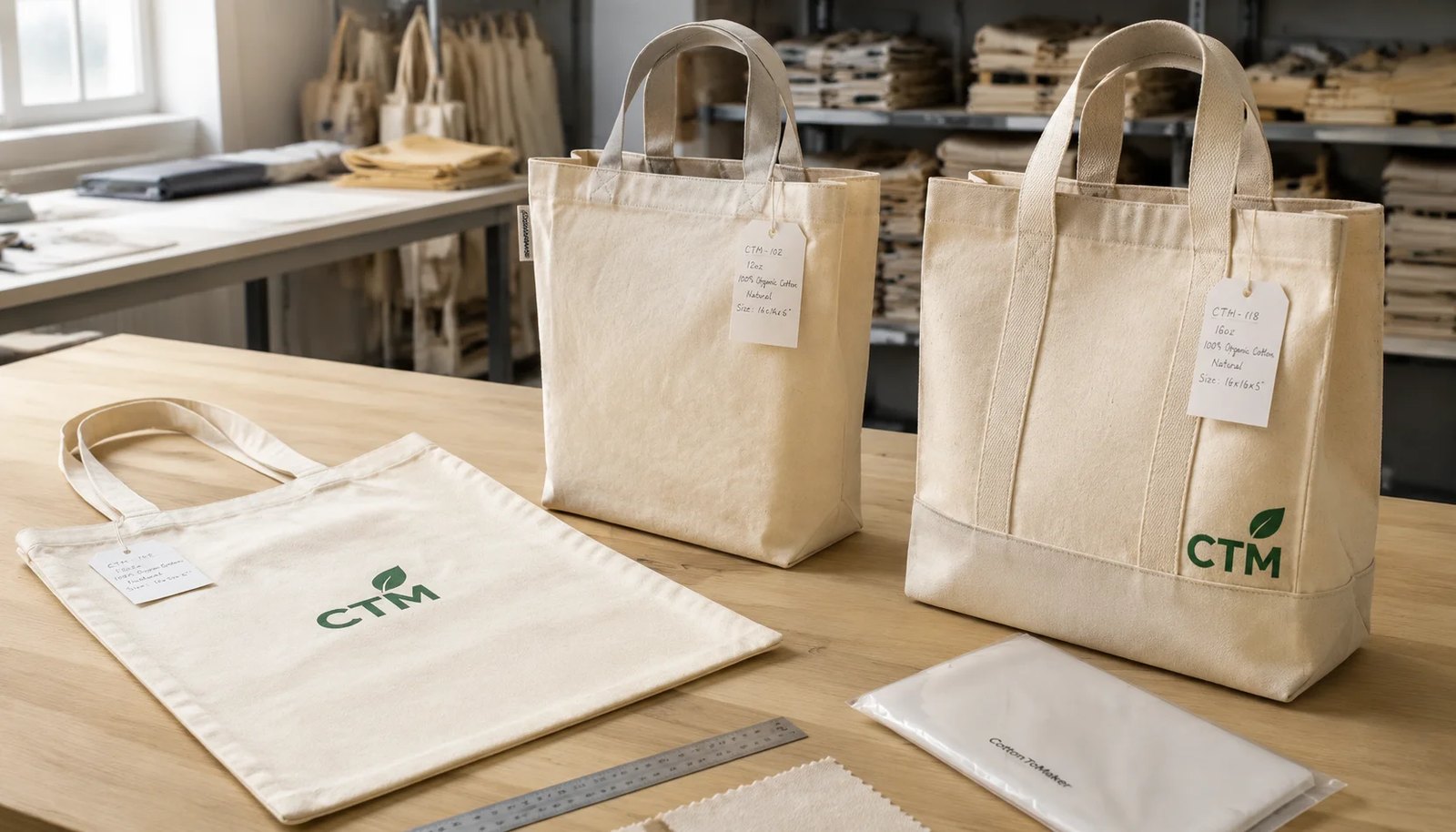
Why material selection is the main cost and performance decision
For natural grocers, the biggest buying mistake is treating all organic cotton totes as the same product with a different logo. They are not. The material package drives almost every outcome that matters to a buyer: unit cost, carry strength, print appearance, freight cube, MOQ flexibility, and customer satisfaction after repeated use. A 5 oz promotional tote and a 12 oz retail tote can both be quoted as 'custom organic cotton bag', but they serve very different programs and should not be compared as if the only difference is price.
Natural grocer use also creates a specific loading pattern. These bags often carry produce, jars, boxed pantry goods, and bottles in mixed weights. That means bottom stress, corner abrasion, and handle pull are more relevant than they would be for a fashion gift bag. If the RFQ only says 'organic cotton tote, custom logo', suppliers will fill in the blanks differently, and quote comparisons will become misleading. A useful material guide starts by choosing the intended load profile, not by chasing the lowest piece price.
- Light promo distribution usually targets lower fabric weight and fewer construction details.
- Checkout resale or loyalty redemption usually needs a stronger fabric and better handle attachment.
- Premium retail merchandise can justify heavier canvas, pockets, gussets, or webbing handles.
- Freight and packing rise quickly once fabric weight and added features increase.
Choosing the right GSM for grocery use, not just a cheaper quote
For most natural grocer tote programs, 8 oz to 10 oz organic cotton is the safest starting point. In GSM terms, that is roughly 270 to 340 GSM, depending on weave and finishing. This range gives enough body for regular grocery use without making the bag too expensive or too bulky for shipping. It also prints well with common one-color or two-color branding. If a buyer wants a foldable giveaway bag, 5 oz to 6 oz can work, but it should be positioned clearly as a light-duty tote rather than an everyday grocery carrier.
At the higher end, 12 oz canvas around 400 GSM gives a more premium hand feel and better shape retention. It works for retail sale, subscription gift packs, or private-label reusable bag programs. The tradeoff is straightforward: higher material cost, more sewing labor, larger carton weight, and potentially higher defect exposure if the factory is not experienced with thicker seams. Buyers should not specify heavy canvas just because it sounds durable. The actual question is whether the store program needs the extra structure badly enough to pay for it.
- 5 oz to 6 oz: best for light promotions, event handouts, or low-cost campaigns.
- 8 oz to 10 oz: best general-purpose range for natural grocer reusable totes.
- 12 oz: best for premium retail positioning and heavier weekly-use programs.
- Include finished GSM tolerance in RFQ, for example plus or minus 5 percent.
- Approve actual production fabric swatch because natural cotton finish affects hand feel.
Plain weave or canvas: the fabric structure changes the bag behavior
Many buyers focus on weight and ignore weave, but weave directly changes how the tote performs. A plain weave organic cotton can feel lighter, fold flatter, and suit value-oriented promotional bags. It is practical when the bag will be distributed in high quantity and packed compactly. For grocery use, though, lighter plain weave can distort more under load, especially if the tote has no gusset and carries boxed or glass items with hard corners.
Canvas weave is usually the stronger and more stable choice for medium- and heavy-duty grocery totes. It supports cleaner structure, better retail presentation, and less stretching in repeated use. The issue is terminology: some suppliers use 'canvas' as a sales word for almost any cotton bag. A better RFQ requests actual weave type, finished weight, and a swatch. If two suppliers quote similar GSM but one uses a looser construction, the lower-cost option may look acceptable in a quotation sheet while delivering a weaker bag in bulk.
- Use plain weave when compact packing and low cost matter more than structure.
- Use canvas weave when shelf presentation and repeated load bearing matter more.
- Require a fabric swatch with weave visible under normal light, not only a PDF spec.
- If washed or softened finish is offered, note that finished size and print sharpness can shift.
Bag shape, gussets, and handles matter as much as fabric weight
A natural grocer tote carrying produce and packaged goods benefits from usable volume, not just panel width. A common buying error is ordering a flat tote with decent fabric weight but no gusset. The bag may technically hold the load, but it becomes awkward, distorts under wider items, and looks overstuffed at checkout. For most grocery programs, a bottom gusset of 10 to 12 cm improves function without making the bag overly complex. For larger-format retail totes, side and bottom gussets give better shape and easier loading.
Handle design is another frequent source of quote mismatch. Some suppliers quote total handle loop length, others quote handle drop. For shoulder-carry grocery use, a full loop length around 58 to 70 cm is common, depending on bag width and target user. Self-fabric handles are acceptable for standard programs, but cotton webbing handles often last longer under repeated heavier loads. If the bag is intended for jars, beverages, or dense pantry items, handle attachment details should be treated as a structural spec, not a decorative one.
- Bottom gusset improves loading for produce containers and boxed goods.
- Side + bottom gusset works better for larger, basket-style silhouettes.
- Clarify handle measurement method: full loop length or drop length.
- Specify handle width, attachment length, and whether cross stitch or box stitch is required.
- If self-fabric handles are used, ask whether they include internal reinforcement or folded multiple layers.
Printing on organic cotton: fit the method to artwork and volume
Natural grocer branding often favors simple, earthy graphics, and that makes water-based screen printing the most practical option for many orders. It is cost-efficient at stable quantities, works well on natural fabric shades, and usually delivers the hand feel buyers want for an organic product line. One-color or two-color logos are especially efficient because setup cost is spread over the run. Screen printing also tends to be the most predictable for repeat programs when the same SKU is reordered seasonally.
Digital printing becomes useful when artwork includes multiple colors, gradients, or smaller test quantities. It can reduce setup friction for short runs, but buyers should watch color consistency and unit cost on larger orders. On natural cotton, absorbency affects ink appearance, so a print proof on paper is not enough. The print strike-off should be done on the actual approved fabric. If the tote uses dark fabric or dyed cotton instead of natural color, colorfastness and ink opacity become much more relevant, which can change both print method and QC thresholds.
- Screen print: best for simple logos, medium to high volume, and repeatability.
- Digital print: best for multicolor artwork, short runs, and seasonal graphics.
- Require print strike-off on actual production fabric, not a substitute fabric.
- State print placement tolerance in millimeters or centimeters on the PO.
- If inside the bag matters to your retail program, specify whether print show-through is acceptable.
MOQ logic: how material and customization choices change your order flexibility
MOQ is not only a factory policy. It usually reflects how many moving parts are being customized at once. A standard natural-color organic cotton fabric with one-color screen print may be possible at a relatively accessible MOQ because the fabric may already be sourced regularly and the print setup is simple. Once the buyer adds dyed fabric, multiple size variants, interior pockets, custom labels, and several artwork versions for regional stores, the practical MOQ per SKU rises even if the factory's headline MOQ sounds low.
This is where many procurement teams compare quotes unfairly. One supplier may quote a low MOQ but only on a standard body shape with one print position and one fabric color. Another may quote a higher MOQ because they are pricing the actual requested assortment. To compare correctly, buyers need to separate MOQ at three levels: fabric color, print design, and finished SKU. That makes it clear whether the quote is operationally realistic or only attractive at the top line.
- Standard natural fabric usually gives more MOQ flexibility than custom dyed fabric.
- Each print design can trigger its own setup and minimum run logic.
- Added trims such as pockets, snaps, or woven labels can raise practical MOQ.
- Ask for MOQ by style, by color, and by logo version rather than one overall number.
- If assortment is split across stores, request cost impact for mixed-SKU production.
How to compare supplier quotes without being misled by a lower unit price
When buyers compare custom organic cotton tote quotes, the cheapest unit price often hides the largest omissions. Common examples include lower finished GSM than expected, shorter handles, no gusset, fewer print colors, lighter stitching, or minimal packing. A useful quote comparison should isolate at least six variables: fabric specification, bag construction, print method, trim details, packing method, and lead-time assumption. If one supplier prices FOB with export carton and another assumes ex-works with minimal packing, the apparent savings are not meaningful.
A practical way to review quotes is to convert them into a landed-cost worksheet by usable bag function, not by headline cost alone. For example, a slightly higher-cost 9 oz gusseted tote with stronger handles may outperform a cheaper 6 oz bag that causes complaints or reorder delays. This matters especially for natural grocers planning recurring programs. A weak first run creates replacement demand, margin erosion, and store-level dissatisfaction. The buyer's job is not to buy the lowest number. It is to buy the lowest total cost for the intended use.
- Line up all quotes against one shared drawing and spec sheet.
- Separate print setup charges from running unit price.
- Note whether sample cost is credited back against bulk order.
- Compare carton pack and gross weight because freight can erase unit savings.
- Treat lead-time assumptions as a quote variable, not a fixed fact.
Sample approval: what to review before bulk production starts
A pre-production sample should answer the practical questions that a quote cannot. On organic cotton totes, buyers should review actual hand feel, body shape after sewing, handle comfort, print sharpness, shade consistency, and folding method. If the sample uses substitute fabric or placeholder print, it is useful only for confirming dimensions, not for final approval. The production sample should be made with the actual selected material package, especially when the bag is targeted for retail sale or repeat grocery use.
It is also worth evaluating the sample under realistic load. Place typical natural grocer items inside: jars, produce, cartons, and boxed goods. This shows whether the opening width is usable, whether the gusset sits correctly, and whether handles twist or strain. Many failures become obvious only after a simple load test. A buyer who approves a sample visually but never tests it functionally is leaving the most important part of the tote unverified.
- Review sample fabric weight, weave, and softness against approved swatch.
- Measure finished dimensions after the sample has relaxed flat on the table.
- Check print position and ink feel on the real fabric.
- Load-test the sample with realistic grocery products, not only paper stuffing.
- Photograph approved details and attach them to the PO for factory reference.
Packing and carton decisions that affect freight, receiving, and store rollout
Packing is often treated as an afterthought, but for imported reusable totes it directly affects landed cost and warehouse efficiency. Most natural grocer tote programs do not need expensive individual retail packaging. Flat packing by dozen in an inner polybag, then export cartons by SKU, is usually enough. This method protects goods from moisture and dirt while keeping freight cube under control. If the tote is intended for direct shelf retail, then barcode labels, hangtags, belly bands, or individual polybags may be justified, but they should be specified intentionally rather than inherited from a previous non-grocery project.
Carton planning also matters for importer receiving. If cartons are too heavy because the bag uses 12 oz fabric and high piece count, warehouse handling becomes slower and damage risk rises. Mixed-SKU cartons can save a little space but often create counting errors and longer receiving time. For most buyers, one SKU per carton with clear carton marking is more reliable. The right packing standard depends on whether the shipment goes to a central DC, a 3PL, or direct store allocation.
- State fold method if logo presentation on arrival matters.
- Use one SKU per carton unless distribution requirements force assortments.
- Request estimated carton size and gross weight before PO approval.
- Add barcode and retail ticketing only if downstream handling actually needs it.
- If print scuffing is a concern, specify interleaving or looser inner pack counts.
Lead time, approval timing, and where schedule risk usually hides
Organic cotton tote timelines are rarely delayed by sewing alone. More often, schedule risk sits upstream in material approval and artwork approval. If the buyer needs certified organic fabric in a specific weight and shade, sourcing or reserving the correct fabric can take longer than expected, especially if the order is split across several SKUs. Printing also creates timing sensitivity because strike-offs, color confirmation, and sample revisions can push the production start back by days or weeks.
A realistic schedule should separate development, sample approval, bulk production, and shipment booking. Buyers should also identify which inputs are standard and which are made to order. Natural fabric with simple print may move quickly once approved. Dyed fabric, multiple labels, or premium packaging will add dependency points. The safest workflow is to freeze artwork and dimensions early, then lock fabric and handle construction before discussing ship dates with internal sales teams.
- Swatch approval and print strike-off approval often decide the real start date.
- Custom dyed fabric usually adds more lead-time risk than natural fabric.
- Multiple artwork versions increase proofing and packing complexity.
- Booking vessel space late can erase any production gains on the factory side.
- Keep an approval log with dates for artwork, fabric, sample, and packing sign-off.
Specification comparison for buyers
| Spec decision | Recommended option | When it fits | Buyer risk to check |
|---|---|---|---|
| Fabric weight for everyday grocery tote | 8 oz to 10 oz organic cotton, about 270 to 340 GSM | Best balance for reusable store tote programs, promo resale, and weekly produce shopping | Quoted GSM may be based on greige fabric, not finished fabric; require finished GSM tolerance and fabric test method |
| Fabric weight for budget giveaway | 5 oz to 6 oz organic cotton, about 170 to 200 GSM | Suitable for event distribution, light retail carry, and price-sensitive campaigns | Too thin for glass jars or heavy pantry items; bottom corner stress and show-through are common failures |
| Fabric weight for premium retail sale | 12 oz organic cotton canvas, about 400 GSM | Good for structured silhouettes, longer life, and higher perceived value on shelf | Higher freight cost, slower drying after printing, and higher sewing difficulty can affect yield and lead time |
| Weave choice | Plain weave for lighter totes; canvas weave for medium to heavy totes | Plain weave works for foldable bags, canvas for durability and shape retention | Suppliers may use 'canvas' loosely; require actual weave description and fabric swatch approval |
| Gusset construction | Bottom gusset 10 to 12 cm for grocery load, side + bottom gusset for larger basket-style use | Better for produce tubs, cartons, and wider packaged goods | Some quotes keep body size constant but reduce usable opening width once gussets are added |
| Handle material and length | Self-fabric handles for value; cotton webbing handles for heavy loads; 58 to 70 cm total length for shoulder carry | Self-fabric suits standard retail tote, webbing suits heavier basket loads and longer life | Handle length is often quoted inconsistently as drop length or full loop length; clarify measurement method |
| Print method on organic cotton | Water-based screen print for simple logos; digital print for multicolor short runs | Screen print fits most natural grocer branding, digital fits seasonal artwork and lower quantity tests | Dark ink on natural cotton can vary by absorbency; require print strike-off on actual production fabric |
| Closure and inner features | No closure for base grocery use; add inner pocket or snap only for paid retail programs | Keeps unit cost controlled unless the bag is positioned as a premium accessory | Added trims can push MOQ up and slow production because multiple components need matching |
| Packing method | Flat packed by dozen in polybag, export carton by size and color, barcode label only if retail-ready | Best for importer receiving, easier counting, and lower freight cube than individual retail packing | Over-packing each bag inflates labor and carton volume; under-packing can cause print rubbing and wrinkles |
Buyer checklist before sampling
- Define the real use case first: giveaway, loyalty program, checkout resale, or premium merch, because the correct GSM changes with expected load and retail price point.
- Specify finished fabric weight in GSM or oz, not only 'organic cotton canvas', and include allowed tolerance such as plus or minus 5 percent.
- State whether the fabric must be certified organic at fiber stage, fabric stage, or finished bag stage, and what document format your compliance team accepts.
- Lock body size, gusset size, and handle measurement method in one drawing so suppliers do not quote different constructions under the same dimensions.
- Match print method to artwork complexity and volume: screen print for simple logos and stable repeat runs, digital for short runs with multicolor graphics.
- Request a pre-production sample in the actual fabric, actual print colors, and actual handle construction before bulk approval.
- Define carton quantity, individual bag folding method, barcode label placement, and whether inner polybags are required for retail or only for moisture protection.
- Set acceptance criteria for seam strength, print placement tolerance, shade variation, fabric defects, and final carton count before issuing the PO.
Factory quote questions to send
- What is the exact finished fabric specification in GSM, weave, yarn count if available, and color after washing or finishing?
- Is the quoted fabric certified organic, and does the certification cover raw fiber, dyed fabric, or the finished bag supplier in the chain?
- What bag dimensions are included in the quote, and are handles measured as full length or handle drop?
- Does the quote include bottom gusset only or side and bottom gussets, and what is the finished usable opening width after sewing?
- What print method is assumed, how many print colors are included, and is a print setup charge separated from unit cost?
- What MOQ applies to each fabric color, each print design, and each bag size if we split the order across several store SKUs?
- What sample stages are available: blank fabric swatch, print strike-off, sewn pre-production sample, and shipping sample from bulk lot?
- What packing method is included in the quote, including fold method, pieces per polybag, pieces per carton, carton dimensions, and estimated gross weight?
- What production lead time is based on lab dip approval, print approval, and deposit receipt, and which materials are on stock versus made to order?
- What quality standard is used for bulk inspection, and how are seam defects, fabric knots, print offset, and size tolerance classified?
Quality-control points to confirm
- Finished fabric weight should be verified on production fabric, not only mill declaration; keep tolerance clearly stated in the PO.
- Bag body dimensions and gusset depth should be measured after sewing and packing relaxation, using agreed tolerance by size.
- Handle attachment must be checked for stitch count, back tack consistency, and alignment from top edge to avoid uneven carry load.
- Print position should follow approved artwork placement with defined tolerance, especially on gusseted bags where center shifts easily.
- Natural cotton shade variation should be controlled against approved standard; mixed lots from different fabric rolls should be avoided in one SKU carton.
- Needle damage, slub holes, oil marks, loose threads, and skipped stitches should be recorded by defect category before packing.
- Carton count, carton marking, barcode labels, and assortment ratio must match packing list to prevent receiving errors at importer warehouse.
- Random drop and rub checks on packed goods help catch print offset, abrasion, and handle twisting before container loading.