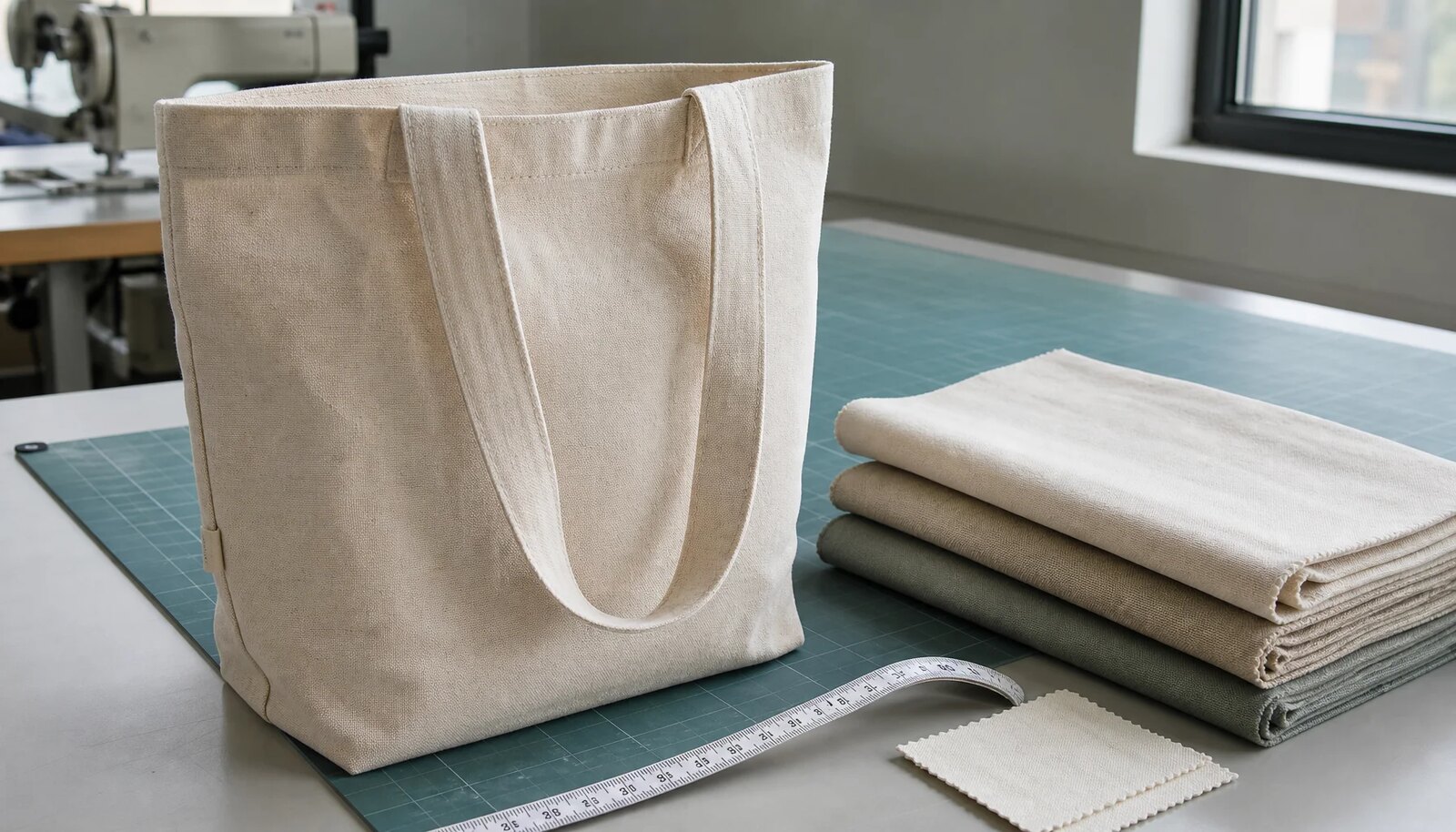
Start With the Event Load
A custom organic cotton tote specification should begin with the job the bag has to do. For an event planner, the tote is not only a branded carrier. It sits in the registration line, carries sponsor materials, affects attendee comfort, and may appear in photos long after the venue closes. Fabric weight matters, but it should follow the event load rather than lead the decision.
Build the spec around the heaviest realistic kit, not the neatest sample layout. A folded agenda, badge, and leaflet create a very different load from a notebook, stainless bottle, boxed sponsor gift, folded hoodie, and printed catalog. Dense items pull on handle seams. Sharp box corners can stress side seams even when the total weight looks modest on paper. If bags will be pre-packed by a fulfillment team, they also need to survive carton handling, pallet movement, venue receiving, and repeated lifting before attendees ever use them.
Expected lifetime is the next filter. Some events need a straightforward one-day literature bag. Others want a reusable attendee tote that feels appropriate for a paid conference, VIP gift, university program, brand launch, or retail-style merchandise table. A short-use bag can be lighter if the contents are light and the event team accepts a softer shape. A reusable tote needs better handle reinforcement, cleaner seam work, more careful print testing, and often a heavier fabric body.
- List every planned kit item, including bottles, books, boxed samples, apparel, and sponsor inserts.
- Estimate total filled weight in kilograms or pounds and identify the heaviest single item.
- Decide whether the tote is a one-day handout, a standard conference kit bag, or a reusable merchandise item.
- If bags ship pre-packed, include carton compression, fold marks, and fulfillment handling in the quality brief.
- Mock-pack the actual contents before approving final dimensions, especially when the tote has a gusset.
Know What GSM Really Tells You
GSM means grams per square meter. Some suppliers also quote ounces per square yard. Both describe fabric area weight, not finished-bag strength. As a reference, 1 ounce per square yard is about 33.9 GSM, so a 6 oz fabric is roughly 203 GSM. That conversion helps compare supplier language, but it should not become the whole specification.
A GSM number does not tell you everything that affects performance. Weave density, yarn quality, finishing, shrinkage, seam allowance, and handle construction all change how a tote behaves. Two suppliers may both quote 220 GSM organic cotton and deliver very different hand feel. One fabric may be a tighter plain weave with a smooth print surface. Another may be a looser canvas with more visible slub and a softer structure. Both can be legitimate, but they are not interchangeable in a procurement comparison.
Ask for finished fabric GSM. This phrase matters. Some quotes are based on greige fabric before dyeing, washing, calendaring, bleaching, or compaction. Other quotes refer to finished fabric after those processes. Finishing can change measured weight, surface feel, shade, and shrinkage. If the tote will be dyed or washed, confirm whether the stated GSM is before or after that work.
Use weight ranges as a buying guide. Around 150-170 GSM suits very light literature bags and tight freight targets. Around 180-220 GSM is the practical midweight zone for many conference totes. Around 230-280 GSM gives a more substantial hand for premium kits. Above 300 GSM, the bag can feel structured and retail-oriented, but fabric cost, sewing time, carton weight, print handling, and folding stiffness all rise.
- Ask whether GSM is measured before or after finishing.
- Request the normal GSM tolerance, stated as a plus-or-minus range or percentage.
- Compare the same color state: natural, bleached, dyed, and printed fabrics can feel different at similar GSM.
- Use ounce-to-GSM conversion only as a reference, then approve by measured sample and hand feel.
- Keep a swatch from the approved fabric lot when possible for later inspection comparison.
Choose a Weight Range by Use Case
The best custom organic cotton totes fabric weight guide for event planners is practical: match weight to contents, presentation level, and delivery constraints. A roadshow bag for flyers and badges does not need the same build as a sponsor gift tote carrying a drink bottle and apparel. A high-volume trade show may value fast distribution and lower freight volume. A premium summit may value shape, texture, and reuse.
For lightweight handouts, 150-170 GSM can work when the contents are flat, the event is short, and the bag is not expected to stand upright. This range can reduce fabric consumption and carton weight, but it may show contents, wrinkle more visibly, and distort under large ink coverage. It is rarely the right choice for dense books, bottles, or heavy boxed items unless the construction is tested carefully.
The 180-220 GSM range is often the balanced starting point for conference programs. It usually gives enough body for programs, notebooks, small apparel, badges, and sponsor inserts without pushing freight and folding bulk too high. Still, do not assume all 200 GSM totes are equal. Handle reinforcement and seam quality decide whether the bag feels trustworthy when filled.
Heavier canvas, roughly 230-280 GSM, suits VIP kits, retail-style event merchandise, reusable attendee bags, and heavier inserts. It improves perceived value and structure, but it raises unit cost and can require more careful print testing. Above 300 GSM, the tote becomes a more structured textile product. That can be the right call for high-value programs, but check needle selection, seam bulk, folding method, and carton plan before approving bulk production.
- 150-170 GSM: flyers, badges, light sponsor literature, and short indoor events.
- 180-220 GSM: conference kits, notebooks, small apparel, program packs, and moderate reuse expectations.
- 230-280 GSM: premium kits, heavier inserts, retail-style giveaways, and higher perceived value.
- 300 GSM and above: structured reusable totes where higher sewing cost and freight volume are acceptable.
- For bottles, boxed samples, or books, test the loaded sample instead of relying on GSM alone.
Specify Construction Before Pricing
Construction is where many tote quotes quietly drift apart. Two bags with the same organic cotton GSM can perform very differently if one uses narrow handles, minimal seam allowance, and a simple stitch while the other uses wider handles, reinforced attachments, and a stronger bottom seam. Procurement teams should put these details into the RFQ before suppliers price the job.
Start with finished dimensions. Width, height, gusset depth, handle width, and handle drop should be written as numbers. Reference photos help communicate style, but they do not control production. Handle drop is especially important because it affects comfort and the way the tote hangs when filled. A short drop may work for hand carry. A longer drop can support shoulder carry, but it can also change balance and perceived length when the bag is loaded.
Name the reinforcement method. Bar tack, box stitch, cross stitch, double row stitching, or reinforced patches should not be left to factory habit when the bag carries event kits. Ask for close-up photos or a construction sample before production. Stitch density should suit the fabric. Loose stitches can weaken seams. Overly tight stitching on heavier cotton can cut fibers or cause puckering.
Gussets need the same attention. A flat tote is simple and efficient, but it may not pack bulky items well. A side or bottom gusset increases capacity and improves the filled shape, though it changes fabric consumption, print layout, folding method, carton volume, and sewing time. If the tote will be used for welcome kits, place the actual contents inside the sample and check the opening, bottom shape, and handle angle.
- Write finished body width, height, gusset depth, handle width, and handle drop into the RFQ.
- State seam allowance expectations if the bag needs a defined strength or appearance standard.
- Name the handle reinforcement method rather than accepting an unspecified factory standard.
- Confirm whether seams are single stitched, double stitched, overlocked, bound, or folded.
- Check sample performance with the real event load before releasing bulk production.
Account for Organic Cotton Appearance
Organic cotton is a material claim. It does not mean every tote will look perfectly identical. Natural unbleached cotton often includes small flecks, seed particles, slubs, or slight shade variation. Many buyers like this because it signals a natural textile. In other settings, such as a luxury product launch, medical conference, or minimalist corporate program, the same variation may feel too irregular. Decide early what is acceptable.
Color state changes both appearance and process risk. Natural cotton has a warmer tone and visible fiber character. Bleached cotton can look cleaner, but it involves additional processing. Dyed organic cotton introduces shade matching, colorfastness, and lot-control questions. If body panels, handles, and labels are cut from different lots, a mismatch may appear even when each part is individually acceptable.
Certification language also needs precision. A supplier may support an organic cotton fiber claim, but that is not automatically the same as finished-product certification or permission to use a certification logo on a hangtag. Ask for the documents required for the claim your organization intends to make. Certificate scope, supplier name, product description, transaction documents when applicable, invoices, and shipment quantities should align before purchase order release.
If the event does not need consumer-facing certification labeling, say that clearly. Procurement can still request organic cotton material documentation without printing certification marks on the product. This reduces confusion and helps suppliers quote the correct document and labeling requirements.
- Approve the natural shade range with a signed sample or physical swatch.
- Define acceptable levels of slubs, specks, seed marks, and fiber variation.
- Ask whether the body, handles, labels, and trim come from the same or different fabric lots.
- Confirm organic document requirements before purchase order release, not after packing.
- Do not use certification logos unless scope, permission, and labeling rules are confirmed.
Match Print Method to Fabric Surface
Decoration should be selected after fabric weight, color, and surface are known. Screen printing is often the practical option for event totes with one or two solid colors, especially at larger quantities. It can produce clean branding at a controlled cost when the factory manages screen tension, ink deposit, registration, and curing. The same artwork, however, may look different on loose natural cotton than on a smoother finished canvas.
Ink choice affects hand feel, opacity, and durability. Water-based inks can feel softer when specified and cured correctly. Heavier ink deposits can sit more on the surface and may stiffen lighter fabric, especially across a large solid logo. Fine text can fill in on coarse cotton. Thin lines can visually break across slubs or seed marks. Review artwork at actual size on the final fabric color before approving the print plan.
Transfers and digital decoration can work well for full-color artwork, gradients, small runs, or regional event versions. They also create different risks: surface feel, edge marks, fold durability, heat sensitivity, or reduced flexibility. Embroidery can look premium but may pucker light fabric and is usually not ideal for very large filled areas. Woven labels and patches can lift perceived value, but their attachment points need inspection.
Print placement should be measurable. A phrase such as center front is not enough for bulk inspection. State the distance from the top edge, the horizontal centerline requirement, the print area, and the placement tolerance. If the bag has a gusset or a large front pocket, confirm whether the print is centered on the flat panel or the full bag width.
- Use screen print for simple logos, solid colors, and larger repeat quantities.
- Use transfer methods when full color, gradients, short runs, or versioned artwork matter more than soft hand feel.
- Test embroidery, patches, or woven labels on the chosen fabric before bulk approval.
- Specify print size, print location, color reference, and placement tolerance in measurable terms.
- Check cure, rub resistance, fold marks, edge definition, odor, and offset before packing approval.
Build RFQs Suppliers Can Actually Compare
A strong RFQ prevents an incomplete quote from looking attractive. If one supplier prices 220 GSM organic cotton with bar-tacked handles, individual packing, carton labels, and inspection support while another assumes 170 GSM, simple stitching, and bulk packing, the unit prices are not measuring the same product. Send one controlled specification to every supplier and ask them to mark exceptions line by line.
Quantity tiers make the quote more useful. Tote pricing changes with setup, cutting efficiency, printing screens, material minimums, labor, packing, and freight. Ask for realistic tiers such as 1,000, 3,000, 5,000, and 10,000 pieces if those volumes fit your program. A tiered quote helps determine whether consolidating several regional event orders will reduce cost or simply move cost into freight and storage.
Separate quote lines protect the buyer. Unit bag price, decoration setup, screen or plate charges, sampling, woven labels, hangtags, individual packing, carton marking, inspection, inland freight, and export freight should not be buried in one number. For organic cotton programs, document handling and claim requirements may also affect cost and timing. Clear line items make negotiation more factual and help finance teams understand the landed price.
Use the same Incoterms and delivery point when comparing suppliers. A low ex-factory unit price may not be cheaper after inland transport, export handling, duties, inspection, and delivery to the venue or fulfillment center. For event work, the useful number is not only unit cost; it is the cost of correct bags arriving clean, on time, and ready to distribute.
- Include size, GSM, weave, color state, handle spec, reinforcement, print method, print area, quantity tiers, packing, destination, and document requirements.
- Attach artwork files, color references, and placement diagrams to the RFQ.
- Ask suppliers to list every deviation from the requested specification.
- Separate pricing for bag, decoration setup, labels, packing, sampling, inspection, and freight.
- Compare the same Incoterms, destination, lead time, and inspection assumptions.
Use Sampling to Remove Guesswork
Sampling is where the sourcing plan becomes real. A concept sample can confirm general proportions and visual direction. A pre-production sample should represent the actual production method: intended fabric weight, color state, handle construction, print method, label, fold, and packing. Treat those as different approvals when the timeline allows.
Measure the sample. Body width, body height, gusset depth, handle drop, handle width, print position, print size, seam finish, and reinforcement placement should be checked with a ruler. A finished bag weight can be useful for reference, but it does not replace fabric GSM because size, handles, labels, ink, and packing all affect total bag weight. If needed, request a fabric cutting from the same lot for area-weight checking.
Use the real event contents during approval. Fill the tote, lift it, let it hang, set it down, and inspect handle stretch, seam stress, print distortion, and bottom shape. This practical check does not replace formal lab testing when a buyer requires it, but it catches many problems that appear only when the bag is used as intended.
Keep control samples organized. The approved sample should be signed, dated, photographed, and referenced in the purchase order. If there are separate approvals for fabric shade, print color, label, and packing, keep those records together. Inspection teams need a standard they can compare against, not a chain of email descriptions.
- Approve concept sample and pre-production sample as separate steps when timing allows.
- Make the pre-production sample from intended bulk fabric whenever possible.
- Measure dimensions and print placement with tools, not by eye.
- Reject samples that are hand-corrected in ways bulk production will not repeat.
- Keep an approved reference sample for inspection and future reorders.
Define QC Tolerances Before Bulk Production
Quality control works best when it is agreed before cutting starts. Without tolerances, buyer and supplier end up debating taste after production is already finished. Dimension tolerance, print placement tolerance, shade range, defect classification, and packaging standards should be written into the purchase order or inspection checklist.
For cotton totes, practical tolerance bands are usually necessary because cutting and sewing fabric is not the same as molding plastic. Body dimensions may allow modest variation. Print placement often needs tighter control because an off-center logo is obvious on a registration table or in event photos. Handle mismatch, twisted bodies, heavy puckering, broken seams, oil marks, dirt, mildew odor, loose threads, and uncured ink should be classified clearly.
Natural cotton needs its own standard. If flecks, seed marks, and slubs are acceptable, record the accepted range on the signed sample. If dark specks near the logo or front panel are not acceptable, define that. A vague instruction such as clean natural cotton leaves too much room for dispute.
Inspection should include visual and functional checks. Open the bag, pull the handles by hand, review seam stress with a sample load, rub the print after curing, confirm counts, and check carton marks against the packing list. For larger orders or strict procurement policies, use an agreed sampling plan or third-party inspection. The point is simple: event-day problems are expensive because there is rarely time to repair, replace, or reprint.
- Set dimension tolerance for width, height, gusset depth, and handle drop.
- Set print placement tolerance from the top edge and horizontal centerline.
- Define major defects such as broken seams, wrong artwork, wrong size, severe stains, mildew odor, or uncured print.
- Define minor defects such as trim threads, slight shade variation within approved range, or small natural fiber marks.
- Check carton quantity, carton marks, packing list, purchase order, and destination details before shipment release.
Control Packing, Cartons, and Delivery Timing
Packing is part of the product for event planners. A tote can pass sewing inspection and still arrive in a way that slows fulfillment or weakens presentation. Bulk flat packing is efficient and often right for cost-sensitive programs. Individual packing, paper bands, hangtags, or kit-ready folding may be worth the added cost when bags are handled by a fulfillment center, shipped to multiple venues, or presented as premium sponsor gifts.
Confirm packing details before production approval: fold style, pieces per inner bundle, pieces per export carton, carton dimensions, carton gross weight, carton marks, and pallet requirements. Heavy cotton totes can push carton weight up quickly. Overpacked cartons may crease prints, distort handles, or make boxes difficult for venue staff to move. Underpacked cartons increase freight volume. The best plan balances protection, labor, carton handling, and landed cost.
Printed totes may need cooling or set time before folding. If ink is packed too soon, prints can offset, stick, smell, or mark the opposite panel. Ask the supplier what cure checks, cooling time, rub checks, and folding process they use. This is especially important for large print areas and heavier ink deposits.
Break the schedule into visible steps: fabric availability, sampling, sample approval, cutting, sewing, printing, curing, inspection, packing, freight handoff, customs, inland delivery, fulfillment, and venue receiving. For organic cotton programs, document review may also need time. Work backward from the date the totes must be physically available at registration, not from the event start date. A production completion date is not the same as bags ready for attendee pickup.
- Specify fold style, inner bundle quantity, individual bagging, hangtags, carton marks, and pallet requirements.
- Approve carton dimensions, gross weight, and pieces per carton before shipment.
- Ask whether print requires cooling or set time before folding to avoid offset.
- Confirm moisture protection for long ocean transit or warehouse storage when relevant.
- Build schedule buffers for artwork approval, sampling, inspection, customs, fulfillment, and venue receiving.
Specification comparison for buyers
| Spec decision | Recommended option | When it fits | Buyer risk to check |
|---|---|---|---|
| Supplier route | Direct cut-and-sew factory with documented printing process | Medium to large event runs where fabric, sewing, decoration, packing, and shipment timing must be controlled from one production plan | If printing is subcontracted, confirm who approves ink cure, registration, rework, and final inspection |
| Supplier route | Trading company with named factory capability and sample control | Standard tote programs where the buyer wants one communication point but still needs production transparency | Ask whether the quote is based on an actual factory cost sheet or a generic catalog tote |
| Supplier route | Blank tote plus local decorator | Small rush orders, regional events, or late artwork changes where existing blanks are acceptable | Fabric weight, sewing quality, and organic claims may be fixed before decoration and harder to verify |
| Fabric weight | 150-170 GSM, light canvas or plain weave | Very light literature bags, short indoor events, low load weight, and tight freight targets | May show contents, lose shape when empty, and distort under large ink coverage |
| Fabric weight | 180-220 GSM, midweight organic cotton | Most conference totes carrying programs, notebooks, small apparel, badges, and sponsor inserts | Confirm finished GSM tolerance and handle reinforcement so the bag does not feel underbuilt |
| Fabric weight | 230-280 GSM, heavier canvas | VIP kits, retail-style event merchandise, reusable attendee bags, or heavier inserts | Higher fabric use increases unit cost, carton weight, folding stiffness, and freight volume |
| Fabric weight | 300 GSM and above | Structured retail totes, high perceived value, and long reuse expectations | May require stronger needles, longer sewing time, print testing, and revised carton packing |
| Print method | 1-2 color screen print with water-based or discharge-compatible ink where suitable | Solid logos, large runs, flat color artwork, and repeat programs that need consistent cost | Check registration tolerance, ink curing temperature, crocking, and print hand on the exact cotton surface |
| Print method | Digital transfer or heat transfer | Full-color artwork, gradients, short runs, fine detail, or personalized event versions | Can add surface feel, edge marks, or reduced fold durability if not tested on the final fabric |
Buyer checklist before sampling
- Write the finished bag width, height, gusset depth, seam allowance expectation, handle width, and handle drop into the RFQ.
- State fabric weight as finished fabric GSM, plus acceptable tolerance, weave type, and color state: natural, bleached, dyed, or printed fabric.
- Request the supplier's ounce-to-GSM conversion only as a reference; approve the finished sample by measured GSM and hand feel.
- Define the intended event kit load in kilograms or pounds, including the heaviest item and whether sharp carton edges or bottles will be inside.
- Confirm handle reinforcement: bar tack, box stitch, cross stitch, double row, or another named method, with approximate stitch density.
- Specify print method, ink type if required, number of colors, print area, print placement, and placement tolerance before sampling.
- Require artwork approval on the same fabric color and weight planned for bulk production, not on a smooth substitute swatch.
- Ask for MOQ by size, fabric color, print color count, label type, and packing format so setup costs are not hidden in the unit price.
- Separate unit bag price, print setup, screen or plate charges, sampling, labels, packaging, inspection, inland freight, and export freight in the quote.
- Request sample, pre-production, bulk production, inspection, packing, and handoff dates rather than a single delivery promise.
Factory quote questions to send
- What finished GSM are you quoting, what tolerance do you use, and is the number measured after dyeing, washing, calendaring, or other finishing?
- What weave construction and yarn description are included in the quote, and is the fabric natural, bleached, dyed, or printed before cutting?
- What are the finished bag dimensions, gusset depth, handle width, handle length, handle drop, seam allowance, and reinforcement method?
- What event kit load do you recommend this construction for, and can you perform or document a simple loaded hang test on the approved sample?
- Which print method are you quoting, how many colors are included, what is the maximum print area, and what setup charge applies per color or screen?
- What ink or transfer system will be used, and what cure, wash, rub, or fold-resistance checks do you perform before packing?
- What is the MOQ by fabric weight, fabric color, bag size, print color count, label type, and packing method?
- What is included in the unit price, and what is billed separately for sampling, screens, plates, woven labels, hangtags, individual packing, carton marks, inspection, or freight?
- Can the pre-production sample be made from the intended bulk fabric lot, and if not, how will you confirm the bulk fabric matches the sample?
- Which steps are in-house and which are outsourced: fabric sourcing, cutting, sewing, washing, printing, embroidery, labeling, inspection, and packing?
Quality-control points to confirm
- Finished body width, height, gusset depth, and handle drop are measured against the signed sample and agreed tolerance.
- Fabric GSM is checked from a representative cutting or finished panel sample using the agreed method, not only accepted from the quote sheet.
- Handle length is even on both sides, handle width is consistent, and reinforcement placement is centered without skipped stitches.
- Stitching has consistent density, locked thread ends, no needle cuts, no broken threads, no loose bundles, and no seam puckering beyond the approved sample.
- Side seams, bottom seams, and gusset folds are straight enough for the bag to stand and pack consistently when filled.
- Print placement, scale, color, edge sharpness, registration, and skew match the approved artwork and pre-production sample.
- Ink or transfer surface shows no obvious cracking, bleeding, tackiness, odor, offset, or rub-off after proper cure and cooling.
- Natural cotton shade, slub, specking, and minor fiber variation stay within the range accepted on the signed sample.
- Dyed fabric or dyed handles stay within the approved shade range and do not show obvious lot mismatch between body and handles.
- Bag surface is clean, dry, and free from oil marks, dirt, mildew odor, excessive lint, or foreign fibers.