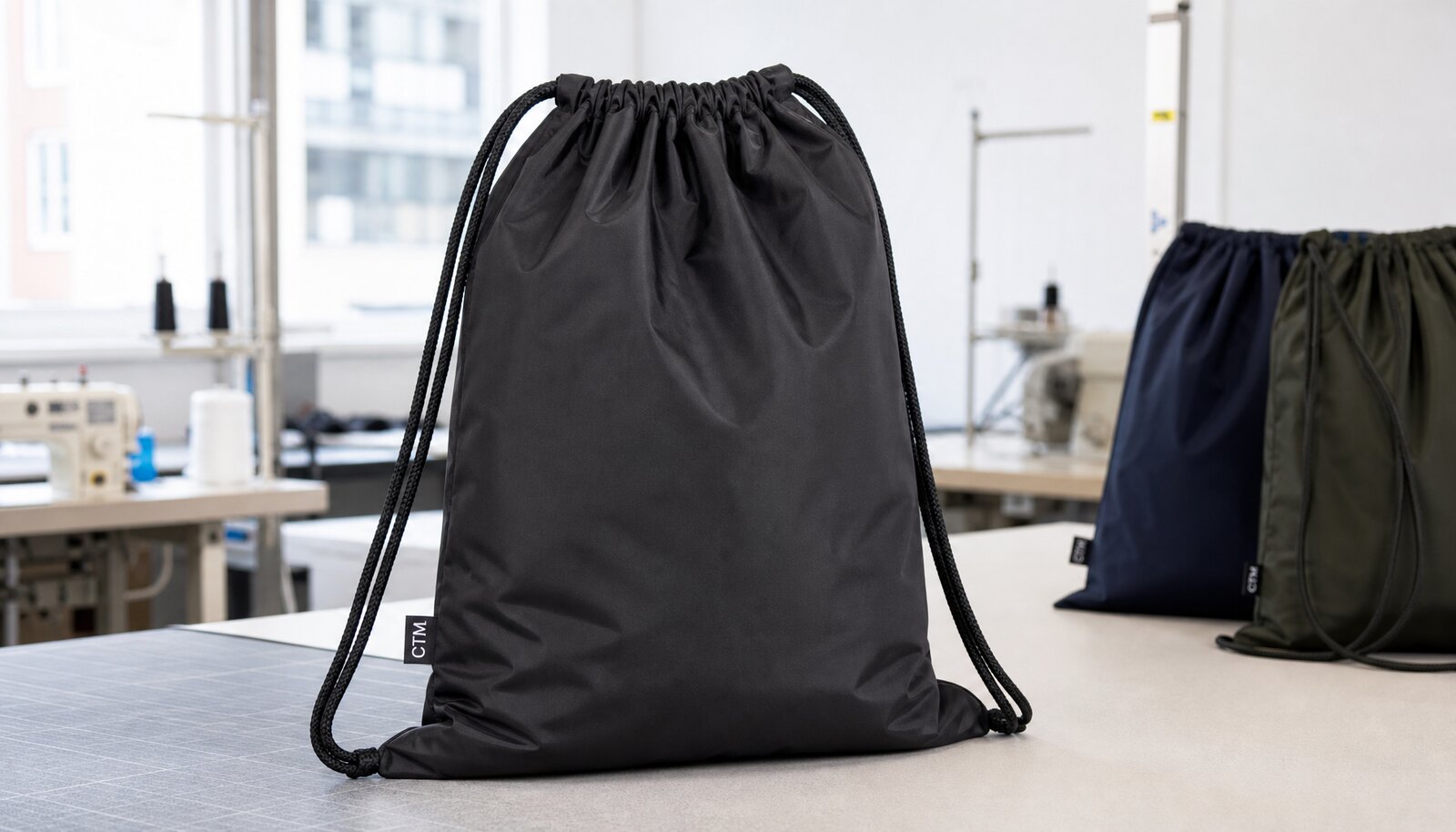
What buyers are really buying
Custom nylon drawstring bags are usually bought for one of three jobs: low-cost event giveaways, light retail packaging, or reusable merchandise bags that need a cleaner look than a disposable pouch. The fabric choice changes the bag's behavior more than the logo does. A 210D bag folds small and quotes aggressively; a 420D bag holds shape better and feels closer to a retail item. If the end user will carry a few soft goods or literature, nylon is often the practical choice because it is light, prints well enough for simple branding, and does not absorb moisture the way cotton can.
Buyers get into trouble when they describe the product only as "nylon drawstring bags" and leave the factory to fill in the rest. That produces quote spread, sample drift, and late changes. The commercial problem is not just finding a cheap bag. It is deciding which combination of fabric weight, print method, cord style, and packing will hold the target price while still passing use in the field. The supplier can usually make a better bag than the spec if the RFQ is clear, but the quote is only comparable when the spec is clear first.
- Use nylon when you need low weight, quick packing, and a surface that supports simple branding.
- Use 210D for promo programs and 420D when handfeel, body, and reuse matter more than the lowest unit cost.
- Treat the logo as one line item in a broader construction spec, not as the whole product definition.
Choose the fabric first, not the logo
For custom nylon drawstring bags, fabric weight drives most of the price and durability difference. Common sourcing choices are 70D to 210D for very light bags and 420D for more structure. Denier tells you yarn thickness, not finished quality by itself, but it is still a useful shorthand in quote comparison. If the factory only says "nylon" or "high quality nylon" without denier, GSM, or weave detail, the quote is not yet firm enough to compare. Ask whether the bag is plain weave, ripstop, or another construction, because that affects both appearance and tear behavior.
Fabric selection should reflect the actual load and retail expectation. A 210D nylon bag can be fine for a T-shirt, a brochure pack, or a trade-show handout. If the bag will hold heavier consumer goods, you need to evaluate seam strength, cord channel reinforcement, and whether the fabric has enough body to prevent the contents from showing through. Some buyers ask for lining to improve opacity, but lining adds cost and sewing time, so it only makes sense when the bag is part of a premium assortment or when print show-through is a risk.
- 210D is the common starting point for general promotional use.
- 420D is a better fit when the bag should stand up straighter or be reused more often.
- If opacity matters, evaluate fabric color and lining together instead of assuming a darker ink will solve it.
Construction details that change the quote
Two bags can look similar in a photo and still have different factory cost because of stitch count, seam reinforcement, and top-channel construction. The drawstring channel is a cost point because it affects sewing time and cord insertion. Side seams also matter: a clean bag with reinforced stress points tends to hold up better, but the extra stitch operations can lift the quote. If your bag has a gusset, printed base panel, or shaped top edge, expect additional cutting and sewing labor. These are not cosmetic details; they drive yield, machine time, and rejection rate.
Buyers should decide early whether they want a simple flat pouch style or a more finished retail bag. Flat bags are cheaper, easier to pack, and usually have fewer sewing variables. Bags with a bottom gusset or structured panel carry better and present better on shelf, but they need tighter sample approval because the bag shape can distort if the seam allowances are inconsistent. If the end use is packaging or simple event distribution, a flat build is often the best commercial choice. If the bag is intended to be resold, a more robust construction can justify the extra cost.
- Top channel width, cord diameter, and seam reinforcement should be specified together.
- Gussets improve usable volume but increase sewing complexity and dimension risk.
- More structure usually means better shelf presentation, but also more opportunities for inconsistency.
Print method drives both quality and MOQ
Print method is one of the biggest gaps between what buyers expect and what factories quote. Screen print is still the best option for simple logos, large enough quantities, and durable color laydown on nylon. It usually works well when the artwork is one to three solid colors and the logo area is not too detailed. Heat transfer and digital transfer are better when the design has gradients, fine text, or a short run that does not justify screen setup. Embroidery is less common on lightweight nylon drawstring bags because the fabric can pucker, but it can be appropriate on heavier constructions if the buyer wants a more premium finish.
The print method also changes MOQ logic. A factory may accept a lower overall bag MOQ but impose a separate minimum by color or by screen because each print screen or transfer setup carries its own cost. If a supplier quotes a low unit price but hides setup charges, the real cost comparison is wrong. Buyers should ask whether artwork changes after proof approval create new charges, whether the quoted price includes one position or multiple positions, and whether the print area is limited by the bag seam or drawcord channel. If the logo is close to the edge, alignment and distortion become real production risks.
- Screen print is the best baseline for simple logos and repeat volume.
- Transfer methods work better for short runs or detailed artwork, but may wear differently.
- Print placement should be tied to seam layout so the factory is not forced to move the logo later.
How to compare supplier options without mixing apples and oranges
The right sourcing route depends on how much control you need. A direct factory usually gives the best control over fabric, stitching, and packing, especially for repeat programs where a sealed sample can become the reference. A trading company is useful when you need one source across multiple item types or want better coordination on mixed orders, but you need more visibility into what is being outsourced and where the cost sits. A local decorator or stock-shipping supplier can be acceptable for very small or urgent programs, but it rarely gives the best landed cost once the order scale grows.
For custom nylon drawstring bags, the right comparison is not just unit price. Compare the sourcing route on sample quality, material transparency, packing flexibility, and how quickly they resolve revisions. If one supplier gives a lower quote but cannot state fabric denier, carton count, or print method clearly, you do not yet have a comparable offer. Good buyers compare the data behind the price: what is included, what is excluded, and what changes trigger a revision. That is where hidden cost usually lives.
- Direct factory fits repeatable custom programs with tighter spec control.
- Trading companies help when the order is mixed or the buyer needs coordination across categories.
- Local stock suppliers reduce lead time, but usually limit customization and raise unit cost.
What to put in the RFQ so the quote is usable
A usable RFQ for custom nylon drawstring bags should let the factory quote without guessing. Include finished size, flat or gusseted construction, fabric weight or denier, color, print method, print position, cord color, and packing. Add whether the measurement tolerance is based on flat bag size or usable opening size. If you have a target retail presentation, say so directly, because the factory may need to use better stitching or tighter panel cutting than a basic promo build. If the bag must fit a specific insert or product bundle, provide the product dimensions and not just the bag dimensions.
Quote data should also include the commercial terms that affect total cost. Ask for sample cost, production lead time, MOQ by color and by print design, carton dimensions, gross weight, and whether packing is bulk, individual polybag, or set packing. For buyers who compare across factories, one-line unit pricing is not enough. You need to know whether the unit price includes labels, standard cartons, and one print position, or whether those are charged separately. A clear RFQ shortens sample revisions and usually reduces the chance of a false low quote.
- State finished size, material spec, print method, and packing in the first RFQ pass.
- Request carton data and gross weight before freight planning.
- Ask for explicit inclusions and exclusions so the quote can be compared across suppliers.
Sample approval should catch the expensive mistakes
The sample stage is where buyers should verify more than appearance. A good pre-production sample should reflect the actual fabric, actual print method, actual cord, and actual label or side tag. If the sample comes in a different fabric weight or with a different print process than the bulk order, it is only a design reference. That is not enough for approval. The sample also needs to be judged in the same folded or packed condition the customer will receive, because many drawstring bag issues appear only after compression and carton storage.
A practical sample review should cover size, handfeel, print sharpness, seam quality, and functional pull. If the logo shifts, the factory should revise the print position before bulk. If the drawcord drags or the channel bunches, the bag may work in hand but fail in packing or retail display. A buyer should approve the sample only after it is measured and handled, not just photographed. If the program is large, keep a sealed sample on file and reference it in the PO so later disputes are not based on memory.
- Sample with production fabric and production print method whenever possible.
- Measure size, opening width, and cord pull behavior, not just visual appearance.
- Keep a sealed sample tied to the PO for bulk comparison.
QC thresholds that protect the order
Quality control for nylon drawstring bags should focus on measurable defects. Start with dimensions and allow only the tolerance you can live with in the end use. Then check print position, stitch quality, and cord function. The most common failure points are loose thread ends, skipped stitches at stress corners, misaligned print on seam crossings, and cords that are too short or uneven. If the bags will be inserted into retail packaging, count accuracy matters just as much as appearance because a shortage in one carton can ruin the retail flow.
Set the reject rules before production starts. For example, severe print smearing, holes, broken seams, missing cords, and wrong packing should be reject items. Minor shade variation may be acceptable if it stays inside the approved sample range, but that tolerance should be written. If your market is sensitive to presentation, add a bright-light inspection stage for oil marks, needle damage, and surface contamination. The aim is not to over-inspect every bag. It is to define the few points that would make the shipment commercially unusable.
- Measure size and opening tolerance against the approved spec.
- Reject broken seams, missing cords, severe print error, and wrong counts.
- Use the approved sample as the visual standard for shade, print density, and handfeel.
Packing and carton specs affect freight more than buyers expect
Packing can change the landed cost almost as much as fabric choice. Bulk packing lowers labor and carton volume, which helps ocean freight and warehouse intake. Individual polybags improve retail presentation and protect the print, but they increase materials, labor, and carton density. Some buyers want each bag folded to a specific size for shelf or ecommerce prep, and that is reasonable as long as the factory gets the fold method in writing. Otherwise, the carton may be packed in a way that looks efficient to the factory but creates repacking work at destination.
Carton data should be reviewed before freight booking, not after. Ask for carton dimensions, piece count, net weight, gross weight, and estimated CBM. If the order is sensitive to freight class or container utilization, that information is part of the quote, not an afterthought. For mixed SKUs, carton labeling becomes important because nylon drawstring bags are often bundled with other promotional items. Clear carton marks, SKU identifiers, and packing lists reduce receiving errors and make warehouse counting faster.
- Bulk packing is cheapest, but only if the buyer can receive and distribute efficiently.
- Individual polybags add cost and volume, but may be required for retail or ecommerce handling.
- Carton size and piece count should be confirmed before you commit to freight.
Lead time risk is usually in the front half of the order
Most schedule problems on custom nylon drawstring bags happen before bulk sewing begins. Artwork approval, fabric confirmation, and sample sign-off often take longer than the sewing itself. If the buyer keeps changing logo placement or print colors after the first proof, the factory has to rework screens or re-cut print tools, which pushes the schedule more than a simple production queue would. The safest path is to lock the artwork early, then move fast on sample approval while the fabric and packing spec are still open only if needed.
A realistic timeline should include sampling, bulk material procurement, production, final inspection, and booking lead time. If the fabric is custom dyed or the packing is special, add slack. Buyers should also plan for pre-shipment photos or inspection if the shipment is time-sensitive, because a small issue caught before departure is far cheaper than a return or repack at destination. If the order is tied to a sales event or launch date, back-plan from the in-market date rather than from the purchase order date. That is where real schedule pressure shows up.
- Freeze artwork early to avoid screen or transfer rework.
- Build in time for sample approval and carton approval, not just sewing.
- Treat custom dye, special packing, and final inspection as schedule risk items.
Specification comparison for buyers
| Spec decision | Recommended option | When it fits | Buyer risk to check |
|---|---|---|---|
| Sourcing route | Direct factory for custom production | Best when you need exact spec control, artwork approval, and stable repeat orders | Risk of weak communication if the factory is set up for volume only and does not handle sampling well |
| Sourcing route | Trading company with factory control | Best when you need one point of contact across multiple bag styles or mixed programs | Risk of hidden markups and less transparency on fabric, print, or packing substitutions |
| Sourcing route | Local decorator or stock-shipping supplier | Best for small rush orders or domestic rebranding with limited customization | Risk of limited fabric choices, higher unit cost, and less control over bag construction |
| Fabric weight | 210D nylon for standard promo and event use | Best when you need a light bag that folds small and holds basic giveaways | Risk of thin handfeel and color show-through if the print is heavy or the bag is overfilled |
| Fabric weight | 420D nylon for better body and durability | Best for retail programs, longer reuse, or buyers who want a firmer product | Risk of higher cost and longer lead time if the mill color is not standard |
| Print method | Screen print for simple logos and larger runs | Best when artwork is one to three colors and repeat volume is meaningful | Risk of ink thickness, cracking, or misregistration on textured nylon |
| Print method | Heat transfer or digital transfer for small runs and detailed art | Best for short runs, multi-color art, or fine text that screen print cannot hold cleanly | Risk of lower wash and abrasion resistance if the film or adhesive is not specified well |
| Closure style | Self-cord channel with standard polypropylene drawcord | Best for cost-sensitive bulk orders and general-purpose giveaways | Risk of uneven cord pull, fraying ends, or weak top stitching if the channel is underspecified |
| Packing method | Bulk packed by count with clear carton marks and inner polybags only if needed | Best when you want lower packing labor and lower freight volume | Risk of transit scuffing, print transfer, or count errors if the carton spec is vague |
Buyer checklist before sampling
- Confirm finished size, tolerance, and whether the measurement is flat or filled.
- Specify nylon fabric type and weight in denier or GSM, not just "nylon".
- State print method, logo size, print colors, and artwork file format.
- Define drawcord color, cord diameter, end finish, and whether cord tips are required.
- Set stitch requirements for seams, side reinforcements, and top channel construction.
- Agree on packing count per inner pack and per export carton.
- Request a pre-production sample that matches fabric, print, cord, and packing.
- Ask for carton dimensions, gross weight, and CBM before approving freight booking.
- Confirm acceptable shade variation and print position tolerance in writing.
- Specify inspection standard for dimensions, appearance, function, and packaging count.
Factory quote questions to send
- What nylon fabric weight and weave do you quote, and can you state it as denier or GSM?
- Is the quote based on finished size or cut size, and what tolerance do you allow?
- Which print method is included, how many colors are covered, and what is the setup charge if art changes?
- What is the MOQ by color and by print design, and does a multi-color order change the MOQ?
- Are drawcords, labels, cord ends, and sewing reinforcements included in the quoted unit price?
- What packing is included in the quote, and what extra cost applies for individual polybags or header cards?
- How long is the sample lead time, and does the sample use production fabric and production print?
- What is the bulk lead time after sample approval, and what delays should I expect for custom dye or special packing?
- Can you share carton size, carton quantity, gross weight, and estimated CBM for the order?
- Which defects are treated as reject items during final inspection, and how are shortages handled?
Quality-control points to confirm
- Finished size matches the approved spec within the agreed tolerance after stitching and finishing.
- Fabric weight, handfeel, and opacity match the approved production sample or sealed sample.
- Drawcord pulls smoothly, stays centered, and does not slip through the channel under normal use.
- Top stitching, side seams, and stress points are secure with no loose threads or skipped stitches.
- Print placement is centered, clean, and within the agreed position tolerance.
- Print color, opacity, and edge sharpness are consistent across the lot and close to the approved sample.
- No broken needles, oil stains, fabric holes, or adhesive marks are visible on finished bags.
- Carton count matches the packing list, and inner packs are labeled correctly if used.
- Cartons are strong enough for export handling and show correct shipping marks and PO references.
- Random pull tests confirm the seam and cord area can handle normal retail or promotional use without failure.