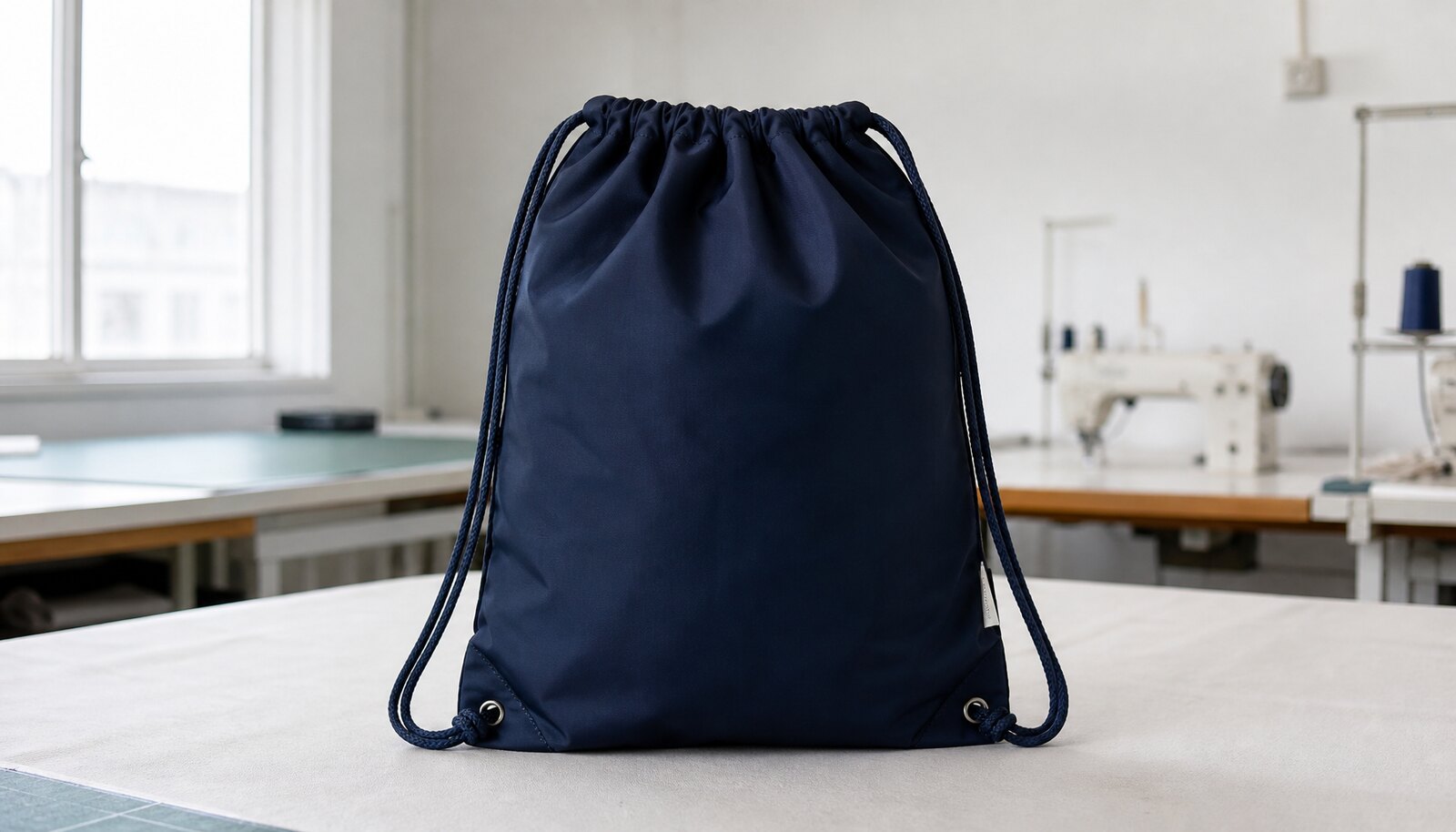
1. Start with the use case, not the bag name
A custom nylon drawstring backpack can mean three different products in practice: a low-cost giveaway, a mid-grade brand accessory, or a light utility bag that gets used more than once. Those are not the same buying problem. If the buyer starts with a vague request for a "standard nylon drawstring backpack," the first quote usually mixes assumptions about fabric, reinforcement, print method, and packing. That makes supplier comparison weak before production even starts.
Procurement teams should define the job the bag has to do. A trade show handout that carries brochures only needs a different build than a gym bag that holds shoes and a water bottle. If the bag will be carried every day, the supplier should not be pricing it as a one-off promo piece. If it only needs to support light event materials, the spec can stay lean and the buyer can focus on logo visibility, color consistency, and volume pricing.
A practical way to frame the request is to separate three questions: what it carries, how long it needs to last, and how much brand finish the buyer expects. That framing often tells the factory whether 210D nylon is enough or whether 420D nylon and stronger corner reinforcement are a better fit. It also tells the supplier whether the bag is a price-led program or a quality-led one.
- Promo use: prioritize unit cost, stable supply, and clean logo reproduction.
- Retail use: prioritize consistent finish, fabric body, and packaging presentation.
- Utility use: prioritize seam strength, reinforced corners, and cord durability.
2. Build the fabric spec around denier, coating, and appearance
The largest quote spread on a custom nylon drawstring backpack usually comes from fabric assumptions. Nylon is not one universal material. A quote should state the denier, coating, and whether the body fabric is stock or made to order. In this category, 210D nylon is common for promotional volume because it balances cost and printability. 420D nylon is thicker, has more body, and usually looks closer to a retail-ready product. If the supplier only writes "nylon" or "poly nylon," the buyer does not yet have a production spec.
Coating changes more than moisture resistance. A light PU coating can improve shape retention and reduce show-through, but it can also affect print adhesion, hand feel, and odor if the finish is unstable. The buyer should not assume that a coated fabric behaves like uncoated nylon during print or folding. If the bag is dark, repeated folding can highlight whitening at stress points. If the bag is printed large and the fabric is too thin, the logo can telegraph through or wrinkle when packed.
Color control matters too. If the program depends on a branded shade, the buyer should tie the body color to a physical master sample or a Pantone reference that the factory can reproduce. For one-off promotional runs, a stock shade is often the better commercial choice because it reduces MOQ pressure and lead time. For repeat retail or campaign orders, the buyer should ask whether the factory holds the same fabric lot long enough to support replenishment without visible shade drift.
- Use 210D for lower-cost bulk programs and 420D when the bag needs better body or a more premium feel.
- Ask whether the fabric is stock, reserved from stock, or dyed to order before comparing quotes.
- If the body color is brand-critical, approve a physical swatch rather than relying on a screen image.
3. Match the logo method to the artwork, not to habit
A good logo can fail because the print method was chosen for convenience rather than for nylon. Screen printing is usually the most practical option for bold one-color or two-color art on a custom nylon drawstring backpack. It gives strong opacity and a clean commercial look when the artwork is simple. Heat transfer is better when the design has gradients, fine detail, or multiple colors, but it is more sensitive to fabric finish, pressure, and post-print handling.
The buyer should also consider whether the logo should be printed at all. A woven label, sewn patch, or small side label can be the better choice when the bag surface is textured, coated, or intended to look more premium. That approach also reduces the risk of print cracking on folds. If the artwork includes tiny copy, thin rules, or a gradient fade, the file should be reviewed at the actual print size, not only on the laptop screen.
One practical procurement rule: the more the bag will be folded, crushed, or stuffed, the more the branding needs to survive movement. A front print that looks perfect on a sample card can fail after packing if the ink, substrate, or pressure settings were not matched to the nylon surface. If the buyer wants a retail finish, the sample should be checked after folding and reopening, not just the day it comes out of the press.
- Bold, simple art: screen print is usually the strongest commercial option.
- Detailed, multi-color art: heat transfer may work, but it needs a production sample.
- Premium branding: woven label, patch, or sewn side label can be more durable than a large print.
4. Model MOQ and unit price like a buyer, not a shopper
MOQ is not just a number the factory throws onto a quote. It is the point where setup labor, fabric buying, cutting waste, and packing labor become economical for the factory. A stock-fabric order with one print location and standard packing can often start at a lower MOQ because the supplier is not taking on much material risk. Once the buyer asks for a custom fabric color, a unique cord color, an extra label, or retail polybag packing, the MOQ usually rises because the factory has to commit more material and more labor in advance.
Unit price is only useful if the buyer knows what is behind it. Some factories keep the per-piece price low but add separate charges for screens, artwork setup, sample development, carton marks, or inner packing. Others bundle more into the unit price and look expensive at first glance, but the landed cost may be flatter as volume rises. The only way to compare fairly is to normalize the quote to the same order size, same packing format, and same shipment term.
If the order is part of a recurring program, the buyer should also ask what happens on reorders. A quote that looks competitive for the first order can become less attractive if the factory needs to remake screens, relabel the bag, or rebuy fabric every time. For a custom nylon drawstring backpack that will be reordered, repeatability matters as much as the first price.
- MOQ usually drops when the order uses stock nylon, a standard cord, and one print location.
- MOQ usually increases when the buyer changes fabric color, packaging, label type, or trim.
- Compare first-order pricing and reorder pricing separately so setup costs do not hide in the unit rate.
5. Read supplier quotes line by line before comparing suppliers
A useful quote for a custom nylon drawstring backpack should show where the money is going. At minimum, the supplier should split fabric, cutting and sewing, print setup, print application, cord, packing, cartons, and any special label or insert card. If the quote is a single lump sum, the buyer cannot see whether the factory is strong on materials but weak on packing, or whether a low price is being offset by hidden assumptions on print coverage or carton count.
The buyer should also check what the quote excludes. Freight, duty, inland transport, samples, and artwork revision are commonly left out. That is not automatically a problem, but it must be visible. A quote can be technically accurate and still be commercially misleading if the exclusion list is long enough. The safest practice is to line up all offers to the same incoterm and the same packing method before making a decision.
A second layer of quote review is spec drift. If two suppliers use slightly different fabric weights, different cord lengths, or different carton counts, the prices are not really comparable. The buyer should force all bids onto the same spec sheet before evaluating price. This is especially important on promotional programs, where a small difference in stitching, print placement, or packaging can become a large issue once the whole shipment is distributed.
- Demand separate lines for fabric, sewing, print, trim, packing, and cartons.
- Check exclusions carefully so freight and duty do not appear late in the process.
- Normalize all bids to the same spec sheet before deciding which supplier is actually cheaper.
6. Choose the supplier route that fits the order, not the one with the loudest quote
For a custom nylon drawstring backpack, there are three common sourcing routes: direct factory, trader, and one-stop merchandiser. A direct factory is usually the strongest choice when the spec is stable, the buyer wants repeatability, and the order will be reordered. It gives the buyer the cleanest line of sight into fabric, sewing, and final packing. A trader can make sense when the order is small, the buyer needs several product types in one PO, or the internal team wants one point of contact rather than several factories.
A merchandiser is useful when the buyer wants coordination across artwork, labels, packing, and multiple SKUs, but the buyer should still insist on knowing where the bag is physically made. The risk in indirect sourcing is not always price. It is the chance that the approved sample came from one production path and the bulk order comes from another. That is how fabric shade, stitch density, or print behavior drifts without warning.
The buyer should judge the supplier by evidence, not promises: sample consistency, the clarity of the quote, carton data, responsiveness to spec questions, and whether the factory can explain which steps are in-house. If the answer to basic construction questions is vague, the quote is not ready for award.
- Direct factory: best when the program will repeat and the buyer needs tighter control.
- Trader: useful for smaller orders or mixed baskets, but spec control has to be stronger.
- Merchandiser: helpful for coordination only if the underlying factory and process are transparent.
7. Use a sourcing decision matrix for different order profiles
This is the section buyers usually need but supplier blogs often skip: the right sourcing model changes with order complexity. A 300-piece event giveaway does not deserve the same factory process as a 5,000-piece retail run. If the buyer over-specifies a small one-time order, the quote gets inflated by setup and the lead time becomes harder to manage. If the buyer under-specifies a repeat program, the price may be attractive but the post-shipment defect risk rises.
For smaller programs, the winning move is usually to keep the structure simple: stock nylon, one print position, standard cord, and bulk packing. The supplier should still produce a real pre-production sample, but the goal is to reduce variables, not to create a custom build for every feature. For medium-volume branded kits, the buyer can add a better label, stronger reinforcement, or retail-ready packing as long as those changes are captured in the same version-controlled spec sheet.
For retail or resale programs, the buyer should think in terms of operational repeatability. The question is not just whether one sample looks good. It is whether the same bag can be produced again with consistent print placement, consistent stitch quality, and the same carton configuration. The table below is useful because it links order profile to the level of control the buyer should demand.
- Small promo run: simplify the build and focus on speed, price, and acceptable appearance.
- Mid-volume branded kit: add reinforcement, better labeling, and stricter sample sign-off.
- Retail-facing order: tighten the spec, repeat the test, and plan reorder stability before award.
8. Approve samples as production evidence, not as marketing material
A sample is only useful if it reflects the actual production path. For a custom nylon drawstring backpack, the buyer should insist on a pre-production sample made from the final fabric, final cord, final print method, and final packing format. A hand-cut mockup or a photo proof only confirms layout. It does not prove how the bag behaves when stitched, folded, or packed. If the supplier sends a visual mockup and calls it a sample, the buyer should not treat it as production approval.
The physical sample should be checked in the same way the bulk order will be used. Measure the bag flat, open and close the cord several times, and check whether the top hem remains even when tension is applied. Look at the logo under daylight, not only under warm warehouse light. If the bag has a coating, rub the print area and fold the body to see whether the finish cracks, glosses, or lifts.
It is also worth keeping one approved sample as a control reference. The approved sample should be labeled with the date, artwork revision, fabric note, and packing format. That control sample becomes the baseline for bulk inspection, reorders, and dispute resolution. Without it, the team ends up debating memory instead of evidence.
- Approve the actual fabric, not a substitute or similar-looking material.
- Measure size and logo placement on the physical sample, not only from digital artwork.
- Keep one signed sample as the control reference for bulk inspection and future reorders.
9. Write QC thresholds into the PO so inspection is not subjective
QC for a custom nylon drawstring backpack should be based on measurable thresholds, not broad language like "good quality" or "no obvious issues." A buyer-controlled inspection plan should name the defect classes, the AQL level, the measurement method, and the reject conditions. That way, the factory knows what will fail the lot before the order ships. This is where many procurement teams under-specify and then discover that the supplier and buyer disagree on what counts as acceptable.
A practical starting point is ANSI/ASQ Z1.4 or ISO 2859-1 with AQL 2.5 for major defects, AQL 4.0 for minor defects, and zero tolerance for critical defects such as wrong artwork, open seams on stress points, or missing cords. For retail-facing orders, buyers often tighten the major-defect limit further, especially when the logo is highly visible. The important thing is not the exact textbook setting. It is that the standard is written down, accepted by both sides, and used consistently.
The inspection itself should include size checks, placement checks, stitch checks, color reference checks, and a simple pull test on the cord anchors and bartacks. If the supplier can report delta E, rub performance, or other test data, those reports should be attached to the quality file. If not, daylight comparison against the master sample and a practical pull/rub check are still better than a visual glance at the end of the line.
- Set AQL levels before production so the factory knows the acceptance target.
- Use a physical master sample and daylight comparison for logo and color control.
- Treat wrong artwork, open seams, and cord failure as critical defects, not minor ones.
10. Plan packing, lead time, and landed cost together
Packing changes the total landed cost more than buyers often expect. Bulk packing is usually the most efficient option for warehouse distribution and promotional fulfillment because it uses fewer materials and less carton volume. Individual polybag packing is more expensive, but it is often the right choice when the bags are going to retail shelves, direct-to-consumer fulfillment, or a kit assembly line. If the order needs a barcode sticker, insert card, or hangtag, that requirement should be included in the first quote because it changes labor time and carton count.
Lead time should be mapped by stage. Sample approval, fabric reservation, sewing, printing, final inspection, and carton loading are not the same process and they do not fail for the same reasons. The most common delay is not the sewing itself. It is artwork revision, sample back-and-forth, or a late change to packing. If the shipment is tied to a launch date, trade show, or seasonal distribution window, the buyer should leave enough cushion for a second sample round.
When planning freight, ask for carton dimensions, gross weight, and units per carton. Those numbers determine not only the shipping quote but also warehouse handling and pallet fit. A low unit price can disappear quickly if the carton configuration is inefficient. On a custom nylon drawstring backpack order, the procurement win is not the lowest piece price by itself. It is the best total landed cost with an acceptable defect risk and a realistic delivery date.
- Bulk pack for efficiency; polybag and retail pack only when the downstream channel needs it.
- Map the production timeline by stage so sample delays do not get mistaken for bulk delays.
- Use carton data early because freight, pallet fit, and warehouse handling all depend on it.
Specification comparison for buyers
| Spec decision | Recommended option | When it fits | Buyer risk to check |
|---|---|---|---|
| Nylon fabric choice | 210D nylon for promotional volume; 420D nylon for heavier daily use; coated 210D if moisture resistance or shape retention matters | Trade shows, school kits, gym giveaways, and light retail programs | Thin 210D can look acceptable in photos but show through at stress points, while poorly controlled coating can add odor or stiffness |
| Print method | Screen print for bold logos; heat transfer for multi-color art; woven label or patch for premium branding | Simple one-color marks, limited-color artwork, or retail packs that need a cleaner finish | Complex art on nylon can blur, crack, or shift if the supplier uses the wrong method or prints over an unstable coating |
| Logo placement | Centered front print, lower-front print, or small corner label away from the drawcord channel | Brands that want clear visibility without distorting the bag opening | Artwork too close to the top hem can wrinkle when the cord is pulled, and side placement can be hidden by folds |
| Drawcord construction | Polyester cord with 4-6 mm diameter, clean cut ends or capped tips, and reinforced cord channels | Most bulk programs where hand feel and durability matter more than decorative detail | Loose cord ends, weak bartacks, or uneven exit lengths create returns and a poor first impression |
| Reinforcement | Bottom corner bartacks or triangle reinforcement at the main stress points | Backpacks carrying shoes, bottles, catalogs, or repeated event use | Skipping reinforcement saves a small amount but creates seam failures after repeated pulls and overstuffing |
| MOQ route | 500-1,000 pcs for stock fabric and simple printing; 1,500+ for custom dyeing, special labels, or nonstandard packaging | Buyers balancing quote competitiveness with inventory risk | Low MOQ requests usually push the factory toward stock materials and higher setup fees |
| Packing method | Bulk packed by quantity with carton marks; individual polybag only when retail-ready or fulfillment-ready | Distribution, warehouse programs, and e-commerce prep | Overpacking increases freight volume and cost, while underpacking raises scuffing and contamination risk |
| Supplier route | Direct factory for repeat volumes; trader or merchandiser for mixed SKUs or lower-volume consolidated orders | Stable repeat specs versus one PO across several product types | Indirect sourcing can hide subcontracting, fabric origin changes, or schedule slippage if the quote is not itemized |
| QC standard | Use a written AQL plan, measured size tolerance, print placement tolerance, and pull-force checks for stress points | Any program with retail resale, brand visibility, or strict delivery dates | If the QC plan is vague, the shipment will default to subjective visual approval and unresolved disputes |
Buyer checklist before sampling
- Define the end use first: giveaway, retail resale, school kit, gym bag, or event pack. That drives the fabric weight, reinforcement level, and print durability target.
- Lock the fabric spec in denier, coating, and color. If the supplier can only say "nylon," the quote is too vague to compare.
- State the finished size, seam allowance expectations, and whether the bag needs a flat bottom, gusset, pocket, or zipper add-on.
- Choose the logo method based on artwork complexity and fabric finish. Include the exact artwork size, number of colors, placement, and acceptable alternative branding if print is not suitable.
- Confirm cord diameter, cord color, cord tip finish, and whether the ends are heat-sealed, knotted, or capped.
- Request a pre-production sample made from the final fabric with the final print method, not a visual mockup or photo proof.
- Ask for itemized pricing for fabric, sewing, print setup, print application, packing, cartons, and any special label or insert card.
- Write the inspection standard into the PO, including AQL level, size tolerance, logo placement tolerance, and reject conditions for open seams or wrong artwork.
- Verify the packing configuration, carton quantity, carton dimensions, gross weight, and shipping marks before freight is booked.
- Confirm the timeline by stage: sample approval, material reservation, bulk production, final inspection, and dispatch.
Factory quote questions to send
- What is the exact nylon specification, including denier, coating type, and whether the fabric is stock or dyed to order?
- What is the finished bag size, and what tolerance do you hold on length, width, and cord length?
- Which logo method is included in the quote, and what is the setup charge per color, plate, or screen?
- Can you quote the same bag with bulk packing and with individual polybag packing so I can compare total landed cost?
- What is your MOQ for this exact construction, and what changes the MOQ the most: color, fabric, print position, trim, or packaging?
- Which production steps are handled in-house, and which steps are subcontracted, such as printing, embroidery, labeling, or packing?
- What sample will you send first: prototype, pre-production sample, or production reference sample?
- What is the lead time after sample approval, and what can extend it, such as fabric sourcing, print revision, or packing changes?
- Can you provide carton dimensions, units per carton, carton weight, and palletization assumptions for freight planning?
- What inspection standard do you use at final inspection, and can you align it with our AQL and tolerance sheet?
Quality-control points to confirm
- Use a written inspection plan based on ANSI/ASQ Z1.4 or ISO 2859-1. A practical starting point for buyer-controlled orders is AQL 2.5 for major defects, AQL 4.0 for minor defects, and zero tolerance for critical defects such as wrong artwork or unsafe construction.
- Finished size should stay within the agreed tolerance, commonly +/-0.5 cm for smaller promotional bags and +/-1.0 cm for larger bodies, unless the spec sheet calls for tighter control.
- Logo placement should match the approved sample or artwork map. A practical buyer target is +/-3 mm on small logos and +/-5 mm on larger front graphics, measured from the agreed reference edge.
- If color matching matters, approve against a physical master sample or Pantone reference under daylight or D65 lighting. If the supplier has a spectrophotometer, a reasonable target is delta E <= 2.0 on visible body panels.
- Dry rub and wet rub should be checked on the printed area using the supplier's method or a referenced standard such as AATCC 8 or ISO 105-X12. For practical acceptance, there should be no visible transfer or smearing on the test cloth after the agreed rub count.
- Cord channels, bottom corner bartacks, and stress seams should hold a simple pull test of 30 N without seam opening, skipped stitches, or anchor failure, unless the product is intentionally specified for lighter use only.
- Inspect for fabric flaws, coating inconsistency, oil marks, holes, needle damage, loose threads, and open seams. Any defect that affects appearance at arm's length or function should be counted as at least a major defect.
- Check odor after unpacking and airing. A strong chemical smell, sticky coating feel, or print tackiness should be treated as a nonconformance until the cause is identified.
- Verify packing count, master carton labels, inner polybag count if used, and shipping marks. Carton count accuracy should be 100 percent at shipment, not estimated.
- For retail or brand orders, open a sample carton from the top, middle, and bottom of the stack and inspect for print drift, color variation, seam consistency, and packing damage, not just one hand-picked piece.