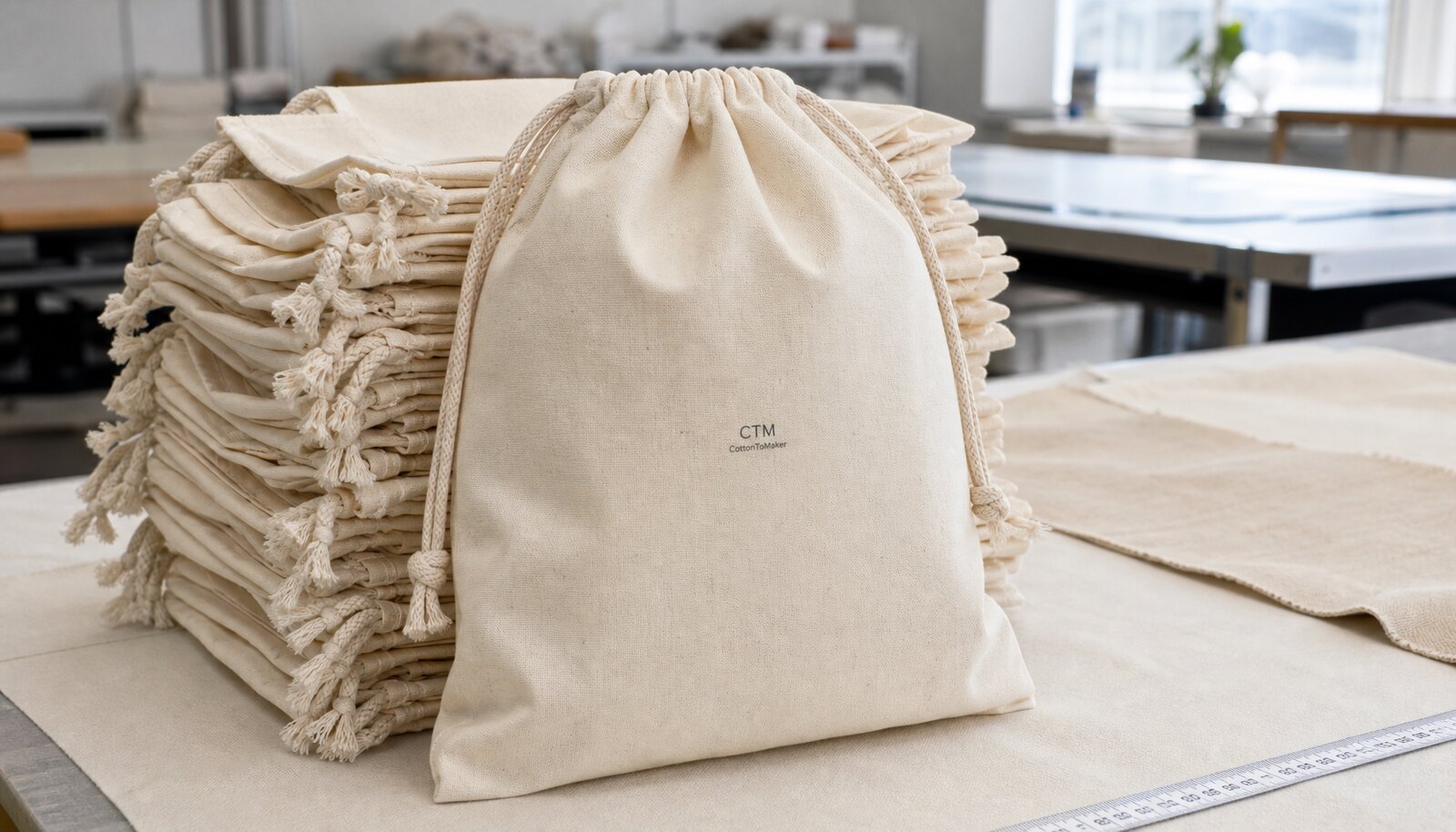
Why custom muslin drawstring bags fail at the quote stage
Most procurement problems with custom muslin drawstring bags start before production. Buyers often send a product name, a logo file, and a target quantity, then compare quotes that are not based on the same fabric weight, bag size, or packing standard. The lowest number on paper usually comes from a thinner cloth, a simpler print method, or a quote that excludes the packing labor your warehouse actually needs.
Muslin is a flexible material category, so one supplier may quote a soft 45 GSM bag while another is pricing 100 GSM with tighter weave and cleaner stitching. Those two bags are not substitutes. If your team wants a reliable comparison, the RFQ has to define the construction, not just the appearance.
- Name the use case: retail gift bag, product pouch, event giveaway, or secondary packaging.
- State whether the bag must feel premium, survive repeated handling, or only hold light contents once.
- Separate fabric spec, decoration, and packing so the factory can price each part clearly.
Start with the right muslin spec, not the cheapest cloth
For custom muslin drawstring bags, the most important choice is fabric weight. Light bags in the 45–60 GSM range are economical and compact, but they show the shape of the contents more easily and may feel too thin for retail presentation. Midweight options around 70–90 GSM usually offer the best balance for most brand buyers because they hold print better and look cleaner on shelf.
If the bag is part of a premium gift set or will be reused by the end customer, move toward 100–120 GSM. That adds cost and slightly larger carton volume, but it improves drape, stitch stability, and the perceived value of the item. If you are buying for a subscription box or jewelry line, the cost increase is often justified by fewer complaints and better unboxing quality.
- Natural unbleached muslin gives a handmade look but may vary more in shade.
- Bleached white offers cleaner logo contrast and is easier to standardize for retail.
- Pre-washed or softened finish improves hand feel, but it changes shrink behavior and cost.
Print method drives price, sharpness, and MOQ logic
Most custom muslin drawstring bags use screen printing because it keeps unit cost low and works well for simple logos. One-color or two-color artwork is usually the sweet spot. If the design has fine lines, gradients, or small type, the factory may suggest heat transfer, but that should be treated as a short-run solution rather than the default for bulk orders.
Embroidery and woven labels can look more premium, but they are usually applied on thicker bags or as an accent rather than full coverage branding. On thin muslin, heavy embroidery can pucker the panel and distort the opening. For a flat logo with consistent repeatability, screen print is usually the most practical route.
- Ask for print area in centimeters, not just a visual description.
- Define whether artwork must match Pantone or if close visual match is acceptable.
- For dark ink on natural muslin, request a strike-off because absorbency changes the final shade.
How to compare quotes without missing hidden cost
A useful quote for custom muslin drawstring bags should break out the main cost drivers: fabric, print setup, labor, packing, and carton terms. If a supplier only gives a single unit price, the missing detail is usually where later disagreements begin. You need to know whether the quote includes one side print or both sides, whether the cord is cotton or polyester, and whether cartons are export-ready or just basic shipping boxes.
When you compare suppliers, line up the same commercial assumptions. A quote with free individual polybags can still be more expensive than a quote without them once you add packing labor and carton volume. Landed cost is also affected by compression: thinner bags pack more per carton, which can reduce freight cost even if the unit price is slightly higher.
- Compare unit price only after confirming the same GSM, size, print method, and packing.
- Check whether setup fees are one-time or recharged for every repeat order if artwork changes.
- Use carton dimensions to estimate freight, not just gross weight.
Supplier route: direct factory, trading company, or local converter
The best sourcing route depends on order size and how much control you need over the process. Direct factory sourcing usually gives the strongest price and the clearest control over fabric and sewing details, but it requires a more complete spec sheet and longer coordination. Trading companies can be useful when your order mixes different bag types, colors, or packing requirements and you need consolidation across multiple factories.
A local converter or importer can be the right fallback for very low MOQ or urgent replenishment, but buyers should expect less flexibility on fabric choices and a higher unit cost. For launch programs, it is often sensible to pay a little more for a route that provides a finished sample fast and keeps the production standard consistent.
- Direct factory: best for repeat orders, custom dimensions, and stable print repeatability.
- Trading company: useful for mixed SKUs, urgent combined shipments, or broad sourcing support.
- Local converter: practical for small tests, but usually limited on fabric options and cost control.
Sample approval should test the real production build
A sample is only useful if it matches the bulk order in the details that matter. For muslin drawstring bags, that means the same fabric weight, the same drawcord, the same print method, and the same seam construction. A blank stock sample proves almost nothing if your order uses a different weave or an added logo panel. The sample should also arrive in the same packing style if your retail team needs carton counts or label placement checked.
Before approving, measure the finished bag size, inspect the channel stitching, and test the drawcord pull. Light friction on the print area can show whether the ink is properly cured. If the bag is intended for repeated handling, fill it with a realistic product weight and inspect seam distortion at the opening and bottom corner.
- Check width, height, and opening tolerance against the approved spec sheet.
- Pull-test the drawcord several times to spot channel fraying or snagging.
- Rub the print lightly with dry and slightly damp cloth to detect weak curing.
Packing details matter more than many buyers expect
Packing can change both cost and damage rate. Bulk packing in inner bundles is the most efficient format for many B2B buyers, especially when the bags will be repacked later at a warehouse or fulfillment center. If your channel is retail-ready or the end customer must receive the bag individually sealed, then individual polybag packing may be necessary, but it increases labor and carton volume.
The quote should state how many bags go into each inner bundle and each master carton. It should also specify carton mark content, whether barcode stickers are required, and whether cartons are drop-tested or reinforced. If packing is vague, buyers often discover that the carton count is different from the sample approval and the warehouse process becomes more expensive than planned.
- Bulk pack is usually cheapest; retail-ready packing usually costs more and ships less efficiently.
- Use carton dimensions to estimate warehouse fit and freight charge.
- If you need SKU separation, require clear carton labels and inner bundle marks.
Lead time and schedule risk are driven by fabric availability
Standard custom muslin drawstring bags can often be sampled in about 5–10 days and produced in roughly 20–35 days after approval, but only when the factory already has suitable base fabric and a simple print job. Lead time stretches when the buyer wants a dyed muslin tone, a special weave, a custom label, or a mixed packing pattern that needs more manual handling.
The schedule risk is usually not sewing time; it is material preparation, strike-off approval, and artwork corrections. Buyers who send a final print file late or revise the size after sample approval create avoidable delays. The most reliable production plan is the one that locks fabric, print, and packing before bulk starts.
- Allow time for artwork correction if small text or logo proportions need adjustment.
- Expect longer lead times when the order uses custom-dyed fabric or special finishing.
- Build buffer time if the bags must arrive before a seasonal launch or trade event.
QC thresholds that prevent disputes after shipment
A good QC plan for custom muslin drawstring bags is simple and measurable. Size tolerance should be defined in writing, especially for opening width and bag height. Fabric defects like stains, thick slubs, holes, and loose threads should have a clear rejection standard. If the design includes print, the buyer should define what counts as acceptable misalignment so the factory does not treat obvious offset as normal.
Because muslin is a natural material, some variation is expected. The goal is not perfection across every piece; the goal is to decide where the limit sits. If your brand sells to retail or gift channels, a tighter standard is worth the extra inspection time. If the bags are secondary packaging, a broader tolerance may be acceptable as long as function is not affected.
- Reject bags with holes, heavy stains, broken seams, or major print offset.
- Set acceptable tolerance for size variation before bulk begins.
- Ask for pre-shipment photos of carton count, outer labels, and random sample pieces.
Landed-cost comparison: where buyers save and where they pay later
The true cost of custom muslin drawstring bags is not just the factory unit price. Freight, carton volume, packing labor, and rework risk all affect landed cost. A lighter bag can lower freight per carton, but if it feels too thin and triggers customer complaints, the savings disappear quickly. A slightly heavier fabric may look more expensive in the quote but cheaper in the total program because it improves perceived value and reduces reject risk.
Procurement teams should compare at least three scenarios: low-cost light fabric, midweight retail-grade fabric, and a premium option with better finishing or printed label detail. Once freight and warehouse handling are added, the cheapest bag is not always the best deal. The right decision is the one that matches the product’s selling price and usage pattern.
- Cheaper fabric can increase defect handling if the weave is too open or weak.
- Simpler packing can lower labor cost and improve carton density.
- Repeat orders benefit most from a stable spec, not from constant price chasing.
Specification comparison for buyers
| Spec decision | Recommended option | When it fits | Buyer risk to check |
|---|---|---|---|
| Fabric weight | 45–60 GSM muslin for light retail use; 80–120 GSM for better hand feel and logo visibility | Use lighter fabric for giveaway or accessory packaging; use heavier fabric for reusable retail or gift presentation | Very light fabric can show seam distortion and shrink more after washing; heavier fabric changes bag cost and packing cube |
| Fabric construction | Plain woven cotton muslin with consistent weave and low slub variation | Best for natural-look branding, artisan products, kids' items, wellness packaging, and eco-focused retail | Loose weave can reduce print sharpness and increase dust transfer if the fabric is not properly finished |
| Print method | 1-color screen print for simple logos; heat transfer only for short runs or highly detailed art; woven label for premium packaging | Screen print fits most bulk orders and gives the best unit cost at scale | Fine text, small QR codes, and tonal artwork can fail on rough muslin; insist on print proof and minimum line thickness |
| Closure style | Single drawcord channel with cotton cord or matching muslin cord | Good for cosmetics, herbs, small gifts, jewelry, and brand packaging | Thin cord can cut into the fabric if the bag is overfilled; confirm knot security and cord length consistency |
| Supplier route | Direct factory for repeat volumes; trading company for mixed SKUs or urgent consolidation; local converter for very low MOQ | Choose based on volume, timeline, and how much QC control your team wants | Middlemen may quote faster but hide fabric source, print process, and carton detail unless you request a full spec sheet |
| MOQ logic | Start with 3,000–10,000 pcs per size/color for custom print; lower MOQ only if you accept higher unit cost or stock fabric limits | Best for launch orders, seasonal retail, and branded inserts | Small MOQ often means limited fabric colors, less efficient print setup, or extra surcharge for special packing |
| Packing format | Bulk packed by inner polybag or bundle, then master carton; retail polybag only if your channel requires it | Fits warehouse distribution, e-commerce prep, and replenishment orders | Retail-ready packing adds labor and carton volume; the quote must state bag count per inner and per carton |
| Lead time profile | Sample 5–10 days, bulk 20–35 days after approval for standard fabric and print | Suitable when artwork is approved and material is in stock | Natural-dyed or custom-colored muslin, special labels, or rush shipping can extend timeline and create partial shipment risk |
| Compliance and documentation | Request fiber content, care note, carton dims, and pre-shipment inspection photos; add test reports only if your market requires them | Important for retail importers and distributors with compliance file requirements | Do not assume generic cotton claims are enough; define whether bleaching, azo restrictions, or phthalate-free print is needed |
Buyer checklist before sampling
- Define the exact bag size with finished dimensions, not just the product name.
- Specify fabric weight in GSM and whether you want bleached white, natural unbleached, or dyed muslin.
- State print method, print size, ink color, and whether artwork must match Pantone or only visual reference.
- Confirm cord type, cord thickness, channel construction, and whether a knot, toggle, or heat-sealed end is needed.
- Set MOQ by size/color/print version and separate it from target annual volume.
- Request a sample that matches production fabric, stitch count, print method, and packing format.
- Ask for carton size, carton count, and gross weight so you can compare landed cost realistically.
- Approve acceptable defect limits for stains, holes, loose threads, misprints, and size tolerance before bulk starts.
Factory quote questions to send
- What is the exact fabric GSM, weave count, and finish for the quoted muslin?
- Is the price based on natural unbleached fabric, bleached white, or dyed fabric?
- Which print method is included, how many colors are priced, and what is the setup fee if artwork changes?
- What is the MOQ per size, per color, and per print version?
- What dimensions are quoted: finished size, cut size, or stitched size?
- What is included in packing: bulk pack, individual polybag, barcode sticker, insert card, or carton mark?
- How many bags per carton, what are the carton dimensions, and what is the carton gross weight?
- What sample type will be sent first: blank fabric sample, pre-production sample, or fully finished approval sample?
- What is the production lead time after sample approval, and what can delay it?
- Which quality inspection points are covered before shipment, and can you provide photos or a pre-shipment report?
Quality-control points to confirm
- Fabric must match the agreed GSM tolerance and feel consistent across the shipment; large lot variation usually signals mixed greige stock.
- Finished size should stay within the buyer’s tolerance band, especially bag opening width and drawcord channel depth.
- Stitching at side seams, bottom seam, and cord channel should be even, with no skipped stitches, broken thread, or weak top stitching.
- Print must be centered, legible, and cured properly; rub test should not leave heavy smudge under normal handling.
- Drawcord must pull smoothly through the channel without snagging, fraying, or uneven length between left and right sides.
- No visible oil stains, dark fiber contamination, or untrimmed loose threads on the front panel and opening edge.
- Carton count, label content, and packing method must match the approved packing list before final payment or shipment release.