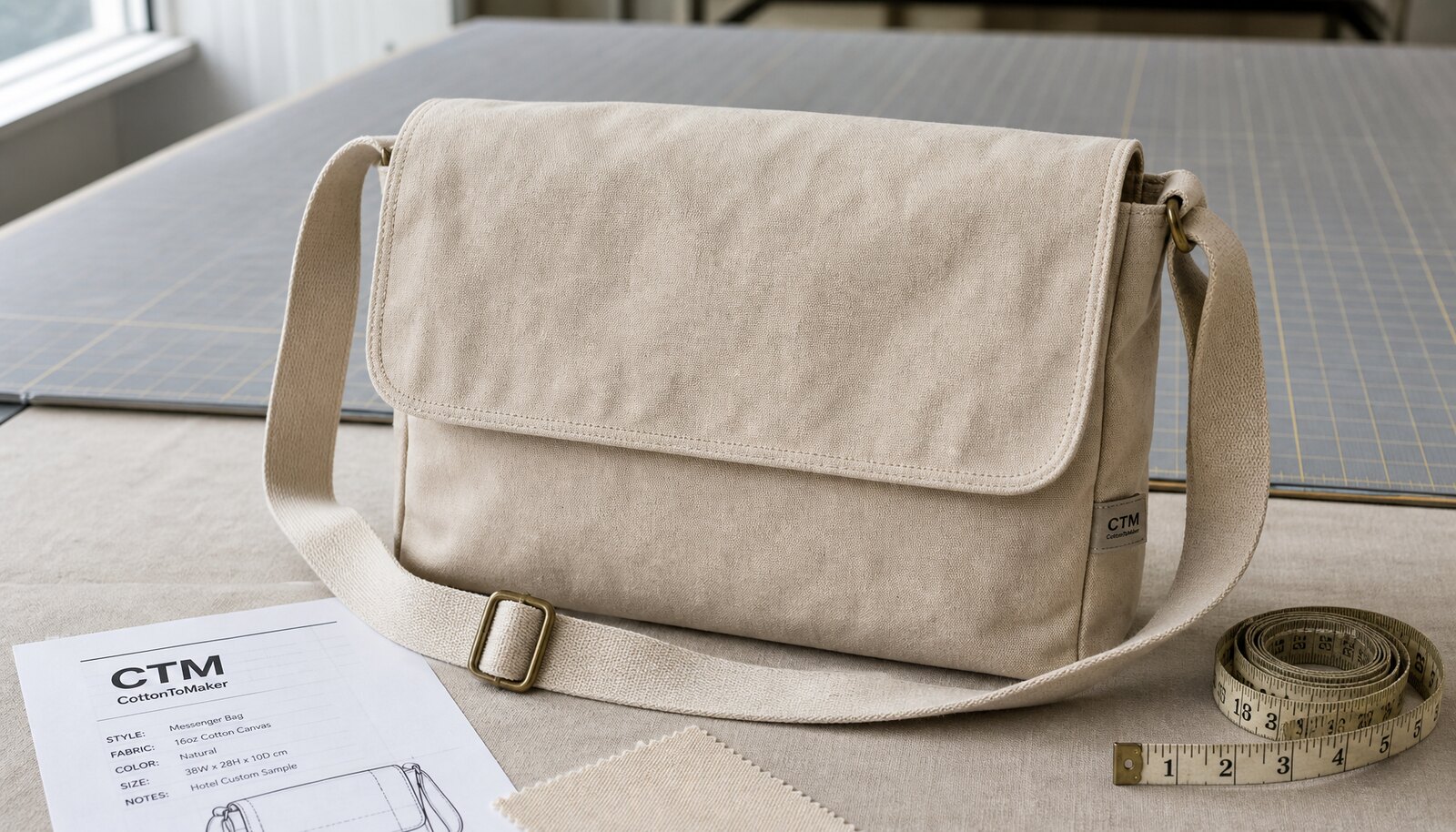
1. Start with the hotel use case, not the bag photo
When buyers search for custom messenger bags for hotels, they often begin with a style reference. That is useful, but it is not yet a buying brief. A hotel messenger bag can support very different functions: guest welcome kit carry, concierge delivery, staff document transport, conference collateral, in-room retail, or branded gift shop resale. Each use case changes the right canvas weight, closure type, pocket layout, decoration method, and packing standard. If the bag is for staff circulation, durability and ease of opening matter most. If the bag is guest-facing or retail, the visual finish and logo presentation matter more. If the same bag will be used across several departments, the spec should be built to the most demanding use case rather than the cheapest one.
The fastest way to reduce quote confusion is to define the actual contents first. Ask what the bag must carry, how often it will be used, who will see it, and what failure looks like. A bag that only needs to hold a brochure set can be lighter and simpler. A bag that must carry A4 folders, a tablet, a charger, and amenity items needs more structure, a wider gusset, and better reinforcement. That is not over-specifying; it is aligning the product to the job. Procurement teams save money when they avoid paying for decoration that does not improve function and avoid under-specifying load-bearing features that later create returns.
A useful hotel-specific distinction is whether the bag is part of the guest experience or part of the operational workflow. Guest-facing bags should open cleanly, close quietly, and present the logo neatly. Staff-use bags should resist abrasion, handle daily movement, and hold shape after repeated packing. Retail bags need the best finish consistency because the hotel brand is being evaluated as a product brand, not only as a service brand. Buyers should capture this distinction in the RFQ so suppliers understand what 'good' means before they quote.
To keep the rest of the sourcing process efficient, write down three things before asking for prices: the item list the bag must hold, the expected use frequency, and the visual standard the hotel expects. Those three inputs drive the rest of the spec and prevent the usual RFQ pattern where suppliers answer a vague request with a vague price.
- Guest-facing bags: prioritize presentation, quiet closure hardware, and clean logo placement.
- Staff-use bags: prioritize reinforcement, abrasion resistance, and carrying comfort.
- Retail or resale bags: prioritize stitching finish, color consistency, and presentation packing.
- Conference bags: keep the build simple, but still define dimensions and decoration clearly.
2. Size the bag around the contents, not a generic medium size
Size is one of the easiest details to under-specify and one of the hardest to fix after production starts. For hotel messenger bags, a common working range is about 34–38 cm wide, 28–32 cm high, and 8–12 cm deep. That size class usually fits A4 or letter documents, brochures, a notebook, and a small tablet case without making the bag awkwardly large. If the bag needs to carry a folio, hard-back folder, or thicker welcome kit, widen the gusset first. Increasing depth preserves the silhouette better than simply making the bag taller, which can create a top-heavy shape and make the flap sit poorly.
Procurement language should use finished dimensions, not vague sample language. Ask whether the supplier is quoting cut size or finished size, because seam allowances affect the final measurement. The RFQ should also state the tolerance range. A normal commercial expectation for a bag of this type is around +/-1 cm on body dimensions, while logo placement and strap drop should be controlled more tightly. If the bag is soft-structured or oversized, ask the factory to specify separate tolerances for flat dimensions and loaded dimensions so the approval standard is not subjective.
Think in terms of the real load path. A flat brochure set is easy; a tablet charger, water bottle, or hard-edged folder changes how the bag hangs and how the strap pulls on the body. If the contents are weighty or irregularly shaped, ask for a reinforced bottom panel and stress-point bartacks. If the contents are sensitive to bending, the internal pocket or sleeve size should be defined with the item dimensions in mind. This is why buyers get better pricing when they define the contents clearly: the supplier can build the structure around the real use rather than guessing at a generic size.
A simple rule helps keep the quote useful: the bag should be large enough to contain the intended items without forcing the flap open, but not so large that the bag looks empty or becomes expensive to ship. For hotel programs, that balance usually lands in the mid-size range above, with gusset depth adjusted to the contents. If the bag is being sold in a retail setting, the size may need to feel more substantial on the shelf, but the same content-based logic still applies.
- Ask the supplier to quote finished size and, if needed, cut size separately.
- Confirm whether the bag must fit A4, letter paper, folios, tablets, or amenity kits.
- Use gusset depth to solve load and shape problems before increasing height.
- Include a tolerance range in the RFQ so sample approval is not judged by eye alone.
3. Compare fabrics by weight, weave, finish, and shade control
For most hotel programs, 12oz canvas is the practical starting point. It gives the bag enough body for a messenger profile, prints well, and usually stays within a reasonable cost range for bulk purchasing. If the bag needs to hold heavier items or the hotel wants a firmer retail feel, 14oz canvas is worth considering. Heavier canvas generally resists sagging better and gives the bag a more substantial handfeel, but it also increases material use and can add sewing load. In procurement terms, 12oz is the better cost-control option; 14oz is the better presentation-and-durability option. The right choice depends on whether the bag is a utility item, a guest amenity, or a retail product.
Weight alone does not define quality. Ask for the fiber composition, weave density, and whether the canvas is raw, dyed, pre-washed, or pre-shrunk. A tighter weave usually creates a cleaner print surface and reduces visual distortion near seams. A looser weave can feel more casual and may suit certain hospitality brands, but it can also make the logo edges less sharp. If the hotel has strict color standards, request a physical shade reference or lab dip approval rather than relying on screen images. Canvas can look materially different under warm indoor light, daylight, and phone camera processing, so color control needs a physical reference point.
The most practical sourcing question is not 'Which canvas is premium?' but 'Which canvas will stay consistent across repeat orders?' Ask the supplier how the fabric behaves after sewing, pressing, and packing. Some fabrics wrinkle heavily in transit and look used before they are even unpacked. Others are so rigid that they feel uncomfortable on the shoulder. If the bags will be stacked for shipment, ask to see how the surface looks after compression. For hotel procurement, the best fabric is the one that meets the visual standard after production, packing, freight, and opening—not only at sample stage.
When comparing quotes, ask suppliers to specify whether the canvas has been washed, pre-shrunk, or finished to reduce size drift. That detail matters if the program needs repeatability. A bag that changes size noticeably after handling or exposure to humidity creates avoidable complaints. The ideal quote should let procurement compare weight, finish, and consistency together rather than treating canvas as a single line item.
- 12oz canvas: good baseline for most guest and staff programs.
- 14oz canvas: better for heavier carry and a more substantial retail feel.
- Pre-washed or pre-shrunk canvas: helps reduce size drift and can soften handfeel.
- Tight weave: usually improves print crispness and finish consistency.
- Ask for a physical color reference if brand shade accuracy matters.
4. Use a comparison table to separate price from real commercial tradeoffs
A quote is only meaningful when the spec behind it is the same. The fastest way to make a hotel sourcing exercise useful is to compare suppliers against one normalized bill of requirements. That means the same fabric weight, same size, same closure, same logo method, same reinforcement standard, same packing, and same carton assumptions. If one supplier quotes 12oz canvas with bulk packing and another quotes 14oz with individual packing, the unit price difference is not a true comparison. The buyer is looking at two different products.
The table below is the commercial shortcut procurement teams usually need. It shows where lower price is often hiding a tradeoff and what line item to verify before any award decision. Use it as a live comparison sheet in the RFQ process, not as a theoretical guide. Ask each bidder to state every deviation from the baseline in writing. If a supplier cannot or will not normalize the quote, the pricing should be treated as incomplete rather than competitive.
There are three common ways a supplier can appear cheaper without truly reducing cost: by using lighter fabric, by reducing hidden reinforcement, or by trimming packing and quality control. Buyers should keep these as separate checks. In hotel programs, the hidden costs of a weak bag show up later as complaints, repacking, rework, or a shorter service life. That is why the best procurement decision is not the lowest ex-factory number; it is the best landed value for the approved construction standard.
- Normalize every quote to the same fabric, size, decoration, reinforcement, and packing.
- Ask suppliers to list every deviation from the RFQ in writing.
- Separate unit price from freight density, rework risk, and reorder consistency.
- Use the comparison table as an award sheet, not just a research note.
5. Build quality depends on the hidden construction choices
A messenger bag can look attractive from the outside and still fail quickly if the hidden construction is weak. That is why hotel buyers need to specify the reinforcement details rather than assuming they are included. Strap attachment points should have bartacks or an equivalent reinforcement method, especially where the shoulder strap joins the body. The bottom panel should be reinforced if the bag must stand up to regular use or carry hard-edged contents. Seams should be clean and consistent, with no raw edges that fray during repeated handling. These details are small in a quote but large in actual service life.
Closure choice should be matched to the guest experience. A flap with a snap is usually the cleanest option for a hotel messenger bag because it presents neatly from the front and makes a tidy opening action. Velcro is functional and easy to use, but it can feel less premium and can wear over time. A zipper improves security and containment, but it adds hardware cost, more labor, and more potential QC variation. The best choice depends on whether the bag is being used by guests, staff, or retail shoppers. Buyers should ask the supplier to explain the construction route, not simply send photos of the finished front panel.
Pockets deserve the same level of precision. A front slip pocket can hold a note card, brochure, or room key sleeve. An internal sleeve helps keep documents flat. But every pocket adds operations and can create a fit issue if the opening is too tight or the pocket is placed too close to a seam. Put pocket dimensions in the RFQ if the pocket matters functionally. For a hotel program, the most common mistake is specifying a pocket by location only, then discovering that the intended contents do not fit cleanly after production starts.
A well-built bag is mostly about repeatable structure. Ask for the seam allowance, bartack count, reinforcement method, and whether the factory uses the same construction sequence on the sample and the bulk run. That may sound technical, but it is exactly what prevents a visually acceptable sample from turning into inconsistent bulk quality.
- Require strap-end bartacks or equivalent reinforcement on the production spec.
- Ask for bottom reinforcement details, not just exterior photos.
- Choose flap snap, Velcro, or zipper based on use case and cost, not habit.
- List pocket dimensions in the RFQ if the pocket has a functional purpose.
6. Match logo method to artwork, volume, and brand standard
The decoration method should be chosen for the artwork and the bag’s real use, not just for the cheapest quote. Screen print is often the default for hotel branding because it is cost-efficient, repeatable, and well suited to canvas. It works especially well for one-color logos, short wording, and simple graphics. If the design needs fine lines, multiple colors, or stronger visual impact, embroidery or a woven label may be better. Heat transfer can reproduce detail on smaller runs, but buyers should test how it behaves after folding, packing, and handling. A decoration method that looks good in a mockup may not perform well once the bag is compressed in cartons.
The biggest quoting mistake is to ask for 'logo included' without defining size, position, number of colors, and file format. A procurement-ready request should state the exact artwork reference, the logo location from seams or edges, and the target size in centimeters. If the brand uses Pantone or PMS standards, provide them. Then ask the supplier to confirm whether the chosen method can reproduce that standard within an acceptable tolerance. This turns decoration from a vague selling point into a controlled commercial line item.
For hotel procurement, durability matters as much as first appearance. Ask for a cure check on screen print, rub resistance if relevant, and a real sample of the exact decoration method rather than a generic sample board. If the bags will be folded in cartons, ask whether the print can crack or crease at the bend line. Embroidery should be checked for puckering, backing show-through, and thread break risk. Woven labels should be checked for edge finish and placement consistency. The key is to verify the decoration under the same handling conditions the bag will face before it reaches the hotel or the guest.
If your branding has strict visual rules, require the supplier to state the maximum logo size, the exact placement tolerance, and whether the method is suitable for repeat production across multiple lots. That gives procurement a usable standard when the bag is reordered months later.
- Screen print: best for simple logos and controlled cost.
- Embroidery: premium appearance, but check distortion and added lead time.
- Heat transfer: useful for detail, but test fold and crack resistance.
- Woven or side label: useful when the front panel should stay visually clean.
7. Sourcing route matters because control, not title, drives risk
Hotel buyers often ask whether a factory, trading company, or reseller is cheapest. That question misses the real issue: who controls the construction, who owns the QC, and who can fix problems quickly. A direct factory is usually strongest when the bag spec is fixed and the buyer wants visibility into sewing, printing, and packing. A trading company can be useful when the hotel needs multiple products in one shipment or wants one commercial contact for a broader program. A reseller can be acceptable for small or urgent orders, but the buyer should expect less traceability about who actually made the bag and which facility will handle rework.
The commercial risk is accountability. If the same supplier manages both sewing and printing, it is easier to assign responsibility when a logo is off-center or a strap seam fails. If work is split among subcontractors, the buyer needs clearer documentation on who performed the final inspection. Ask whether production is in-house or outsourced, and ask for images from the line that will make the bulk order. If the supplier is a trading layer, ask for the same information anyway. The important factor is evidence, not the label on the company type.
Procurement should also ask how the supplier handles lead-time risk. Useful questions include: What happens if canvas is delayed? What happens if the print line is overloaded? What is the backup plan if a closure component is out of stock? A credible supplier should be able to explain escalation steps, revised dates, and whether partial shipments are possible without compromising the approved spec. This matters because the hotel calendar often has a fixed date for guest arrivals, conference starts, or seasonal launches. A good-looking quote is not enough if the supplier cannot explain how they recover from delays.
For repeat programs, the best sourcing route is the one that makes reorder consistency easy. If the supplier can hold an approved sample, document the bill of materials, and reproduce the same fabric lot or equivalent standard on repeat orders, procurement time drops dramatically. That is often worth more than a small difference in first-order price.
- Direct factory: strongest for repeatability and construction control.
- Trading company: useful for mixed programs, but ask for disclosure of the actual maker.
- Reseller: acceptable for urgent or small runs, but weaker on traceability.
- Ask how the supplier manages material delay, print-line delays, and rework escalation.
8. Compare quote terms, not just unit price
A serious procurement comparison should answer one question: what is the landed cost of a bag that truly meets the hotel requirement? That means the same fabric weight, reinforcement, decoration method, closure hardware, pocket count, packing standard, and carton size. A lower quote only matters if it covers the same spec. If one supplier includes 14oz canvas, bartacked strap ends, and individual polybags while another quotes 12oz canvas with minimal reinforcement and bulk loose packing, the second quote is not a better commercial choice even if the unit number looks lower. The buyer would be paying less for a weaker product.
The best comparison sheet separates the quote into line items. Ask suppliers to break out fabric, sewing, print, hardware, packing, and setup charges. That makes hidden cost differences visible and gives you room to negotiate without weakening the bag. You can then see whether a supplier is saving money through efficient production or through spec dilution. It also makes follow-up questions more productive. Instead of asking for a generic discount, procurement can ask whether the price changes because of fabric weight, packing style, or reinforcement level.
Beyond the bag itself, procurement teams should compare payment terms, document readiness, and delivery reliability. Ask what deposit is required, what balance timing is expected, and whether the supplier can provide the compliance documents or shipping paperwork your organization needs. If the hotel or parent company requires material declarations, social audit summaries, restricted substance statements, or country-of-origin paperwork, ask early. A supplier that cannot provide the documents may not be the right partner, even if the bag price is attractive.
The same logic applies to escalation. If a problem appears during sampling or production, how quickly will the supplier respond, who has authority to approve rework, and how are disputes handled before shipment? These are commercial questions, not administrative extras. They determine whether an order stays on schedule or becomes a chain of delays.
When comparing bids, do not only ask 'Which quote is cheaper?' Ask 'Which quote is complete, auditable, and repeatable?' That frame is more useful for hotel procurement and usually produces a better supplier decision.
- Normalize all bids to the same spec before award.
- Ask for line-item pricing so hidden cost differences are visible.
- Compare payment terms, documents, and escalation support as part of commercial value.
- Treat repeat-order ease as a real procurement benefit.
9. Approve samples against a practical QC standard, not just appearance
A sample is the physical contract. For custom messenger bags for hotels, approval should go beyond 'looks good.' The sample must prove the bag works with the intended contents and that workmanship is stable enough for production. Start with a tape measure and verify finished width, height, gusset depth, strap drop, and logo placement against the RFQ. Do not use visual judgment alone. Then load the bag with the actual items it will carry—documents, tablet, brochure pack, or welcome kit—and check whether the flap closes cleanly and the bag still hangs properly. A bag that looks neat empty may be wrong once it is filled.
The inside of the bag matters as much as the outside. Check stitch lines, seam finishing, pocket openings, bartacks, and any raw edges that may fray. Ask the supplier to photograph the interior construction and point out where reinforcement has been added. If the bag includes a snap or zipper, open and close it repeatedly to see whether alignment holds. Hardware that binds in a sample usually becomes a recurring problem in bulk. If the decoration is embroidery, check for puckering and backing visibility. If it is screen print, check for rub-off, tackiness, or cracking on a light fold test.
For sign-off, use a simple and repeatable approval pack: one physical sample, one measured photo sheet, and one written spec summary. If the buyer must approve remotely, require front, back, inside, close-up, and measurement photos with a ruler visible in the frame. That is better than a general product photo and gives procurement a record for follow-up. Keep the approved sample or the signed photo sheet in the PO file so reorders are judged against a fixed reference rather than memory.
QC works best when the acceptance criteria are defined before production, not after a problem is found. Set a basic sampling plan, define critical versus major versus minor defects, and state the acceptance limit the factory must meet. A well-run supplier will understand this immediately; if the supplier resists, that is useful information in itself.
- Measure the sample against the RFQ, including strap drop and logo placement.
- Test the bag with the real contents, not only when empty.
- Inspect the inside: stitch lines, seam allowances, pocket finishing, and bartacks.
- Keep one approved sample or signed photo sheet for reorder control.
- Use a defined sampling plan and defect classification before bulk starts.
10. Lock packing, cartons, and lead time before releasing the PO
Packing is part of the product economics, not a side note. Hotel messenger bags are often packed in bulk polybags and master cartons because that keeps cost and freight under control. If the bags are for retail or gift shop sale, individual tissue, inserts, barcode stickers, or hang tags may be needed, but those items should be quoted separately so the commercial impact is visible. Packing affects cost, carton size, shipping density, and how wrinkled the bag looks when opened. Buyers should specify it up front rather than treating packing as a last-minute operational detail.
Lead time should be broken into stages: sample preparation, artwork approval, material sourcing, and bulk production. For a standard canvas program, a sample might take one to two weeks depending on complexity and revisions, while bulk production may take several weeks after sample approval. These are planning ranges, not guarantees. The useful question is when the clock starts: when the inquiry arrives, when the artwork is finalized, when the sample is approved, or when the deposit is paid? Different suppliers use different start points, and procurement needs that clarified before the schedule becomes a dispute.
Ask for carton details before PO release: pack count, carton dimensions, gross weight, label format, and whether there are any mixed-SKU cartons. Freight cost is driven by volume as much as weight, so a compact packing plan can save real money. A slightly higher factory price can still be the better commercial choice if the cartons are efficient and the goods arrive in good condition. For hotel buyers, this matters because the program cost includes not only the bag but also the time it takes for the operation to receive, store, and distribute it.
Good suppliers can also explain the delay escalation path. If materials are late or a rework is needed, what happens next, who approves the revised plan, and can partial shipments be made without changing the approved spec? Those answers are more valuable than a generic 'fast lead time' promise because they tell procurement how much schedule risk is really being carried.
- Use bulk polybag plus master carton unless retail presentation justifies more packing.
- Quote retail-style packing separately so labor and freight impact are visible.
- Confirm carton count, carton size, gross weight, and marks before PO release.
- Clarify the exact lead-time start point and how delays will be escalated.
Specification comparison for buyers
| Decision area | Practical recommendation | Commercial tradeoff | What to verify in the quote |
|---|---|---|---|
| Fabric weight | 12oz canvas is a solid baseline for most hotel programs; 14oz if the bag must hold tablets, document folders, or heavier amenity kits | 12oz keeps cost and freight down; 14oz adds body and a more substantial feel, but increases material use and sewing load | Ask for fabric weight in oz and GSM, yarn composition, weave density, finish, and whether the fabric is pre-washed or pre-shrunk |
| Finished size | Typical working range: 34–38 cm W x 28–32 cm H x 8–12 cm gusset for A4/letter carry | Smaller sizes reduce cost and carton volume; larger sizes improve utility but raise canvas usage and shipping density | Confirm finished size, cut size if applicable, and tolerance by dimension |
| Strap spec | Webbing strap about 3.0–3.8 cm wide with adjustable length and reinforced attachment points | Wider straps carry better and feel more premium; narrower straps cost less but can be less comfortable on repeated use | Check strap width, webbing thickness, adjuster type, drop length range, and reinforcement method |
| Closure | Flap with snap for guest-facing presentation; Velcro for speed; zipper for security | Snap looks cleaner and quieter; Velcro is functional but less premium; zippers add labor, hardware cost, and more QC risk | Ask for hardware type/brand, alignment tolerance, cycle durability, and whether closure motion snags the lining or seam allowance |
| Pocket layout | One main compartment plus one front slip pocket or one internal sleeve | More pockets improve utility but add operations, cost, and potential fit issues | Request pocket dimensions, location, opening width, and whether pocket tops are bound, turned, or reinforced |
| Logo method | Screen print for simple branding; embroidery or woven label for more premium positioning | Screen print is cost-efficient and repeatable; embroidery and labels raise cost but can improve perceived value | Verify method, size, placement, color count, artwork file format, and color reference standard |
| Reinforcement | Bartacks at strap points, reinforced bottom panel, and clean seam finishing at stress points | Reinforcement adds labor, but it reduces returns and extends service life | Require stitch photos, bartack count, seam allowance, and close-ups in pre-production approval |
| Packing | Bulk polybag and master carton for operations; retail sleeve/tissue only when presentation justifies it | Minimal packing reduces freight and handling cost; retail packing increases labor and carton volume | Confirm pack count, carton dimensions, gross weight, label format, and whether inserts or hang tags are included |
| Sampling | One pre-production sample plus measured photo proof if timing is tight | Samples add time and sometimes a fee, but they reduce expensive bulk errors | Ask for sample fee, sample lead time, revision limit, and whether the fee is credited against bulk |
Buyer checklist before sampling
- Define the use case first: guest welcome kit, staff document bag, concierge pouch, conference giveaway, or retail resale.
- List exactly what must fit inside the bag, such as A4 files, letter paper, folios, brochures, tablets, chargers, or amenity items.
- Fix the core spec before quoting: finished size, fabric weight, closure type, strap width, pocket layout, and logo method.
- Provide vector artwork and Pantone/PMS references if color matters; specify whether the logo is one color or multi-color.
- Ask every supplier to quote the same baseline construction so the prices are directly comparable.
- Request the fabric spec in both oz and GSM, plus weave type and any wash or pre-shrink treatment.
- State the required tolerance range for dimensions, strap drop, and logo placement in the RFQ.
- Ask for a pre-production sample or measured photo proof with measurements called out from seams and edges.
- Set a simple defect definition: major defect, minor defect, and rework item.
- Confirm carton pack count, master carton dimensions, and gross weight before PO release.
Factory quote questions to send
- Please quote this bag using the same fabric weight, weave, reinforcement, closure, strap width, and pocket layout across all options.
- What is your MOQ for this exact spec, and which changes raise MOQ or unit price: custom dyeing, lining, extra pockets, special labels, or custom packing?
- What is the exact canvas spec in oz, GSM, yarn composition, and weave density? Is it pre-washed or pre-shrunk?
- What stitch standard do you use at the strap attachment points, and how many bartacks or reinforcement stitches are included?
- What is the seam allowance on the body and gusset, and what tolerance do you hold on finished size?
- What logo method is included in the base price, and what are the surcharges for extra colors, extra placements, embroidery, woven labels, or heat transfer?
- Can you show photos of the pre-production sample from the inside and outside, including strap ends, closure alignment, pocket construction, and stitch finishing?
- What is the sample fee, sample lead time, and whether the sample fee is refundable or creditable against the bulk order?
- What packing is included in the quote: bulk polybag, individual polybag, tissue, insert card, barcode sticker, or master carton mark?
- What are the carton dimensions, estimated gross weight, and carton count per master shipment for this spec?
Quality-control points to confirm
- Use a simple AQL workflow rather than a vague visual check. For most hotel programs, inspect pre-shipment cartons using a defined sampling plan and require the supplier to report defect counts by lot.
- Define acceptance criteria before production: for example, critical defects = 0, major defects within the agreed AQL limit, and minor defects within the agreed AQL limit.
- Finished dimensions should match the approved spec within a clear tolerance, commonly around +/-1 cm for body dimensions and tighter control on logo placement and strap drop.
- Canvas surface should be free from oil marks, broken yarns in visible panels, major shade variation within one shipment, and obvious weave defects on the front panel.
- Print should be centered and aligned to the approved placement window, with no blur, double image, pinholes, missing ink, or visible color drop-off.
- Screen print should pass a simple rub check and fold check: no tackiness, visible flaking, cracking, or ink transfer under moderate handling.
- Embroidery should sit flat without puckering, thread breaks, looped stitches, loose backing, or exposed stabilizer in the logo field.
- Strap attachments should have even bartacks or equivalent reinforcement at both ends, with no skipped stitches, loose ends, or twisting at the load points.
- Closure hardware should align cleanly and operate repeatedly without snagging seam allowance, misalignment, or deformation of the flap.
- Pocket openings should be straight, secure at both ends, and large enough to fit the approved contents without forcing or distortion.