What buyers are really solving
Custom messenger bags are not hard to source if the only goal is a printed shoulder bag. They become difficult when the bag has to carry weight, hold its shape, look branded on a retail shelf, and still arrive at a cost that leaves margin. The buying problem is usually not the bag shell itself. It is the combination of load performance, decoration method, and repeatable production. A weak spec can look acceptable in a sample room and fail once the first carton lands at a distributor or retail DC.
For procurement teams, the real task is to define the bag as a working product, not just an item with a logo. A good RFQ for custom messenger bags should tell the factory who will use the bag, what it must carry, how it will be branded, and how many times you expect to reorder the same spec. If those answers are vague, the quote will also be vague. The factory may price a basic promotional bag while you expected a premium canvas build with structure and reinforcement.
- State the use case: commuter, laptop, conference, retail fashion, or gift packaging.
- Tie the spec to a real load, not just an aesthetic reference.
- Treat branding, structure, and packaging as part of the product, not add-ons.
Choose the right bag construction
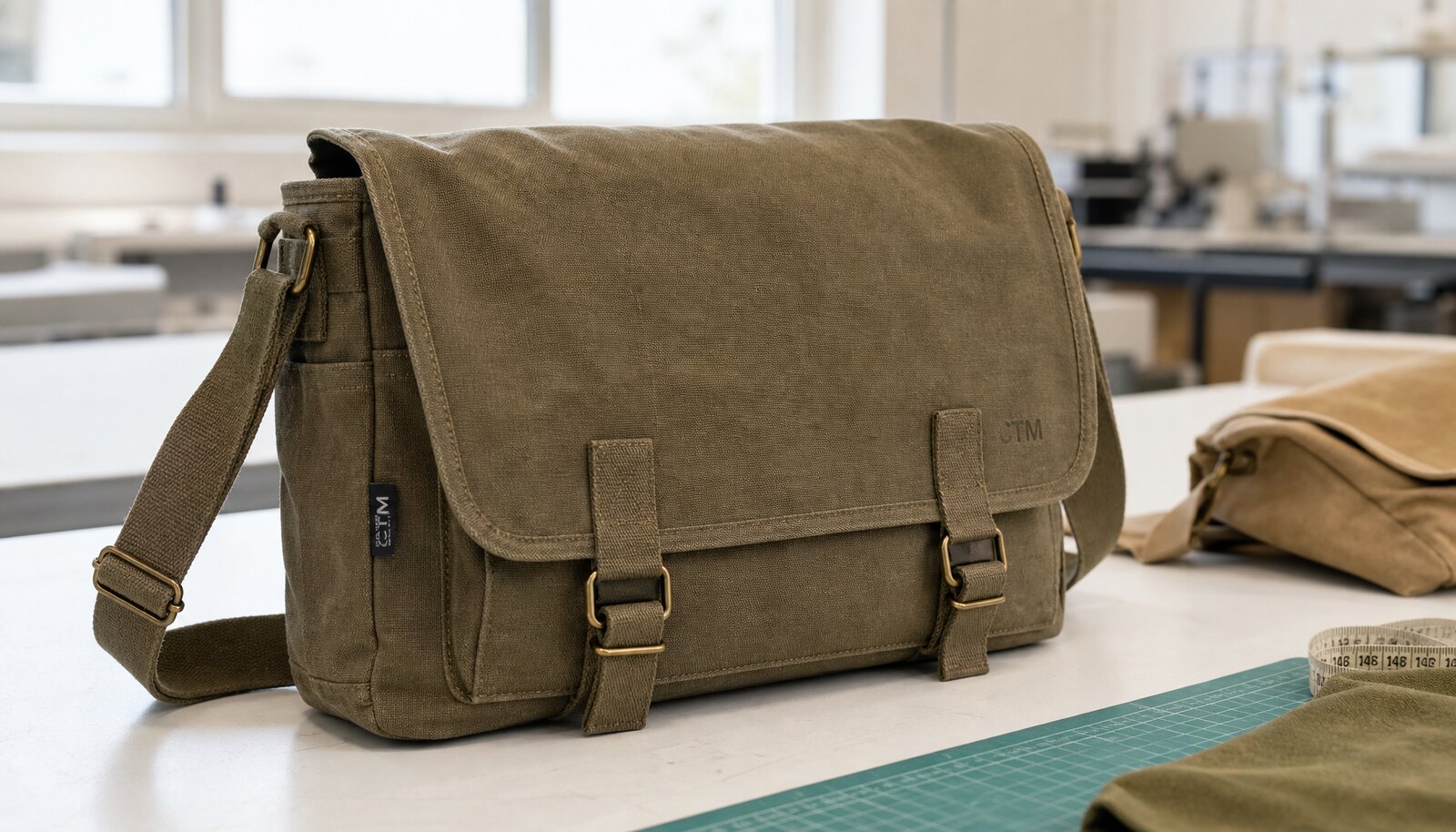
Canvas weight is the first decision that changes both feel and cost. For a light promotional messenger bag, 10 oz canvas can work if the bag only carries folders or light accessories. For a more durable everyday bag, 12 oz canvas is a common middle ground. If the bag needs a more premium hand feel, better body, and stronger retail perception, 14 to 16 oz canvas is usually the safer range. Heavier canvas improves structure, but it also changes sewing difficulty, folding behavior, and freight weight. The same pattern in different weights can feel like a different product.
Construction details matter as much as the canvas. A bag with no lining, weak webbing, and a single row of stitching on the strap will quote cheaper, but it will also be more likely to fail in use. A retail-grade messenger bag often needs a lining, a reinforced base or flap area, bar tacks or box stitching at strap ends, and a pocket layout that does not distort the front panel. If a laptop or tablet is part of the use case, ask the factory to build to the device size, not just a generic bag dimension.
- Use 10 oz canvas for light-duty promo or event carry.
- Use 12 oz canvas for general commuter and mid-market retail programs.
- Use 14 to 16 oz canvas when structure, hand feel, and brand perception matter more.
- Add reinforcement at strap anchors and flap stress points if the bag will carry electronics.
Branding choices that affect cost and durability
Logo method changes both the quote and the risk profile. Screen printing is usually the most practical option for large logos, simple color counts, and clean flat placement on canvas. It is also the easiest for a factory to repeat at scale, provided the artwork is prepared correctly. Embroidery works when you want a more premium look, but it adds needle limitations, thread cost, and backing requirements. Woven labels, sewn patches, and side labels are useful when the brand mark should be subtle and durable. Heat transfer can be efficient for complex art, but it is the first method I would review carefully if the bag will be handled hard or exposed to abrasion.
The practical decision is not which method looks best in a mockup. It is which method will survive the bag's use and fit the production route you can actually buy. A large full-panel print on rough canvas can look clean at first but become sensitive to alignment and ink coverage. A small woven label on the side seam may be cheaper to execute, but it may not deliver enough brand visibility for retail. Buyers should ask the factory to quote at least two decoration options so they can compare the real cost of the brand effect, not just the artwork itself.
- Use screen printing for simple logos and larger brand marks.
- Use embroidery for premium positioning, but confirm backing and stitch density.
- Use woven labels or sewn patches when you want durability and lower print risk.
- Confirm logo placement on the approved sample with actual size, not just artwork dimensions.
How to read the quote line by line
A useful quote for custom messenger bags should not be a single unit price with no context. It should show the price break at each quantity, the fabric spec, the print method, the closure and lining assumptions, and every setup cost that changes the order economics. If the bag has a custom zipper pull, metal buckle, or woven label, those details should be separated so you can see what happens when you change one item. When the factory only gives one price, you cannot tell whether the quote is stable or simply incomplete.
The most common quote mistake is comparing unit prices across suppliers without checking whether they are quoting the same construction. One factory may include a lining, reinforced strap ends, and folded edges, while another omits those items and saves money on paper. The same problem happens with packing. A quote that excludes individual polybags, carton marks, or inner dividers may look lower until the logistics team adds the missing packing requirements. Procurement should compare quotes as a full landed spec, not as isolated unit numbers.
- Ask for quantity breaks, not just one price.
- Separate fabric, logo, trim, packing, and freight assumptions.
- Compare quotes only after the spec is normalized across suppliers.
- Request carton size and gross weight so logistics can validate the quote.
MOQ logic and when it shifts
For custom messenger bags, MOQ is rarely driven by the sewn bag alone. It usually comes from the combination of fabric sourcing, color matching, print setup, label production, and hardware procurement. A simple stock canvas in a standard color with one screen print may support a lower MOQ than a custom dyed fabric with branded zipper pulls and a woven interior label. This is why buyers should ask what part of the order is setting the floor, rather than accepting a single MOQ number as if it were fixed by the product category.
There is also a difference between MOQ for development and MOQ for repeat production. A factory may accept a smaller first order to secure the program, then expect better economics on the second order once the pattern, print screen, and material chain are already established. Buyers should use that to their advantage. If the first order is an internal launch test, keep the spec simple and use stock components where possible. If the bag is intended as a core retail item, invest in a spec that can scale without having to rework the entire construction later.
- Custom fabric, custom lining, and custom hardware usually push MOQ up.
- One-color logo on stock canvas is the easiest route for a lower MOQ.
- First orders can sometimes be structured as a development run plus a bulk run.
- Ask which line item is the MOQ driver before negotiating quantity.
Supplier routes and the tradeoff you actually buy
The right supplier route depends on how much control you need versus how much speed you need. A direct cut-and-sew factory is the best fit when spec control matters and you expect to reorder. A trading company can help if your team wants one contact for multiple items, but you pay for that convenience in transparency. A local decorator can be useful for short runs, but they are often limited to decoration on stock bags rather than true bag development. That distinction matters because the cheapest route for a sample order is often not the safest route for a production order.
Buyers should also separate prototype capability from mass production capability. A small domestic sample shop may be excellent at making one or two prototypes quickly, but the bulk factory may use different machines, different operators, and a different finishing method. If the final order is going overseas, the safest process is to validate size, artwork, and functional fit first, then approve a pre-production sample from the actual bulk factory. That reduces the risk of approving a sample that cannot be repeated at scale.
- Direct factory: best for repeatability and cost control on medium to large orders.
- Trading company: useful for consolidation, but verify the real factory and spec ownership.
- Local decorator: fast for small runs, weaker for custom construction.
- Prototype shop: good for fit testing, not a substitute for bulk approval.
Sample approval and QC thresholds
A sample should prove three things: the bag matches the approved dimensions, the decoration is clean and durable, and the build can handle the intended load. Do not approve a sample just because the color is close. Check the strap drop, pocket depth, flap closure, zipper movement, and internal capacity with the items the bag is supposed to carry. For messenger bags, a small difference in pocket position or flap size can change usability more than a small difference in shade.
QC thresholds should be written in practical terms, not vague language. Ask the factory to approve a sealed reference sample and then define what will be measured in bulk. For example, width, height, and strap drop should stay within the agreed tolerance; printed logos should remain centered and legible; seams should have no skipped stitches, loose thread clusters, or visible stress distortion; and hardware should operate smoothly without snagging. If you expect the bags to move through retail or distribution, add a basic carton drop and packing integrity check so the bag is not damaged before it reaches the shelf.
- Measure the actual carry load during sample approval.
- Seal one approved sample for the factory and one for the buyer.
- Check print alignment, logo clarity, and wash or rub resistance if relevant.
- Require a pre-production sample before mass cutting if the order is new.
Packing, carton data, and freight impact
Packing is part of the product economics, not just a warehouse detail. A messenger bag packed flat in an individual polybag is easy to handle, but the factory must control wrinkles, print scuffing, and strap folding. If the bag has structured canvas, metal hardware, or a printed surface, the pack method should protect the finish without adding too much bulk. Some buyers prefer each bag in a polybag with a small desiccant pack; others want tissue or a cardboard insert to protect shape. The correct choice depends on the brand position and the destination market, but the decision should be made before the quote is finalized.
Carton information affects freight cost and warehouse efficiency. A quote that ignores carton size, pack count, and gross weight will not help the logistics team. Ask for master carton dimensions, units per carton, expected carton weight, and any outer marks required for distribution. If your receiving team uses barcode labels or carton-level SKU marks, include that in the pack spec. Small changes in packing density can change container utilization and trucking charges more than buyers expect, especially on canvas products that are bulky relative to their selling price.
- Specify whether each bag ships in a polybag, tissue wrap, or with an insert.
- Lock carton count and carton size before final pricing.
- Ask for gross weight so freight and warehouse handling can be modeled.
- Include carton marks, SKU labels, and barcode rules in the PO.
Lead time, change control, and reorders
Custom messenger bag timelines usually break into sample development, pre-production approval, and bulk production. The sample stage can be short if the bag uses stock fabric and a simple logo, but it can stretch quickly if the buyer changes artwork, strap hardware, or lining color after the first sample. Bulk production should not start until the pre-production sample is approved against a written spec. That is the point where the factory knows the real approved build, and the buyer can still correct a mismatch before the entire order is committed.
The biggest schedule risk is late change control. If the art file is still moving while fabric has already been cut, the project becomes expensive and slow at the same time. Buyers should freeze the key variables early: size, canvas weight, logo placement, color count, and packing. Reorders are easier when the first order is built with standard materials and the factory keeps the same pattern and artwork files. If you expect a second or third run, ask the factory to archive the approved sample, fabric references, and packing spec so the next order does not restart from zero.
- Freeze the artwork and size before pre-production sampling.
- Do not start bulk until the approved sample is signed off internally.
- Use standard materials if you expect fast reorders.
- Ask the factory to retain the pattern, print screen, and approved reference sample.
What a clean purchase order should lock
A clean purchase order for custom messenger bags should remove ambiguity on the items that usually cause disputes. It should identify the approved sample reference, the canvas weight, the lining spec, the logo method, the pack method, the carton data, and the destination terms. If the order includes multiple sizes or colorways, list them separately so the factory cannot mix assumptions across styles. The PO should also state what happens if incoming goods miss the agreed standard, because that is easier to enforce when it is written before production starts.
For buyers managing several suppliers, the best practice is to attach a one-page spec sheet and the approved artwork file set to the PO. That gives operations, quality, and receiving teams a shared reference. It also helps the factory avoid the classic problem where sales, sampling, and production each remember a slightly different version of the product. The cleaner the order record, the easier it is to compare reorders later and to tell whether a cost change is due to material inflation, a spec change, or a real supplier issue.
- Attach the approved sample reference and spec sheet to the PO.
- List every size, colorway, and decoration variant separately.
- Define defect handling and replacement rules before bulk production.
- Keep the first order spec reusable if the product will reorder.
Specification comparison for buyers
| Spec decision | Recommended option | When it fits | Buyer risk to check |
|---|---|---|---|
| OEM cut-and-sew factory | Use a factory that sews the bag body, straps, lining, and branding in-house | Best for controlled sizing, stable quality, and repeat orders with the same spec | Confirm they own the critical operations and are not outsourcing the strap build or print step |
| Trading company | Use when you need one contact for mixed categories or consolidated sourcing | Works for buyers who want one PO across several bag styles or need sourcing support | Watch for spec drift, hidden markups, and unclear responsibility when defects appear |
| Local decorator | Use for short runs with simple print or embroidery on stock bags | Fits events, quick launches, or test orders where speed matters more than exact construction | Check whether the base bag can really carry the load and whether decoration changes wash or abrasion performance |
| Stock bag with custom logo | Start from an existing messenger bag and add logo only | Good when MOQ is tight or you want to validate the market before full development | The shape, lining, and hardware may not match your brand standard, so compare the base bag carefully |
| Custom fabric and trim build | Specify fabric weight, lining, zipper, webbing, and label from the start | Best for premium retail, corporate gifting, or long-term brand programs | Expect higher setup complexity and make sure the factory quotes every trim change separately |
| Domestic prototype shop | Use for fit, size, and artwork validation before overseas bulk | Useful when the product must fit a device, folder, or product kit precisely | Prototype quality can be good while mass production quality differs, so recheck against production methods |
| Overseas canvas specialist | Source from a factory that makes canvas bags at scale | Fits buyers who need better unit economics on medium to large volume orders | Confirm lead time, carton loading, and communication on artwork approvals before committing |
| Full-service sourcing hub | Use when you need design support, sample coordination, and shipment consolidation | Works for teams without deep bag sourcing bandwidth | Make sure the hub can still provide transparent factory identity, audit trail, and spec ownership |
Buyer checklist before sampling
- Lock the target use case first: laptop carry, commuter bag, event giveaway, or retail fashion item
- State the finished size, strap drop, laptop fit, pocket count, and closure type in the RFQ
- Choose the canvas weight in gsm or oz and note whether you want a structured or soft hand feel
- Specify print method, print size, logo placement, and acceptable color matching standard
- Ask for strap construction details, including webbing width, reinforcement patches, and stitch count at stress points
- Request a sample approval set that includes bulk fabric, print strike-off, and pre-production sample
- Confirm carton pack count, polybag requirement, master carton marks, and gross weight target
- Ask for quote breakdown by quantity, logo setup, sample fee, packaging, and delivery terms
- Define your QC standard in writing, including dimension tolerance, seam quality, and hardware function
- Get the lead time split into sample, pre-production, and bulk production milestones
Factory quote questions to send
- What is the exact canvas weight, weave type, and finish you will use for the body and flap?
- Is the price based on in-house production or any outsourced printing, embroidery, or packing step?
- What is the MOQ for this spec, and what part of the order drives that MOQ: fabric dye lot, print screen, or hardware?
- Which print methods do you recommend for the artwork, and what are the setup costs for each method?
- Can you quote the bag with and without lining, internal pocket, zipper closure, and reinforced base?
- What sample stages are included before bulk, and which sample stage will reflect the real production method?
- What are the carton size, pack count, and gross weight, and do these change the unit price?
- What incoterms are included in the quote, and what local charges are excluded?
- What is your defect handling process if the bulk shipment misses the approved sample standard?
Quality-control points to confirm
- Finished dimensions should stay within the agreed tolerance for width, height, depth, and strap drop
- Canvas weight and hand feel should match the approved swatch or sealed sample
- Print registration should stay aligned, with no bleeding, pinholes, or color shift beyond the approved target
- Strap ends, pocket corners, and zipper ends should have reinforced stitching and no loose threads at delivery
- Seams should remain straight under normal load, with no skipped stitches or visible puckering at stress points
- Hardware should open, close, and run smoothly without sharp edges, loose rivets, or weak attachment points
- The bag should pass a realistic carry test for the intended use, such as documents, tablet, or laptop load
- Packing should protect the product surface, keep cartons clean, and preserve shape during transit