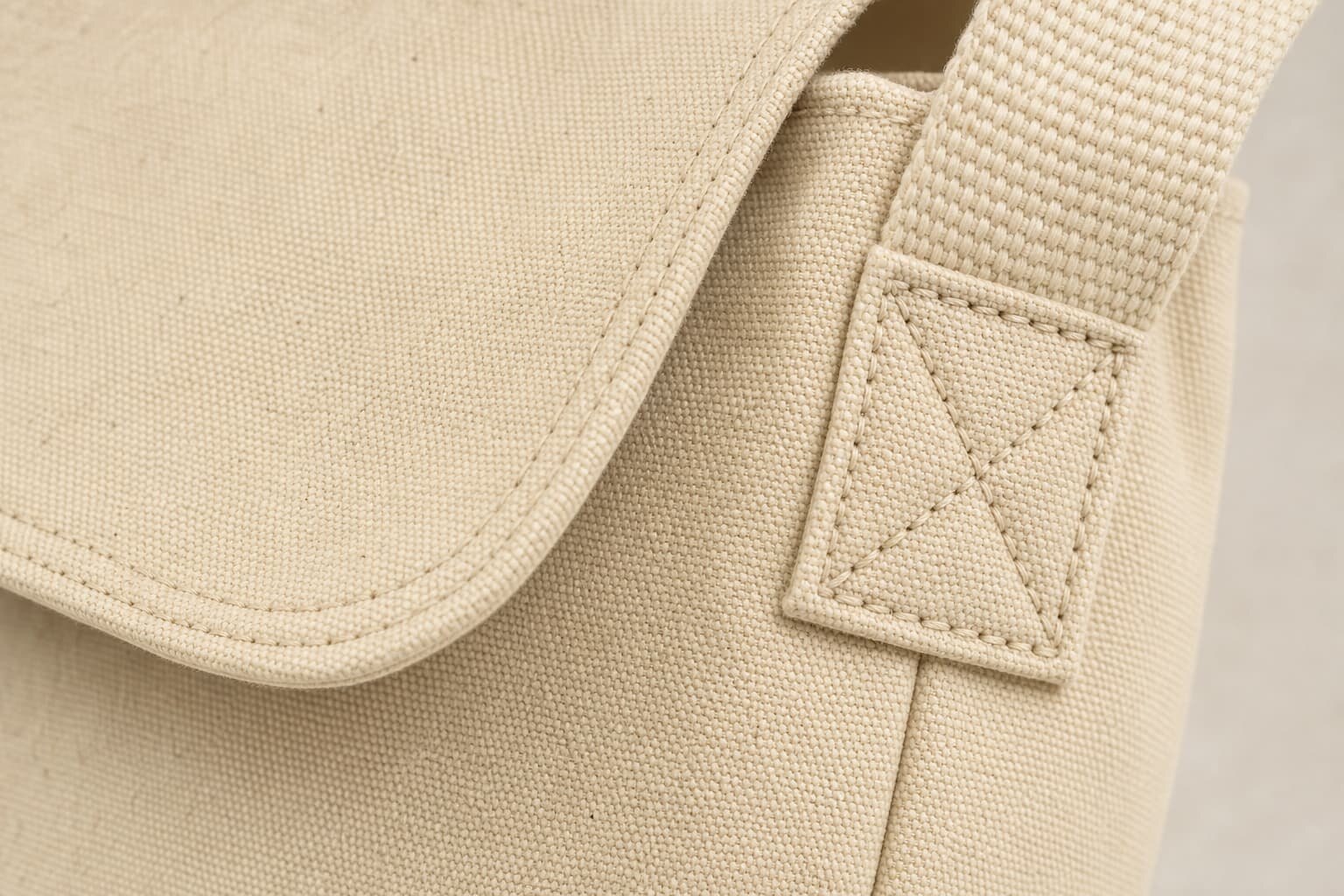
Why carton packing belongs in the messenger bag RFQ
For custom canvas messenger bags, carton packing is not a warehouse detail left until the end. It affects the quoted unit cost, carton CBM, sea freight cost, warehouse receiving, product shape, and buyer claim rate. A messenger bag has a wide flap, shoulder strap, hardware, gusset, and sometimes padding or lining. These parts do not behave like a flat cotton tote. If the factory folds the bag too tightly or overloads the carton, the importer may receive bags with crushed flaps, strap marks, buckle impressions, or uneven printed panels.
Procurement teams should put the packing method into the RFQ at the same level as fabric GSM and logo artwork. A supplier quote that says only standard export carton is incomplete. You need to know how many bags go into each carton, whether the bag is flat packed or folded, how the strap is placed, what inner protection is included, and what carton board strength is used. Without those details, two factories may quote the same bag size and fabric weight but ship very different carton volumes and quality risk.
- Ask for estimated carton size and quantity per carton during quotation.
- Set a maximum carton gross weight if your warehouse has handling limits.
- Require packing approval before mass packing, not after all cartons are sealed.
- Treat packing material changes as cost changes, because they affect both unit price and freight.
Start with the bag structure before deciding carton quantity
Carton quantity should be based on the finished bag structure, not only the length and height. A simple 12 oz canvas messenger bag with one large compartment and a soft cotton strap may pack flat in stacks of 20 or more pieces per carton. A 16 oz canvas bag with gusset, padded laptop sleeve, metal adjuster, leather patch, and reinforced flap may need a lower carton quantity because the hardware and padding create pressure points. If the supplier uses the same carton count for both styles, one shipment will likely arrive with deformation or crushed corners.
Buyers should send a technical sketch or reference sample showing the gusset depth, flap closure, strap attachment, internal pocket, and any stiffener. The factory can then trial-pack a sample carton and report the realistic piece count. This is more reliable than asking for the lowest CBM. Low CBM can look attractive in a quote comparison, but if it is achieved by forcing bulky messenger bags into a carton, the cost saving can disappear through rework, discount claims, or rejected retail stock.
- Soft unlined messenger bag: usually easier to flat stack with higher carton quantity.
- Lined or padded messenger bag: needs more space to prevent compression marks.
- Metal hardware: should not face printed panels or light fabric during packing.
- Boxy gusset style: usually needs controlled carton height to avoid side collapse.
Fabric weight, GSM, and how canvas affects packing behavior
Canvas messenger bags are commonly quoted by ounce weight or GSM. A 10 oz canvas may be roughly 300 to 340 GSM, 12 oz around 380 to 420 GSM, 14 oz around 450 to 480 GSM, and 16 oz around 500 to 540 GSM, depending on yarn count, weave density, and finishing. These figures are practical ranges, not universal standards. The same nominal ounce weight can feel different if one mill supplies a tighter weave and another supplies a looser weave.
Packing behavior changes with weight. Lighter canvas collapses more easily and can show sharp fold lines when compressed. Heavier canvas resists folding but increases gross carton weight and may need larger cartons. Natural canvas also shows dirt, scuffing, and moisture marks more easily than dark dyed canvas. If the buyer wants a premium retail appearance, the RFQ should state both fabric weight and packing expectation. For example, a 14 oz natural canvas messenger bag with front flap screen print should not be packed with unprotected buckles pressing into the printed surface.
- For economy promotions, 10 oz to 12 oz canvas can work if the bag is not overloaded with hardware.
- For retail or corporate resale, 12 oz to 16 oz canvas gives better handfeel and shape retention.
- For structured laptop messenger bags, confirm whether foam, lining, or backing board changes carton volume.
- For natural canvas, request dust control, clean packing tables, and inner protection.
Logo method changes the inner packing requirement
A custom messenger bag often uses the large front flap as the logo area. Screen printing is common for cotton canvas because the panel is flat before sewing and the cost is efficient for repeat orders. Heat transfer can support detailed artwork but may feel less natural on heavy canvas. Embroidery adds texture but can distort thinner fabric if the backing is not controlled. Woven labels, leather patches, and embossed patches are useful when the buyer wants a quieter retail finish.
Each logo method creates a different packing risk. Fresh screen print can stick or transfer if the curing is not complete or if printed flaps are stacked face to face. Embroidery thread can snag on metal sliders. Leather or PU patches can leave pressure marks on the bag above it if the carton is overfilled. A buyer should not approve only the logo appearance on one sample. The packed sample must also show whether the logo area is protected by tissue, glassine, a paper sheet, a polybag, or a packing direction that keeps hardware away from the logo.
- Screen print: confirm ink curing, rub test, and whether tissue is required over the print.
- Embroidery: check backing trimming and whether stitches rub against other bags.
- Woven label: confirm label position does not twist when bag is folded.
- Patch logo: check carton pressure marks around patch edges after 24 hours packed.
Choose flat packing, light folding, or shaped packing deliberately
The cleanest packing method for most canvas messenger bags is flat packing with the flap closed and the shoulder strap tucked inside or laid along the back panel. This protects the front flap appearance and keeps the bag easy to count. It also uses more carton space than tight folding. Light folding may be acceptable for low-cost promotional bags, especially if the buyer does not require a retail shelf appearance. However, the fold line should not run across the logo, leather patch, magnetic snap, or flap corner.
Shaped packing is sometimes used for premium messenger bags with firm gussets, laptop padding, or structured bottoms. In this method, the bag is not fully flattened; it is packed with light support so the gusset keeps its shape. This increases CBM and carton cost, but it can reduce complaints for higher-value retail programs. The buyer should decide what level of presentation matters. A distributor shipping to corporate events may accept flat compression. A retail buyer selling at full price may need better shape protection.
- Flat packing: best balance of protection, carton efficiency, and counting accuracy.
- Half folding: only use when fold marks are acceptable and logo position is safe.
- Shaped packing: best for structured or padded messenger bags but increases freight volume.
- Mixed methods: avoid unless each SKU has clear packing photos and carton labels.
Set carton specifications that match export handling
Messenger bag cartons are handled several times before reaching the final warehouse: factory storage, truck loading, port handling, container stacking, destination unloading, and domestic delivery. A weak carton may look fine at the factory but fail after weeks under load. For heavier canvas messenger bags, buyers should ask for five-ply export cartons such as K=K or B=C board grades, depending on local material standards. The exact grade should be confirmed with the factory because carton naming varies by country and supplier.
Carton size also needs control. A carton that is too tall can bulge and crush the bottom bags. A carton that is too loose allows bags to shift, causing scuffed fabric and mixed orientation. A practical target is to keep cartons full but not forced, with the top flaps closing naturally before taping. Many importers also set a maximum gross weight, often for warehouse handling rather than ocean freight. If your receiving team prefers cartons below a certain weight, include that number in the RFQ.
- Confirm outer carton length, width, height, net weight, gross weight, and CBM.
- Ask whether carton strength changes when the order uses heavier canvas or more hardware.
- Use carton liners or inner sheets if light fabric may rub against brown carton board.
- Require clear carton sealing: tape width, H-taping if needed, and no open carton corners.
Inner packing options and when each one is worth paying for
Individual polybags are still common because they control dust, moisture during handling, barcode placement, and SKU separation. Some buyers now prefer recycled polybags, paper bags, glassine bags, or paper belly bands to reduce plastic. No inner packing can be acceptable for low-cost bulk giveaways shipped directly to one event location, but it is risky for light canvas, printed flaps, and mixed-color cartons. The factory quote should clearly state what inner packing is included, because a small material change can affect both price and lead time.
If the product is going into retail or a distributor warehouse, inner packing is also a receiving tool. Barcode stickers, color labels, size labels, and carton allocation must match the packing list. If one carton contains multiple colors or SKUs, each inner pack must prevent confusion. Buyers should avoid vague wording such as retail packing unless the factory receives a photo or written standard. A belly band, hangtag, barcode sticker, and individual polybag are four different cost and labor items.
- Individual polybag: practical for dust control, barcode labels, and warehouse picking.
- Glassine or paper bag: useful for plastic reduction, but test tearing and moisture resistance.
- Paper belly band: good for brand presentation, weaker for dust and humidity control.
- No inner pack: lowest cost, but only suitable when appearance requirements are modest.
MOQ logic: bag production MOQ is not the same as packing MOQ
Many quote problems happen because buyers ask only for the messenger bag MOQ. The factory may be able to sew 500 pieces of a standard canvas style, but the real MOQ can change when you add custom dyed fabric, special metal hardware, woven labels, printed hangtags, custom polybags, or printed carton marks. Packing materials often have their own supplier minimums. If a distributor orders five colors with separate carton labels and barcode stickers, the packing setup can become more complex than the sewing setup.
A clean RFQ separates MOQ by decision point. Ask the factory for MOQ by fabric color, logo design, hardware color, inner packing type, carton mark version, and barcode label. This helps procurement compare quotes honestly. A lower unit price may rely on one carton mark and one mixed bulk pack, while a slightly higher quote may include SKU-level labeling and retail-ready packing. For importers selling to chain stores or online fulfillment centers, the second quote may be cheaper after receiving costs are considered.
- Fabric MOQ: affected by stock canvas availability, dye lot, and fabric width.
- Logo MOQ: affected by screen setup, embroidery programming, patch mold, or label weaving.
- Inner pack MOQ: affected by custom printed bags, barcode labels, and hangtags.
- Carton mark MOQ: affected by SKU count, PO count, and retail routing requirements.
Sample approval should include a packed sample, not only a loose bag
A loose pre-production sample can show sewing quality, logo position, fabric handfeel, and hardware function. It cannot prove that the bulk shipment will arrive in good condition. For messenger bags, the buyer should request packed sample photos or one physical packed sample if the order value justifies it. The sample should show the bag folded or flat packed exactly as mass production will be packed. It should include the inner packing, hangtag, barcode, tissue, carton arrangement, and carton mark.
After the sample has been packed for at least 24 hours, open it and check the front flap, corners, gusset, logo area, strap hardware area, and any light-colored panels. Look for pressure marks, ink transfer, buckle dents, trapped threads, dust, and uneven folds. This simple check catches many problems before the factory packs hundreds of cartons. If the packed sample fails, adjust the packing direction, lower the carton quantity, add tissue protection, or change hardware placement before approving mass packing.
- Check the bag after it has stayed packed, not immediately after the factory folds it.
- Photograph the approved packing method and attach it to the purchase order.
- Approve carton marks and barcode label position together with the bag sample.
- Do not allow mass packing to start until the packing method is confirmed in writing.
Lead time and quote data buyers should request before order release
Lead time for custom messenger bags depends on fabric sourcing, cutting, printing, sewing, inspection, packing material preparation, and final carton packing. A typical factory schedule may show separate stages, but buyers should ask which materials are on hand and which are made to order. Custom dyed canvas, embroidered patches, special buckles, and printed retail packaging can add time before sewing even starts. Packing materials should be ordered early enough to avoid finished bags waiting unpacked in the workshop.
For quote comparison, request the same data from each supplier: finished bag size, fabric GSM, logo process, inner packing, pieces per carton, carton dimensions, gross weight, net weight, estimated CBM per 1,000 pieces, sample lead time, bulk production lead time, and what is excluded. This gives procurement a full landed-cost view. The cheapest FOB unit price is not always the best option if the carton count is unrealistic, carton board is weak, or barcode labeling is not included.
- Ask for sample lead time and mass production lead time separately.
- Confirm when final carton dimensions will be available for freight booking.
- Request estimated CBM per 1,000 pieces for easy comparison across suppliers.
- List exclusions clearly: barcode labels, hangtags, reinforced cartons, inspection, or special palletization.
Specification comparison for buyers
| Spec decision | Recommended option | When it fits | Buyer risk to check |
|---|---|---|---|
| Fabric weight for bulk messenger bags | 12 oz to 16 oz cotton canvas, roughly 380 to 540 GSM depending on weave | Retail promotions, bookstore bags, work bags, conference merchandise, and brand resale programs | Too light fabric can collapse in carton and show flap creases; too heavy fabric increases carton weight and freight cost |
| Logo method before carton packing | Screen print for flat flap logos; woven label or leather patch for premium programs | Simple brand marks, one to three colors, medium to large order quantities | Thick ink or raised patches can transfer marks if bags are packed face to face without tissue or poly separation |
| Bag folding method | Flat packed with flap closed, strap tucked inside or laid along back panel | Most canvas messenger bags with soft body and standard shoulder strap | Aggressive folding saves carton volume but creates permanent corner and flap fold marks |
| Inner protection | One bag per recycled polybag, glassine bag, or paper belly band depending on buyer policy | Retail distribution, barcode control, warehouse receiving, and dust-sensitive light colors | No inner pack can reduce cost but increases rubbing, loose thread contamination, and mixed color risk |
| Carton loading direction | Flat stack, same orientation, 10 to 25 pieces per carton based on size and weight | Common export carton packing for medium canvas messenger bags | Overfilled cartons deform bottom bags; underfilled cartons crush during container loading |
| Carton strength | K=K or B=C corrugated export carton with five-ply board for heavier styles | Orders with 14 oz to 18 oz canvas, metal buckles, padded straps, or long sea freight routes | Thin cartons may pass factory packing but fail at importer warehouse after stacking |
| Carton marking | Buyer PO, SKU, color, size, quantity, gross weight, net weight, carton number, country of origin if required | Multi-SKU programs, distributor orders, Amazon or retail DC receiving | Missing or inconsistent carton marks cause receiving delays even when product quality is acceptable |
| MOQ planning for packing | Confirm MOQ by fabric color, print setup, carton mark version, and inner pack style | Buyers ordering several colors or private label versions | A factory MOQ for bag sewing may not include separate packing materials or printed carton labels for each SKU |
Buyer checklist before sampling
- Confirm finished bag size, gusset depth, flap size, strap length, and whether bags must be packed flat or can be lightly folded.
- Specify canvas weight in oz or GSM, fabric color, dye tolerance, lining requirement, and whether fabric shrinkage must be controlled before cutting.
- State the logo method, logo position, logo size, Pantone references, print side, and whether tissue protection is needed over printed areas.
- Define inner packing clearly: individual polybag, paper bag, belly band, no poly, barcode sticker, suffocation warning, or retail hangtag.
- Set target carton quantity per SKU and maximum gross weight accepted by your warehouse or retail customer.
- Ask for carton dimensions before production, not only after packing, so freight forwarders can estimate CBM accurately.
- Request one packed pre-production sample or packing photo set showing folding, strap position, polybag, carton fill, and carton marks.
- Check whether accessories such as buckles, sliders, magnets, snaps, and leather patches need extra protection inside the carton.
- Require carton drop, compression, or at least stacking checks for heavy canvas messenger bags going by sea freight.
- Match carton labels, shipping marks, SKU barcodes, and packing list quantities before balance payment or shipment release.
Factory quote questions to send
- What canvas weight and composition are included in your quote, and is the GSM measured before or after washing or finishing?
- How many pieces will be packed in each export carton for our bag size, and what are the estimated carton dimensions, gross weight, and CBM?
- Will the bags be packed flat, half-folded, or flap-folded, and where will the shoulder strap and hardware sit inside the pack?
- Is individual inner packing included in the unit price, and what material thickness or paper grade is quoted?
- How will printed flaps, leather patches, metal buckles, and magnetic snaps be protected from rubbing during transport?
- Are custom carton marks, SKU labels, FNSKU labels, retail barcodes, or mixed-carton labels included or charged separately?
- What is your MOQ for the bag style, each canvas color, each print design, and each packing version?
- Can you provide a packed sample photo or video before mass packing starts, including carton weight and carton sealing method?
- What quality checks are done after packing, and do you inspect carton quantity, carton mark accuracy, and gross weight by SKU?
- If carton dimensions change after final packing, when will you inform us so we can update freight booking and warehouse receiving data?
Quality-control points to confirm
- Measure finished bag dimensions after packing rest time, not only immediately after sewing, because heavy canvas can relax and change shape.
- Check fabric GSM, color shade, weave defects, and panel direction before cutting, especially for natural and dyed canvas orders.
- Test print adhesion, crocking, and ink transfer before stacking printed flaps face to face.
- Inspect seam strength at strap anchors, flap corners, gusset joins, and stress points carrying the packed product weight.
- Verify strap hardware does not press into the front flap or printed logo when packed in the carton.
- Confirm each bag has the correct hangtag, barcode, woven label, care label, and country label if required by the destination market.
- Open random packed cartons to check count accuracy, SKU separation, inner pack condition, dust, stains, odor, and moisture risk.
- Record carton dimensions, gross weight, net weight, carton number sequence, and shipping marks before final shipment approval.