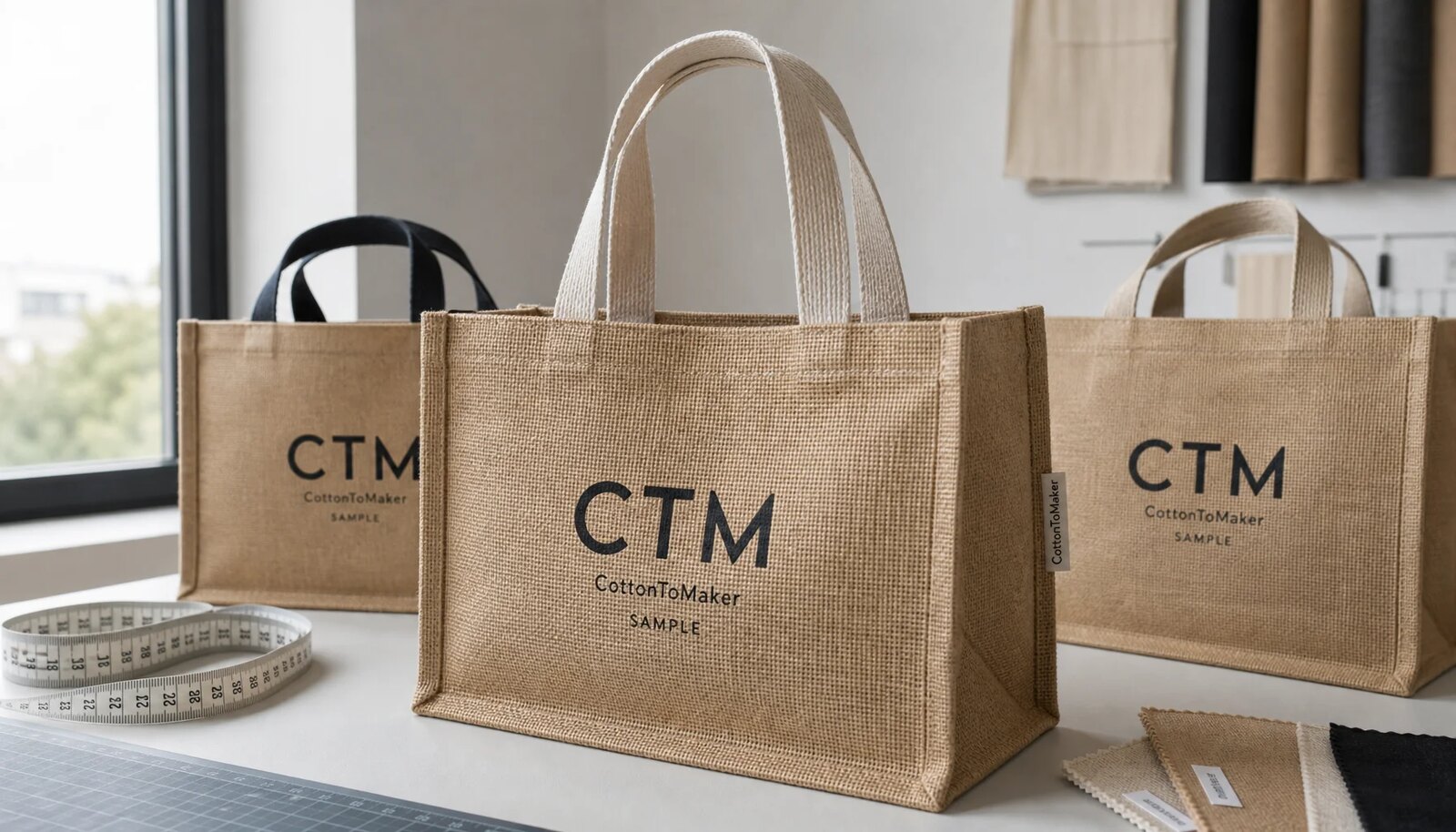
Start With the Hotel Retail Job
Custom jute tote bags wholesale sourcing for hotel retail should start with the job the bag has to do, not with a product photo. A resort boutique tote is different from a conference giveaway. A spa retail bag is different again. The retail version needs shelf presence, clean branding, comfortable handles, predictable sizing, and a finish that supports the hotel’s price point. If the RFQ only says natural jute tote with logo, every supplier will make different assumptions.
Write the use case in plain terms. What will the tote carry? Where will it be sold or placed? How long is the distribution chain? A pool shop tote may need inside lamination because guests may carry sunscreen, damp towels, and swimwear. A boutique hotel shop may choose cotton lining because guests inspect the inside before they buy. A conference tote may need simpler construction, fast packing, and carton sorting by event date. A room amenity tote may need extra attention to odor and fiber shedding because it may sit near linens, robes, or bath products.
The point is not to make the bag complicated. The point is to define the few details that change cost, MOQ, guest experience, and inspection. For hotel retail, the front logo panel should arrive clean. The handle should feel good with real purchases inside. The bag should hold a useful shape on the shelf. The branding should look intentional, not like an afterthought. Put those expectations in writing before comparing prices.
- Gift shop resale: prioritize shelf shape, barcode readiness, clean front-panel printing, and carton packing that protects retail presentation.
- Room amenity: prioritize odor control, fiber control, efficient packing, and construction that will not stain or mark linens.
- Beach or pool retail: consider inside lamination, wider cotton handles, gusset depth, and space for towels, sunscreen, sandals, or water bottles.
- Premium boutique retail: consider cotton lining, woven side label, inner pocket, base insert, and restrained logo placement.
- Event gifting: prioritize artwork freeze dates, fast packing, carton sorting, and consistent logo placement across high-volume units.
Define the Bag Platform Before Styling
A hotel buyer needs dimensions a factory can actually measure. State finished width, height, side gusset, base depth, handle drop, handle width, print size, and print position from fixed reference points. Do not rely on a catalog name such as medium tote or beach bag. Once jute weight, lining, handle tape, and closure change, the same catalog size can behave like a different product.
For many hotel retail totes, an 8-12 cm side gusset and boxed bottom give better shelf presence than a flat tote. The bag opens more easily at checkout and holds folded apparel, books, candles, boxed amenities, local food items, or spa products with less slumping. A base insert can help shape, but it adds cost, packing bulk, and another inspection point. Use it when the retail load or display requirement justifies it, not by default.
Tolerance should be discussed before sample approval. Jute shifts during cutting and sewing, especially when the construction includes lamination, lining, boxed corners, or stiff handles. A practical starting point is around +/- 1 cm for sewn body dimensions and a tighter tolerance for handle width or print placement where the supplier confirms it is achievable. Put the final tolerance in the purchase order, not just in an email thread.
For hotel groups, one shared platform usually beats many small custom builds. Create one standard gift shop tote and, if needed, one premium resort tote. Then vary the logo, hangtag, barcode, or carton mark by property. When every property changes the size, lining, closure, and handle color, procurement loses the advantage of a wholesale order.
- Core dimensions: width, height, side gusset, base depth, handle drop, handle width, and print placement from fixed reference points.
- Retail function: confirm whether the bag must stand empty, fit a folded towel, hold a boxed amenity set, or hang neatly on a display hook.
- Tolerance control: write acceptable finished-size and print-placement tolerance into the purchase order or approved specification sheet.
- Platform strategy: keep the body construction common and vary only logo, hangtag, barcode, or carton allocation where possible.
- Sample lock: treat the approved pre-production sample as the physical control for pattern, structure, and appearance.
Set Jute Weight and Finish Clearly
Jute is often described by GSM, ounces, or supplier grades. Those terms are not always interchangeable. One factory’s 14 oz fabric may not feel like another factory’s 14 oz fabric, and premium natural jute can mean almost anything unless the quote names the weight, finish, and construction. Ask for a labeled swatch before full sample making, then compare the sample against that swatch.
For light amenity or low-load formats, about 280-330 GSM may be acceptable if the buyer is comfortable with a softer bag and less structure. For most hotel retail totes, about 360-420 GSM is a useful starting range. It gives more body for shelf display without automatically pushing the product into excessive stiffness or freight cube. Heavier 420 GSM+ fabric can work for premium resort totes, but it needs a physical review. Check fold marks, stiffness, lamination behavior, and handle comfort before approval.
Heavier is not automatically better. Very stiff jute may pack poorly, increase carton volume, show hard crease lines, or place extra stress on laminated seams. Coarse jute may also feel rough against apparel or skin. The right choice balances structure, hand feel, print result, load capacity, freight efficiency, and the retail price point the hotel wants to support.
Finish matters as much as weight. Unwashed natural jute can look rustic and textured. Washed or softened finishes may feel different and may affect print results. Lamination changes stiffness, odor, seam behavior, and moisture resistance. If the order will repeat later, require written approval before the supplier changes fabric weight, shade, finish, or mill source.
- Light format: 280-330 GSM can suit small amenity bags, light souvenir bags, or lower-price retail items with limited load.
- Standard retail format: 360-420 GSM is often the practical range for structured hotel shop totes.
- Premium format: 420 GSM+ should be sampled first because stiffness, fold marks, and freight cube can offset the premium feel.
- Swatch approval: request labeled swatches showing weight, finish, shade, weave appearance, and lamination status before full sample production.
- Substitution control: require written approval before changing fabric weight, shade, finish, or mill source for repeat orders.
Choose Interior, Closure, and Handles
Guests notice the inside of the tote. Unlined jute is simple, natural, and cost-efficient, but it can shed fibers and look rough. Inside lamination adds structure and light moisture resistance, which can help for beach, pool, grocery-style souvenir, or casual resort retail. Cotton lining creates a more finished product for boutique hotel retail, but it adds material cost, sewing time, inspection points, and sometimes MOQ for lining color or fabric.
Closures should solve a real retail need. An open top is efficient for gift shops and fast counter packing. A magnetic snap can make the bag feel more complete, but the snap area needs reinforcement so it does not pull through the jute. A zipper is useful for travel, airport retail, or higher-value contents. It also adds checks for alignment, smooth running, end-stop security, and seam allowance. Closures can reduce packing density, so ask for carton data after the sample is approved.
Handles deserve more attention than they often get. Cotton webbing around 3-4 cm wide is usually more comfortable than narrow jute tape when guests carry towels, bottles, books, boxed products, or local goods. Specify the material, width, drop, attachment depth, stitch pattern, thread color, and reinforcement. A handle can survive a quick pull test and still feel poor in real use. Test with the expected contents, lift repeatedly, and inspect the attachment points afterward.
- Unlined jute: choose for rustic positioning, simpler production, and lower cost when fiber shedding is acceptable.
- Laminated jute: choose for added structure and light moisture resistance; inspect seam peeling, shine, odor, and fold marks.
- Cotton lining: choose for premium retail; specify lining weight, color, seam finish, pocket details, and inspection standard.
- Closure detail: define open top, snap, zipper, or tie closure before quoting because each changes labor and QC.
- Handle detail: specify material, width, drop, reinforcement, stitch pattern, and load expectation in the RFQ.
Match Artwork to Jute Texture
Jute is not a smooth print surface. The weave interrupts ink edges, breaks fine lines, and can make small text look uneven. Screen printing is usually the safest option for bold hotel logos, simple destination icons, solid lettering, and one- to three-color artwork. The artwork may need to be adjusted for the fabric, with enough line thickness, spacing, and contrast to stay readable.
Heat transfer can handle finer detail or more complex graphics, but it changes the hand feel and may look less integrated with the natural texture. Use it only after checking adhesion, edge finish, flexibility, and appearance on the actual jute. Woven patches, embroidered patches, or printed cotton labels can be better for fine hotel crests, serif lettering, or subtle premium branding. These options may add development time and separate MOQ requirements.
A digital mockup is useful for layout, but it is not an approval sample. Ask for a strike-off on the same jute weight, shade, and finish planned for production. The approval should state print dimensions, Pantone references, placement from the top edge or side seam, acceptable color variation, opacity, registration, and edge quality. If the order includes several property logos, check every logo before screens, labels, or transfers are finalized.
- Screen print: best for bold logos, simple marks, strong contrast, and controlled one- to three-color branding.
- Heat transfer: consider for detailed graphics only after checking adhesion, edge finish, flexibility, and appearance on jute.
- Sewn label or patch: useful when artwork is too fine for direct jute printing or when the buyer wants subtle premium branding.
- High-risk artwork: avoid tiny serif text, thin lines, gradients, metallic effects, low-contrast beige-on-jute, and tight registration.
- Approval rule: approve physical strike-offs, not only catalog photos, digital mockups, or paper proofs.
Understand MOQ and Cost Drivers
MOQ is rarely about quantity alone. Fabric purchase, cutting yield, handle color, lining availability, label production, print setup, retail packing material, and sewing-line efficiency all affect the minimum. A supplier may accept a lower total order if the bag body is common. The same total quantity can become expensive if it is divided into multiple sizes, linings, handle colors, closures, and property-specific packing formats.
For hotel groups, importers, and distributors, separate the common construction from the variable branding. One natural jute body may support several hotel logos if the size, handle, interior finish, and packing method stay the same. The buyer should ask exactly how split artwork affects MOQ, unit price, screen charges, schedule, carton sorting, and inspection.
Do not compare unit price in isolation. A useful quote separates recurring unit cost from setup or version-specific charges. Screen charges, strike-offs, sample fees, woven label setup, hangtag printing, barcode application, base inserts, zipper or snap installation, and special carton marks should be visible. That lets procurement see the true first-order cost and the cleaner repeat-order cost.
Price breaks should also be tied to the actual construction. A lower price at higher volume may assume one logo, one carton mark, and one packing style. If the order will be split by hotel property, confirm whether the price break still applies or whether the factory treats each split as a separate production run.
- Lower-cost route: one size, one jute weight, one handle, one interior finish, one print design, and one packing method.
- Hotel group route: one common bag body with split property logos, hangtags, barcodes, or carton destinations.
- Higher-cost route: multiple sizes, linings, closures, custom handle colors, woven labels, and property-specific retail packing.
- Quote visibility: separate unit price, sample fee, screen charge, label setup, hangtag cost, barcode cost, and packing surcharge.
- Repeat planning: confirm which setup charges are reusable and which apply again when artwork or label details change.
Build a Comparable RFQ
A strong RFQ forces suppliers to quote the same bag. Include target quantity, finished size, fabric weight range, finish, handle details, print requirements, artwork files, lining, closure, labels, packing method, carton marking, inspection requirements, and delivery terms. If these details are missing, the lowest quote may simply be the quote with the most assumptions left out.
Ask for logistics data in the first formal quote, not after the purchase order. Carton dimensions, units per carton, gross weight, net weight, and estimated CBM affect landed cost. Jute totes can take more space than expected when they include boxed bases, stiff handles, lamination, cotton lining, or individual packing. A low ex-factory price may lose its advantage if carton density is poor or destination repacking is needed.
Quote comparison should include risk. A supplier with a slightly higher unit price may be quoting clearer tolerances, stronger handle construction, cleaner packing, and better sample control. A lower-price supplier may still be the right choice, but only after the buyer confirms that the same fabric, same construction, same print size, same packing, and same QC standard are included.
The RFQ should also ask how the factory handles changes. If a hotel swaps the logo, adds a barcode, changes a hangtag, or adjusts the carton destination after approval, procurement needs to know whether that change affects cost, schedule, MOQ, or sample status.
- Product data: size, GSM range, finish, handle, lining, closure, print size, print colors, label details, and sample requirements.
- Commercial data: MOQ, price breaks, payment terms, tooling or setup charges, sample cost, sample lead time, and production lead time.
- Logistics data: carton dimensions, units per carton, gross weight, net weight, CBM, carton marks, and inner packing method.
- QC data: tolerances, inspection level, defect classification, testing method, approval documents, and rework process.
- Comparison rule: reject vague quotes that do not state fabric weight, finish, handle specification, print method, and packing data.
Approve Samples With Tolerances
The approved sample is not just a sales sample. It becomes the physical control for production. It should lock the finished size, gusset, base, fabric weight, fabric shade, interior finish, handle material, handle drop, stitch pattern, print size, print position, print color, labels, hangtags, closures, base insert, and packing method. If the buyer approves the sample with changes, those changes must be written down clearly before bulk production starts.
Tolerances need to be realistic for jute but firm enough for inspection. Natural jute can vary slightly in shade and weave. That does not excuse oil stains, mold marks, strong odor, loose handles, broken stitches, misaligned prints, peeling lamination, missing labels, dirty front panels, or damaged cartons. Define critical, major, and minor defects before shipment. Critical defects involve safety, contamination, or severe usability issues. Major defects affect retail sale, function, or brand presentation. Minor defects are small issues that do not materially affect use or saleability within the agreed standard.
Functional testing should match the real hotel retail load. If the tote will carry two towels, sunscreen, and a water bottle, test that mix. If it will carry books, candles, boxed amenities, coffee, or wine accessories, use those shapes and weights. Load the bag, lift it repeatedly, and inspect handle attachment, side seams, base corners, closures, and comfort. A bag that looks good empty may fail the real guest experience.
Keep photos of approved details and rejected defects. These references are useful for repeat orders and for multi-property programs where several logo versions share one construction. The factory, buyer, and inspector should all work from the same approved sample and tolerance sheet.
- Measurement control: check width, height, gusset, base, handle drop, handle width, and print placement against the tolerance sheet.
- Material control: approve jute swatch, lining swatch, handle swatch, label sample, base insert, and closure hardware before bulk cutting.
- Print control: approve strike-off for color, opacity, edge sharpness, registration, alignment, and readability on the actual jute.
- Function control: perform repeated lifting with expected contents and inspect handle joins, bottom corners, side seams, and closures.
- Defect control: define critical, major, and minor defects before final inspection so accept/reject decisions are not subjective.
Control Packing and Retail Readiness
Packing protects the product and the margin. Jute can abrade, crease, absorb odor, and collect dust if it is handled poorly. For hotel retail, the front logo panel is often guest-facing as soon as the carton is opened, so it needs to arrive clean and presentable. Flat packing is efficient, but too much compression can crease laminated fabric, bend base inserts, distort handles, or mark the print.
Individual polybags are not always necessary, and some hotel buyers prefer reduced-plastic packing. Still, premium retail totes or long distribution chains may need added protection. Options include bulk inner liners, kraft separators, tissue over printed panels, or limited individual packing for higher-value versions. The chosen method should be sampled and photographed so the factory does not improvise during final packing.
Carton markings matter when the order includes multiple properties, logos, SKUs, barcodes, or destinations. Warehouse teams should be able to identify the version without opening cartons. Mark by hotel property, logo version, SKU, barcode, PO number, destination, and quantity where applicable. Also check carton gross weight. If cartons are too heavy or too bulky, receiving and property allocation become harder.
Retail readiness includes labels. Hangtags, barcode stickers, care notes, country-of-origin labels, woven side labels, and retail price areas should be approved before bulk production. Barcode scan quality should be checked on the actual tag or sticker, not only in a PDF file.
- Protection method: define flat pack, folded pack, separators, tissue, inner polybag, or bulk inner liner based on retail value and transit risk.
- Carton data: confirm units per carton, carton dimensions, gross weight, net weight, and estimated CBM before purchase order approval.
- Retail details: attach hangtags, care notes, barcode stickers, price labels, or property tags at factory only after position approval.
- SKU control: mark cartons by hotel property, logo version, SKU, barcode, PO number, destination, and quantity.
- Packing approval: request packing photos and compare final cartons with the approved packing sample before shipment release.
Schedule Production Around Approval Gates
Lead time risk often starts before sewing. Late artwork, unclear Pantone references, missing barcode files, unapproved jute swatches, and repeated sample revisions can slow the order more than bulk production itself. A realistic schedule includes artwork review, swatch approval, print strike-off, sample making, sample shipping, buyer review, pre-production approval, material booking, bulk cutting, sewing, inline checks, final inspection, export packing, and freight booking.
Jute availability can vary by weight, shade, finish, and lining choice. Dyed jute, special handle colors, custom woven labels, cotton linings, closures, and heavier fabric may need more preparation than a standard natural jute body. Do not authorize bulk cutting until the material standard and pre-production sample are approved in writing. If timing is tight, ask the supplier to identify which components are stock and which require custom ordering.
Hotel retail launches are often tied to travel seasons, spa promotions, renovation openings, conferences, or holiday merchandising. Work backward from the in-store date, not from the purchase order date. Build in time for inspection, possible rework, customs, distributor receiving, property allocation, and local display preparation. If several hotels are involved, freeze artwork by a shared deadline so one late logo does not delay all SKUs.
The best schedule has named approval gates. It should say who approves swatches, who approves artwork, who signs off the pre-production sample, when inspection happens, and what happens if a defect requires rework. That level of planning feels slower at the beginning, but it prevents rushed decisions at shipment time.
- Approval gates: swatch, artwork, print strike-off, pre-production sample, packing sample, inline review, and final inspection.
- Artwork control: set a last-change date for logos, Pantone targets, barcode files, hangtags, and carton marks.
- Material control: confirm jute, lining, handles, labels, closures, and inserts before bulk cutting begins.
- Inspection window: reserve time before shipment for rework of stains, odor, print defects, weak handles, or packing errors.
- Launch planning: schedule from required in-store date and include freight, customs, distributor receiving, and property allocation time.
Specification comparison for buyers
| Spec decision | Recommended option | When it fits | Buyer risk to check |
|---|---|---|---|
| Main body jute weight | Use a stated range instead of a vague grade: about 280-330 GSM for light amenity bags, 360-420 GSM for most structured hotel retail totes, and 420 GSM+ only after sample review | Hotel gift shops, resort boutiques, spa retail, beach shops, welcome kits, destination merchandise, and property-branded retail programs | Terms such as 13 oz, 14 oz, premium, and export quality are not used consistently across suppliers; confirm the fabric with a labeled swatch, written weight, and approved pre-production sample |
| Finished size and tolerance | List finished width, height, side gusset, base depth, handle drop, handle width, print size, and print placement; agree practical sewn-bag tolerances such as +/- 1 cm for body dimensions and +/- 0.5 cm for handle width/drop where feasible | Retail totes used for towels, books, boxed amenities, wine accessories, sunscreen, candles, coffee, folded apparel, local gifts, and spa products | A quote based on a flat catalog size can produce a bag that photographs well but does not stand, pack, scan, or carry comfortably in a hotel shop |
| Interior finish | Choose unlined jute, inside lamination, cotton lining, or lining plus pocket before pricing; state lamination side and lining fabric weight where used | Rustic low-complexity retail, pool and beach sales, grocery-style souvenir totes, boutique resort shops, and premium amenity bundles | Unlined jute may shed; weak lamination can peel near seams; lining adds material, cutting, sewing, inspection, and MOQ requirements |
| Handle construction | Specify handle material, width, drop, attachment depth, stitch pattern, thread color, and reinforcement; cotton webbing around 3-4 cm wide is usually more comfortable for heavier hotel retail totes | Guest-facing bags carried beyond the hotel, especially with towels, bottles, books, retail boxes, or local goods | Handles are a common failure point; narrow handles can pass a short pull test but still feel uncomfortable or distort after repeated use |
| Print method | Use screen print for bold one- to three-color logos; use heat transfer only after adhesion and edge checks; use a woven patch or sewn cotton label for fine detail or premium understated branding | Property logos, spa marks, destination graphics, resort collections, retail SKU programs, and group-wide hotel branding | Jute texture breaks fine lines; approve artwork minimum line thickness, Pantone targets, print size, placement tolerance, and strike-off on the actual production jute |
| Gusset and base | Use an 8-12 cm side gusset and boxed bottom for most retail totes; add a removable or sewn-in base insert only when the load and shelf shape justify it | Gift shops and resort retail counters where the bag should stand, open easily, and hold boxed goods or folded merchandise | Flat totes are cheaper but slump more easily; base inserts add cost, packing bulk, and edge-cleanliness checks |
| Closure choice | Use open top for simple resale, magnetic snap with reinforcement for mid-tier retail, and zipper for travel use or higher-value contents | Fast checkout, spa bundles, airport retail, guest travel, loyalty gifts, conference retail, and amenity kits | Snaps can tear through jute without backing; zippers require smooth running, alignment checks, secure end stops, and seam allowance control |
| MOQ logic | Build one common bag platform first, then split artwork, hangtags, barcodes, or carton marks where possible | Hotel groups, distributors, resort chains, importers, and multi-property buyers managing seasonal SKUs | Different sizes, linings, closures, handle colors, and carton marks can turn one efficient wholesale order into several small and costly productions |
| Retail labeling | Confirm hangtag size, barcode type, retail price label area, care note, country-of-origin label, woven side label, and carton SKU mark before sampling | Hotel shops that need scan-ready SKUs, property allocation, giftable presentation, and story-led merchandising | Late label decisions can force re-sampling or manual rework; barcode position and scan quality should be checked on the actual tag or sticker |
Buyer checklist before sampling
- Define the commercial use first: gift shop resale, room amenity, spa retail, beach welcome kit, minibar upsell, conference gift, loyalty gift, or property launch merchandise.
- Write finished dimensions in centimeters: width, height, gusset, base depth, handle drop, handle width, print size, print position, and acceptable tolerances.
- Specify jute weight as a target range with a physical swatch approval step; do not rely only on terms such as premium, heavy, natural, or export quality.
- Confirm the interior construction before pricing: unlined, laminated, cotton lined, inner pocket, seam binding, base insert, zipper, snap, or open top.
- Send vector artwork and mark Pantone references, minimum line thickness, smallest readable text, number of print colors, print area, and exact placement from seams or top edge.
- Ask the supplier to recommend the print method based on the actual jute texture, not only the digital artwork, and require a strike-off for any new logo or fine-detail design.
- Set sample approval criteria for fabric shade, fabric weight, hand feel, odor, print clarity, stitch quality, handle strength, lining, closure function, labels, and packing.
- Request quote data for carton dimensions, units per carton, gross weight, net weight, estimated CBM, packing method, carton marks, and export handling suitability.
- Separate one-time and recurring costs: sample fee, screen charge, strike-off, label setup, hangtag printing, barcode application, base inserts, special carton marking, and tooling if any.
- Confirm what drives MOQ: fabric purchase, cutting yield, handle color, lining material, label minimum, print setup, split artwork, sewing-line efficiency, or retail packing material.
Factory quote questions to send
- What exact jute fabric weight, weave description, finish, and measurement standard are included in this quote, and can you provide a labeled swatch before sample making?
- Is the quoted fabric unlaminated, inside laminated, outside laminated, washed, softened, dyed, or cotton lined, and what changes if we request another finish?
- What finished size tolerance do you use for width, height, gusset, base depth, handle drop, handle width, and print placement on sewn jute bags?
- What is the MOQ for the common bag body, and how does MOQ change if we split the order by hotel logo, hangtag, barcode, lining color, or carton destination?
- Which print method do you recommend for our artwork on this exact jute, and what minimum line thickness or text height should we avoid going below?
- Are screen charges, sampling fees, strike-off fees, label development, hangtags, barcode stickers, base inserts, closures, and export carton markings included or listed separately?
- What handle material, width, drop length, attachment depth, reinforcement stitch, thread type, and load-test method are included in the quoted price?
- What are the sample lead time, production lead time after written approval, material booking time, inspection window, and latest artwork approval date?
- How many units are packed per carton, and what are the estimated carton dimensions, gross weight, net weight, cubic meters, inner packing method, and carton board strength?
- Can you provide a pre-production sample, material swatches, print strike-off, and production photos before bulk packing, and what is the charge if revisions are needed?
Quality-control points to confirm
- Measure finished width, height, gusset, base depth, handle drop, handle width, print size, and print placement against the approved sample and written tolerance sheet.
- Check jute weight, weave density, shade, stiffness, odor, and hand feel against the approved swatch because material substitutions change retail appearance and landed value.
- Review print clarity on textured jute, including small text, fine lines, registration, edge bleeding, opacity, contrast, Pantone match, and placement from top edge or side seam.
- Test handle strength using the intended retail load; check attachment depth, box stitching, bar-tacks if specified, thread breaks, and seam stress after repeated lifting.
- Inspect reinforcement at handle joins, side seams, bottom corners, boxed base, zipper ends, magnetic snap areas, pocket openings, and label attachment points.
- Confirm lining, lamination, seam binding, base insert, inner pocket, care label, woven label, hangtag, barcode sticker, and retail price area before bulk packing.
- Control musty odor, dampness, mold marks, oil stains, dark fiber contamination, loose fibers, dirty front panels, carton-transfer marks, and pest or storage contamination.
- Verify closure performance where applicable: zipper smoothness, puller attachment, end stops, magnetic snap alignment, snap reinforcement, and fabric tearing around closure points.
- Check carton quantity, SKU mix, barcode or shipping mark, inner packing method, carton compression, carton gross weight, and whether mixed-property cartons are clearly identified.
- Compare final packed cartons with the agreed packing sample and retain photos of acceptable and rejected examples for repeat-order consistency.