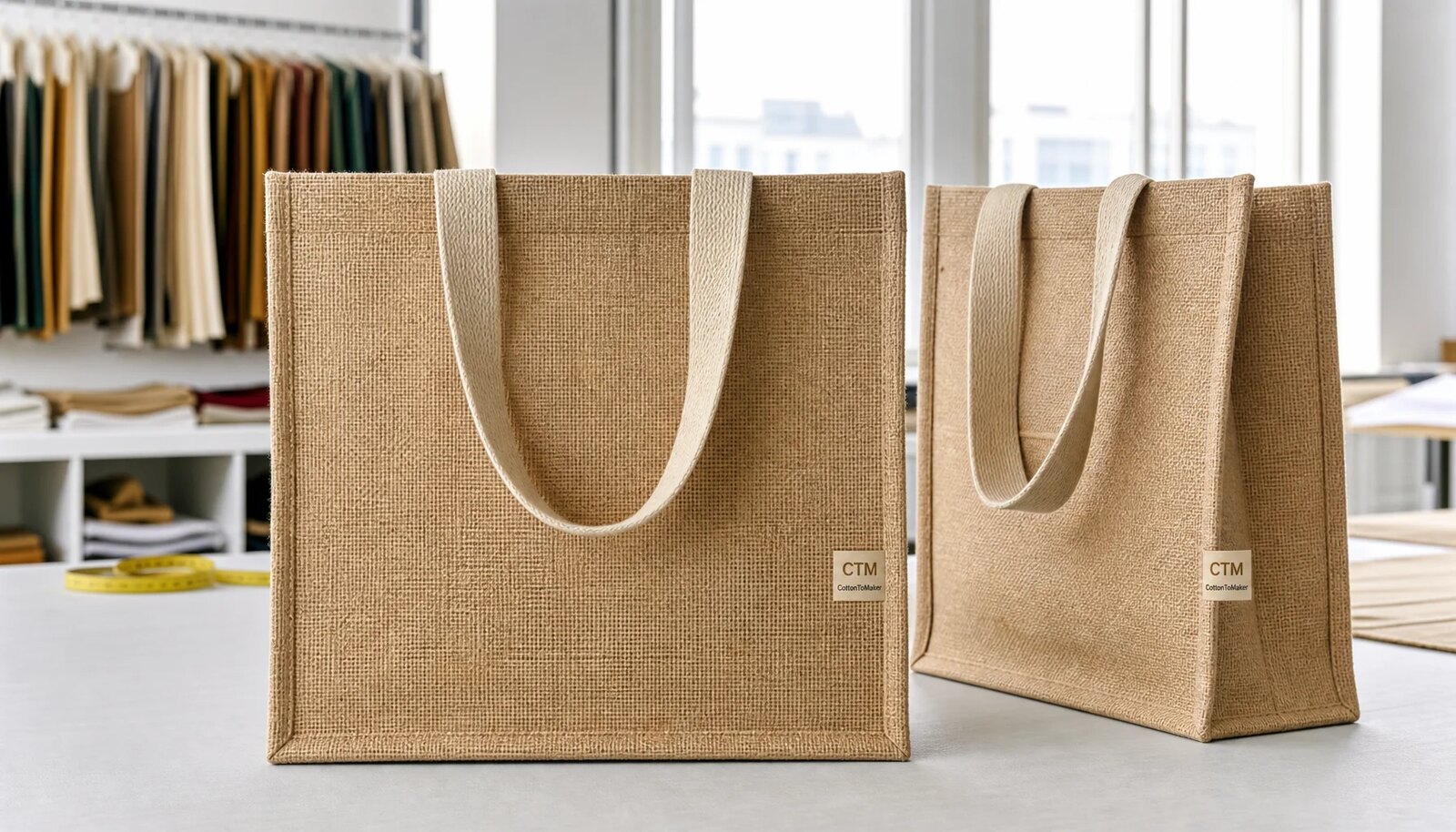
Start With the Use Case, Not the Logo
A wholesale jute tote quote is only useful when the supplier knows how the bag will be used. An event planner handing out catalogs in a conference hall needs a different build from a brand selling a retail carry bag at checkout. The first version can prioritize cost, print clarity, and easy packing. The second version usually needs better shape retention, cleaner finishing, and handles that survive repeat use.
The common mistake is to begin with artwork and leave the bag structure vague. That produces quotes that look comparable but are not. A supplier can quote the same flat size and still change the gusset depth, handle length, or jute weight enough to shift the real cost and the final appearance. If the bag will carry bottles, brochures, or gift boxes, define the load before anything else.
- State the actual contents the tote must carry.
- Give the finished size, not only the artwork area.
- Define whether the bag is a one-time handout or a reusable retail item.
- Tell suppliers if the bag must stand upright on a table or remain soft and foldable.
Choose the Jute Build That Matches the Job
Jute is not a single spec. The weave weight, finishing, and surface treatment decide whether the bag feels promotional or retail-ready. For light event use, many buyers stay around 230 to 280 gsm. For heavier inserts, better structure, or a more premium shelf presence, 300 to 360 gsm is often the safer range. If the bag needs to hold shape, ask whether a stiffener, laminated back, or lining is part of the build.
Natural jute has visible fiber variation, which is normal, but that variation should not hide sloppy construction. You want a bag that is cut square, stitched straight, and consistent from one carton to the next. If the supplier suggests a lower gsm to hit a target price, compare the loaded bag in hand, not the empty bag on the table. The cheaper option often bows, wrinkles, or shows print distortion once packed.
- Light event kits: 230 to 280 gsm can be enough if the contents are soft and low weight.
- Mixed-use or premium giveaways: 300 gsm or above usually gives better body.
- Request a filled sample if the tote must carry hard items or bottles.
- Ask how the bag is finished to control fiber shedding and odor.
Print Method Decides Both Cost and Appearance
For custom jute tote bags wholesale buying, print method is one of the biggest cost and quality split points. Spot-color screen print is usually the most efficient choice for simple logos, sponsor marks, or event names. It gives strong color on rough natural fiber and is easier for factories to repeat across a large order. If the art uses gradients, fine lines, or photographic detail, the real issue is not whether the supplier says yes. The issue is whether the result will still look clean on a textured surface.
If the bag has a laminated panel or a smoother lining surface, the print options open up, but the assembly cost also rises. Many buyers are better off simplifying the artwork rather than forcing a more complex decoration process onto a jute surface. When the logo is important, use a wider safe area with clear spacing, and place it where the bag naturally presents itself during handout or retail display.
- Use screen print for one to three spot colors when repeatability matters.
- Keep fine type and thin rules away from rough jute texture.
- Ask for a print strike-off or pre-production reference if the logo color is sensitive.
- If the bag has a woven label, patch, or side tag, confirm the attachment method before bulk approval.
Compare Supplier Routes Before You Compare Unit Prices
A quote is not just a price line. It reflects the supplier route. A direct factory can usually give the cleanest cost structure when the bag spec is custom and the order is large enough to justify setup. A trading company may be better when the program includes several products, but the buyer must separate service value from actual manufacturing cost. A local decorator works when time is short and the bag body is standard, but the route adds another handoff and another place for defects to enter.
The right route depends on the event calendar and how much control you need over the build. If the tote is part of a branded launch, the factory should be able to show you the same construction method from sample to bulk. If the order is a short-term event giveaway, the supplier's ability to move fast may matter more than a perfect custom build. The table below is the shortest way to compare those choices without getting trapped by a low first number.
- Ask whether sewing, printing, and packing happen in one site.
- Separate service fees from product cost if the supplier is not the factory.
- Use the same spec sheet across every quote so route differences stay visible.
- Do not compare a stock bag route against a fully custom sewn bag as if they were the same product.
Read the Quote Like a Production Buyer
A useful quote should break out what is driving cost. Look for fabric weight, handle type, print colors, lamination, lining, carton packing, and any setup charges. If the supplier only gives a flat per-piece number, they may be hiding the real variables. That makes later comparison difficult because one vendor has priced the printing, another has not, and a third has quietly changed the bag structure to stay cheap.
Ask for tiered pricing around your expected volume, but keep the spec fixed. The goal is to see the shape of the cost curve, not to invite the factory to simplify the product. In jute bags, small changes can move the price more than buyers expect: a wider handle tape, a gusset increase, a sewn lining, or a different pack count can alter both labor and carton efficiency. The quote should also state what is excluded so the landed cost does not surprise you later.
- Review separate lines for material, decoration, packing, and setup.
- Compare the same size, same print colors, and same carton plan across suppliers.
- Flag any quote that changes spec wording to keep the price low.
- Request the excluded-cost list in writing before you shortlist suppliers.
Set Acceptance Criteria Before the Pre-Production Sample
The pre-production sample is not just a formality. It is where the buyer locks the build that will become the bulk order. If the sample is approved casually, the factory will treat small inconsistencies as acceptable later. That is a problem with jute because natural texture already introduces variation. You need the reference sample to define what variation is normal and what becomes a defect.
A good sample approval should cover dimensions, handle length, seam finish, print placement, and the way the bag folds. Measure the sample when it is filled and when it is empty if the event kit has a fixed load. If the bag smells strongly of oil, mildew, or chemicals, solve that before mass production. A weak sample process can turn a low-risk order into a lot of rejects that are expensive to sort at the destination.
- Use the approved sample as the quality reference for bulk inspection.
- Record size tolerance, print location, and seam quality in writing.
- Approve the bag with the real insert load if the tote must carry a kit.
- Keep one sealed reference sample in procurement records and one with the supplier.
Packing, Cartons, and Moisture Protection Matter More Than Most Buyers Think
Jute bags can be damaged by poor packing even when the sewing is fine. Over-compression creates permanent folds, crushes printed areas, and distorts bag shape. Under-packing wastes freight and can let cartons shift in transit. The right packing plan depends on whether the bag is soft, lined, laminated, or intended to hold its shape on arrival. If the event team will distribute the bags directly from cartons, the carton layout should match that handout flow.
Moisture control is also important. Jute is a natural fiber, so transit and storage conditions matter. If the route crosses humid weather or the goods will sit in a warehouse before the event, ask for dry packing, a carton liner, or desiccant where appropriate. Carton labels should show SKU, color, quantity, and lot number so a mixed shipment can be sorted quickly. These details sound minor until a shipment arrives split across several pallets and the wrong color lands at the wrong venue.
- Confirm pieces per carton, carton dimensions, and carton weight limit.
- Protect printed surfaces from rubbing during transit.
- Use clear carton marks for SKU, quantity, and lot traceability.
- Match pack method to the event team's distribution plan.
Plan Lead Time Around Approval Gates, Not Calendar Hope
Lead time for custom jute tote bags is usually less about the sewing line and more about decision delay. Artwork revisions, sample approval, carton label changes, and final sign-off can consume more time than the physical production run. If the event date is fixed, work backward from the handout day and build space for sample review, corrective changes, and transit. The safest schedule is the one with explicit approval gates and a cutoff for artwork changes.
Buyers also need to account for seasonal congestion. Conference season, holiday gifting, and year-end promotions can compress factory capacity and freight space at the same time. A quote that looks fast on paper may not be realistic when everyone is trying to book the same production window. If the order is tied to a hard event date, ask the supplier which step is the risk point: material allocation, print queue, sewing capacity, or packing. That tells you where to add buffer.
- Freeze artwork before the sample stage if possible.
- Build buffer for revisions to logo placement, carton labels, or pack count.
- Treat transit time as separate from production time.
- For urgent events, consider standard size bags with custom print rather than a fully custom build.
Compare Landed Cost, Not Just Factory Cost
A low factory quote can still be the expensive option after freight, packing upgrades, and hidden handling are added. Event planners and procurement teams should compare the landed cost picture: bag cost, decoration, cartonization, inland transport, export handling, and any final-mile distribution that the project needs. A supplier that packs more efficiently may beat a cheaper unit price once freight is added, especially on bulky jute bags that consume cubic space quickly.
The same logic applies to defect risk. A slightly higher quote from a supplier with better pre-production control can save money if the bags arrive usable, on spec, and sorted by event lot. To compare fairly, ask every bidder to quote the same pack count, the same print method, and the same carton detail. If one supplier offers a much lower number, it usually means something changed: fabric weight, handle spec, finishing, or packing density.
- Compare full landed cost assumptions line by line.
- Ask for the same packaging format across every quote.
- Treat hidden rework cost as part of the real price.
- Shortlist suppliers that can explain why their quote is higher or lower without changing the spec.
Specification comparison for buyers
| Spec decision | Recommended option | When it fits | Buyer risk to check |
|---|---|---|---|
| Direct factory in a jute-producing region | Best for custom sizes, custom handles, and lower setup waste | You need control over construction details and can wait for sampling | Confirm the factory actually sews and prints in-house, not through a middleman |
| Trading company or buying agent | Useful for multi-item event programs and mixed accessory orders | You want one contact for several products or split sourcing across vendors | Make sure the quote separates factory cost, service fee, and any hidden handling charges |
| Stockholding wholesaler with local print | Good for short lead times and simpler artwork | The event date is close and the tote spec can stay close to standard | Standard stock may limit bag size, jute weight, handle color, and carton format |
| Factory with in-house print and sewing | Preferred for repeat programs and color-controlled branding | You need stable production from sample to bulk with fewer handoffs | Check whether print registration, color matching, and QC happen inside the same site |
| Factory + local decorator split route | Useful when transit time is tight or the print is only needed on the final market side | You already have blank bags and want domestic branding close to the event | Two-step sourcing adds damage risk, duplicate handling, and extra responsibility for defects |
| Standard size with custom print | Best value for first-order event programs | You want the lowest-risk quote comparison across suppliers | Watch for suppliers quoting the same bag but changing gusset depth or handle length |
| Custom size with standard print layout | Better when the bag must fit a kit, bottle, or catalog bundle | The event kit has fixed contents and the bag is part of the packaging system | Confirm internal dimensions, not just outer dimensions, and approve a filled sample |
| Premium finish route with lining or lamination | Use for retail resale or sponsor gifts that need shape retention | The bag must stand up, protect the contents, or feel more finished | Verify odor, stiffness, and fold lines because lined or laminated jute can look better but behave differently in packing |
Buyer checklist before sampling
- Set the use case first: giveaway, retail resale, press kit, conference kit, or sponsor gift. The bag size, handle strength, and print method should follow the load and the way the bag will be handed out.
- Lock the target size with both outside and inside dimensions, plus gusset depth and handle drop. A bag that looks right flat can fail once brochures, bottles, or catalogs are inserted.
- Choose a jute weight range before requesting quotes. Light event bags often sit around 230 to 280 gsm, while heavier retail or kit bags usually need 300 gsm or more.
- Decide whether you need unlined jute, cotton lining, PP lamination, or a backed panel. Each choice changes the quote, the feel, the print result, and the bag's resistance to dust and shedding.
- Provide finished artwork in vector format and state the number of ink colors, print position, and acceptable registration tolerance.
- Request a pre-production sample or a sealed reference sample before bulk work starts, especially if the bag has a special handle, lining, or logo placement.
- Specify carton pack count, master carton size limit, and whether the bags can be folded, nested, or kept flat to protect shape.
- Ask for the quote in tiers at your expected volume, plus one lower and one higher tier. That exposes where the supplier's real setup cost sits.
- Confirm moisture protection for transit and warehouse storage if the route passes through a humid port or the bags will sit before event day.
- Collect a defect acceptance rule in writing: size tolerance, print tolerance, stitch quality, odor limits, and how many samples are pulled from each lot.
Factory quote questions to send
- What jute fabric weight, weave type, and finishing are included in this quote, and what changes the price if we move up or down in gsm?
- Is the bag sewn, printed, and packed in the same facility, or are any steps outsourced?
- What is the MOQ by size, print color count, and handle type?
- What sample type do you provide first: stock sample, blank size sample, printed pre-production sample, or a full production-reference sample?
- What is the quoted tolerance for size, print placement, and stitch quality?
- How are the bags packed inside the carton, and how many pieces fit per master carton at our target size?
- Which extra charges are excluded from the quote, such as plate charges, artwork cleanup, carton labels, inserts, or outer master carton upgrades?
- What is the standard production lead time after sample approval, and what part of the schedule is most likely to slip?
Quality-control points to confirm
- Measure finished size against the approved sample, not against the flat spec sheet alone.
- Inspect stitch lines at handles, side seams, and gusset corners for skipped stitches, loose threads, and weak reinforcement.
- Check print placement, color consistency, and edge sharpness on at least the first and last cartons from the run.
- Verify handle width, handle drop, and bar-tack or box-X reinforcement where the load transfers into the body.
- Reject bags with heavy odor, wet spots, oil marks, or excess fiber shedding that transfers to the product inside.
- Confirm that lined or laminated bags still fold and pack the way the carton plan expects.
- Review carton labels, SKU codes, color codes, and quantity marks before shipment leaves the factory.
- Pull random bags from different cartons so a single good carton does not hide a lot-wide issue.